


Yes. Pure, unedited text generated by GPT-5.6 is often detectable by current commercial AI detectors. Early vendor studies covering GPT-5.6 Sol, Terra, and Luna report high recognition rates, including results above 96 percent in several test configurations.
That answer needs an important qualification. An AI detector can identify patterns that resemble machine-generated writing, but it generally cannot prove that GPT-5.6 produced a particular document, identify the person who used it, or reconstruct how much human work went into the final text.
The difference matters. “This passage looks AI-generated” is a probabilistic classification; “GPT-5.6 wrote this passage” is a provenance claim. The available evidence supports the first conclusion much more strongly than the second.
Quick Answer: Is GPT-5.6 Detectable?
GPT-5.6 content is detectable when the input is long enough, primarily AI-generated, and close to the model's original output. Both Originality.ai and Pangram published GPT-5.6-specific evaluations shortly after the model family became generally available in July 2026.
However, those tests do not establish a universal detection rate for every GPT-5.6-assisted document. Real writing may combine model output with human planning, original reporting, quotations, revisions, citations, translation, and collaborative editing.
| Question | Practical answer |
|---|---|
| Can AI detectors identify pure GPT-5.6 output? | Often yes |
| Were Sol, Terra, and Luna all tested publicly? | Yes, in vendor-published studies |
| Can a detector identify GPT-5.6 as the exact source? | Usually no |
| Does a high AI score prove misconduct? | No |
| Can edited or mixed text produce a different score? | Yes |
| Can human writing receive a false positive? | Yes |
The most defensible conclusion is therefore conditional: GPT-5.6 is detectable as AI-like text under many test conditions, but detection is not the same as certain attribution.
What GPT-5.6 Means: Sol, Terra, and Luna
OpenAI made the GPT-5.6 family generally available on July 9, 2026. Unlike a release represented by one model name and one output profile, GPT-5.6 is organized into three capability tiers: Sol, Terra, and Luna.
Sol is the flagship model for demanding reasoning and professional work. Terra is positioned as a balanced model for everyday tasks, while Luna prioritizes speed and lower cost.
| GPT-5.6 model | OpenAI positioning | Typical writing context | Why it matters for detection |
|---|---|---|---|
| Sol | Flagship capability | Complex analysis, research, structured professional writing | Longer reasoning and stronger instruction following may change output style |
| Terra | Balanced everyday model | Emails, articles, reports, general knowledge work | Broad use creates a varied mix of prompts and document types |
| Luna | Fast, cost-efficient model | High-volume drafting and routine content | Shorter or more standardized outputs may produce different signals |
These tiers should not automatically be assumed to have identical writing fingerprints. They may differ in verbosity, sentence organization, reasoning depth, and how closely they follow a requested style.
Current public results nonetheless suggest that the major distinction between the three tiers is not enough to make any one of them broadly invisible to detection. In the two early vendor evaluations, all three produced high rates of AI classification.
What Current GPT-5.6 Detection Tests Found
Two public tests offer the clearest early evidence. They are useful because both cover Sol, Terra, and Luna, but they should be read as vendor-reported evaluations rather than independent certification.
Originality.ai's GPT-5.6 Results
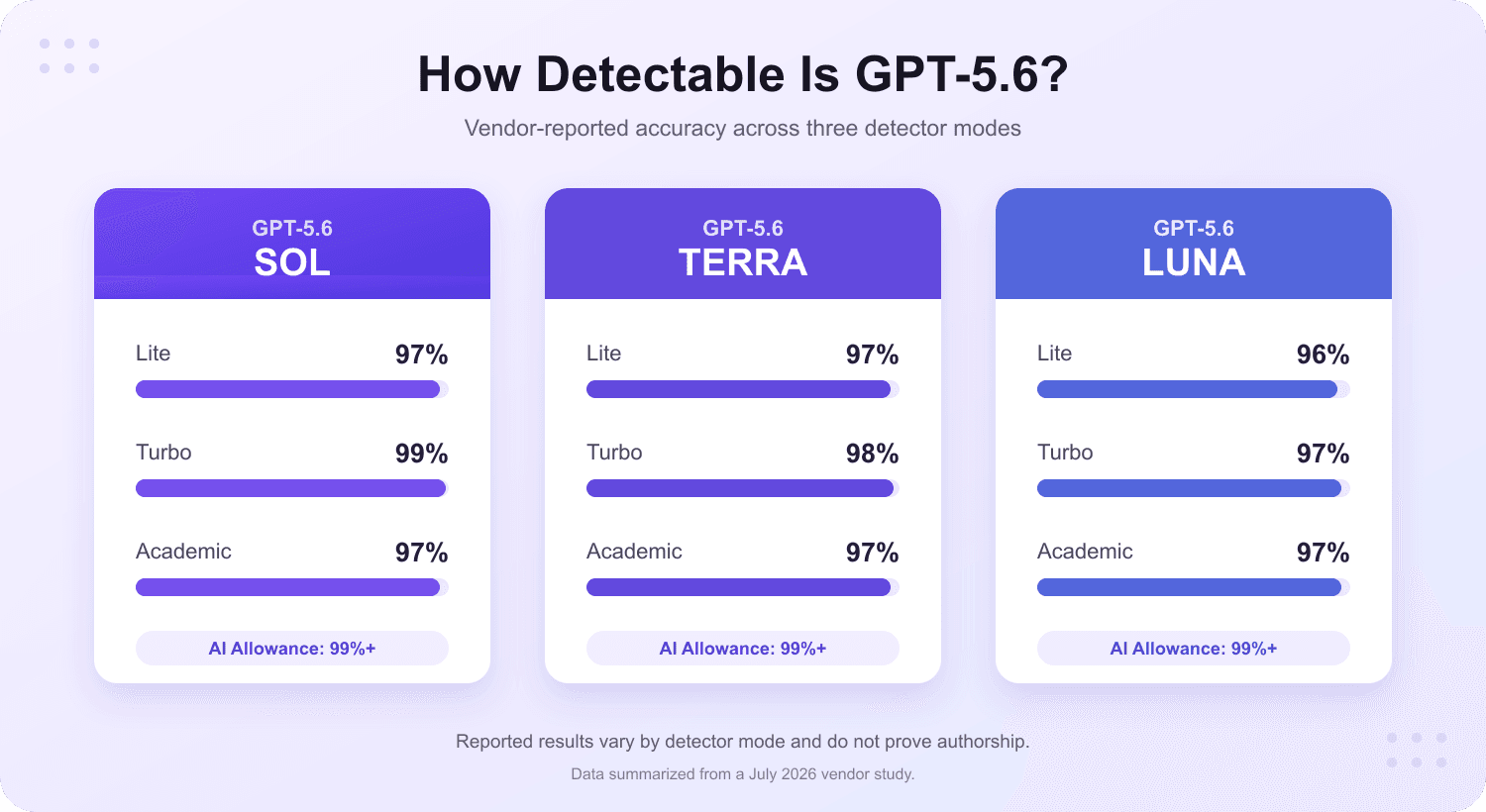
Originality.ai evaluated GPT-5.6 output with four of its detection configurations: Lite, Turbo, Academic, and AI Allowance. The company reports that Lite, Turbo, and Academic had not been trained on GPT-5.6 data before the test.
Its published results place every Sol, Terra, and Luna accuracy figure between 96 and 99 percent for Lite, Turbo, and Academic. AI Allowance is reported at more than 99 percent for all three tiers when using its default 15 percent allowance setting.
| Originality.ai configuration | GPT-5.6 Sol | GPT-5.6 Terra | GPT-5.6 Luna |
|---|---|---|---|
| Lite | 97% | 97% | 96% |
| Turbo | 99% | 98% | 97% |
| Academic | 97% | 97% | 97% |
| AI Allowance, default setting | 99%+ | 99%+ | 99%+ |
Originality.ai describes a dataset built from 5,000 human-written samples across health, news, finance, technology, arts, and entertainment. It used GPT-5.6 to generate completions from prompts associated with that material, covering blogs, reviews, expository articles, and conversational writing.
The breadth is useful, but the public article does not provide every detail needed to reproduce the study from beginning to end. For example, a reader cannot derive a complete confusion matrix for each tier and content type from the headline table alone.
Pangram's GPT-5.6 Results
Pangram published a separate evaluation using 3,423 GPT-5.6 responses. It collected 1,141 responses from each model tier and says its detector had not been trained on Sol, Terra, or Luna.
Pangram classified 3,408 of the 3,423 responses as fully AI-generated, which equals 99.56 percent of the test set. Its per-model fully AI classification rates were 99.47 percent for Sol, 99.74 percent for Terra, and 99.47 percent for Luna.
| Pangram result | GPT-5.6 Sol | GPT-5.6 Terra | GPT-5.6 Luna |
|---|---|---|---|
| Samples | 1,141 | 1,141 | 1,141 |
| Classified fully AI | 1,135 | 1,138 | 1,135 |
| Fully AI rate | 99.47% | 99.74% | 99.47% |
The prompts asked the models to generate material such as emails, essays, and stories from scratch. That is a reasonable way to test whether a detector recognizes direct model output, although it does not reproduce every real writing workflow.
What the Two Studies Support
The studies use different datasets and different detection systems, yet they point in the same direction. Newly generated, unedited GPT-5.6 text often retains enough machine-associated patterns to be classified as AI.
| Study | Test material | Main reported result | What it supports |
|---|---|---|---|
| Originality.ai | GPT-5.6 completions across several domains and formats | 96-99% or higher, depending on model and detector mode | Its detectors generalize to pure GPT-5.6 output |
| Pangram | 3,423 generated responses, evenly split across tiers | 99.56% classified fully AI overall | Its detector recognizes most direct GPT-5.6 responses in that dataset |
Neither study shows that every detector performs equally well. They also do not show that the same rates will hold for short excerpts, collaborative documents, translated passages, heavily revised drafts, or text containing only limited AI assistance.
Why High Detection Rates Do Not Settle the Question
A result such as 99 percent sounds final, but it answers a narrower question than many readers assume. It describes performance on a particular dataset under a particular threshold and testing procedure.
An individual document arrives without those controlled conditions. Its authorship history, editing process, genre, length, and proportion of AI-generated language may all be unknown.
The Tests Focus on Pure Model Output
Both current GPT-5.6 studies primarily evaluate text produced directly from prompts. That is the clearest setting for measuring whether a detector recognizes a new model, but it is not the only way people use GPT-5.6.
A researcher might use Sol to organize questions and then write the report independently. A marketer might use Terra for a first draft and replace half of it with interviews, product facts, and original examples. A team might use Luna for sentence alternatives inside a document otherwise written by several people.
Those documents are not equivalent to a response copied directly from ChatGPT or the API. Calling all of them simply “GPT-5.6 text” hides meaningful differences in authorship and editorial control.
Detector-Owned Studies Need Careful Reading
Originality.ai and Pangram each tested their own detector. This does not make the results useless; detector developers often have the infrastructure and urgency required to evaluate new models quickly.
It does mean the numbers should be described accurately as vendor-reported results. Stronger independent evidence would reproduce the datasets, thresholds, and scoring procedures across several detectors while measuring both AI samples and genuinely human controls.
False-positive performance is particularly important. A detector that catches nearly every AI sample can still create serious problems if it also incorrectly flags a meaningful share of human writing.
Accuracy Is Not the Probability That a Flag Is Correct
Suppose a test reports 97 percent accuracy on a balanced dataset containing equal numbers of human and AI samples. That figure does not mean a document receiving a high score has a 97 percent probability of being written by GPT-5.6.
The probability depends on the detector's false-positive and false-negative rates, its threshold, the type of document, and how common AI-generated text is in the population being reviewed. This is the base-rate problem: benchmark accuracy and the reliability of an individual accusation are not interchangeable.
For low-stakes content triage, a false positive may simply trigger another review. In education, hiring, publishing, or compliance, the same false positive can carry much greater consequences and therefore requires stronger supporting evidence.
Can a Detector Tell That GPT-5.6 Specifically Wrote the Text?
Most public AI detectors are designed to distinguish patterns associated with human and machine writing. They are generally not forensic tools that recover a model ID from the text.
A high score may be consistent with GPT-5.6, but it may also be consistent with another OpenAI model, Claude, Gemini, a smaller language model, or formulaic human prose. Models share training influences, common instruction-following patterns, and similar tendencies toward polished structure.
This creates three different levels of inference:
- AI-like pattern detection: The passage resembles material the detector associates with machine generation.
- Model-family suspicion: The passage could have come from a modern language model.
- Exact provenance: GPT-5.6 Sol, Terra, or Luna generated the passage in a specific session.
Current consumer detectors can provide evidence for the first level. They may support a cautious hypothesis at the second level, but they rarely establish the third.
Exact provenance would require evidence outside the prose itself, such as platform logs, API records, document history, account activity, or a reliable cryptographic provenance system. A linguistic score alone does not contain that chain of custody.
What Changes GPT-5.6 Detection Results?
Detector behavior is not fixed across every sample. The same model can produce text with different patterns when the prompt, genre, length, reasoning setting, and amount of human editing change.
| Factor | Likely effect on score stability | Responsible interpretation |
|---|---|---|
| Text length | Very short passages provide fewer signals | Avoid strong conclusions from a few sentences |
| Genre | Technical, legal, academic, and templated prose may be naturally uniform | Compare the result with genre-appropriate human writing |
| Prompt constraints | Strict format or tone instructions can make output more regular | Treat the score as specific to that output, not the entire model |
| Sol, Terra, or Luna | Model tier may alter structure and wording | Do not assume one result represents the full family |
| Human editing | Revisions can introduce human choices and mixed patterns | Describe the document as mixed when its process is mixed |
| Translation | Translation systems can standardize sentence patterns | Review original-language text and translation history |
| Quotations and references | Embedded source language may affect local highlights | Separate quoted material before interpreting passages |
| Detector threshold | A more sensitive setting catches more AI and may increase false positives | Record the selected mode and threshold |
| Detector update | Models and detectors change over time | Date the scan and avoid treating it as permanent |
Text Length and Context
Detectors need enough language to estimate patterns such as predictability, variation, and structural regularity. A 40-word email and a 1,200-word article do not offer the same amount of evidence.
Short results should therefore be treated with extra caution. Combining unrelated short passages to reach a word minimum can also distort the context and create a score that does not describe any one passage well.
Human Editing and Mixed Authorship
Editing is not a binary switch that converts AI writing into human writing. It creates a continuum of involvement, ranging from minor proofreading to a complete reconstruction based on original research and judgment.
A mixed document may contain sections with different histories. Sentence-level highlights can be more informative than one overall percentage because they help a reviewer ask what happened in specific passages.
Genre and Professional Style
Some human writing is intentionally standardized. Policy language, lab methods, support documentation, legal clauses, and corporate templates may repeat conventional phrases and maintain consistent sentence patterns.
That can resemble the regularity associated with model output. A reviewer should consider whether the flagged traits arise from authorship, genre conventions, institutional templates, or a combination of factors.
How to Check OpenAI-Written Text With Lynote
Lynote's OpenAI content detector can provide a first-pass signal when you need to review text that may include ChatGPT or GPT-5.6 assistance. It reports AI-generated, mixed, and human-written percentages and highlights sentences that deserve closer inspection.
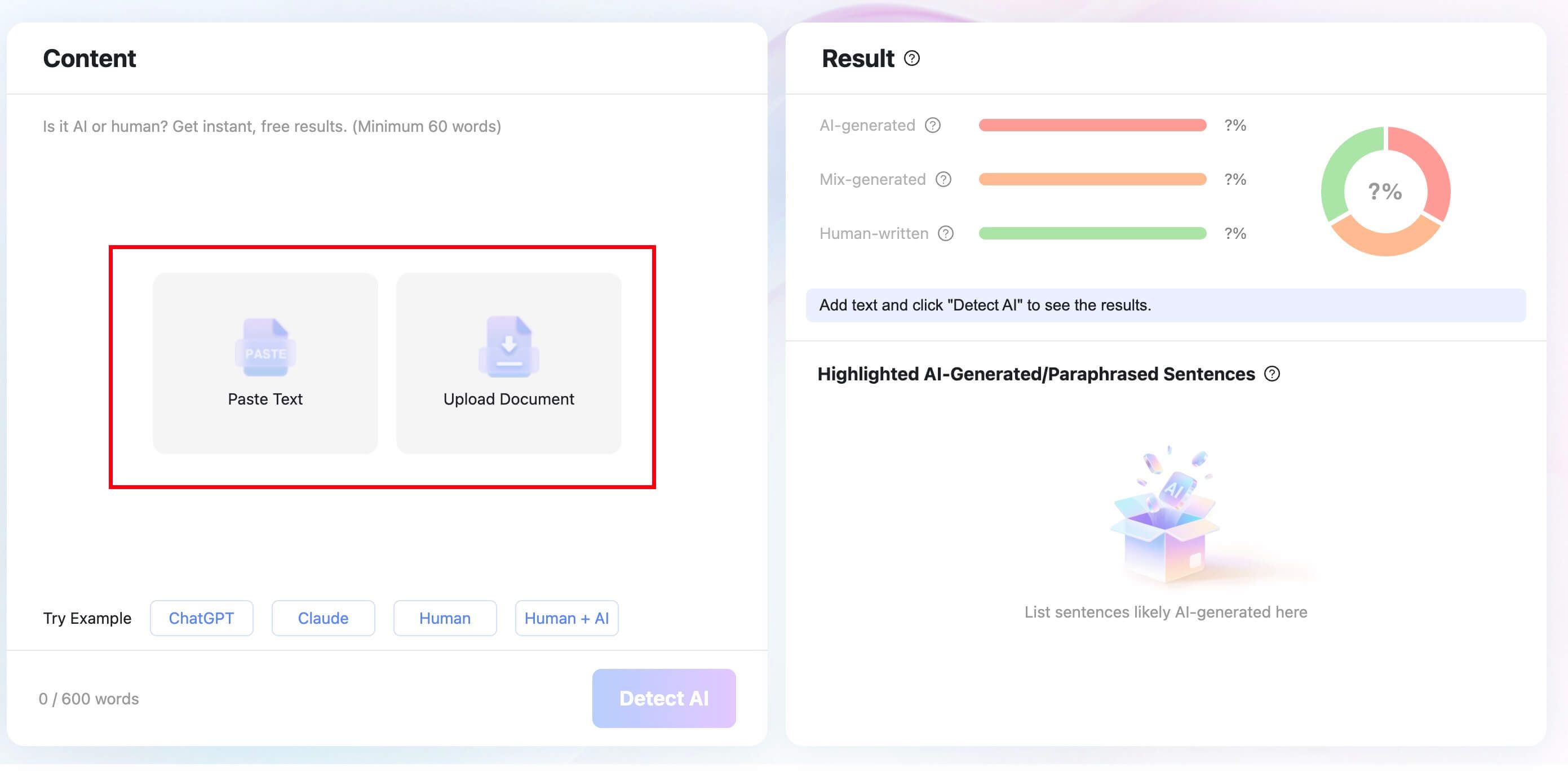
- Paste the passage into Lynote or upload a supported document.
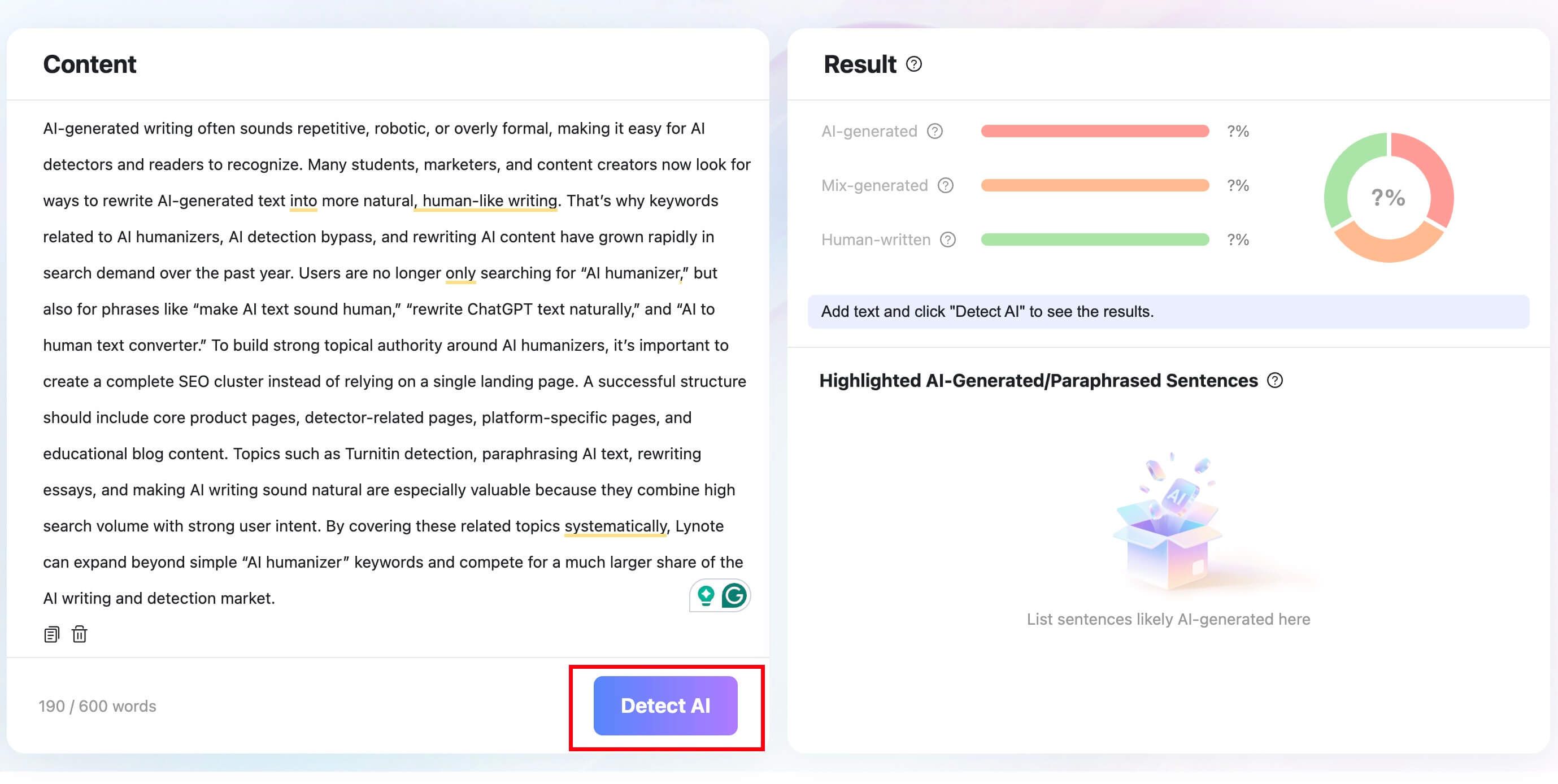
- Click Detect AI to analyze the text.
- Review the AI, mixed, and human distribution.
- Inspect sentence-level highlights instead of relying only on the overall score.
- Compare highlighted passages with drafts, notes, citations, and version history.
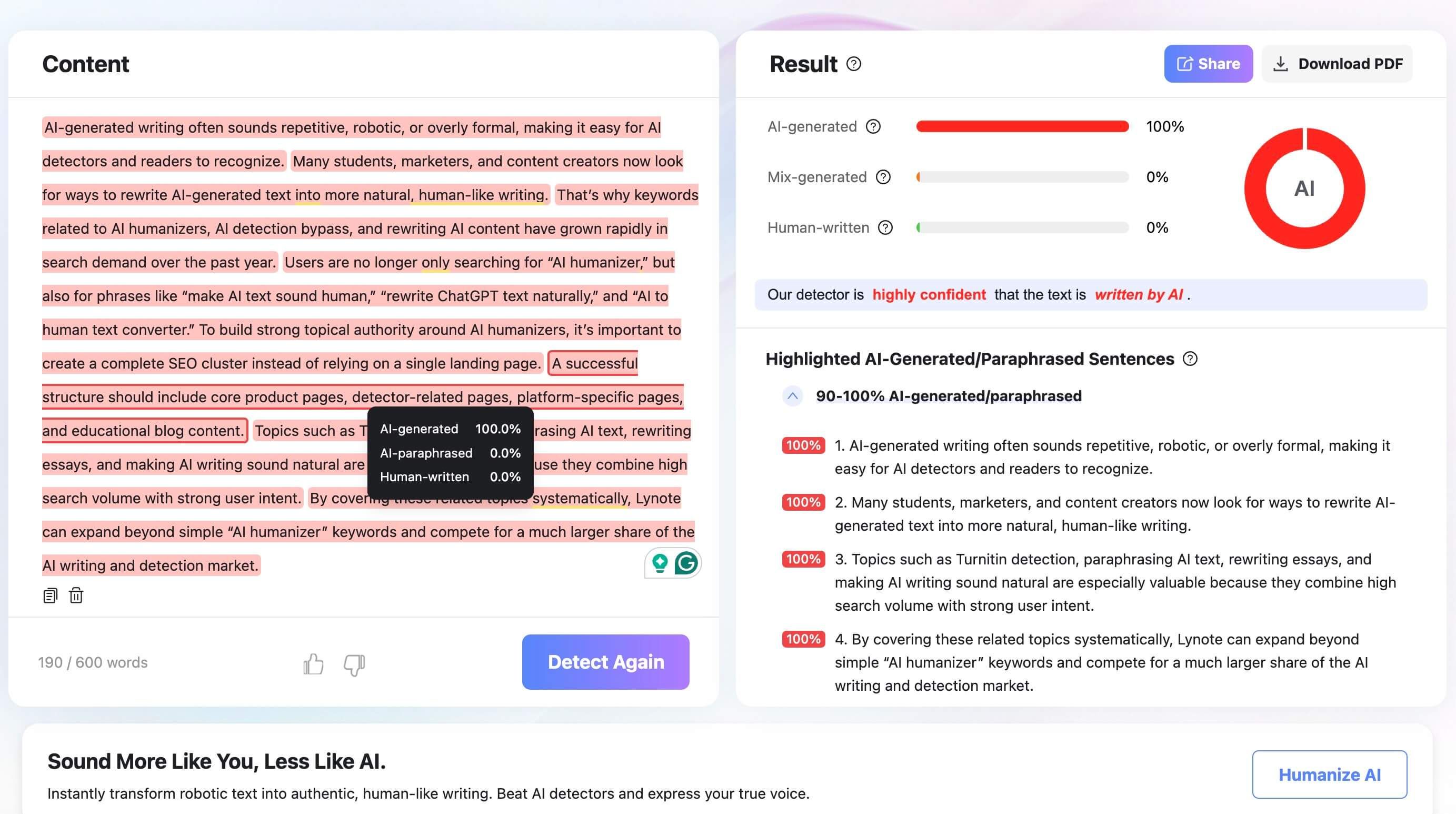
The final step is the most important. Lynote can help locate patterns for review, but its result should not be presented as proof that GPT-5.6 wrote the document.
If the document contains legitimate AI assistance, describe that process accurately. A draft that began with GPT-5.6 but was substantially researched, checked, and rewritten by a person should be evaluated differently from an unreviewed model response, even if both trigger a detector.

How Students and Writers Should Read a GPT-5.6 Flag
The meaning of a flag depends on the decision being made. A publisher checking incoming copy has a different responsibility from an instructor investigating possible academic misconduct.
For Students
Keep evidence of your writing process: outlines, source notes, document history, drafts, citations, and feedback. If an institution permits limited AI support, retain the instructions and disclose your use according to the applicable policy.
When human work is falsely flagged, process evidence is usually more persuasive than repeatedly scanning the same passage with additional detectors. A second percentage does not recreate how the document was written.
For Writers and Publishers
An AI score is not a quality score. GPT-5.6 text can be factually weak or useful, while human text can be inaccurate, derivative, or poorly supported.
Editorial review should examine factual provenance, originality, citations, voice, audience value, and accountability. The central question is not merely whether a model contributed words, but whether a responsible person verified and owns the final work.
For Educators and Reviewers
Use detection as a triage signal rather than an automatic verdict. Review the assignment design, permitted AI policy, version history, sources, writing process, and the student's ability to explain the work.
One detector result should not determine a grade or disciplinary outcome. The higher the consequence, the more important independent evidence and human review become.
A Better Evidence Checklist Than One AI Score
AI detection becomes more useful when it is placed inside a broader evidence process. Each evidence type answers a different question, and none should be stretched beyond what it can show.
| Evidence | What it can show | What it cannot prove alone |
|---|---|---|
| AI detector result | The text contains patterns associated with AI output | Which model generated it or who used the model |
| Sentence highlights | Which passages most influenced the classification | The history of each sentence |
| Version history | How the document changed over time | Whether every edit was made without AI |
| Notes and outlines | Planning, source selection, and idea development | Exact authorship of every final phrase |
| Citations and source checks | Whether claims are traceable and responsibly supported | Whether prose was generated |
| Platform or API logs | That a model was accessed or produced recorded output | Whether that output appears unchanged in the document |
| Author discussion | Understanding of reasoning, evidence, and choices | Complete technical provenance |
| Human review | Contextual judgment across all available evidence | Absolute certainty in every case |
A fair review asks whether the evidence converges. If a detector flag conflicts with extensive drafting history, original notes, verified sources, and a credible explanation, the conflict should be investigated rather than resolved automatically in favor of the software.
The reverse is also true. If an unedited model response is presented as independent human work and the detector result aligns with missing drafts, fabricated citations, and an inability to explain the argument, the score may contribute to a larger evidentiary picture.
FAQs About GPT-5.6 Detection
Can Turnitin detect GPT-5.6?
Turnitin may classify GPT-5.6 output as AI-generated if the text contains patterns recognized by its current model. However, a public GPT-5.6-specific result from another detector cannot be treated as Turnitin's accuracy, and Turnitin's output should not be used as sole proof of authorship.
Can GPTZero detect GPT-5.6?
GPTZero is designed to detect AI-generated writing and may flag GPT-5.6 content. Its performance can vary with text length, genre, editing, and model updates, so a score should be interpreted as a signal rather than exact GPT-5.6 attribution.
Is GPT-5.6 Sol easier to detect than Terra or Luna?
The current vendor studies do not establish a consistent meaningful ranking. Originality.ai's reported figures vary slightly by detector mode, while Pangram reports fully AI classification rates above 99 percent for all three tiers.
Can edited GPT-5.6 text still be detected?
Yes. Editing does not guarantee a human classification, particularly when much of the original structure and wording remains. Substantial human contribution may also produce mixed signals, making document history and contextual review important.
Can human writing be falsely flagged as GPT-5.6?
Human writing can receive a false AI classification, especially when it is short, formulaic, highly standardized, translated, or written in a style underrepresented in a detector's training data. A detector also usually cannot label a false positive as specifically “GPT-5.6”; it reports an AI-related classification.
Does a maximum AI score prove that GPT-5.6 wrote the text?
No. A detector's maximum displayed score is a confidence or classification output under its own scoring system. It does not prove exact model provenance, identify a user, or replace corroborating evidence.
Does GPT-5.6 include an invisible text watermark?
The public GPT-5.6 launch information does not establish that ordinary text output contains a universally readable watermark available to consumer detectors. Most current detection tools analyze linguistic and statistical patterns rather than querying an official OpenAI provenance record.
Will GPT-5.6 become harder to detect after updates?
It could become easier or harder for a particular detector as model behavior and detector training change. A result from July 2026 should be dated and should not be assumed to describe every future GPT-5.6 revision or detector version.
Final Verdict
GPT-5.6 is detectable in the practical sense that current commercial detectors often recognize pure outputs from Sol, Terra, and Luna. Early vendor studies report strong results across thousands of generated samples, so the newest OpenAI family is not automatically invisible simply because detectors were trained before its general release.
What remains uncertain is the interpretation of one real document. A high score cannot independently prove that GPT-5.6 generated the text, distinguish Sol from Terra or Luna, identify the user, or measure the amount of human authorship.
Use detection to identify passages that deserve review. For consequential decisions, combine that signal with version history, notes, citations, policy context, platform evidence when available, and informed human judgment.

Written by Danny
Product Marketing Manager
Danny explains how Lynote features fit real workflows, from everyday productivity to product-led writing use cases. View all articles →