


Yes, GPT-6 Astra content is detectable in current published tests. Two large vendor studies flagged more than 99% of the unedited, known-AI samples they scored, and a smaller comparison found that five different detectors all flagged the same Astra essay. That is strong evidence that polished Astra output does not automatically become invisible to AI detectors.
It is not proof that every detector will catch every Astra passage. More importantly, a high score cannot tell you who wrote a document, which model produced it, or whether a person used AI at all. The useful question is not simply "Can AI detect GPT-6 Astra?" It is what the available evidence actually measures, and what it leaves unresolved.
Quick Answer: Is GPT-6 Astra Content Detectable?
For unedited English prose of reasonable length, the answer is often yes. The strongest public results available in October 2026 point in the same direction, although they come from detector companies and use different samples, thresholds, and inclusion rules.
| Published test | Astra material tested | Reported result | What it establishes | What it does not establish |
|---|---|---|---|---|
| Originality.ai | 1,000 known Astra responses across five writing categories | 999 crossed its AI threshold | Very high detection of this known-AI sample on one detector setting | False-positive rate or performance on human writing |
| Pangram | 986 scored Astra responses from filtered prompts | 982 AI, 3 mixed, 1 human | Very high fully-AI classification rate for eligible passages | Performance below its 50-word minimum or on human controls |
| Five-detector comparison | One 300-word Astra essay | 5 of 5 tools flagged it; four displayed their maximum AI score | Several detectors agreed on that particular essay | Model-wide accuracy from a one-document sample |
| Passage-length experiment | 40 Astra texts shown at four lengths | 9/40 detected at 25 words, 29/40 at 50, and 40/40 at 100 and 200 | Length can materially change one detector's result | A universal minimum length for every detector |
The practical takeaway is straightforward: a complete Astra article is more likely to produce a meaningful detector signal than a sentence copied out of one. Even then, "flagged" means the writing matched patterns the detector associates with AI. It does not mean the tool recovered a hidden GPT-6 label.
What GPT-6 Astra Changes - and What It Does Not
OpenAI positions GPT-6 Astra as its most capable model for demanding reasoning, research, coding, computer use, and document creation. It is built to follow detailed instructions and sustain complex work, which can produce drafts that are more coherent and useful than the stereotypical chatbot answer.
The model's own documentation also notes a tendency toward detailed formatting and recurring phrases unless the user specifies a different writing style. That observation helps explain why improved capability and detectability can coexist. A document may be accurate, well organized, and fluent while still showing regularities that a statistical classifier notices.
This is where people often make the wrong leap. Better prose does not necessarily look more human to a detector, because detectors are not grading the prose for intelligence or usefulness. They are estimating whether its language patterns resemble material in their AI and human training data.
Nor is awkward writing automatically AI-written. Humans repeat transitions, use formulaic essay structures, and write generic sentences too. A detector reads patterns, not intent, authorship, or the history behind the cursor.
What Published GPT-6 Astra Detection Tests Found
The headline studies look remarkably consistent. Their methods, however, answer narrower questions than the headlines sometimes suggest.
Originality.ai: 999 of 1,000 Responses Crossed the Threshold
Originality.ai generated and scanned 1,000 English Astra responses: 200 blogs, 200 conversational pieces, 200 expository responses, 200 news responses, and 200 reviews. It counted a score of at least 0.50 in its AI Allowance 15% mode as detected.
All blog, expository, news, and review samples crossed that threshold. The conversational category returned 199 detections out of 200, producing 999 out of 1,000 overall. The one result below the threshold was conversational writing.
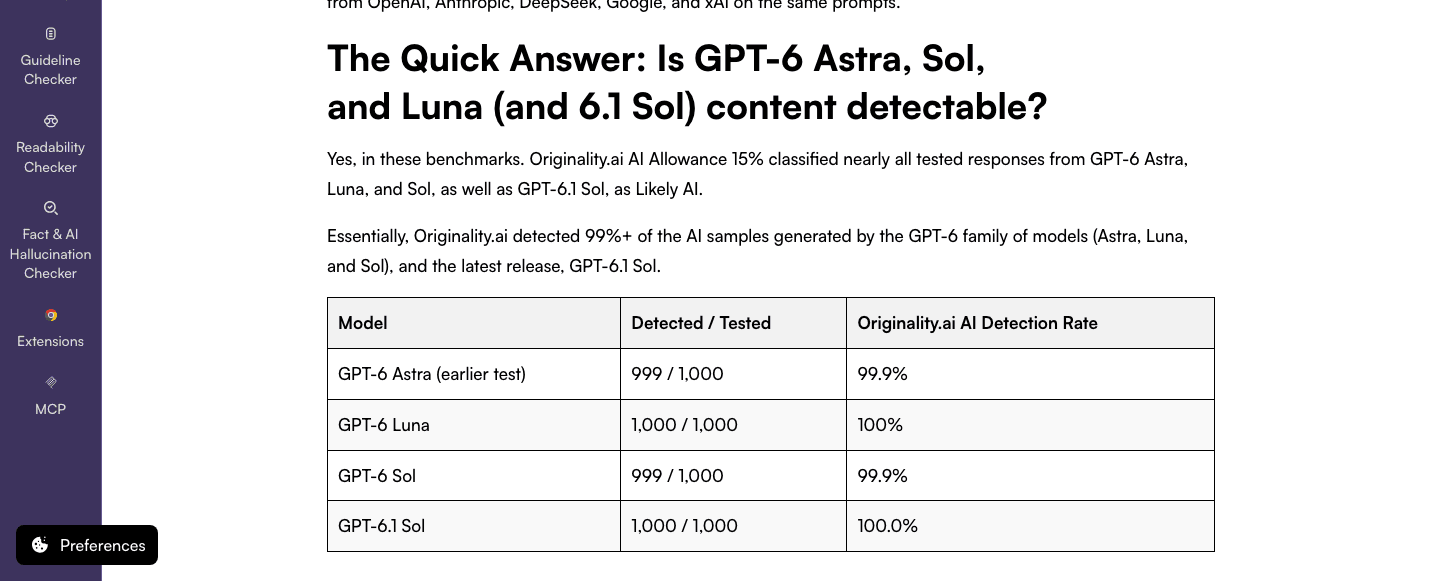
This is a strong known-AI detection result for that detector and setting. It is not a full accuracy study because there was no matched collection of human writing. Without human negatives, the study cannot show how often the same detector might flag a person.
Pangram: Four Outputs Were Not Fully Classified as AI
Pangram began with 1,032 Astra responses to filtered first-turn Chatbot Arena prompts. It did not score 46 responses that contained fewer than 50 words, leaving 986 eligible passages.
Among those, 982 were classified as AI, three as mixed, and one as human. The non-AI results included short or creative formats such as an email, an explanation, and a poem. That detail matters because the misses were not spread evenly across a uniform set of long essays.
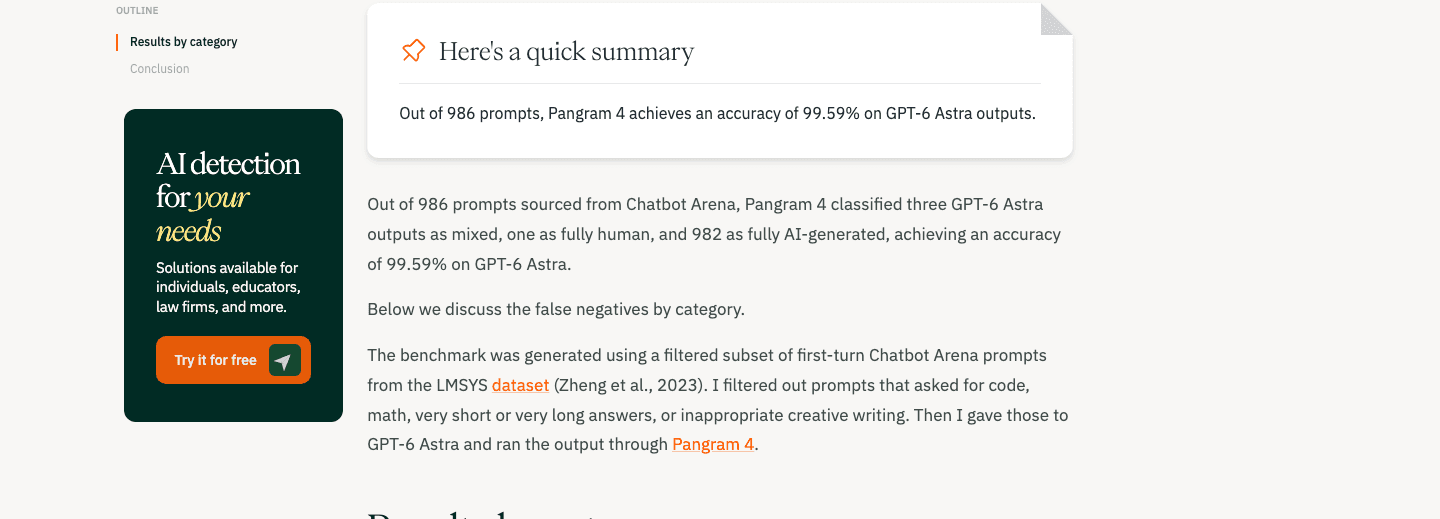
The study supports a high detection rate for Astra text that met Pangram's length requirement. It does not tell us how the excluded short answers would have scored, and it again contains no human control group for estimating false positives.
Five Detectors Agreed on One Astra Essay
A smaller study took one 300-word Astra essay and scanned it with Phrasly, GPTZero, Pangram, Copyleaks, and QuillBot. Every tool flagged the essay. Four returned their maximum displayed AI score, while QuillBot returned 82% AI.
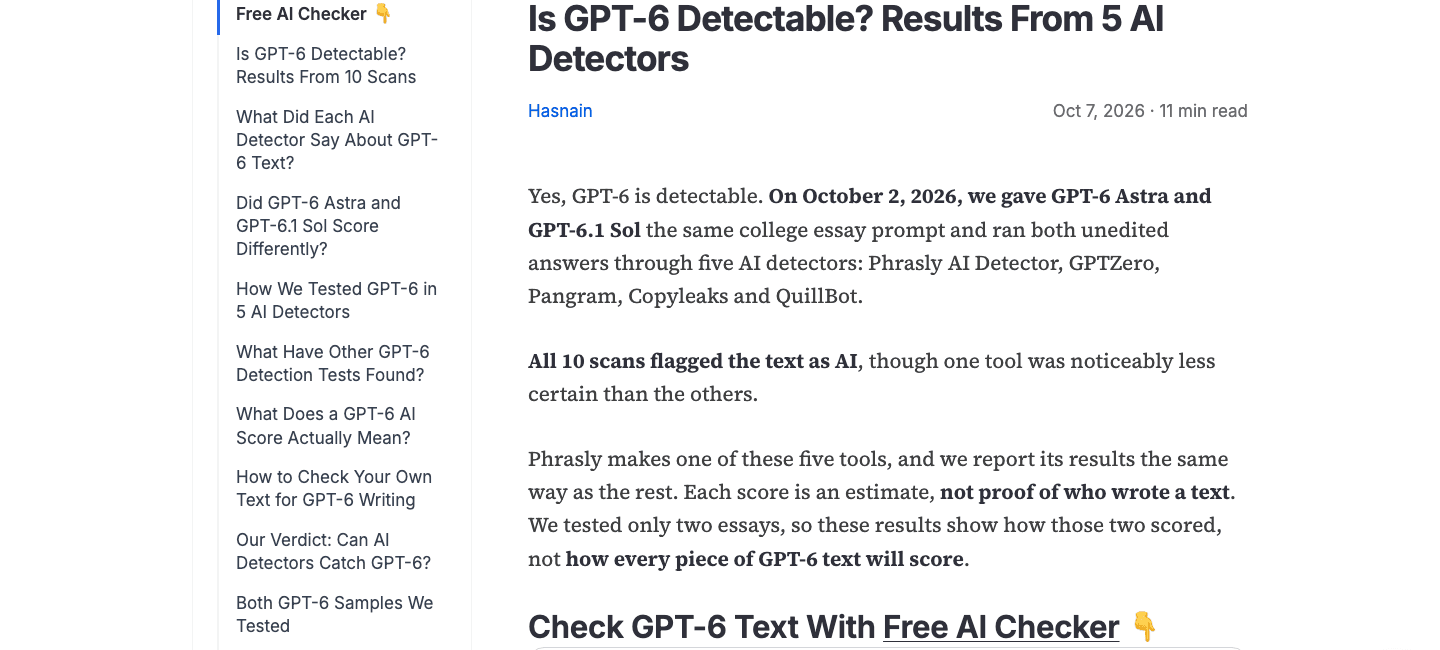
That comparison is useful because it holds the text constant while changing the detector. It shows that agreement across tools is possible, but it also shows that their percentages are not interchangeable. An 82% score and a maximum score can lead to the same practical label while coming from different models and scales.
One essay cannot establish the performance of five detectors across blogs, emails, technical reports, and edited drafts. It is a cross-tool snapshot, not a ranking.
The Same Text Became Harder to Detect When It Was Shortened
The most revealing result may be the smallest study. Researchers took 40 known Astra passages and showed the same detector the first 25, 50, 100, or 200 words of each passage. Only the amount of visible text changed.
At 25 words, 9 of 40 passages were detected. At 50 words, 29 of 40 were detected. At both 100 and 200 words, all 40 crossed the threshold.
This does not establish a universal 100-word rule. It does show why checking an isolated sentence can produce false reassurance: there may not be enough language for the detector to find a stable pattern.
Our Re-Analysis: 99.9% Detection Is Not 99.9% Real-World Accuracy
The published counts allow a useful independent calculation. A sample result is an estimate, so we recalculated approximate 95% Wilson confidence intervals instead of treating each percentage as exact.
| Published count | Observed rate | Approximate 95% interval | Careful interpretation |
|---|---|---|---|
| Originality.ai: 999/1,000 | 99.90% | 99.44%-99.98% | High detection rate on known Astra samples under the reported setting |
| Originality.ai conversational: 199/200 | 99.50% | 97.22%-99.91% | Strong result, but less precise because the category sample is smaller |
| Pangram fully AI: 982/986 | 99.59% | 98.96%-99.84% | High fully-AI classification rate among eligible scored outputs |
These intervals reinforce the conclusion that the reported known-AI detection rates were high. They do not fill the missing half of the experiment.
To measure a detector in the real world, we need both AI and human documents. That is the only way to see whether a tool catches AI without also accusing too many people.
| Metric | Can the Astra-only studies calculate it? | Why it matters |
|---|---|---|
| Detection rate on known AI text | Yes | Shows how often the tool catches the AI samples it was given |
| False-negative rate | Yes | Shows how many known AI samples were missed under the test rules |
| Specificity | No | Requires human text to measure how often human work is correctly cleared |
| False-positive rate | No | Requires human text to count how often people are incorrectly flagged |
| Precision | No | Depends on both false positives and how common AI text is in the population being checked |
| Overall accuracy | No | Requires both positive and negative examples, plus a defined class balance |
Calling 999 out of 1,000 "99.9% accuracy" quietly assumes the only possible mistake is missing AI. In a classroom, newsroom, or hiring workflow, falsely flagging a human is a different and often more consequential error. The Astra-only tests were not designed to measure it.
Why the Same GPT-6 Astra Text Can Get Different Scores
Detector results are sensitive to the document in front of them. A model name alone cannot predict the final score.
Passage length changes the available signal. A 20-word email and a 1,000-word report may come from the same model but offer very different amounts of evidence. Low scores on short excerpts deserve especially cautious interpretation.
Genre changes the language pattern. In Originality.ai's test, conversational writing contained the only miss. Pangram's non-fully-AI classifications included formats such as a poem, email, and short explanation. A detector calibrated on essays may behave differently on dialogue or creative prose.
The prompt shapes the output. Astra can follow detailed constraints about tone, structure, audience, and examples. Two people using the same model can receive text with very different rhythm and specificity.
Detector versions and thresholds differ. Each tool defines its own labels, training data, minimum length, and decision threshold. A percentage from one service is not a score you can compare point for point with another.
Human editing changes the text under review. Adding original evidence, reorganizing an argument, correcting facts, and rewriting from personal knowledge can alter the statistical pattern. That does not give a reliable recipe for avoiding detection, and it does not erase the need to disclose AI use when a policy requires it.
Can a Detector Tell That GPT-6 Astra Wrote It?
No. A typical text detector does not identify the exact model that produced a passage. None of the five tools in the cross-detector comparison named Astra; they returned variants of AI, mixed, human, or a probability score.
| Question | Can a text detector answer it? |
|---|---|
| Does this passage resemble patterns associated with AI writing? | It can estimate this, with uncertainty. |
| Was AI involved somewhere in the writing process? | Not reliably from the final text alone. |
| Did GPT-6 Astra specifically produce this passage? | No. The score does not identify the exact model. |
| Who entered the prompt or edited the output? | No. That history is outside the text. |
| Does the document violate a school or workplace policy? | No. That requires the policy, context, and human judgment. |
The most defensible wording is therefore "the passage was flagged as AI-like," not "the detector proved this was written by GPT-6 Astra."
How to Check GPT-6 Astra Text With Lynote
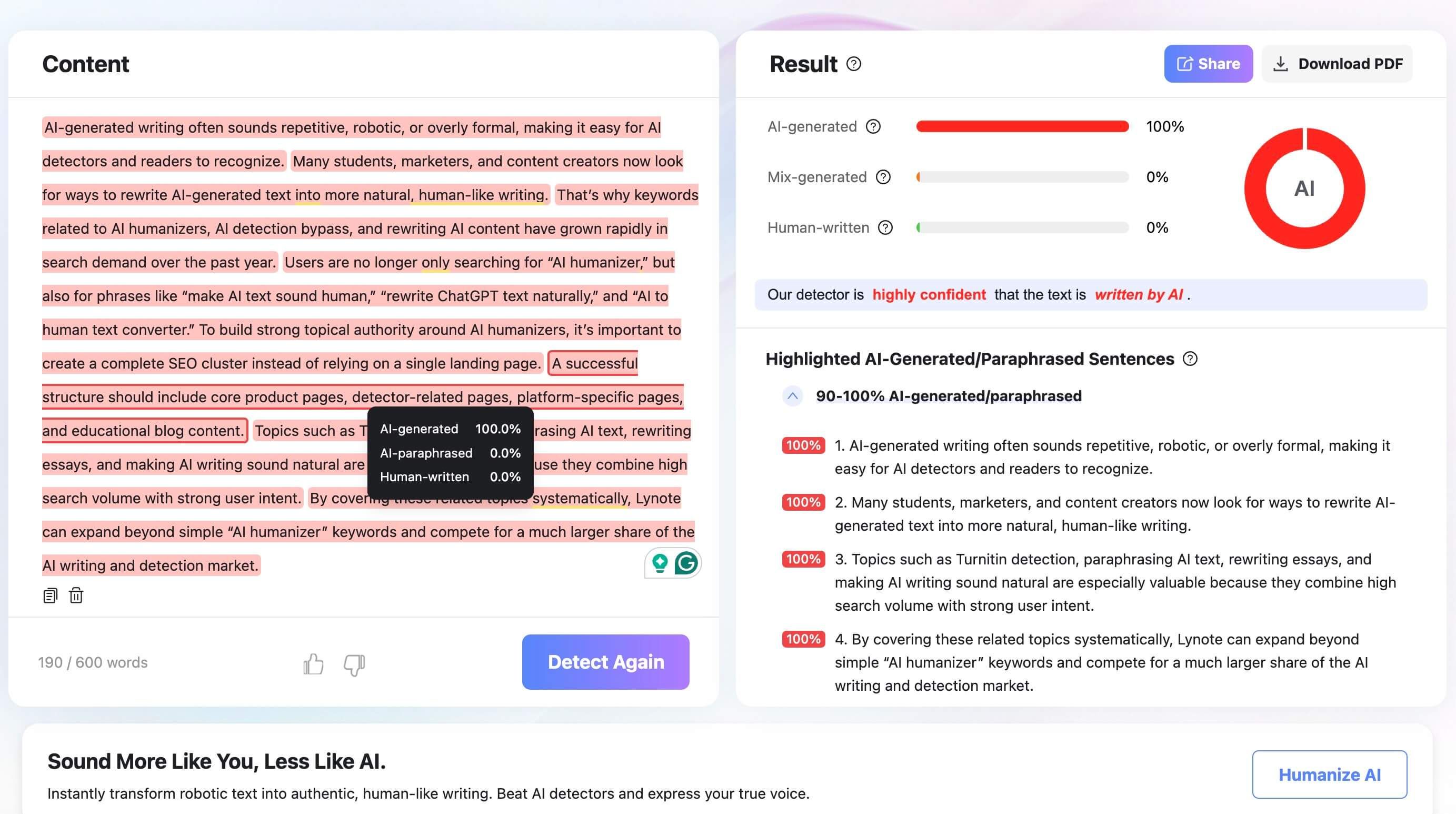
If you want to review a complete draft rather than guess from a few sentences, Lynote AI Detector provides a simple first-pass workflow. It separates its result into AI-generated, mixed, and human-written percentages and highlights sentences for closer review.
-
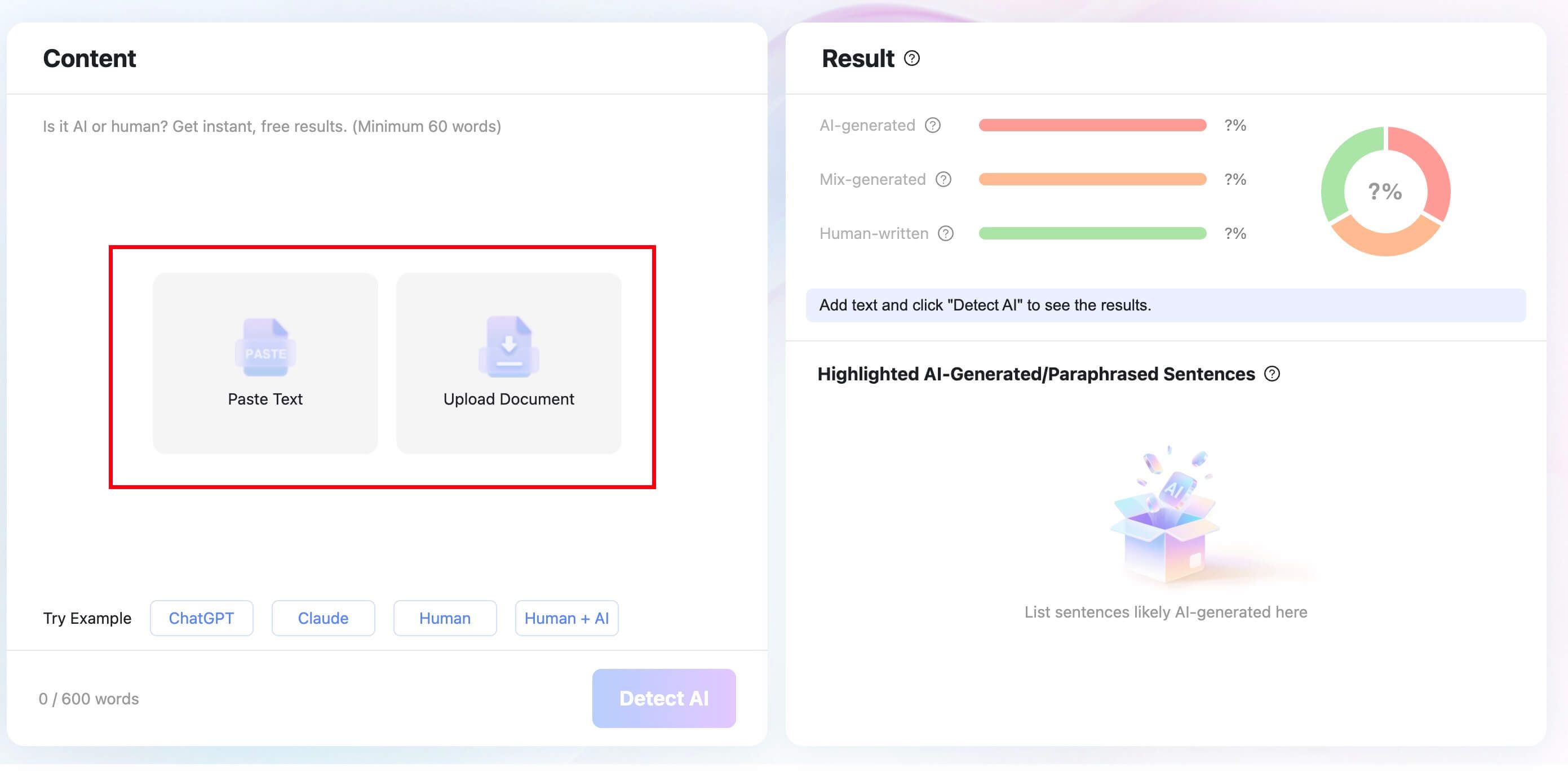
Paste the text or upload a document. Use the text box for a quick check, or upload a supported DOCX, PDF, or TXT file. Submit a meaningful section rather than an isolated line when possible.
-
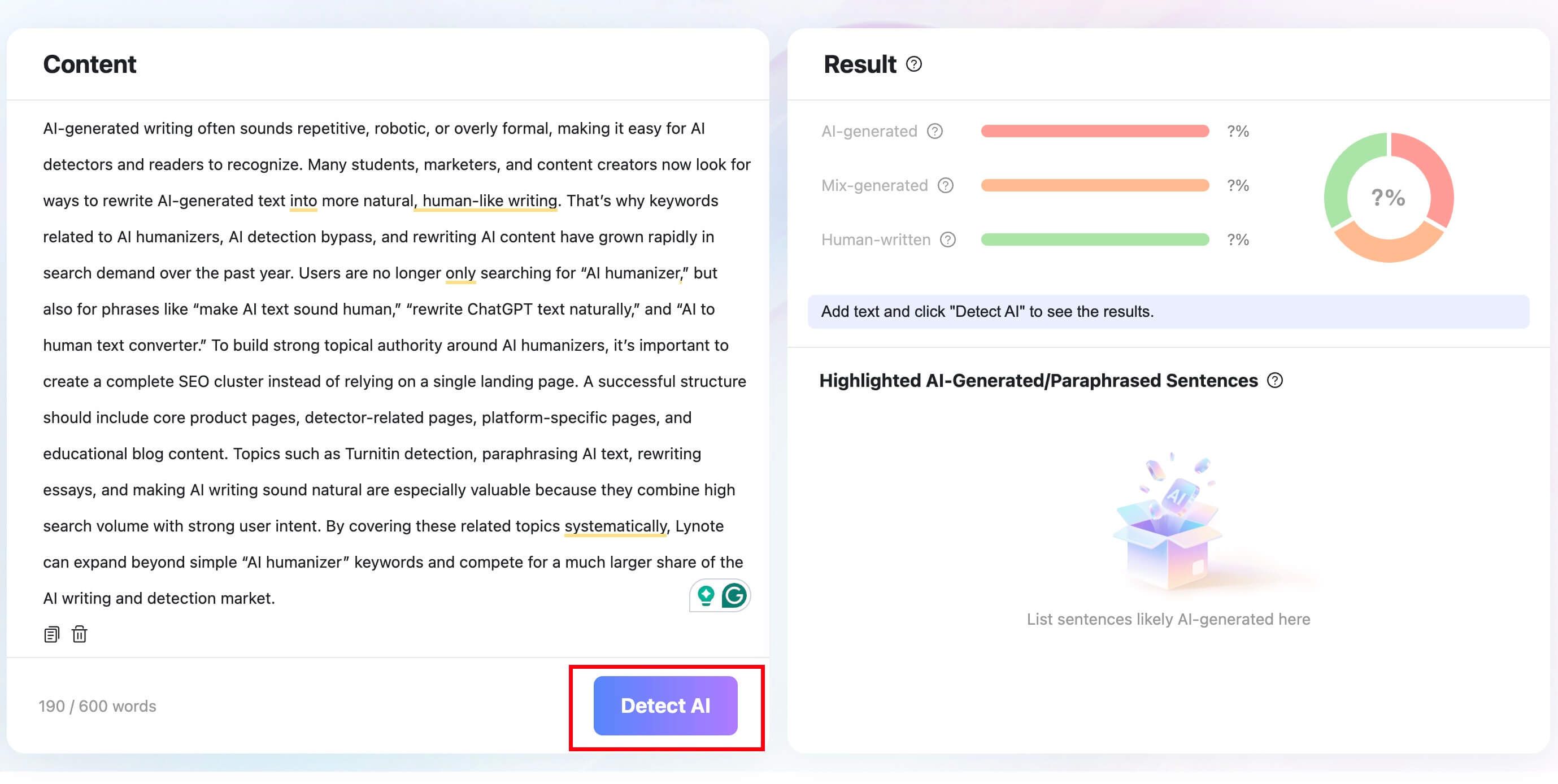
Run the scan. Click Detect AI and let the tool analyze the submitted text.
-
Review the full result. Read the AI, mixed, and human percentages together, then inspect the highlighted sentences instead of reacting only to the largest number.
-
Compare the signal with evidence outside the detector. Look at drafts, version history, cited sources, notes, and the writer's explanation before drawing a conclusion.
The result can tell you where to look. It cannot tell you who wrote the document or whether its use of AI was permitted.

How to Interpret a High or Low AI Score
A score becomes useful only when it changes what you review next.
| If the score is high | If the score is low |
|---|---|
| Read the highlighted passages in context. | Do not treat the result as proof that a person wrote it. |
| Check claims, citations, examples, and unusual shifts in voice. | Check whether the passage is too short for a stable result. |
| Compare the document with earlier drafts or version history. | Remember that detectors can miss AI text and model updates can change performance. |
| Ask the writer about process rather than presenting the score as a verdict. | Use other evidence if authorship or policy compliance matters. |
| Request a second human review for consequential decisions. | Avoid declaring the document "verified human" from one scan. |
For writers reviewing their own work, a high score is not an instruction to make random substitutions or add deliberate errors. A better response is to verify every claim, replace generic filler with specific evidence, and make sure the final argument reflects your own understanding.
For educators and editors, the detector should start a review, not finish one. Process evidence often tells you more than a probability attached to the final draft.
The False-Positive Problem Still Matters
High known-AI detection rates and false positives can exist at the same time. A detector may catch nearly every Astra sample in one benchmark while still struggling with particular kinds of human writing.
Stanford researchers previously found that widely used GPT detectors frequently misclassified writing by non-native English authors. A more recent 2026 study examined 135,389 pairs of human-written manuscripts before and after professional English editing. Across 13 detectors, reported false-positive rates spanned the full possible range, and the same editing changes pushed different detectors in opposite directions.
That does not mean every detector is useless. It means style can become a confounding variable: formal phrasing, consistent grammar, limited vocabulary, or professional editing may affect a score even when authorship did not change.
Turnitin's own guidance reflects this uncertainty. It describes its AI report as one data point and says it is not intended to provide definitive answers in isolation.
That is sensible advice beyond education too. A grade, job, publication decision, or accusation should not rest on one opaque percentage.
FAQs About GPT-6 Astra AI Detection
Can Turnitin detect GPT-6 Astra?
Turnitin may flag text generated by newer language models when the writing matches patterns its system associates with AI. However, no public Astra-specific Turnitin benchmark reviewed for this article establishes a detection rate, and Turnitin says its report should not be used as a definitive answer by itself.
Can an AI detector identify GPT-6 Astra specifically?
No. Current detector results generally estimate whether text looks AI-generated, mixed, or human-like. They do not reliably identify Astra as the exact model or reveal the prompt and editing history.
Does editing GPT-6 Astra text change its score?
It can. Meaningful human editing changes wording, structure, evidence, and voice, which may alter a detector's pattern estimate. The direction is unpredictable, and editing should improve accuracy and authorship quality rather than aim to manipulate a score.
How much text does a detector need?
Requirements vary by tool. In one Astra experiment, detection on the same passages rose from 9 of 40 at 25 words to 29 of 40 at 50 words and all 40 at 100 words. That result belongs to one detector, but it shows why a complete passage is more informative than a sentence.
Is the Highest Possible AI Score Proof That Astra Wrote the Text?
No. It is the detector's strongest classification under its own model and scale. It does not prove which AI model was used, who used it, or whether a person substantially edited the document.
Can human writing be flagged as GPT-6 content?
Human writing can receive an AI-like score, especially when a detector reacts to style rather than origin. Non-native English writing, highly standardized academic prose, and professionally edited text deserve particular caution because research has documented inconsistent false positives.
Is a low score proof that a human wrote the text?
No. A low score means the detector did not find enough AI-associated evidence to cross its threshold. Short passages, unusual genres, and edited AI output can all reduce detection confidence.
Final Verdict
GPT-6 Astra is detectable in the strongest published tests available so far. Originality.ai flagged 999 of 1,000 known Astra outputs, Pangram fully classified 982 of 986 eligible outputs as AI, and five separate detectors agreed on one unedited Astra essay.
Those results support a narrow conclusion: current detectors can often recognize unedited, long-form Astra prose. They do not show that every detector is equally reliable, that short or edited text will behave the same way, or that a score proves authorship.
Use AI detection as triage. Give the tool enough text, read the highlighted passages, and then check the evidence a classifier cannot see: drafts, sources, context, writing history, and the person behind the work.

Written by Danny
Product Marketing Manager
Danny explains how Lynote features fit real workflows, from everyday productivity to product-led writing use cases. View all articles →