

AP World History Notes: Unit 1–9 Review Guide 2026

Preparing for AP World History: Modern means connecting centuries of political change, trade, cultural exchange, and global conflict. Having organized AP World notes can make it easier to review historical developments, compare civilizations, and build evidence-based arguments without repeatedly searching through textbooks and lecture slides.
However, good AP World History notes should do more than list dates and historical figures. They should explain causes and effects, identify historical patterns, and connect events across different regions and periods.
This guide covers the nine AP World History units, effective note-taking methods, useful study resources, and ways to organize your materials with Lynote AI Note Generator.
TL;DR: How to Organize Your AP World History Notes
- Follow the nine official units. Organize your notes chronologically, from The Global Tapestry to Globalization.
- Focus on historical reasoning. Record causes, consequences, comparisons, continuities, and changes over time.
- Use structured note-taking. Cornell notes, timelines, comparison charts, and topic summaries help make complex information easier to review.
- Review the original sources. Combine your class materials with official College Board resources and trusted educational explanations.
- Use AI as an assistant. Lynote can generate editable notes from supported PDFs, lecture recordings, YouTube videos, and webpages, then help you review source-based concepts with AI Chat and Flashcards.
The goal is not to memorize every event independently. It is to understand the historical developments well enough to explain relationships and support arguments with specific evidence.
What Should Good AP World History Notes Include?
AP World History: Modern covers historical developments from approximately 1200 CE to the present. The course emphasizes global connections, historical evidence, and reasoning skills rather than memorization alone.
Strong AP World History review notes should help you answer several questions about every topic: What happened? Why did it happen? How did it affect other regions or societies? What changed, and what remained the same?
Essential Elements of AP World Notes
| Element | What to Record | Example |
|---|---|---|
| Historical Context | Time period, region, and background | East Asia during the Song Dynasty |
| Key Developments | Major events, ideas, and processes | Expansion of commercial networks |
| Causes and Effects | Why changes occurred and their consequences | Effects of growing maritime trade |
| Comparison | Similarities and differences between societies | Ottoman and Mughal governance |
| Continuity and Change | What changed or persisted over time | Evolution of global trade systems |
| Historical Evidence | Specific supporting examples | Printing technology, maritime navigation, trade goods |
| Review Questions | Prompts requiring explanation | How did trade networks facilitate cultural exchange? |
This structure is particularly useful for short-answer questions, document-based questions, and long essays. It encourages you to turn factual information into historical explanations that can support a written argument.
AP World History Notes by Unit: Complete Overview
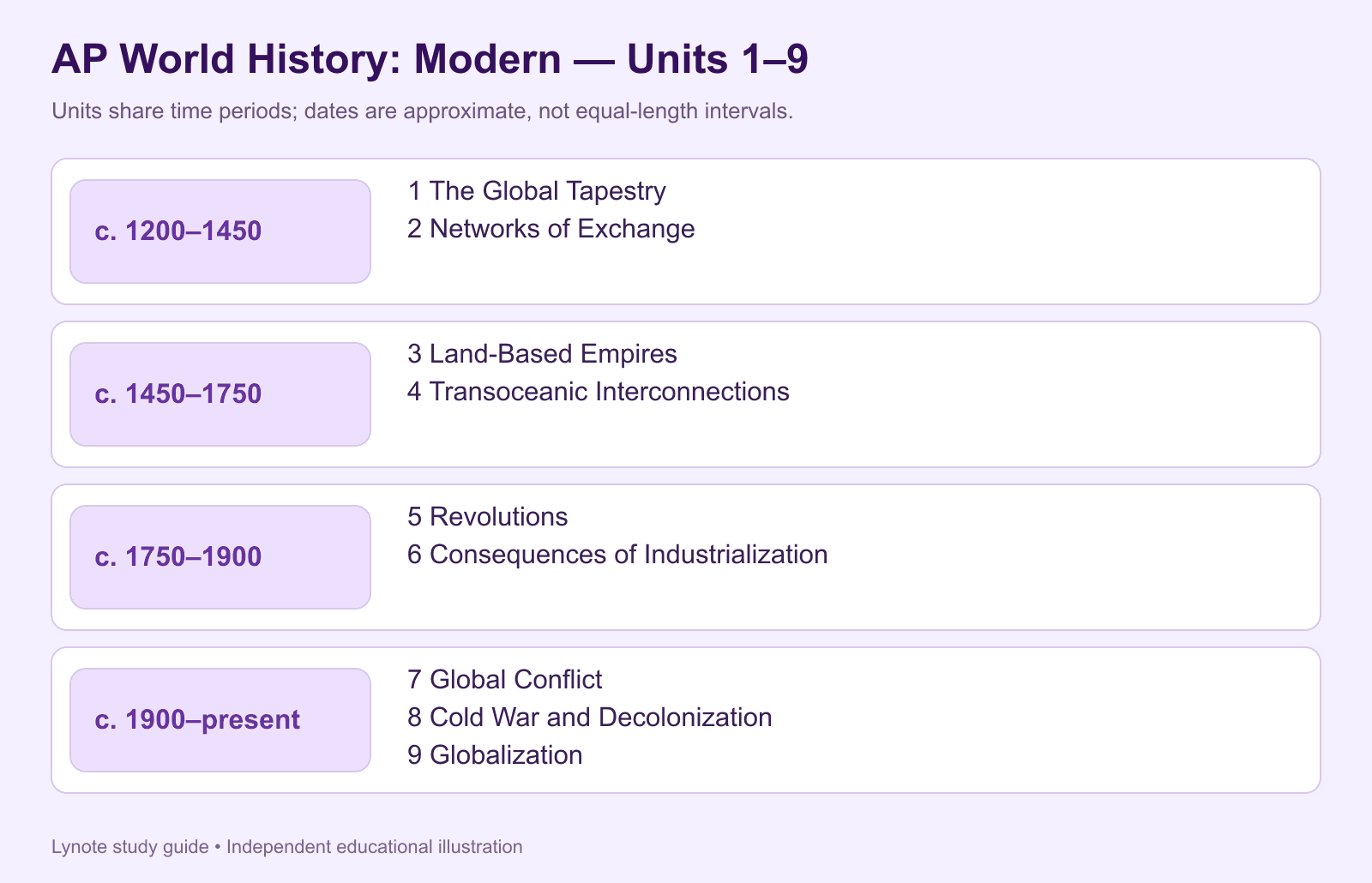
Original chronological overview; units with the same date range are grouped together. Official source.
AP World History: Modern contains nine units organized around major historical periods and developments. The following outline follows the College Board course framework, although teachers may arrange individual lessons differently.
Use these descriptions as a starting point, then expand each unit with evidence, definitions, examples, and explanations from your own class materials.
Unit 1 AP World History Notes: The Global Tapestry (1200–1450)
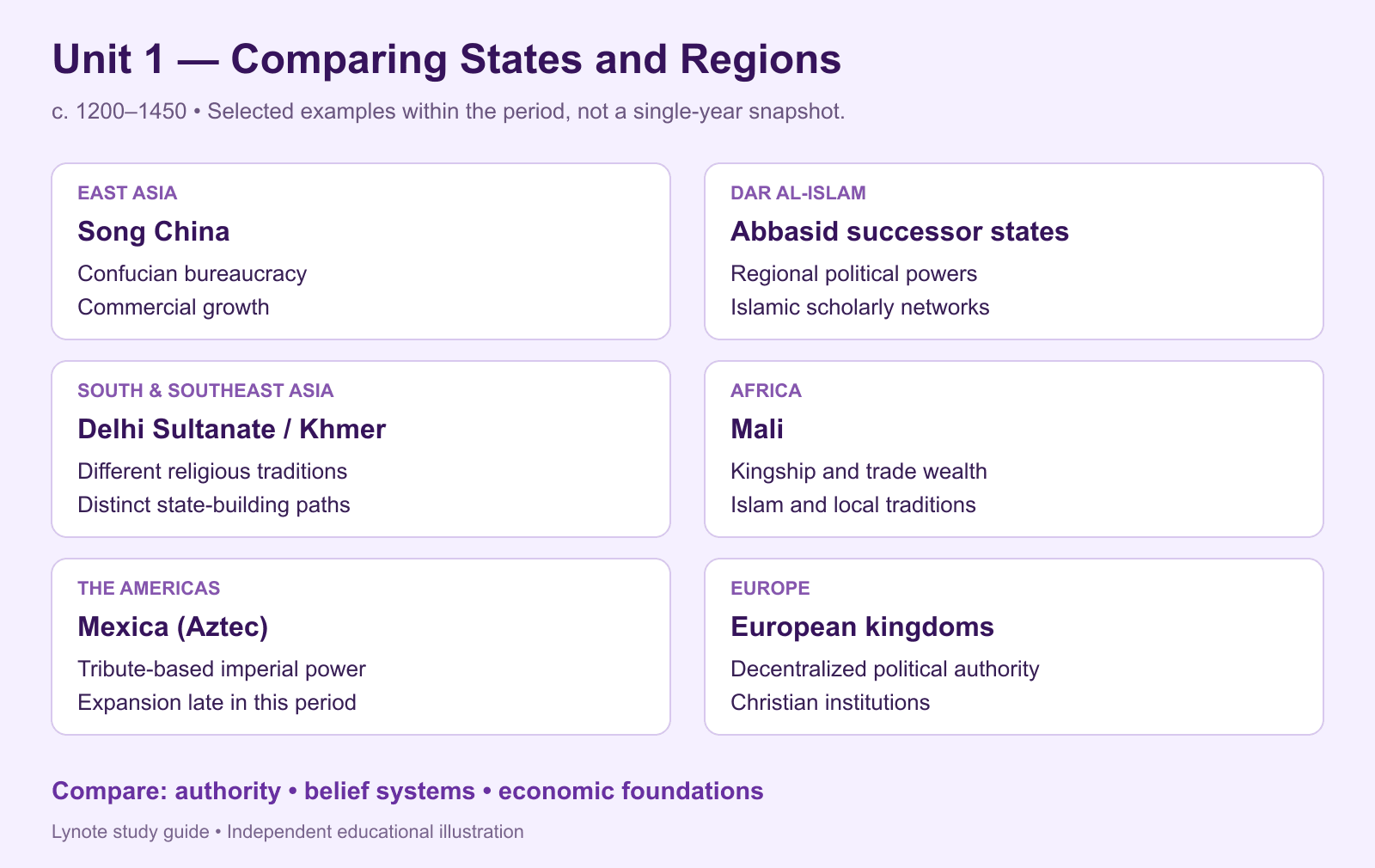
Selected examples from c. 1200–1450; not a simultaneous political map. Official source.
AP World Unit 1 notes focus on the political, cultural, and social developments of major societies around the world between approximately 1200 and 1450.
Topics include states and belief systems in East Asia, Dar al-Islam, South and Southeast Asia, Africa, Europe, and the Americas. Students should pay attention to how rulers established authority and how religious and cultural traditions shaped societies.
Key topics to review:
- Political and economic developments in Song China.
- State formation and Islamic societies across Afro-Eurasia.
- Hindu and Buddhist influences in South and Southeast Asia.
- Political organization in the Americas and Africa.
- Religious traditions, social structures, and cultural developments.
Example review question: How did different states use political institutions and belief systems to maintain authority between 1200 and 1450?
For your AP World History Unit 1 notes, create a comparison chart identifying how two or three states organized power. Record both shared strategies and significant regional differences rather than treating every civilization separately.
AP World History Unit 2 Notes: Networks of Exchange (1200–1450)
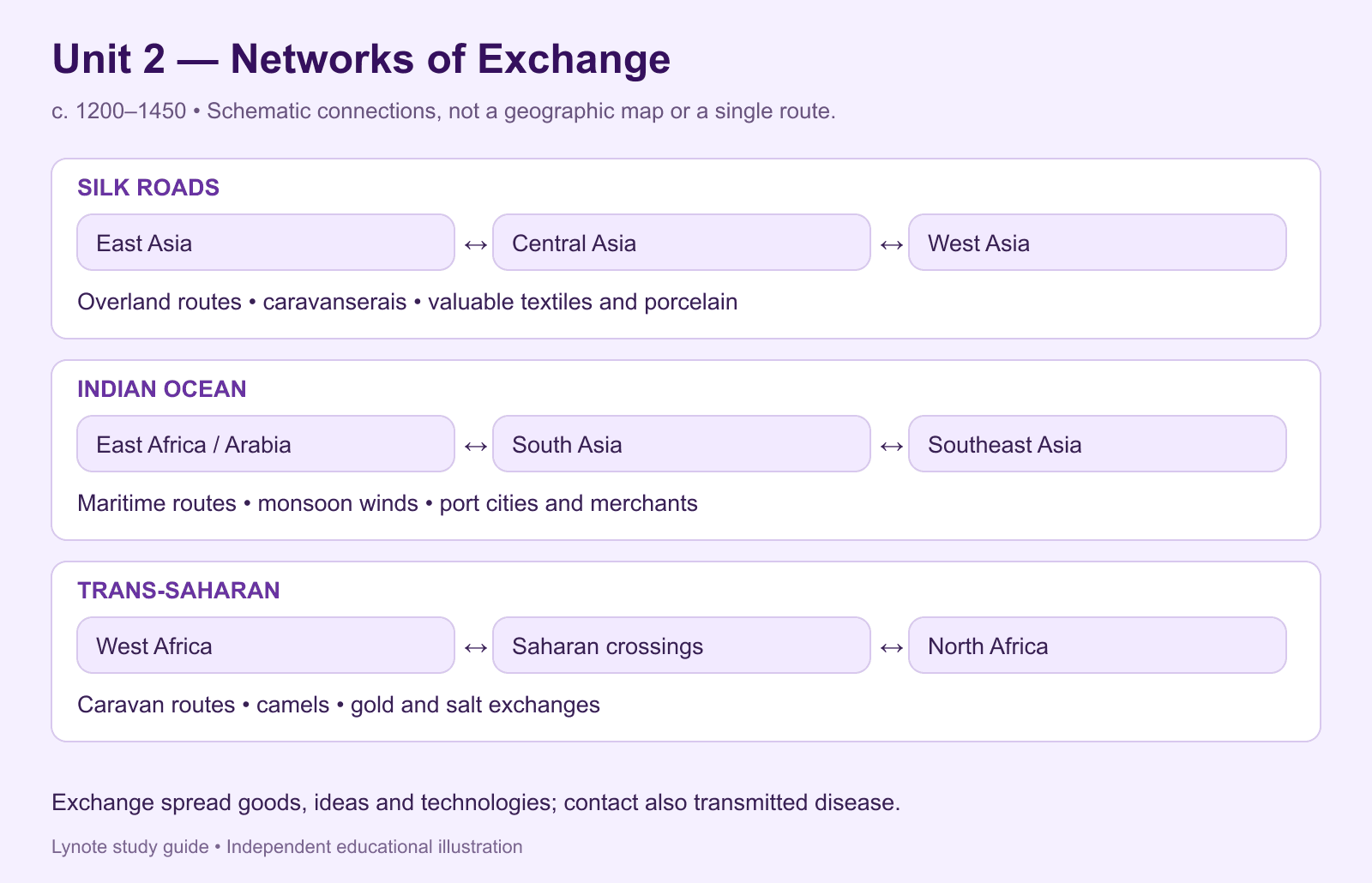
Schematic connections among selected regions; not a geographic map or an exhaustive route network. Official source.
AP World Unit 2 notes examine the trade networks that connected distant societies and influenced economic, political, cultural, and environmental changes.
The Silk Roads, Indian Ocean trade, and trans-Saharan routes are central to this unit. You should understand how commercial connections developed, which technologies supported trade, and what consequences followed from increased interaction.
Key topics to review:
- Causes of Silk Road expansion.
- The Mongol Empire and Eurasian connections.
- Indian Ocean trade networks and maritime technology.
- Trans-Saharan trade and West African states.
- Cultural diffusion, disease transmission, and environmental effects.
Example review question: How did improved transportation technologies influence economic and cultural exchange between 1200 and 1450?
A useful approach is to organize your notes into three columns: trade network, enabling factors, and effects. This makes it easier to compare commercial systems during short-answer and essay preparation.
AP World History Unit 3 Notes: Land-Based Empires (1450–1750)
AP World Unit 3 notes focus on the development and expansion of major land-based empires between approximately 1450 and 1750.
Important examples include the Ottoman, Safavid, Mughal, Qing, and Russian empires. Students should examine military expansion, bureaucratic institutions, belief systems, and methods rulers used to legitimize political authority.
Key topics to review:
- Expansion of major Eurasian land empires.
- Gunpowder technology and military development.
- Bureaucracy and systems of taxation.
- Religious policies and imperial legitimacy.
- Similarities and differences in imperial governance.
Example review question: How did land-based empires use military power, administrative institutions, and religion to strengthen their authority?
When preparing AP World History Unit 3 notes, compare at least two empires using specific examples. A table covering methods of expansion, administration, and religious policy can help you prepare for comparison-based writing prompts.
AP World Unit 4 Notes: Transoceanic Interconnections (1450–1750)
Unit 4 examines the expansion of maritime exploration and the increasingly interconnected world that developed between approximately 1450 and 1750.
Your notes should explain how navigational technologies, economic motivations, and state sponsorship contributed to overseas exploration. They should also address the consequences of European maritime expansion for populations, labor systems, trade, and the environment.
Key topics to review:
- Maritime technology and European exploration.
- The Columbian Exchange.
- Establishment and expansion of maritime empires.
- Labor systems and economic changes.
- Cultural interaction and changing social hierarchies.
Example review question: How did transoceanic exchanges transform societies in the Americas, Africa, and Eurasia?
For this unit, a cause-and-effect diagram is especially effective. Start with maritime exploration, then connect it to biological exchange, changing labor systems, commercial expansion, and social transformations.
AP World Unit 5 Notes: Revolutions (1750–1900)
AP World Unit 5 notes cover the political and economic transformations associated with revolutionary ideas and industrialization between approximately 1750 and 1900.
The Enlightenment, political revolutions, nationalism, and the Industrial Revolution are major areas of study. Understanding the relationship between new ideas, technological developments, and social change is essential.
Key topics to review:
- Enlightenment ideas and political thought.
- The American, French, and Haitian Revolutions.
- Nationalism and the formation of new states.
- Technological developments supporting industrialization.
- Social and economic consequences of industrial growth.
Example review question: How did Enlightenment ideas and industrialization contribute to political and social change between 1750 and 1900?
AP World History Unit 5 notes work well when organized into separate political and economic timelines. You can then connect the timelines to explain how revolutionary ideas and industrial developments influenced societies.
AP World Unit 6 Notes: Consequences of Industrialization (1750–1900)
Unit 6 builds on industrialization by examining imperial expansion, economic dependency, resistance movements, and migration.
Students should understand why industrial powers expanded their influence and how imperialism affected colonized societies. Migration patterns, labor systems, and changing global economic relationships are also central.
Key topics to review:
- Causes of nineteenth-century imperial expansion.
- Resistance to colonial rule.
- Economic imperialism and unequal commercial relationships.
- Industrial capitalism and global economic changes.
- Migration, labor systems, and demographic change.
Example review question: How did industrialization contribute to new forms of imperialism and migration?
For stronger AP World Unit 6 notes, connect economic motivations to political decisions and social consequences. A comparative chart of imperial rule and resistance can help organize examples from different regions.
AP World Unit 7 Notes: Global Conflict (1900–Present)
AP World Unit 7 notes focus on the major global conflicts and political transformations of the twentieth century.
The causes and consequences of World War I, interwar developments, World War II, and mass atrocities are important parts of this unit. Students should also understand how ideological movements and changing political systems influenced global conflict.
Key topics to review:
- Long-term and immediate causes of World War I.
- Political and economic developments during the interwar period.
- Causes and consequences of World War II.
- Changes in warfare and military technology.
- Mass atrocities and changing political ideologies.
Example review question: How did political instability, economic conditions, and ideological movements contribute to global conflict in the twentieth century?
Use interconnected timelines to organize your AP World Unit 7 notes. Record not only the sequence of events but also how earlier developments contributed to later conflicts.
Unit 8: Cold War and Decolonization (1900–Present)
Unit 8 examines the geopolitical competition between the United States and the Soviet Union, the spread of competing ideologies, and the independence of former colonies.
The Cold War and decolonization are closely connected to broader political transformations after World War II. Your notes should explain both global patterns and regional differences in the pursuit of independence.
Key topics to review:
- Origins and consequences of the Cold War.
- Expansion of communist influence.
- Decolonization in Asia and Africa.
- Nationalist movements and newly independent states.
- The end of the Cold War.
Example review question: How did Cold War competition influence political developments and independence movements in different regions?
Organize Unit 8 notes around ideology, political independence, and international relationships. Include examples showing how individual societies experienced these global processes differently.
Unit 9: Globalization (1900–Present)
Unit 9 explores the increasing interconnectedness of societies through technology, economic exchange, cultural interaction, and international institutions.
Rather than treating globalization as one event, focus on how multiple developments reshaped societies around the world. Your notes should consider both opportunities and challenges associated with increased global connections.
Key topics to review:
- Technological innovations and communication.
- Global economic integration.
- Environmental changes and disease.
- Cultural exchange and social movements.
- International institutions and global cooperation.
Example review question: How did technological and economic developments accelerate globalization after 1900?
A thematic comparison chart works well for this unit. Separate economic, environmental, political, and cultural developments, then identify how changes in one area influenced the others.
How to Take AP World History Notes Effectively
Students often ask how to take AP World History notes without copying entire chapters or writing transcripts of every lecture. The most effective approach is to record historical explanations in a structure that makes them easy to revisit and apply.
Whether you prefer handwritten notebooks or digital documents, the following methods can make your review more focused.
1. Organize Notes by Unit and Historical Theme
Start by separating your notes into the nine AP World History units. Within each unit, create sections for major events, historical processes, key terms, and supporting examples.
Then identify recurring themes such as governance, economic systems, technology, and cultural interaction. These connections can help you recognize broader patterns across different historical periods.
2. Focus on Causes, Effects, and Historical Connections
A timeline is useful, but a sequence of dates alone cannot explain why developments matter. Add short explanations of the causes and consequences of major events.
For example, rather than only recording when the Columbian Exchange began, explain how transatlantic connections affected agriculture, populations, labor, and economies.
This prepares you to use historical evidence in more complex questions.
3. Write Questions Instead of Only Definitions
Turn important ideas into questions that require explanations. Questions such as "How did the Mongol Empire influence exchange networks?" encourage deeper recall than isolated terms.
You can use these prompts during review by hiding the answers and explaining the historical relationship from memory. This method also fits naturally with Cornell notes and flashcards.
4. Use Comparison Charts and Timelines
Some historical topics are easier to understand visually. Comparison charts work well for imperial governments, trade networks, and revolutionary movements.
Timelines are useful when explaining changes over time, while cause-and-effect diagrams clarify how different developments influenced one another.
Choose the format that best represents the relationships you need to remember.
How to Use Cornell Notes for AP World History
Cornell notes divide a page into a main note-taking area, a cue column, and a summary section. This format helps students move from recording information to asking questions and reviewing concepts.
AP World History Cornell notes are particularly useful when studying historical processes that involve several causes, consequences, and comparisons.
Cornell Notes for AP World History: Example
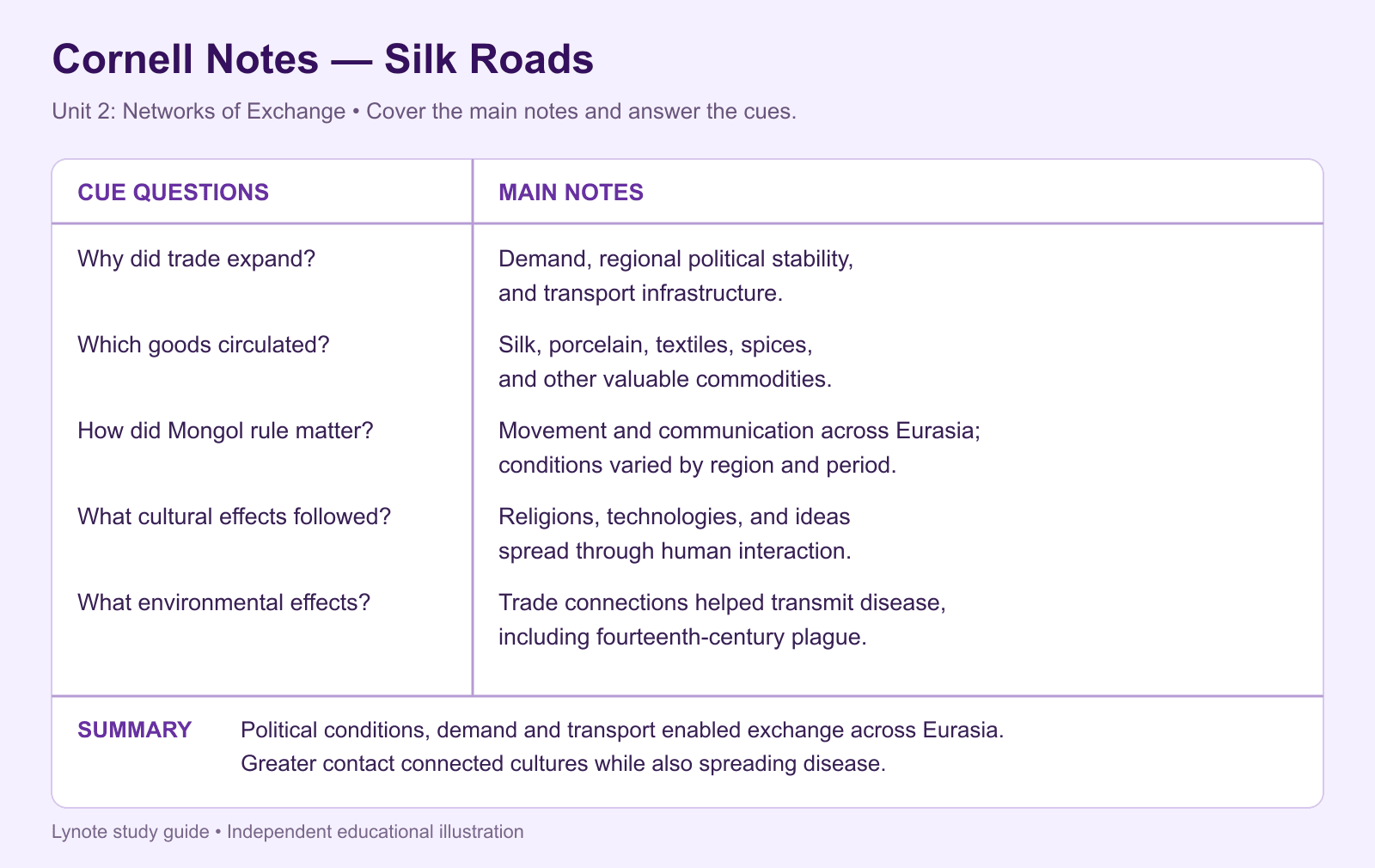
Original Cornell layout summarizing the Silk Roads example below. Official source.
Unit: Unit 2, Networks of Exchange
Topic: Silk Roads
| Cue Questions | Main Notes |
|---|---|
| Why did Silk Road trade expand? | Increasing commercial demand, political stability in certain regions, and transport infrastructure supported long-distance exchange. |
| What were important trade goods? | Silk, porcelain, textiles, spices, and other valuable commodities circulated through interconnected routes. |
| How did the Mongol Empire affect exchange? | Mongol rule facilitated movement and communication across large parts of Eurasia, although conditions varied across regions and periods. |
| What were the cultural effects? | Religious traditions, technologies, and ideas spread through commercial and human interactions. |
| What were the environmental consequences? | Trade connections contributed to the transmission of diseases, including the spread of plague during the fourteenth century. |
Summary: The Silk Roads connected societies across Eurasia and facilitated commercial and cultural exchange. Their development depended on political conditions, economic demand, and transportation networks, while increasing contact produced both beneficial exchanges and serious consequences.
After completing the main notes, cover the explanations and answer the cue questions from memory. This makes Cornell notes for AP World History useful for both information organization and active recall.
How to Create AP World History Notes PDF Files
Many students prefer AP World History notes PDF files because they are easy to store, read, and revisit across devices. A consistent PDF-based note system can also keep information organized throughout the school year.
Start with a unit-based folder structure and use descriptive file names. For example, AP-World-Unit-1-Global-Tapestry.pdf makes the topic easier to identify than a generic filename.
A Simple PDF Note Organization System
| Folder | Suggested File |
|---|---|
| Unit 1 | Global Tapestry Summary |
| Unit 2 | Networks of Exchange Notes |
| Unit 3 | Land-Based Empires Comparison |
| Unit 4 | Transoceanic Connections Timeline |
| Unit 5 | Revolutions Review |
| Unit 6 | Industrialization and Imperialism |
| Unit 7 | Global Conflict Notes |
| Unit 8 | Cold War and Decolonization |
| Unit 9 | Globalization Review |
When creating AP World History Unit 1 notes PDF documents, include a concise overview, essential examples, a comparison chart, and a set of review questions. Use the same structure for later units to make your collection easier to navigate.
If your teacher provides digital handouts or chapter PDFs, organize those original files separately from your personal summaries. This makes it easier to verify details and return to the sources when necessary.
How to Use Heimler and AMSCO for AP World History Notes
Students frequently search for Heimler notes AP World resources or AMSCO notes AP World summaries. Both are common starting points for building personal study notes, but they serve different purposes.
Rather than relying entirely on prewritten notes, use your course syllabus to determine which chapters and video lessons are relevant. Then convert important information into explanations, comparison charts, and review questions.
Heimler AP World Notes: Learn from Video Explanations
Heimler's History offers educational videos focused on AP history topics, including unit reviews and historical reasoning skills.
If you learn best by listening to explanations, Heimler's History can be a useful companion to your classroom lessons. Take notes on the historical arguments, examples, and connections presented in each video.
When making Heimler AP World notes, divide the material into main ideas, supporting evidence, and questions for review. This is more useful than recording every sentence from the video.
AMSCO AP World History Notes: Organize Textbook Reading
AMSCO AP World History textbooks are commonly used as supplementary course materials. Students can use assigned chapters to build structured notes around historical developments, specific evidence, and relationships between regions.
For AMSCO AP World History notes, begin with the assigned section and identify its central historical questions. Record key evidence and write short explanations showing why each example matters.
Keep your notes aligned with the College Board course framework and your teacher's assigned curriculum. Do not assume a third-party textbook provides the only possible explanation or all the evidence you need.
Can You Use AI with Heimler or AMSCO Materials?
Yes, AI tools can help organize supported learning materials you are authorized to process. For example, Lynote can generate structured notes from supported YouTube videos and uploaded documents.
However, Lynote does not host official Heimler study packets or licensed AMSCO textbook copies. Respect copyright restrictions, publisher access terms, and the rights associated with any study materials you upload.
How to Generate AP World Notes with Lynote AI
AP World History often involves switching between textbook readings, teacher slides, videos, and personal study notes. When those sources are scattered across different locations, preparing a consistent revision document can become repetitive.
Lynote AI Note Generator helps turn supported source materials into editable, structured notes. It is a study assistant rather than an official AP World History content library.
Step 1. Add Your AP World Study Materials
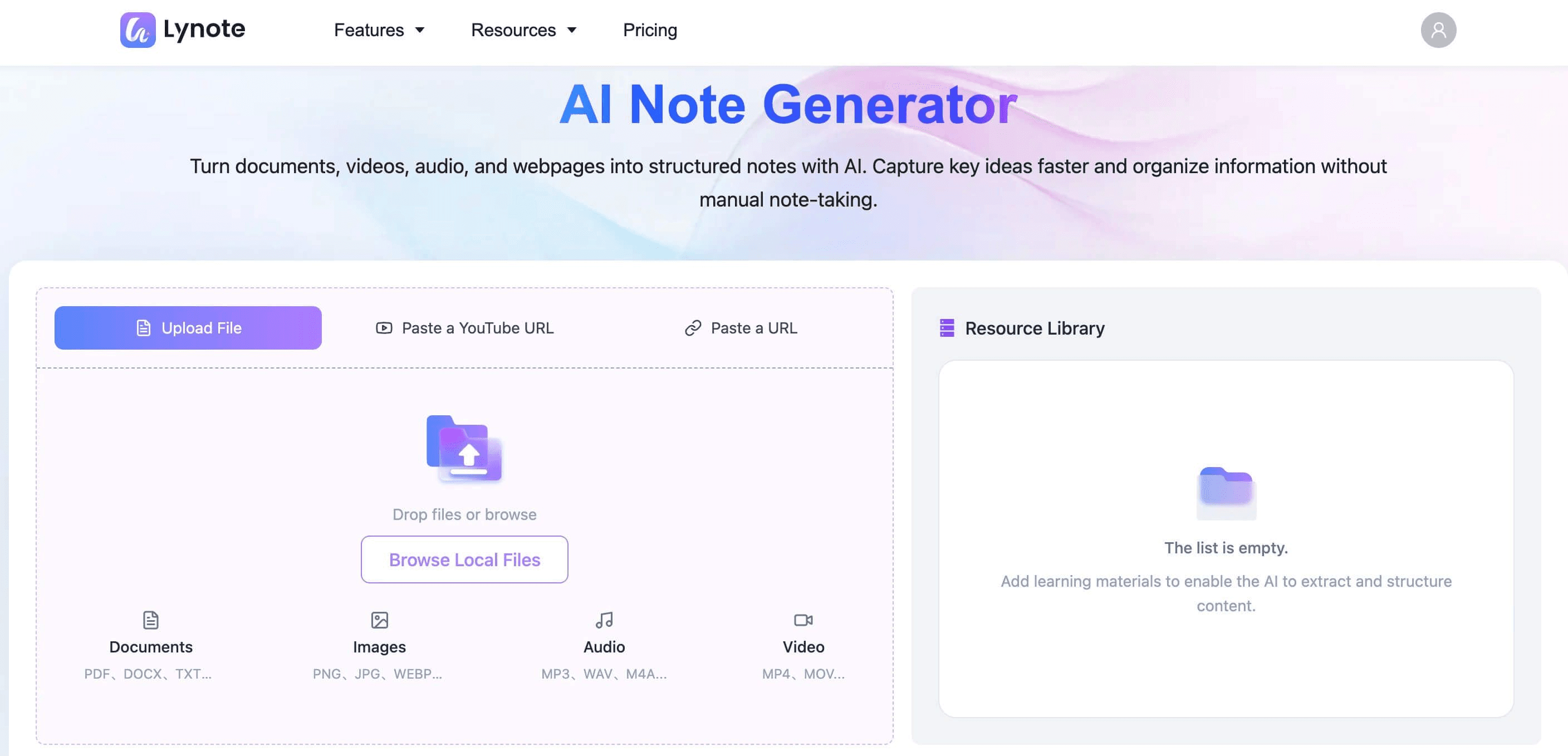
Real Lynote AI Note Generator upload interface. Official source.
Upload a PDF, document, audio recording, or video, or paste a supported YouTube or webpage link into Lynote. Choose materials that correspond to the AP World unit you are currently studying.
For example, you could start with a Unit 3 lecture presentation about land-based empires or a supported video explaining maritime trade. Use only materials you have the right to process.
Step 2. Generate and Customize Structured Notes
Select Create Note to generate organized notes from the source content. Lynote can structure information into headings, important concepts, summaries, and supporting details.
Next, review the output and reorganize it according to your unit outline. Add specific historical evidence, remove irrelevant information, and correct anything that does not accurately reflect the original material.
Step 3. Explore Concepts with AI Chat
Use Lynote AI Chat to ask questions about information included in your uploaded materials. For example, you might ask how two empires differed in their methods of maintaining political authority if those details are covered in the source.
AI Chat depends on the information available in the material you provided. When a question requires evidence outside those sources, consult your textbook, teacher, or official course resources.
Step 4. Turn Important Concepts into Flashcards
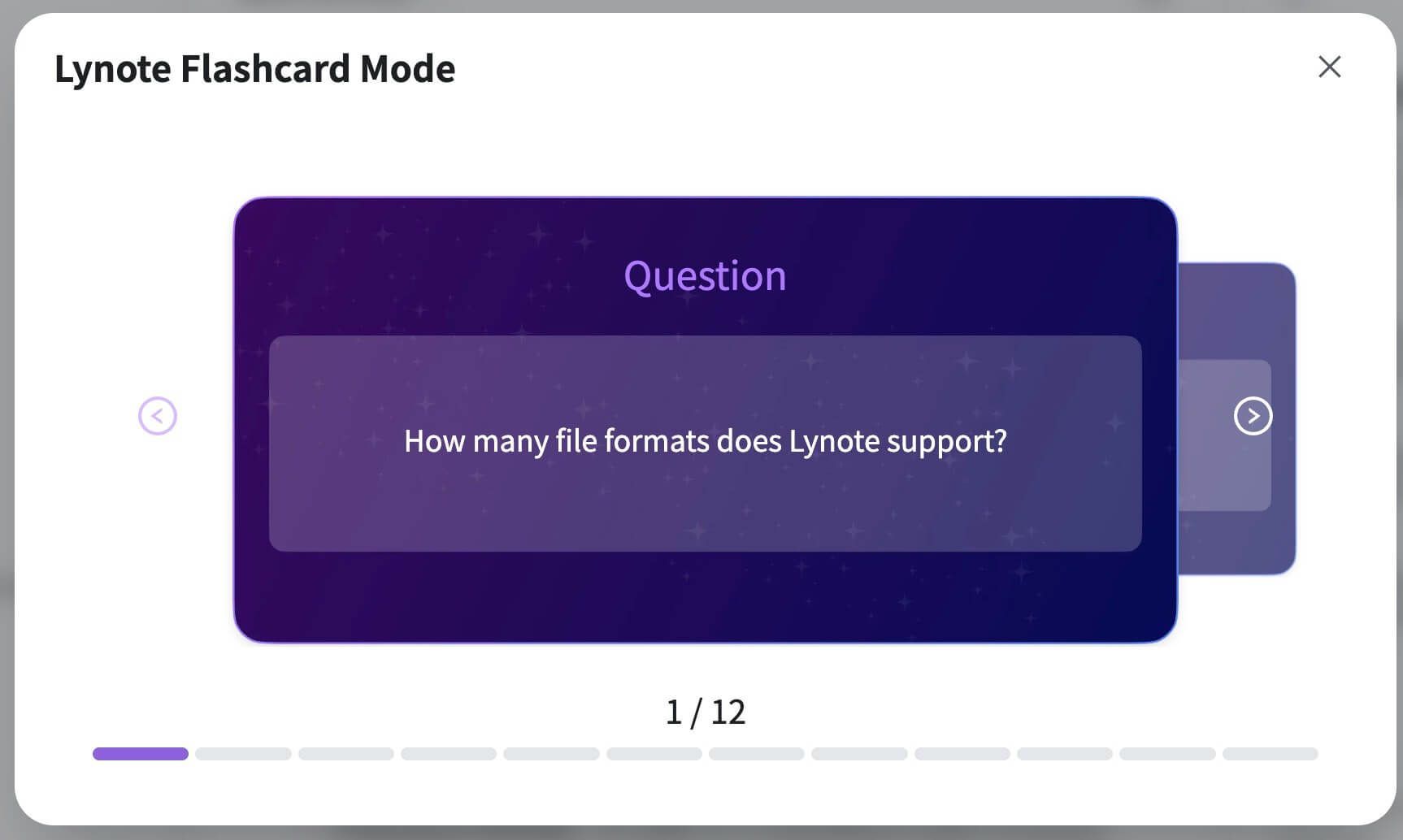
Actual Lynote Flashcard Mode interface. The sample card demonstrates the product, not AP World course content. Official source.
Use Lynote's Flashcards feature to create question-and-answer cards from your notes. Focus on prompts involving historical causes, comparisons, definitions, and important developments.
Instead of simply rereading the cards, attempt to answer each question before revealing the explanation. Check the answers against your source material, especially where historical interpretations or specific evidence matter.
How to Review AP World History Notes for the Exam
Creating notes is only the first stage of exam preparation. You also need to practice explaining historical developments and using evidence to support your answers.
The AP World History: Modern exam includes multiple-choice questions, short-answer questions, a document-based question, and a long-essay question. Your review method should prepare you for both factual recall and historical analysis.
For current exam format and administration details, consult the official College Board exam page.
Build a Unit-by-Unit Review Checklist
Use the following checklist to track your progress as you revise:
- Can I explain the main historical developments in each unit?
- Can I identify causes and consequences using specific examples?
- Can I compare societies across different regions?
- Can I explain continuity and change over time?
- Can I support an argument with relevant historical evidence?
- Can I connect individual examples to broader historical processes?
If you struggle with any question, return to your original notes and identify the missing explanation. Then write a new cue question or flashcard that tests that concept.
Practice Different Question Types
Multiple-choice review should include interpreting historical sources and recognizing relevant context. Short-answer practice should emphasize concise explanations supported by evidence.
For document-based and long-essay questions, use your notes to develop historical arguments rather than memorizing a fixed response. Review official examples, scoring guidelines, and practice resources to understand the current expectations.
Use Spaced Review Instead of Last-Minute Reading
Review older units while continuing to study new ones. For example, you might revisit Unit 1 comparison questions while preparing new notes for Unit 5.
Short sessions focused on explaining ideas from memory can be more useful than repeatedly reading the same pages. Use mistakes to decide which topics deserve another review.
Conclusion: Build Better AP World Notes with a Clear Study System
Effective AP World notes should make historical information easier to understand, connect, and review. Organize your materials by unit, use Cornell notes and comparison charts, and practice explaining historical developments with supporting evidence.
Whether you're preparing AP World Unit 1 notes or revising the complete course, accuracy and active review matter more than the number of pages you collect.
If you want help turning supported PDFs, videos, and lecture recordings into editable study notes, try Lynote AI Note Generator.
Frequently Asked Questions
Where Can I Find AP World History Unit 1 Notes?
Start with the official College Board AP World History: Modern course framework and your teacher's materials. Unit 1, The Global Tapestry, covers major political, cultural, and social developments from approximately 1200 to 1450.
You can organize your AP World History Unit 1 notes around state formation, religious traditions, governance, and regional comparisons. If you prefer a digital document, create a separate Unit 1 PDF summary for review.
What Should AP World Unit 5 Notes Cover?
Unit 5, Revolutions, covers major political and economic developments between approximately 1750 and 1900. Important areas include Enlightenment ideas, political revolutions, nationalism, industrialization, and associated social changes.
Useful AP World History Unit 5 notes should explain how new ideas and economic developments contributed to historical transformations. Include comparisons and specific supporting examples instead of only listing events.
How Can I Take Notes for AP World History More Efficiently?
If you're wondering how to take notes for AP World History, begin with the unit's central historical questions. Record key developments, causes, effects, comparisons, and supporting evidence.
Then add review questions and a short summary. You can also use AI tools to prepare a source-based draft, but you should verify the content and add your own historical reasoning.
Are Cornell Notes Good for AP World History?
Yes. Cornell notes can help organize historical explanations and prepare questions for active recall.
Use the main column for evidence and explanations, the cue column for historical reasoning questions, and the bottom section for a concise summary. This format works particularly well for trade networks, imperial comparisons, and cause-and-effect relationships.
Can I Make AP World History Notes from Heimler's Videos?
You can create personal study notes from educational explanations in Heimler's History videos, subject to applicable access and copyright rules. Focus on important concepts, supporting examples, and historical connections.
Lynote supports generating notes from supported YouTube links, which can help organize source content. It does not provide official Heimler-branded note packets or guarantee complete coverage of the AP exam.
Can I Generate AMSCO AP World History Notes with AI?
AI can help prepare notes from compatible AMSCO materials that you are authorized to upload or process. You can then refine the notes according to your assigned chapter and class syllabus.
Lynote does not provide licensed AMSCO textbooks or official publisher summaries. Check your notes against the original material and respect the publisher's usage conditions.
Are AP World History Notes PDFs Better Than Handwritten Notes?
Both formats can be useful. PDF notes are convenient for storing structured summaries and reading across devices, while handwriting may be preferable for timelines, diagrams, and quick classroom annotations.
Choose the format that helps you review and explain the material effectively. The quality of your questions, summaries, and historical evidence matters more than the file format alone.
Should I Study Only AP World Units 1–7?
No. AP World History: Modern includes nine units, and all nine belong to the course framework. Unit 8 covers Cold War and Decolonization, while Unit 9 focuses on Globalization.
If you have mainly collected AP World Unit 1–7 notes, make sure your revision plan also includes Units 8 and 9. Consult the official course description for the complete scope of the exam.
Can AI Notes Replace AP World History Practice Exams?
No. AI-generated notes help organize material for review, but they do not replace practicing historical arguments, source analysis, or timed exam questions.
Use official AP Classroom resources, released questions, scoring information, and teacher feedback for assessment preparation. AI notes and flashcards can complement those activities by helping you review the underlying course content.
Are Lynote Notes Official AP World History Notes?
No. Lynote is an independent AI note-taking platform and is not affiliated with or endorsed by the College Board.
It generates notes from the supported study materials you provide. For authoritative course scope and exam requirements, always consult College Board resources and your instructor.
Lynote is also not affiliated with or endorsed by Heimler's History or AMSCO.

Written by Hamza Razzaq
Technical Writer
Hamza creates hands-on explainers and technical guides that make AI writing tools easier to understand and use. View all articles →