

AP US History Notes: Complete Unit 1–9 Study Guide

AP United States History covers centuries of political change, economic development, cultural movements, and social conflict. Creating organized notes for AP US History can help you understand these developments, connect historical events, and prepare stronger arguments for the AP exam.

But effective history notes should do more than summarize textbook chapters. They should explain why events happened, how different groups experienced historical change, and what evidence supports important historical interpretations.
This guide covers all nine AP U.S. History units, practical note-taking methods, AMSCO and American Pageant textbook strategies, and ways to use Lynote AI Note Generator to organize your learning materials.
TL;DR: How to Make Better AP US History Notes
- Follow the nine official APUSH units. Organize your materials from Period 1 (1491–1607) through Period 9 (1980–Present).
- Focus on historical reasoning. Connect causes, effects, comparisons, continuity, and change instead of memorizing isolated dates.
- Use reliable course materials. Build your notes from class readings, approved textbooks, primary sources, and College Board resources.
- Try structured note-taking. Cornell notes, timelines, comparison charts, and chapter summaries can make revision more focused.
- Use AI to organize source material. Lynote can turn supported PDFs, lecture recordings, and videos into editable notes, with AI Chat and Flashcards for further review.
The most useful AP American History notes are organized around historical questions. They help you explain developments using specific examples rather than simply recognize familiar terms.
What Should Good AP US History Notes Include?
AP U.S. History is not only about remembering presidents, laws, and wars. The course asks students to evaluate historical sources, understand developments in context, and support interpretations with evidence.
Your AP US History notes should therefore combine factual information with historical reasoning. A strong note set explains what happened, why it mattered, and how it connected to broader changes in American history.
Essential Elements of AP History Notes
| Element | What to Include | Example |
|---|---|---|
| Historical Context | Period, location, and background | British North America before independence |
| Key Events | Important developments and turning points | Constitutional Convention of 1787 |
| Causes and Effects | Reasons and consequences | Causes of the American Revolution |
| Historical Comparison | Similarities and differences | Northern and Southern colonial economies |
| Continuity and Change | Developments over time | Changing federal authority |
| Historical Evidence | Specific examples supporting claims | Federalist Papers, legislation, political movements |
| Review Questions | Prompts requiring explanation | How did industrialization transform American society? |
Whether you call them US History notes, APUSH notes, or United States History notes, the purpose should be the same: building a resource that supports understanding, explanation, and review.
Organizing evidence by historical themes also makes it easier to prepare for source-based and written questions. Instead of memorizing information as separate facts, you can connect evidence to an argument.
AP US History Notes by Unit: Complete Overview
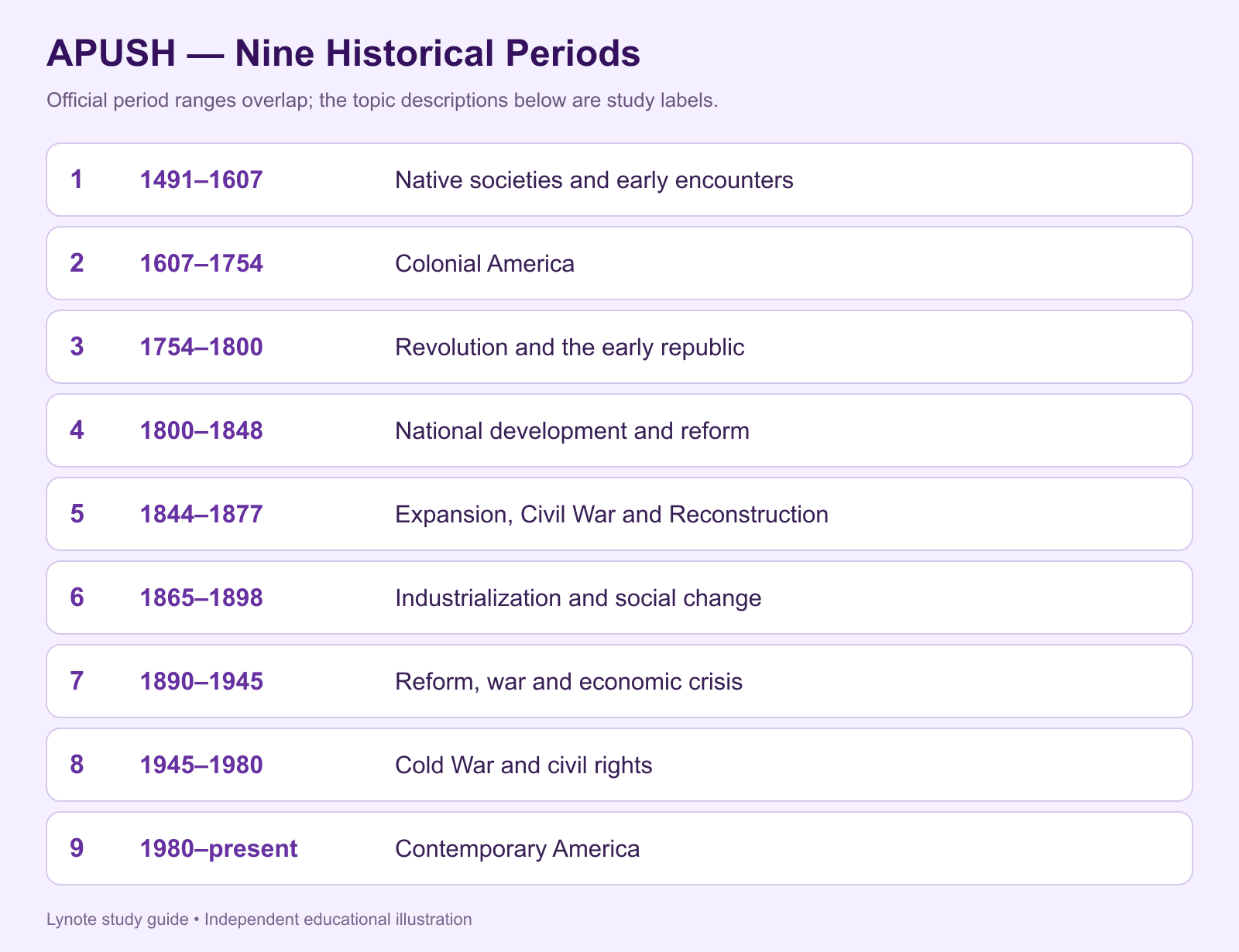
Original study timeline using official APUSH period ranges, including overlapping dates. Official source.
The College Board organizes AP United States History into nine chronological periods, beginning in 1491 and continuing to the present. Teachers may arrange lessons and textbook readings differently, so use the official course framework alongside your classroom syllabus.
The following unit guide highlights major topics, suggested note structures, and example review questions.
Unit 1: Period 1 (1491–1607), Native American Societies and Early Encounters
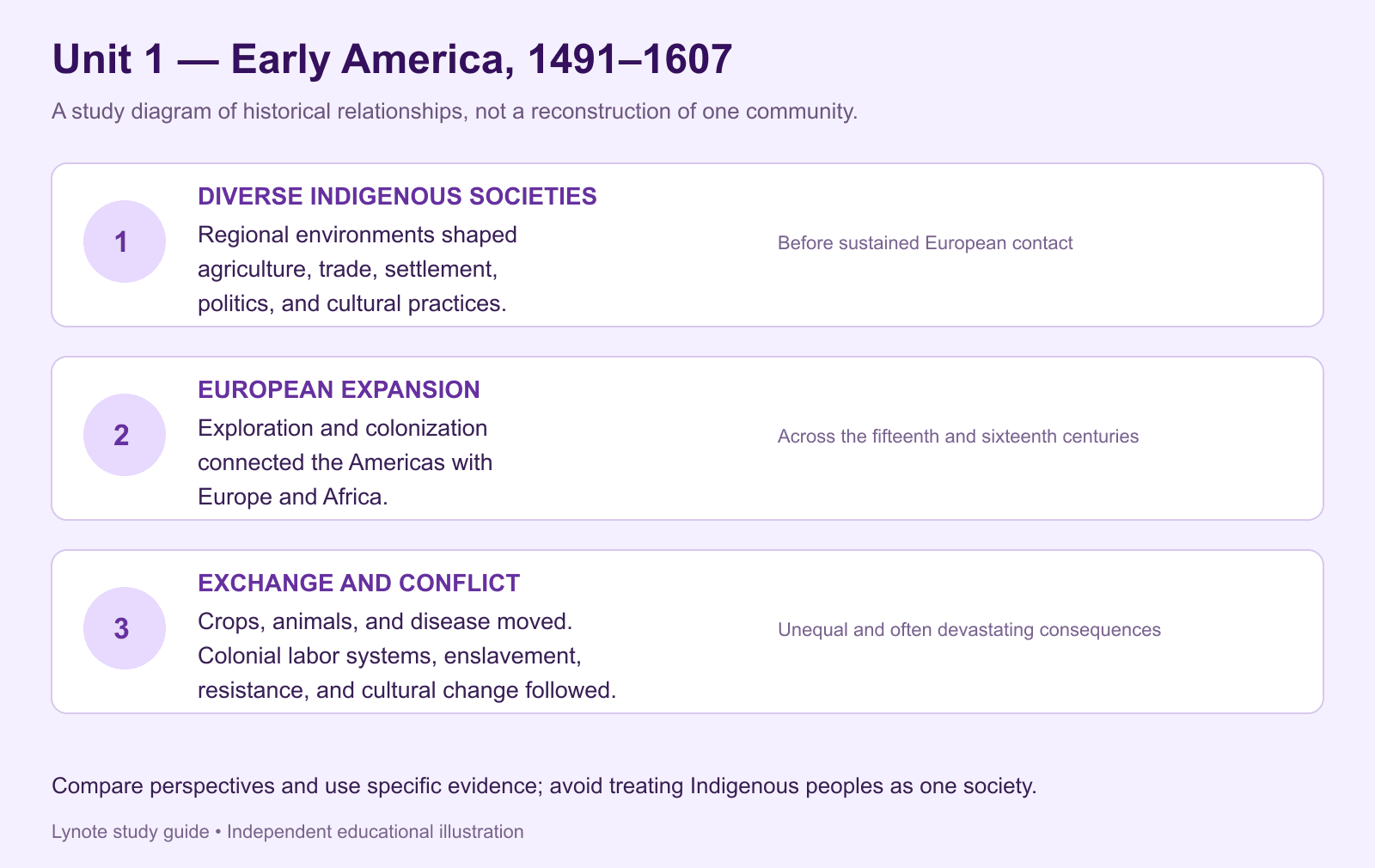
Original conceptual illustration of Indigenous societies, European expansion, and early encounters. Official source.
AP US History Unit 1 notes should begin with Native American societies before European contact. Students should understand regional differences in political organization, economic activity, culture, and relationships with the environment.
The unit also examines European exploration, the Columbian Exchange, Spanish colonization, and interactions among Europeans, Indigenous peoples, and Africans.
Key topics to review:
- Native American societies before European contact.
- Reasons for European exploration and colonization.
- The Columbian Exchange and its consequences.
- Spanish labor systems and colonial social hierarchies.
- Cultural interaction, conflict, and change.
Example review question: How did European arrival transform economic, social, and environmental conditions in the Americas?
For AP US History chapter 1 notes, distinguish the content of your assigned textbook's first chapter from the official Unit 1 requirements. Some textbooks introduce a broader historical background or organize early American history differently.
A regional comparison chart works particularly well for this unit. Include differences among Indigenous societies and explain how geography influenced their development.
Unit 2: Period 2 (1607–1754), Colonial America
Unit 2 explores the development of European colonies in North America and the formation of distinctive colonial societies. British, French, Dutch, and Spanish settlement patterns provide opportunities to compare political institutions, economic systems, and cultural interactions.
Students should also examine transatlantic trade, slavery, religious movements, and relationships between European settlers and Indigenous peoples.
Key topics to review:
- Development of the English colonies.
- Regional differences between colonial economies.
- Transatlantic commerce and the Atlantic slave trade.
- Enslaved labor and colonial society.
- Religious and cultural movements, including the Great Awakening.
- Colonial relationships with Native American communities.
Example review question: How and why did colonial societies develop differently across North America?
For this period, organize your notes around New England, the Middle Colonies, and the Southern Colonies. Compare their economies, labor systems, religious institutions, and political structures.
This approach helps you understand patterns of colonial development rather than memorizing each colony independently.
Unit 3: Period 3 (1754–1800), Revolution and the Early Republic
Unit 3 covers the movement toward American independence, the Revolutionary War, and the creation of the federal government. It also explores the challenges faced by the new republic and debates about national authority.
Political ideas, resistance to British rule, constitutional development, and changing concepts of national identity are central to this period.
Key topics to review:
- The Seven Years' War and its consequences.
- British colonial policies and colonial resistance.
- The Declaration of Independence and American Revolution.
- The Articles of Confederation.
- Ratification of the U.S. Constitution.
- Federalists, Democratic-Republicans, and debates over federal power.
Example review question: How did disagreements about political authority shape the creation of the United States?
Use a cause-and-effect timeline to connect the Seven Years' War, British taxation policies, colonial protests, and independence. Then create a separate comparison chart for the Articles of Confederation and the Constitution.
These techniques can help explain the political transformation from colonies to an independent republic.
Unit 4: Period 4 (1800–1848), National Development and Reform
Unit 4 examines the expansion of political participation among some groups, changes in the national economy, and the rise of reform movements. Technological innovation and market expansion transformed work, transportation, and regional relationships.
Students should also examine the Second Great Awakening, debates over federal authority, and the growth of social reform.
Key topics to review:
- Development of political parties and Jacksonian democracy.
- The Market Revolution.
- Transportation and communication innovations.
- The Second Great Awakening.
- Abolitionism and women's rights movements.
- Federal authority, sectionalism, and regional economic differences.
Example review question: How did economic and political changes influence American society between 1800 and 1848?
A useful set of history textbook notes should connect technological changes with their economic and social consequences. For example, explain how improved transportation supported market expansion and regional specialization.
Avoid reducing reform movements to lists of leaders. Record their goals, historical contexts, and the groups they affected.
Unit 5: Period 5 (1844–1877), Expansion, Civil War, and Reconstruction
Unit 5 focuses on territorial expansion, escalating sectional conflict, the Civil War, and Reconstruction. Understanding disagreements over slavery and the expansion of federal power is essential.
This period also explores how the Civil War and Reconstruction transformed citizenship, constitutional rights, and political authority.
Key topics to review:
- Manifest Destiny and westward expansion.
- The Mexican-American War.
- Sectional conflict over slavery.
- Compromises and political developments before secession.
- Causes and consequences of the Civil War.
- Reconstruction policies and constitutional amendments.
Example review question: How did territorial expansion and the conflict over slavery contribute to the Civil War?
For this unit, create a timeline of political compromises and sectional tensions. Add notes explaining why each attempted compromise failed to resolve fundamental disagreements.
When studying Reconstruction, compare political goals with actual outcomes. Include constitutional changes, federal policies, resistance, and their effects on formerly enslaved people.
Unit 6: Period 6 (1865–1898), Industrialization and Social Change
Unit 6 examines the rapid industrial and economic growth of the United States after the Civil War. Immigration, westward settlement, labor conflict, and the rise of large corporations transformed American society.
Students should understand how different groups responded to industrial capitalism and changing economic relationships.
Key topics to review:
- Expansion of railroads and industrial corporations.
- Immigration and urbanization.
- Labor unions and industrial conflict.
- Westward settlement and Native American displacement.
- Economic inequality and the Gilded Age.
- Political debates over business and government regulation.
Example review question: How did industrialization change economic opportunities and social relationships after 1865?
Organize your notes into economic, social, and political categories. Explain how industrial growth affected workers, business owners, immigrants, and communities differently.
For comparison practice, identify the goals and methods of labor movements and business leaders. Specific examples can later support arguments about the consequences of industrialization.
Unit 7: Period 7 (1890–1945), Reform, War, and Economic Crisis
Unit 7 covers the emergence of the United States as a global power, the Progressive Era, World War I, the Great Depression, and World War II. Students should examine the changing relationship between government, business, society, and international affairs.
The period provides many opportunities to compare reform movements and evaluate changes in federal responsibility.
Key topics to review:
- Progressive Era reform.
- U.S. imperialism and foreign policy.
- American involvement in World War I.
- Social and cultural developments during the 1920s.
- Causes and consequences of the Great Depression.
- The New Deal.
- World War II and its effects on the United States.
Example review question: How did economic crises and global conflicts change the role of the federal government between 1890 and 1945?
Build a timeline showing major political and economic developments. Then compare Progressive reforms and New Deal policies to identify similarities and differences in how government responded to social and economic problems.
Remember to distinguish each movement's goals from its practical outcomes and limitations.
Unit 8: Period 8 (1945–1980), Cold War and Civil Rights
Unit 8 examines the Cold War, the United States' growing global influence, and movements for social and political change. The period includes significant developments in civil rights, foreign policy, economic growth, and American culture.
Students should analyze both international ideological competition and domestic struggles over equality and citizenship.
Key topics to review:
- Origins and development of the Cold War.
- Containment and international alliances.
- The Korean and Vietnam Wars.
- The Civil Rights Movement.
- The Great Society.
- Women's rights and other social movements.
- Cultural change and political division.
Example review question: How did Cold War politics and domestic reform movements reshape the United States after World War II?
A comparison chart can separate foreign policy developments from domestic social changes. Then identify connections, such as how international competition influenced debates about American political ideals.
For civil rights notes, include specific legislation, court decisions, organizations, and examples of activism.
Unit 9: Period 9 (1980–Present), Contemporary America
Unit 9 explores the rise of modern conservatism, technological development, demographic change, and the United States' evolving place in the world. It also examines changing economic policies and the consequences of globalization.
The period encourages students to connect recent developments with longer-term trends from earlier units.
Key topics to review:
- The rise of political conservatism.
- The Reagan administration and economic policy.
- The end of the Cold War.
- Technological innovation and economic change.
- Immigration and demographic shifts.
- Globalization and international relationships.
- Major challenges of the twenty-first century.
Example review question: How did political, economic, and technological developments reshape American society after 1980?
For Unit 9, organize information by political, economic, and social themes. Connect these changes to earlier debates about the federal government, national identity, immigration, and economic opportunity.
This final unit is particularly useful for practicing continuity and change over time.
How to Take Notes for AP US History Effectively
Students often wonder how to take notes for AP US History without copying entire textbook chapters. The most effective approach is to record important historical evidence while explaining relationships between events.
Good AP US History course notes should make it easier to identify patterns across different periods. They should also help you prepare for questions requiring historical reasoning rather than simple factual recall.
1. Organize Notes by Period and Historical Theme
Begin with the nine official units and divide each unit into major topics. Add recurring themes such as politics, national identity, migration, culture, economic development, and America's role in the world.
For example, a folder on political power could include evidence from the Constitution, Jacksonian democracy, Reconstruction, the New Deal, and later political movements. This helps connect events across different centuries.
2. Record Causes, Effects, and Historical Significance
Avoid recording events without explaining why they mattered. For each major development, write at least one cause, one consequence, and a sentence about its historical significance.
For example, notes about the Market Revolution should explain what enabled economic expansion and how it changed labor, transportation, and regional relationships. This creates a more useful resource than a list of technological inventions.
3. Include Specific Historical Evidence
Arguments in AP U.S. History require historical support. Include relevant legislation, documents, social movements, political decisions, and events in your notes.
However, avoid memorizing evidence without understanding its context. Explain how each example could support a broader historical interpretation.
4. Write Review Questions
Turn your main ideas into questions that require explanation. Instead of writing only "Reconstruction," ask how federal policies attempted to redefine citizenship after the Civil War.
Use your questions to practice retrieval from memory. Then compare your answers against the original notes to identify missing evidence.
5. Use Timelines and Comparison Charts
Timelines are useful when you need to explain the sequence of events and relationships between developments. Comparison charts work well for political parties, colonial regions, reform movements, and government policies.
A strong note-taking system can combine both approaches. Choose the format that best supports the historical thinking skill you are practicing.
How to Use Cornell Notes for AP US History
Cornell notes are a structured method that separates key questions from detailed explanations. Each page typically contains a cue column, a main notes section, and a short summary area.
AP US History Cornell notes are useful for organizing historical causes, effects, and comparisons. They can also turn ordinary reading notes into prompts for active recall.
Cornell Notes AP US History Example: The Market Revolution
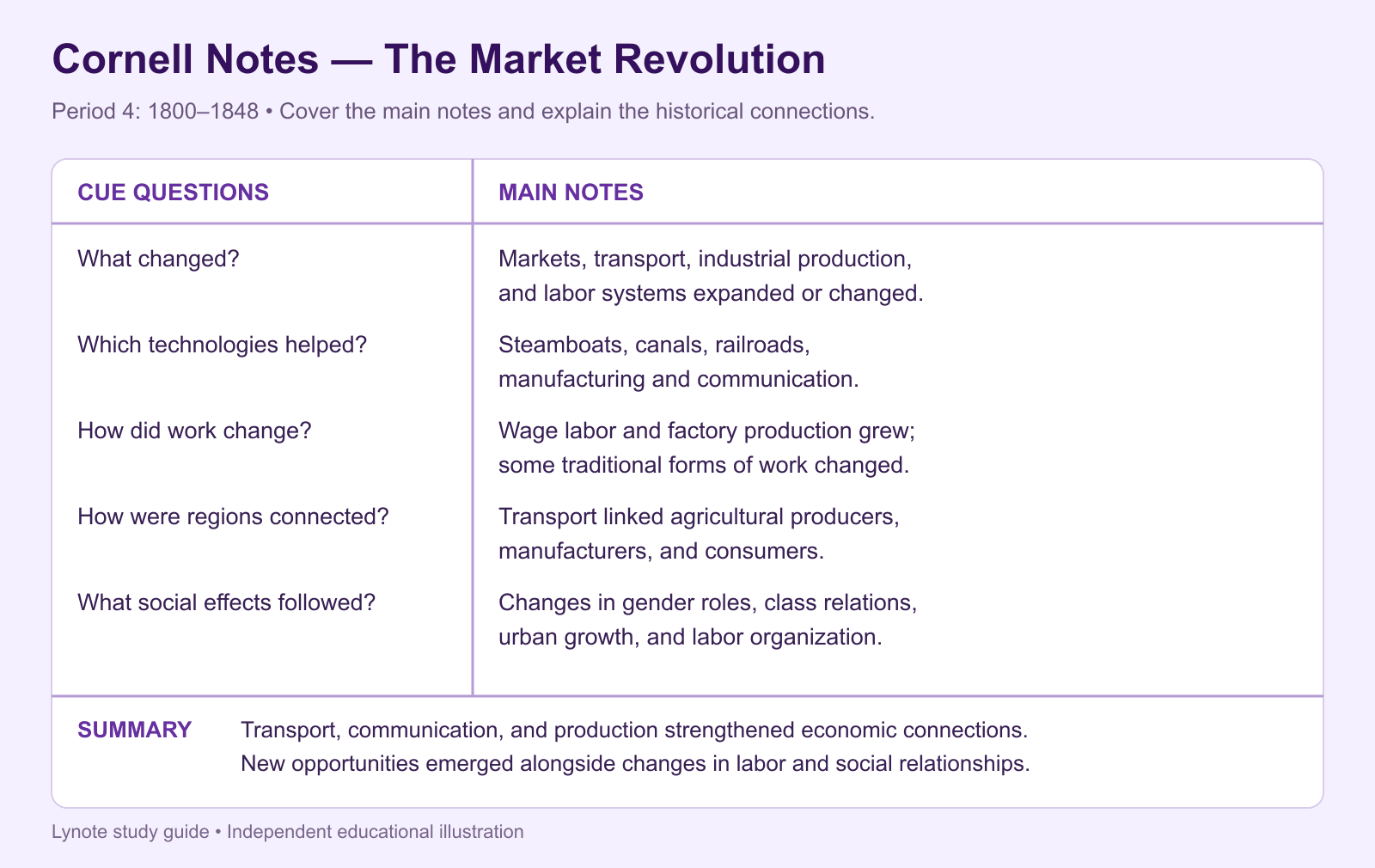
Original Cornell notes layout summarizing the Market Revolution example below. Official source.
Unit: Period 4 (1800–1848)
Topic: The Market Revolution
| Cue Questions | Main Notes |
|---|---|
| What was the Market Revolution? | A period of economic transformation involving expanding markets, transportation networks, industrial production, and changing labor systems. |
| Which technologies supported economic growth? | Steamboats, canals, railroads, and improvements in manufacturing and communication. |
| How did work change? | Wage labor and factory production expanded, while industrialization transformed some traditional forms of work. |
| How did regional economies become connected? | Transportation improvements helped connect agricultural producers, manufacturers, and consumers across regions. |
| What were some social consequences? | Economic changes affected gender roles, class relationships, urban growth, and the organization of labor. |
Summary: The Market Revolution expanded economic connections across the United States through changes in transportation, communication, and production. It created new economic opportunities while also transforming labor and social relationships.
After writing the notes, cover the right-hand column and answer each cue question from memory. This method can help transform Cornell notes for AP US History into a practical review resource.
How to Organize AP US History Chapter Notes
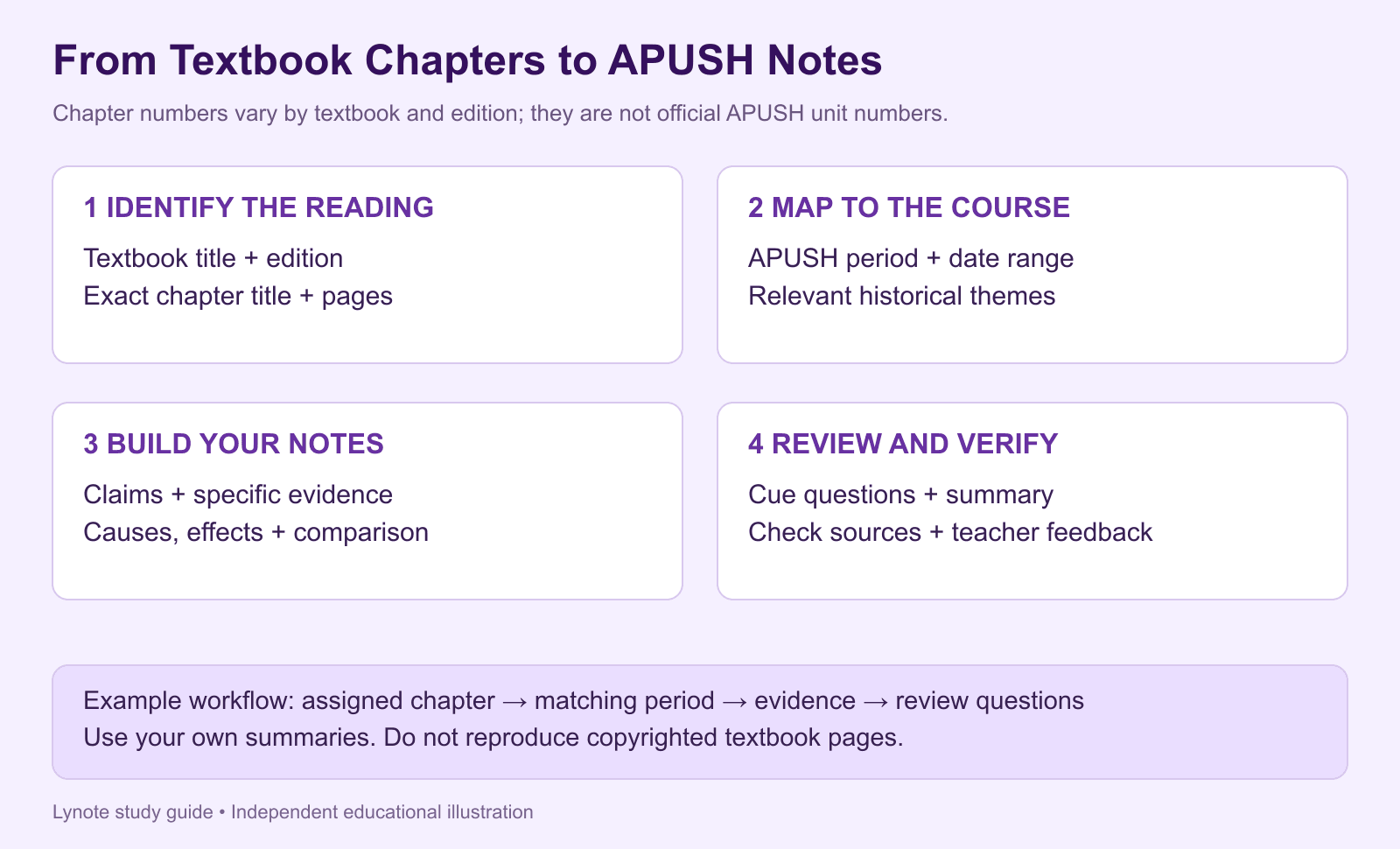
Original chapter-to-notes workflow; chapter numbering varies by textbook and edition. Official source.
Many classes use textbooks organized by chapter rather than AP course period. Students may search for AP US History chapter notes or specific chapters because their assignments follow a publisher's sequence.
However, textbook chapter numbers are not universal. AMSCO, The American Pageant, and other textbooks may organize the same historical developments into different chapters depending on the book and edition.
AMSCO AP US History Notes
AMSCO AP U.S. History review books are commonly used as supplementary study materials. They help students connect historical developments with the course framework and examination preparation.
When creating AMSCO AP US History notes, begin with your assigned section and identify its central topics. Record the main explanations, relevant examples, and historical reasoning questions.
After reading, compare your notes with the official College Board unit outline. This helps identify areas where your notes need additional context or examples.
AP US History American Pageant Notes
The American Pageant is a U.S. history textbook commonly used for APUSH courses. It includes narrative explanations of American history that students can turn into chronological summaries and historical analysis notes.
When preparing AP US History American Pageant notes, focus on the argument and historical developments in each assigned chapter. Record important examples and explain how they connect to broader political, economic, and social changes.
Do not assume that chapter numbers correspond directly to official APUSH units. Refer to the edition your school uses when labeling notes.
What About AP US History Chapter 10, 11, and 13 Notes?
Students frequently search for AP US History notes chapter 10, AP US History chapter 11 notes, and AP US History notes chapter 13. These searches may refer to chapter assignments from different textbooks or editions.
For example, in some editions of The American Pageant, Chapter 10 addresses the early federal republic, Chapter 11 covers Jeffersonian-era developments, and Chapter 13 discusses the rise of mass democracy. Other textbooks may use different chapter titles and sequences.
For an edition-specific reference, see the publisher’s table of contents for the 16th edition of The American Pageant. Check your assigned edition before matching chapter numbers to topics.
Before using chapter summaries, confirm the textbook title, edition, and assigned reading. Then organize the historical developments within the relevant APUSH period.
A Practical Chapter Note Template
| Section | What to Write |
|---|---|
| Chapter Title | Exact textbook chapter and edition |
| APUSH Period | Corresponding College Board course unit |
| Main Developments | Important historical events and processes |
| Key Terms | People, institutions, laws, and ideas |
| Causes and Effects | Explanation of historical relationships |
| Evidence | Specific historical examples |
| Review Questions | Prompts that require written explanations |
| Summary | Main significance of the chapter |
Using a consistent template makes AP US History chapter notes easier to compare and review. It also helps prevent your notebook from becoming a collection of disconnected reading summaries.
How to Generate AP US History Notes with Lynote AI
AP U.S. History students often work with textbooks, primary sources, lecture slides, recorded explanations, and educational videos. Organizing this material into clear notes can take considerable time.
Lynote AI Note Generator helps turn supported source materials into editable notes. It is not an official APUSH content library, but it can assist with organizing information from materials you provide.
Step 1. Upload Your History Study Materials
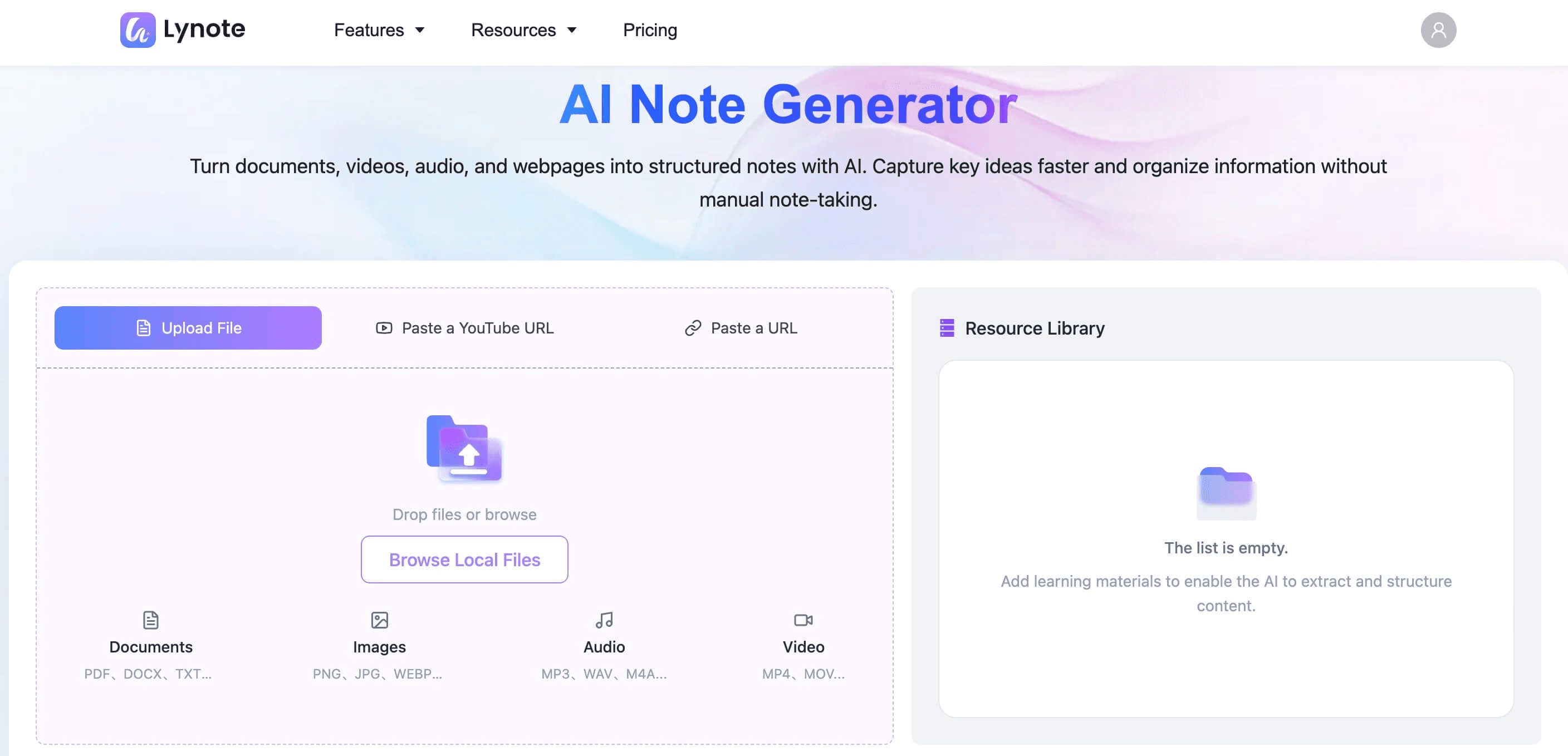
Real Lynote AI Note Generator upload interface. Official source.
Start with a supported PDF, document, audio recording, or video. You can also add a supported YouTube or webpage URL.
For example, use a teacher-provided presentation about the Civil War or a recorded lecture on the Market Revolution. Choose materials you are authorized to upload or process.
Step 2. Generate Structured History Notes
Use Create Note to generate organized notes based on the source material. Lynote can help structure explanations into headings, summaries, and key points.
Review the results against the original sources. Check dates, historical context, terminology, and interpretations before using the notes for exam preparation.
Step 3. Adapt Notes to Your APUSH Unit
Edit the generated notes to match your course outline. Organize information according to the relevant period, historical theme, or assigned chapter.
Add supporting evidence, comparison questions, and your own explanations. This helps create a more useful revision resource than an unedited summary.
Step 4. Review with AI Chat and Flashcards
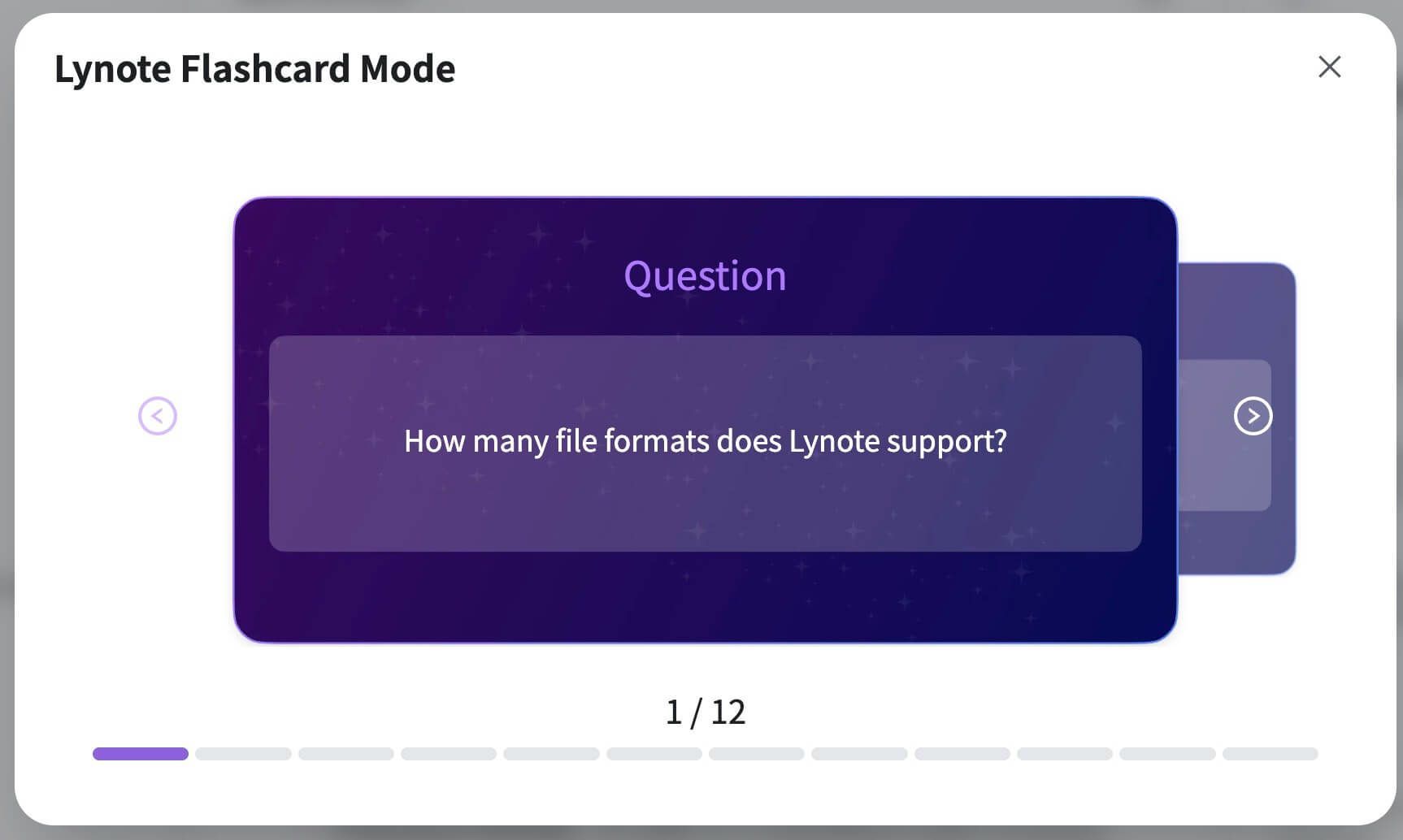
Actual Lynote Flashcard Mode interface. The sample card demonstrates the product, not APUSH course content. Official source.
Use AI Chat to ask questions about information included in your uploaded materials. For example, ask how a historical policy influenced different groups if the source content discusses those effects.
You can also generate flashcards from your notes to review key terms, events, and historical connections. Practice answering questions from memory before checking the explanation.
How to Review AP U.S. History Notes for the Exam
AP U.S. History assessment requires both content knowledge and historical reasoning. Your review process should therefore prepare you to analyze sources and develop arguments using specific evidence.
According to the College Board assessment page, the exam includes multiple-choice questions, short-answer questions, a document-based question, and a long-essay question. Use official practice materials to become familiar with the current exam format.
Review Unit Connections, Not Just Individual Facts
Start by reviewing your unit summaries. Identify recurring themes such as federal authority, economic development, migration, civil rights, and foreign policy.
Then connect examples from different periods. For instance, compare debates about federal power during the early republic, Reconstruction, and the New Deal.
Practice Historical Evidence and Argumentation
For each major development, practice writing a short explanation that connects evidence to a historical claim. Avoid listing facts without explaining their significance.
A useful exercise is to choose a question, write a brief thesis, and identify two or three relevant historical examples. Then check whether your evidence genuinely supports the argument.
Combine Flashcards with Written Practice
Flashcards can help you remember terminology, historical figures, and important developments. However, they do not replace practicing longer explanations and document analysis.
Use flashcards for recall, then write short responses to questions about causes, effects, continuity, or comparison. This combination helps connect factual knowledge with historical reasoning.
Return to Reliable Sources
AI-generated notes, textbook summaries, and online study guides can all contain omissions or mistakes. When important details are unclear, consult your original learning materials and official course resources.
The goal is to build a reliable collection of history notes that you can use confidently during revision.
Conclusion: Build Better Notes for AP US History
Effective notes for AP US History should help you explain historical developments, compare time periods, and support arguments with specific evidence. Organize your materials by official APUSH units, use chapter notes and Cornell questions, and review important concepts regularly.
Whether you're studying colonial America, the Civil War, or the Cold War, the quality of your explanations matters more than the number of pages you write.
For help turning supported textbooks, lecture recordings, and videos into editable study notes, try Lynote AI Note Generator.
Frequently Asked Questions
Where Can I Find AP US History Unit 1 Notes?
The official College Board AP U.S. History course framework is a useful starting point. Unit 1 covers the period from 1491 to 1607, including Native American societies, European exploration, and early colonial interactions.
Use your class materials to create notes on regional differences, the Columbian Exchange, and changing social relationships. Compare your notes with the official course outline to check coverage.
How Should I Take Notes for AP US History?
Organize your notes by unit, historical theme, and assigned chapter. Focus on causes, consequences, comparisons, and specific historical evidence rather than copying every textbook paragraph.
Add review questions and summaries after each lesson. Cornell notes, timelines, and comparison charts can make historical information easier to revisit.
What Are the Best AP US History Cornell Notes Strategies?
Place detailed explanations and evidence in the main notes column. Use the cue column for questions about causes, effects, continuity, and historical comparison.
Then write a short summary explaining the significance of the topic. During review, cover the explanations and answer your cue questions from memory.
Can I Use AMSCO to Create AP U.S. History Notes?
Yes. You can create personal summaries from AMSCO readings you have access to, while respecting copyright and publisher restrictions.
Focus on important historical processes and supporting evidence. Compare your notes with the official course framework and your teacher's assigned topics.
Are American Pageant Chapter Notes Useful for APUSH?
American Pageant chapter notes can help students organize narrative textbook readings. They are particularly useful for reviewing historical context, events, and political or social developments.
However, different editions use different chapter organizations. Always verify that a chapter summary matches your assigned textbook before relying on it.
What Topics Are Covered in AP US History Chapter 11 Notes?
The answer depends on the textbook and edition. In some editions of The American Pageant, Chapter 11 concerns the Jeffersonian republic and related early nineteenth-century developments.
Other textbooks may assign different subjects to Chapter 11. Check the exact chapter title and compare it with your course syllabus.
Can I Make Digital AP American History Notes from PDFs?
Yes. You can organize PDF textbooks, class handouts, and course documents into digital notes using compatible note-taking tools.
Lynote supports generating editable AI notes from supported PDFs. You should check the output against the original text, especially when the source includes complex historical arguments or visual information.
Can AI Generate AP US History Course Notes?
AI can help prepare structured notes from source materials such as documents, recordings, and educational videos. The quality and completeness of the notes depend on the information provided.
Lynote allows users to generate and edit notes, ask source-based questions, and create flashcards. It does not guarantee that every concept in the APUSH syllabus will appear in the generated notes.
Are AP U.S. History Notes Enough to Prepare for the Exam?
Notes are an important study resource, but they are not sufficient on their own. The APUSH exam also requires source interpretation, historical reasoning, and written argumentation.
Combine your notes with official practice questions, document analysis, and feedback from your teacher. Focus on explaining relationships between events rather than only memorizing definitions.
Is Lynote an Official AP U.S. History Study Resource?
No. Lynote is an independent AI note-taking platform and is not affiliated with or endorsed by the College Board or textbook publishers.
It helps users organize information from supported materials they provide. For official APUSH course requirements and examination details, consult College Board resources.

Written by Kristen I.
Content Strategist
Kristen focuses on content structure, editorial planning, readability, and creating useful experiences for readers. View all articles →