

Bullet Point System for Notes: A Simple 5-Step Guide

Have you ever finished a lecture or reading session with pages of notes that are difficult to understand later? A bullet point system for notes can help you turn scattered information into short, organized ideas that are easier to read, connect, and review.
Instead of writing everything in long paragraphs, bullet point note-taking uses concise phrases, clear symbols, and indentation to show which ideas matter most. You can use this approach for classroom lectures, textbook chapters, meeting notes, or personal learning.
In this guide, you'll learn how to build a bullet point note-taking system, choose useful and aesthetic symbols, see practical examples, and use tools like Lynote AI Notes to organize study materials.
TL;DR: Key Takeaways
- Keep one idea per bullet. Use short phrases that communicate important information without unnecessary details.
- Create a clear hierarchy. Separate main ideas from explanations and examples with consistent indentation.
- Choose meaningful symbols. Use dots, circles, squares, arrows, and stars to distinguish different types of information.
- Balance style and readability. Cute and aesthetic bullet points can personalize your notes, but consistency matters more than decoration.
- Review your notes actively. Turn important bullets into questions, summaries, or flashcards.
- Use AI as a starting point. Lynote can generate editable, structured notes from supported learning materials that you can refine into your preferred bullet point format.
What Is the Bullet Point System for Notes?
The bullet point system for notes is a method of organizing information into short statements marked with symbols. Each bullet represents an idea, fact, explanation, task, or example, while indentation shows how different pieces of information relate.
Unlike paragraph-based notes, this method emphasizes structure and quick scanning. Readers can identify key concepts without searching through long blocks of text.
The system is flexible rather than fixed. You can use a simple dot for every point, create multiple levels of subpoints, or introduce a small set of symbols to identify questions and important information.
What Do Bullet Point Notes Look Like?
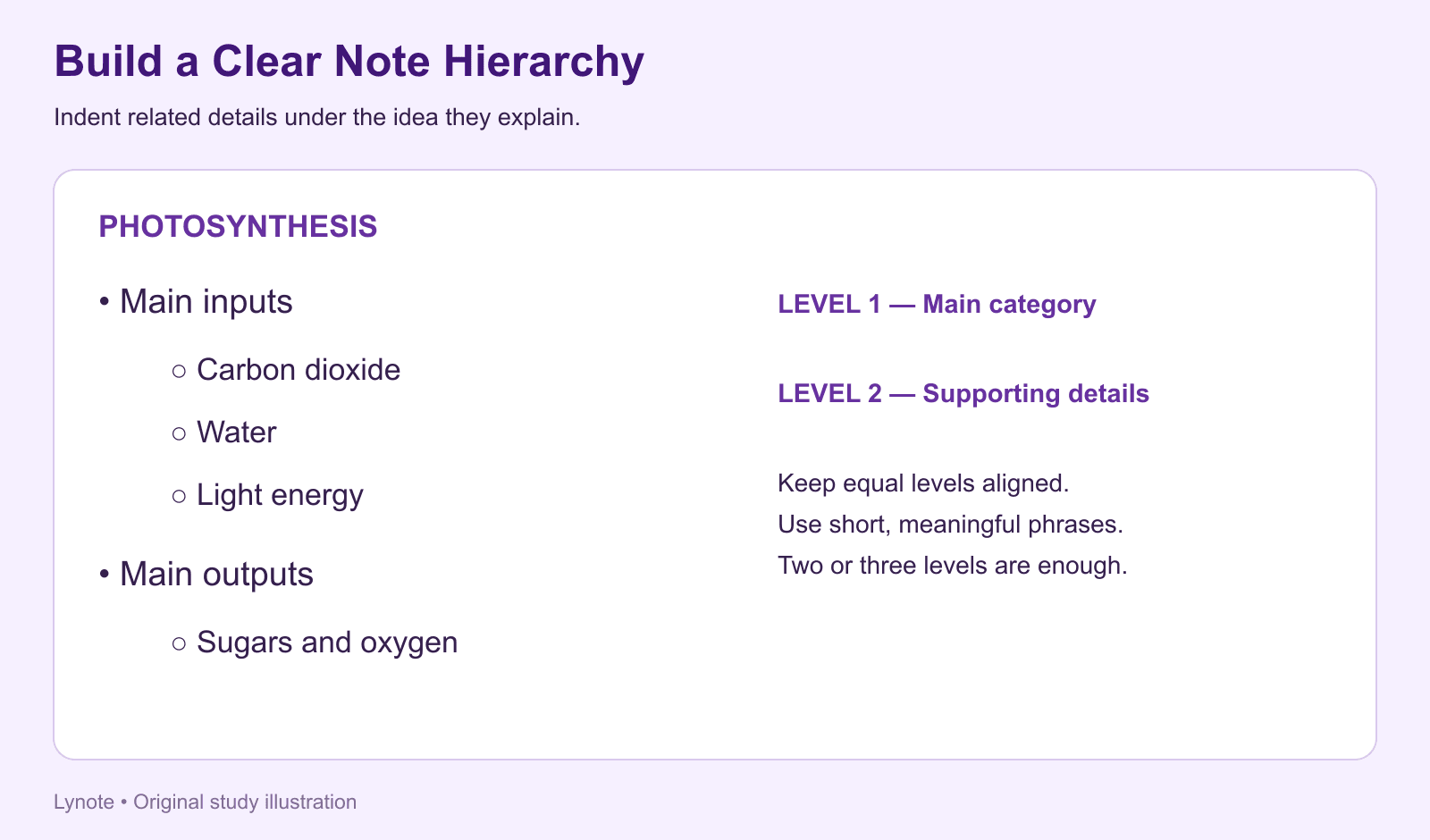
Imagine you're taking notes during a biology lecture about photosynthesis. Instead of recording one long paragraph, you could organize the lesson like this:
Photosynthesis
- Definition: Process that converts light energy into chemical energy stored in sugars.
- Takes place mainly in chloroplasts.
- Chlorophyll absorbs light energy.
- Main inputs:
- Carbon dioxide
- Water
- Light energy
- Main outputs:
- Sugars
- Oxygen
- Why it matters:
- Supports plant growth.
- Provides the basis for many food webs.
Each main bullet identifies a category, while the indented points provide supporting information. This structure makes it easier to locate definitions, inputs, outputs, and explanations during revision.
Why Use Bullet Points for Note Taking?
Using bullet points for note taking helps you separate essential information from supporting details. The method works for both quick capture during a lesson and more detailed organization afterward.
Its main advantage is not the appearance of the bullet itself. It is the thinking process involved in deciding what deserves a separate point and how information should be grouped.
1. Make Notes Easier to Scan
Long paragraphs can hide important definitions, facts, and relationships. Bullet points divide information into smaller sections that are easier to identify visually.
For example, a list of causes or consequences is usually easier to review when each item appears on its own line. You can quickly return to the exact concept you need.
2. Separate Main Ideas from Supporting Details
Indentation allows you to create an outline of a topic without writing lengthy explanations. Main bullets identify important concepts, while subpoints provide examples and supporting evidence.
This can be especially useful when reviewing textbook chapters. You can see the overall structure of a lesson without losing the details that explain it.
3. Reduce Unnecessary Writing
Effective bullet points focus on information rather than complete prose. You can record definitions, keywords, and relationships using fewer words than a traditional paragraph.
However, shorter does not always mean better. If a bullet becomes so brief that you cannot understand it later, add the necessary explanation.
4. Support Active Review
Bullet points provide a useful starting point for making review questions. A key definition can become a flashcard, while a list of processes can become a question about sequence or cause and effect.
This helps turn organized notes into material you can actively practice remembering. Instead of only rereading information, you can test whether you understand it.
How to Take Bullet Point Notes in 5 Steps
You don't need special stationery or a complicated application to start. A notebook, digital document, or note-taking editor is enough.
The following five-step process works for lectures, research papers, online courses, and personal study materials.
Step 1. Capture the Main Ideas
Start by identifying the topic and the most important information. During a lecture, focus on definitions, explanations, examples, and repeated concepts instead of copying every sentence.
Write a short heading for each new topic. Under the heading, record the key information as separate bullets, even if the structure is not perfect yet.
For example, during a history lesson about the Industrial Revolution, you might begin with three headings: Causes, Technological Changes, and Social Effects. These provide a foundation for organizing information later.
Step 2. Break Information into Short Bullet Points
Rewrite long sentences as shorter statements that communicate one idea at a time. Remove filler words while preserving the meaning of the original material.
Compare these two versions:
Before: Industrialization changed how goods were produced because factories increasingly used machines and centralized production, which influenced employment and urban development.
After:
- Industrialization transformed production.
- Factories increasingly used machinery.
- Production became more centralized.
- Employment patterns changed.
- Industrial cities expanded.
The second version separates related developments so they can be reviewed individually. You can then add supporting details where they are needed.
Step 3. Organize Ideas with Indentation
Use indentation to show which bullets are main points and which are supporting information. This turns an ordinary list into a structured outline.
For example:
Industrial Revolution
- Technological changes
- Mechanized textile production
- Steam power
- Improved transportation
- Economic changes
- Factory production
- Expanding markets
- Social consequences
- Urbanization
- Changing labor conditions
Try to use no more than two or three levels of indentation for most study notes. Deeply nested lists can become harder to follow than the paragraphs they replace.
Step 4. Add Keywords, Examples, and Important Details
Once the structure is clear, add details that help explain the main points. Use bold text for essential terms, include examples where they improve understanding, and mark questions that require further review.
For example:
- Urbanization: Growth of the population living in towns and cities.
- Example: Expansion of industrial cities during the nineteenth century.
- Question: How did industrial employment contribute to urban growth?
This approach creates concise notes without removing the information needed for understanding. It also helps you recognize which concepts might become useful review questions.
Step 5. Summarize and Review Your Notes
After completing your notes, write a short summary explaining the main lesson. The summary should connect the most important points rather than simply repeat the entire list.
Next, cover selected bullets and attempt to explain them from memory. Turn difficult concepts into questions or flashcards for another review session.
You can also revisit your notes after a day or a week to identify missing information. A bullet point system becomes more useful when it supports repeated learning, not just initial recording.
Different Types of Bullet Points for Notes
Not every bullet needs to look the same. Different bullet point symbols for notes can help distinguish key concepts, supporting details, tasks, questions, and examples.
However, symbols should have consistent meanings. Using too many designs without a clear system can make notes more confusing.
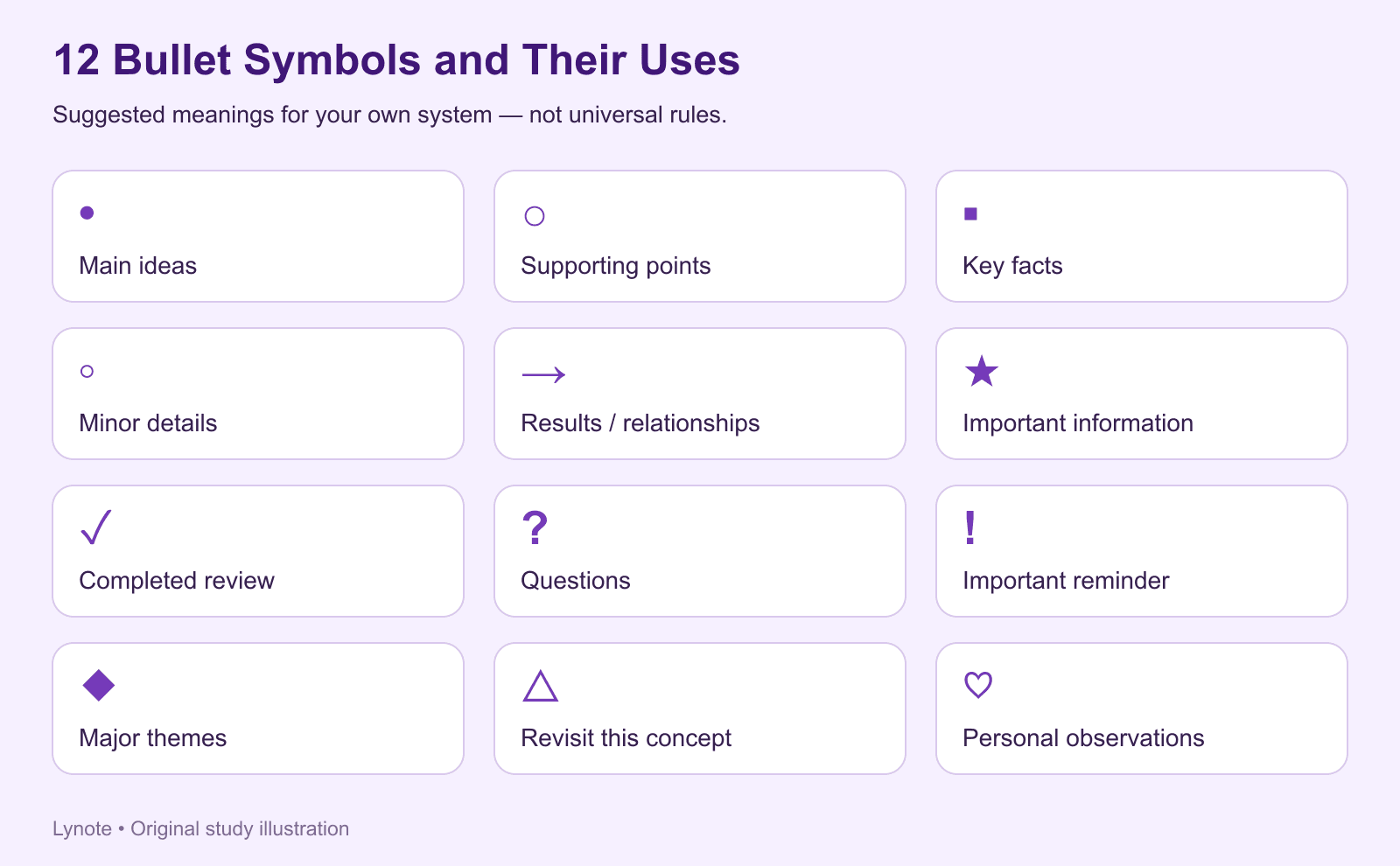
Common Bullet Point Symbols and Their Uses
| Symbol | Suggested Use | Example |
|---|---|---|
| • | Main ideas | • Main concept |
| ○ | Supporting points | ○ Additional explanation |
| ▪ | Key facts | ▪ Important definition |
| ◦ | Minor details | ◦ Supporting example |
| → | Results or relationships | → Leads to economic growth |
| ★ | Important information | ★ Review before the exam |
| ✓ | Completed review | ✓ Topic understood |
| ? | Questions | ? Why did this happen? |
| ! | Important reminder | ! Check the original source |
| ◆ | Major themes | ◆ Causes of industrialization |
| △ | Concepts to revisit | △ Needs more explanation |
| ♡ | Personal observations | ♡ Interesting connection |
These are suggested meanings for a personal note-taking system, not universal rules. Choose a small number of symbols and create a legend explaining what each one means.
How to Choose a Bullet Point Symbol for Notes
A useful bullet point symbol for notes should be easy to write, recognize, and reproduce. Simple marks such as dots, circles, and squares are usually sufficient for ordinary information.
If you want to highlight special information, introduce one or two additional symbols. For example, a star can represent an important concept, while a question mark identifies something to investigate.
Consistency is more important than having a different symbol for every idea. You should be able to understand your system quickly when reviewing older notes.
Aesthetic Bullet Points for Notes: Simple and Creative Ideas
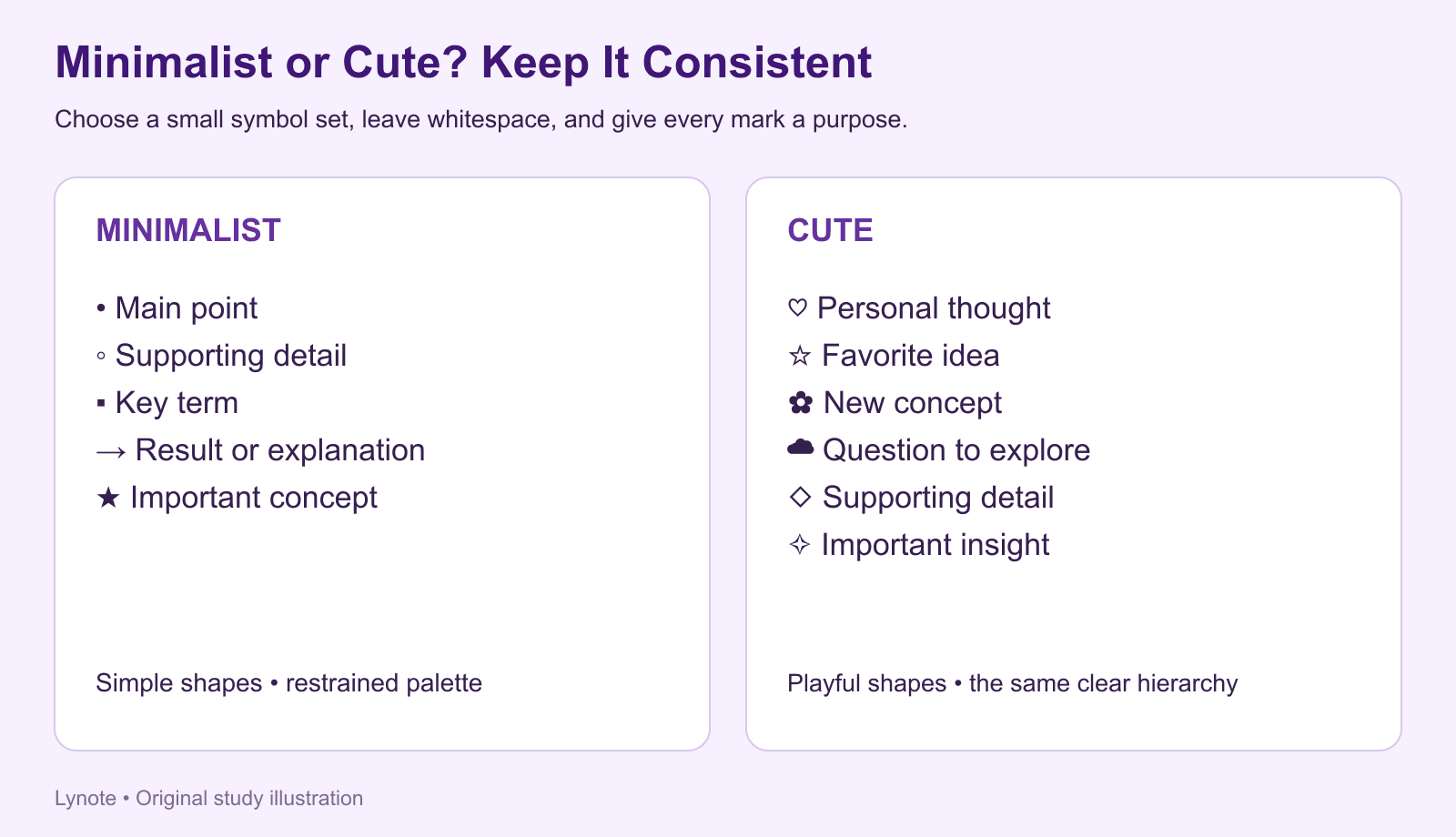
Aesthetic bullet points for notes can make a study page feel more organized and visually appealing. Color, spacing, and small symbols can help separate topics while giving your notes a personal style.
The most useful aesthetic designs still prioritize readability. Decorative details should support the organization of information instead of distracting from it.
Minimalist Bullet Point Ideas for Notes
If you prefer a clean look, use simple shapes with consistent spacing.
Minimalist Symbol Set
- • Main point
- ◦ Supporting detail
- ▪ Key term
- → Result or explanation
- ★ Important concept
A minimalist system works well for lecture notes and textbook summaries because it is quick to reproduce. It is also suitable for digital editors that support only basic list formatting.
Cute Bullet Points for Notes
Cute bullet points for notes can add personality to personal journals, study planners, and handwritten notebooks. Stars, hearts, flowers, and small decorative shapes are popular choices.
Cute Symbol Set
- ♡ Personal thought
- ☆ Favorite idea
- ✿ New concept
- ☁ Question to explore
- ◇ Supporting detail
- ✧ Important insight
Try assigning each design a clear purpose rather than using the symbols randomly. This keeps the page functional even when the style is playful.
Aesthetic Bullet Point Ideas for Different Subjects
Different subjects can benefit from different visual approaches. The goal is to make important categories easy to recognize.
| Subject | Suggested Style | Organization Idea |
|---|---|---|
| Biology | Green accents, circles | Definitions, processes, examples |
| History | Neutral tones, arrows | Events, causes, consequences |
| Mathematics | Squares, numbered steps | Formulas, methods, worked examples |
| Literature | Stars, quotation marks | Themes, characters, evidence |
| Psychology | Pastel accents, diamonds | Theories, studies, definitions |
| Computer Science | Monospace labels, square bullets | Concepts, syntax, examples |
You do not need to change your entire note-taking system for every subject. A consistent structure with small visual differences is usually easier to maintain.
How to Keep Decorative Notes Readable
Use one main bullet style and one secondary style for supporting points. Limit your color palette and leave enough space between sections.
Avoid decorating every sentence or switching symbols without a reason. When every line is highlighted, important information becomes harder to distinguish.
If you create digital notes, remember that some decorative Unicode symbols may display differently across fonts and devices. Common symbols such as •, ○, and ▪ are generally more reliable.
Bullet Point Notes Examples for Students
The best way to understand bullet point notes is to see how they transform ordinary information. The following examples show how the same method can work across different learning situations.
Example 1. Turn Paragraph Notes into Bullet Points
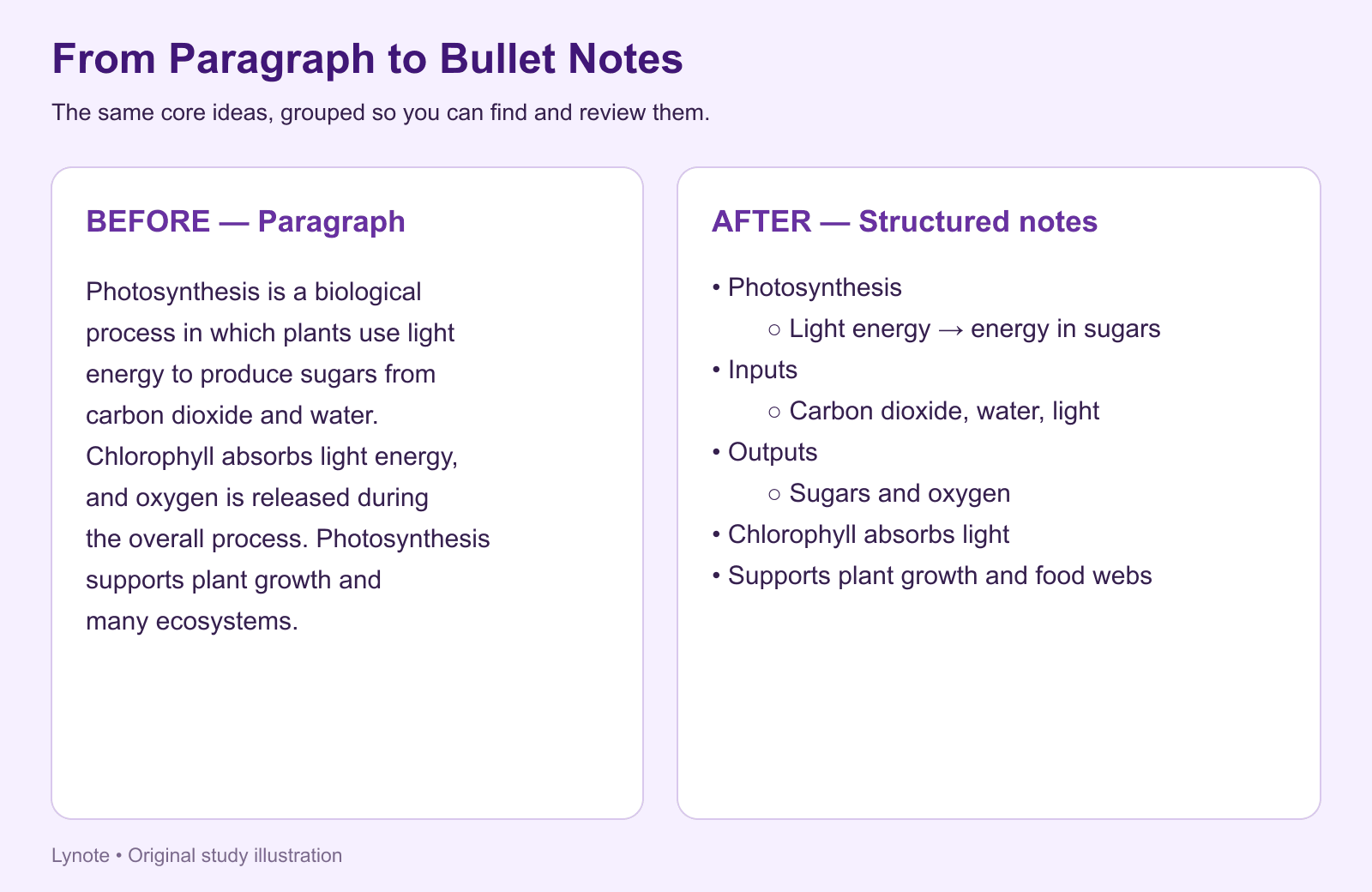
Before: Paragraph Notes
Photosynthesis is a biological process in which plants use light energy to produce sugars from carbon dioxide and water. Chlorophyll absorbs light energy, and oxygen is released during the overall process. Photosynthesis supports plant growth and many ecosystems.
After: Bullet Point Notes
Photosynthesis
- Definition
- Converts light energy into chemical energy stored in sugars.
- Main inputs
- Carbon dioxide
- Water
- Light energy
- Main outputs
- Sugars
- Oxygen
- Important component
- Chlorophyll absorbs light energy.
- Significance
- Supports plant growth and food webs.
The bullet point version makes the categories easier to identify. It also provides a structure for converting important concepts into review questions.
Example 2. Bullet Points for Lecture Notes
Imagine you're attending a psychology lecture about memory. You need to record key definitions, processes, and examples without transcribing every sentence.
Memory and Learning
- Encoding
- Information is processed into a form that can be stored.
- Storage
- Information is maintained over time.
- Retrieval
- Stored information is accessed when needed.
- Study application
- Retrieval practice involves attempting to recall information.
- Spaced review distributes study sessions over time.
This format keeps related information grouped while allowing you to add examples later. You can also turn each main bullet into a question for review.
Example 3. Bullet Points for Reading Notes
Suppose you're reading a history textbook chapter about the causes of World War I. A bullet-based outline can help separate political conditions from immediate events.
Causes of World War I
- Militarism
- Expansion of armed forces and military planning.
- Alliance systems
- International commitments increased the risk of wider conflict.
- Imperial competition
- Rivalries contributed to tension between major powers.
- Nationalism
- National identities and competing political goals intensified disputes.
- Immediate trigger
- Assassination of Archduke Franz Ferdinand in 1914.
Each bullet identifies a factor that can be explained with further evidence. The notes are concise enough for review but still preserve the relationships needed for historical analysis.
Bullet Point Notes vs. Other Note-Taking Methods
The bullet point system is flexible, but it is not the only way to organize information. Some methods are designed for structured classroom review, while others focus on daily planning or connected ideas.
Understanding the differences can help you choose a format that matches your learning goals.
| Method | Main Purpose | Structure | Best For |
|---|---|---|---|
| Bullet Point Notes | Organize key information | Main bullets and indented subpoints | Lectures, reading, summaries |
| Cornell Notes | Record and review information | Notes, cue questions, summary | Classroom study and active recall |
| Outline Method | Show relationships between ideas | Multilevel headings and subheadings | Complex subjects and textbooks |
| Bullet Journal | Track tasks, events, and notes | Rapid logging, symbols, logs | Planning and daily organization |
| 5-Bullet Log | Record experiences and reflections | Brief daily entries | Personal reflection and journaling |
Bullet Point Notes vs. Cornell Notes
Cornell notes use a predefined page layout containing a main notes area, a cue column, and a summary section. This makes the method particularly useful when students want ready-made review questions.
Bullet point notes are more flexible and can be used inside almost any document or notebook. You can also combine the two methods by writing bullet points in the main Cornell notes column.
Bullet Point Notes vs. Bullet Journaling
Bullet journaling is a broader system for organizing tasks, events, and notes. The official Bullet Journal method uses rapid logging and defined symbols to distinguish different types of entries.
A bullet point note-taking system does not require calendars, daily logs, or task migration. Its primary purpose is to organize knowledge rather than manage a daily schedule.
Bullet Point Notes vs. the 5-Bullet Log
A 5-Bullet Log focuses on capturing short daily reflections and observations. Its purpose is different from creating detailed notes from lectures, documents, and learning resources.
You can borrow the idea of writing briefly and reviewing regularly without adopting an entire journaling system. For academic study, a structured bullet outline may be more appropriate.
How to Create Bullet Point Notes with Lynote AI
Turning long study materials into bullet point notes can take time, especially when you're working with lecture recordings, PDF chapters, and educational videos. Before organizing the information, you first need to identify the key ideas and supporting details.
Lynote AI Notes helps prepare structured notes from supported source materials. You can then review and edit the generated content to create your preferred bullet point format.
Step 1. Upload or Link Your Study Materials
Start by uploading a supported PDF, document, image, audio recording, or video. You can also paste a supported YouTube or webpage URL.
For example, you might upload lecture slides from a biology course or add a recorded lesson. Lynote uses the supplied material as the basis for note generation.
Step 2. Generate Structured AI Notes
Use Lynote to turn the material into structured notes with headings, key points, and supporting explanations. This gives you an initial organization that you can refine instead of manually extracting every detail.
Check the generated content against the original material before relying on it. Important explanations, terminology, and examples may need corrections or additional context.
Step 3. Customize the Bullet Point Structure

Actual Lynote interface; the sample content is a product demonstration. Official source.
Open the generated notes in Lynote's editor and reorganize the information into a clearer hierarchy. Separate main ideas from supporting points and remove repeated or unnecessary details.
Use short phrases, consistent indentation, and meaningful headings. You can also add questions and examples that reflect your own understanding of the material.
Lynote provides editable AI notes, but it should not be described as offering a dedicated one-click bullet point template unless that feature is available.
Step 4. Review with AI Chat and Flashcards
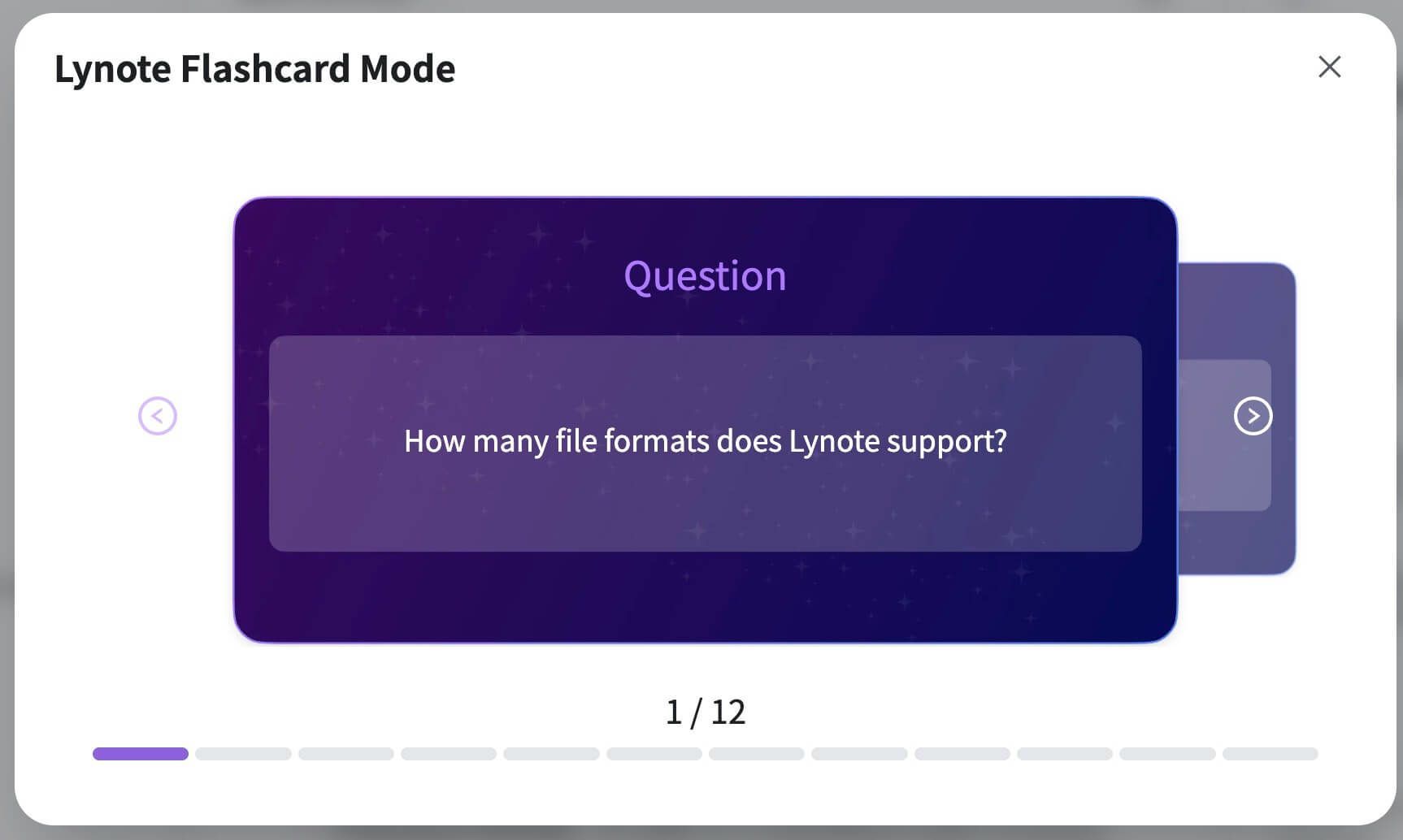
Actual Lynote interface; the sample content is a product demonstration. Official source.
Once your notes are organized, use AI Chat to explore explanations available in your uploaded materials. This can help you revisit concepts without searching through the entire source again.
You can also use Lynote's Flashcards feature to turn important information into question-and-answer cards. Try answering each question from memory before checking the explanation.
This creates a practical workflow:
Study Materials → AI Notes → Bullet Point Organization → AI Chat & Flashcards
Common Bullet Point Note-Taking Mistakes
A bullet point system only works well when it remains clear and consistent. Some common habits can make notes harder to understand instead of easier.
Using Too Many Bullet Point Symbols
Decorative symbols can make notes attractive, but using too many styles creates visual clutter. It becomes difficult to tell whether a symbol represents a main topic, supporting idea, or important reminder.
How to fix it: Choose three to five symbols with clear meanings. Keep a short legend and reuse the same system across subjects.
Writing Long Paragraphs Under Every Bullet
Bullet points lose their advantage when every item contains several long sentences. Readers still need to search through dense blocks of text to identify the important information.
How to fix it: Keep each bullet focused on one idea. Move supporting explanations into indented subpoints, or use a separate paragraph when more detail is necessary.
Creating Too Many Levels of Indentation
Nested lists can show relationships, but excessive indentation makes information difficult to follow. A page with five or six levels may be more confusing than a simple outline.
How to fix it: Use two or three levels for most study notes. If a section becomes too complex, create a new heading and reorganize the content.
Focusing on Decoration Instead of Understanding
Aesthetic notes can be enjoyable to create, but visual design is not a substitute for learning. Spending too much time decorating headings may leave less time for checking and reviewing important concepts.
How to fix it: Finish the content first, then add minimal styling. Use visual elements to clarify the structure, not to fill empty space.
Forgetting to Review the Notes
Organized notes are helpful, but simply creating them does not prove that you remember the material. Without review, even well-structured notes may become difficult to recall.
How to fix it: Convert important bullets into questions and test yourself regularly. Revisit concepts that are difficult to explain and check your answers against reliable sources.
Conclusion: Make Your Bullet Point System Work for You
A bullet point system for notes can turn long, scattered information into a clear structure that is easier to read and review. Use concise ideas, consistent symbols, meaningful indentation, and occasional summaries to keep your notes useful.
Whether you prefer minimalist formatting or cute bullet points for notes, prioritize understanding over decoration. A simple system you use consistently is more valuable than a complicated layout you rarely revisit.
If you want help turning PDFs, lectures, and videos into editable study notes, try Lynote AI Notes and organize the results into your own bullet point system.
Frequently Asked Questions
What Is a Bullet Point System for Notes?
A bullet point system for notes is a method of organizing information into short statements marked with symbols. Main bullets identify important ideas, while indented subpoints provide explanations, examples, and supporting details.
The method works for classroom notes, textbook summaries, research materials, and personal learning. It can be used on paper or in digital note-taking applications.
What Are the Best Bullet Points for Notes?
Simple symbols such as •, ○, and ▪ work well for most notes because they are recognizable and easy to reproduce. Arrows, stars, and question marks can add meaning when used consistently.
The best choice depends on how you organize your material. Use a small number of symbols that help you understand the structure without introducing unnecessary decoration.
What Are Some Cute Bullet Point Ideas for Notes?
Cute bullet point ideas include stars, hearts, flowers, diamonds, and clouds. You can use symbols such as ☆, ♡, ✿, ◇, and ☁ to create a personalized style.
Assign each symbol a purpose and avoid mixing too many designs. A consistent visual system makes aesthetic notes easier to read.
How Can I Make Aesthetic Bullet Points for Notes?
Start with a limited color palette and consistent spacing. Choose one main bullet symbol and one or two secondary symbols for examples, questions, or important details.
Use headings and indentation to establish a clear hierarchy before adding decorative elements. Readability should remain the priority.
What Are the Different Types of Bullet Points for Notes?
Common types include round bullets, hollow circles, squares, diamonds, arrows, and stars. Each can represent a different level or category of information.
For example, round bullets may indicate main ideas, hollow circles can mark supporting details, and stars can highlight important concepts. The exact meanings are up to you.
Can I Use Bullet Points for Notes in Digital Apps?
Yes. Most digital note-taking applications support bulleted lists, indentation, and basic text formatting.
You can organize lecture notes, reading summaries, and personal study materials using headings and multilevel bullet lists. Some editors may display decorative symbols differently, so check compatibility before relying on complex designs.
Is Bullet Point Note Taking Better Than Writing Paragraphs?
Bullet points are useful for organizing information that can be separated into definitions, examples, processes, and key facts. Paragraphs may be better when you need detailed reasoning, nuanced explanations, or connected arguments.
Many students benefit from using both formats. Bullet points provide structure, while short paragraphs preserve explanations that cannot be reduced without losing meaning.
Can AI Turn Long Text into Bullet Point Notes?
AI tools can help extract important information and generate structured notes from supported source materials. You can then edit the output into a bullet point format that matches your preferences.
Lynote supports generating editable AI notes from PDFs, documents, audio, videos, and webpages. Users should review the results for accuracy and organize the final content according to their learning goals.

Written by Kristen I.
Content Strategist
Kristen focuses on content structure, editorial planning, readability, and creating useful experiences for readers. View all articles →