


Is Claude detectable? Claude-generated or Claude-assisted writing can be flagged by AI detectors when the final text looks machine-generated, but most detector scores cannot prove that Claude was the exact model used. Detectability is about signals, not a full authorship record.

This matters because "detectable" can mean several different things. A teacher noticing a style shift, a detector assigning a high AI score, and a platform having account logs are separate kinds of evidence.
Quick Answer: Is Claude Detectable?
Yes, Claude text can be detectable when it has patterns that AI detectors associate with generated writing. That can include highly polished structure, balanced phrasing, generic transitions, and claims that do not show much source-specific reasoning.
But a detector result is still probabilistic. It can suggest that a passage looks AI-like, but it usually cannot say with certainty that Anthropic's Claude wrote it.
What People Mean by "Detectable"
The word "detectable" is easy to misuse. In AI writing discussions, it can refer to pattern detection, model attribution, watermarking, teacher review, or separate platform evidence.
| Detection route | What it checks | What it may suggest | What it cannot prove |
|---|---|---|---|
| AI detector | Writing patterns in the text | The passage may be AI-generated | The exact model behind it |
| Teacher review | Style, drafts, sources, and assignment fit | The process may need explanation | A full tool history by itself |
| Model attribution | Whether one model likely produced text | Possible model similarity | Certainty without strong evidence |
| Watermarking | A hidden or statistical marker | Text may come from a marked system | That all Claude outputs are marked |
| Platform logs | Account or document activity | A tool may have been used | What the final writing process looked like |
For most students and writers, the practical question is narrower: could this text be flagged or questioned? The answer is yes, especially if the final draft reads like generic AI output.
Can AI Detectors Detect Claude Text?
AI detectors do not need a Claude label to flag Claude-like writing. They look for patterns such as predictability, sentence rhythm, low specificity, and repeated paragraph structure.

Claude can produce fluent and careful prose, which is useful for editing and brainstorming. But if the prompt asks for a broad essay, the result may also sound polished in a way that detectors associate with AI writing.
The length of the text matters too. Very short passages are harder to judge, while longer generic drafts give detectors more material to analyze.
The prompt matters as much as the model. A prompt like "write a balanced essay about..." often produces a predictable essay shape: broad opening, tidy topic sentences, evenly weighted points, and a conclusion that restates the obvious. That shape can be more detectable than the word "Claude" itself.
By contrast, a draft that starts from real notes, a narrow question, and specific evidence is less dependent on the model's default writing pattern. It may still involve AI assistance, but the final text gives a reviewer more human context to evaluate.
Can a Detector Prove the Text Came From Claude?
Usually, no. A high AI score is not the same as a confirmed Claude fingerprint.
Claude, ChatGPT, Gemini, and other language models can produce similar academic structures. They can all write broad introductions, balanced pros-and-cons paragraphs, and tidy conclusions that lack the writer's own evidence.
That overlap is why exact attribution is risky. A responsible article should say "AI-like" or "possibly generated," not claim that Claude wrote the passage unless there is documented tool-specific evidence.
Is Claude Less Detectable Than ChatGPT or Gemini?
There is no universal answer. Detectability depends on the prompt, the topic, the detector, the length of the passage, and how much the writer revised it.
A generic Claude essay may be easy to flag. A short, heavily revised paragraph with real course evidence may be harder to classify. The same is true for ChatGPT, Gemini, and other models.
The better comparison is not "which model is invisible?" It is "does the final work show original reasoning, source engagement, and a process the writer can explain?"
Can Teachers Detect Claude Without an AI Detector?
Teachers do not need software to notice that a draft deserves a closer look. A sudden shift in voice, unusually polished language, weak citations, or a mismatch with class discussions can all raise questions.
Draft history can matter more than a detector score. If a student can show notes, outlines, source annotations, and earlier versions, the writing process is easier to understand.
Teachers may also ask the student to explain the argument. If the student cannot explain the claims, sources, or structure, the issue is bigger than whether one detector can name Claude.
A Responsible Claude Workflow That Reduces Review Risk
If Claude is allowed, use it for bounded support: brainstorming questions, testing an outline, asking for feedback, or finding places where a paragraph is unclear. Then write the final claims from your own notes and sources.
Do not let Claude add citations, examples, or analysis that you cannot verify. If the tool changes your argument, treat that as new material that needs checking, not as ready-to-submit writing.
Keep a simple process record. Save your outline, research notes, drafts, and any disclosure required by the class or workplace policy.
| Claude use case | Typical risk | Why it may be reviewed | Responsible alternative |
|---|---|---|---|
| Brainstorming questions | Lower | Final text may still be yours | Keep notes and write the answer yourself |
| Editing for clarity | Moderate | Voice may become too polished | Compare edits against your original meaning |
| Generating full paragraphs | Higher | Authorship and evidence become unclear | Rebuild from sources and class notes |
| Creating citations or examples | Higher | Sources may be wrong or unsupported | Verify every claim manually |
| Rewriting to sound human | Higher | The goal may conflict with policy | Follow disclosure and revise honestly |
Check Claude-Assisted Text With Lynote AI Detector
You can use Lynote AI Detector as a second signal when reviewing Claude-assisted writing. The goal is to find passages that sound too generic or machine-like, not to prove that Claude was or was not used.
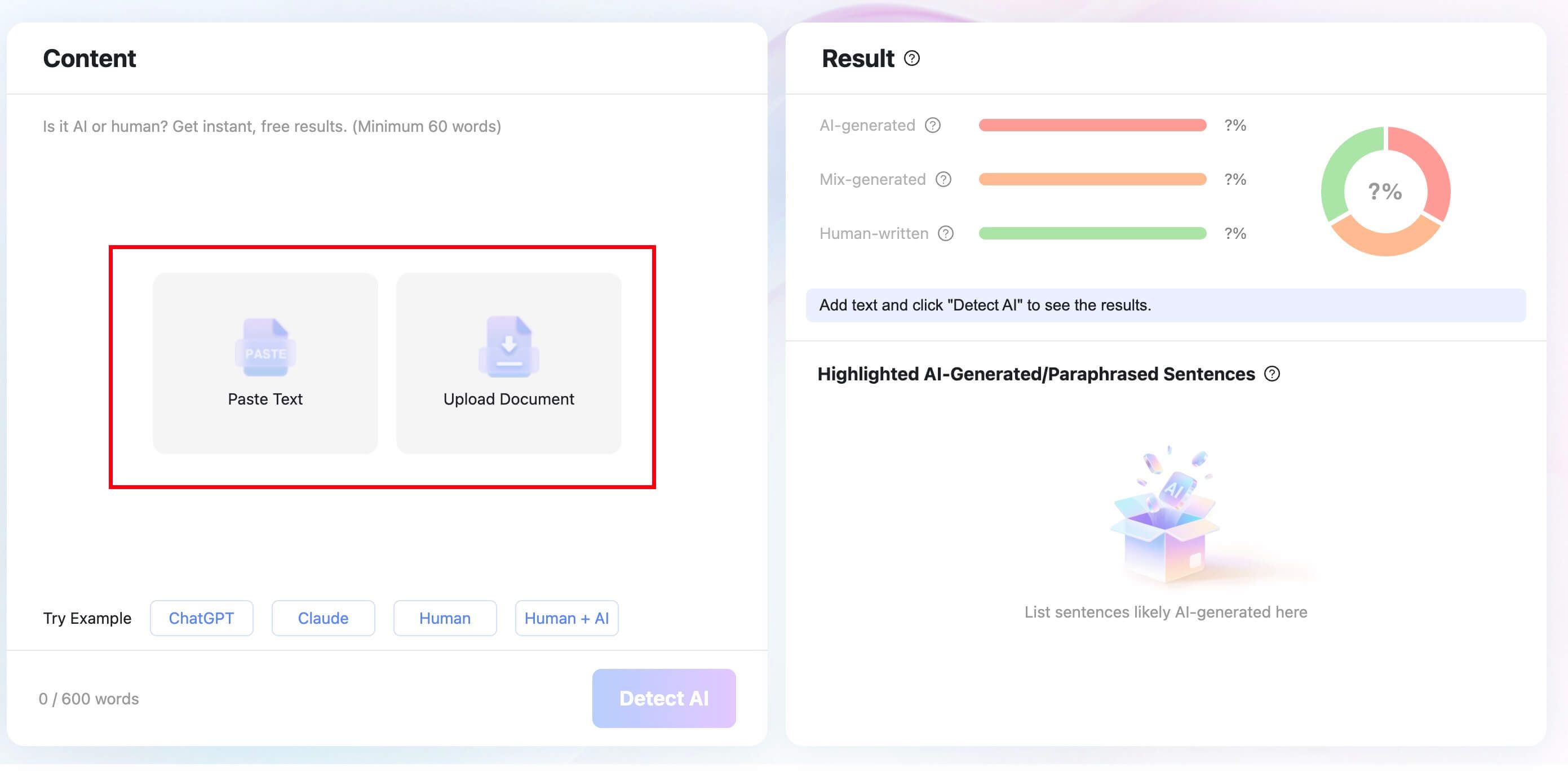
Step 1. Paste Text or Upload a Document
Paste your Claude-assisted passage into Lynote AI Detector, or upload a supported Word, PDF, or TXT document. Check the final draft rather than a fragment whenever possible.
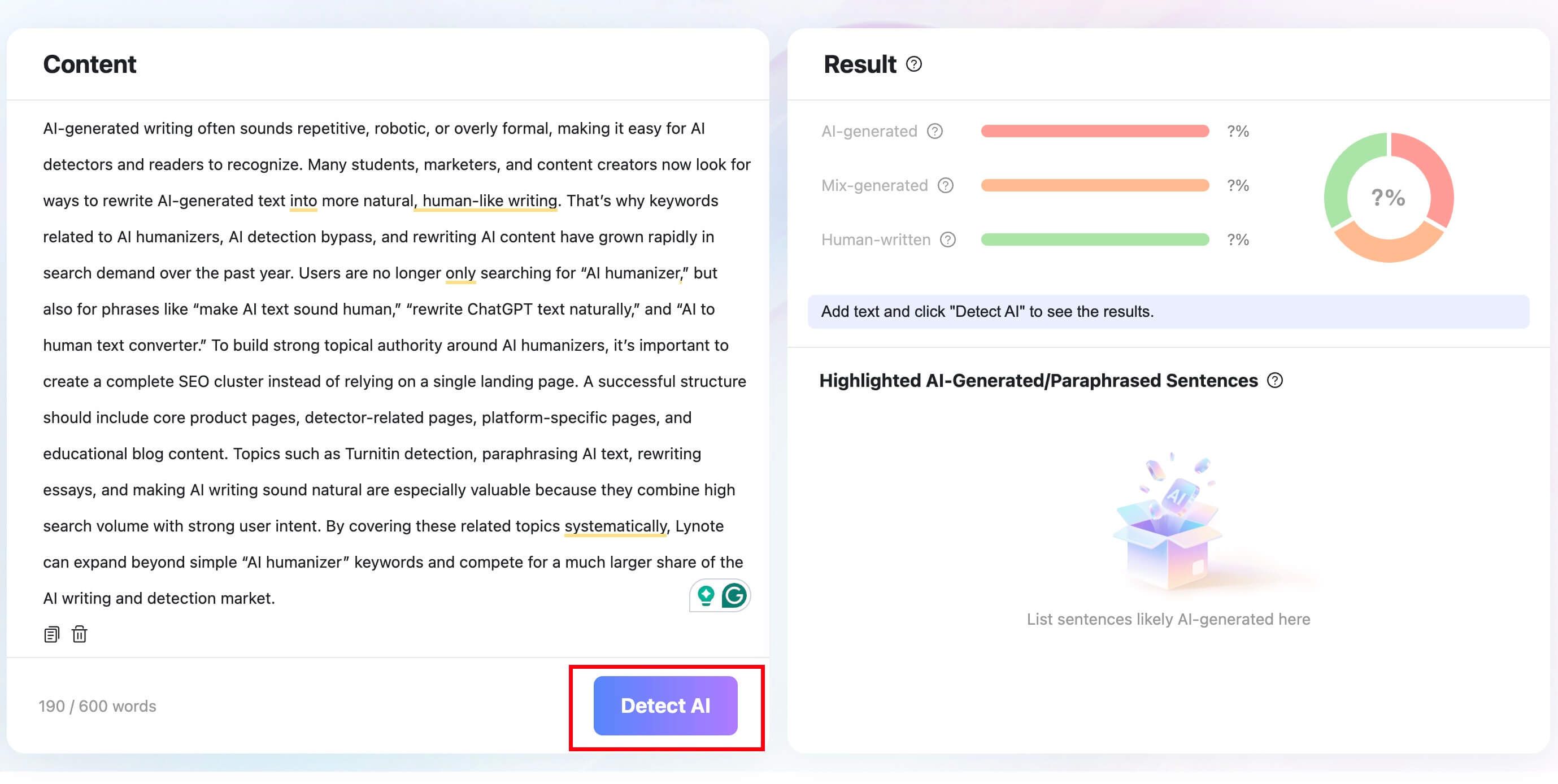
Step 2. Click Detect AI
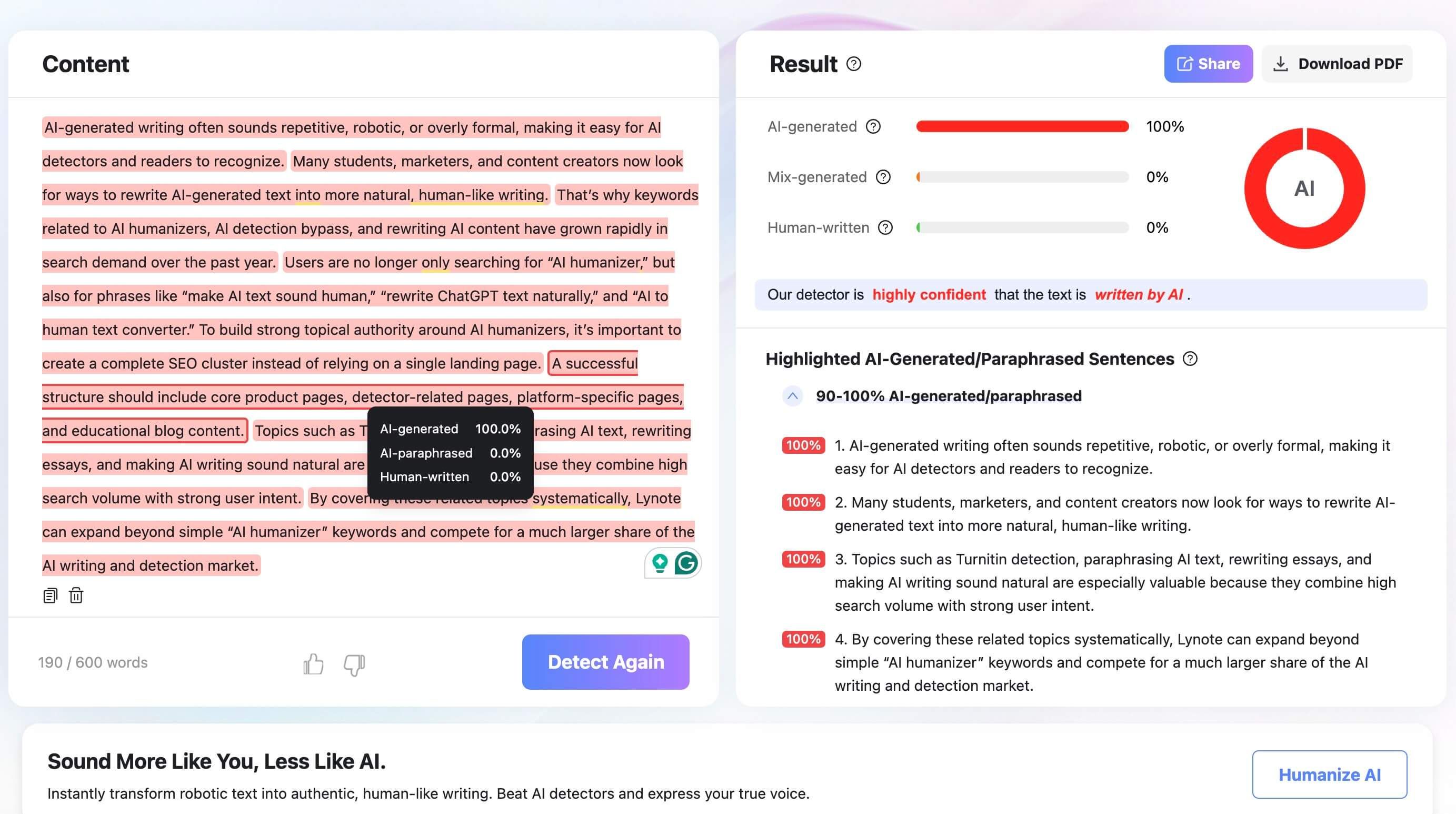
Click "Detect AI" to scan the writing. Lynote shows AI-generated, mixed, and human-written percentages as a review aid.
Step 3. Review the Highlighted Sentences
Look at the highlighted sentences and ask what they need: stronger evidence, more precise wording, a clearer connection to your source, or a more natural rhythm. Then revise from your own understanding.

Claude Detectability Depends on the Prompt, Not Just the Model
Many people ask whether Claude is more or less detectable than ChatGPT. That question is understandable, but it misses the biggest variable: what the user asked Claude to do.
If the prompt asks Claude to produce a complete response from a thin instruction, the model has to fill in structure, examples, transitions, and tone. The result may be fluent, but it can also be broad and self-contained in a way that feels detached from a student's real process.
If the prompt asks Claude to critique an outline, identify unclear sentences, or suggest questions to ask while reading a source, the final submitted writing may depend less on generated prose. That does not automatically make the use allowed, but it changes what a detector or teacher is evaluating.
This is why "Claude wrote it" and "Claude helped me think about it" are very different situations. A detector score usually sees only the final text. It does not know which parts came from brainstorming, editing, outlining, or direct generation.
Why Claude Writing Can Feel Human and Still Be Flagged
Claude often produces calm, natural, well-organized prose. That can make the writing feel more human than older AI outputs, but it does not make the text immune to detection.
One reason is over-balance. Claude may present both sides of an issue, qualify claims carefully, and avoid strong unsupported statements. That style can be useful, but in an assignment it may also feel generic if the paper never commits to a specific reading of the evidence.
Another reason is frictionless organization. Human drafts often show traces of decision-making: a surprising example, a sentence that narrows the claim, a source-specific caveat, or a rough transition that reflects the writer wrestling with the topic. Claude can remove that friction and make the paper sound complete before the reasoning is actually complete.
The result is a strange problem. The writing may be clear and pleasant, but it may not show enough of the student's intellectual fingerprints. Detectors and teachers can both react to that absence, even if they cannot prove the exact model behind it.
Claude-Specific Risk Patterns in School or Work Drafts
Claude is often used for long-form reasoning, summarizing, and rewriting. Those strengths can become risks when the final output replaces the writer's source engagement.
| Claude-assisted pattern | Why it can raise questions | Better use of Claude |
|---|---|---|
| A complete essay from a broad prompt | The structure may look generic and detached from class material | Ask for outline feedback, then write from notes |
| Polished paragraphs with few concrete details | The text may sound fluent but unsupported | Add evidence only you can explain |
| Smooth summaries of sources you barely read | The paper may not show real source understanding | Use Claude to create questions, not final claims |
| Tone rewriting across the whole draft | Voice can become inconsistent with earlier work | Apply local edits and compare with your original |
| AI-generated citations or examples | Unsupported material can become an integrity problem | Verify every example before it enters the draft |
For workplace writing, the same logic applies in a different way. A Claude-polished memo may be fine if the organization allows it and the facts are verified. But if the memo invents details, overstates confidence, or removes necessary caveats, the risk is professional rather than academic.
How To Make Claude-Assisted Work Easier To Defend
The best protection is not trying to make Claude invisible. It is keeping the final work grounded in a process you can explain.
Start with your own notes before asking Claude for help. Write the messy version first: the claim, the evidence, the question you are unsure about, and the place where your argument still feels weak. Then use Claude for a narrow task, such as asking what is unclear or where the paragraph needs more support.
After that, revise manually. Add details from your actual source, class, project, or experience. Remove polished lines that sound correct but do not connect to evidence you understand.
If disclosure is required, follow the policy. If disclosure is not required but you are worried, keep a private process log that shows the boundary between your work and the AI assistance.
What Not To Over-Interpret From a Low AI Score
A low detector score does not prove that a Claude-assisted draft is policy-compliant. It only means that one detector did not strongly classify the final text as AI-generated.
That distinction matters because academic and workplace review can involve more than the text. A teacher may compare the paper with past writing. A manager may check whether the analysis matches available data. A reviewer may ask how a claim was developed.
Use a low score as a comfort signal, not a permission slip. The stronger question is still whether the final work is accurate, allowed, and genuinely supported by your own understanding.
FAQs About Claude Detectability
Can Turnitin detect Claude?
Turnitin may flag Claude-like writing if it resembles AI-generated text. That is not the same as proving that Claude specifically wrote the assignment.
Can GPTZero detect Claude?
GPTZero and similar detectors may flag Claude text when the writing has AI-like patterns. The result should still be treated as an estimate, not a complete authorship judgment.
Does Claude watermark its writing?
Do not assume that ordinary Claude text contains a public, universally readable watermark. Watermarking, detector scores, and teacher review are different concepts.
Can teachers detect Claude without software?
Teachers may notice style changes, weak source engagement, missing drafts, or claims that a student cannot explain. Human review is not the same as model-specific proof, but it can still lead to questions.
Is Claude less detectable than ChatGPT?
Not in any universal way. Detectability depends on the prompt, the final editing, the detector, the assignment, and the amount of real source-specific reasoning in the draft.
Can edited Claude text still be flagged?
Yes. Editing can change the surface of the text, but a generic structure or unsupported claims can remain. Strong revision means rebuilding the argument, not only polishing the wording.
Final Verdict
Claude writing can be detectable, but detection is not the same as exact proof. AI detectors estimate whether text looks generated; they usually do not prove that Claude was the named source.
The safest approach is policy-compliant use, transparent process records, clear citations, and final writing that reflects your own understanding.

Written by Janet L. Harris
AI Writing Specialist
Janet reviews AI detectors and humanization tools, with a focus on accuracy, limitations, and responsible use. View all articles →