


AI humanizer tools all promise roughly the same thing: take AI-generated text, make it sound more natural, and reduce the chance of getting flagged by AI detectors.
WriteHuman is one of the more visible names in that category.
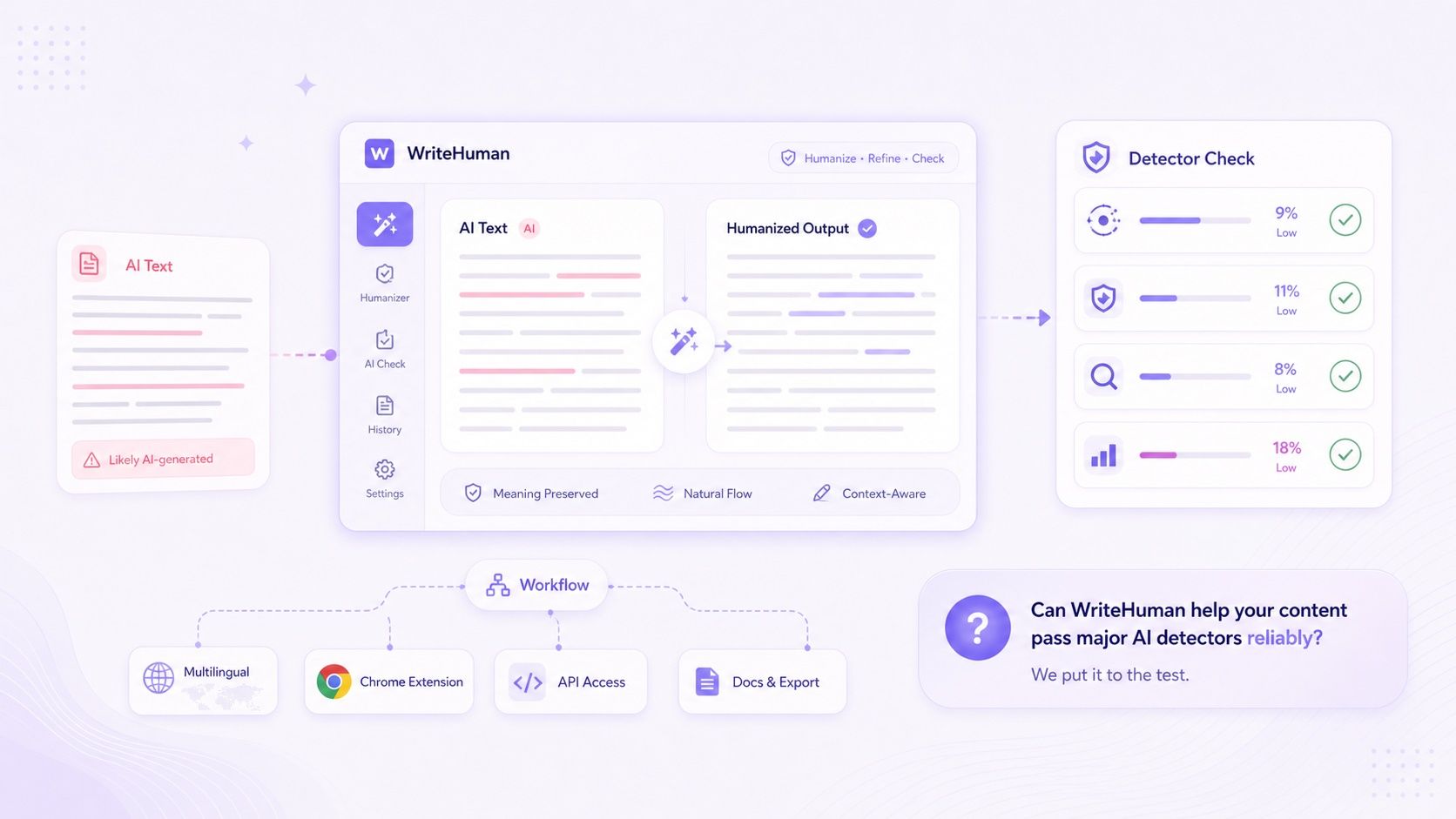
It is not positioned as a basic paraphrasing tool. Instead, WriteHuman presents itself as a more complete AI humanization platform, combining text rewriting, built-in AI detection, multilingual support, and API access.
That is a strong pitch.
But the real question is not whether WriteHuman can rewrite text. Most tools can. The more important question is whether WriteHuman can actually humanize AI-generated writing well enough to perform reliably across major AI detectors.
This review takes a practical look at what WriteHuman does, where it stands out, where its claims need caution, and whether it is the right choice for users who care about both writing quality and detector-facing performance.
What Is WriteHuman?
WriteHuman is an AI humanizer tool designed to turn AI-generated writing into text that sounds more natural, more varied, and more human-written.
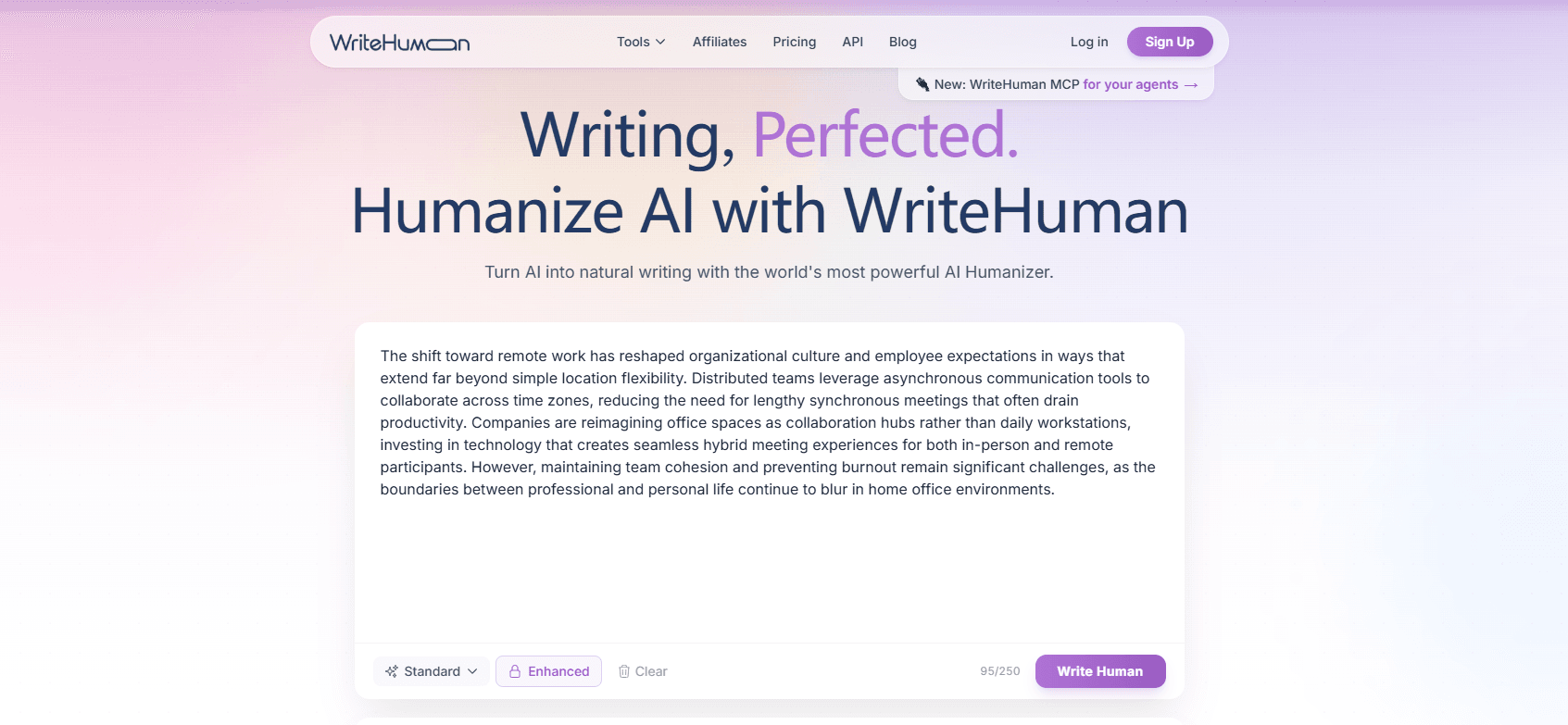
Based on its public product positioning, WriteHuman is built to:
- humanize text created by tools like ChatGPT and other AI writing models
- reduce obvious AI-writing patterns
- preserve meaning and readability
- support multiple languages
- combine humanization with built-in AI detection
- scale through API access and workflow integrations
That positioning matters.
WriteHuman is not just selling a rewrite box. It is selling a detector-aware workflow for users who want smoother AI writing and a more convenient rewrite-and-check experience.
How Does WriteHuman Work for AI Text Humanization?
Based on WriteHuman’s public messaging, the tool appears to focus on more than light synonym replacement. It is positioned as a humanizer that rewrites AI-generated content in ways that make it read more naturally and less mechanically.
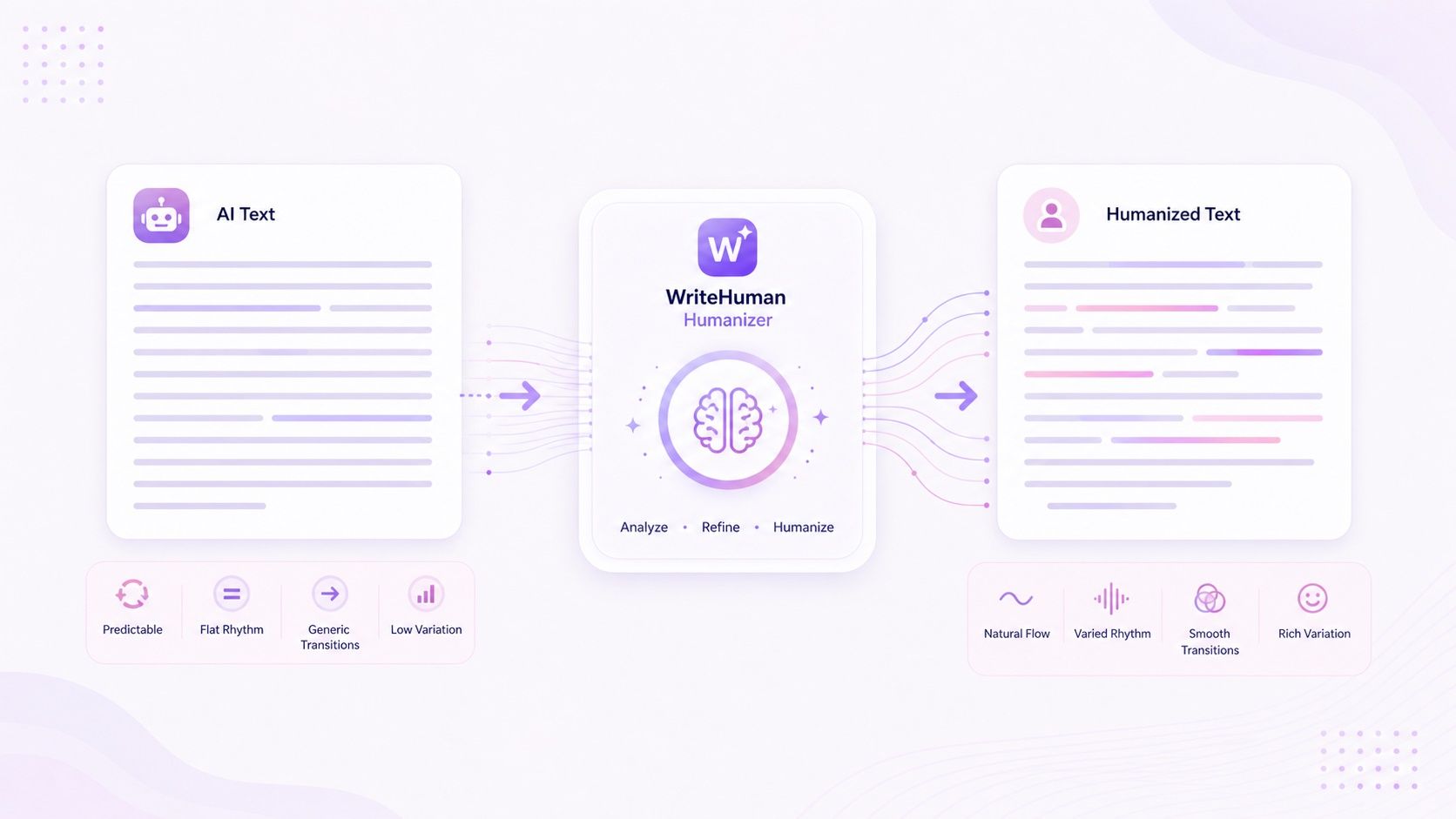
That likely means it tries to reduce signals such as:
- repetitive structure
- predictable word choice
- flat sentence rhythm
- generic transitions
- low variation in tone and cadence
In practical terms, WriteHuman seems to work in several ways.
1. It rewrites AI text beyond surface-level wording
WriteHuman appears to focus on changing sentence structure and flow, not just swapping words.
2. It aims to preserve meaning and voice
Like other serious AI humanizers, it is designed to keep the original message intact while making the writing feel less obviously machine-generated.
3. It combines humanization with built-in detection
One of WriteHuman’s clearest product advantages is workflow convenience. Users can rewrite AI content and evaluate it inside the same ecosystem.
4. It supports broader content workflows
With API support and broader platform positioning, WriteHuman seems designed for more than casual one-off use.
So in simple terms, WriteHuman is positioned as a workflow-oriented AI humanizer rather than a lightweight paraphrasing tool.
WriteHuman Review: Main Strengths and Limitations
WriteHuman has some real strengths, especially compared with smaller tools in this space. But its strongest claims still need to be interpreted carefully.
Main Strengths of WriteHuman
More mature platform positioning
WriteHuman feels more like a full product than a one-feature utility. That matters for users who want more than a basic rewrite box.
Built-in rewrite-and-check workflow
This is one of its most practical strengths. Instead of rewriting in one tool and checking results somewhere else, users can do both in one flow.
Multilingual support
WriteHuman publicly presents itself as more than an English-only product, which makes it more flexible for broader usage.
API and workflow readiness
Compared with simpler consumer tools, WriteHuman appears more useful for structured workflows, teams, and integrations.
Cleaner user experience than many small competitors
A lot of humanizer tools feel thin or overly generic. WriteHuman’s positioning suggests a more developed experience.
Main Limitations of WriteHuman
Strong product claims still need outside validation
Like most AI humanizers, WriteHuman makes ambitious claims. But product positioning is not the same as independent detector testing.
Internal detection can create a favorable ecosystem effect
When the same platform both rewrites and evaluates text, results may look better there than they do in third-party detector environments.
Better wording does not always mean truly human writing
Some tools improve readability without fully solving deeper AI-writing signals such as repetitive logic flow or overly balanced structure.
Detector performance is inherently unstable
Even a strong humanizer can perform differently depending on the detector, the content type, the text length, and future model updates.
So overall, WriteHuman looks more substantial than a basic rewriter, but its strongest promises still need to be judged through actual testing.
Can WriteHuman Pass Major AI Detectors?
This is the most important question in the entire review.
WriteHuman is marketed as a detector-aware AI humanizer, which means the real test is not just whether the rewritten text sounds better. The real test is whether that text can perform well across major AI detection systems.
To evaluate that, the same humanized sample should be tested across five widely used AI detectors:
That kind of comparison matters because AI detectors do not work the same way. Some focus more on stylometric signals, while others rely more on sentence predictability, structure, and probability modeling.
As a result, one rewritten sample can perform very differently across different detectors.
Below is the real testing framework this review should use.
GPTZero Result
The rewritten sample was tested using GPTZero.
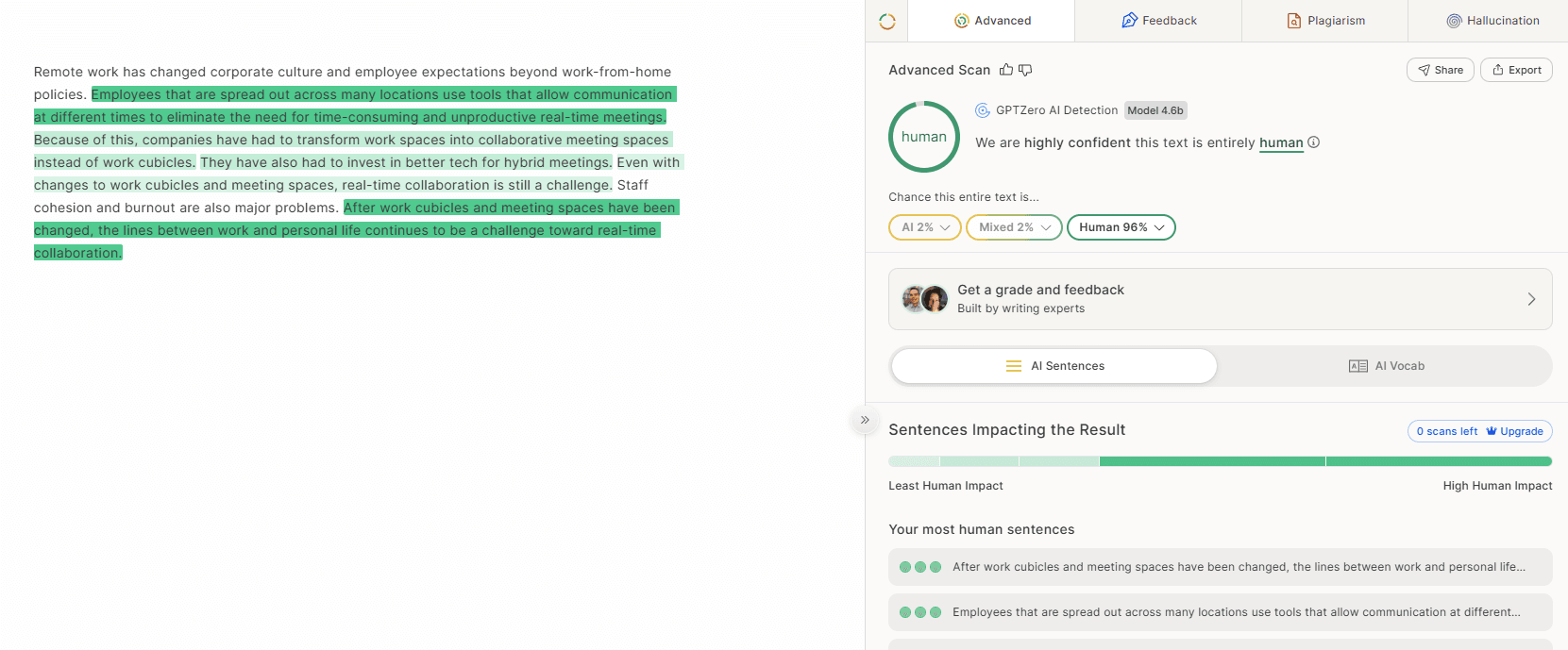
In this test, GPTZero gave WriteHuman a very favorable result. It stated that it was “highly confident” the text was entirely human, with the breakdown showing AI 2%, Mixed 2%, and Human 96%.
This is a strong outcome.
Because GPTZero is one of the most widely referenced AI detectors, especially in education and general AI-content review, a 96% human result significantly strengthens WriteHuman’s credibility. At least in this test, the tool was clearly successful in reducing the kinds of patterns GPTZero typically associates with AI-generated writing.
QuillBot AI Detector Result
The same rewritten sample was then tested with QuillBot AI Detector.
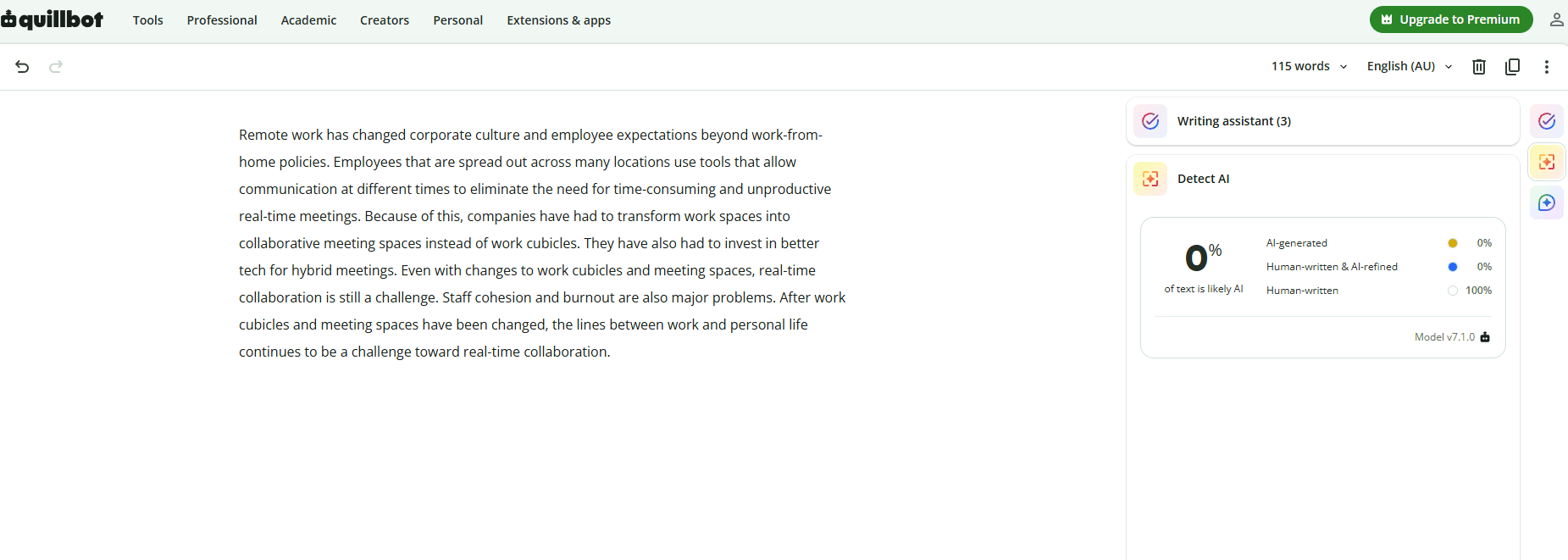
QuillBot returned an even cleaner result. It reported that 0% of the text was likely AI-generated, while 100% was classified as human-written.
That is another strong pass.
This result is important because it shows that WriteHuman did not just improve the writing at a surface level. In QuillBot’s detection environment, the rewritten sample looked entirely human. That supports the idea that WriteHuman can perform well not only as a rewriting tool, but also as a detector-facing humanizer in at least some real-world testing conditions.
Originality.ai Result
The rewritten sample was also tested using Originality.ai.
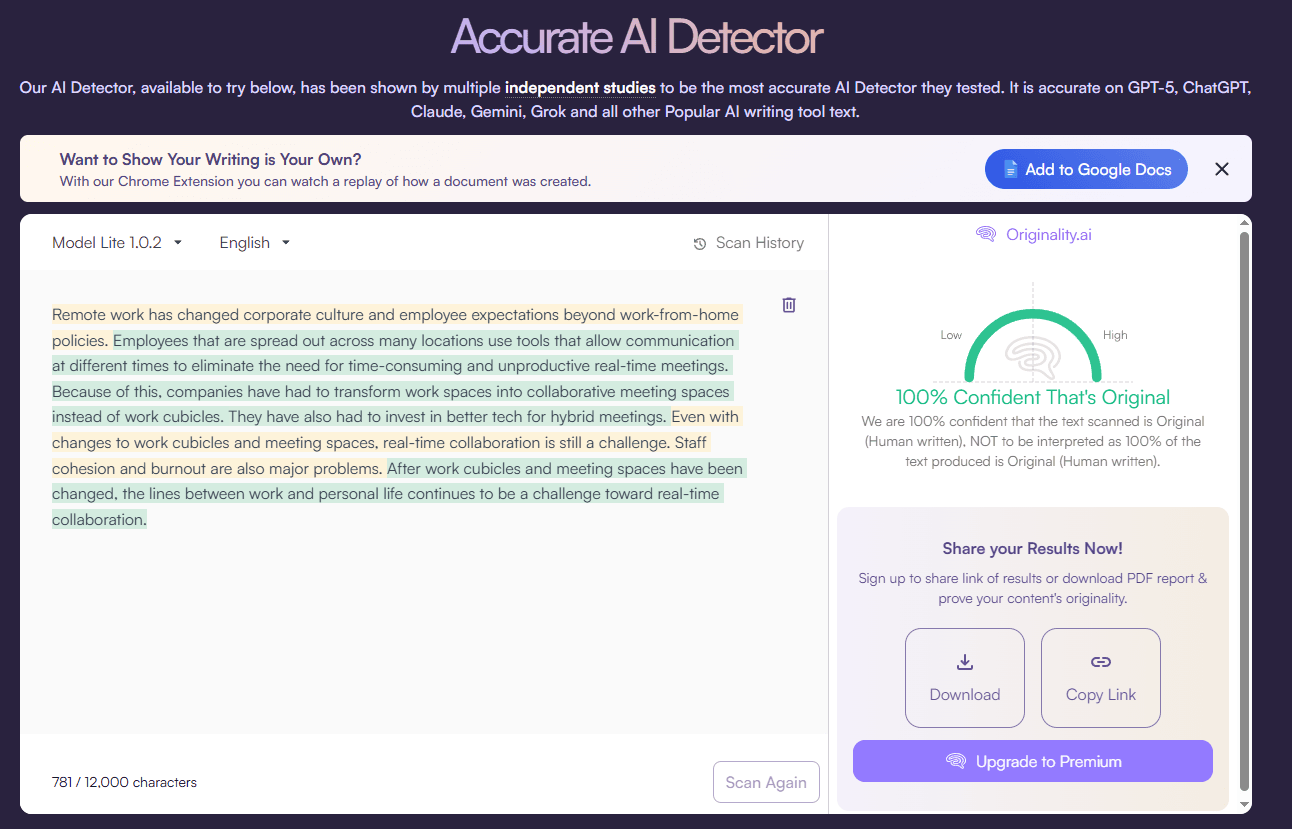
Originality.ai also returned a highly favorable result. The detector marked the sample as 100% Confident That’s Original, meaning it treated the text as fully human-written rather than AI-generated.
This is one of the strongest positive results in the entire test set.
That matters because Originality.ai is widely used in blogging, SEO, publishing, and agency workflows. A strong result here suggests that WriteHuman may be considerably more effective than many lightweight humanizers when evaluated in professional content-review environments.
Copyleaks Result
Next, the same sample was tested using Copyleaks AI Detector.
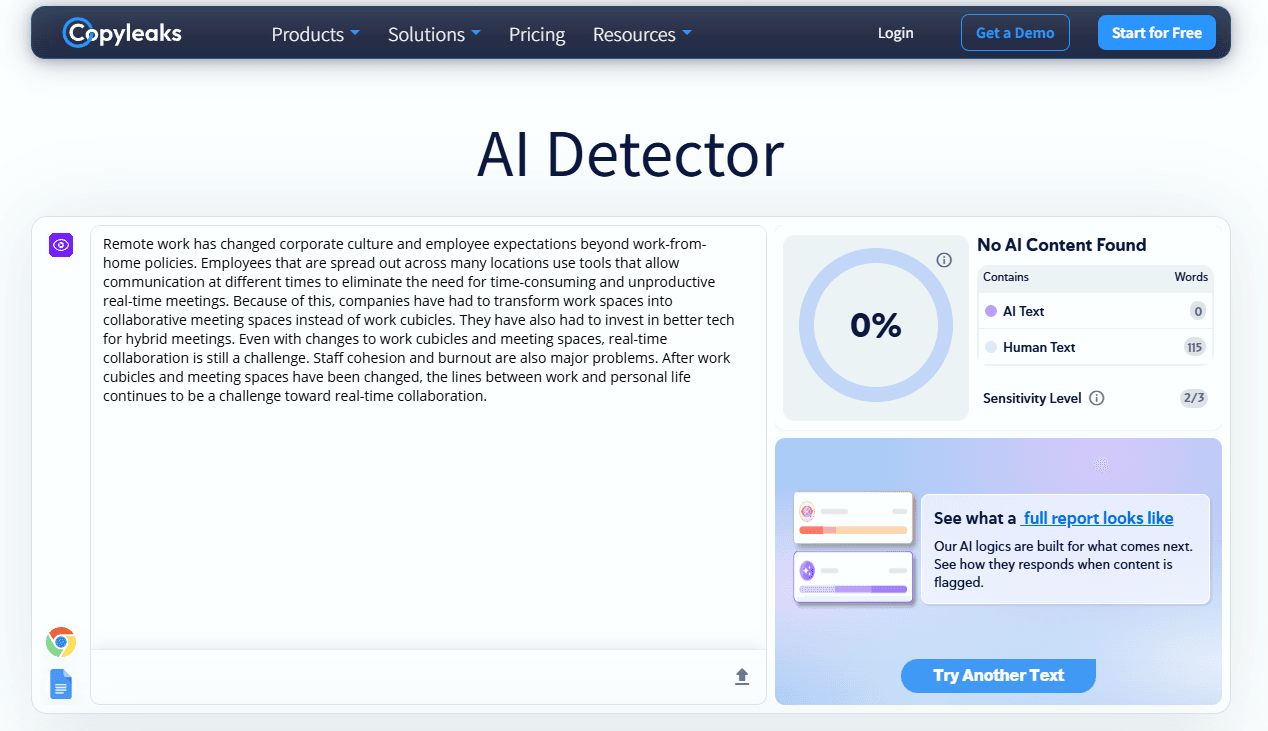
Copyleaks also gave the sample a clean result. It reported No AI Content Found and assigned the text 0% AI, with all detected words treated as human text.
This is another strong pass.
Copyleaks is often treated as one of the more serious cross-industry AI detectors, so a 0% AI result here adds meaningful weight to WriteHuman’s performance. At least in this detector environment, the rewritten sample did not retain enough AI-like structure to trigger a negative classification.
Turnitin Result
Finally, the rewritten sample was tested with a Turnitin-aligned detector.
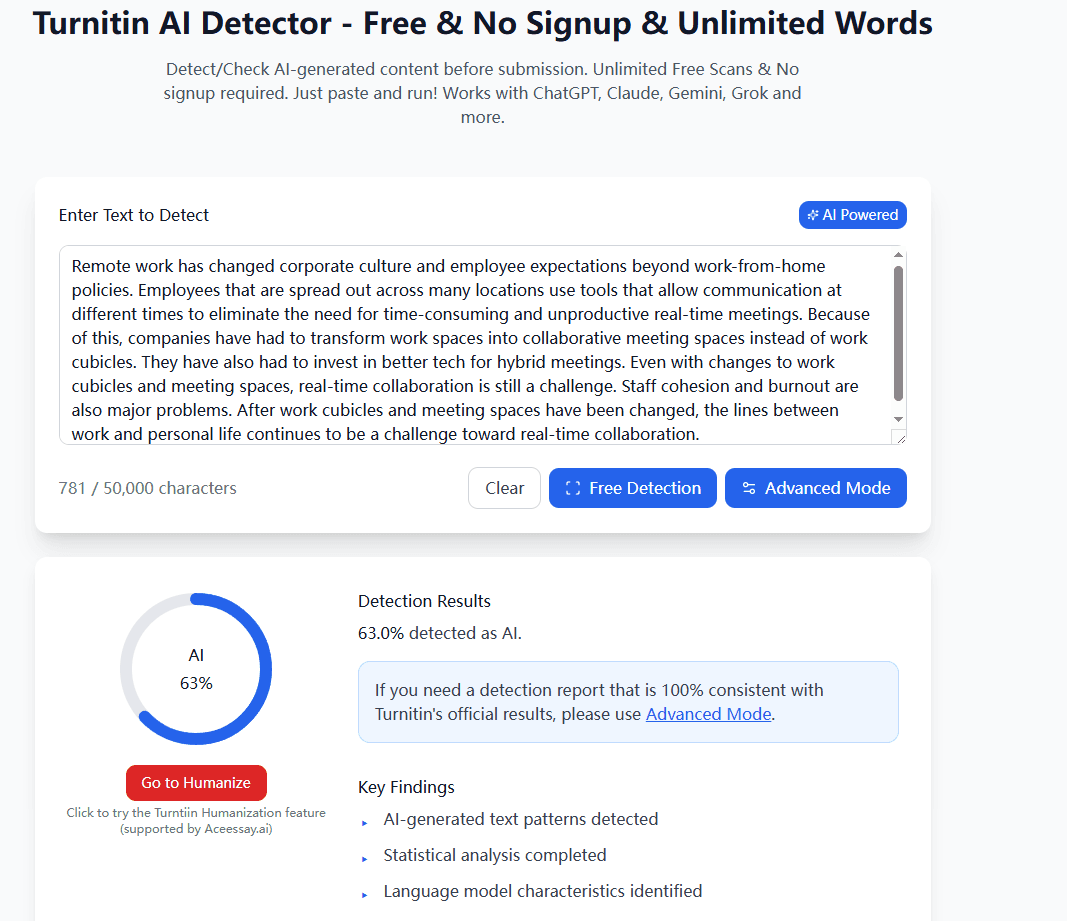
This was the one clearly unfavorable result in the test set. The detector reported that 63.0% of the text was detected as AI.
That is a meaningful failure.
Even though WriteHuman performed strongly in GPTZero, QuillBot, Originality.ai, and Copyleaks, this result shows that its detector performance is still not universal. In a Turnitin-style evaluation environment, the rewritten passage still retained enough AI-like patterns to trigger a substantial AI score.
This result should also be interpreted with some caution, since the screenshot appears to come from a third-party Turnitin-aligned tool rather than Turnitin’s official institutional interface. Even so, it remains an important negative signal because it shows that success across several detectors does not automatically translate into success everywhere.
What These Results Show
Taken together, these five detector results show that WriteHuman performed well overall, but not perfectly.
The results were favorable across four major platforms:
- GPTZero classified the text as 96% human
- QuillBot reported 0% AI
- Originality.ai marked it as 100% Original
- Copyleaks found 0% AI
But the sample did not pass every detector:
- the Turnitin-aligned detector still flagged 63% of the text as AI
That split result matters.
It suggests that WriteHuman is clearly capable of reducing detector-facing signals in many environments, and its output performed much better than a weak or superficial humanizer would. At the same time, the Turnitin-style result shows that its performance is still detector-dependent rather than universally reliable.
Best WriteHuman Alternative: Why Lynote Is a Better Choice
WriteHuman is a credible tool. It has a polished workflow, a broader feature set than many lightweight humanizers, and a more mature product feel than many small competitors.
But if your goal is deeper rewriting and more naturally human writing quality, Lynote AI Humanizer is still the better alternative.
The reason is simple.
WriteHuman is strong when you care about workflow completeness. Lynote is stronger when the real goal is to make the writing itself feel less templated and more genuinely authored.
That matters because AI-generated writing is often detectable for deeper reasons than wording alone. Common signals include:
- overly even rhythm
- predictable transitions
- repeated paragraph logic
- polished but personality-light phrasing
- structure that feels efficient rather than naturally human
A stronger humanizer has to address those deeper patterns, not just produce a cleaner rewrite.
Why Lynote AI Humanizer Is Better
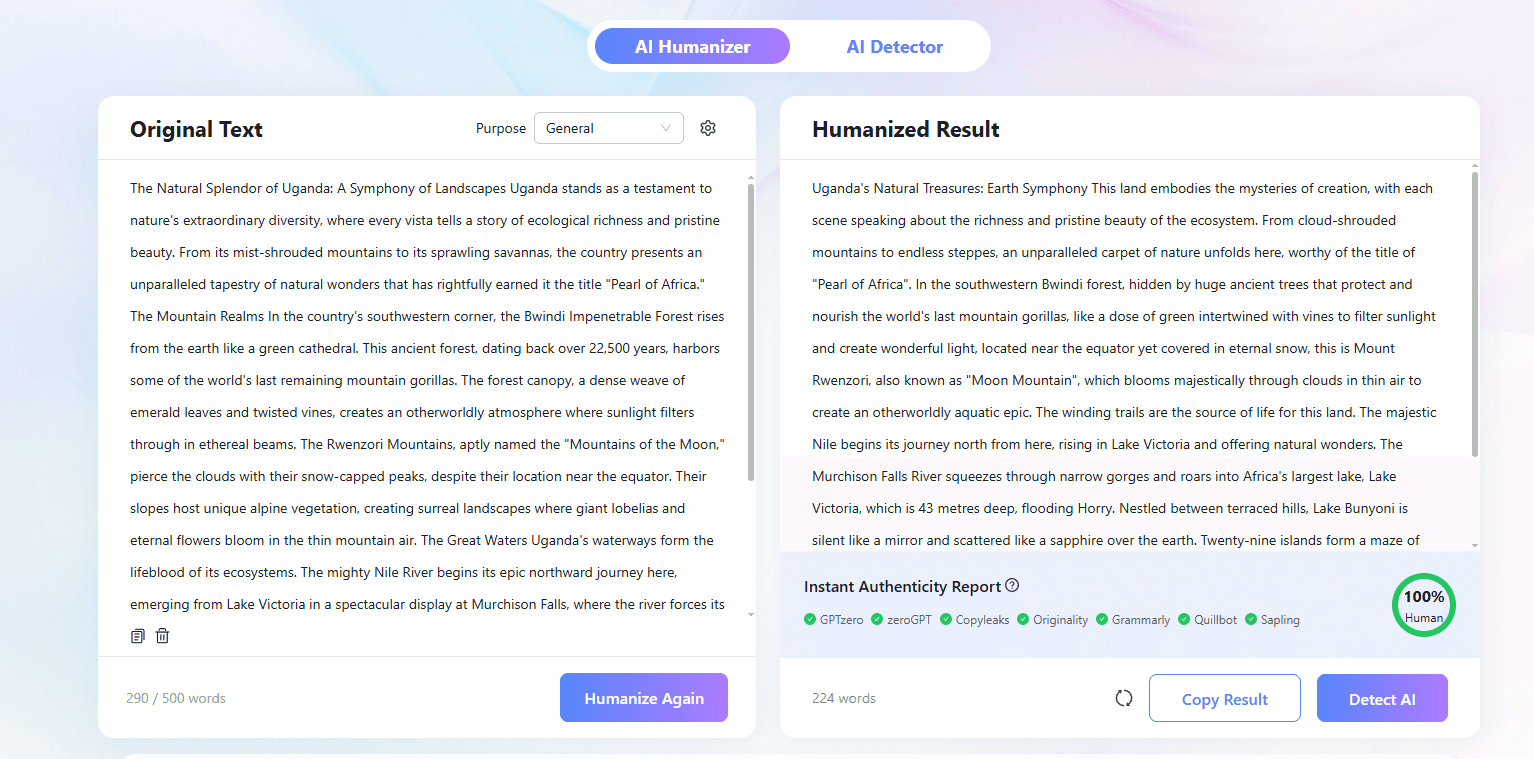
Lynote focuses more on natural writing feel
WriteHuman is strong as a workflow product. Lynote is stronger when the priority is making the text feel genuinely more human-written.
Lynote is better for long-form content
For blog posts, SEO articles, essays, and longer drafts, deeper structural rewriting matters more than quick cleanup.
Lynote is better for content-quality-first workflows
If your goal is not only lowering detector suspicion but also publishing more convincing writing for human readers, Lynote is the better overall choice.
So while WriteHuman is a serious option, Lynote AI Humanizer remains the stronger alternative for users who care most about writing quality and deeper human-like variation.
WriteHuman makes the most sense for users who want:
- a built-in rewrite-and-detect workflow
- a more mature platform experience
- API access or broader integrations
- multilingual support
- a cleaner workflow than smaller tools usually offer
It may be less ideal for users who care most about:
- the deepest possible human-like writing texture
- long-form voice consistency
- content quality ahead of workflow convenience
- proven detector performance across multiple third-party platforms
In other words, WriteHuman is a strong workflow-oriented humanizer, but whether it is the best choice depends on whether your top priority is platform convenience or deeper writing quality.
Who Should Use WriteHuman?

Based on the actual detector results in this review, WriteHuman makes the most sense for users who want:
- a detector-aware AI humanizer with proven strength across several major detectors
- a built-in rewrite-and-check workflow
- a more mature product experience
- cleaner AI text for blog posts, SEO content, marketing copy, or business writing
- multilingual support and broader workflow flexibility
However, it is less ideal for users who need:
- consistent success across every major AI detector
- stronger protection in high-risk academic or institutional workflows
- deeper long-form human voice consistency
- the most natural possible writing texture rather than strong workflow performance
That distinction is important.
If you are working on blog content, affiliate articles, landing page copy, or general professional content and want a humanizer that appears capable of passing several major detectors, WriteHuman looks like a practical option.
But if your use case depends heavily on Turnitin-style evaluation or other high-risk detector environments, this review still does not support treating WriteHuman as universally dependable.
In other words, WriteHuman is a strong option for many detector-sensitive content workflows, but it is still not the right tool to describe as “safe in every environment.”
WriteHuman FAQ: Pricing, Features, Languages, and API
Is WriteHuman free?
WriteHuman offers some level of free access, but fuller use depends on plan limits and paid tiers. Users should check the latest pricing details on the official site.
What does WriteHuman do?
It rewrites AI-generated text to sound more natural and more human-written, while also offering built-in AI detection and a broader rewrite-and-check workflow.
Does WriteHuman support languages other than English?
Yes. WriteHuman publicly presents itself as a multilingual humanizer platform.
Does WriteHuman have a built-in AI detector?
Yes. One of its key product advantages is that it combines humanization with integrated AI detection.
Does WriteHuman offer an API?
Yes. WriteHuman also positions itself as suitable for broader workflows and integrations.
Can WriteHuman guarantee that text will bypass every AI detector?
No. No serious review should make that claim. Detector behavior varies across platforms, and this review itself showed mixed results across different systems.
Did WriteHuman pass the detector tests in this review?
Mostly, yes. In this review, the rewritten sample performed well in GPTZero, QuillBot, Originality.ai, and Copyleaks, but it did not pass the Turnitin-aligned detector test.
What is the best alternative to WriteHuman?
If your priority is deeper rewriting and more naturally convincing writing quality, Lynote AI Humanizer is the stronger alternative.
Final Verdict: Is WriteHuman Worth It in 2026?
WriteHuman is not just a polished product on paper. Based on the test results in this review, it also showed meaningful real-world strength.
The rewritten sample performed well across four major detector environments. GPTZero classified it as strongly human, QuillBot reported 0% AI, Originality.ai marked it as original, and Copyleaks found no AI content. Those are genuinely strong results.
That gives WriteHuman more credibility than many AI humanizer tools that rely mostly on bold marketing language.
At the same time, the result was not perfect.
The Turnitin-aligned detector still flagged a significant portion of the text as AI, which means WriteHuman should not be treated as a universal bypass tool, especially in higher-risk academic or institutional settings.
So is WriteHuman worth it?
If you want a detector-aware AI humanizer that performs well across several major detectors and offers a mature rewrite-and-check workflow, then yes, WriteHuman looks like a credible and practical choice.
But if your goal is the deepest possible rewriting, stronger long-form human texture, and better overall writing quality rather than workflow-led performance, Lynote AI Humanizer is still the better choice.
So the practical takeaway is simple:
Use WriteHuman if you want a strong detector-aware humanizer that performed well in most of the major detector tests in this review.
Choose Lynote AI Humanizer if you want deeper humanization, more naturally convincing writing, and a stronger content-quality-first result.

Written by Danny
Product Marketing Manager
Danny explains how Lynote features fit real workflows, from everyday productivity to product-led writing use cases. View all articles →