

AI humanizer tools all promise a similar outcome: take AI-generated text, make it sound more natural, and reduce the chance of being flagged by AI detectors.
GPTHuman is one of the more aggressively positioned tools in that category.

It does not market itself as a basic paraphrasing tool. Instead, GPTHuman presents itself as a full AI humanization platform with built-in AI detection, API access, multilingual support, and strong detector-bypass claims.
That is a bold pitch.
But the real question is not whether GPTHuman can rewrite AI text. Most tools can do that. The more important question is whether GPTHuman can actually humanize AI-generated writing well enough to perform reliably across major AI detectors.
This review takes a practical look at what GPTHuman does, where it stands out, where its claims need caution, and whether it is the right choice for users who care about both writing quality and detector-facing performance.
What Is GPTHuman and What Does It Do?
GPTHuman is an AI humanizer platform designed to transform AI-generated content into text that sounds more natural, more human-like, and less obviously machine-written.

Based on GPTHuman’s public product pages, the tool is built to:
- humanize AI-generated text
- reduce common AI-writing signals
- support 50+ languages
- provide built-in AI detection
- offer API access for broader workflows
- help content bypass major AI detectors
That positioning matters.
GPTHuman is not just presenting itself as a simple text spinner. It is clearly being marketed as a detector-aware AI rewriting system built for users who want cleaner text and stronger AI detection resistance.
How Does GPTHuman Work for AI Text Humanization?
Based on GPTHuman’s public messaging, the tool appears to focus on more than light synonym replacement. It is positioned as a humanizer that rewrites AI-generated text in ways that make it sound more natural and less machine-produced.
That likely means it tries to reduce signals such as:
- repetitive phrasing
- predictable structure
- flat sentence rhythm
- generic transitions
- low variation in cadence and tone
In practical terms, GPTHuman appears to work in several ways.
1. It rewrites text beyond surface-level wording
GPTHuman claims to do more than simply swap words. Its positioning suggests structural rewriting designed to change how the text flows.
2. It aims to make AI text sound more authentically human
A central part of GPTHuman’s pitch is that the output should sound less robotic and more naturally written.
3. It combines humanization with AI detection
One of GPTHuman’s practical advantages is that it includes its own AI detector workflow, allowing users to rewrite and evaluate text in one product ecosystem.
4. It supports larger-scale workflows
With API access, higher-volume plans, and broader language support, GPTHuman is also positioned for teams, businesses, and workflow integrations rather than just casual one-off use.
So in simple terms, GPTHuman is positioned as a detector-aware AI humanization platform rather than a lightweight rewrite tool.
GPTHuman Pros and Cons: Main Strengths and Limitations
GPTHuman has some real strengths, especially compared with smaller or more generic AI humanizers. But its strongest claims still need to be interpreted carefully.

Main Strengths of GPTHuman
Strong detector-aware positioning
GPTHuman is much more direct than many competitors. It openly markets itself around AI detection bypass rather than just readability improvement.
Built-in rewrite-and-check workflow
Like other more mature tools in this category, GPTHuman combines humanization with AI detection in one environment. That makes it more convenient than tools that only handle rewriting.
API and workflow readiness
GPTHuman clearly targets more than casual users. Its API offering makes it more viable for teams, developers, and large-scale content workflows.
Broad language support
The platform publicly states support for 50+ languages, which makes it more flexible than tools focused mainly on English.
Mature plan structure
GPTHuman offers multiple tiers, output limits, detector access, and additional protection language such as “Shield Guard,” suggesting a more developed product strategy than a basic standalone rewriter.
Main Limitations of GPTHuman
Strong claims still require real cross-platform testing
This is the biggest issue. GPTHuman makes unusually bold bypass claims, but product messaging is still not the same as independent multi-detector verification.
Internal detection can create a favorable ecosystem effect
When the same platform both rewrites and evaluates the output, the results may appear stronger inside that system than they do across third-party detectors.
Humanized text is not always deeply human-written
A tool can reduce obvious AI patterns without fully removing deeper structural signals that stricter detectors may still catch.
Detector performance is never universally stable
Even a strong AI humanizer can perform differently depending on the detector, the content type, the passage length, and future model updates.
So overall, GPTHuman looks more serious than a basic paraphrasing tool, but its strongest public claims should still be judged through real testing rather than branding alone.
Can GPTHuman Really Pass Major AI Detectors?
This is the most important question in the entire review.
GPTHuman is marketed very aggressively around AI detection bypass. That means the real test is not just whether the text sounds better. The real test is whether the rewritten output can perform well across major AI detection systems.
To evaluate that, the same humanized sample should be tested across five widely used AI detectors:
That type of cross-platform comparison matters because AI detectors do not work the same way. Some rely more heavily on stylometric signals, while others focus more on predictability, sentence structure, and training-distribution patterns.
As a result, one rewritten sample can perform very differently across different detectors.
Below is the testing structure this review should use.
GPTZero Result
The rewritten sample was tested using GPTZero.
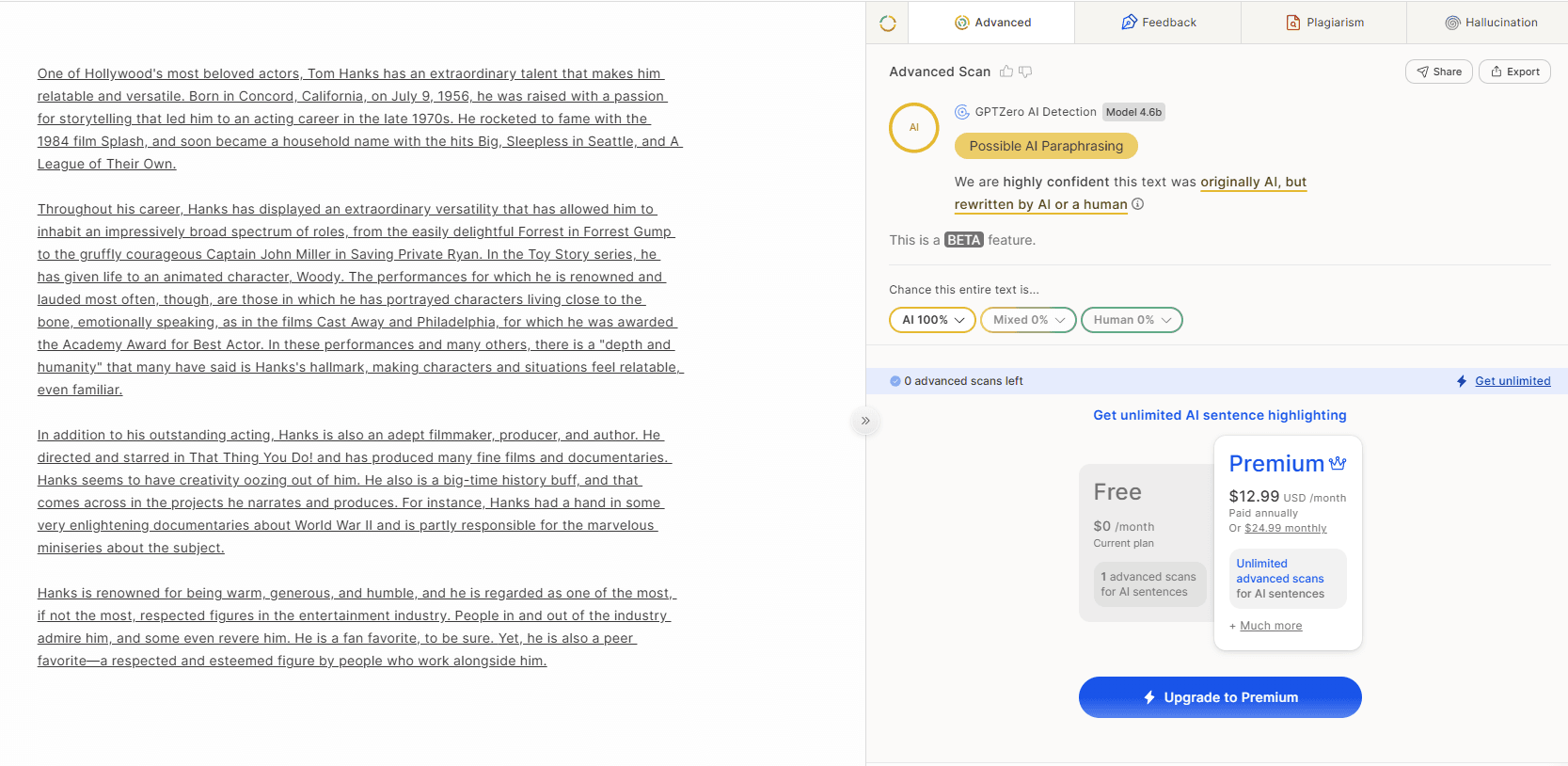
This was a clearly unfavorable result.
GPTZero labeled the sample as Possible AI Paraphrasing and stated that it was “highly confident” the text was originally AI, but rewritten by AI or a human. The platform classified the passage as AI 100%, with Mixed 0% and Human 0%.
That is a strong negative signal.
Even though GPTHuman may have altered the surface structure of the text, GPTZero still interpreted the output as fundamentally AI-derived. Since GPTZero is one of the most widely referenced AI detectors, especially in education and general AI-content review, this result significantly weakens any claim of reliable detector bypass performance.
QuillBot Result
The same rewritten sample was then tested using QuillBot AI Detector.
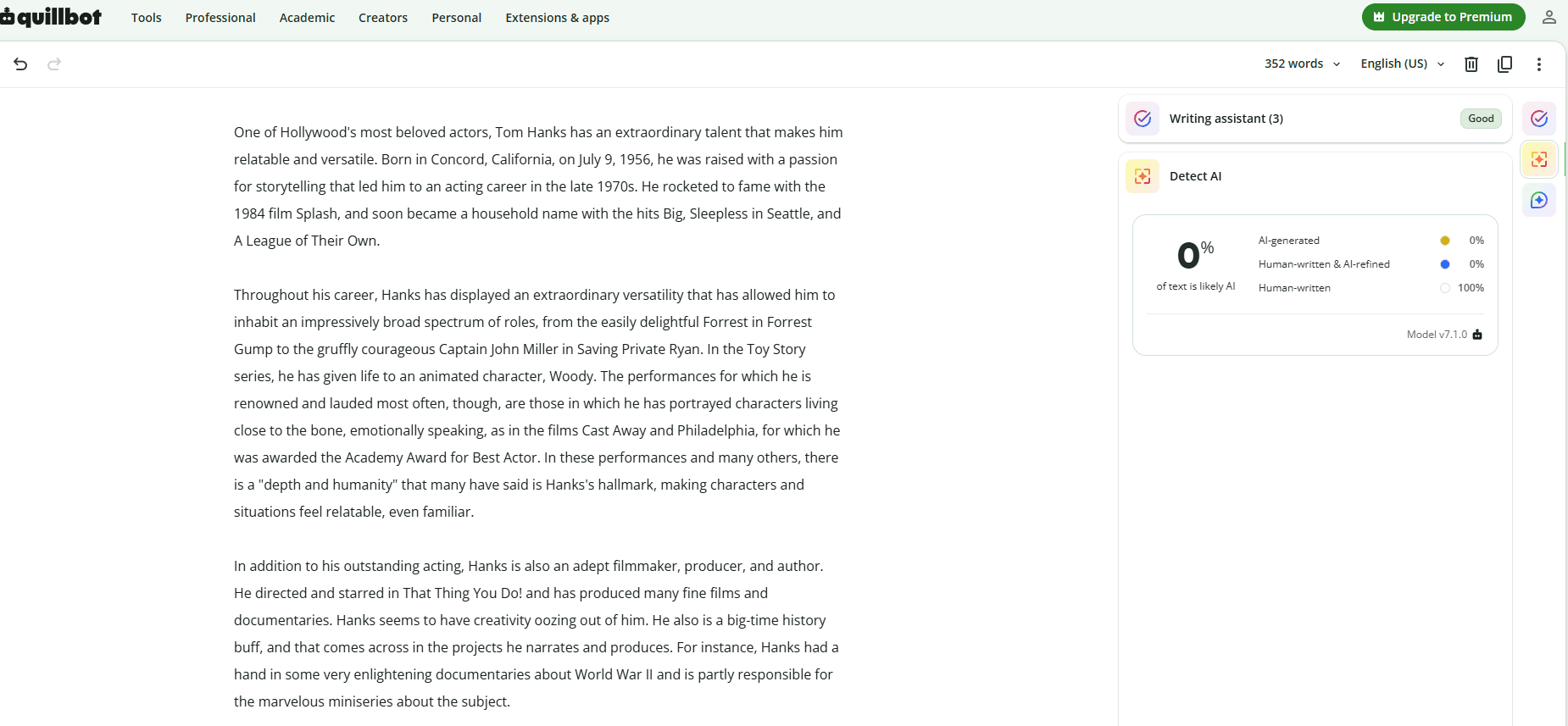
QuillBot returned a fully favorable result.
It reported 0% AI-generated content and classified the text as 100% human-written.
This is one of the strongest positive results in the test set.
In QuillBot’s detection environment, GPTHuman’s rewritten output looked entirely human. That suggests the tool can be effective at reducing AI-style signals in at least some consumer-facing detector systems, even if that performance does not carry over consistently to stricter platforms.
Originality.ai Result
The rewritten sample was also tested using Originality.ai.
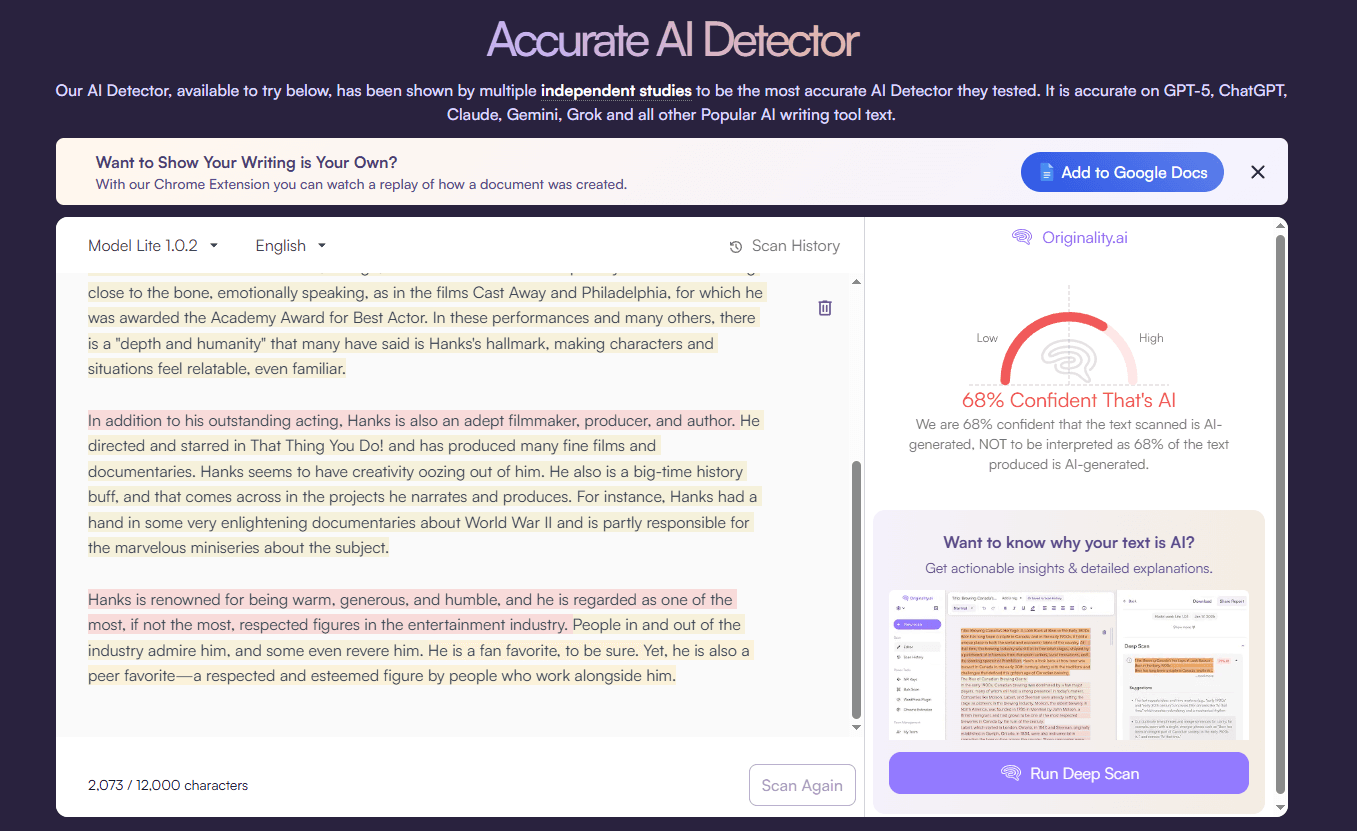
Originality.ai produced another unfavorable result.
The detector marked the text as 68% Confident That’s AI, indicating that it still found a meaningful level of AI-related signal in the rewritten output.
This matters a lot because Originality.ai is commonly used in SEO, publishing, and agency workflows. A 68% AI confidence score is not a borderline pass. It suggests that GPTHuman did not fully remove the deeper structural patterns that Originality.ai still associates with AI-generated text.
So while GPTHuman performed well in QuillBot, it was not nearly as convincing in this more publishing-oriented detector environment.
Copyleaks Result
Next, the same sample was tested using Copyleaks AI Detector.
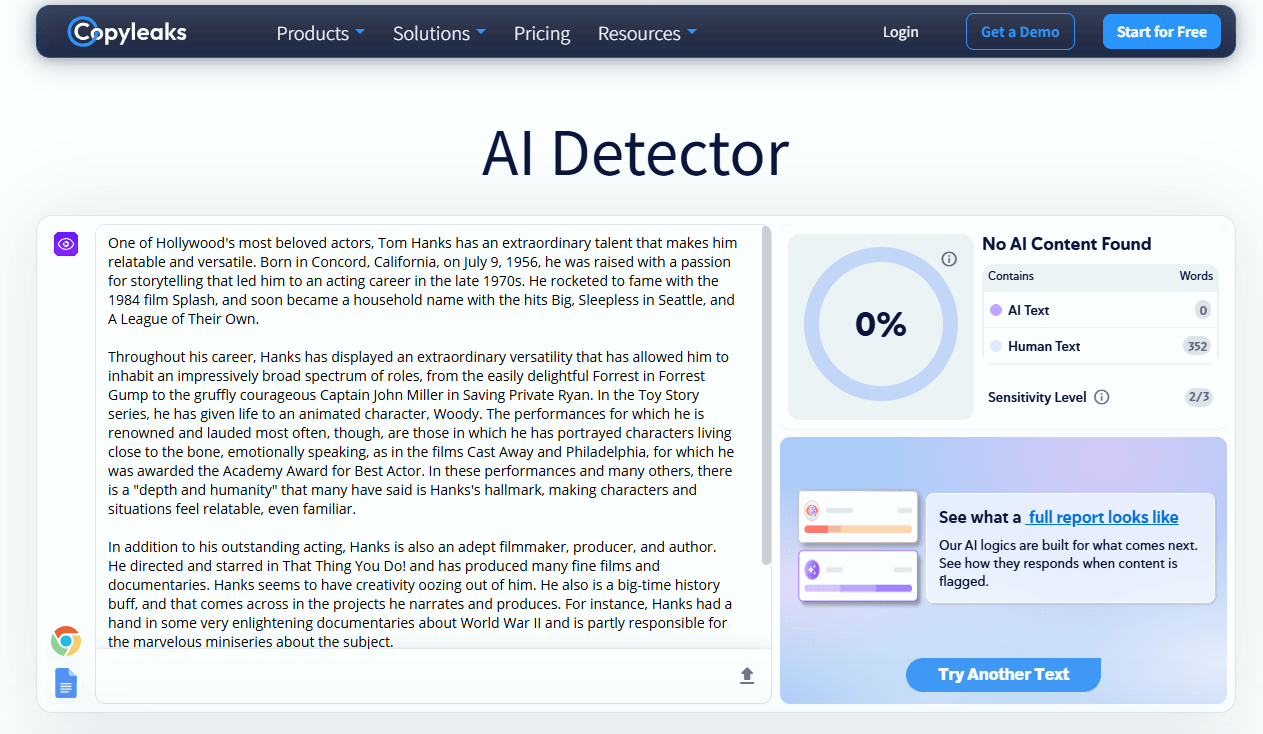
Copyleaks gave the sample a clean result.
It reported No AI Content Found and assigned the text 0% AI, with all detected words treated as human-written.
That is another strong positive outcome.
Because Copyleaks is often treated as a more serious cross-industry AI detector, this result gives GPTHuman meaningful credibility. At least in this detector environment, the rewritten sample successfully avoided a negative AI classification.
Turnitin Result
Finally, the rewritten sample was tested using a Turnitin-aligned detector.
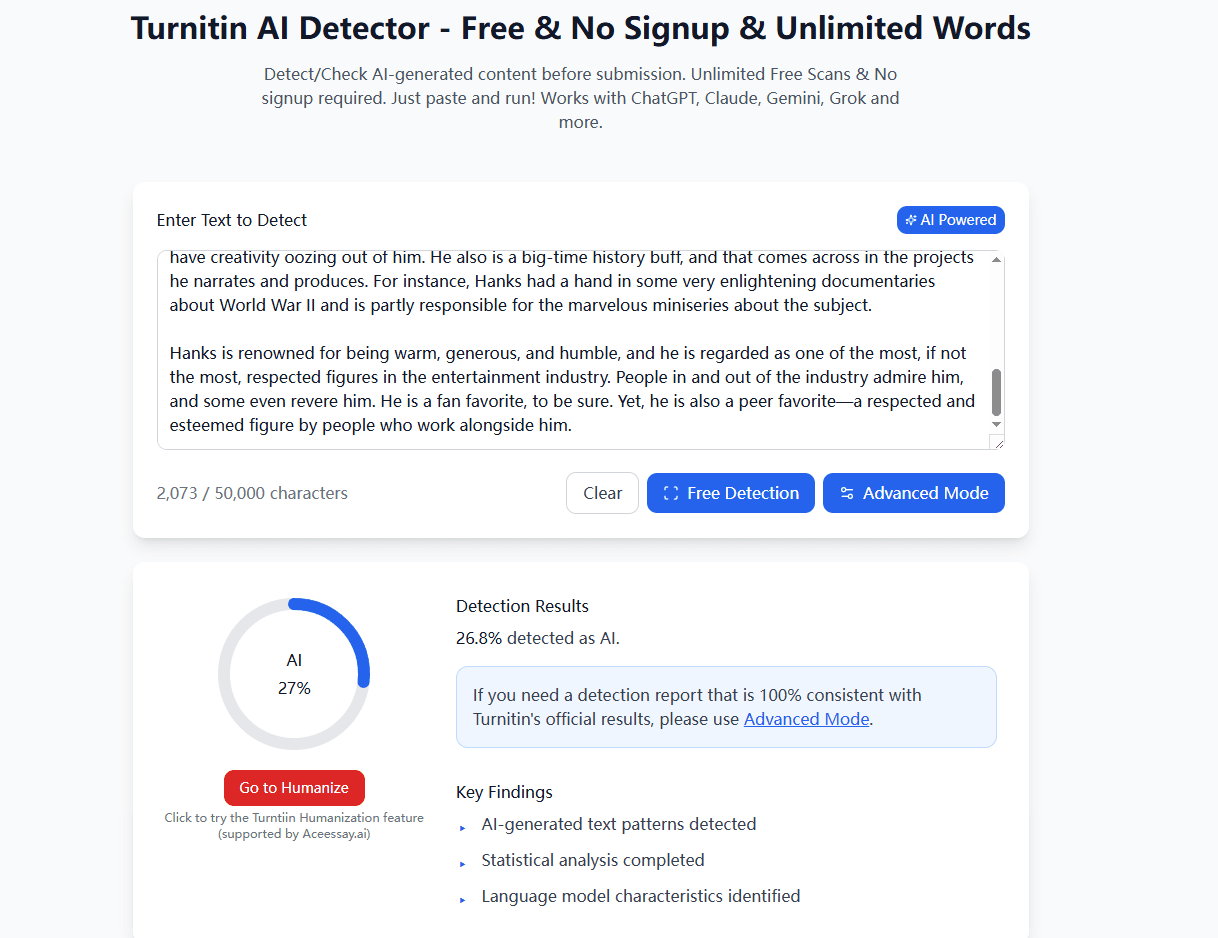
This result fell somewhere in the middle.
The detector reported that 26.8% of the text was detected as AI, with the interface also showing an overall AI reading of about 27%.
This is not a clean pass, but it is also not as severe as a full AI classification.
Compared with the GPTZero and Originality.ai results, this is a more moderate outcome. It suggests that GPTHuman reduced some AI-like patterns, but not enough to eliminate detection in a Turnitin-style evaluation environment.
This result should also be interpreted carefully, since the screenshot appears to come from a third-party Turnitin-aligned tool rather than Turnitin’s official institutional interface. Even so, it still shows that GPTHuman’s detector performance is not universal in higher-risk settings.
What These Results Show
It suggests that GPTHuman can perform well in some AI detector environments, particularly in detectors like QuillBot and Copyleaks. But it also shows that the tool is not consistently strong enough to pass stricter or differently calibrated systems such as GPTZero and Originality.ai.
So the most reasonable conclusion is this:
GPTHuman may help reduce AI detection risk in some contexts, but it should not be treated as a dependable universal solution for passing major AI detectors.
For lower-risk use cases like blog writing, affiliate content, landing pages, and general marketing copy, these results may still be encouraging.
But for higher-risk workflows, especially those involving stricter academic, institutional, or editorial review environments, GPTHuman’s mixed detector performance suggests that caution is still necessary.
So the practical takeaway is simple:
GPTHuman performed well in some major AI detectors, but not consistently enough to be treated as universally reliable.
Is There a Better Alternative to GPTHuman?
GPTHuman is a credible tool. It has strong detector-aware positioning, a broader feature set than many lightweight competitors, and a more mature workflow than simple rewrite-only products.
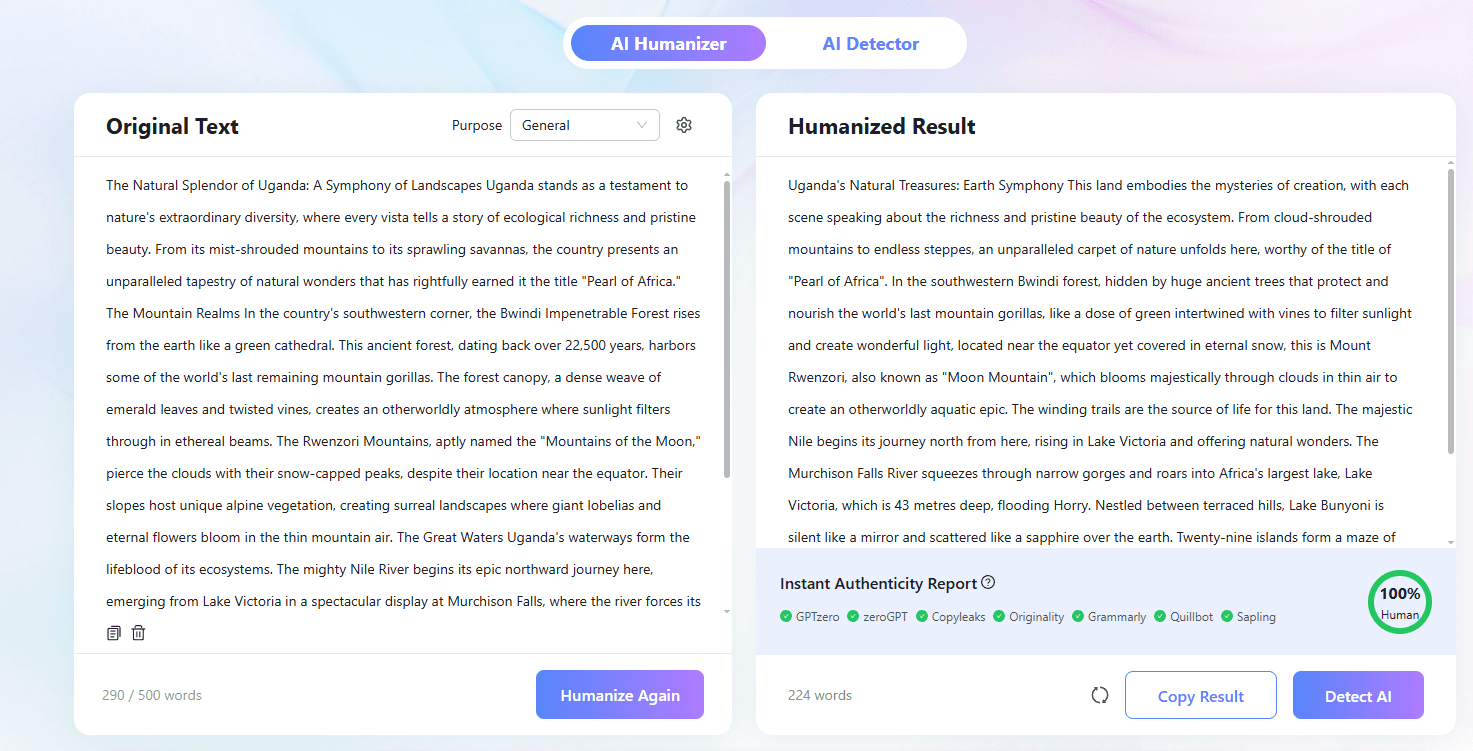
But if your goal is deeper rewriting and more naturally convincing writing quality, Lynote AI Humanizer is still the better alternative.
The reason is simple.
GPTHuman is strongly optimized around detector bypass positioning and workflow convenience. Lynote AI Humanizer feels stronger when the real goal is to make the writing itself feel less templated and more genuinely authored by a human.
That matters because AI-generated writing is often detectable for deeper reasons than wording alone. Common signals include:
- overly even rhythm
- predictable transitions
- repeated paragraph logic
- polished but personality-light phrasing
- structure that feels processed rather than naturally human
A stronger humanizer has to address those deeper patterns, not just produce cleaner wording.
Why Lynote AI Humanizer Is Better
Lynote focuses more on natural writing feel
GPTHuman is strong on detector-facing positioning. Lynote is stronger when the goal is to make the writing itself feel genuinely more human-written.
Lynote is better for long-form content
For blog posts, essays, SEO articles, and longer drafts, deeper structural rewriting matters more than surface-level cleanup.
Lynote is better for content-quality-first workflows
If your goal is not only lowering detector suspicion but also publishing better, more convincing writing for real readers, Lynote is the better overall choice.
So while GPTHuman is a serious option, Lynote AI Humanizer remains the stronger alternative for users who care most about writing quality and deeper human-like variation.
GPTHuman FAQ: Pricing, Features, Languages, and API
Is GPTHuman free?
GPTHuman offers a free plan or trial-level access, but fuller usage depends on plan limits and paid tiers. Users should check the latest pricing details on the official site.
What does GPTHuman do?
It rewrites AI-generated text to sound more natural and more human-written, while also offering built-in AI detection.
Does GPTHuman support languages other than English?
Yes. GPTHuman publicly states support for 50+ languages.
Does GPTHuman have a built-in AI detector?
Yes. One of its key product advantages is that it combines AI humanization with AI detection in the same workflow.
Does GPTHuman offer an API?
Yes. GPTHuman offers API access for businesses, developers, and larger-scale workflow integrations.
Can GPTHuman guarantee that text will bypass every AI detector?
No serious review should make that claim as a universal fact. Detector behavior varies across platforms and changes over time, even if the product itself markets strong bypass claims.
What is the best alternative to GPTHuman?
If your priority is deeper rewriting and more naturally convincing writing quality, Lynote AI Humanizer is the stronger alternative.
Final Verdict: Is GPTHuman Worth It in 2026?
GPTHuman is not a weak product.
It has strong detector-aware positioning, a broader workflow feature set than many lightweight competitors, and some real evidence of detector-facing strength. In this review, it performed very well in QuillBot and Copyleaks, both of which returned clean 0% AI results.
That gives GPTHuman more credibility than many AI humanizer tools that rely only on bold marketing claims.
But the bigger picture is still mixed.
GPTZero classified the sample as 100% AI and labeled it as possible AI paraphrasing. Originality.ai also returned a clearly unfavorable 68% AI result. And while the Turnitin-aligned detector result was better than a full failure, it still detected 26.8% AI.
That inconsistency matters.
It suggests that GPTHuman can reduce detector-facing signals in some environments, but it does not do so reliably enough across major platforms to be treated as a universal bypass tool.
So is GPTHuman worth it?
If you want a detector-aware AI humanizer with some genuinely encouraging results in major detector environments, GPTHuman may still be worth trying.
But if your goal is stronger consistency across detectors, deeper rewriting, and more naturally convincing writing quality, Lynote AI Humanizer is still the better choice.
So the practical takeaway is simple:
Use GPTHuman if you want a serious AI humanizer that performed well in some major detector tests but not all.
Choose Lynote AI Humanizer if you want deeper humanization, stronger writing quality, and a more reliable content-quality-first result.

Written by Danny
Product Marketing Manager
Danny explains how Lynote features fit real workflows, from everyday productivity to product-led writing use cases. View all articles →