

How to Use Pauls Online Math Notes for Better Study

Pauls Online Math Notes is one of the most searched resources for students who need clear explanations in algebra, calculus, and differential equations. The problem is not finding math notes; the harder part is turning long tutorials, worked examples, iPad math notes, and class handouts into a study system you can review before homework, quizzes, or exams.
Why Pauls Online Math Notes Still Gets Attention
Pauls Online Math Notes has stayed popular because it gives students a practical middle ground. It is more detailed than a quick formula sheet, but usually easier to follow than a dense textbook chapter.
The official site explains that the notes were written for classes taught at Lamar University, while still being accessible to students outside those classes. That makes Paul’s Online Math Notes useful for self-study, review, and filling gaps when a course moves too quickly.
For many students, the site becomes a backup teacher. When a lecture on limits, derivatives, integrals, algebra, or differential equations feels too fast, Pauls math notes can slow the concept down.
What Paul’s Online Math Notes Covers
Paul’s math notes are especially useful for students working through college-prep and college-level math. The site includes algebra, Calculus I, Calculus II, Calculus III, differential equations, and review materials.
That range matters because math understanding is cumulative. A student struggling with calculus may not have a calculus problem first; they may have an algebra, trig, exponent, or function-notation gap.
| Resource Area | Why Students Use It |
|---|---|
| Algebra | Review equations, functions, factoring, and graphing |
| Calculus I | Study limits, derivatives, and basic integrals |
| Calculus II | Review integration techniques and series |
| Calculus III | Work through multivariable calculus ideas |
| Differential Equations | Study first-order, second-order, and Laplace topics |
| Review and extras | Fix common math errors and prerequisite gaps |
This is why searches such as pauls math notes, paul math notes, pauls math online notes, and paul’s online math notes often have the same intent. Students want an organized math explanation they can trust.
The Real Problem: Math Notes Are Hard to Reuse
Most students do not fail math because they lack notes. They struggle because their math notes are hard to reuse.

A notebook may have copied formulas, scattered examples, half-finished steps, and unclear corrections from homework. An iPad may have beautiful handwritten pages, but the student still needs to search, summarize, and turn those pages into practice.
That is where an AI note workflow can help. Lynote AI Note Generator can help turn documents, audio, video, images, webpages, and YouTube links into structured AI notes with headings and bullet points, so students can organize math material faster.
How to Take Math Notes That Actually Help
If you are wondering how to take math notes, start with the structure of problem solving. Good math notes should show the concept, the rule, the example, the mistake to avoid, and one practice prompt.
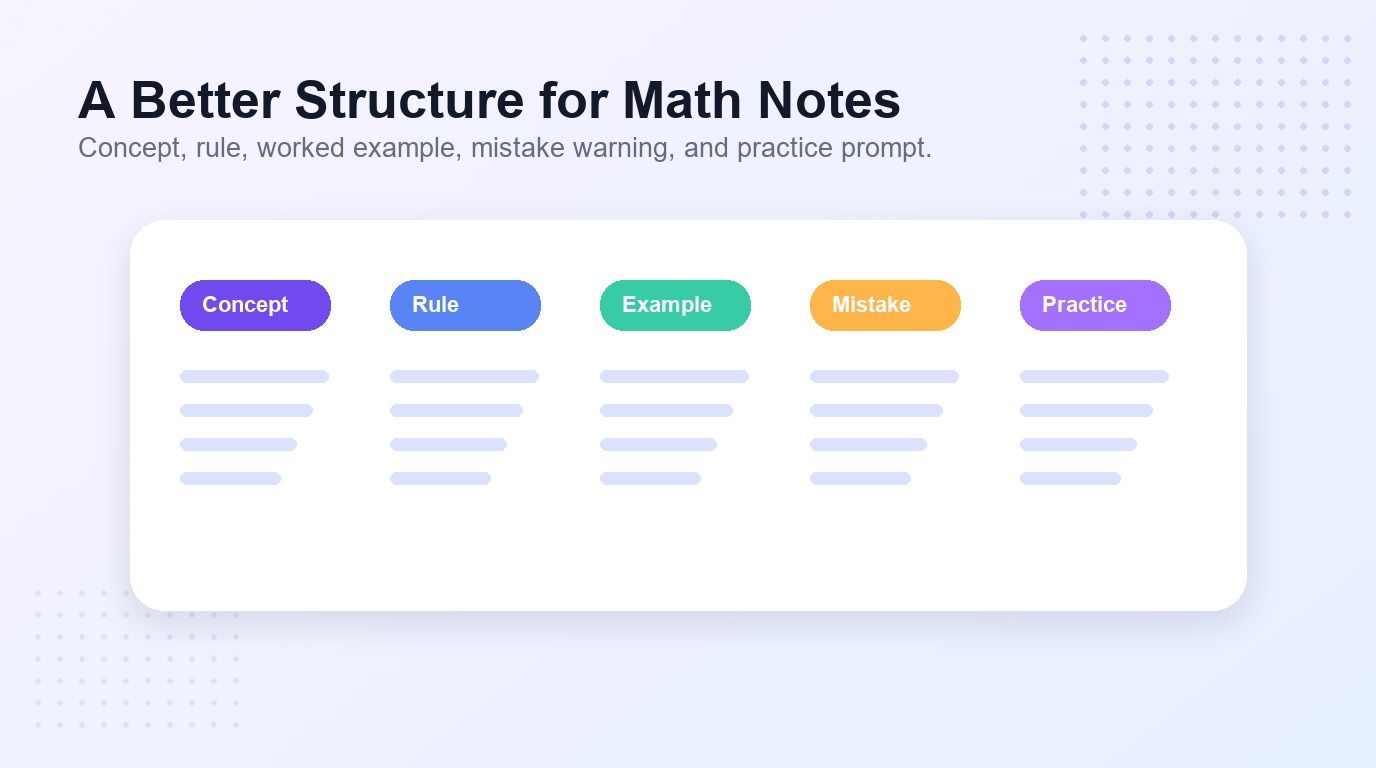
A weak math note says: “Use the chain rule.” A stronger math note says what the chain rule does, when to recognize it, how one example works, and where students usually make errors.
Use this structure for each topic:
| Math Note Part | What to Write |
|---|---|
| Concept | The main idea in simple language |
| Formula or rule | The exact rule, theorem, or method |
| Worked example | One clean example with steps |
| Mistake warning | A common error to avoid |
| Practice prompt | One problem to solve later |
This format works whether you are making math notes notebook pages, math Cornell notes, or math notes on iPad.
How Lynote Can Improve Pauls Online Math Notes Study
Pauls Online Math Notes is strongest as a source of explanations and examples. Lynote is useful when you want to convert those explanations, class notes, and related materials into a cleaner review system.
For example, you might study a Pauls math note page on derivatives, upload your class worksheet, and add a screenshot of your iPad math notes. Lynote can help organize those materials into structured study notes you can revise.
The goal is not to replace the original source. The goal is to make the source easier to review, connect, and practice from.
Step 1. Collect the Math Material
Start with the source you need to understand. That might be a Pauls Online Math Notes page, a PDF handout, a lecture recording, an iPad screenshot, or a homework solution.

If you are working on calculus, collect the related example and the class problem that confused you. If you are working on algebra, collect the rule plus one problem where you made a mistake.
Step 2. Generate Structured Study Notes
Use Lynote to turn the source material into organized math notes. The output can help you separate definitions, formulas, examples, and review points.

For math, this structure is important because one long explanation can hide the step you actually need. A cleaner summary makes it easier to see what to memorize, what to understand, and what to practice.
Step 3. Rewrite the Steps in Your Own Words
Never stop at generated notes. Math learning depends on doing the steps yourself.

After Lynote creates the note, rewrite key steps in your own words. If the topic is integration by parts, explain why you choose each part; if the topic is factoring, explain how you recognized the pattern.
Step 4. Turn Notes Into Practice Prompts
Math notes to write down should always lead to practice. A note that cannot become a problem is often too passive.
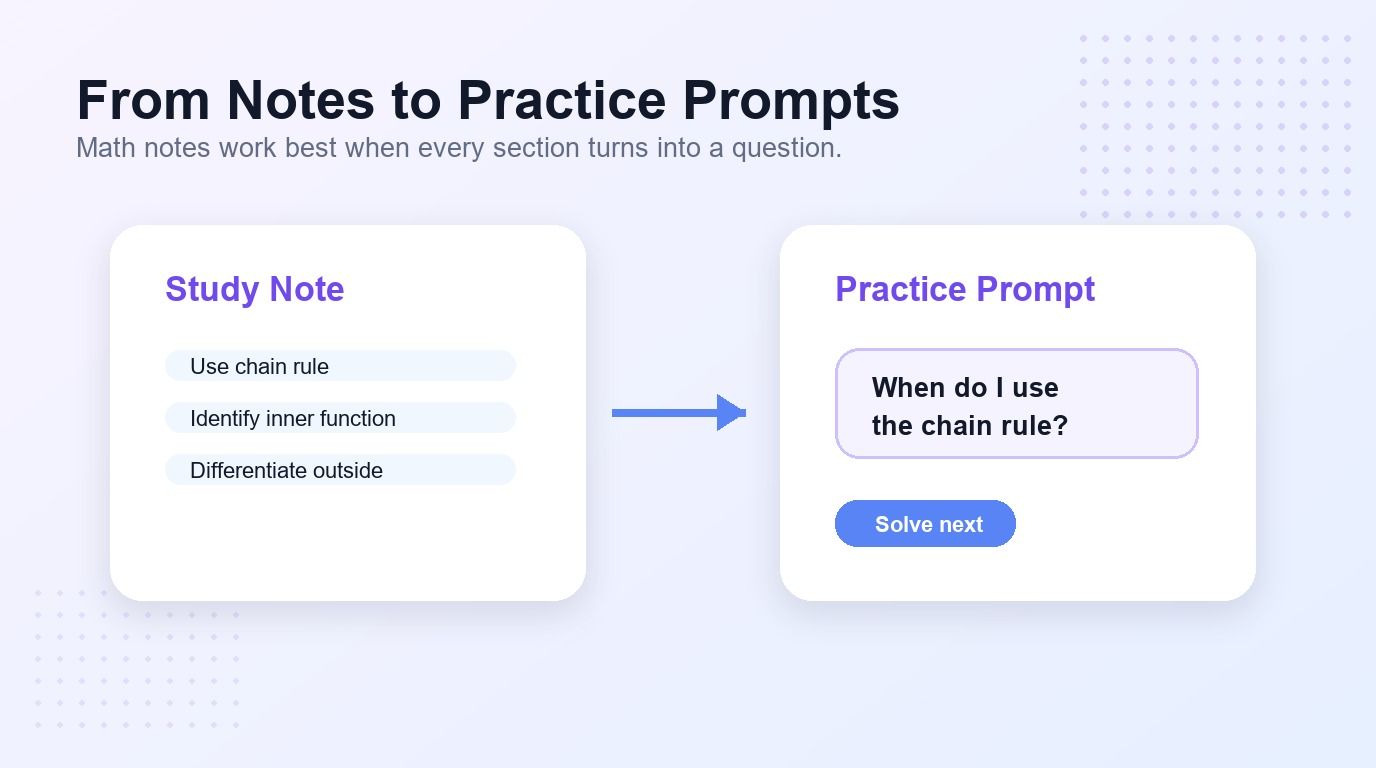
Turn each section into a question: “When do I use this method?” “What is the first step?” “What error should I avoid?” “Can I solve a similar problem without looking?”
Pauls Online Math Notes for Algebra Review
Algebra is one of the most useful parts of Pauls Online Math Notes because so many math problems depend on it. Students often search for math notes because they need help with factoring, functions, radicals, inequalities, or graphing.
If you are in 6th grade, pre-algebra, algebra, or preparing for higher math, the same principle applies. Your notes should explain the operation, show the pattern, and include one example you can repeat.
For math notes for 6th graders or 6th grade math study notes, keep the format lighter. Use fewer formulas and more examples, diagrams, and “what this means” explanations.
Pauls Math Notes for Calculus
Calculus notes need more than formulas. You need to understand when a limit, derivative, or integral method applies.
A good calculus note should include the visual idea, the rule, the algebra steps, and one interpretation. For example, a derivative is not only a formula; it can represent rate of change, slope, velocity, or sensitivity.
When you use Paul’s math notes for calculus, do not copy every line. Pull out the recognition pattern: “This is a chain rule problem because there is one function inside another.”
iPad Math Notes: Helpful but Easy to Lose
iPad math notes can be beautiful, but they are not automatically useful. Many students write clean pages in GoodNotes, Notability, OneNote, or Apple Notes and still cannot find the right example later.
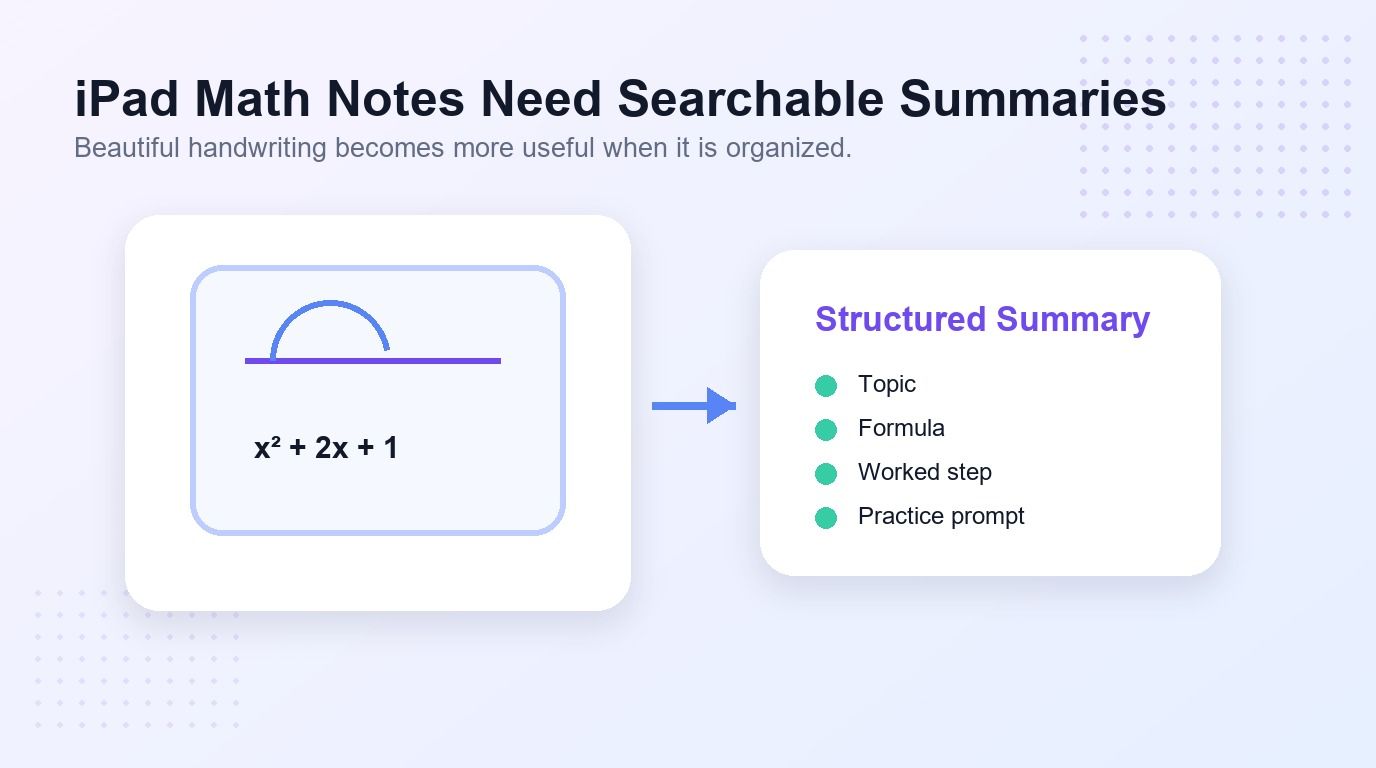
The solution is to tag and summarize. After a class, turn the page into a short review note with the topic, formula, example, and mistake warning.
If you use math notes on iPad, export key pages as images or PDFs and organize them by unit. Lynote can help you turn those visual notes and files into a more searchable study structure.
Math Cornell Notes for Problem Solving
Math Cornell notes work well when you adapt the format for problem solving. The left column should not only hold keywords; it should hold questions.
Use the right side for worked steps and explanations. Use the bottom summary for the method: when to use it, what to check, and which mistake to avoid.
A math Cornell notes page might look like this:
| Cornell Area | Math Version |
|---|---|
| Cue column | “When do I use this formula?” |
| Notes area | Worked example and step explanation |
| Summary | Rule, recognition clue, common mistake |
| Review prompt | Similar problem to solve without notes |
This helps students review actively instead of rereading passively.
Pauls Math Note vs AI Study Notes
A Pauls math note is a source explanation. An AI study note is a personalized review layer built from your source materials.
You still need the original explanation because math accuracy matters. But an AI note can help you organize related materials, condense long examples, and turn scattered notes into a study plan.
| Use Case | Better Tool |
|---|---|
| Learn a new calculus topic | Pauls Online Math Notes |
| Review your class handout | Lynote |
| Organize iPad notes | Lynote |
| Check a worked example | Paul’s math notes |
| Build a study guide from many sources | Lynote |
| Create practice prompts | Lynote plus your own solving work |
The strongest workflow uses both: a trusted explanation source and an organized note system.
How to Avoid Bad Math Notes
Bad math notes usually have three problems. They are too long, too formula-heavy, or too disconnected from practice.
A page full of formulas may look productive, but it often fails during a test because the student does not know when to use each formula. A page full of copied examples may also fail if the student never solves a similar problem alone.
Better math notes explain recognition. Before each example, write: “I know this method applies because…”
Best Topics to Turn Into AI Math Notes
Not every math topic needs AI notes. Short arithmetic or simple one-step examples may be faster to write by hand.
AI notes are more useful for multi-step topics, long explanations, or mixed sources. That includes calculus review, algebra error logs, differential equations summaries, statistics units, and exam-prep packets.
Good candidates include:
| Topic Type | Why AI Notes Help |
|---|---|
| Long tutorials | Easier to summarize into study sections |
| Lecture recordings | Helps capture steps and explanations |
| iPad note exports | Makes handwritten material easier to organize |
| Practice problem sets | Helps group errors by topic |
| Review packets | Turns scattered review into a plan |
FAQs About Pauls Online Math Notes
What is Pauls Online Math Notes?
Pauls Online Math Notes is a free math tutorial and notes site created by Paul Dawkins for courses taught at Lamar University. It includes algebra, calculus, differential equations, and review materials.
Is Paul’s Online Math Notes good for calculus?
Yes, Paul’s Online Math Notes is widely used for calculus review because it includes explanations, examples, practice problems, and downloadable materials. Students should still compare it with their own course requirements.
Can Lynote replace Pauls Math Notes?
No. Lynote should not replace a trusted math source. It can help organize, summarize, and reuse materials from Pauls Math Notes, class lectures, PDFs, and iPad notes.
How do I take better math notes?
Write the concept, formula, worked example, mistake warning, and practice prompt. Good math notes should help you solve problems, not just reread rules.
Are iPad math notes better than notebooks?
iPad math notes can be easier to organize, export, and search, but only if you structure them well. A paper notebook can work just as well when the notes are clear and reviewable.
Final Thoughts
pauls online math notes is valuable because it gives students clear explanations across algebra, calculus, and differential equations. The next step is making those math notes usable: combine Paul’s Online Math Notes with class materials, iPad math notes, Cornell notes, and Lynote-generated study summaries so every topic becomes easier to review, practice, and remember.
Sources:

Written by Janet L. Harris
AI Writing Specialist
Janet reviews AI detectors and humanization tools, with a focus on accuracy, limitations, and responsible use. View all articles →