
AP Chemistry Notes: How to Study Every Unit and Prepare for the Exam

Preparing for AP Chemistry means connecting atomic structure, chemical bonding, reactions, energy, and equilibrium rather than memorizing isolated facts. Well-organized AP chemistry notes help you understand how these ideas relate, remember important equations, and apply chemical principles to calculations, laboratory data, and exam questions.
This guide follows the nine-unit AP Chemistry course structure and explains what to include in your study notes, how to review formulas and experiments, and how to prepare for the exam. It also shows how to turn your own class materials into editable study resources with Lynote AI Note Generator.
TL;DR: How to Make AP Chemistry Notes More Useful
- Organize your notes around the nine current AP Chemistry units.
- Connect each concept to a particle-level model, chemical representation, equation, or experiment.
- Keep formulas together with variable definitions, units, assumptions, and a worked example.
- Compare related concepts such as ionic and covalent bonding, reaction rate and equilibrium, or strong and weak acids.
- Review laboratory methods, data interpretation, and sources of experimental uncertainty.
- Practice multiple-choice and free-response questions instead of only rereading notes.
- Use Lynote to structure your own supported study materials, then verify and edit the generated notes.
What Should AP Chemistry Notes Include?
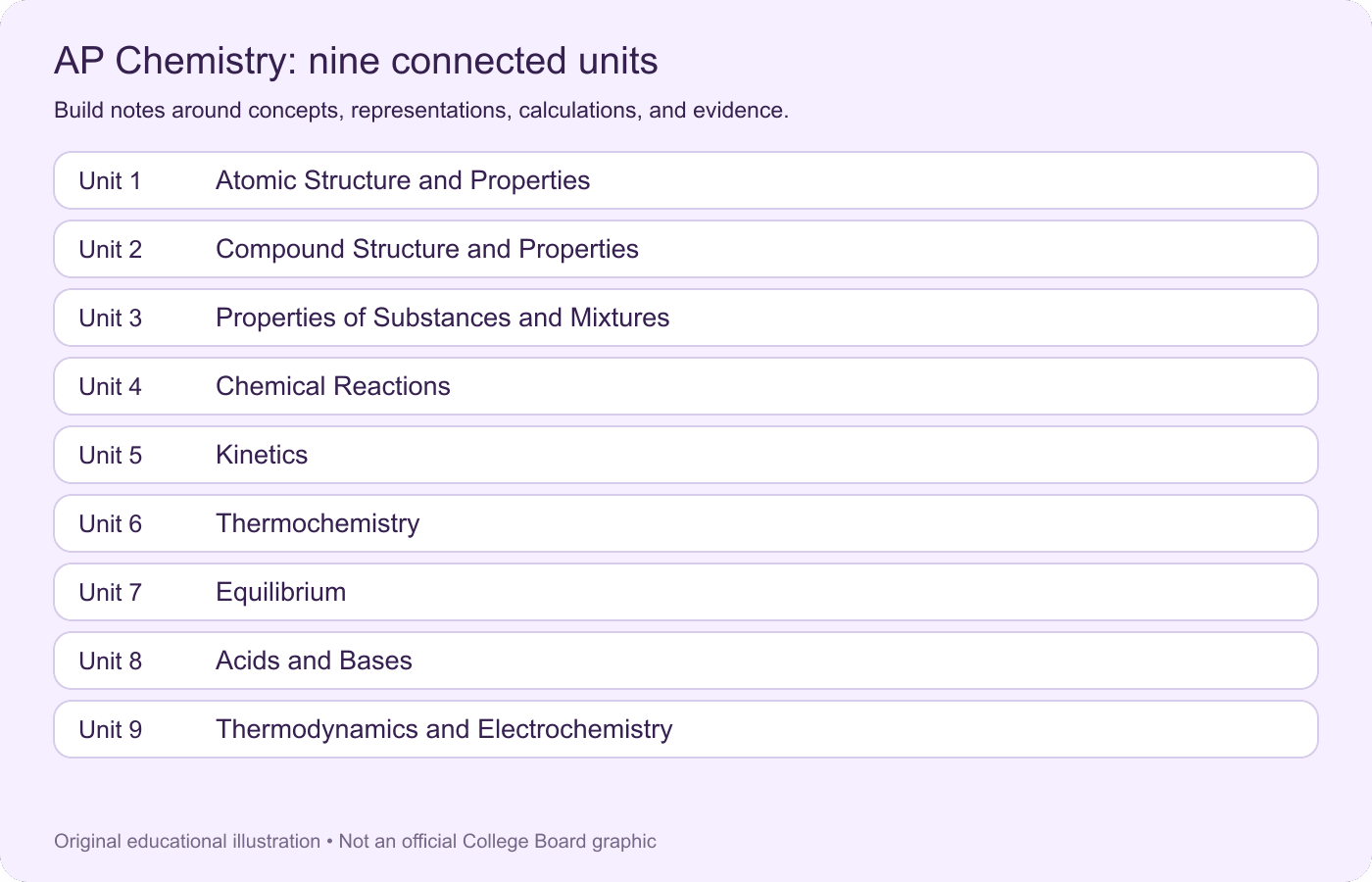
Effective AP Chemistry notes explain how chemical ideas work and how to apply them. A page of definitions may help you recognize terminology, but exam preparation also requires interpreting models, writing equations, performing calculations, and supporting conclusions with evidence.
A useful topic note can include six parts:
- Core idea: A short explanation of the chemical principle.
- Representation: A particle diagram, Lewis structure, graph, or chemical equation.
- Relationship: The formula or rule that connects the variables.
- Worked example: A calculation or application using the concept.
- Common mistake: A misconception, unit error, or condition to check.
- Review prompt: A question that requires you to explain or apply the idea.
AP Chemistry Notes vs. Formula Memorization
Memorizing an equation does not automatically tell you when to use it. For example, knowing the ideal gas law is different from identifying which quantities are given, converting temperature to kelvin, and selecting the correct gas constant.
Add a short example beneath each important formula. Include units and explain why the equation applies to that situation.
AP Chemistry Unit 1 Notes: Atomic Structure and Properties
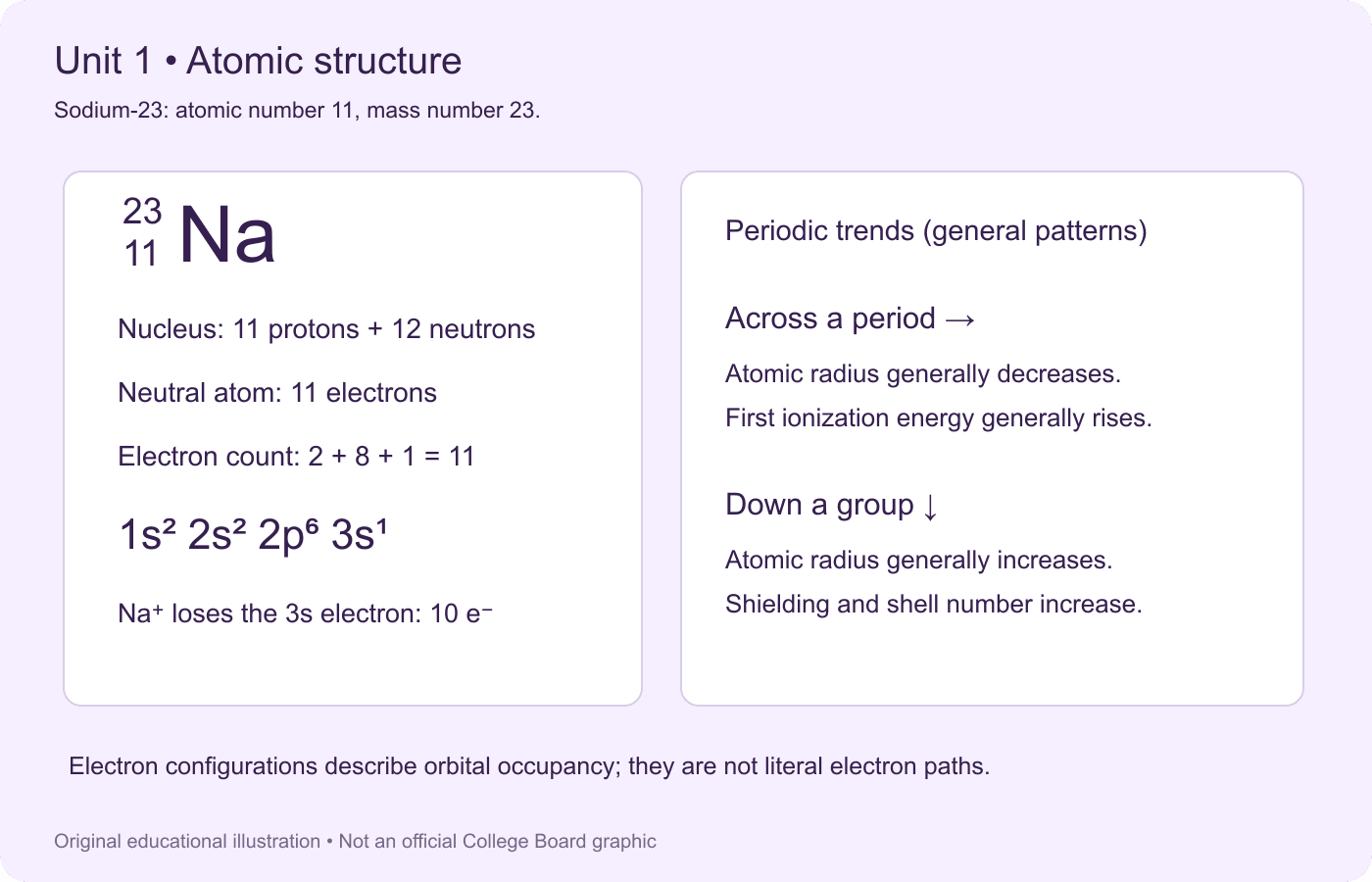
Unit 1 focuses on atomic structure and the evidence used to describe it. Your AP Chemistry Unit 1 notes should connect subatomic particles, isotopes, mass spectrometry, electron structure, and periodic trends.
Key Topics for Unit 1
- Moles and atomic mass: Connect the mole to particle counting and molar mass.
- Mass spectrometry: Interpret isotopic mass and relative abundance from a mass spectrum.
- Atomic structure: Review protons, neutrons, electrons, and the organization of the nucleus.
- Electron configurations: Write configurations and identify valence electrons.
- Photoelectron spectroscopy: Interpret relative electron binding energies and subshell information.
- Periodic trends: Explain patterns in atomic and ionic radii, ionization energy, and electron affinity using effective nuclear charge and shielding.
Create a comparison table for atomic properties and explain the reason behind each trend. When reviewing AP Chemistry Unit 1 notes PDF materials, check that diagrams and electron configurations are readable.
AP Chemistry Unit 2 Notes: Compound Structure and Properties
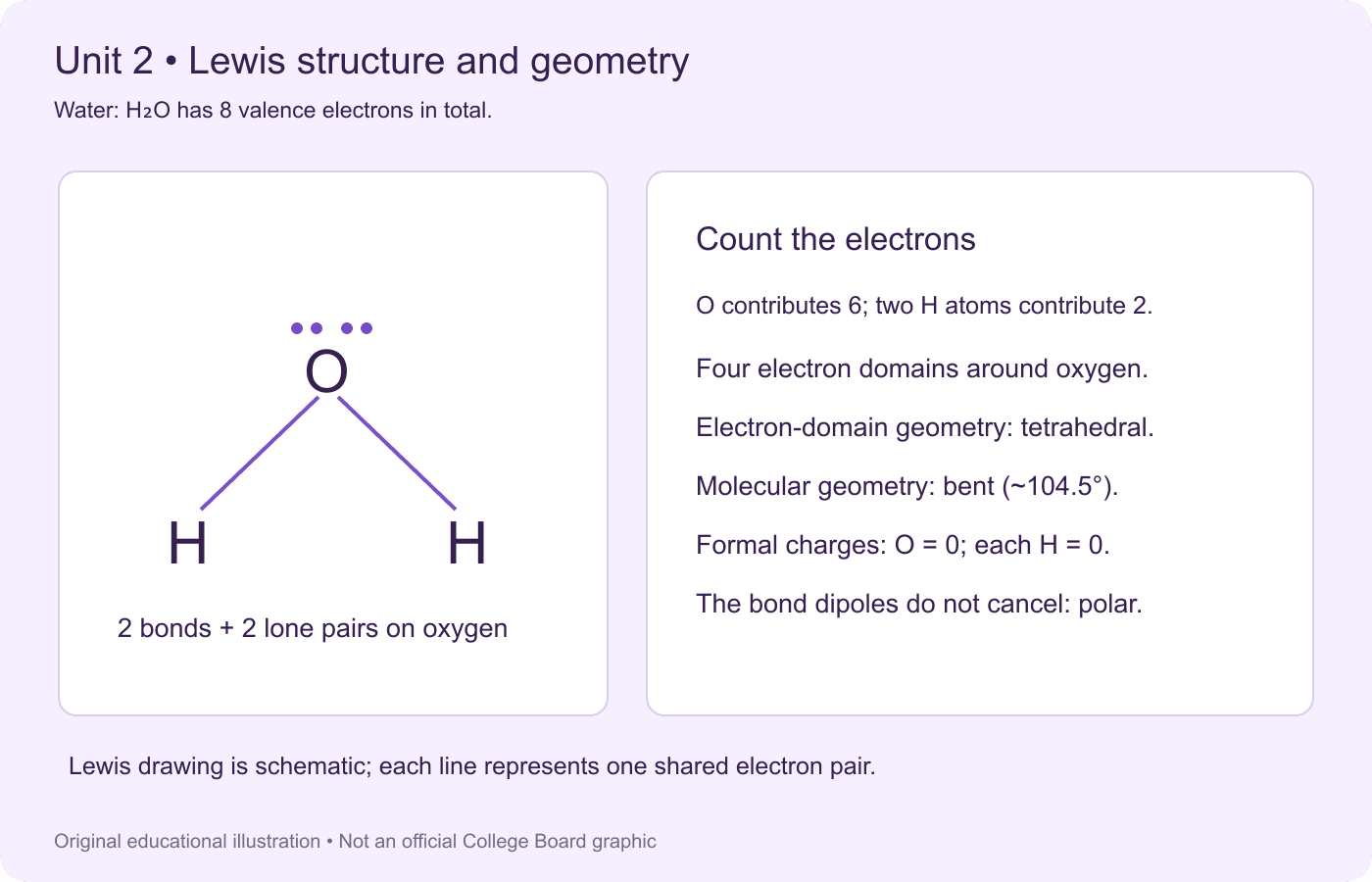
Unit 2 examines how atoms bond and how bonding and structure influence the properties of substances. Your notes should connect chemical bonds, molecular structure, intermolecular forces, and bulk properties.
Key Topics for Unit 2
- Chemical bonding: Compare ionic, covalent, and metallic bonding models.
- Lewis structures: Represent valence electrons and bonding arrangements.
- Formal charge and resonance: Evaluate alternative valid structures.
- VSEPR theory: Predict molecular geometry from electron domains.
- Bond polarity: Relate electronegativity differences to bond dipoles.
- Intermolecular forces: Compare dispersion forces, dipole-dipole interactions, and hydrogen bonding.
- Properties of solids: Connect structure and bonding to conductivity and melting behavior.
Build Structure-to-Property Connections
Explain how molecular shape and bond polarity affect the overall polarity of a molecule. Then connect intermolecular attractions to properties such as boiling point and vapor pressure.
Use Lewis structures and particle diagrams alongside written explanations. Verify valence electrons, formal charges, and geometry against your course materials.
AP Chemistry Unit 3 Notes: Properties of Substances and Mixtures
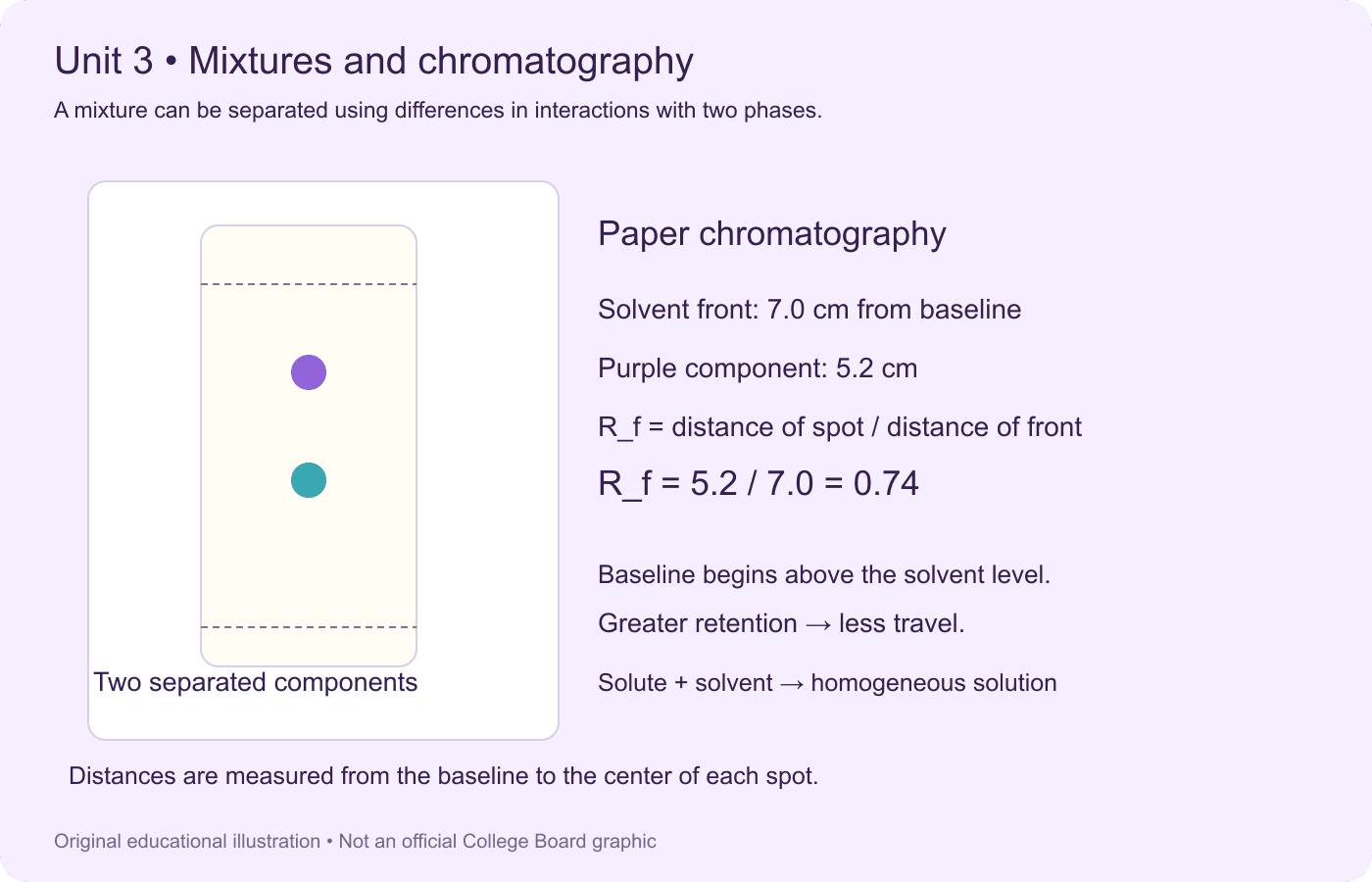
Unit 3 focuses on how particle structure and interactions help explain substances and mixtures. Your AP Chemistry Unit 3 notes should connect solutions, mixtures, solubility, and separation methods to particle-level behavior.
Key Topics for Unit 3
- Intermolecular attractions: Explain how particle interactions influence physical properties.
- Solutions and mixtures: Distinguish solutes, solvents, homogeneous mixtures, and heterogeneous mixtures.
- Solubility: Describe how temperature, pressure, and intermolecular interactions can affect dissolving.
- Concentration: Practice molarity and other concentration representations used in your course.
- Separation methods: Understand how filtration, distillation, and chromatography use differences in physical properties.
For each mixture or solution, identify its components and explain what happens at the particle level. Include a worked concentration example with units and show each conversion step.
AP Chemistry Unit 4 Notes: Chemical Reactions
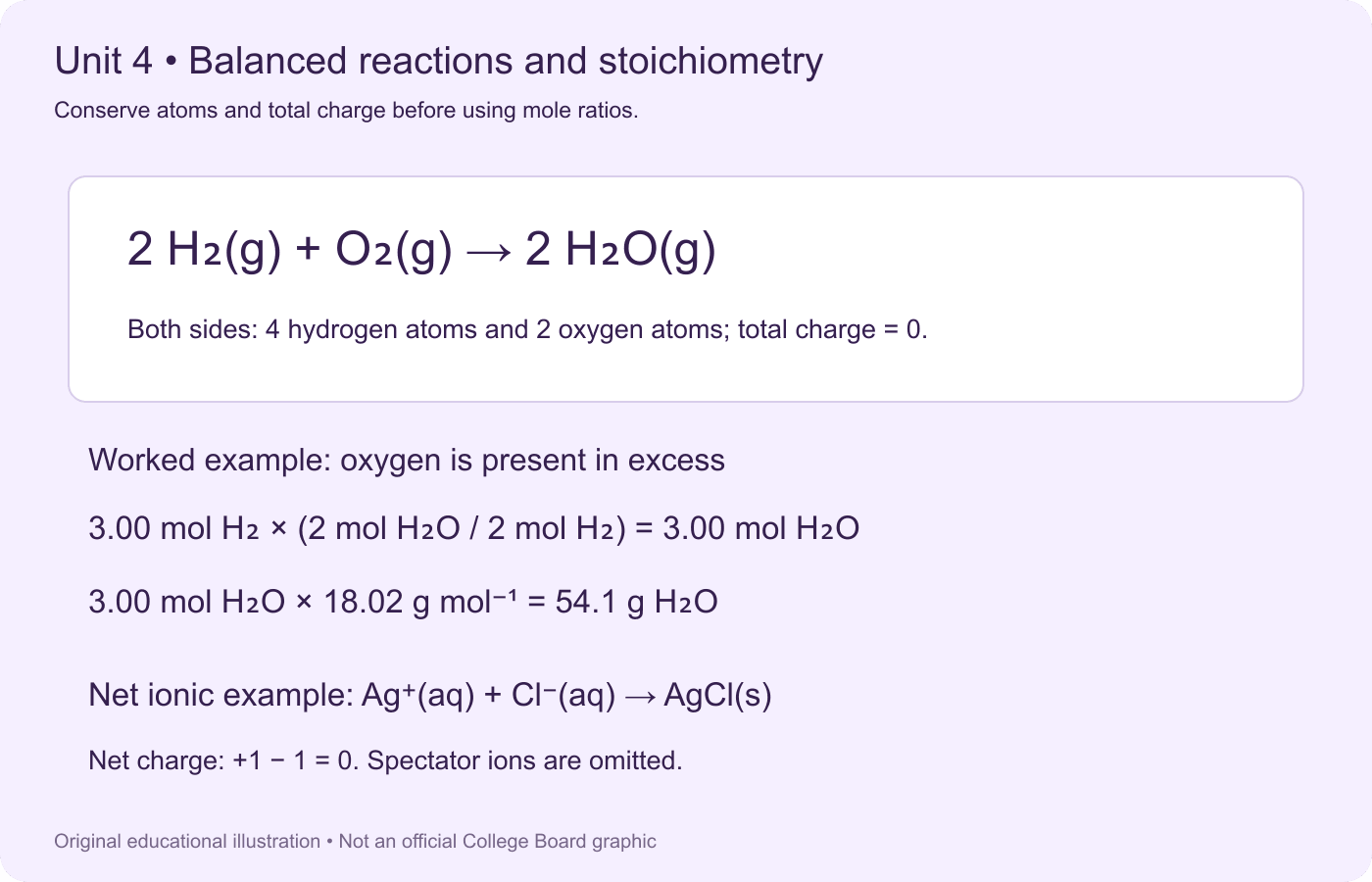
Unit 4 focuses on representing and analyzing chemical reactions. Your AP Chemistry Unit 4 notes should cover reaction equations, stoichiometry, net ionic equations, and relationships between quantities of reactants and products.
Key Topics for Unit 4
- Reaction representations: Translate between chemical equations, particle diagrams, and written descriptions.
- Balancing equations: Conserve atoms and charge.
- Reaction types: Identify relevant reaction patterns.
- Stoichiometry: Use mole ratios to calculate reactants and products.
- Limiting reactants: Determine which reactant limits product formation.
- Net ionic equations: Remove spectator ions while preserving atoms and charge.
- Titration: Connect measured quantities to reaction stoichiometry where appropriate.
Practice Stoichiometry Step by Step
Start with a balanced chemical equation, convert the given quantity into moles, use the mole ratio, and convert to the requested unit. Check that the final answer has correct units and reasonable significant figures.
For limiting-reactant problems, calculate how much product each reactant could produce. The reactant that produces the smaller amount determines the theoretical yield.
AP Chemistry Unit 5 Notes: Kinetics
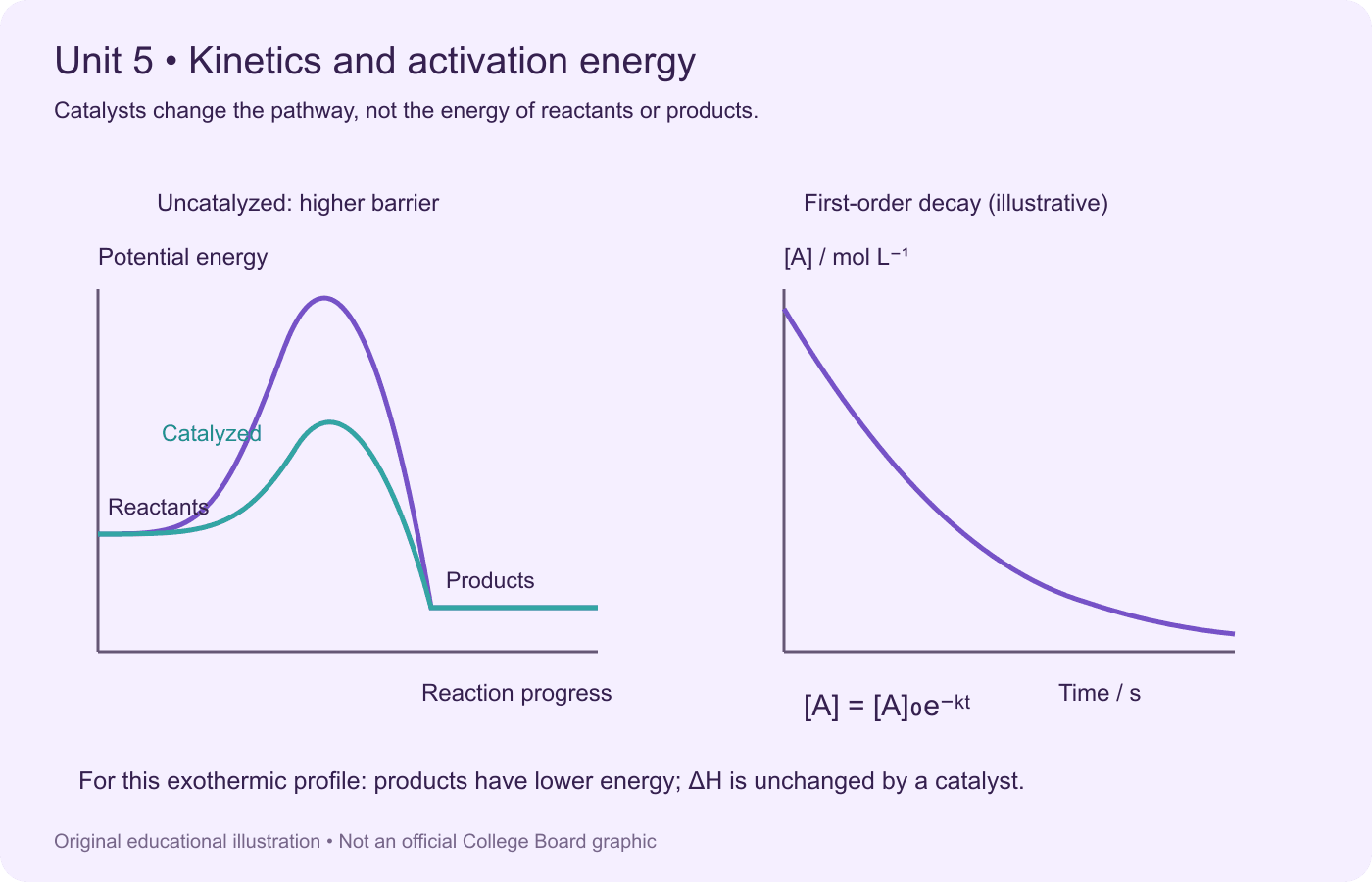
Unit 5 examines reaction rates and the factors that influence how quickly chemical reactions occur. Your AP Chemistry kinetics notes should connect concentration, reaction rate, rate laws, reaction mechanisms, and activation energy.
Key Topics for Unit 5
- Reaction rates: Interpret changes in reactant or product concentration over time.
- Rate laws: Relate reaction rate to reactant concentrations and experimentally determined orders.
- Concentration and time: Use integrated rate laws and graphs to analyze reaction progress.
- Collision model: Explain how particle collisions, orientation, and energy influence reaction rates.
- Reaction mechanisms: Understand elementary steps and how they relate to an overall reaction.
- Activation energy: Interpret energy diagrams and the effect of catalysts.
Keep rate laws, integrated rate laws, and their corresponding graph relationships together. Do not assume reaction orders can always be read from coefficients in the balanced overall equation; rate laws are generally determined experimentally.
AP Chemistry Unit 6 Notes: Thermochemistry
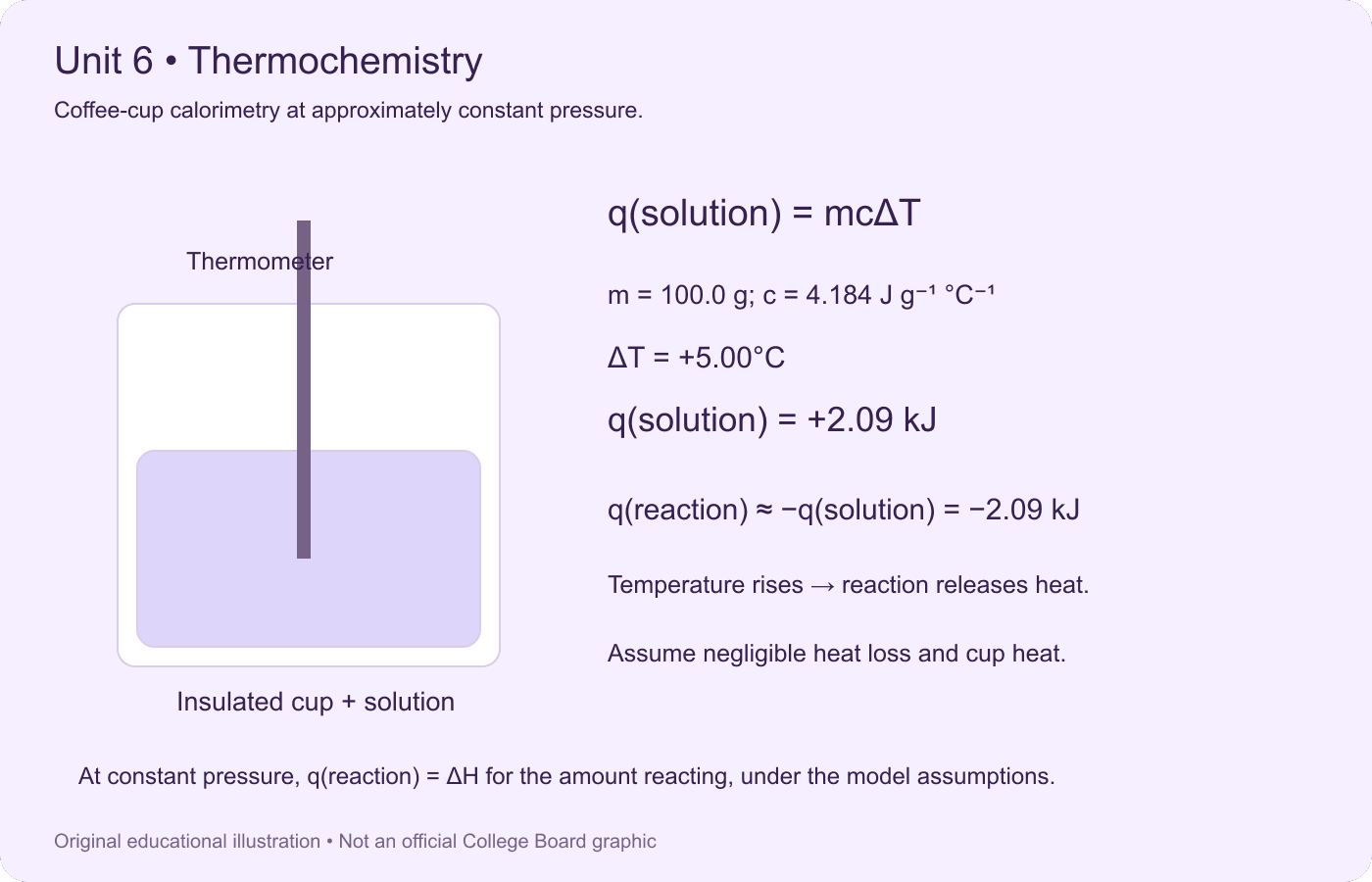
Unit 6 focuses on energy changes in chemical and physical processes. Your AP Chemistry thermodynamics notes should connect heat transfer, calorimetry, enthalpy, and energy diagrams.
Key Topics for Unit 6
- Endothermic and exothermic processes: Distinguish heat absorbed from heat released by a system.
- Heat capacity and specific heat: Relate mass, specific heat, and temperature change to heat transfer.
- Calorimetry: Use experimental temperature changes to estimate energy transfer.
- Enthalpy: Interpret enthalpy changes and thermochemical equations.
- Hess's law: Combine reactions to determine an overall enthalpy change.
- Bond enthalpy: Estimate reaction enthalpy from bonds broken and formed.
For calorimetry, identify the system, surroundings, measured temperature change, and sign of heat transfer. When using Hess's law, show how each reaction is reversed, multiplied, or added, and adjust enthalpy values consistently.
AP Chemistry Unit 7 Notes: Equilibrium
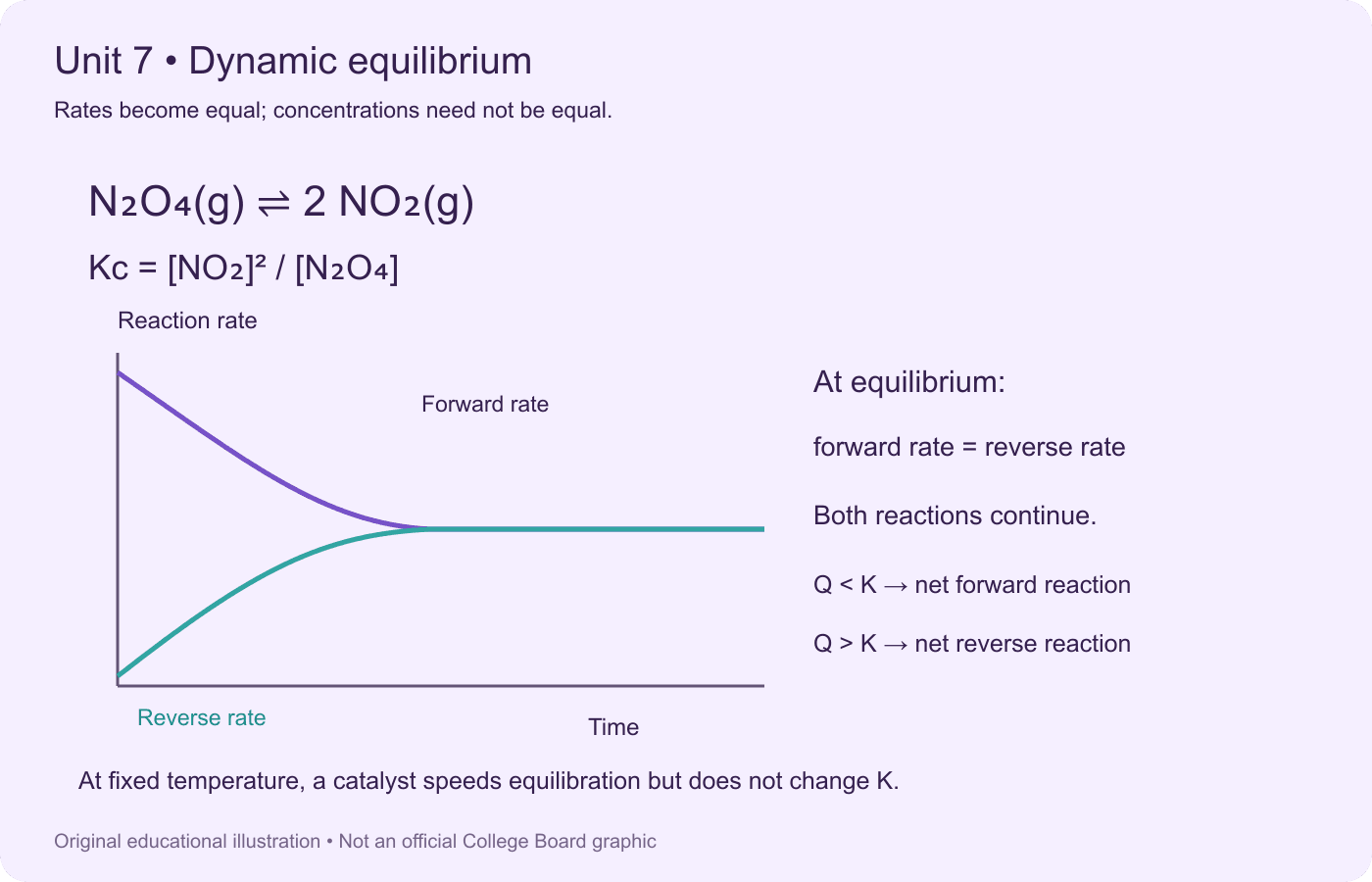
Unit 7 examines reversible reactions and the dynamic balance between forward and reverse processes. Your AP Chemistry equilibrium notes should explain equilibrium expressions, reaction quotients, and how systems respond to changes in conditions.
Key Topics for Unit 7
- Dynamic equilibrium: Forward and reverse reaction rates are equal while concentrations remain constant.
- Equilibrium constants: Write K expressions using appropriate species and powers.
- Reaction quotient: Compare Q with K to predict the direction of net reaction.
- Equilibrium calculations: Use initial, change, and equilibrium values where appropriate.
- Le Châtelier's principle: Predict responses to changes in concentration, pressure, or temperature.
- External conditions: Distinguish changes that affect equilibrium position from those that change K at a fixed temperature.
Practice writing equilibrium expressions from balanced equations. Pure solids and pure liquids are omitted from standard equilibrium expressions.
If Q is less than K, the reaction proceeds in the forward direction toward equilibrium; if Q is greater than K, it proceeds in the reverse direction. Temperature changes can change K, while adding a catalyst does not change the equilibrium constant.
AP Chemistry Unit 8 Notes: Acids and Bases
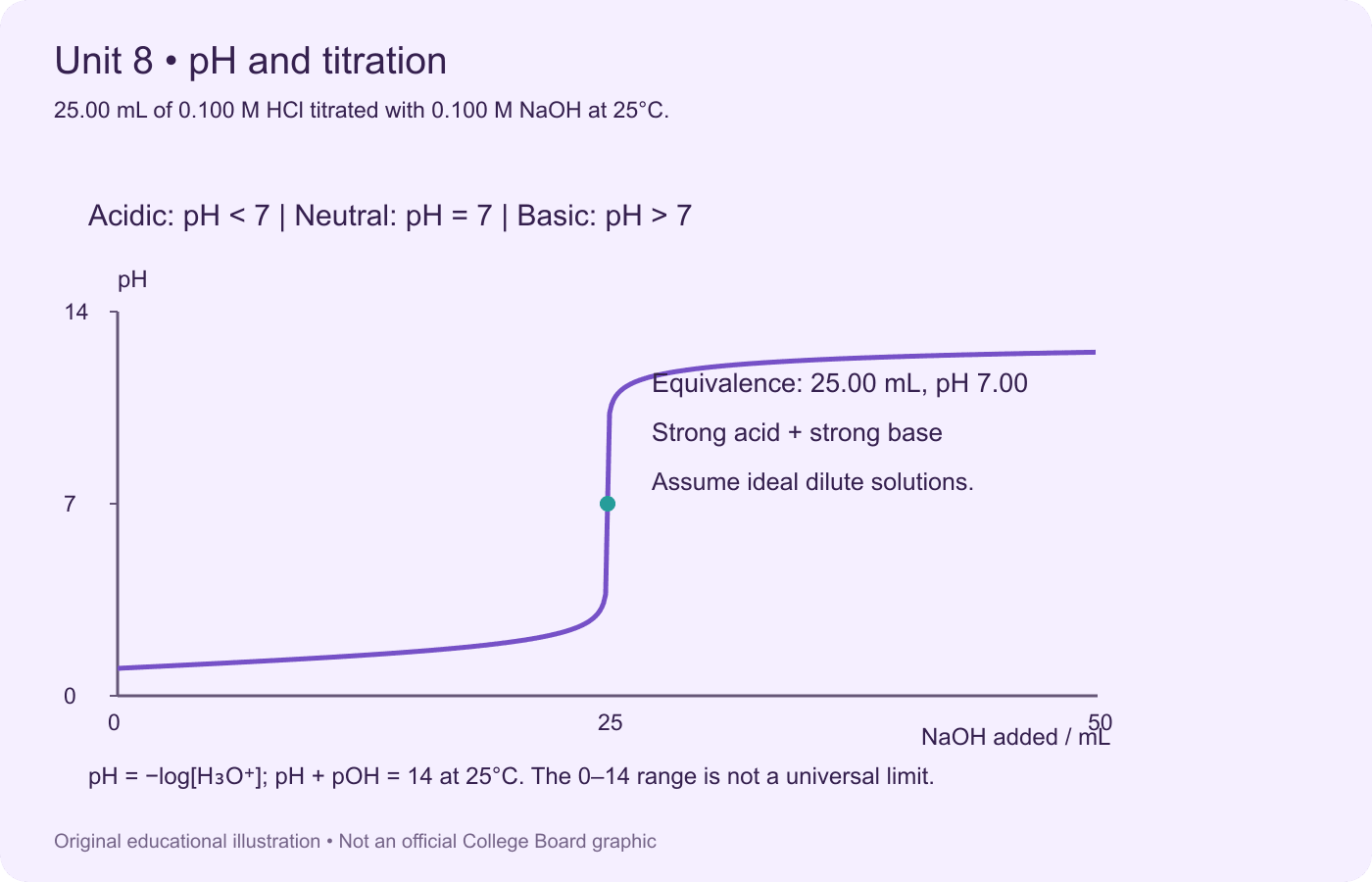
Unit 8 focuses on acid-base behavior, pH, equilibrium, buffers, and titrations. Your acids and bases AP Chemistry notes should connect definitions, mathematical relationships, molecular structure, and experimental evidence.
Key Topics for Unit 8
- Acid-base definitions: Compare relevant models, including Brønsted-Lowry concepts.
- Strong and weak acids and bases: Distinguish complete ionization from partial ionization.
- pH and pOH: Calculate acidity and basicity using concentration relationships.
- Acid-base equilibrium: Use Ka, Kb, and related equilibrium expressions.
- Buffers: Explain how conjugate acid-base pairs resist changes in pH.
- Titrations: Interpret titration curves and identify equivalence points and relevant regions.
Acids and Bases AP Chemistry Review Tips
Do not treat strong and concentrated as interchangeable terms. Strength describes the extent of ionization, while concentration describes the amount of solute in a given volume.
When reviewing titration problems, identify the type of acid and base, the stage of the titration, and the information available. Use the appropriate stoichiometric or equilibrium method rather than applying one formula to every point on a titration curve.
AP Chemistry Unit 9 Notes: Thermodynamics and Electrochemistry
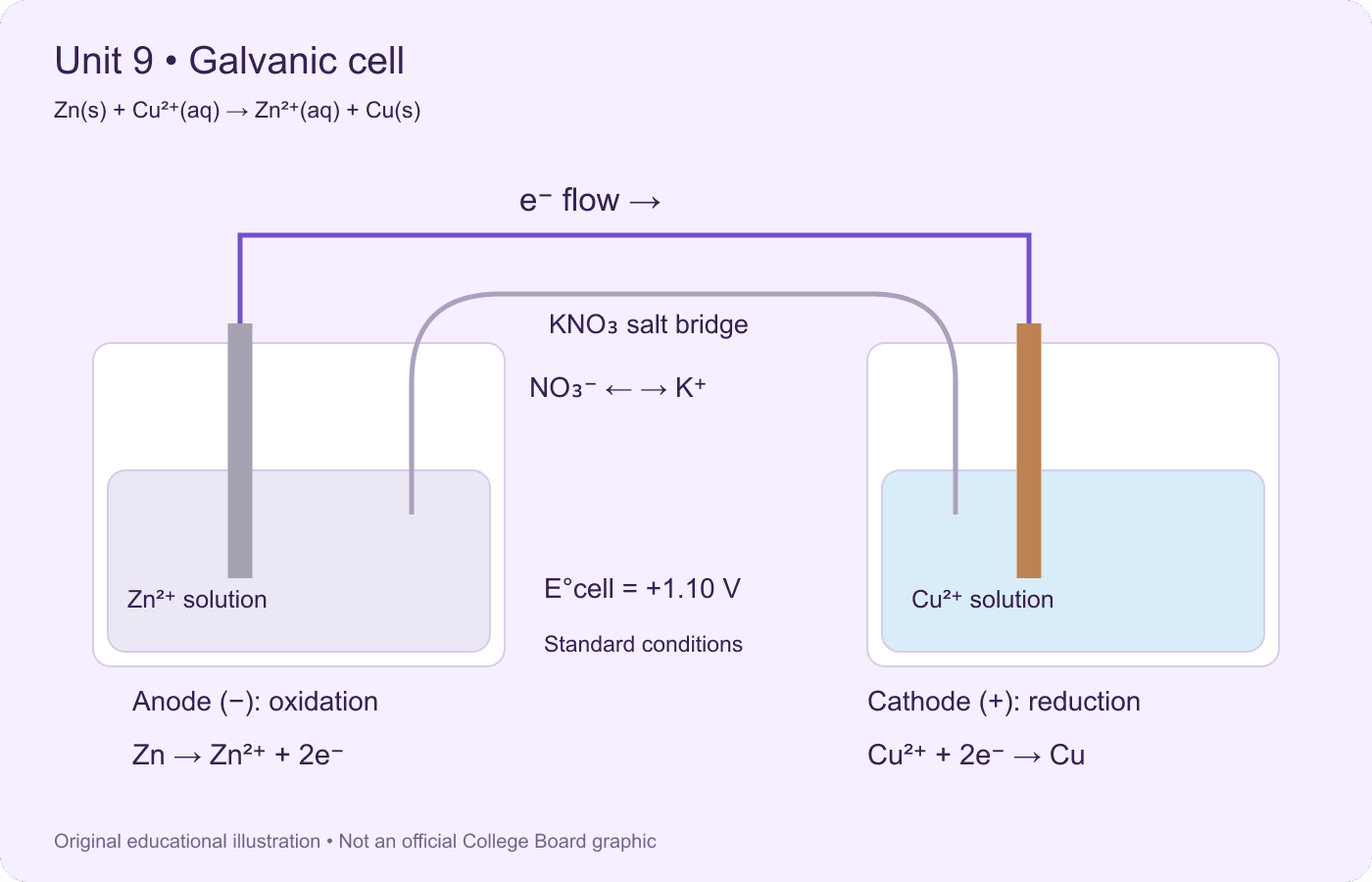
Unit 9 applies thermodynamic principles to chemical processes, including entropy, Gibbs free energy, and electrochemistry. Your notes should connect energy, spontaneity, redox reactions, and electrochemical cell behavior.
Key Topics for Unit 9
- Entropy: Explain how energy and matter can become more dispersed in a process.
- Gibbs free energy: Connect enthalpy, temperature, and entropy.
- Spontaneity: Interpret the sign of Gibbs free energy under specified conditions.
- Redox reactions: Identify oxidation and reduction through electron transfer and oxidation numbers.
- Galvanic cells: Explain how spontaneous redox reactions can produce electrical energy.
- Electrolytic cells: Understand how an external electrical source drives a nonspontaneous reaction.
- Cell potential: Interpret standard reduction potentials and calculate cell potential using the correct convention.
Electrochemistry Notes AP Chemistry Students Should Review
Remember that oxidation occurs at the anode while reduction occurs at the cathode. In a galvanic cell, electrons flow through the external circuit from anode to cathode.
Practice interpreting cell diagrams and connecting electrode reactions to the overall balanced redox equation. Check signs and standard conditions carefully when using reduction potentials and Gibbs free energy relationships.
AP Chemistry Chapter Notes: How to Organize Textbook Readings
Many students create AP Chemistry chapter notes from textbooks, teacher assignments, and supplementary resources. Chapter numbering can vary by textbook, edition, and course sequence, so always use the table of contents and reading schedule assigned by your teacher.
A useful chapter note should include the chapter title, related AP unit, key terms, formulas, diagrams, worked examples, and review questions.
AP Chemistry Chapter 1 Notes
Identify the actual topic covered by Chapter 1 in your textbook. If it introduces measurement, matter, atomic concepts, or foundational chemical ideas, connect the chapter to the appropriate unit in your current course framework.
Record important definitions and measurement conventions, then add practice questions that require unit conversion or interpretation.
AP Chemistry Chapter 8 Notes
Chapter 8 covers different topics in different textbooks. Before creating chapter notes, confirm the title and learning objectives in your assigned edition.
Organize the reading into concepts, chemical representations, equations, and worked examples. Connect the material to the corresponding AP unit rather than assuming the chapter number has a universal meaning.
How to Make AP Chemistry Chapter Notes
Use a consistent format for every reading:
- Chapter objective: What should you understand after studying?
- Key vocabulary: Important terms and concise definitions.
- Chemical models: Structures, diagrams, and reaction representations.
- Equations: Formulas, variable meanings, and conditions.
- Worked problems: Step-by-step calculations.
- Review questions: Prompts that test understanding and application.
This format works with many textbooks, including resources by Zumdahl, while keeping your notes aligned with your teacher's course sequence.
AP Chemistry Notes from Zumdahl, AMSCO, Reddit, and Other Resources
Students use different textbooks, teacher handouts, online communities, and review resources when preparing for AP Chemistry. These materials may use different chapter numbering, terminology, or teaching sequences.
If you are searching for AP Chemistry notes Zumdahl, AMSCO materials, Gordon Watson's older notes, Emily Miller study resources, or AP Chemistry notes Reddit discussions, check the source and edition before relying on them. These are separate resources, not interchangeable versions of the official AP course framework.
How to Use Older AP Chemistry Notes
Older resources can still help explain foundational concepts, but course organization and exam expectations can change. Compare the material with your current class syllabus and the latest College Board course framework.
Searches such as AP Chemistry notes 2020 or AP Chemistry notes 2020 by Gordon Watson may lead to older study resources. Check the publication date, topic coverage, and accuracy before using them for current exam preparation.
What About AP Chemistry Daily Video Notes?
If your teacher assigns AP Daily videos or other recorded lessons, take notes on the learning objective, key explanation, chemical representation, and any example problem. Pause after a major concept and write a short summary in your own words.
Use only recordings and materials you are authorized to access and process. A video note should support your understanding rather than replace the original lesson or assigned practice.
AP Biology Chemistry of Life Notes vs. AP Chemistry Notes
AP Biology Unit 1 includes chemistry-of-life concepts, but AP Biology and AP Chemistry are different courses. AP Biology focuses on how chemical properties support biological structures and processes, while AP Chemistry develops broader chemical models and quantitative reasoning.
If you are looking for AP Biology Unit 1 chemistry of life notes, make sure you use biology-specific course materials. Do not assume AP Chemistry unit notes cover the same learning objectives.
Pre-AP Chemistry Notes
Pre-AP Chemistry materials generally introduce foundational topics that prepare students for more advanced chemistry study. They may cover matter, atomic structure, bonding, chemical equations, and basic quantitative relationships.
Use the course syllabus to distinguish Pre-AP content from AP Chemistry requirements. Building strong foundational notes can help, but the two courses should not be treated as identical.
How to Prepare for the AP Chemistry Exam with Effective Study Notes
Preparing for the AP Chemistry exam requires more than memorizing chemical formulas and definitions. You need to understand chemical relationships, interpret experimental data, solve quantitative problems, and explain why chemical processes occur.
Well-organized AP chemistry notes can help you connect concepts across all nine units and identify areas that need additional practice. Build your revision system around key principles, equations, laboratory skills, and application questions.
1. Review All Nine AP Chemistry Units
Start by organizing your review according to the current nine-unit AP Chemistry curriculum. This makes it easier to identify gaps in your understanding and distribute study time across the course.
| Unit | Topic | What to Review |
|---|---|---|
| Unit 1 | Atomic Structure and Properties | Atomic models, electron configurations, periodic trends |
| Unit 2 | Compound Structure and Properties | Chemical bonding, molecular geometry, intermolecular forces |
| Unit 3 | Properties of Substances and Mixtures | Solutions, mixtures, solubility, separation methods |
| Unit 4 | Chemical Reactions | Reaction types, stoichiometry, net ionic equations |
| Unit 5 | Kinetics | Reaction rates, rate laws, reaction mechanisms |
| Unit 6 | Thermochemistry | Enthalpy, calorimetry, energy changes |
| Unit 7 | Equilibrium | Equilibrium constants, reaction quotients, Le Châtelier's principle |
| Unit 8 | Acids and Bases | pH, pOH, acid strength, buffers, titrations |
| Unit 9 | Thermodynamics and Electrochemistry | Entropy, Gibbs free energy, redox reactions, electrochemical cells |
These units follow the current College Board course organization. Check the current course framework for detailed topic descriptions and exam guidance.
2. Create a Formula and Equation Review Sheet
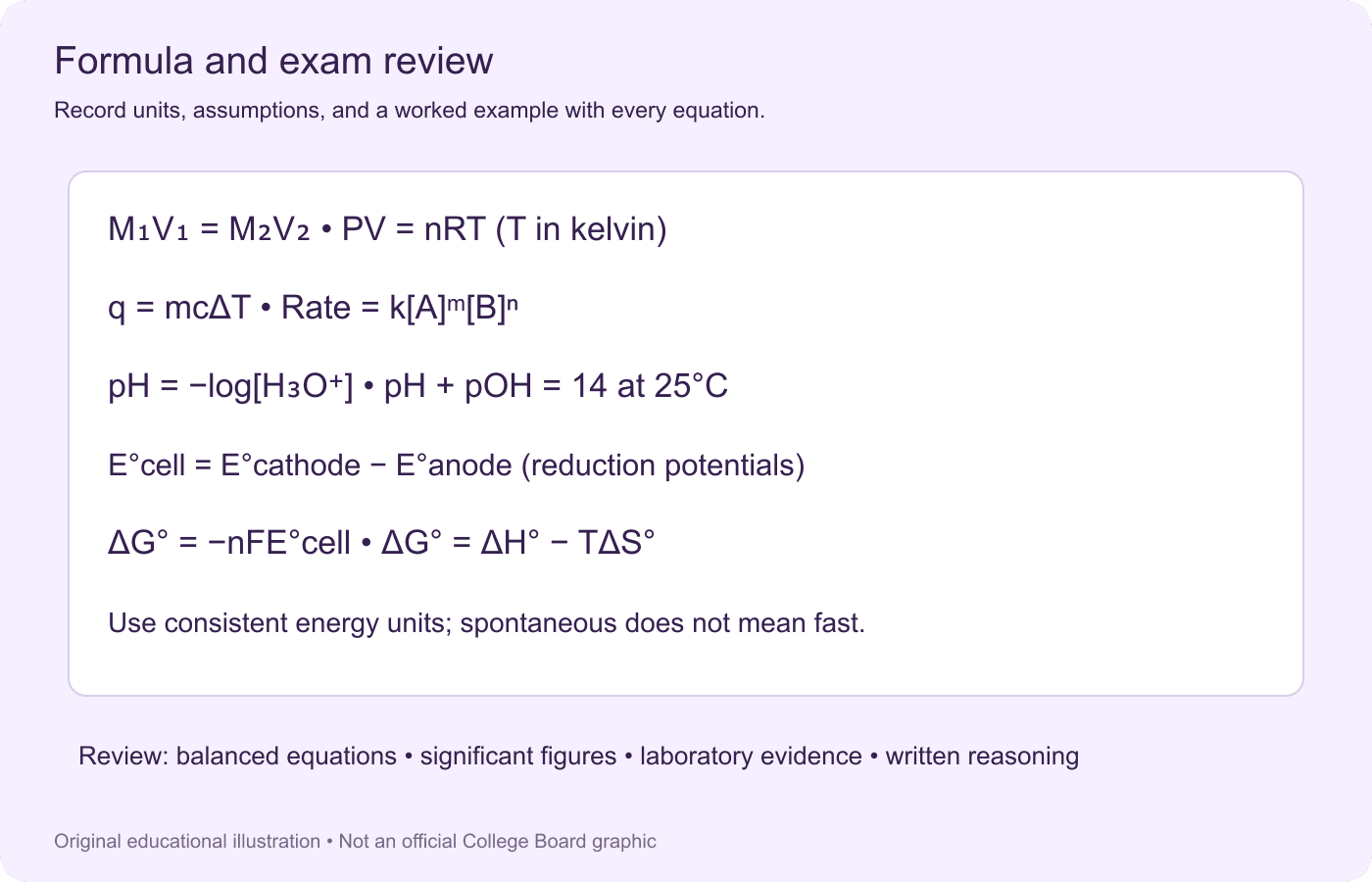
Many AP Chemistry questions require you to select and apply the correct equation. Instead of memorizing formulas without context, organize them by topic and record what each variable represents.
Moles and Concentration
- Moles: amount of substance expressed in mol.
- Molarity: moles of solute per liter of solution.
- Dilution relationship: M₁V₁ = M₂V₂.
Gas Laws
- Ideal gas law: PV = nRT.
- Combined gas law: P₁V₁/T₁ = P₂V₂/T₂.
Thermochemistry
- Heat transfer: q = mcΔT.
- Enthalpy change: ΔH = H(products) − H(reactants).
Kinetics
- Rate law: Rate = k[A]ᵐ[B]ⁿ.
- Integrated rate laws for zero-order, first-order, and second-order reactions.
Equilibrium
- Equilibrium constant expressions: Kc and Kp.
- Reaction quotient: Q.
- Relationships between Q and K to predict the direction of net reaction.
Acids and Bases
- pH = −log[H₃O⁺].
- pOH = −log[OH⁻].
- At 25°C, pH + pOH = 14 under standard introductory assumptions.
Electrochemistry
- Cell potential: E°(cell) = E°(cathode) − E°(anode).
- Gibbs free energy relationship: ΔG° = −nFE°(cell).
The equations available on exam reference materials may differ by exam year. Review the current AP Chemistry equation sheet and practice using each formula in context.
3. Practice Chemical Calculations Step by Step
Understanding a formula is different from knowing how to apply it to an unfamiliar problem. Practice setting up calculations, converting units, identifying known quantities, and checking whether the final result is chemically reasonable.
Focus on stoichiometry, limiting reactants, solution concentration, gas calculations, equilibrium expressions, and acid-base problems. Write down each step rather than relying only on a calculator result.
For calculation notes, include one worked example and one similar practice question for every major equation. This helps you recognize which relationship applies when a problem is presented differently.
4. Master Molecular Structures and Chemical Representations
AP Chemistry requires students to interpret different representations of chemical substances and reactions. Review Lewis structures, molecular geometry, bond polarity, particle diagrams, and intermolecular forces.
Create comparison tables for concepts that are easy to confuse. For example, distinguish ionic and covalent bonding, molecular and empirical formulas, and intramolecular bonds and intermolecular attractions.
When studying a chemical representation, explain what it communicates about the substance. Practice connecting particle-level models with observable properties such as boiling point, solubility, and conductivity.
5. Review Laboratory Techniques and Experimental Data
Laboratory reasoning is an important part of AP Chemistry preparation. Students should understand how to interpret experimental procedures, evaluate measurements, and connect observations to chemical principles.
Review common techniques such as titration, calorimetry, solution preparation, and experimental measurements. For each technique, record its purpose, the equipment involved, the quantities measured, and possible sources of error.
Practice reading tables, graphs, and experimental descriptions. Be prepared to explain how measurement uncertainty or an experimental change could influence the result.
6. Practice Free-Response Questions
Free-response questions require students to explain chemical reasoning, show calculations, interpret representations, and justify conclusions. Knowing a definition is not enough if you cannot apply it to a new chemical situation.
Practice writing concise explanations using appropriate chemical terminology. When a question asks you to justify an answer, connect the evidence to the underlying chemical principle.
Use official released AP questions and scoring guidelines when available. Compare your responses with the scoring criteria to identify missing reasoning or calculation steps.
7. Use Active Recall Instead of Only Rereading Notes
Repeatedly reading a chapter can create familiarity without proving that you can recall the information independently. Active recall encourages you to retrieve a concept, formula, or explanation before looking at your notes.
Turn important definitions into questions and practice explaining processes from memory. Flashcards are useful for terminology, while multi-step chemical problems require written practice and calculations.
For example, instead of simply rereading your equilibrium notes, ask yourself how changing concentration affects the reaction according to Le Châtelier's principle. Then explain the reasoning without looking at the answer.
8. Identify Weak Areas with a Regular Review Schedule
A study schedule helps prevent spending all your time reviewing topics you already understand. After completing a practice set, record the concepts and problem types that caused difficulty.
Group mistakes into categories such as incorrect formula selection, unit conversion, conceptual misunderstanding, graph interpretation, or incomplete explanations. Revisit the relevant notes and solve a new problem to check whether your understanding has improved.
Return to difficult topics periodically rather than reviewing them only once. Short, repeated practice sessions can help reinforce chemical concepts throughout the course.
9. Practice Explaining Chemical Relationships
AP Chemistry questions often test whether you understand why a chemical change occurs, not just whether you can identify the correct result. Practice connecting molecular behavior to measurable chemical properties.
For example, explain how intermolecular forces affect boiling points, how temperature influences reaction rates, or how a change in concentration affects an equilibrium system.
A useful exercise is to write a short cause-and-effect explanation for each major concept. This prepares you to justify conclusions in free-response questions.
10. Build an Exam-Day Strategy
A good preparation plan also includes knowing how to approach the exam itself. Read each question carefully, identify the chemical concept being tested, and note any relevant data or conditions before starting a calculation.
For quantitative questions, show your setup and units clearly. For explanation questions, answer the specific prompt and support your reasoning with an appropriate chemical principle.
During practice exams, monitor your timing and identify questions that require too much time. Move on when appropriate and return to difficult questions if time allows.
AP Chemistry Exam Preparation Checklist
- Review all nine course units.
- Explain key concepts without relying entirely on definitions.
- Understand the major equations and when to use them.
- Practice stoichiometry, gas laws, equilibrium, and acid-base calculations.
- Interpret Lewis structures, molecular models, and particle diagrams.
- Review thermochemistry and electrochemistry concepts.
- Understand laboratory procedures and experimental data.
- Complete multiple-choice and free-response practice.
- Review mistakes and revisit weak topics.
- Practice explaining chemical relationships and reaction mechanisms.
- Check the current College Board exam format and reference materials.
Effective AP Chemistry notes should function as a study resource throughout the course, not simply as a collection of information to read the night before the exam.
How to Create AP Chemistry Notes with Lynote AI Note Taker
Studying AP Chemistry often involves more than one textbook or set of class notes. You may have lecture slides, chemistry textbook chapters, laboratory handouts, recorded explanations, and practice materials covering different topics.
Organizing everything into clear study notes can take considerable time, especially when you need to connect chemical formulas, molecular structures, reaction mechanisms, and experimental results.
Lynote AI Note Generator helps turn supported learning materials into structured, editable study notes. You can organize your chemistry resources, review important concepts, and prepare materials for exam revision without manually rewriting every document.
Step 1. Upload Your AP Chemistry Study Materials
Start by uploading your AP Chemistry learning resources to Lynote. You can use supported PDFs, documents, presentations, images, audio recordings, videos, and educational webpages.
For example, upload a Unit 1 lecture PDF covering atomic structure, a Unit 5 presentation about reaction kinetics, or a recorded explanation of acid-base equilibrium. Use materials you are authorized to process.
Step 2. Generate Structured AP Chemistry Study Notes
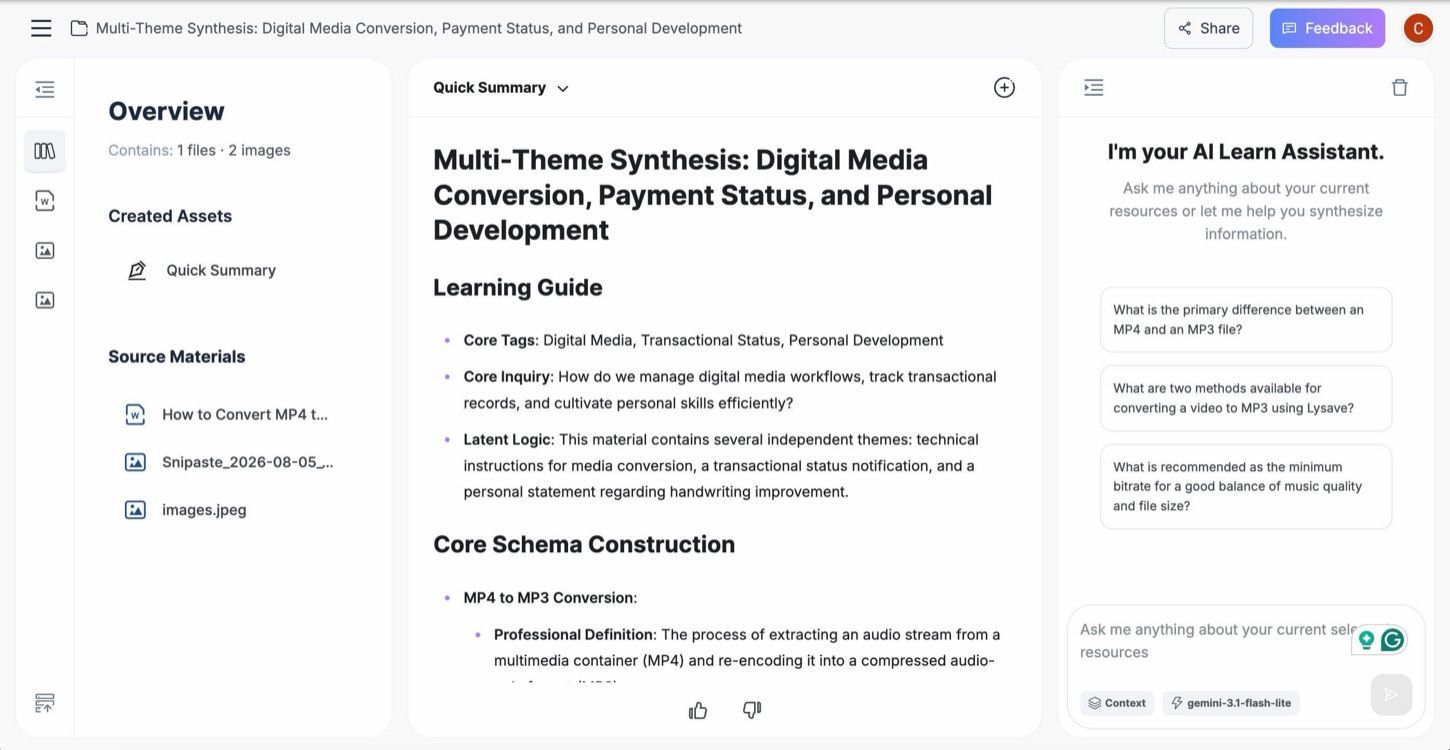
Actual Lynote interface; sample content is a generic product demonstration, not a chemistry lesson. Official source.
Click Create Note and let Lynote organize information from your uploaded materials into structured notes. The generated content can include headings, summaries, key points, and supporting details.
You can organize your AP Chemistry notes around:
- Key Concepts: Atomic structure, chemical bonding, intermolecular forces, and chemical equilibrium.
- Chemical Formulas: Important equations, variables, and relationships from your course materials.
- Reaction Mechanisms: Explanations of reaction processes and chemical changes.
- Laboratory Concepts: Experimental procedures, observations, and relevant scientific explanations.
- Unit Summaries: Organized reviews of topics covered in each AP Chemistry unit.
After generation, use the built-in editor to correct terminology, add your teacher's explanations, and reorganize the information according to your study preferences.
For chemical equations, subscripts, charges, reaction arrows, and mathematical expressions, check the generated content against the original source. Add your own molecular diagrams, laboratory annotations, and worked calculations where necessary.
Step 3. Understand Difficult Chemistry Concepts with AI Chat

Actual Lynote interface; sample content is a generic product demonstration, not a chemistry lesson. Official source.
Some chemistry topics require more than memorizing definitions. You may need to understand why a reaction occurs, how a molecular structure affects a substance's properties, or how changes in concentration influence chemical equilibrium.
Use Lynote AI Chat to ask questions about information contained in your uploaded materials. For example, if your source explains chemical kinetics, you could ask:
- What factors can affect the rate of a chemical reaction?
- How does a catalyst affect activation energy?
- What is the difference between reaction order and reaction rate?
- How does Le Châtelier's principle explain a shift in equilibrium?
You can also ask questions about acids and bases, thermochemistry, electrochemistry, and molecular interactions, provided the relevant information is included in your uploaded sources.
AI Chat helps you revisit explanations without searching through an entire chapter. For complex calculations or concepts beyond your materials, consult your textbook, teacher, and authoritative chemistry resources.
Step 4. Create AP Chemistry Flashcards for Exam Review
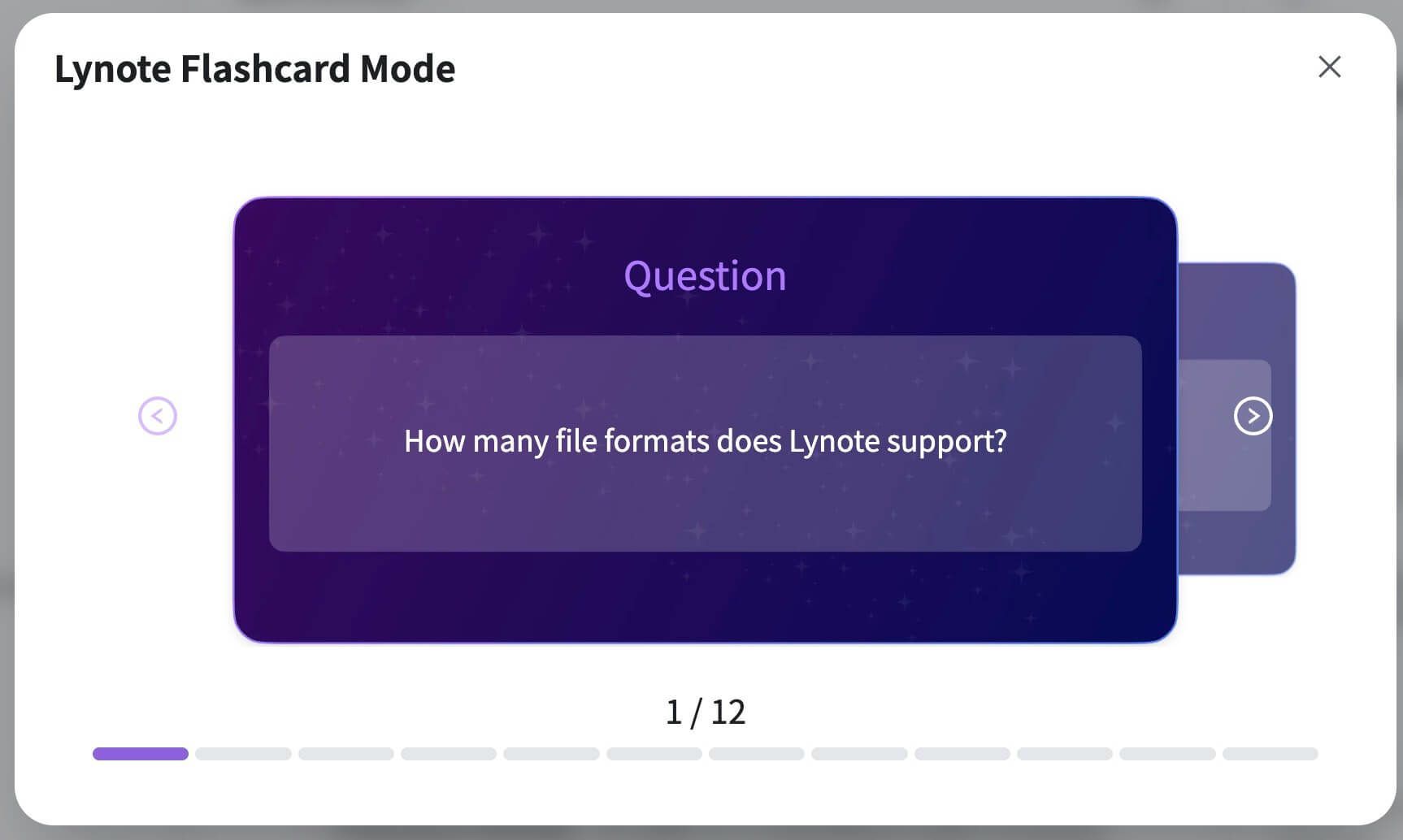
Actual Lynote interface; sample content is a generic product demonstration, not a chemistry lesson. Official source.
Memorizing chemical terminology, formulas, and important relationships is an essential part of exam preparation. Lynote Flashcards can turn key information from your notes into question-and-answer cards for active recall.
For example:
Question: What is the ideal gas law?
Answer: PV = nRT, which relates pressure, volume, amount of gas, and absolute temperature.
Question: What does a catalyst do to activation energy?
Answer: A catalyst provides an alternative reaction pathway with a lower activation energy.
Question: What is the relationship between pH and pOH at 25°C?
Answer: Under standard introductory assumptions, pH + pOH = 14.
Question: What happens to the reaction rate when the concentration of a reactant increases?
Answer: The effect depends on the reaction's rate law and reaction order.
Use your flashcards to review important definitions, equations, and chemical principles. For topics involving calculations, combine flashcard review with independent problem-solving practice.
Build a More Organized AP Chemistry Study Routine
You do not need to wait until the week before the AP Chemistry exam to organize your materials. Use Lynote throughout the course to build a collection of structured notes from your assigned readings, lectures, and study resources.
After each lesson, generate notes, correct important details, and add your own explanations. Before an exam, revisit the material, ask questions about difficult concepts, and use Flashcards to test your understanding.
Combine this workflow with laboratory practice, molecular diagrams, chemical calculations, and official AP exam questions. Lynote helps organize your learning materials, while your own practice builds the understanding needed to apply chemistry concepts.
Create Your AP Chemistry Notes with Lynote AI
Spend less time manually organizing scattered chemistry resources and more time understanding the reactions, models, and principles behind what you learn.
Common AP Chemistry Study Mistakes to Avoid
Memorizing Formulas Without Understanding Their Use
Knowing an equation does not guarantee that you can identify when it applies. Students may choose the wrong relationship or overlook units and assumptions.
Better approach: Keep each formula with a worked example, variable definitions, units, and a note about when it is appropriate.
Confusing Related Chemical Concepts
Some concepts sound similar but describe different ideas. Examples include strong versus concentrated acids, reaction rate versus equilibrium, and intermolecular forces versus chemical bonds.
Better approach: Create comparison tables that explain the distinction and include one example of each concept.
Ignoring Particle-Level Explanations
A correct numerical result does not always demonstrate understanding of the chemical process. AP Chemistry also asks students to interpret molecular representations and explain observable properties.
Better approach: Connect calculations to particle diagrams, molecular structures, and written cause-and-effect explanations.
Reviewing Only Textbook Summaries
Summaries can help you revisit a topic, but they may not include the experimental evidence or reasoning emphasized in your class. Different textbooks and editions can also organize topics differently.
Better approach: Compare summaries with your assigned readings, laboratory materials, and current course framework.
Practicing Calculations Without Checking Units
A calculation can follow the correct steps but still produce an incorrect answer because of unit conversions, significant figures, or sign conventions.
Better approach: Show each step, include units, and check whether the final result is chemically reasonable.
Conclusion: Build AP Chemistry Notes That Connect Every Unit
Effective AP chemistry notes connect atomic structure, bonding, reactions, kinetics, thermodynamics, equilibrium, acids and bases, and electrochemistry into a coherent study system. Organize each topic with explanations, chemical representations, equations, examples, and review questions.
Practice calculations, interpret laboratory data, and prepare for free-response questions throughout the course. To turn your own lectures, PDFs, and study resources into editable notes, try Lynote AI Note Generator and build a more organized AP Chemistry study routine.
Frequently Asked Questions About AP Chemistry Notes
What Should AP Chemistry Notes Include?
Useful notes include key concepts, chemical equations, molecular representations, worked calculations, laboratory observations, and review questions. Organize them by the current nine-unit course structure so you can connect related topics.
How Should I Organize AP Chemistry Notes by Unit?
Use the nine current AP Chemistry units as your main sections. Within each unit, group notes by topic, key vocabulary, formulas, diagrams, experiments, and practice problems.
Where Can I Find AP Chemistry Notes PDF Materials?
Students may find PDF notes through teachers, textbooks, school learning platforms, and educational resources. Check the source, edition, and date, and compare the material with the current College Board course framework.
Are AP Chemistry Notes by Unit Better Than Chapter Notes?
Both formats can be useful. Unit-based notes help you follow the AP course structure, while chapter notes help you review a specific textbook assignment.
You can connect the two by recording the relevant AP unit beside each textbook chapter.
What Should AP Chemistry Unit 1 Notes Cover?
Unit 1 covers atomic structure and properties, including atomic models, isotopes, mass spectrometry, electron configurations, photoelectron spectroscopy, and periodic trends.
Use diagrams and evidence-based explanations to connect atomic structure with observed properties.
What Is Included in AP Chemistry Unit 3 Notes?
Unit 3 is Properties of Substances and Mixtures in the current course framework. Notes should address solutions, mixtures, solubility, particle interactions, and methods used to separate substances.
What Should AP Chemistry Unit 5 Notes Cover?
Unit 5 focuses on kinetics. Review reaction rates, rate laws, concentration and time relationships, collision theory, reaction mechanisms, and activation energy.
What Is the Difference Between AP Chemistry Equilibrium Notes and Acids and Bases Notes?
Equilibrium is Unit 7, while acids and bases are Unit 8 in the current course structure. Acid-base systems use equilibrium principles, but the two units have different learning objectives and applications.
Are Acids and Bases AP Chemistry Notes Part of Unit 8?
Yes. Unit 8 covers acids and bases, including pH, acid and base strength, equilibrium relationships, buffers, and titrations.
What Do AP Chemistry Thermodynamics Notes Cover?
Thermochemistry is covered in Unit 6, while Unit 9, Thermodynamics and Electrochemistry, applies thermodynamic ideas to topics including entropy, Gibbs free energy, and electrochemistry.
Review the relationship between energy changes, spontaneity, redox reactions, and electrochemical cells.
Are Zumdahl AP Chemistry Notes the Same as College Board Materials?
No. Zumdahl is a textbook resource, while College Board defines the AP course framework and exam requirements.
Use textbook notes to support learning, but check topic coverage and terminology against your current syllabus and official course materials.
Can I Use AP Chemistry Notes from Reddit?
Reddit discussions may contain student-created notes, study advice, and resource recommendations. Treat them as supplementary material rather than verified or official course content.
Check formulas, explanations, and topic coverage against your textbook, teacher's materials, and current AP framework.
Can Lynote Help Me Create AP Chemistry Notes?
Yes. Lynote can generate structured notes from supported PDFs, documents, presentations, audio recordings, videos, and other supported learning materials that you provide.
You can edit the generated notes, ask AI Chat questions based on uploaded sources, and create Flashcards for review. Verify chemical equations, structures, and calculations against your original materials.
Can AI-Generated Chemistry Notes Replace Laboratory Practice?
No. AI-generated notes can help organize explanations and review information, but they do not replace laboratory experience, experimental data analysis, or hands-on practice.
Use your notes alongside assigned experiments, teacher guidance, and official AP practice resources.

Written by Hamza Razzaq
Technical Writer
Hamza creates hands-on explainers and technical guides that make AI writing tools easier to understand and use. View all articles →