
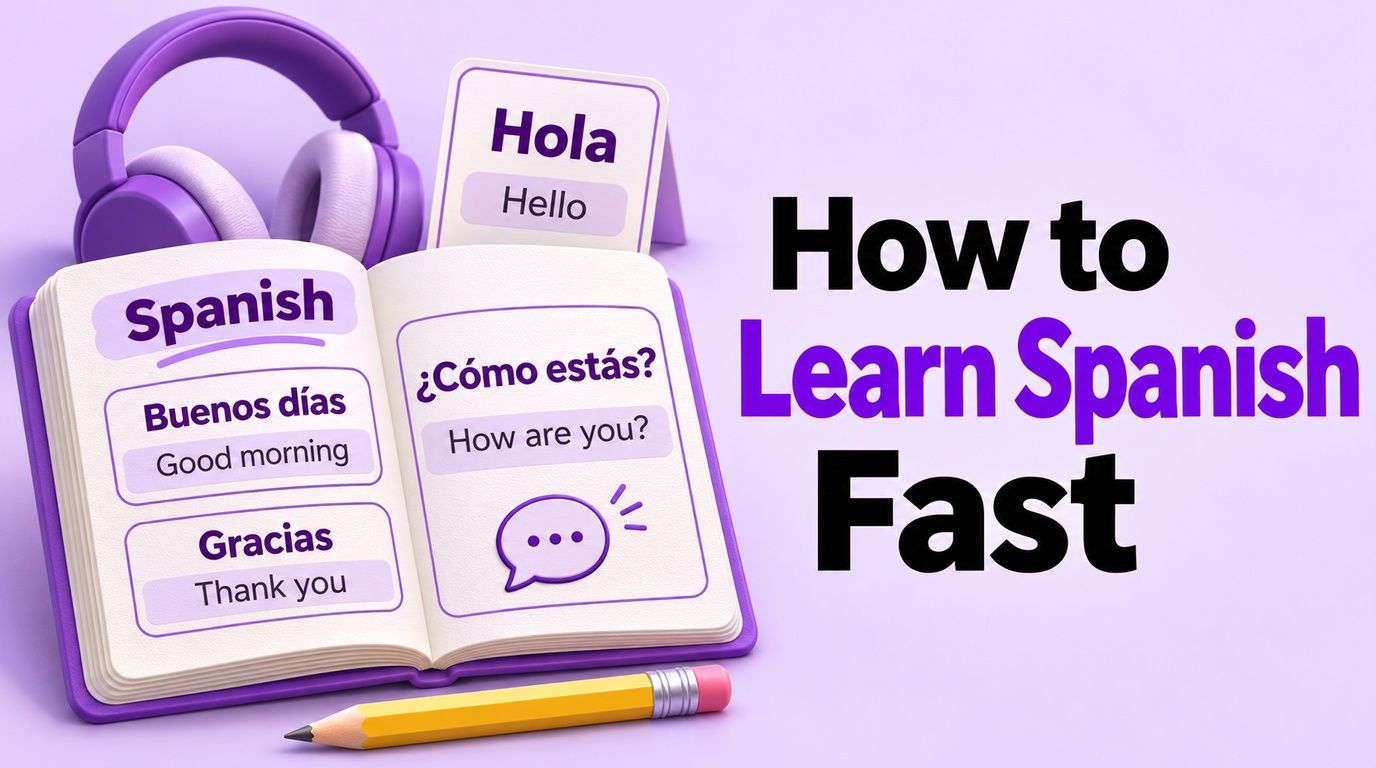
How to Learn Spanish Fast Without Getting Stuck in App Lessons

Want to learn Spanish fast, but keep finishing lessons without knowing what to say? Build your routine around one useful conversation, not another app streak. Combine understandable listening, a few reusable sentence patterns, daily recall, and short speaking attempts with feedback.
You do not need to study everything at once. You need a repeatable way to turn something you understood today into something you can use tomorrow.
The Fastest Approach Is a Smaller, Complete Learning Loop
Choose one beginner course for structure, one source of easy audio, and one opportunity to speak. Study a small topic, hear it in context, produce something without looking, and correct the part that breaks down.
This is more useful than dividing your attention among five apps that all rehearse the same greetings. The missing piece is often not another explanation: it is using familiar material without the answer in front of you.
Start by choosing a task that matters to you:
| Your immediate goal | Build your practice around | Evidence that it is working |
|---|---|---|
| Prepare for a trip | Ordering, directions, prices, and asking for clarification | You can handle a changed item or an unexpected question |
| Talk with family or friends | Introductions, everyday routines, interests, and follow-ups | You can ask something back instead of delivering a memorized speech |
| Follow beginner audio | Short dialogues with reliable transcripts | You understand the same passage after hiding the text |
| Return to Spanish after a break | Retrieving familiar phrases and rebuilding listening | You can respond without translating every word first |
For the next week, choose just one row. Keep the others as future goals rather than competing assignments for tonight.
How Fast Can You Learn Spanish, Realistically?
You can begin practicing useful Spanish immediately, but independent conversation and broad proficiency take sustained work. Your starting point, previous language experience, practice quality, time, and access to feedback all change the pace.
A first month is a reasonable planning period for establishing habits and rehearsing a few everyday situations. It is not a dependable deadline for fluency, and completing a 30-day schedule does not certify a CEFR level.
Think in separate skills. You may read a beginner paragraph comfortably but struggle to recognize the same words in speech; you may understand a question yet need time to construct an answer.
The Council of Europe's CEFR framework distinguishes listening, reading, interaction, spoken production, and writing. That is a better way to describe progress than assigning your entire Spanish ability one vague label.
You may also see Foreign Service Institute estimates quoted online. An archived United States Department of State training page lists Spanish at 30 weeks within a category spanning 600-750 classroom hours, aimed at professional speaking and reading proficiency among diplomats.
Those figures describe a particular training context. They are not a promise that a casual learner will become fluent after the same number of app minutes, nor a reason to postpone a simple conversation until hundreds of hours have passed.
There is one useful calculation you can make without guessing proficiency: 30 minutes a day for 30 days gives you 15 hours of scheduled practice. Use those hours to build a narrow foundation, then judge progress by what you can do.
Seven Changes That Make Spanish Practice More Useful
1. Connect Familiar Letters to Spanish Sounds
The alphabet can look reassuringly familiar to an English speaker. That familiarity can also tempt you to read every word using English sound patterns.
Work on the five vowel sounds, word stress, and the sounds your course introduces through short recordings. Pay attention to contrasts such as a single tap versus a trill, but do not make mastering one difficult sound a condition for speaking at all.
Use a small listen-and-check loop:
- Listen to one short word or phrase without reading.
- Look at the written form and locate the stressed syllable.
- Repeat it, then record your attempt.
- Compare a specific segment rather than judging your whole accent.
- Return to the phrase inside a sentence.
Written accent marks are information, not decoration. When you save a word, preserve its spelling and audio instead of inventing an English pronunciation spelling that becomes another thing to unlearn.
The goal is intelligibility and reliable recognition. Ask whether a listener understands the intended word, not whether you sound indistinguishable from a native speaker.
2. Learn Phrases You Can Change, Not Lists You Can Only Recognize
A frequency list can suggest useful vocabulary, but it does not tell you how to combine words, respond politely, or understand the answer. Build a small set around the interaction you chose instead.
For a cafe conversation, you need a request, the item, a quantity, and ways to understand or clarify the response. Memorizing beverage names alone leaves most of the exchange unpracticed.
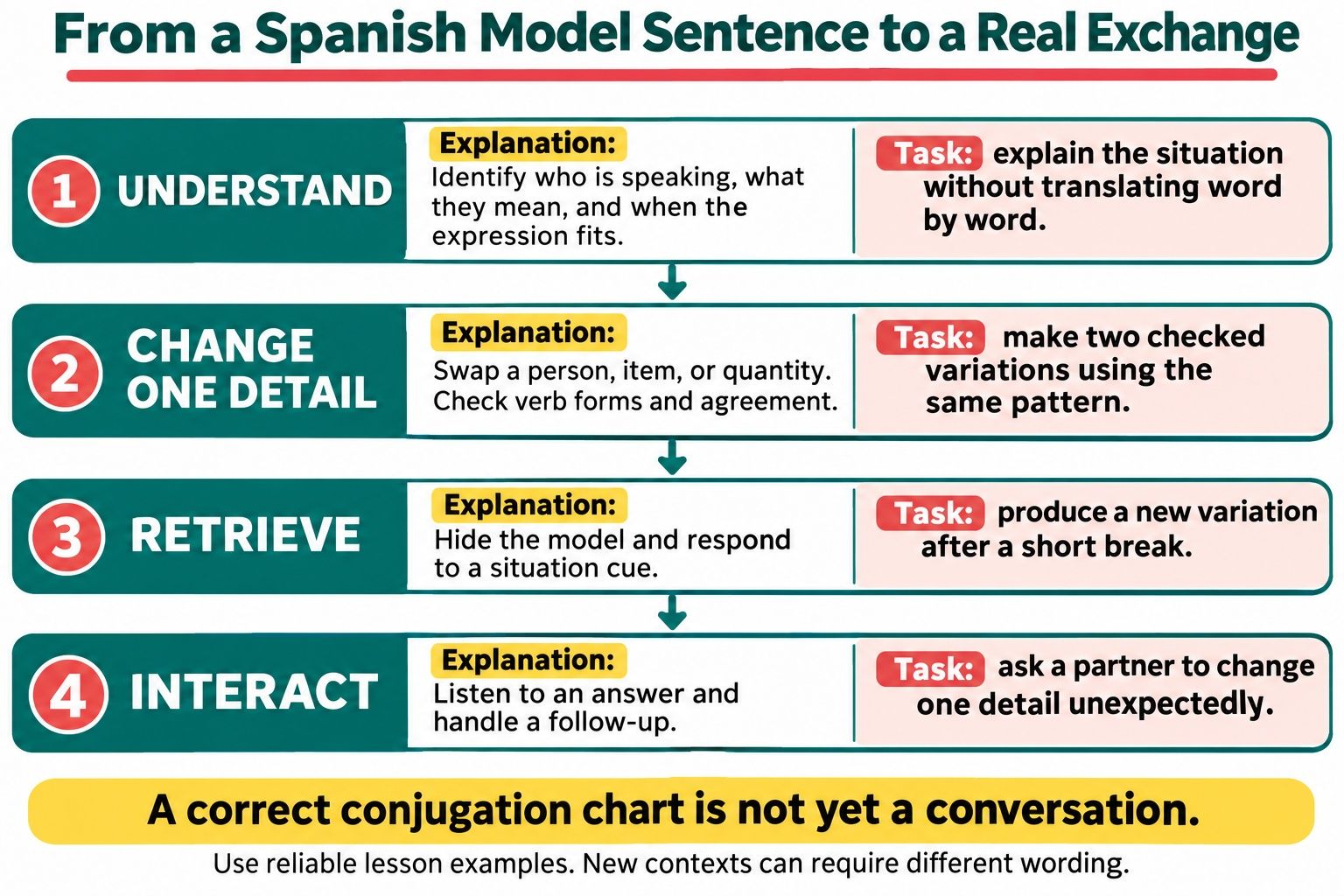
Take a reliable model from your course and change one detail. Request a different item, switch the quantity, or ask a related question, then check that the resulting sentence is valid.
Keep vocabulary connected to its grammar. Save a noun with its article and a useful phrase; save a verb in a short sentence with a clear subject and purpose, not only as an isolated dictionary entry.
Similar-looking English and Spanish words can help recognition, but resemblance is a clue rather than proof. Check meaning and usage in context before assuming a familiar-looking word means what you expect.
Your checkpoint: can you produce the expression from a situation cue? Recognizing the correct answer among four options is a different task.
3. Learn Grammar in the Order Your Conversations Need It
You do not have to finish a grammar book before having a basic exchange. You do need enough structure to change a memorized sentence without losing its meaning.
Use the following priorities as a practical starting point, not a universal curriculum:
| Priority | Why it matters | A useful practice task |
|---|---|---|
| Articles, noun gender, and agreement | Words around a noun may need to match it | Change the person or object in a model description and check the surrounding words |
| Present-tense patterns and common irregular verbs | Everyday questions and routines depend on usable verb forms | Describe your routine, then ask about someone else's |
| Questions and negation | Conversation needs information exchange, not statements only | Turn a statement into a question and give a negative answer |
| Common uses of the two verbs often translated as "to be" | English does not map neatly onto the Spanish distinction | Learn complete contrasting examples rather than one absolute shortcut |
| Future plans and past events | You need to talk beyond the current moment | Prepare one plan and one recent event using the forms your course has taught |
Avoid treating the two "to be" verbs as nothing more than permanent versus temporary. That shortcut does not explain every use; descriptions, identity, location, and states need contextual examples.
Likewise, a conjugation chart is a reference, not a conversation. After studying a form, make a sentence about yourself, ask another person a related question, and listen for their answer.
Do not rush through every tense because it appears in the textbook contents. Reusing a small number of patterns in new situations gives you a clearer foundation for adding more.
4. Use Transcripts to Diagnose Listening, Then Put Them Away
If Spanish sounds like one continuous stream, the problem may not be the recording's speed alone. You may know the written words but not recognize their pronunciation or boundaries in connected speech.
Choose a short beginner dialogue whose topic you can follow. Listen for the overall situation first; then use a reliable transcript to locate a small section you missed.
Try four passes:
- Listen without text and summarize the situation.
- Read the transcript and identify the words or structure blocking understanding.
- Listen again while following that specific section.
- Hide the transcript and listen once more.
If a written sentence remains unclear, Lynote AI Text Translator can help you check its meaning. Paste the sentence or a short excerpt, choose English as the target language, and compare the translation with your own interpretation.
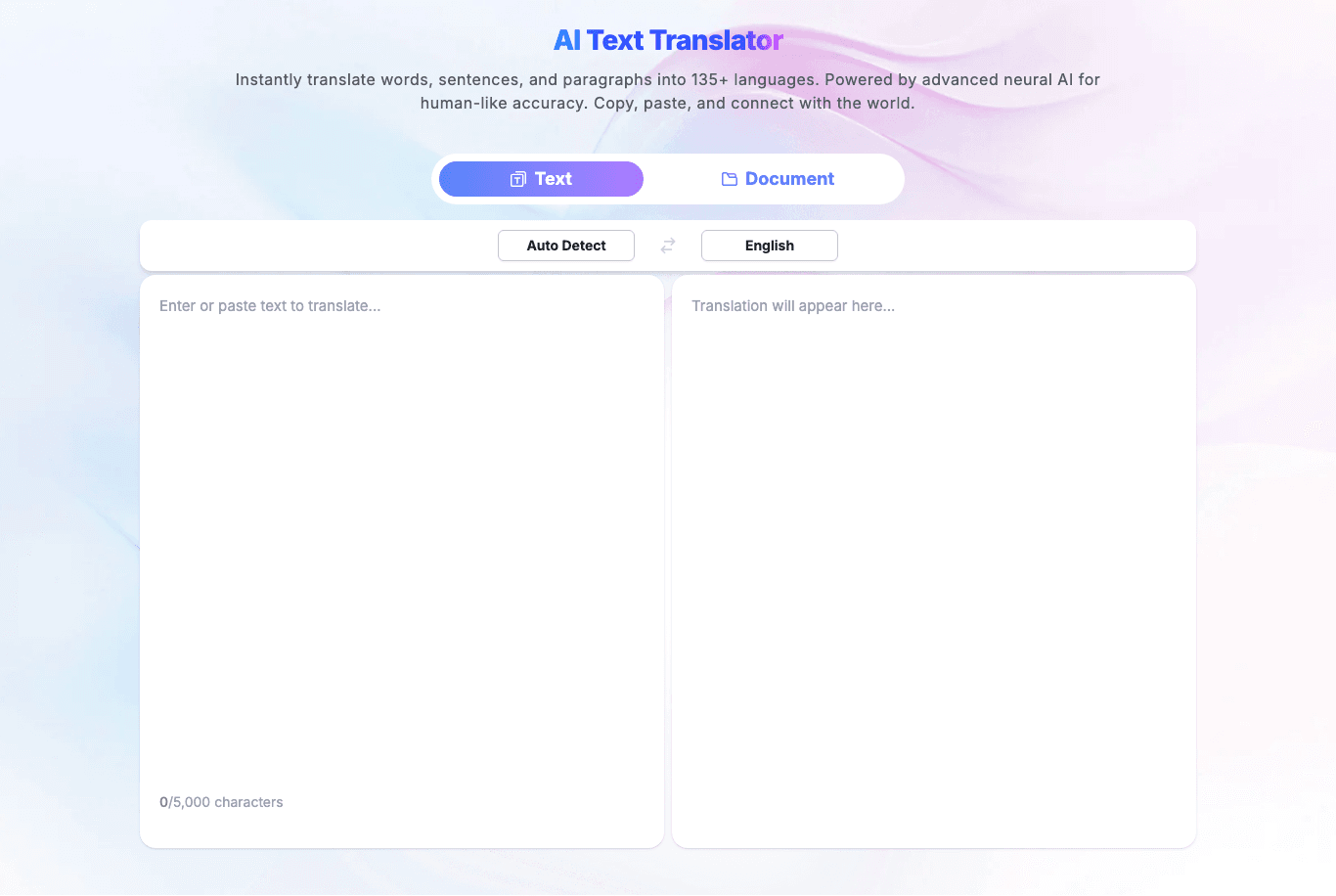
This is the text-translation interface before input, not a tested Spanish translation result.
Translate enough context to understand the line, then return to the Spanish recording. Leaving the English version visible throughout the exercise can turn listening practice into reading practice.
Treat automatic translation as an aid, especially with idioms, ambiguous subjects, or regional wording. It is not pronunciation feedback, a live interpreter, or a substitute for checking a confusing sentence with your teacher.
If the passage still feels opaque after using the transcript, choose easier material. Replaying content you cannot meaningfully follow is not automatically productive immersion.
5. Practice Recovering When a Conversation Changes
Prepared introductions are useful, but real conversation does not stop after your rehearsed paragraph. Someone asks a question, changes a detail, or uses a word you did not prepare.
Build repair skills alongside your opening lines. Learn course-approved ways to ask for repetition, request a slower explanation, check what someone meant, and say that you do not know a word.
Try a three-round practice session with a tutor or partner:
- Round one: complete a familiar exchange with your notes nearby.
- Round two: hide the notes and repeat it with one changed detail.
- Round three: ask your partner to add a follow-up you have not memorized.
Ask for one correction that would make the exchange easier to understand. That might be the verb form, word stress, or the way you framed a request, rather than every mistake at once.
If you cannot remember a noun, describe its purpose or appearance using words you know. This keeps the interaction moving and shows you which vocabulary genuinely deserves a place in your next review.
You can rehearse alone by recording answers to prompts in a different order. Still, self-recording cannot fully reproduce the timing, ambiguity, and feedback of another person.
6. Make Notes That Ask You to Retrieve Something
Copying a clear explanation can feel like learning it. Test that feeling by closing the note and producing a sentence, explaining a distinction, or answering a question.
Keep one compact lesson record with four elements: the situation, the pattern, a checked example from the lesson, and a recall question. Add the mistake you actually made instead of collecting every possible exception.
When a lesson PDF or source page is difficult to organize, Lynote AI Note Generator can help produce an editable structure. Use it to prepare review material, not to avoid working with the Spanish itself.
- Add one lesson through Upload File and Browse Local Files. For a supported source URL, paste the address and select Parse.
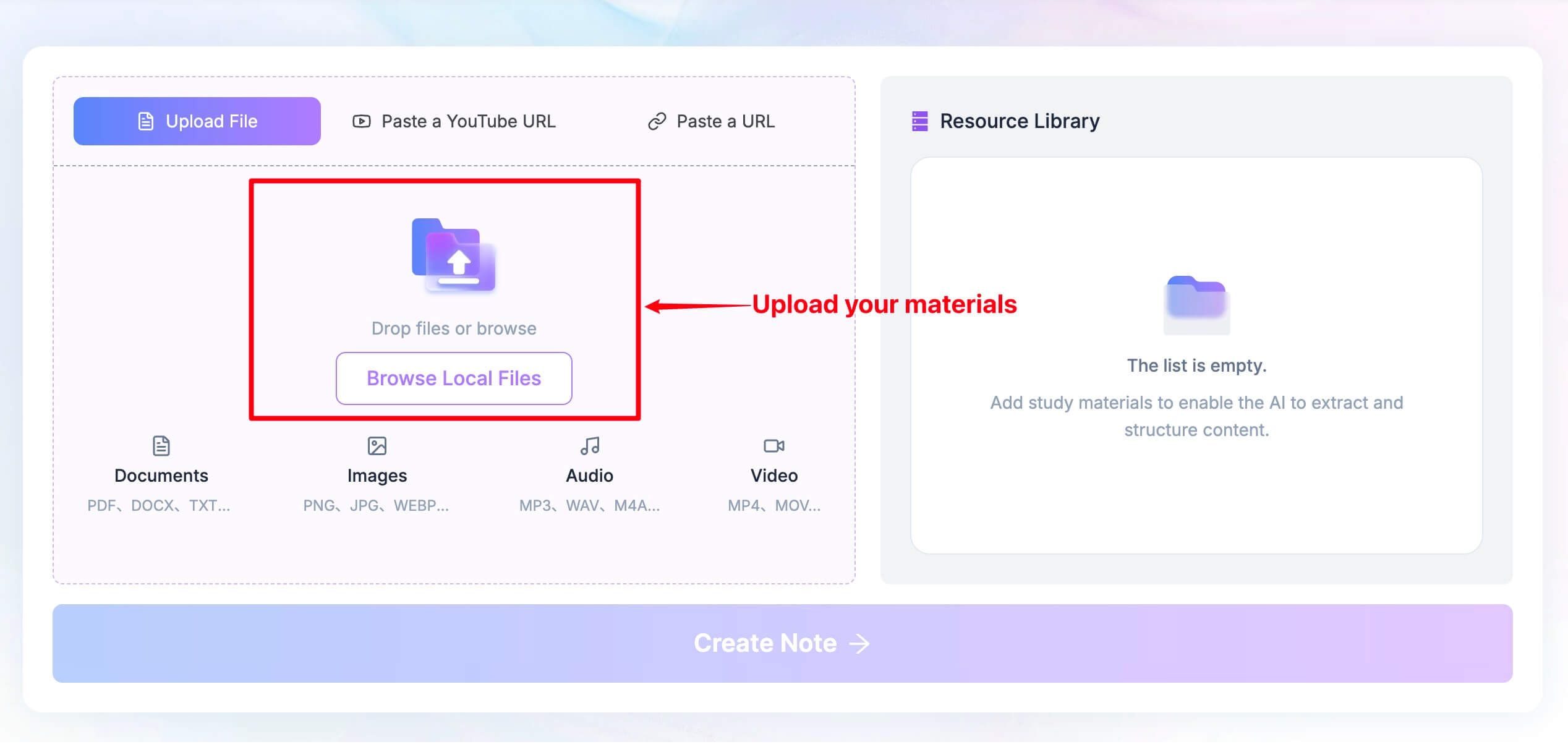
- Select Create Note when the source is ready.
- Check the note against the lesson, correct examples or explanations, and turn the useful points into questions or flashcards.
Preserve accent marks and verify the original Spanish examples. A neatly organized AI note can still contain an incorrect explanation, so do not treat formatting as evidence of accuracy.
During review, answer before opening the note. If you miss an item, check it, make a correct attempt, and revisit it sooner; if you can use it comfortably, gradually leave a longer gap.
There is no need to keep adding cards when the review queue is already unmanageable. Reduce new material, split complicated prompts, and remove vocabulary unrelated to your current goal.
7. Choose a Regional Starting Point Without Treating Other Spanish as Wrong
If you are preparing for life in Mexico, Spanish from Mexican speakers is a sensible starting point. If your main goal is communicating with relatives or colleagues, their variety may be more relevant than an app's default voice.
Spanish varies in pronunciation, everyday vocabulary, and some forms of address. Learn the forms used by your course and intended conversation partners, then expand your exposure rather than switching your whole approach whenever you hear a difference.
For beginners, consistency can reduce the number of unfamiliar patterns encountered at once. Later, hearing a broader range of speakers helps prevent dependence on a single teacher's voice.
Do not assume all of Latin America uses identical Spanish, or that one national variety is universally easiest. Choose for relevance and available learning material, not a ranking of which speakers are most correct.
Build a Routine Around the Time You Actually Have
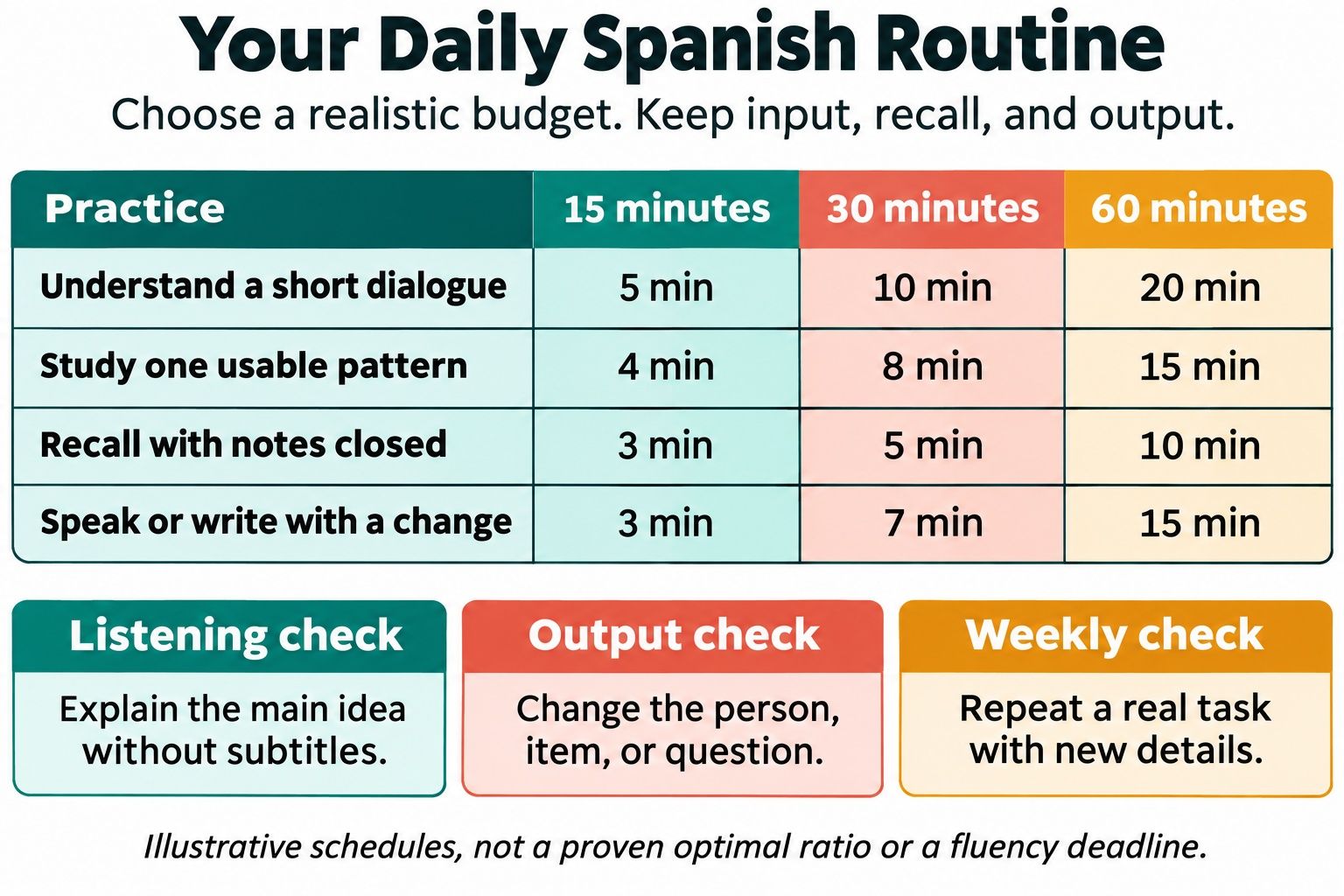
The routine below is an editorial planning example, not a scientifically optimal time ratio. Each version includes understanding, retrieval, and output so that limited time does not become recognition-only practice.
| Daily budget | Listening and reading | Course or pattern work | Closed-note recall | Speaking or writing |
|---|---|---|---|---|
| 15 minutes | 5 minutes on a short dialogue | 4 minutes on one pattern | 3 minutes on recent material | 3 minutes answering a prompt |
| 30 minutes | 10 minutes with a listening loop | 8 minutes on one lesson point | 5 minutes of recall | 7 minutes adapting or rehearsing an exchange |
| 60 minutes | 20 minutes of understandable input | 15 minutes of focused study | 10 minutes of review | 15 minutes of interaction or recorded practice |
You can split the longer routine across the day. For example, listen in the morning and use the same topic in an evening conversation rather than starting unrelated material each time.
Passive background audio may be enjoyable, but do not automatically count it as focused comprehension practice. For the scheduled listening block, be able to explain something you understood.
On a difficult day, do a smaller version: retrieve yesterday's phrase, listen to its model, and use it once with new information. Resume the normal routine tomorrow rather than creating an impossible catch-up session.
A 30-Day Plan With Useful Checkpoints
Use the weeks below to organize practice, not to predict a proficiency level. Repeat a task or reduce its difficulty when the checkpoint is still out of reach.
| Week | Main situation | What to practice | End-of-week check |
|---|---|---|---|
| 1 | Meeting someone | Sounds, greetings, introductions, basic questions | Introduce yourself and understand one familiar follow-up |
| 2 | Getting something done | Requests, quantities, prices, clarification | Complete a purchase scenario when the item or quantity changes |
| 3 | Talking about daily life | Routines, interests, questions, short replies | Ask and answer about a familiar activity without reading |
| 4 | Connecting ideas | A recent event, a plan, and conversational repair | Handle a short exchange with an unexpected but manageable question |
Save a short recording at the start and end of each week. Compare whether you can retrieve language, understand a reply, and recover from confusion, not merely whether the second recording sounds faster.
Make the final check slightly different from your practice material. Changing the person, time, item, or question helps reveal whether you learned a flexible pattern or memorized a single performance.
If week two is difficult, repeating it is not failure. Adding past events while basic requests remain unusable may create more material without creating more communication.
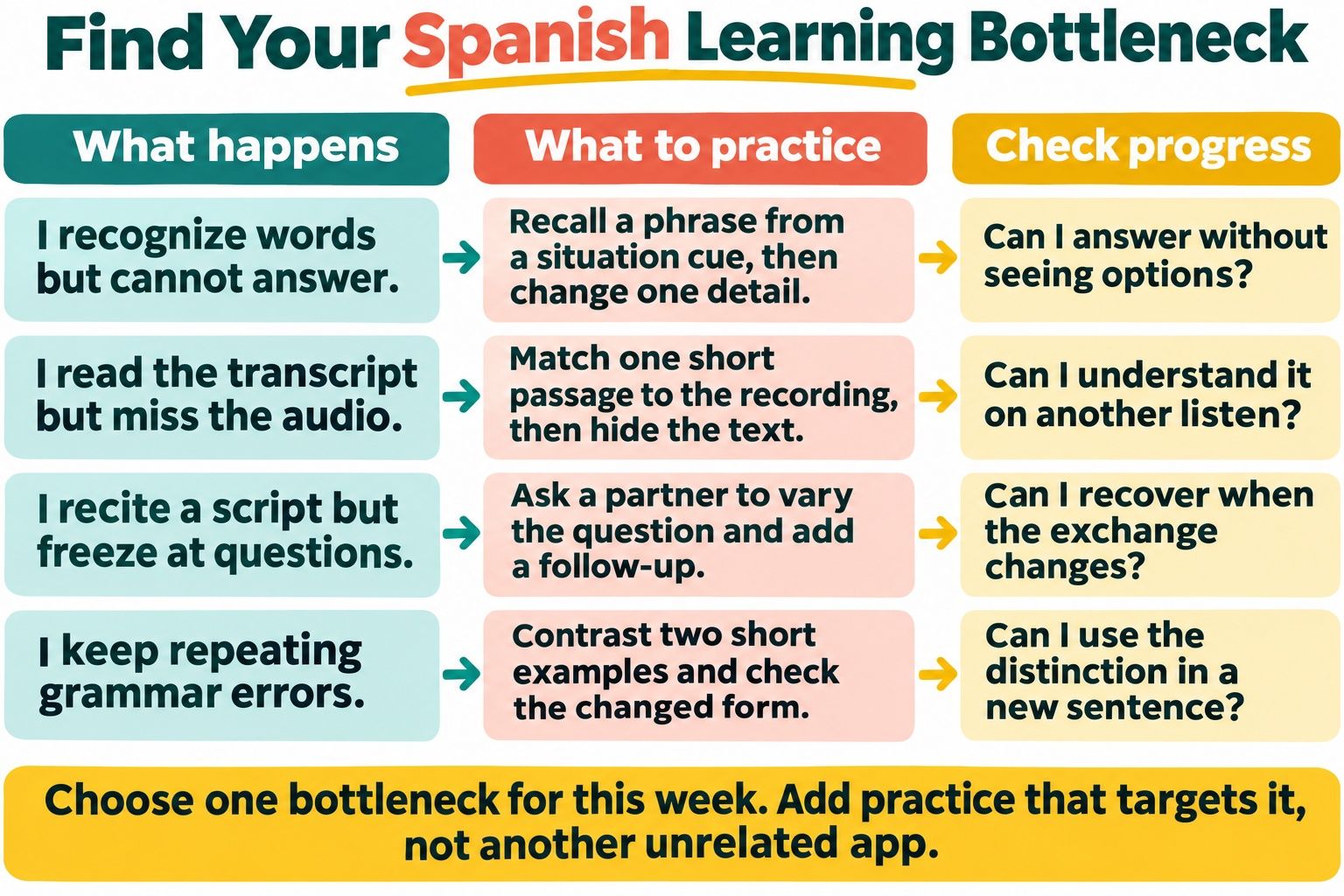
When You Feel Stuck, Change the Practice Task
More hours of the same exercise may reinforce the same imbalance. Identify the missing skill before adding another resource.
| What is happening | Likely gap to investigate | Change for the next session |
|---|---|---|
| I recognize words but cannot answer | Retrieval and sentence building | Answer from a situation cue before revealing the model |
| I understand the transcript, not the audio | Sound recognition and word boundaries | Reconnect one short passage to its recording, then hide the text |
| I can recite but freeze in conversation | Unrehearsed interaction | Have a partner change one detail and ask a follow-up |
| I repeatedly use the wrong verb form | Form is disconnected from context | Practice contrasting subjects in short, checked sentences |
| I spend all my time reviewing | Too much new material or overloaded cards | Pause new items and simplify repeated failures |
| I keep switching apps | No stable sequence or clear goal | Keep one main course for a week and evaluate a real task |
These are diagnostic starting points, not explanations of every learning difficulty. A teacher can help distinguish a misunderstanding from a practice habit that needs adjustment.
Can You Learn Spanish Fast for Free?
You can build a useful low-cost routine without paying for several subscriptions. Start with a structured resource, accessible beginner listening, your own recall questions, and a reciprocal language exchange when available.
Language Transfer offers its Complete Spanish audio course through its official channels, including downloadable audio. Use a structured lesson actively: pause when prompted and try an answer before listening to the model.
For listening, choose beginner material with enough context to understand the situation. Dreaming Spanish's approach emphasizes leveled, understandable input; whichever resource you choose, do not confuse a provider's hour milestones with a personal prediction of progress.
Free does not mean every useful form of feedback is equally accessible. A tutor can be particularly valuable when you repeatedly misunderstand an explanation or cannot identify why people struggle to understand your speech.
Spend money on the bottleneck you can name. Buying another vocabulary subscription is unlikely to solve a lack of conversation practice.
FAQs About Learning Spanish Fast
Can I learn Spanish in 30 days?
You can use 30 days to build a routine and rehearse a limited set of useful situations. Fluency is a much broader goal, and the same calendar period can contain very different amounts of practice and feedback.
Is Spanish easy for English speakers?
Familiar letters and some related vocabulary can make parts of the beginning more approachable. Pronunciation, grammatical agreement, verb forms, and understanding natural speech still require practice; easier in one area does not mean effortless overall.
Should I start speaking from day one?
You can begin with a tiny prepared task supported by reliable audio. Keep it manageable, seek feedback when possible, and continue building comprehension rather than forcing long conversations you cannot yet follow.
Can an app alone make me fluent?
An app can provide structure and repetition, but progress depends on what its activities require you to do. If you only select answers or repeat predictable sentences, add listening without text and interaction with changing questions.
Should I learn Spanish from Spain or Latin America?
Start with the variety most relevant to the people or places you want to understand. Neither is a single uniform accent, and you can broaden your listening after you establish a stable beginner foundation.
How do I know whether I am improving?
Repeat a practical task with slightly different details and compare your performance over time. Track comprehension, independent sentence building, and recovery from confusion separately; lesson counts alone do not show all three.
Make Your Next Session Small Enough to Finish
Choose one conversation you want to handle, one short model, and one detail you will change. Listen, understand, try it without looking, and make a note of the correction that would help most.
Learning Spanish faster is not about eliminating every difficult moment. It is about making each session address a real gap and returning often enough to use what you learned.

Written by Danny
Product Marketing Manager
Danny explains how Lynote features fit real workflows, from everyday productivity to product-led writing use cases. View all articles →