

How to Learn Chinese Fast: A Practical Mandarin Study Plan

The most practical answer to how to learn Chinese fast is to connect pronunciation, useful words, listening and speaking from the beginning. Choose a small real-world goal, learn phrases with their audio, recall them without looking, and get feedback before mistakes become habits. A repeatable routine beats a growing collection of apps you rarely use.

This guide focuses on Mandarin, rather than every language grouped under the name Chinese. It is for beginners who want to do something with the language: order a meal, follow a simple conversation, understand a lesson or read a short message.
You do not need to wait until your pronunciation is flawless to speak. You also do not need to memorize thousands of characters before your first conversation. The useful middle ground is to build small, connected skills and check whether they work outside the exercise that taught them.
10 Practical Ways to Learn Chinese Faster
1. Choose One Mandarin Goal Before Choosing Resources
"Learn Chinese" is too broad to guide tomorrow's study session. "Ask for directions and understand a simple answer" gives you vocabulary, a listening task and a reason to practice numbers and locations.
Choose your first month's emphasis before buying a course. You can still practice every skill, but the goal decides where your limited time goes.
| Your immediate goal | Put more time into | A useful progress check |
|---|---|---|
| Travel | Requests, numbers, directions and likely replies | Complete a short role-play with changed prices or destinations |
| Everyday conversation | Listening, follow-up questions and descriptions | Answer a familiar question without reciting a fixed script |
| Reading messages | Common words, character recognition and sentence structure | Explain a short unfamiliar message using limited lookups |
| A class or exam | The assigned syllabus and actual task formats | Complete a relevant practice task without notes |
Pick one main course with reliable audio. Add a dictionary and a way to review difficult material; you can expand later if a specific problem demands it.
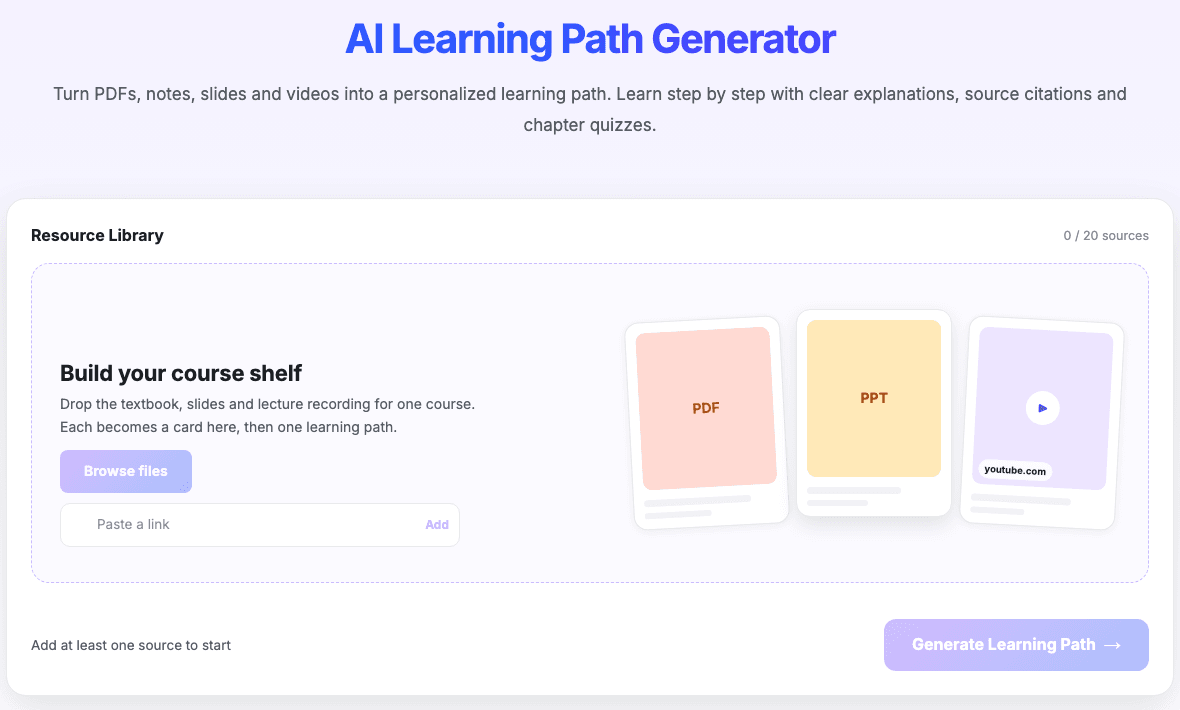
If your materials are scattered across lesson PDFs and recordings, Lynote Learning Path can help organize those sources into a study route. Add the material, select Generate Learning Path, then check the chapter sequence and available quizzes against your course objectives.
This is an organizer for your materials, not a ready-made Mandarin curriculum or pronunciation coach. Keep a teacher's or textbook's sequence when it supplies prerequisites an automatically organized route might miss.
2. Learn Pinyin Through Audio, Not English Spelling
Pinyin uses Latin letters to represent Mandarin pronunciation, but those letters do not reliably behave like English spelling. Guessing a sound from its appearance can make a familiar-looking syllable surprisingly hard to understand later.
Work with a beginner audio chart or a teacher. Listen to a small group of syllables, identify what differs, then imitate the model before checking the written form again.
Try a short practice cycle:
- Hear two contrasting recordings without reading.
- Choose which one matches the target syllable.
- Reveal the pinyin and listen again.
- Record your attempt and ask for feedback on the specific difference.
Keep this practice brief enough that you can still concentrate. Five attentive minutes can be a useful starting allocation; it is a schedule suggestion, not a scientifically established optimum.
Pinyin should help you reach the sound. When reading is part of your goal, gradually practice familiar words with the pinyin hidden so it does not become the only thing your eyes recognize.
3. Practice Tones in Words and Short Phrases
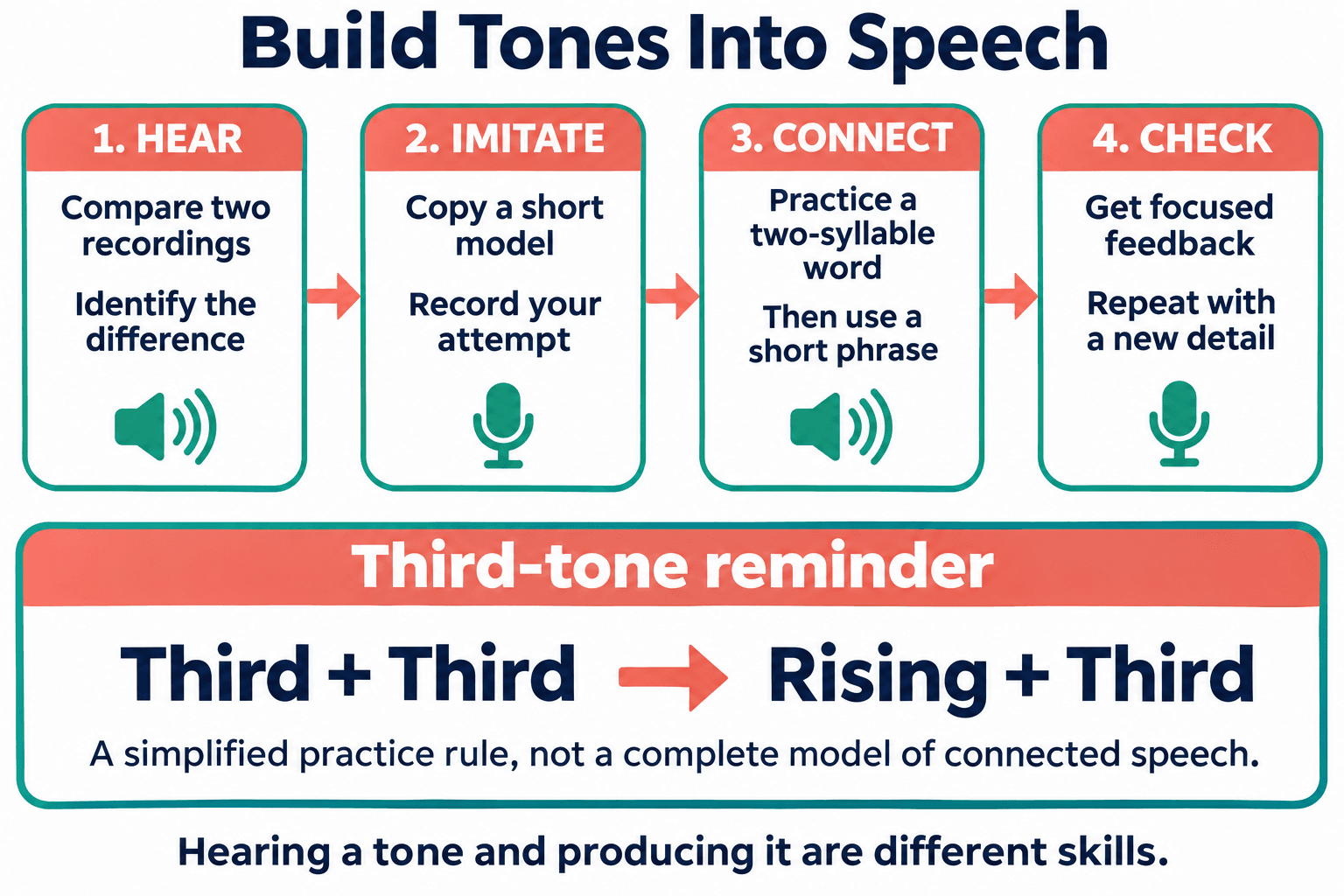
Mandarin has four lexical tones plus a neutral tone. Tone belongs to the word's pronunciation, so learning a word first and planning to "add the tone later" leaves essential information out.
Start with clear recordings of individual syllables, then move into two-syllable words and short phrases. The tone you can identify on its own may be harder to follow when the neighboring syllables and speaking rhythm change.
Third tone deserves particular care: it is often low rather than a full textbook dip-and-rise in connected speech. Before another third tone, the first is normally pronounced with a rising contour; do not turn that into a rule that every third tone always rises.
Separate two questions during practice: Can I hear the distinction? Can I produce it? If you cannot reliably hear it, more recording alone may not reveal what needs fixing.
Ask a tutor or partner to correct one short phrase, then reuse that phrase in a slightly different sentence. A targeted correction is easier to act on than "your tones need work."
4. Learn Useful Words, Not Disconnected Characters
A character is not the same thing as a vocabulary word. Many Mandarin words contain more than one character, and knowing individual characters does not necessarily tell you how a whole word is used.
Build vocabulary around situations you expect to encounter. For a food-ordering task, learn the item, a request, a quantity and a likely response together instead of collecting unrelated nouns.
For each useful word, keep four things connected:
- Sound: a trustworthy recording, including tones.
- Meaning: the meaning relevant to the sentence you encountered.
- Written form: the characters, with pinyin available when needed.
- Use: one short phrase or question containing the word.
Then test it in more than one direction. Listening and identifying the meaning is different from seeing an English cue and producing the Mandarin; both differ from recognizing the characters.
Start with a small number of new items that leaves room for yesterday's review. If you keep forgetting them or the review queue keeps growing, reduce new additions before extending your study day.
For example, introducing five items on 20 study days creates 100 introductions. It does not establish that you have mastered 100 words. Count successful later recall separately from new items added.
5. Learn Characters Alongside the Words You Already Use
Characters are easier to place in context when they belong to words you can already recognize by ear. Add the written form to those words rather than working through a disconnected character list simply because it is numbered.
Choose your main script to match your materials and destination. Simplified characters are commonly used in mainland China and Singapore; traditional characters are used in Taiwan and Hong Kong, although the spoken language you need also depends on the location.
For a Mandarin learner headed to Taiwan, traditional-character materials may be the natural fit. For a mainland course using simplified textbooks, staying with that script initially reduces unnecessary switching.
Components can provide clues, but they are not a universal decoding system. Some relate to meaning or historical sound; neither guarantees that you can predict a modern word accurately without checking it.
Distinguish three separate goals: recognizing characters, typing the correct word and writing it from memory. A learner who mainly wants to read messages may allocate time differently from someone whose class requires handwritten tests.
6. Use One Short Recording for Listening and Speaking
You can spend half an hour watching a video and practice very little Mandarin if you are mostly following English subtitles. A short, understandable recording gives you more opportunities to notice and fix the exact moment you lose the meaning.
Choose a beginner dialogue short enough to replay several times. Use this sequence:
- Listen without text and identify the situation.
- Listen again for a specific detail, such as a time or destination.
- Read the transcript and check the part you missed.
- Replay while connecting the words to the audio.
- Hide the text and explain the message or answer a question about it.
Only imitate at full speed after you understand the phrase. Otherwise you may rehearse a sound sequence without knowing where its words begin and end.
There is an important diagnostic distinction here. If the transcript contains unfamiliar words, you need vocabulary support; if you understand the transcript immediately but not the audio, you need more sound-to-word practice with material you already know.
7. Turn Grammar Into Reusable Speaking Patterns
Mandarin does not require English-style verb conjugations, but that does not mean it has no grammar. Word order, particles, time expressions and measure words still affect meaning and naturalness.
Take one pattern from your course and change a small part of it. A request can become a request for a different item; a sentence about today's schedule can become a question about tomorrow.
Avoid inventing a rule from one English translation. Two sentences may express similar ideas while organizing information differently.
| Practice target | What to vary | What to check |
|---|---|---|
| A request | Item or quantity | Whether the complete phrase remains appropriate |
| A time statement | Day or time | Where the time expression belongs |
| A question | Person, place or object | Whether the question pattern still fits |
| A quantity phrase | Number and noun | Whether the measure word matches the noun |
After a few substitutions, use the pattern to convey something true about your life. That step moves you beyond filling a blank to choosing language for a purpose.
8. Keep Notes That Make You Recall, Not Just Reread
A beautifully organized page can feel like progress even when you cannot remember its contents the next morning. Give every note a job: it should answer a question you will later attempt without looking.
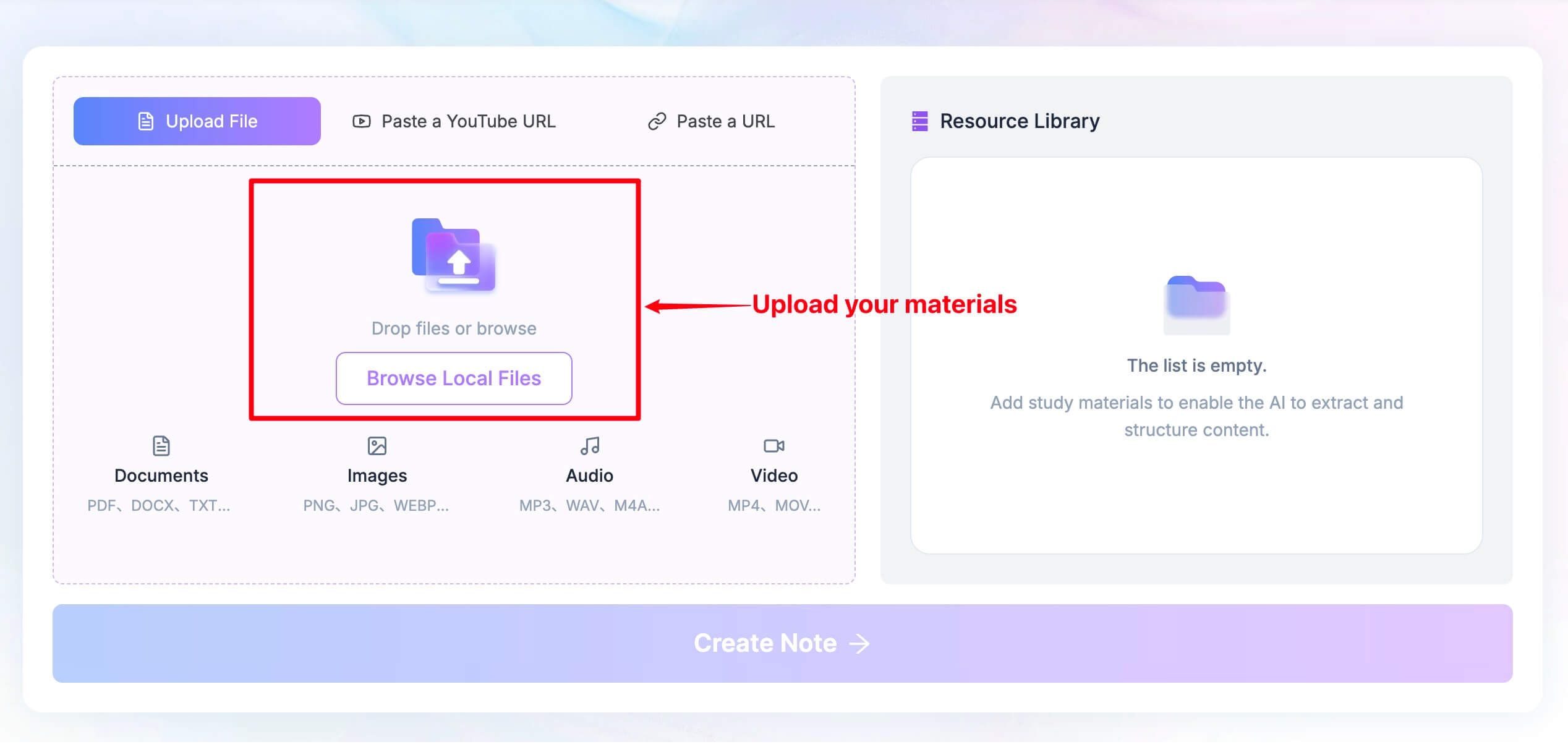
For longer lessons, Lynote AI Note Generator can help turn source material into editable notes. Keep the workflow compact:
- Upload your lesson file or add a supported source URL. For a URL, select Parse; direct uploads do not need that step.
- Select Create Note after the source is ready.
- Check the notes against the lesson, edit uncertain explanations and turn key points into recall questions.
Use the original lesson audio for pronunciation. A generated summary is not proof that a tone, reading or grammar explanation is correct.
Here is a useful note structure for a lesson about making plans:
| Note field | What to keep |
|---|---|
| Communication task | Arrange a time to meet |
| Model | One verified sentence from the lesson |
| Replaceable detail | The day or time |
| Listening cue | The audio segment where the reply occurs |
| Recall question | Can I propose a different time without reading? |
| Correction | The one mistake to avoid next time |
Save fewer examples if necessary, but make them usable. Close the note, attempt the question and reopen it only to check or repair your answer.
9. Translate to Check Meaning, Then Try Again Without It
Translation is useful when a sentence blocks your understanding. It becomes less useful when you consult it before giving yourself a chance to understand anything.
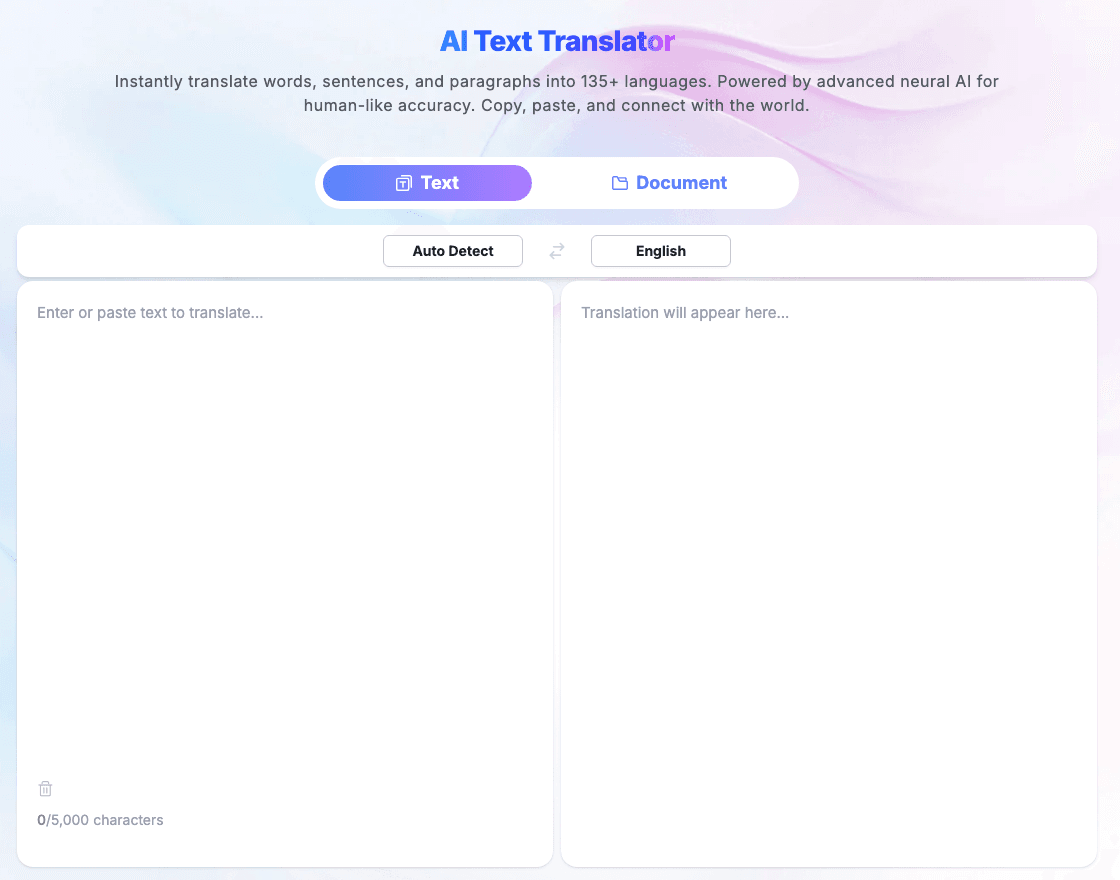
Try predicting the meaning first, even if your prediction is incomplete. Then use Lynote AI Text Translator to check a short passage: paste the text, confirm the detected source language and choose English as the target language.
The text input supports up to 5,000 characters per request, but a few sentences are usually easier to learn from than a whole page. Compare the result with the surrounding context, then hide the translation and explain the passage again.
If two interpretations remain plausible, check your course, a dictionary or a teacher. A fluent English translation can hide uncertainty about an omitted subject, context or the intended tone of a message.
Keep the distinction clear: the tool helps you inspect meaning. It does not demonstrate that you can understand the original at conversational speed.
10. Get Feedback on One Real Conversation Task Each Week
Choose a task small enough to repeat: introduce yourself, ask about someone's schedule or order a drink. Prepare useful phrases, but ask your partner to change one detail so the exchange is not completely scripted.
Your first feedback request could be, "Which word was hardest to understand?" A later session might focus on question formation or where you paused.
Repeat the task after correcting that one problem. Save a brief recording if everyone involved agrees; compare your ability to complete the task, not just how fast you speak.
No conversation partner available today? Record an answer to a simple prompt, then answer a slightly different prompt tomorrow. It is useful rehearsal, although it does not replace feedback or the unpredictability of a real exchange.
A 30-Day Mandarin Plan With Measurable Practice Goals
Thirty minutes a day for 30 days equals 15 hours. That is a useful budget for building a routine and practicing selected tasks, not a reasonable basis for promising broad fluency.
The schedule below is an editorial planning example, not a tested program with established outcomes. Move more slowly when the review tasks expose gaps.
| Week | Main focus | Practice to repeat | End-of-week check |
|---|---|---|---|
| 1 | Sounds and a small set of useful phrases | Audio discrimination, imitation and short recall | Recognize learned phrases without seeing pinyin |
| 2 | Words in context and basic written forms | Add characters to familiar words; vary one sentence detail | Recall a useful word and recognize it in a new sentence |
| 3 | Short-dialogue comprehension | Listen, inspect the transcript and replay without it | Answer a detail question about a short dialogue |
| 4 | Combining skills in practical tasks | Role-play, receive a correction and retry | Handle a changed detail instead of repeating a fixed script |
For a 30-minute session, begin with this allocation:
- 5 minutes: pronunciation or listening discrimination.
- 8 minutes: review previously learned words and phrases.
- 10 minutes: one short lesson or dialogue, including replay.
- 5 minutes: spoken recall or a small conversation task.
- 2 minutes: record the mistake or question to revisit.
On a busy day, shrink the session without removing all recall: review a few old items, replay one familiar clip and say a short answer aloud. On a longer day, deepen the same material before opening three unrelated lessons.
Use a Small Weekly Scorecard, Not a Fluency Score
Choose ten recently studied items and check them after a gap, before reviewing them again. Record the number you recognized from audio, recalled from a meaning cue and recognized in writing as three separate counts.
For example, a hypothetical result of eight recognized in writing but three understood from audio points to a listening gap. It does not mean you are "80% fluent," and the numbers are an illustration, not results from a learner study.
Add one short conversation task to the scorecard. Note whether you completed it independently, needed a prompt or could only repeat a model; those distinctions tell you more than a practice streak.
Why You Can Read Chinese but Still Cannot Follow a Conversation
Reading lets you pause, look up a word and work backward. Conversation asks you to identify sounds, retrieve meaning and follow the next phrase before the previous one has completely settled.
More reading alone may not fix every listening problem. Use the symptom to choose the next exercise.
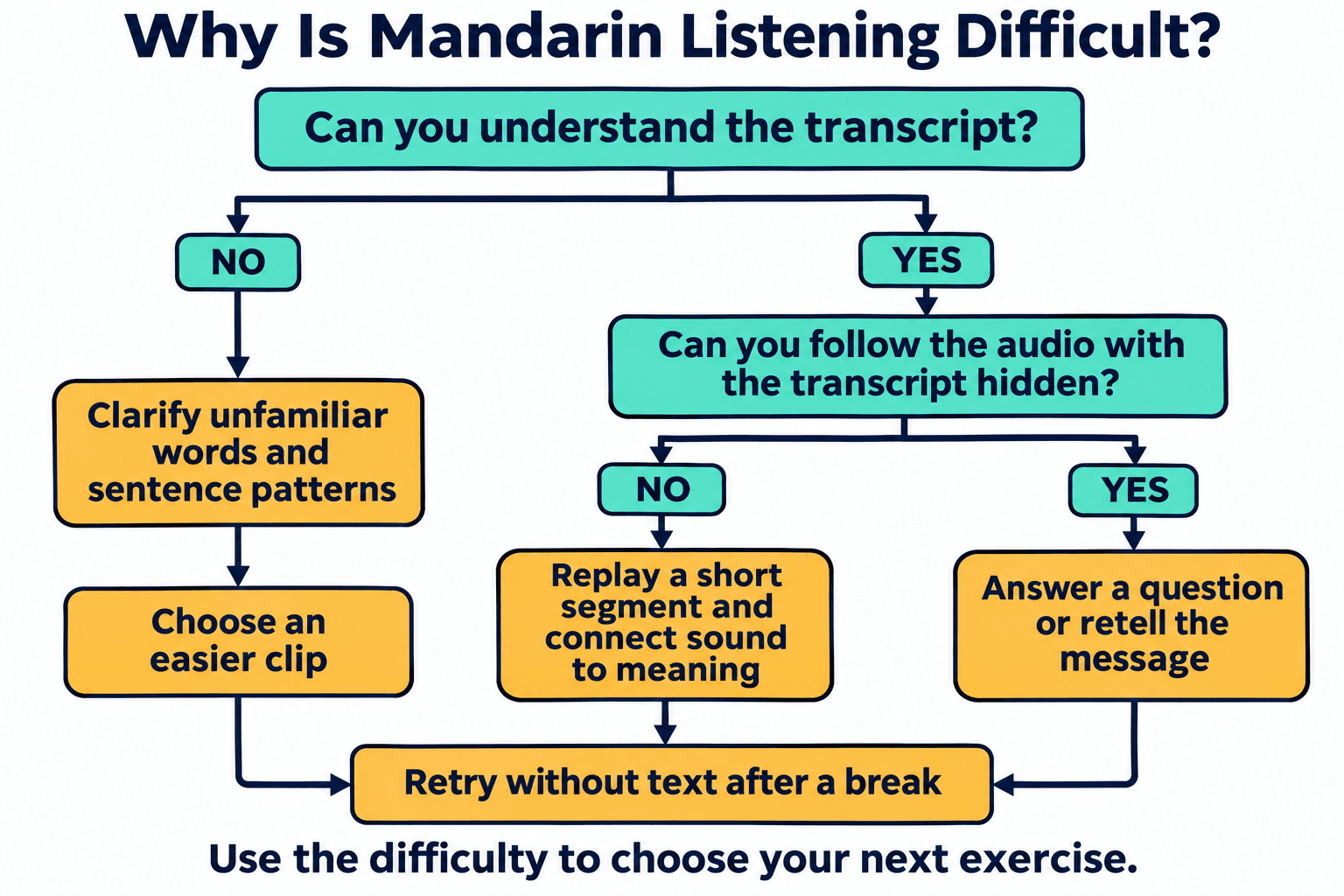
| What happens | A possible bottleneck | What to try next |
|---|---|---|
| The transcript makes immediate sense, but the recording does not | Connecting familiar words to speech | Replay a short segment, then hide the transcript |
| Both transcript and audio are difficult | Vocabulary or sentence structure | Use easier material and clarify the missing pattern |
| You understand only while pinyin is visible | Dependence on written pronunciation cues | Alternate audio-only attempts with brief pinyin checks |
| You recognize a word but cannot say it | Recognition is ahead of retrieval | Answer a meaning or situation cue without seeing the word |
| Your tone sounds right alone but changes in a phrase | Connected pronunciation | Practice the entire short phrase with feedback |
| Every session is consumed by overdue reviews | Too much new material or difficult cards | Pause additions, simplify cards and remove low-priority items |
Change one thing for several sessions before replacing your entire method. If you alter the course, app, vocabulary list and schedule at once, it becomes hard to tell which change helped.
What to Skip When Your Study Time Is Limited
Some activities are worthwhile but poorly timed. The question is not whether they are good in general; it is whether they address your present goal.
Long native-language videos you barely understand: keep them for enjoyment if you like, but do not let them displace understandable listening practice. Select a manageable excerpt instead of treating finishing a video as evidence of comprehension.
Polished handwriting before useful language: handwriting matters for some courses and goals. If your immediate goal is a spoken travel exchange, allocate practice accordingly rather than making penmanship a prerequisite for speaking.
Collecting synonyms before using a common word: several translations can increase choices without improving communication. Learn one appropriate expression, its context and a likely reply before expanding the set.
Rewriting every note: editing can clarify a difficult idea, but repeated copying is not the same as recalling it. Spend part of that time answering questions with the page closed.
Changing resources whenever a lesson feels difficult: a new interface can feel refreshing while leaving the underlying problem untouched. Switch when you can name the mismatch, such as missing audio or content far above your level.
How Long Does It Really Take to Learn Mandarin?
There is no single honest deadline because "learn Mandarin" can mean very different things. Preparing a handful of travel tasks is narrower than following an unscripted group conversation or reading professional material.
Your previous language experience, opportunities for interaction, feedback and available study time all matter. So does whether you practice the skill you want to improve: recognizing text on a screen is not interchangeable with understanding spoken replies.
Use time estimates as planning budgets rather than promises. Thirty minutes daily gives you 3.5 hours in a seven-day week; one hour daily gives you seven hours, but neither figure tells you how effectively those hours were used.
After a month, ask what you can now do without support and where you still need help. That answer is a better basis for your next month's plan than a claim that every beginner should reach the same level on the same date.
FAQs About Learning Chinese Faster
Is Learning Chinese the Same as Learning Mandarin?
Not exactly. Chinese is a broader label that includes multiple spoken varieties; Mandarin is the focus of this guide. Check the spoken variety and writing system used in your course or destination before choosing materials.
Can I Learn Mandarin in 30 Days?
You can use 30 days to establish a routine and work on a limited set of tasks. That is different from becoming fluent across unfamiliar conversations. Set a task you can demonstrate and adjust the plan based on your starting point.
Should I Learn Pinyin or Characters First?
Use pinyin with audio early to understand how pronunciation is represented. Introduce characters alongside familiar words if reading is one of your goals, rather than waiting for flawless pronunciation or memorizing characters without sound.
Can I Learn Chinese Without Living in China?
Yes. Lessons with audio, graded materials and regular conversation practice can support learning elsewhere. You still need to create opportunities to use the language and obtain feedback rather than relying entirely on passive exposure.
Should Beginners Learn Simplified or Traditional Chinese?
Choose according to your destination, course and reading goals. Keep your primary materials consistent at first. You can later expand recognition of the other script without treating that as a requirement before making progress.
Can I Learn Mandarin for Free?
Free lessons, dictionaries, library materials and language exchanges can form a useful starting toolkit. The main challenge is building a coherent sequence and finding reliable feedback; paid support is an option when it solves a specific gap, not a prerequisite for beginning.
Start With One Task You Can Use Tomorrow
Choose a small goal, a reliable audio source and a time you can repeat. Learn the phrase, hear it without the text, say it without the answer in front of you and use it with one changed detail.
Learning Mandarin faster does not require making every session harder. It requires noticing what you cannot yet do and giving that skill the next few minutes of focused practice.

Written by Danny
Product Marketing Manager
Danny explains how Lynote features fit real workflows, from everyday productivity to product-led writing use cases. View all articles →