
How to Build Better AP Notes for Digital Exam Prep

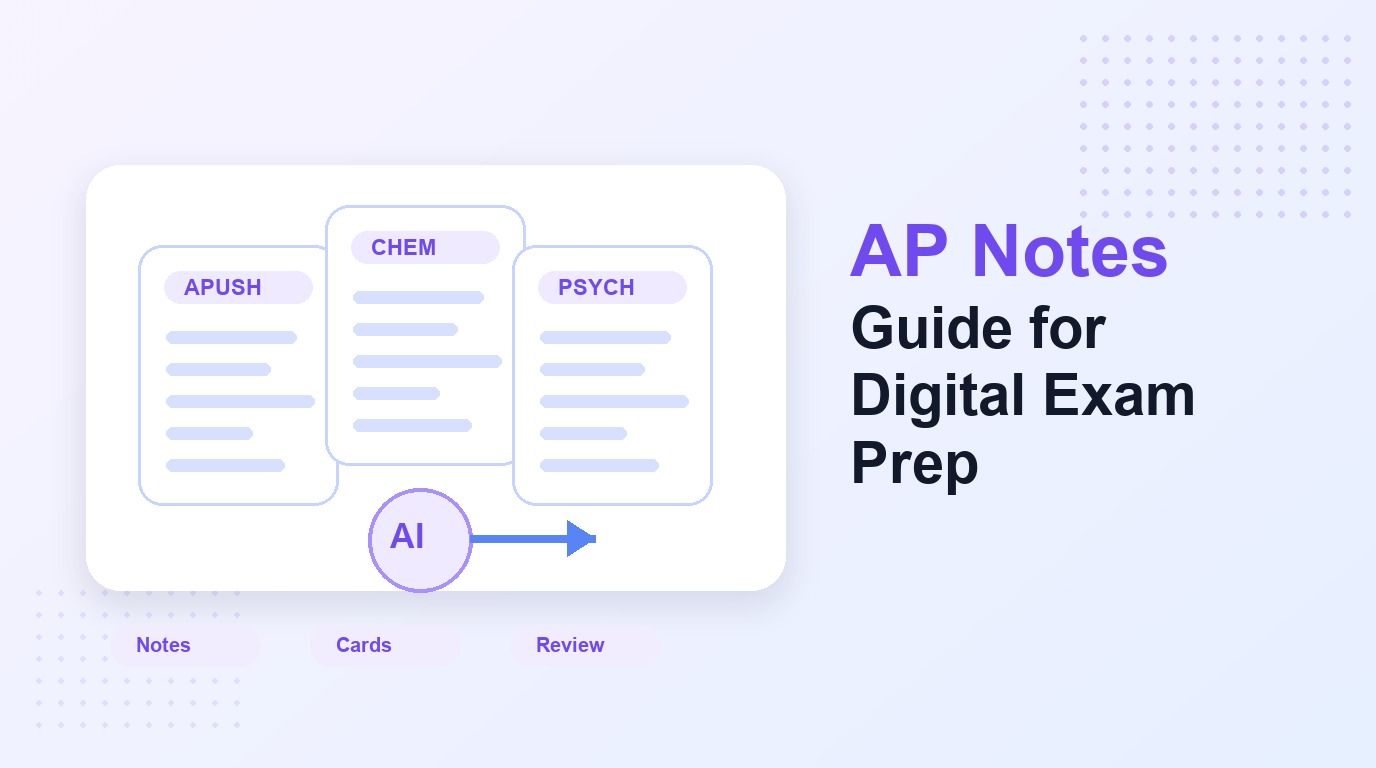
AP notes are no longer just copied textbook outlines or last-minute study packets. With digital and hybrid AP testing now part of the exam routine, students need notes that are searchable, organized, and easy to turn into active review. The best AP notes help you connect class lectures, AP Classroom videos, PDFs, textbook chapters, and practice questions into one system you can actually study from.
Why AP Notes Matter More Now
AP studying has become more digital, but many students still keep messy notes across slides, screenshots, notebooks, and browser tabs. That creates a problem during review season: you may have the information, but not in a form you can use quickly.
College Board’s 2026 AP exam modes show how much the workflow has changed. AP U.S. History and AP Psychology are fully digital, while AP Chemistry is hybrid digital, with multiple-choice in Bluebook and free-response work completed in paper booklets.
That shift makes AP notes more valuable because students need to practice both content recall and exam-style thinking. A clean note system can help you move from scattered material to focused review.
What Good AP Notes Should Include
Strong AP notes should do more than summarize a chapter. They should capture key concepts, vocabulary, examples, evidence, and the exam skill connected to each idea.
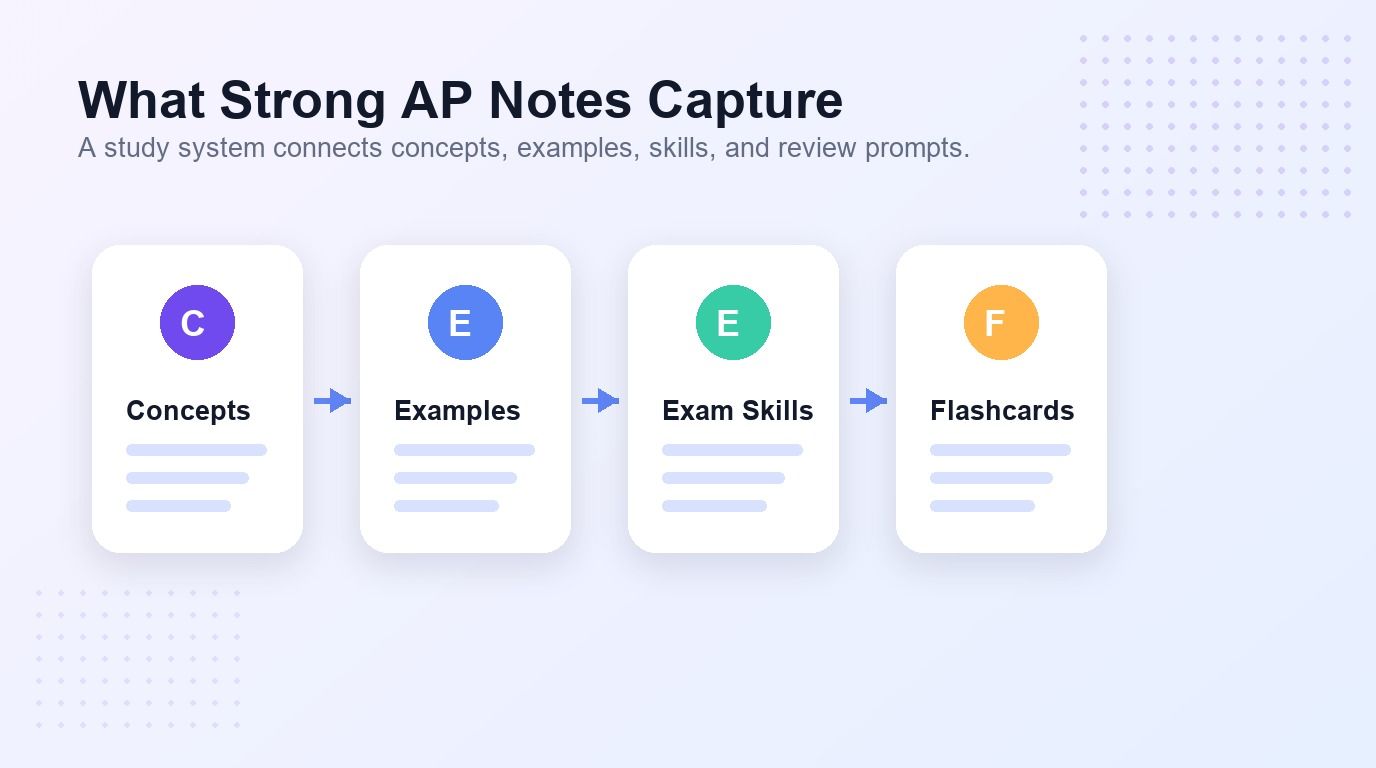
For APUSH, that might mean linking a historical event to causation, continuity, or change over time. For chemistry AP notes, it might mean connecting a formula, a lab pattern, and a free-response explanation.
For psychology AP notes, the goal is often definition plus application. A term is easier to remember when your notes include a real example, research method, and possible evidence-based question.
| Note Element | Why It Helps |
|---|---|
| Key terms | Builds fast recognition for MCQs |
| Examples | Makes abstract ideas easier to apply |
| Cause-and-effect links | Helps with APUSH and science reasoning |
| Common mistakes | Prevents repeated wrong answers |
| Flashcard prompts | Turns notes into active recall |
| Source links | Makes review easier when you need context |
AP Notes vs Regular Class Notes
Regular class notes often follow the teacher’s lecture order. AP notes should follow the way the exam asks students to think.
That means your AP notes should group related ideas even if they came from different places. A lecture, a textbook chapter, an AP video, and a practice FRQ may all explain the same concept from different angles.
The goal is to combine them into one usable review sheet. Students who only copy everything often end up with long notes that are technically complete but too slow to study.
How to Use Lynote for AP Notes
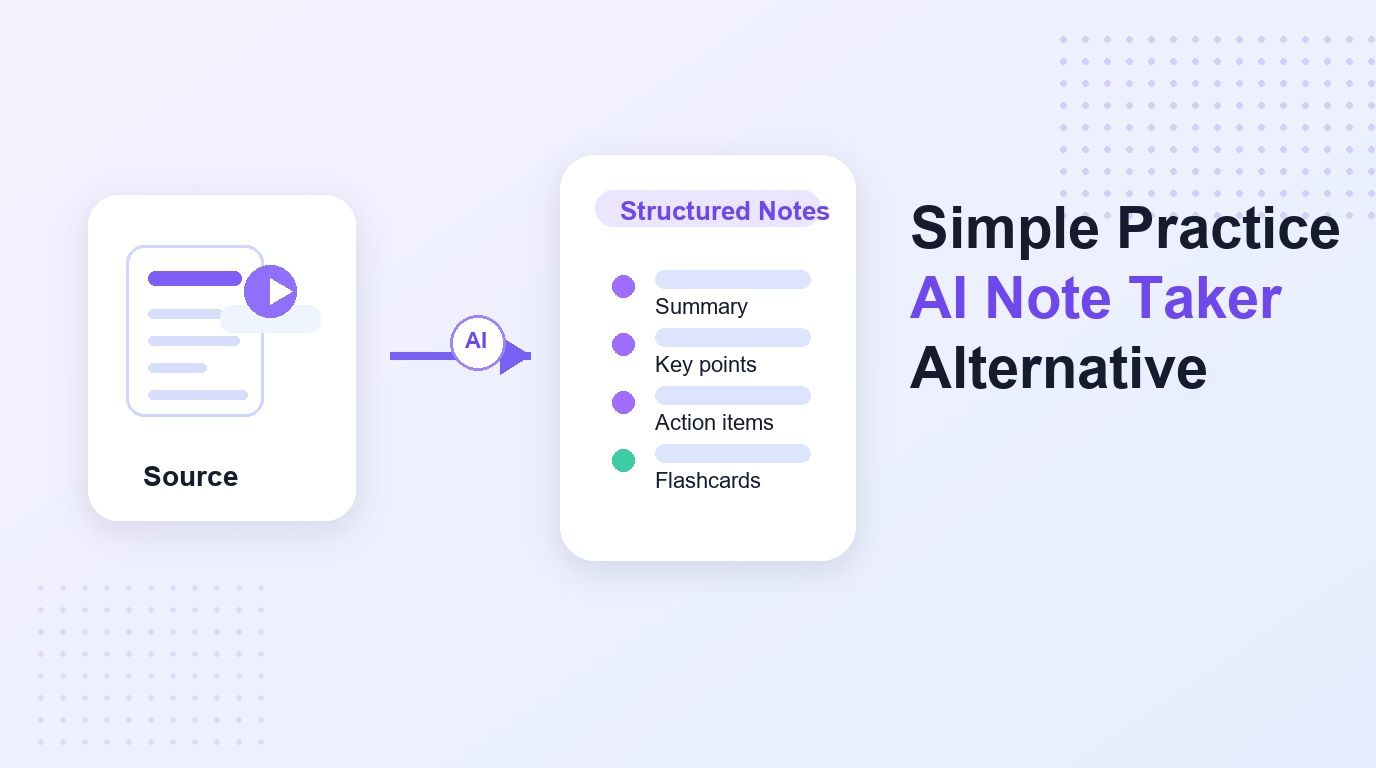
This is where an AI note workflow can help. Lynote AI Note Generator can turn documents, audio, video, images, webpages, and YouTube links into structured notes with headings and bullet points, so students can spend more time reviewing and less time rebuilding their notes manually.
Lynote is useful when your AP materials are scattered. You can add a lecture recording, PDF, webpage, video, or document, then generate structured AP notes from the source.
The workflow still needs student review. For AP studying, you should check names, dates, formulas, definitions, and examples before relying on the final notes.
Step 1. Add Your AP Source Material
Upload a PDF, class handout, lecture recording, image, video, webpage, or YouTube link into Lynote. Use the input that matches the source you actually need to study.
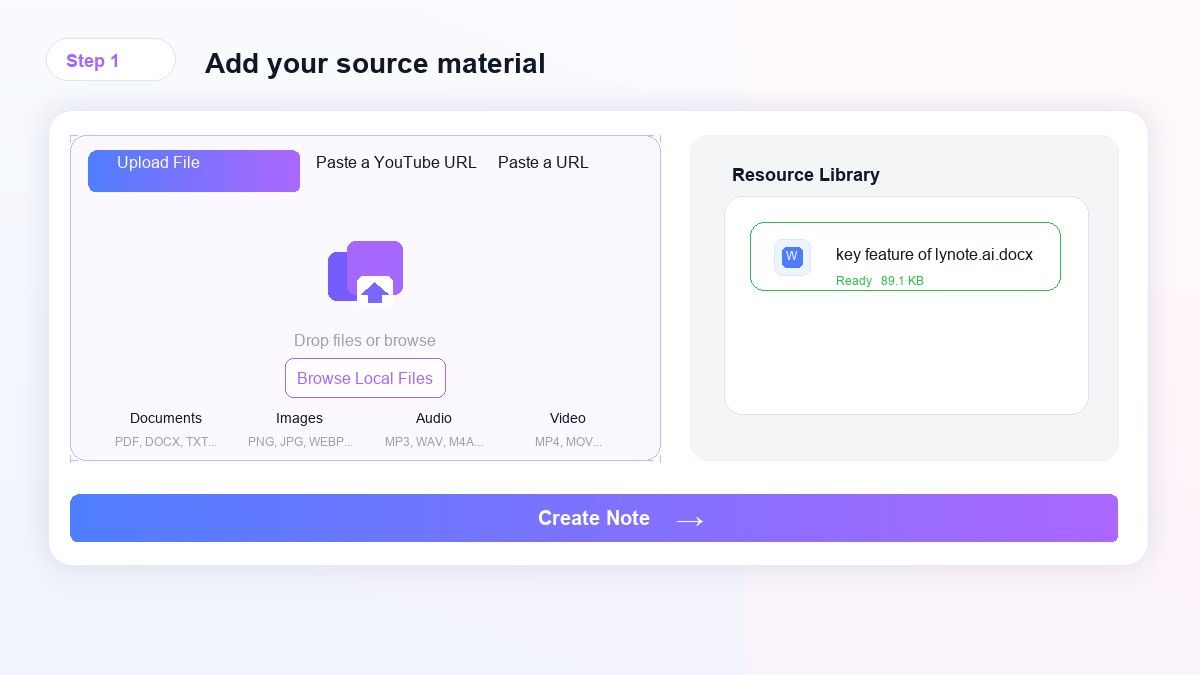
This step is helpful when one AP topic is spread across different resources. Instead of rewriting everything from scratch, you can start from the material you already have.
Step 2. Generate Structured AI Notes
Create the note so Lynote can organize the material into readable sections. The output can help you see headings, bullet points, key ideas, and review-friendly structure.
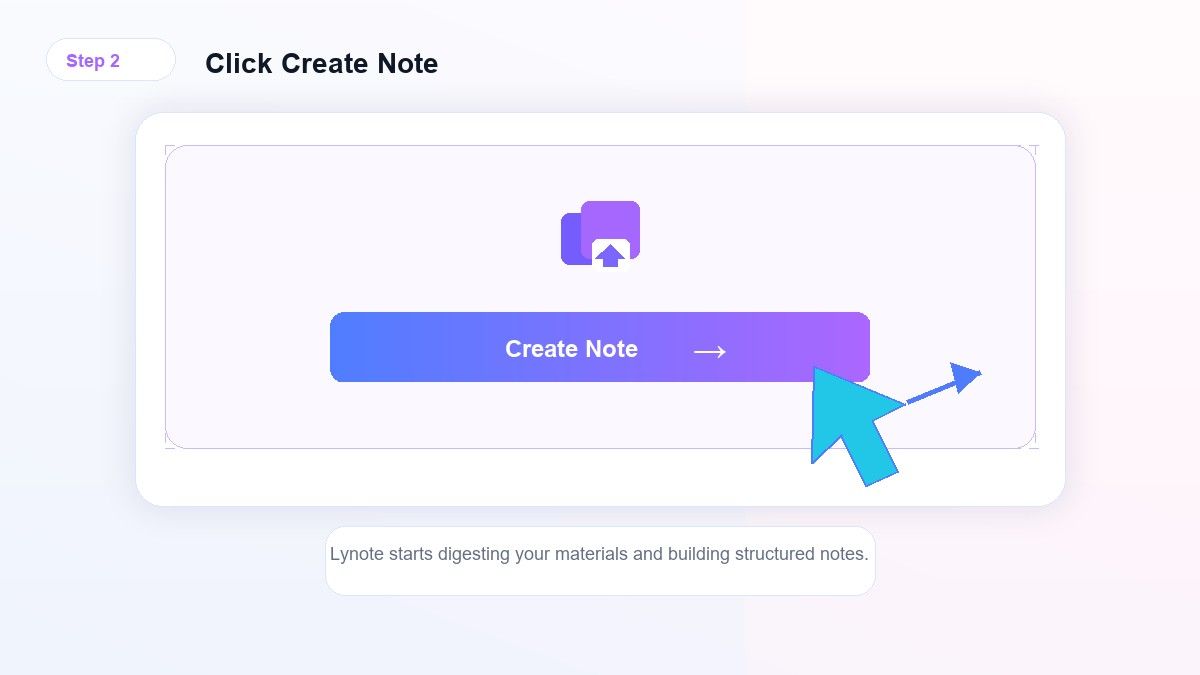
For long AP lectures or review videos, this can save time. You can move from raw material to a cleaner draft before doing your own accuracy check.
Step 3. Review and Turn Notes Into Study Material
Read the generated AP notes, correct details, and add teacher-specific emphasis. Then turn important points into flashcards or practice prompts for active recall.
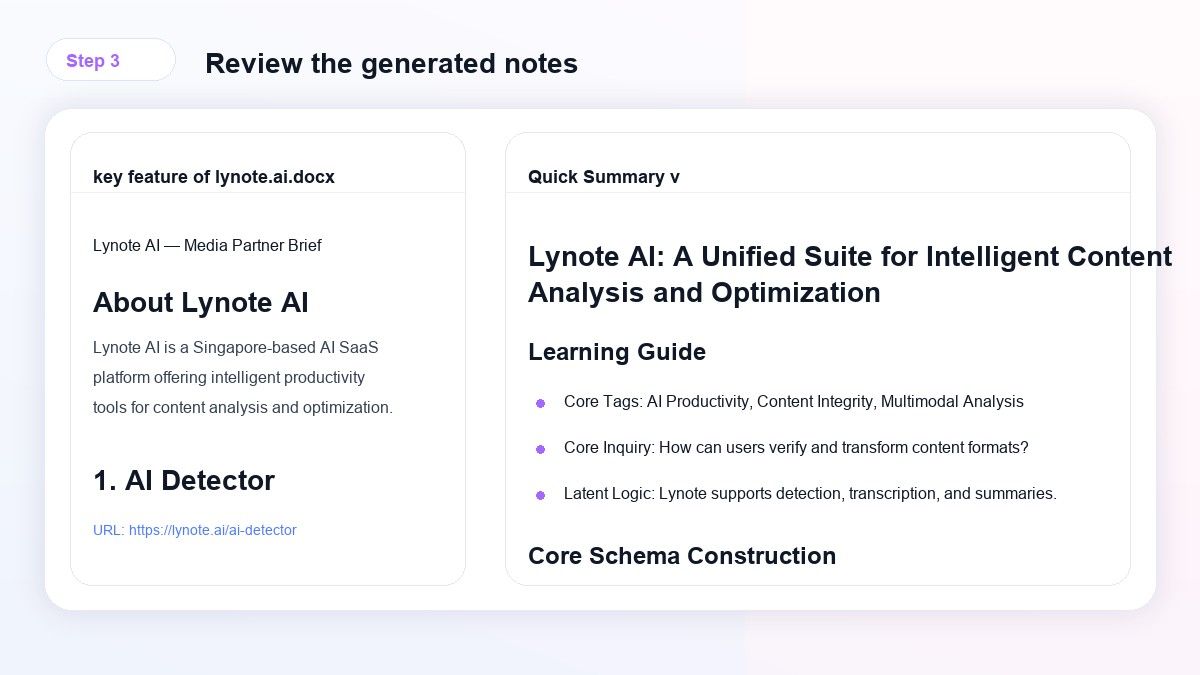
This matters because AP exam prep is not just about having notes. You need to retrieve information, apply it, and explain it under time pressure.
APUSH AP Notes: Build Around Periods and Skills
Students searching for ap notes apush or apush ap notes usually want a faster way to organize AP U.S. History. The mistake is turning every chapter into a long timeline without exam skills.
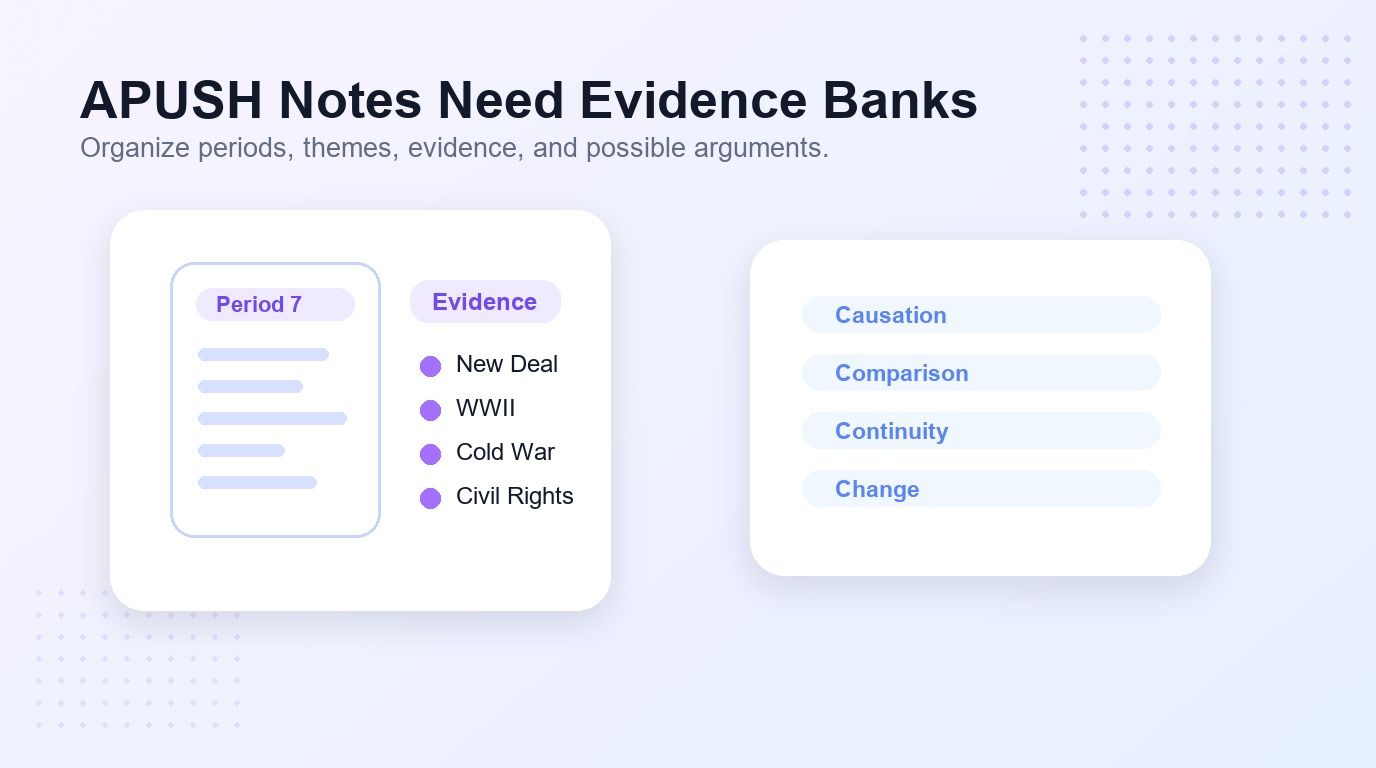
Better APUSH AP notes should connect each period to themes such as identity, migration, politics, work, culture, and America in the world. For each unit, write down the core events, then add why they matter.
A strong APUSH note format looks like this:
| APUSH Note Area | What to Capture |
|---|---|
| Period | Dates and broad historical context |
| Key events | Major developments and turning points |
| Evidence bank | Specific names, laws, conflicts, or movements |
| Skill link | Causation, comparison, continuity, or change |
| Possible prompt | A short LEQ or DBQ-style question |
College Board lists AP U.S. History as a fully digital exam, with multiple-choice, short-answer, DBQ, and long essay components. That means us history AP notes should prepare students to analyze evidence, not just memorize facts.
US History AP Notes: Make an Evidence Bank
US history AP notes become more useful when every unit includes an evidence bank. Instead of writing full paragraphs, collect flexible evidence that can support multiple arguments.
For example, the New Deal can support arguments about federal power, economic crisis, reform movements, and political realignment. A good evidence bank might include the Social Security Act, banking reforms, labor policy, and criticism from different groups.
This makes AP notes more efficient because you can reuse evidence across SAQ, DBQ, and LEQ practice. The point is not to memorize one perfect essay, but to have strong examples ready for different prompts.
Chemistry AP Notes: Pair Concepts With Calculations
Chemistry AP notes need a different structure. AP Chemistry is a hybrid digital exam, which means students need both digital reading fluency and handwritten explanation practice.
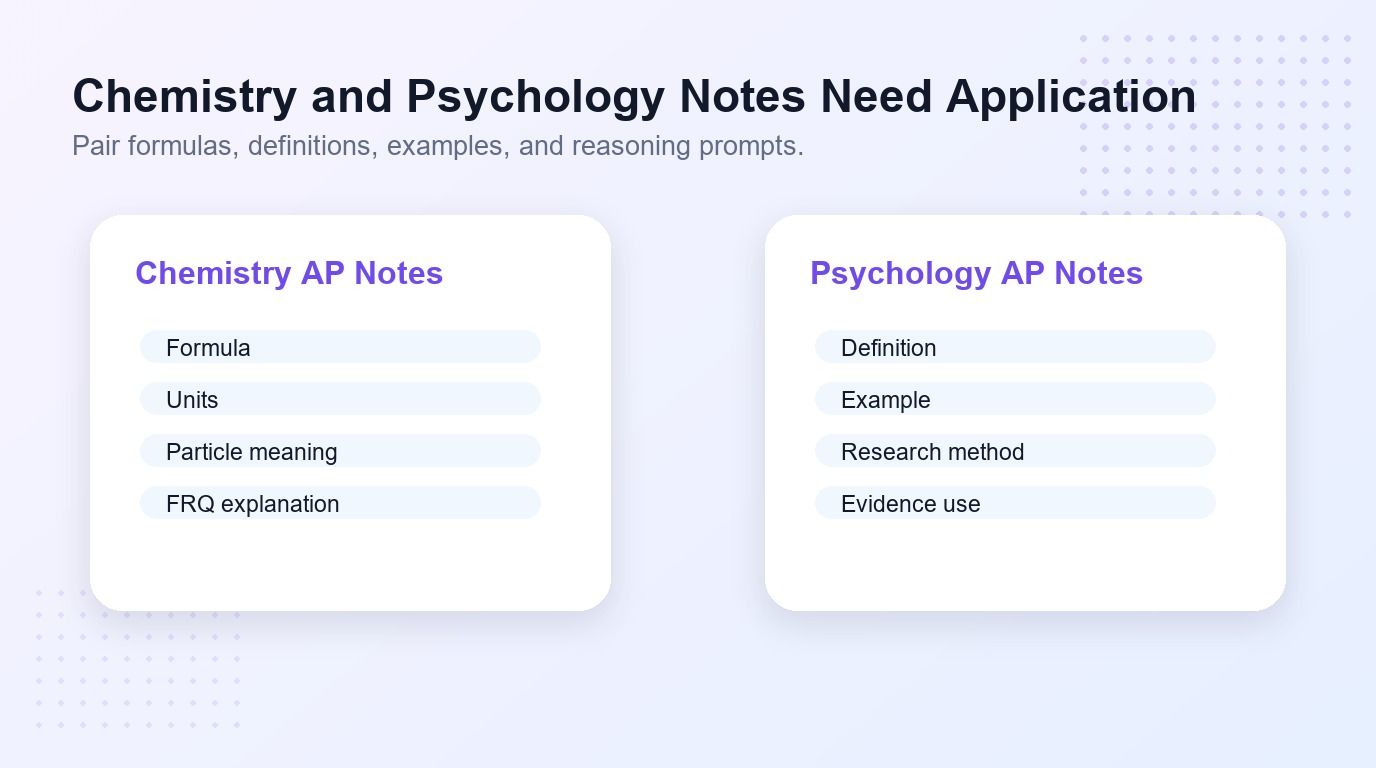
Your chemistry AP notes should include formulas, units, particle-level explanations, and sample calculations. The notes should also show why a calculation matters, not only how to run the numbers.
| Chemistry Topic | Note Strategy |
|---|---|
| Stoichiometry | Show setup, units, and mole relationships |
| Equilibrium | Pair formulas with particle-level meaning |
| Acids and bases | Track definitions, calculations, and titration logic |
| Thermodynamics | Connect signs, equations, and process meaning |
| Kinetics | Link graphs, rate laws, and experimental evidence |
Chemistry AP notes should not be only formula lists. The exam often asks students to explain why a result makes chemical sense, so every formula should have a short plain-English meaning beside it.
Psychology AP Notes: Prepare for Evidence-Based Questions
Psychology AP notes are especially important because the AP Psychology exam now includes source analysis and evidence-based reasoning. College Board describes the exam as fully digital, with multiple-choice questions and two free-response questions.
The two free-response tasks are the Article Analysis Question and Evidence-Based Question. That means psychology AP notes should not be only vocabulary cards.
They should also include research methods, variables, ethical guidelines, statistics interpretation, claims, evidence, and reasoning. This gives students a better bridge between memorizing terms and answering applied questions.
| Psychology Note Area | What to Include |
|---|---|
| Term | Definition in your own words |
| Example | Real behavior or scenario |
| Research link | Study design, variable, or method |
| Evidence use | How it could support a claim |
| Common confusion | Similar terms to avoid mixing up |
Turn AP Notes Into Flashcards
AP notes become stronger when they can turn into questions. If a note says “operant conditioning involves consequences that shape behavior,” the flashcard should ask, “How does operant conditioning differ from classical conditioning?”
For APUSH, flashcards can ask for evidence and historical significance. For chemistry, they can ask for formula setup or conceptual explanation.
For psychology, flashcards can ask for definition, application, and research-method reasoning. The best review system uses both notes and retrieval practice.
A Weekly AP Notes Workflow
A simple weekly workflow can keep AP notes from becoming overwhelming. After each class week, collect your class slides, textbook sections, lecture recordings, and practice questions.
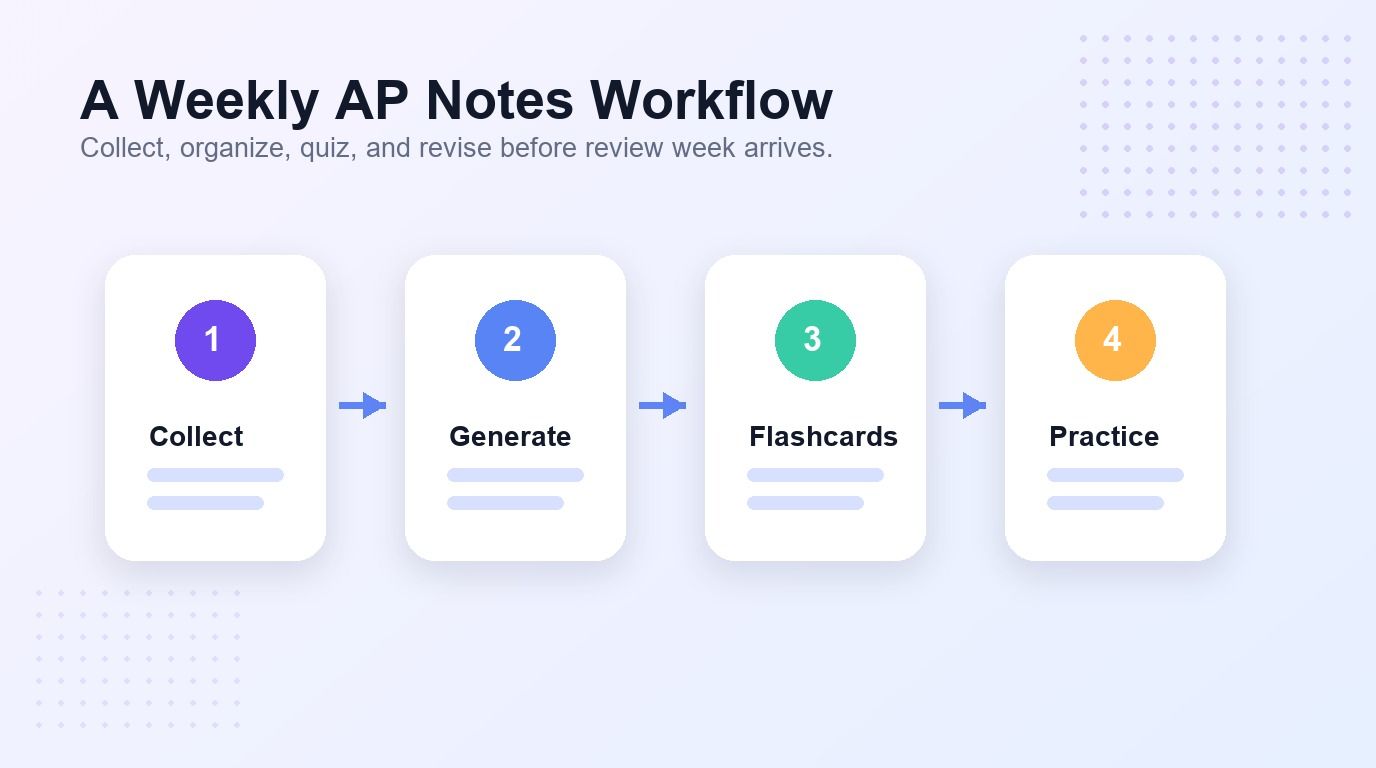
Use those sources to build one organized note set per topic. Then review the note, correct details, and create flashcards from the most testable ideas.
| Day | Task |
|---|---|
| Monday-Thursday | Capture class material and homework notes |
| Friday | Generate or organize weekly AP notes |
| Saturday | Turn weak areas into flashcards |
| Sunday | Practice MCQs or FRQs using the notes |
This system works because it prevents the classic AP review problem: discovering late in the semester that your notes are too long, too scattered, or too passive.
Common AP Notes Mistakes
The first mistake is copying too much. If your AP notes are almost as long as the textbook chapter, they will be hard to review.
The second mistake is separating content from exam skills. APUSH needs evidence and argument, AP Chemistry needs calculation and explanation, and AP Psychology needs concept application and research interpretation.
The third mistake is never revising notes after practice questions. Every missed question should improve your AP notes by adding a warning, example, or clarification.
Best Sources for AP Notes
Students should use official course materials whenever possible. College Board AP Classroom, course and exam descriptions, released free-response questions, and teacher-provided materials are all useful.
Outside notes can help, but they should not replace the course framework. When you use Lynote to organize AP notes, treat the AI output as a structured draft and review it against your teacher’s material and official course expectations.
This is especially important for AP Psychology because older practice materials may not fully match the current exam design. Always check whether a resource aligns with the current course and exam format.
FAQs About AP Notes
What are AP notes?
AP notes are organized study notes for Advanced Placement courses. They summarize important content, examples, vocabulary, formulas, and exam skills so students can review more efficiently.
Are AP notes enough to get a 5?
AP notes are helpful, but they are not enough by themselves. Students also need practice questions, timed FRQs, feedback, and active recall.
What should APUSH AP notes include?
APUSH AP notes should include time periods, key events, historical evidence, themes, and possible DBQ or LEQ connections. The strongest notes help students make arguments, not just remember dates.
What should chemistry AP notes include?
Chemistry AP notes should include formulas, units, sample problems, diagrams, lab patterns, and short explanations of why each concept works. They should connect math steps to chemical meaning.
What should psychology AP notes include?
Psychology AP notes should include definitions, examples, research methods, variables, ethical issues, claims, evidence, and reasoning. This is especially useful for the current AP Psychology free-response section.
Final Thoughts
The best AP notes are organized, searchable, and built for active review. Whether you are making us history AP notes, ap notes apush, chemistry AP notes, or psychology AP notes, the goal is the same: turn scattered class materials into a study system you can trust before exam week.
Sources:

Written by Janet L. Harris
AI Writing Specialist
Janet reviews AI detectors and humanization tools, with a focus on accuracy, limitations, and responsible use. View all articles →