
AP Gov Notes: How to Organize Units and Review for Exams

Preparing for AP U.S. Government and Politics means learning how institutions work, understanding constitutional principles, and applying ideas to political situations. Well-organized AP Gov notes help you connect the five course units, remember foundational documents and Supreme Court cases, and prepare for multiple-choice and free-response questions.
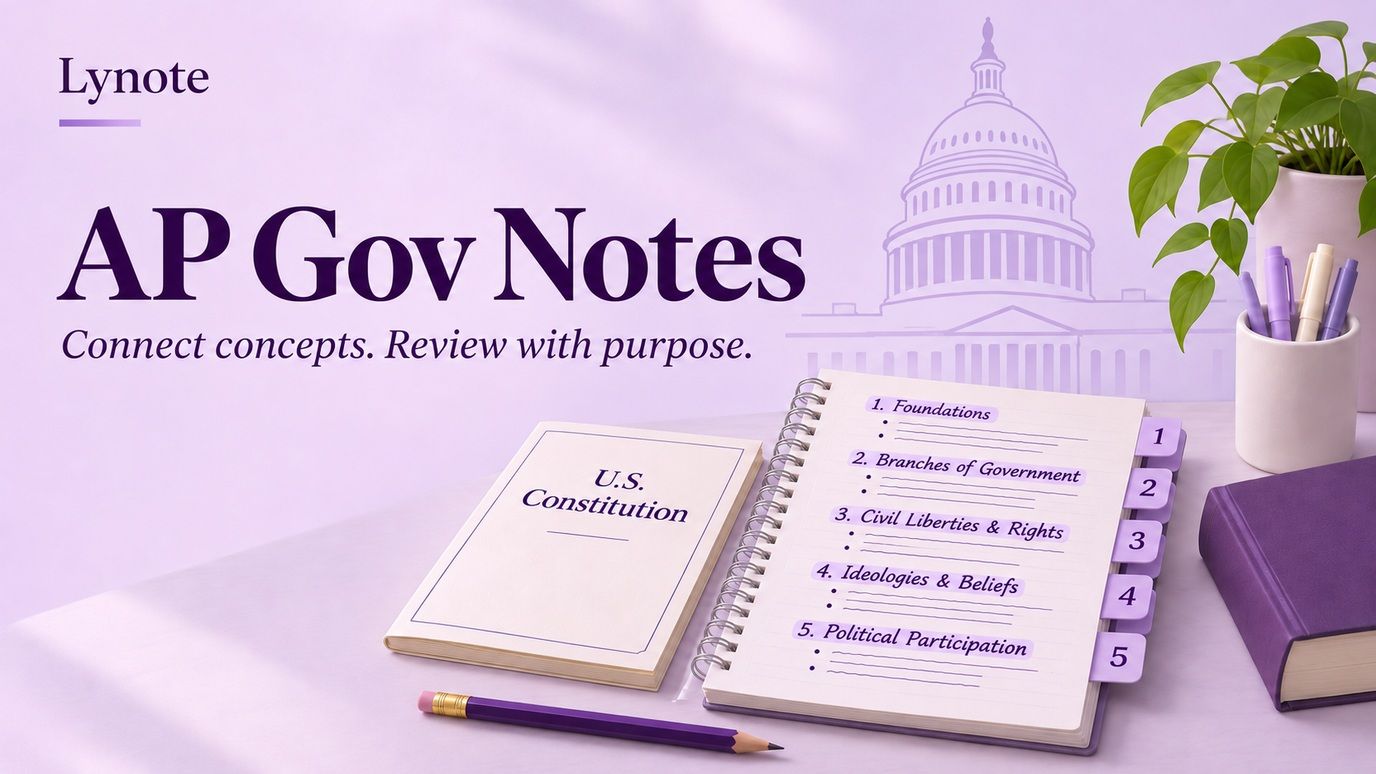
Instead of collecting disconnected definitions, build a study system that connects concepts, evidence, examples, and applications. This guide explains how to organize AP Gov unit notes, create chapter summaries, review key cases, and turn class materials into editable study notes with Lynote AI Note Generator.
TL;DR: How to Make AP Gov Notes More Useful
- Organize notes around the five AP U.S. Government and Politics units.
- For each topic, record a definition, constitutional principle, example, and connection to a document or Supreme Court case.
- Keep case briefs concise: facts, constitutional question, holding, and significance.
- Review charts, polling data, and primary sources, not just vocabulary.
- Practice explaining concepts and supporting arguments with evidence.
- Use Lynote to create a structured draft from your own course materials, then verify and edit it.
What Should AP Gov Notes Include?
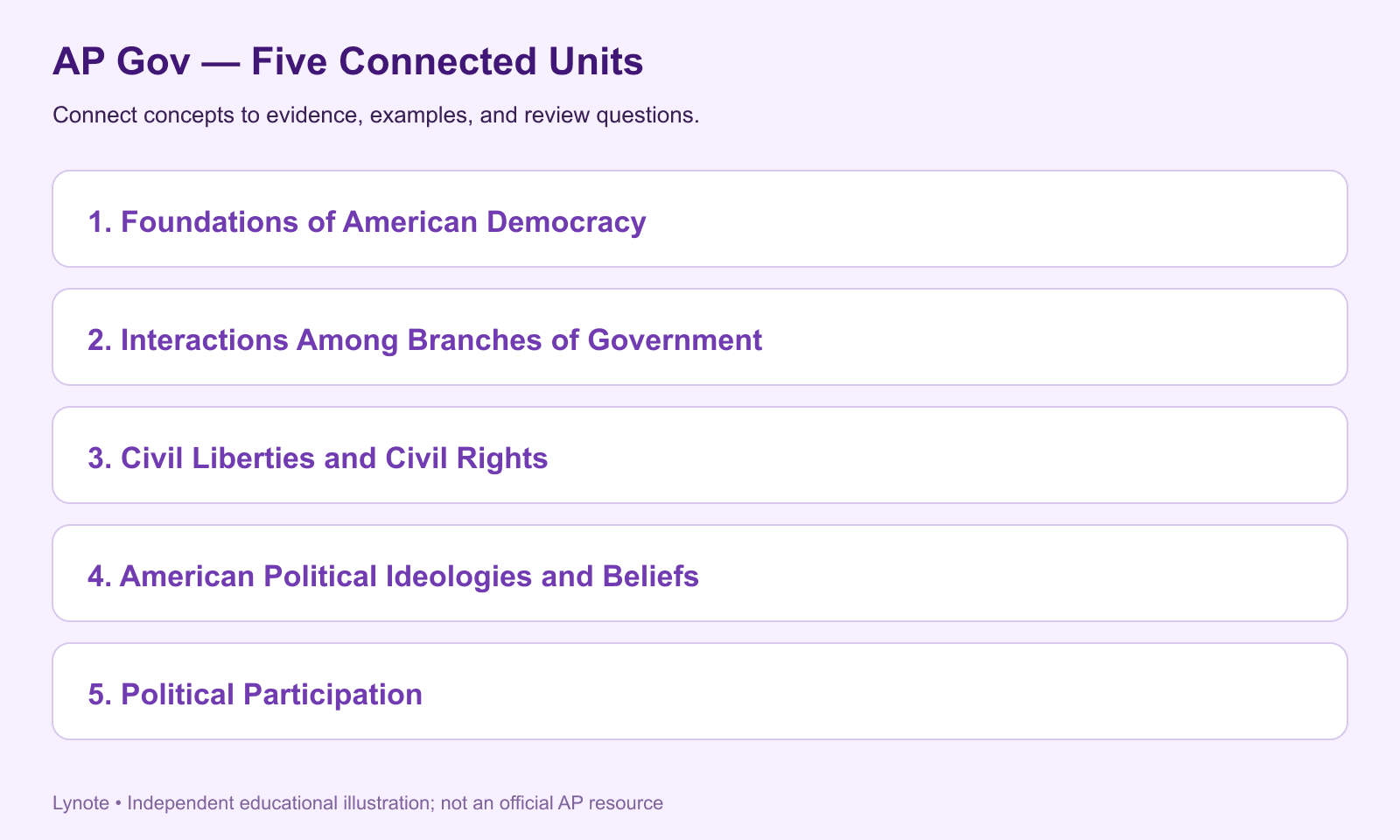
AP Gov notes are study records that help you understand the institutions, principles, processes, and political behaviors covered in AP U.S. Government and Politics. They should do more than list terms. Strong notes explain how a concept works, why it matters, and how it connects to a constitutional or political example.
A useful note for each topic can include five parts:
- Key concept: A concise definition in your own words.
- How it works: The process, institution, or constitutional principle involved.
- Evidence: A foundational document, Supreme Court case, data point, or class example.
- Connection: How the concept relates to another unit or course theme.
- Review prompt: A question that tests whether you can explain or apply the concept.
AP Gov Notes vs. Simple Vocabulary Lists
A vocabulary list may help you recognize terms, but the AP course also asks you to apply concepts and analyze evidence. Knowing the definition of federalism, for example, is not the same as explaining how national and state governments share authority in a policy situation.
Add a short application example beneath important definitions. This makes your notes more useful for stimulus-based questions and written responses.
AP Gov Unit 1 Notes: Foundations of American Democracy
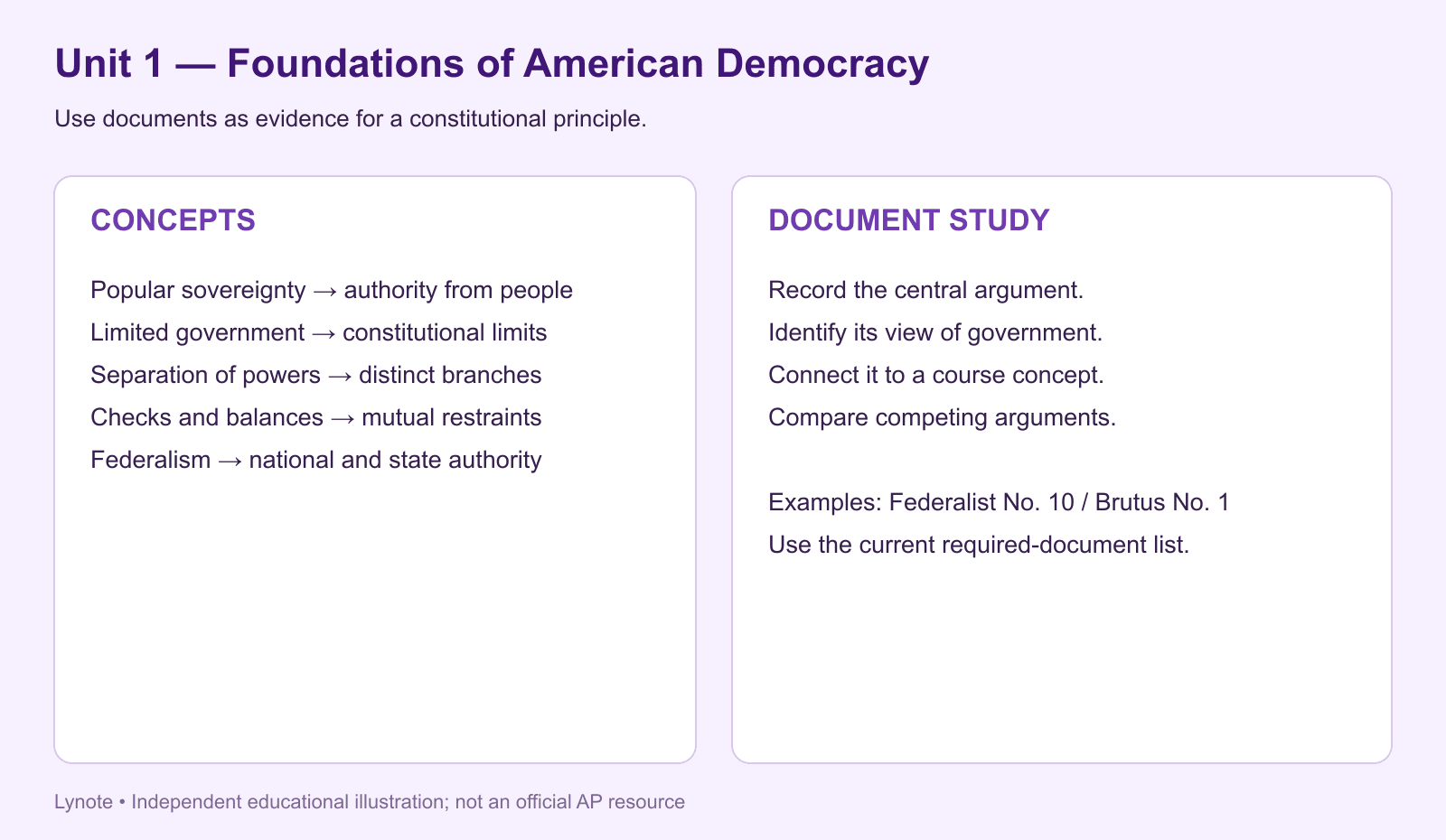
Unit 1 examines the ideas and constitutional principles behind the American system of government. Your AP Gov Unit 1 notes should connect democratic ideals, debates about government power, constitutional design, and federalism.
Key Topics for Unit 1
- Democratic ideals: Popular sovereignty, natural rights, social contract theory, and the purpose of government.
- Types of democracy: Participatory, pluralist, and elite models.
- Government power and individual rights: How constitutional limits protect liberty while allowing government to function.
- Articles of Confederation: Weaknesses of the first national framework and reasons for constitutional change.
- Ratification: Federalist and Anti-Federalist debates about national power and individual rights.
- Constitutional principles: Separation of powers, checks and balances, republicanism, and limited government.
- Federalism: The division of authority between national and state governments.
Important Documents and Connections
Organize Unit 1 notes around the Declaration of Independence, the Constitution, the Articles of Confederation, Federalist No. 10, Federalist No. 51, and Brutus No. 1, following the required document list for your course year.
For each document, record its central argument, view of government, and connection to a constitutional principle. Compare Federalist and Anti-Federalist arguments rather than memorizing each document in isolation.
Unit 1 Review Questions
- How does popular sovereignty influence the structure of the Constitution?
- What problems under the Articles of Confederation encouraged constitutional reform?
- How do separation of powers and checks and balances limit concentrated authority?
- How do Federalist and Anti-Federalist arguments differ about national power?
AP Gov Unit 2 Notes: Interactions Among Branches of Government
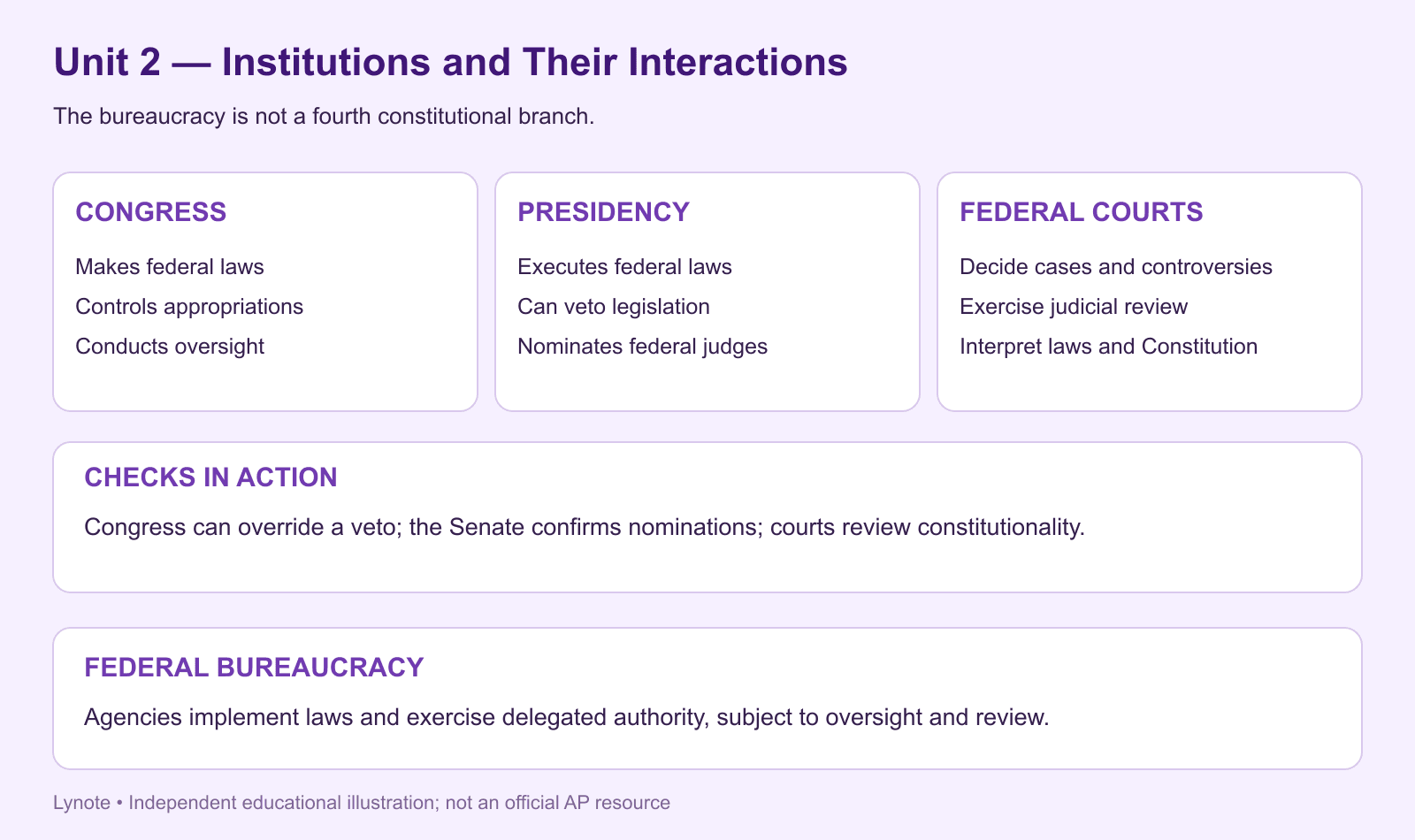
Unit 2 focuses on how the legislative, executive, and judicial branches interact, along with the role of the federal bureaucracy. Your AP Gov Unit 2 notes should explain each institution's powers and show how the branches influence one another.
Congress
Record the structure and responsibilities of the House of Representatives and Senate. Include representation, committee work, leadership, lawmaking, oversight, and the different procedures used by each chamber.
Distinguish enumerated powers from implied powers and explain how the Necessary and Proper Clause relates to legislative authority.
The Presidency
Organize presidential notes around formal and informal powers. Include roles such as chief executive, commander in chief, chief diplomat, and agenda setter.
Explain how executive orders, appointments, vetoes, and public communication can affect policymaking. Add examples from course materials, while distinguishing constitutional authority from political influence.
The Federal Courts
Record the structure of the federal court system and the role of judicial review. Explain how cases reach the Supreme Court and how judicial decisions can affect public policy and constitutional interpretation.
Include required cases such as Marbury v. Madison when studying judicial review. Your case notes should state the constitutional principle and explain why the decision matters.
The Federal Bureaucracy
Create a section for executive departments, independent agencies, regulatory commissions, and government corporations. Note how agencies implement laws, create regulations under delegated authority, and interact with Congress and the president.
Unit 2 Review Questions
- How do the House and Senate differ in structure and responsibilities?
- What checks can Congress and the courts place on presidential power?
- How does judicial review affect the relationship among branches?
- What role does the bureaucracy play after Congress passes a law?
AP Gov Unit 3 Notes: Civil Liberties and Civil Rights
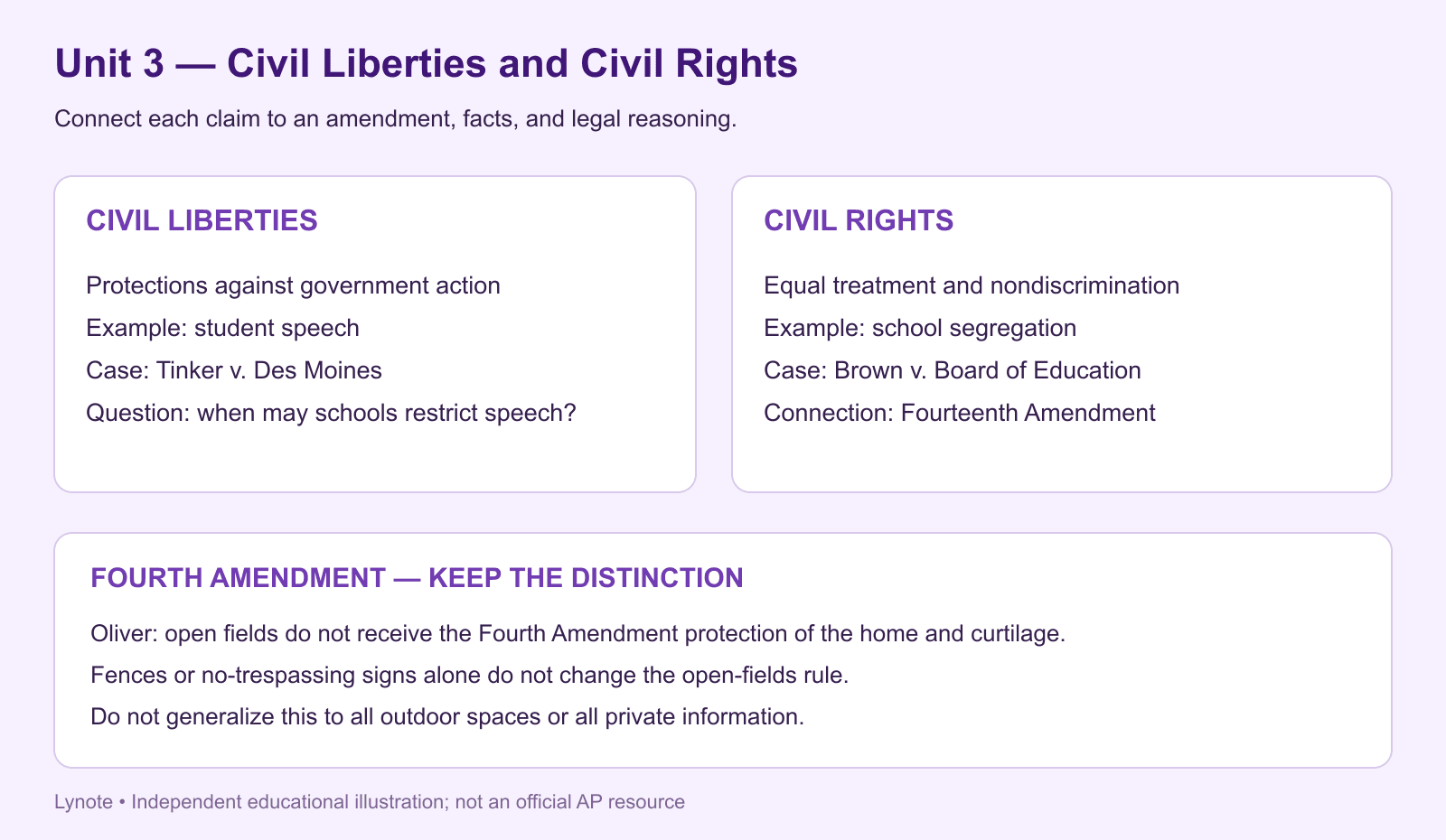
Unit 3 explores the relationship between individual freedoms, equality, and government authority. Your AP Gov Unit 3 notes should distinguish civil liberties from civil rights and connect constitutional protections to Supreme Court interpretations.
Civil Liberties
Civil liberties are protections from certain government actions. Organize notes around the Bill of Rights and the ways constitutional protections apply to state governments through the Fourteenth Amendment.
Important topics include freedom of speech, freedom of religion, freedom of the press, the right to bear arms, criminal procedure, and due process. Record the relevant amendment, the legal question, and a case that illustrates its interpretation.
Civil Rights
Civil rights concern equal treatment and protection against discrimination. Focus on the Equal Protection Clause of the Fourteenth Amendment, the role of federal law, and how social movements have sought changes in law and public policy.
Use case examples to explain how constitutional principles have been interpreted. Note the facts and legal reasoning emphasized in your course materials rather than reducing complex decisions to a slogan.
Supreme Court Case Notes
Create a compact case table for decisions required by your current AP course framework. Examples commonly studied include:
| Case | Central AP Gov Connection |
|---|---|
| Brown v. Board of Education | Equal Protection Clause and school segregation |
| Gideon v. Wainwright | Right to counsel and due process |
| Tinker v. Des Moines | Student speech and First Amendment protections |
| New York Times Co. v. United States | Freedom of the press and prior restraint |
| Engel v. Vitale | Establishment Clause and school-sponsored prayer |
| Wisconsin v. Yoder | Free Exercise Clause |
| McDonald v. Chicago | Application of the Second Amendment to the states |
For every case, write four short points: background facts, constitutional issue, Court's holding, and why the case matters. Check the current College Board required-case list because course frameworks can be updated.
Privacy and the Fourth Amendment: What Is Not Protected?
Students sometimes search for “what kind of privacy is not protected” in AP Gov because the Fourth Amendment does not protect every place or activity in the same way. A useful starting point is the reasonable-expectation-of-privacy framework associated with Katz v. United States.
The Open Fields Doctrine is an important example. In Oliver v. United States, the Supreme Court held that open fields are not protected by the Fourth Amendment in the same way as the home and its curtilage. A person's subjective desire for privacy, including fences or “No Trespassing” signs, does not by itself create a constitutionally recognized reasonable expectation of privacy in open fields.
This does not mean that all outdoor spaces or all private information are unprotected. The legal analysis depends on the place, circumstances, and doctrine involved. Distinguish open fields from the home and its curtilage, and use assigned case materials to explain the rule accurately.
Unit 3 Review Questions
- How are civil liberties different from civil rights?
- How does the Fourteenth Amendment affect the application of rights to states?
- What constitutional protection is at issue in a particular Supreme Court case?
- How does the Open Fields Doctrine differ from privacy protections associated with the home?
AP Gov Unit 4 Notes: American Political Ideologies and Beliefs
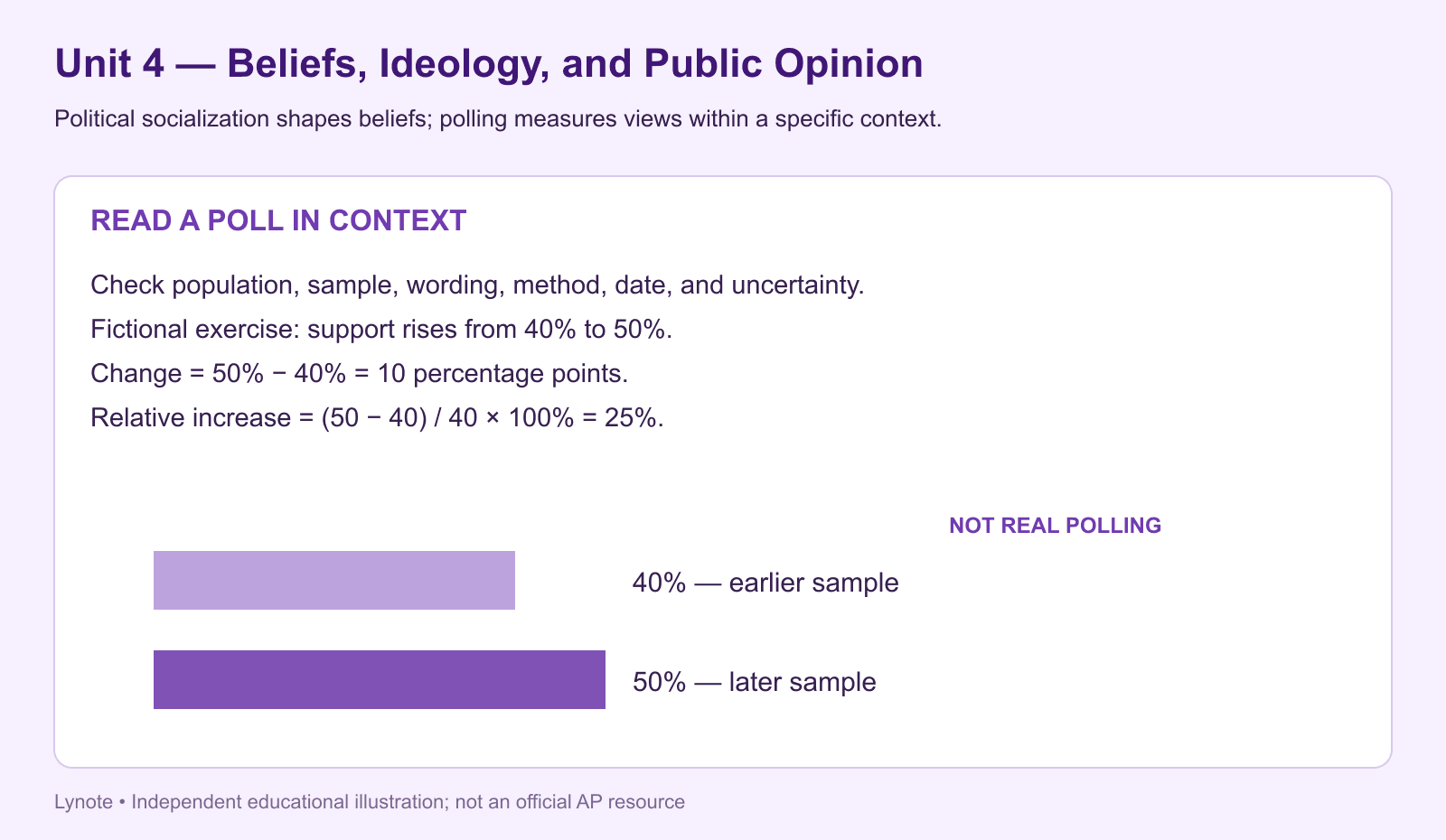
Unit 4 examines how people develop political beliefs and how those beliefs relate to public opinion and policy preferences. Your AP Gov Unit 4 notes should connect political socialization, ideology, polling, and the role of parties in policy debates.
Political Socialization and Public Opinion
Record how family, education, peers, media, community, and major events can shape political attitudes. Distinguish political socialization, which describes how people develop political beliefs, from public opinion, which refers to views held by a population on political issues.
When studying polls, note the target population, sample, wording, method, and margin of error when provided. A poll is evidence about a measured group at a particular time, not a perfect prediction of individual behavior.
Political Ideologies
Organize notes around broad ideological approaches to economic and social policy. Describe principles and policy preferences associated with different viewpoints without treating every member of a party or ideological group as identical.
Compare how competing beliefs can shape debates about taxation, regulation, government services, social policy, and the proper role of government.
Unit 4 Review Questions
- What factors influence political socialization?
- How can question wording affect public opinion polling?
- What is the difference between political ideology and party identification?
- How can ideological beliefs influence policy preferences?
AP Gov Unit 5 Notes: Political Participation
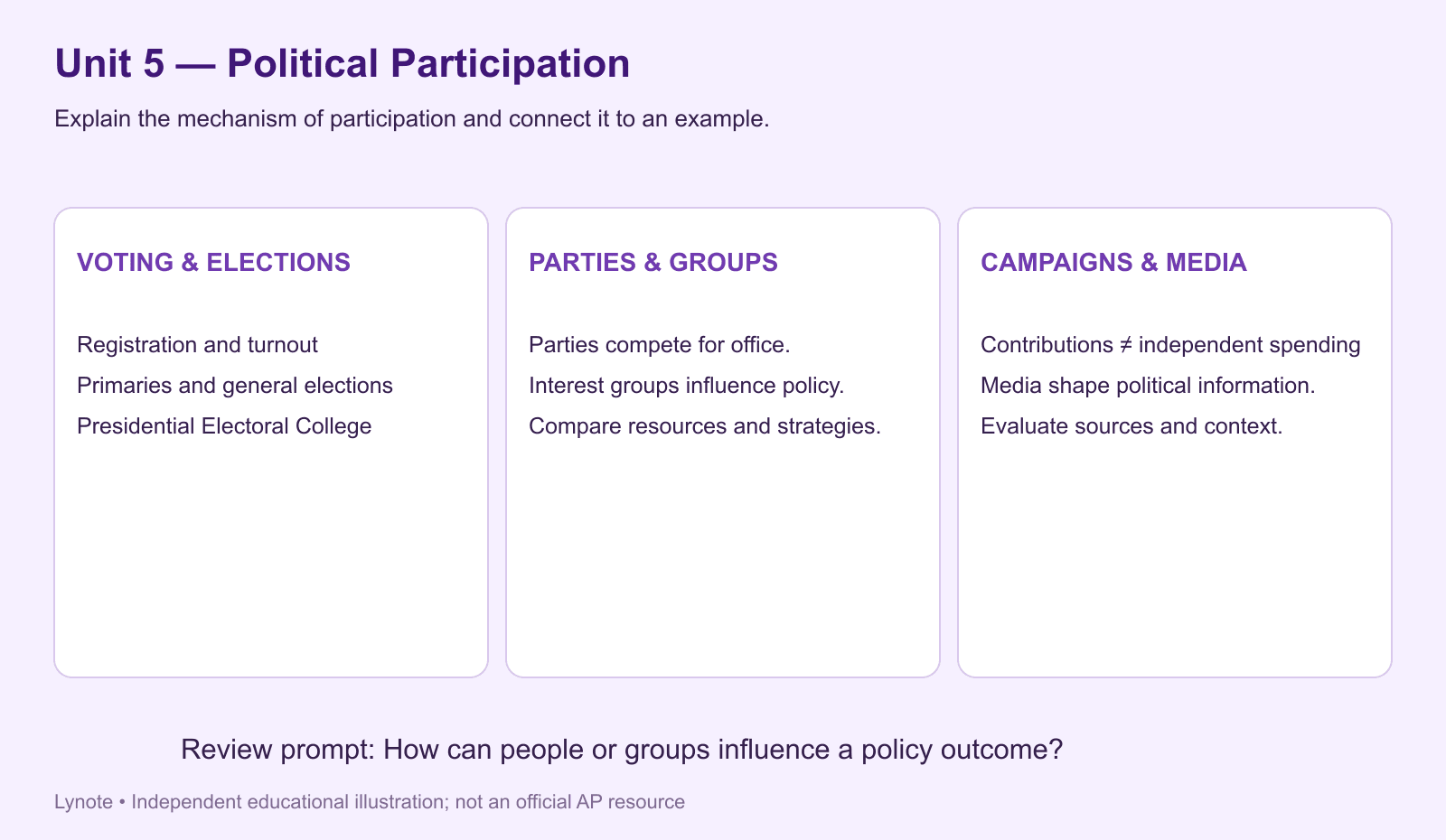
Unit 5 examines how individuals and groups participate in the political process and influence government. Your AP Gov Unit 5 notes should cover voting, elections, political parties, interest groups, campaigns, and media.
Voting and Elections
Record constitutional protections and laws related to voting, voter registration, turnout, and participation. Explain how demographic, institutional, and political factors can affect voter behavior.
For elections, distinguish primaries, general elections, and other forms of electoral participation. Include the role of the Electoral College when studying presidential elections.
Political Parties and Interest Groups
Compare the functions of political parties with those of interest groups. Parties seek to organize political competition and win public office, while interest groups seek to influence public policy and decision makers.
Your notes can include lobbying, litigation, public campaigns, endorsements, and other strategies. Explain how groups may use different resources and methods to pursue policy goals.
Campaigns, Campaign Finance, and Media
Record the role of campaign organizations, political spending, fundraising, and media coverage. Distinguish campaign contributions from independent expenditures and connect relevant rules to constitutional decisions covered in your course.
Also note how traditional media and digital platforms can shape political information, participation, and public debate.
Unit 5 Review Questions
- What constitutional amendments and laws protect voting rights?
- Why can third parties face barriers in the U.S. electoral system?
- How do political parties differ from interest groups?
- How can media coverage influence political participation?
AP Gov Chapter Notes: How to Organize Textbook Readings
Many students organize AP Gov chapter notes around textbook or AMSCO reading assignments. Chapter numbering can vary by edition, teacher, and course sequence, so use the assigned table of contents rather than assuming every chapter corresponds to the same unit.
A useful chapter note should include the chapter title, related AP unit, key terms, major arguments, important documents or cases, and a short review section.
AP Gov Chapter 1 Notes
Start by identifying the chapter's main theme and how it connects to the foundations of American democracy. If the assigned chapter introduces democratic ideals or constitutional principles, connect its terms to Unit 1 concepts.
AP Gov Chapter 2 Notes
If your chapter covers the Constitution or constitutional design, organize the notes around the structure of government, separation of powers, checks and balances, and federalism. Add a short explanation of how each principle limits or distributes authority.
AP Gov Chapter 3 Notes
Identify the chapter's central concepts and connect them to the course framework. Record key definitions, constitutional provisions, and examples that help explain the topic.
AP Gov Chapter 4 Notes
Use a two-column format to compare concepts, arguments, or institutions. For example, when studying federal and state authority, list the principle on one side and a course example on the other.
AP Gov Chapter 5 Notes
Focus on how the chapter's ideas connect to government institutions or political processes. Include the relevant constitutional authority, actors, and likely consequences described in the assigned material.
AP Gov Chapter 7 and Chapter 13 Notes
For later chapters, avoid relying on a generic online chapter summary without checking your textbook edition. Write the exact chapter title and connect it to the relevant AP unit, required documents, and cases.
If your teacher assigns AP Gov Chapter 13 notes or Chapter 7 AP Gov notes, use the assigned reading and course outline to confirm the topic before building your study guide.
AP Comparative Government Notes vs. AP U.S. Government Notes
AP Comparative Government and Politics and AP U.S. Government and Politics are separate courses. AP U.S. Government focuses on the institutions, principles, and political processes of the United States, while AP Comparative Government examines political systems and processes across multiple countries.
Students searching for AP Comp Gov notes should make sure they are using materials for the correct course. Some analytical skills overlap, such as comparing institutions and interpreting political data, but the course content and required examples differ.
How to Make AP Gov Review Notes for the Exam
Review notes should help you retrieve and apply information, not simply repeat textbook paragraphs. Organize your final review around course concepts, required documents, Supreme Court cases, and the skills assessed in the exam.
Build a Foundational Documents Guide
For each required document, record its central claim, political ideas, view of government, and connection to a course concept. Practice explaining how one document supports or challenges an argument found in another.
Create a Supreme Court Case Comparison Chart
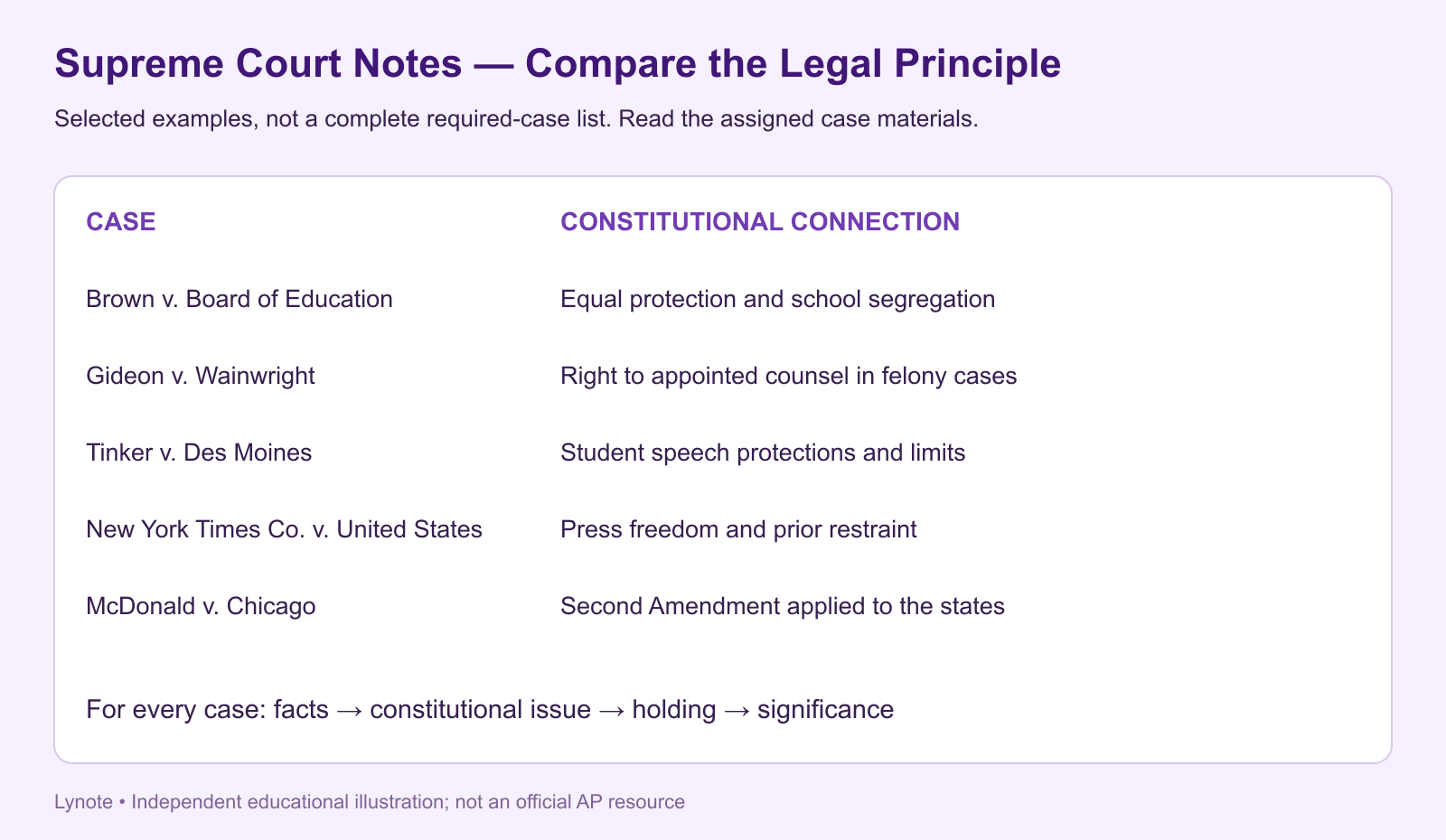
Group cases by constitutional principle or amendment. Compare the facts, holding, and reasoning so you can explain similarities and differences rather than memorizing case names alone.
Practice Data and Source Analysis
Use graphs, tables, polling results, maps, and excerpts from political documents. Write down the trend or claim shown by the source, identify relevant context, and explain how the evidence supports a conclusion.
Prepare for Free-Response Questions
The AP exam includes written responses that assess concept application, quantitative analysis, Supreme Court comparison, and argumentation. Practice responding directly to the task, using specific evidence, and explaining the connection between evidence and claim.
Check the current College Board exam description for the latest format, timing, and scoring guidance before your exam.
How to Create AP Gov Study Notes with Lynote AI
AP Government students often work with textbook chapters, class slides, recorded lectures, primary-source documents, and review handouts. Organizing them manually can take time, especially when you need to connect a concept to a case or foundational document.
Lynote AI Note Generator can help turn supported learning materials into structured, editable notes. Use it as a starting point for your own AP Gov study guide, then verify the details against your course framework and assigned sources.
Step 1. Upload Your AP Gov Study Materials
Upload supported PDFs, documents, slides, or recorded lesson files. You can also use supported webpage or video links when your source is available online.
For example, add a teacher's Unit 1 presentation, an assigned reading, or a lecture recording. Use materials you are authorized to process.
Step 2. Generate and Organize Your Notes
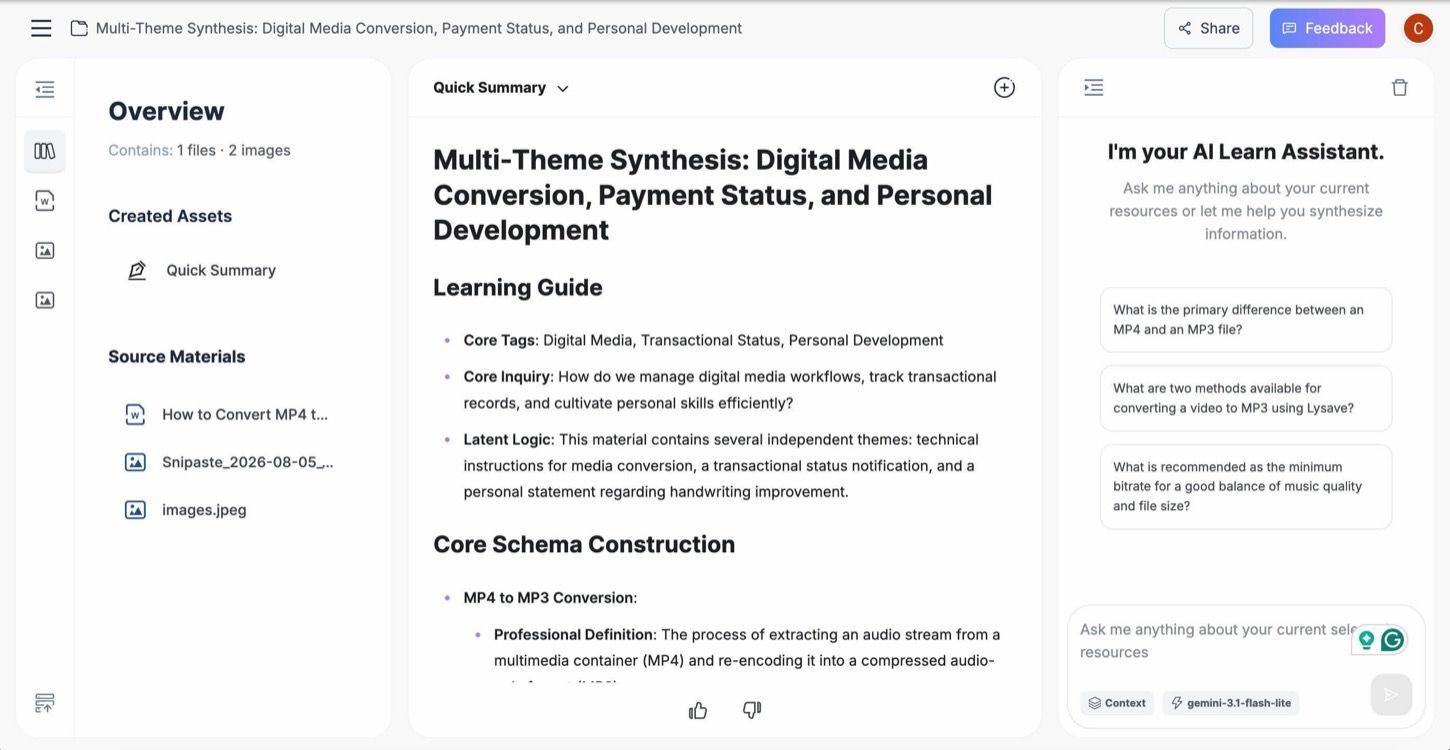
Actual Lynote interface; sample content is a generic product demonstration, not an AP Gov lesson. Official source.
Generate structured notes from the source material. Review the headings and group the content by AP unit, topic, foundational document, or Supreme Court case.
Add missing class explanations and correct any terms or dates that the generated draft does not capture accurately. Keep the original source available for reference.
Step 3. Review with AI Chat and Flashcards
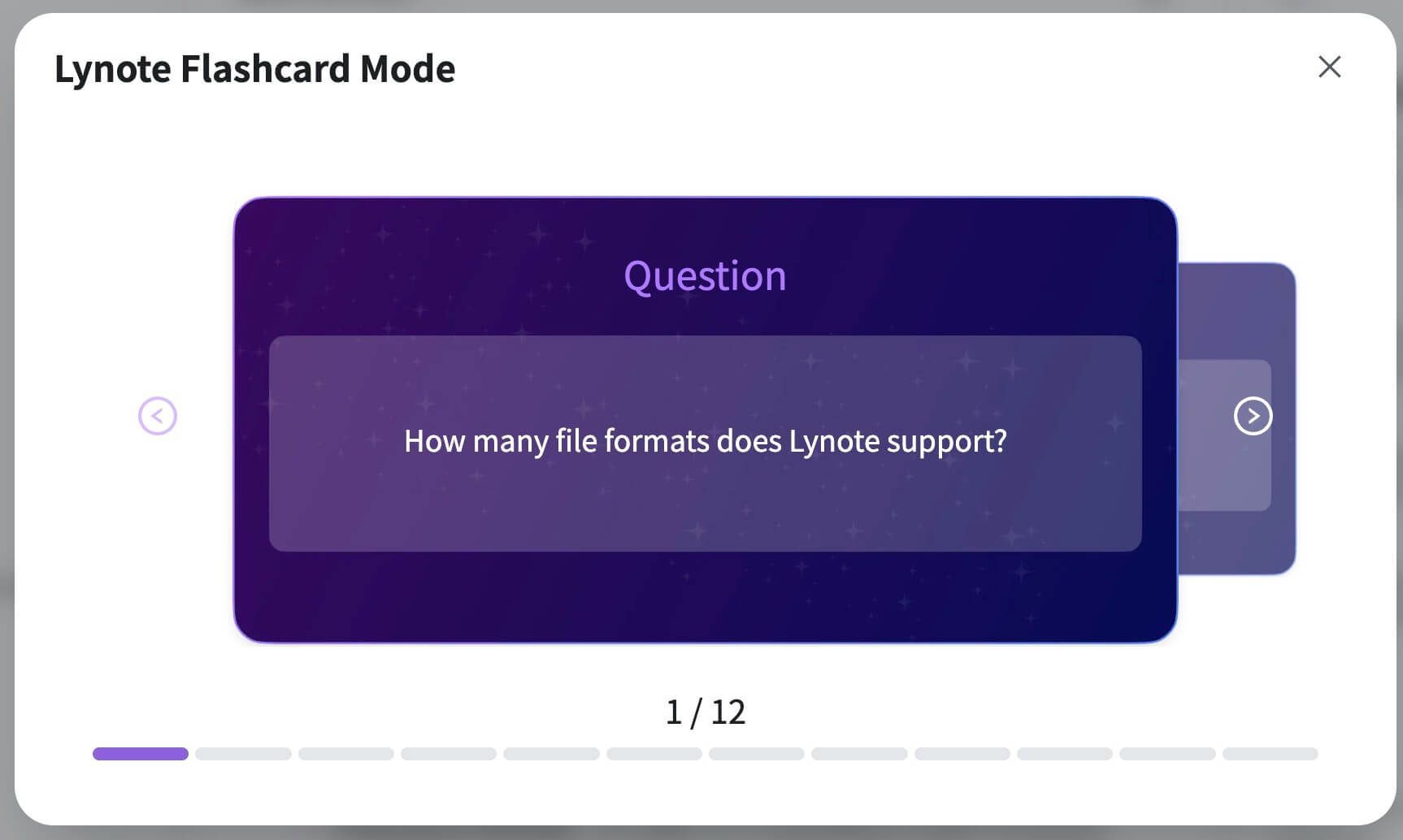
Actual Lynote interface; sample content is a generic product demonstration, not an AP Gov lesson. Official source.
Use AI Chat to ask questions about information contained in your uploaded materials. For example, ask for a comparison of two constitutional principles if both are explained in your source.
Create flashcards from important terms, case holdings, and foundational ideas. Use them for recall practice, then answer application questions in your own words.
Lynote organizes the materials you provide; it does not replace the official AP course framework, teacher guidance, or independent practice with exam-style questions.
Build a More Organized AP Gov Study Routine
You can use Lynote throughout the course rather than waiting until the final exam review period. Start by creating notes from each assigned reading or lecture, then group the results by unit and topic.
Before an exam, revisit your notes, clarify difficult concepts with AI Chat, and use Flashcards to test your memory. Combine this process with official College Board materials and practice questions to prepare for different question types.
Create Your AP Gov Notes with Lynote AI
Common AP Gov Note-Taking Mistakes to Avoid
Memorizing Terms Without Applying Them
Knowing a definition is only one part of understanding a political concept. You also need to explain how it operates in a scenario or connects to a constitutional principle.
Better approach: Add one application example and one review question beneath each important term.
Mixing Up Supreme Court Cases
Case names can become difficult to remember when notes contain only short labels. Without facts and constitutional context, it is easy to confuse the legal issue or holding.
Better approach: Use a consistent case template with facts, issue, holding, and significance. Compare cases that address related constitutional principles.
Treating Textbook Chapters as the Official Unit Structure
Textbook chapter numbers do not always match College Board unit numbers. Different AMSCO editions and teacher syllabi may organize readings differently.
Better approach: Record the actual chapter title and connect it to the relevant AP unit using your assigned syllabus and course framework.
Studying Only by Rereading
Rereading can make information feel familiar without showing whether you can recall or apply it. AP Gov requires students to interpret sources and explain relationships among ideas.
Better approach: Turn headings into questions, practice explaining concepts without looking, and complete exam-style questions.
Ignoring Evidence and Context
A case name or document title alone is not enough to support an argument. You need to understand the relevant facts, constitutional principle, and connection to the question.
Better approach: Add a short evidence note explaining how each case or document supports a specific concept.
Conclusion: Build AP Gov Notes That Help You Apply What You Learn
Effective AP Gov notes do more than collect definitions. They connect the five course units, foundational documents, Supreme Court cases, political concepts, and evidence you need to explain your reasoning.
Organize your notes by unit, add examples to important concepts, and review with questions and practice responses. If you want to turn your own course PDFs, lectures, and study materials into editable notes, try Lynote AI Note Generator and build a study system that works alongside your official AP resources.
Frequently Asked Questions About AP Gov Notes
What Are the Best Ways to Organize AP Gov Notes?
Organize your notes around the five AP U.S. Government and Politics units, then divide each unit into topics, key terms, foundational documents, and Supreme Court cases.
Use a consistent structure with definitions, explanations, examples, and review questions. This makes it easier to connect concepts and prepare for different exam tasks.
Where Can I Find AP Gov Notes on Reddit?
Reddit discussions may contain student-created notes, study advice, and recommendations. Treat these as supplementary resources rather than official course materials.
Check the accuracy of any shared notes against your textbook, teacher's materials, and the current College Board course framework. Course coverage and chapter references may differ.
Are AMSCO AP Gov Notes the Same as College Board Materials?
No. AMSCO is a commercial educational publisher, while the College Board defines the AP course framework and exam requirements.
Students using AMSCO AP Gov notes should compare their reading assignments with the current course framework. A textbook can help explain concepts, but it should not replace official course information.
How Should I Make AP Gov Unit 1 Notes?
Start with democratic ideals, constitutional foundations, ratification debates, constitutional principles, and federalism. Connect each topic to relevant foundational documents and examples.
Add review questions that ask you to explain why a principle matters or how it affects government structure.
What Should I Include in AP Gov Unit 2 Notes?
Focus on Congress, the presidency, the federal courts, and the bureaucracy. Record each institution's powers, constitutional foundations, relationships with other institutions, and examples from your course.
Use comparison charts to review checks and balances and the ways branches can influence one another.
What Is the Difference Between AP Gov Unit 3 and Unit 4?
Unit 3 focuses on civil liberties and civil rights, including constitutional protections and equality. Unit 4 focuses on American political ideologies and beliefs, including political socialization and public opinion.
Keep separate unit summaries, but note connections when political beliefs influence debates about rights or public policy.
What Should AP Gov Unit 5 Notes Cover?
Unit 5 focuses on political participation. Organize notes around voting, elections, political parties, interest groups, campaigns, campaign finance, and media.
Include examples and explain how individuals and groups can influence political outcomes and public policy.
How Do I Make AP Gov Chapter Notes from AMSCO?
Begin with the exact chapter title and learning objectives in your assigned edition. Identify the related AP unit, key terms, constitutional concepts, documents, and cases.
Finish with a short summary and review questions. Do not assume chapter numbers are identical across editions or classroom schedules.
What Privacy Is Not Protected Under the Fourth Amendment in AP Gov?
A commonly taught example is the Open Fields Doctrine. Under the doctrine discussed in Oliver v. United States, open fields outside the home's curtilage generally do not receive the same Fourth Amendment protection as the home.
This is not a blanket rule that all outdoor places or personal information lack privacy protection. The legal analysis depends on the location and circumstances, so review the relevant case and your course materials carefully.
How Should I Study Supreme Court Cases for AP Gov?
For each required case, record the background facts, constitutional issue, holding, and significance. Then compare it with other cases involving related amendments or constitutional principles.
Practice explaining why the case matters in a new scenario rather than memorizing only its name.
Can Lynote Help Me Create AP Gov Study Notes?
Yes. Lynote can generate structured notes from supported materials you provide, including PDFs, documents, presentations, audio, and videos.
You can edit the generated notes, ask AI Chat questions based on the uploaded sources, and create flashcards for review. Always verify constitutional details and exam requirements against authoritative course materials.
Can I Use AI-Generated AP Gov Notes to Prepare for the Exam?
AI-generated notes can help organize material and create a starting point for revision. They should not be treated as a complete or guaranteed substitute for your course readings, teacher guidance, and official AP resources.
Check dates, case holdings, constitutional explanations, and examples. Practice applying what you learn through exam-style questions.

Written by Janet L. Harris
AI Writing Specialist
Janet reviews AI detectors and humanization tools, with a focus on accuracy, limitations, and responsible use. View all articles →