

How to Learn Arabic Fast: 9 Practical Ways to Make Progress

To learn Arabic faster, choose the variety that fits your goal, study sounds and script alongside useful phrases, and practice using a little Arabic every day. A short lesson you can understand, recall, and use is more valuable than a long vocabulary list you only recognize. Start with one real task, such as introducing yourself or ordering a meal, rather than a deadline for fluency.

The tricky part is that two resources labeled "Arabic for beginners" may teach different things. This guide helps you choose a direction, build a manageable routine, and spot the habits that slow progress down.
Which Arabic Should You Learn First?
Before buying a course, ask: who do I want to understand, and what do I want to do? Reading a news report, chatting with relatives, and studying a religious text are related goals, but they need different practice.
Modern Standard Arabic, usually shortened to MSA, is used in formal writing and formal spoken settings. Regional varieties are central to everyday conversation, while Classical and Quranic study involves its own texts, vocabulary, and learning priorities.
| Your main goal | A useful primary direction | What to look for in lessons | A mismatch to avoid |
|---|---|---|---|
| Chat with family or friends | Their regional spoken variety | Familiar situations, recordings, and conversational responses | Learning formal phrases without checking how your family actually speaks |
| Travel to a particular country | A relevant local variety | Greetings, directions, requests, and likely replies | Memorizing a request but never practicing the answer |
| Read news or formal nonfiction | MSA | Graded reading, clear audio, vocabulary in context | Starting with advanced news broadcasts because they are easy to find |
| Study Quranic or classical texts | A course designed for that goal | Guided reading, vocabulary, grammar, and qualified instruction | Assuming recitation practice alone builds everyday conversation |
| Work across Arabic-speaking settings | MSA plus a relevant spoken variety | Formal tasks and conversations labeled separately | Treating every workplace situation as equally formal |
You do not need to reject every other variety. Give one track priority so that your main course, listening material, and conversation practice reinforce each other instead of pulling in different directions.
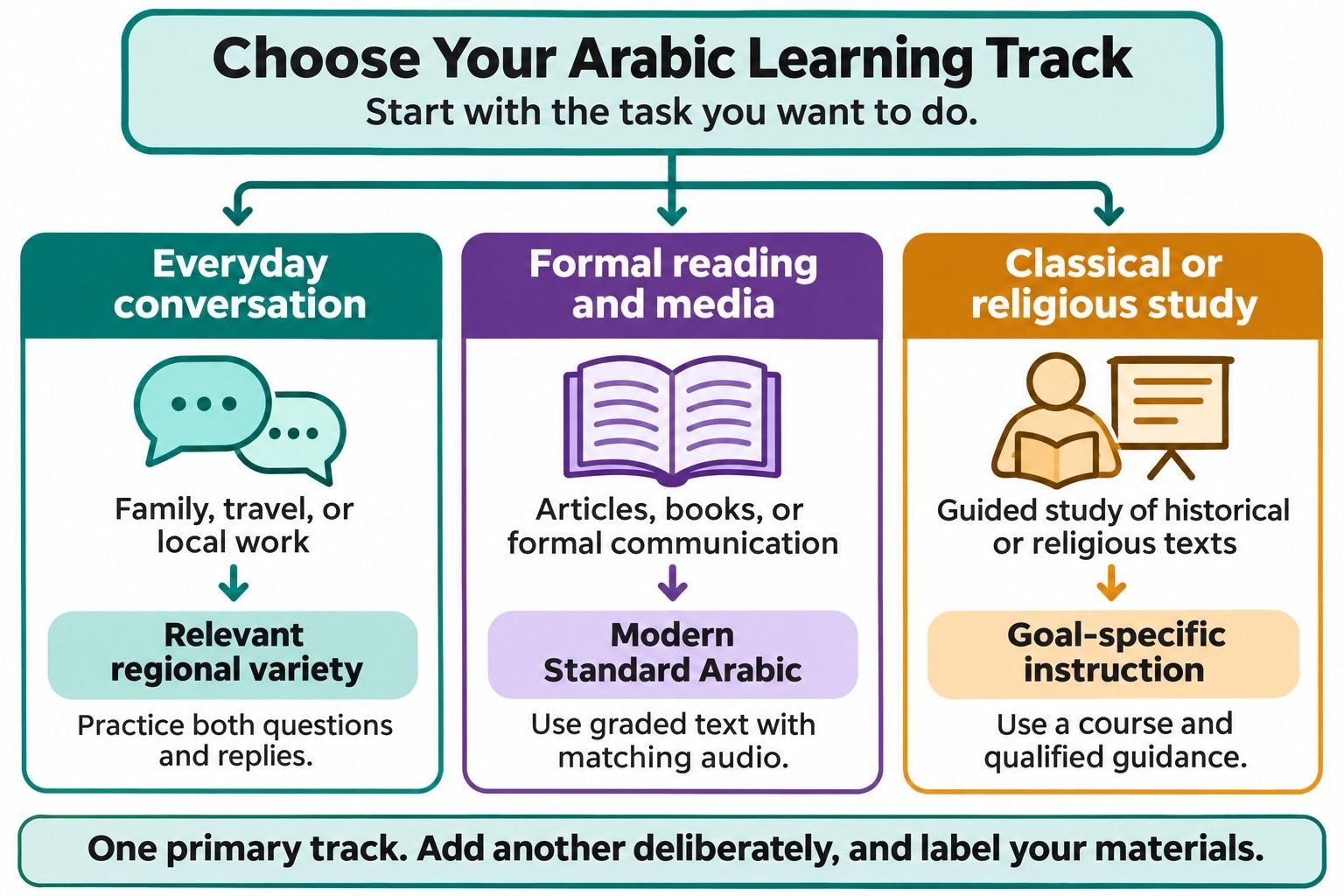
For example, a learner preparing to visit relatives in Jordan could make a relevant Levantine course the main speaking resource and study script alongside it. Someone whose immediate goal is reading formal articles could begin with graded MSA lessons and add spoken practice for their actual social setting.
How to Learn Arabic Fast: 9 Practical Methods
1. Choose One Useful Task and One Primary Arabic Variety
"Learn Arabic" is too broad to guide tomorrow's practice. "Introduce myself, say where I live, and ask the other person the same questions" gives you a small set of phrases and a clear way to check progress.
Write a weekly goal with three parts: the situation, the person you will interact with, and the support you can use. A beginner might allow a phrase sheet during the first conversation, then repeat the task later with fewer prompts.
Useful starting tasks include:
- Introduce yourself and answer two follow-up questions.
- Ask for a price and recognize a likely response.
- Describe a familiar daily routine in a few sentences.
- Read a short learner passage and explain its main point.
Do not measure success only by whether you remembered your lines. If you can say a question but cannot recognize the answer, the next practice session needs listening, not another page of questions.
2. Build a Learning Path From a Small Set of Matching Lessons
Start with a main course, a source of audio at your level, and a way to get feedback. More resources can be useful later, but five beginner courses often mean five versions of the same introduction rather than a clear next step.
Check the variety, difficulty, and available support before adding a resource. For an MSA track, Al Jazeera Learning Arabic offers lessons organized by level; its beginner materials are a more sensible starting point than automatically selecting the newest media lesson.
If your materials are spread across lesson files and links, Lynote Learning Path can help organize source material into a study sequence. Use it to make the next lesson easier to find, not to decide which Arabic variety you should learn.
- Gather a small set of beginner materials for the same primary track.
- Add supported files or links and use Generate Learning Path.
- Review the proposed sequence against your course and weekly task. Remove advanced or unrelated material before using it.

An AI-generated sequence still needs judgment. It should not turn a collection of unrelated videos into an assumed complete Arabic curriculum, and it is not a substitute for pronunciation feedback.
3. Learn Letter Shapes and Sounds Alongside Real Words
Study the writing system in short sessions, but connect it to words you are already hearing. Reciting letter names and recognizing those letters inside a word are different skills.
Arabic runs from right to left, and many letters connect and take different shapes depending on their position. Short-vowel marks provide additional reading support, but they are often absent in ordinary writing; that is one reason sounding out unfamiliar text can feel harder than reading a beginner lesson.
Try this small practice loop:
- Listen to a word from your lesson.
- Find the letters you know in the written word.
- Read it while replaying the recording.
- Cover the English meaning and recall what the word means.
- Meet the same word again in a short phrase.
Transliteration can be a temporary bridge, particularly when you need a phrase immediately. Keep the audio and original script beside it so the English-letter version does not become your only route to recognition.
For unfamiliar sounds, ask a teacher or capable speaker to check one distinction at a time. Avoid forcing your throat or trying to learn every pronunciation difference from an English spelling approximation.
4. Learn Reusable Phrases Before Long Vocabulary Lists
A useful phrase gives you vocabulary, word order, and a situation together. Learning a question about where something is prepares you to ask about several places once you can replace the relevant word.
Build a small phrase set around this week's task. For ordering food, include a request, a clarification, a response to a question, and a polite way to say you did not understand.
| Save this | Why it helps | How to practice it |
|---|---|---|
| A complete request from a trusted lesson | Preserves a usable sentence pattern | Replace one item while keeping the rest of the pattern |
| A likely response | Prepares you for the other half of the exchange | Listen without reading the transcript first |
| A clarification question | Helps you continue when the conversation changes | Practice using it before you feel stuck |
| A short personal answer | Makes the phrase relevant to your life | Say it without translating a full English sentence first |
Keep the variety and source attached to each phrase. A sentence from an Egyptian dialogue and one from a formal MSA reading exercise may both be correct, but they are not automatically interchangeable in the same conversation.
5. Repeat Short Audio You Can Actually Follow
Pick a brief recording that comes with a reliable transcript or explanation. It should be manageable enough that you can connect most of its meaning to the audio after checking the support.
Use several passes with different jobs:
- First listen: identify the situation and any familiar words.
- Supported listen: use the transcript and resolve a few important gaps.
- Focused listen: replay one short phrase and notice its rhythm.
- Recall: pause and say the phrase, then compare with the recording.
- Final listen: remove the transcript and see what is clearer.
Repeating a clip is not the same as leaving it playing in the background. Each pass should solve a particular problem, such as recognizing a word boundary or following a question you missed earlier.
Shadowing can be useful once you understand the passage: speak along with a short segment, then try it just after the speaker. If you are only copying noise, shorten the segment or return to meaning before repeating it again.
6. Turn Lessons Into Notes That Keep Context and Variety Clear
The best notes are the ones you can practice from tomorrow. A long lesson summary may look organized while giving you very little to recall or say.
For each useful phrase, keep its source, variety, meaning, situation, and one practice prompt. Add a recording timestamp when available so you can return to pronunciation instead of guessing from the written form.
When a lesson is lengthy, Lynote AI Note Generator can create an editable starting point from supported source material. Your job is to turn that output into a small practice sheet rather than accepting every generated bullet as something to memorize.
- Upload your lesson file, or paste a suitable webpage or YouTube link. Use Parse for a pasted URL; direct uploads do not need that extra step.
- Select Create Note after the source is ready.
- Review the result against the lesson. Keep the phrases relevant to your weekly task and add variety labels, context, and recall questions.
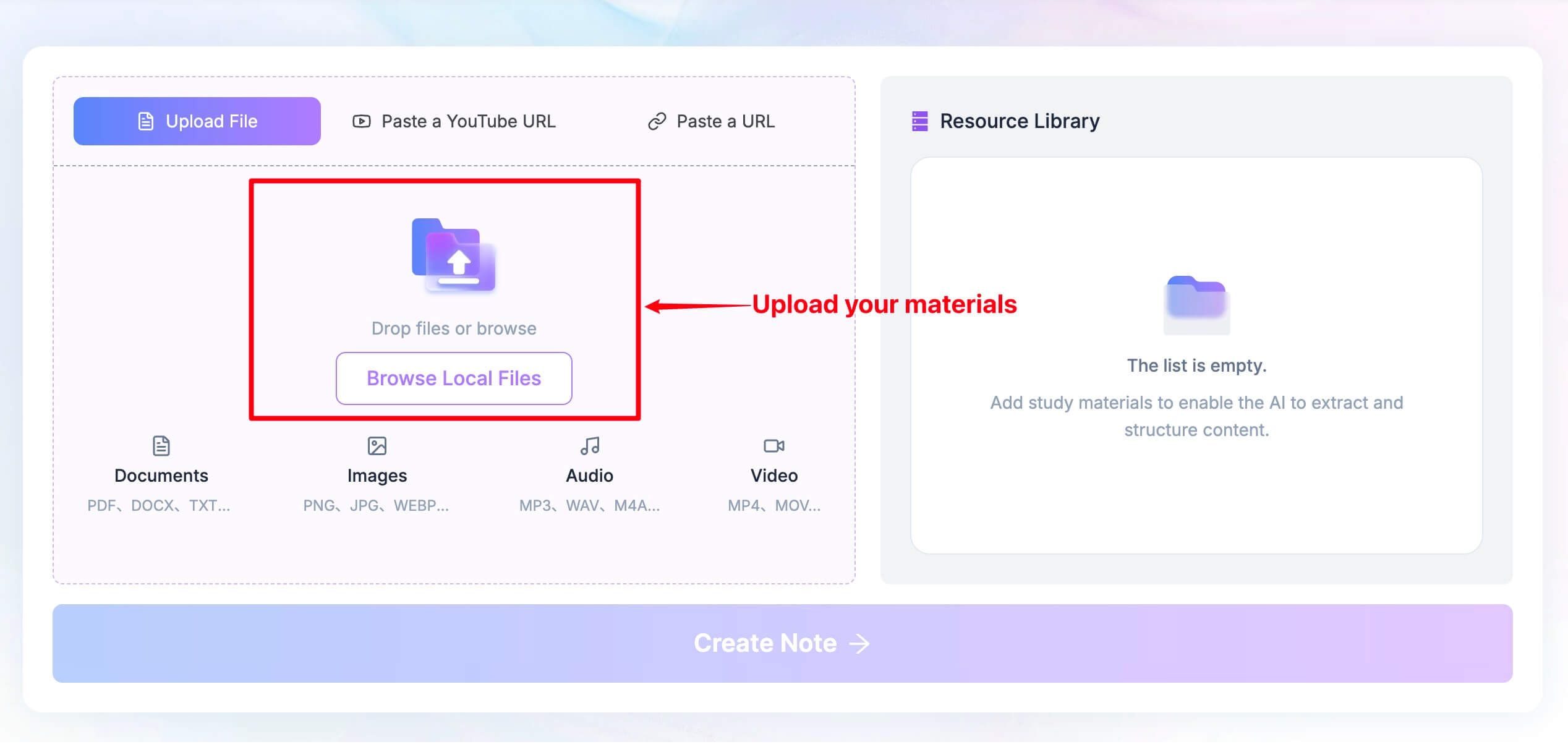
Here is a note structure you can reuse without collecting unnecessary detail:
| Note field | What to record |
|---|---|
| Source and location | Lesson name and page or audio timestamp |
| Variety and setting | MSA or the lesson's regional variety; formal or conversational setting |
| Phrase and meaning | The original phrase from the lesson and its meaning |
| Usage | Who says it, to whom, and in what situation |
| Recall question | A cue that makes you produce the phrase instead of rereading it |
| Feedback | One correction to check the next time you use it |
Check generated wording carefully, especially when the source includes dialect or incomplete transcripts. A tidy note is not evidence that the pronunciation or usage has been verified.
7. Use Translation to Check Meaning, Not Replace Practice
Try to understand a short passage before translating it. Identify what you know, make a tentative guess, and check the part that prevents you from following the meaning.
Lynote AI Text Translator is useful for that quick check. Paste a short passage, select English as the target language, and compare the translation with your interpretation before returning to the original.
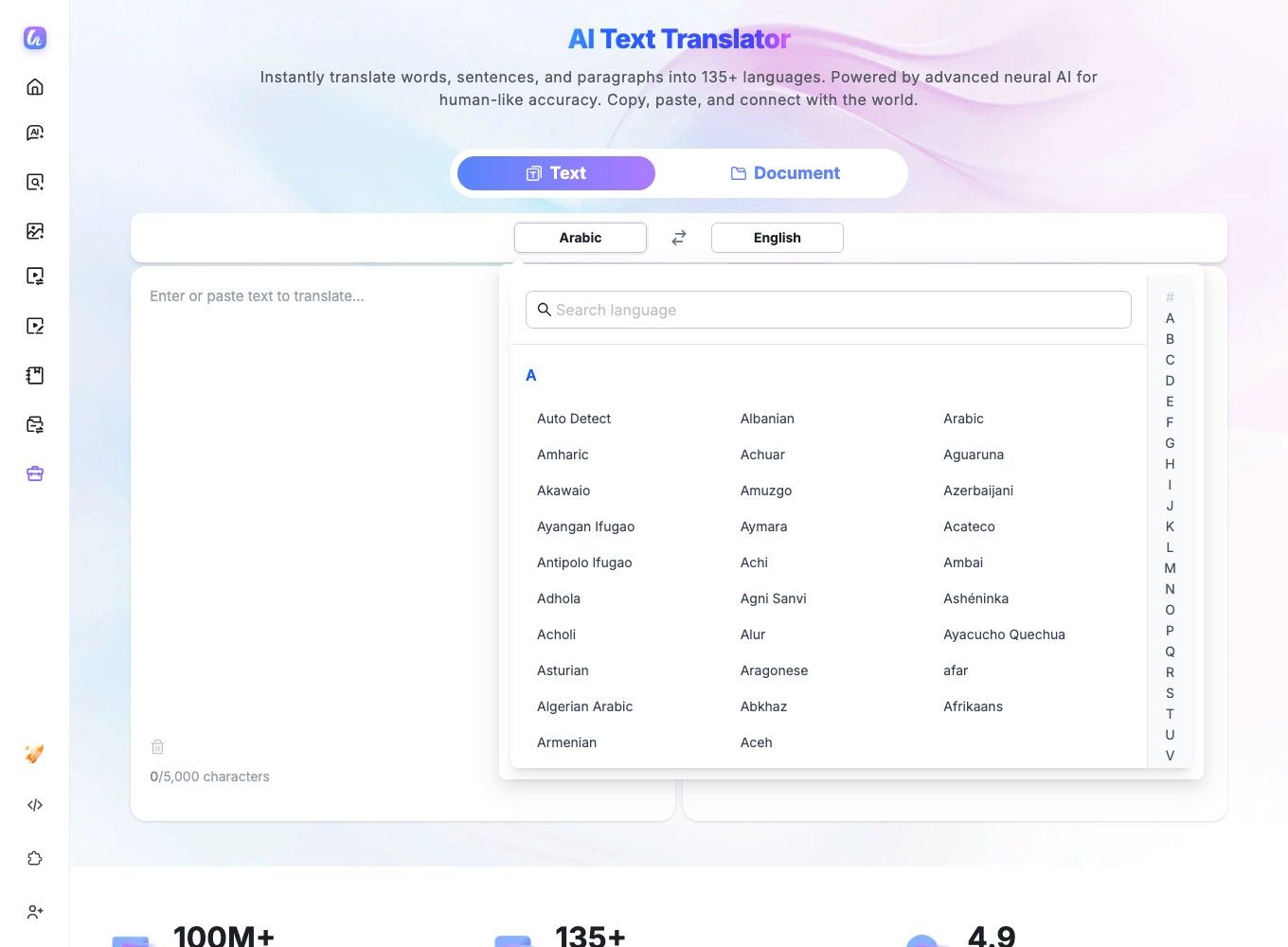
For speaking practice, take an extra step: ask whether the phrase fits the variety and situation you are learning. A translation can communicate the meaning without being the most natural wording for a particular conversation.
A good check ends with retrieval. Hide the translation, explain the passage again, or say the phrase in response to a cue; otherwise, the tool has completed the comprehension task while you watched.
8. Start Short Conversations and Ask for Specific Feedback
You do not need to finish a grammar book before attempting a supported exchange. Prepare one task, tell your partner your level and target variety, and keep the conversation small enough to repeat.
For a tutor session, send the task in advance: "I want to introduce myself and ask about your daily routine. Please help me notice one pronunciation issue and one phrase that sounds unnatural."
Specific feedback is easier to act on than a page covered in corrections. Write down the correction, say the revised version, and use it again later without looking.
If a conversation partner is unavailable, record a short response to a familiar prompt and compare it with a trusted model. This can reveal missing words and hesitation, although it cannot confirm every pronunciation or usage issue on its own.
9. Review From Memory and Notice Reusable Word Patterns
Before opening yesterday's notes, try to recall the phrases you practiced. Use a situation or question as the cue, then check your answer and revisit whatever did not come back.
Return to difficult material on later days rather than treating one successful repetition as permanent learning. If review keeps expanding beyond your available time, reduce the number of new items and remove low-priority phrases.
As you meet related words in a structured course, notice recurring patterns and roots. Use those connections as memory aids, not as permission to guess the exact meaning of every unfamiliar word without checking context.
Grammar is most useful when it solves a problem you have encountered. Learn a pattern, compare a few examples from the same variety, and produce a new sentence that a teacher or reliable resource can help you check.
A 30-Minute Daily Arabic Routine You Can Repeat
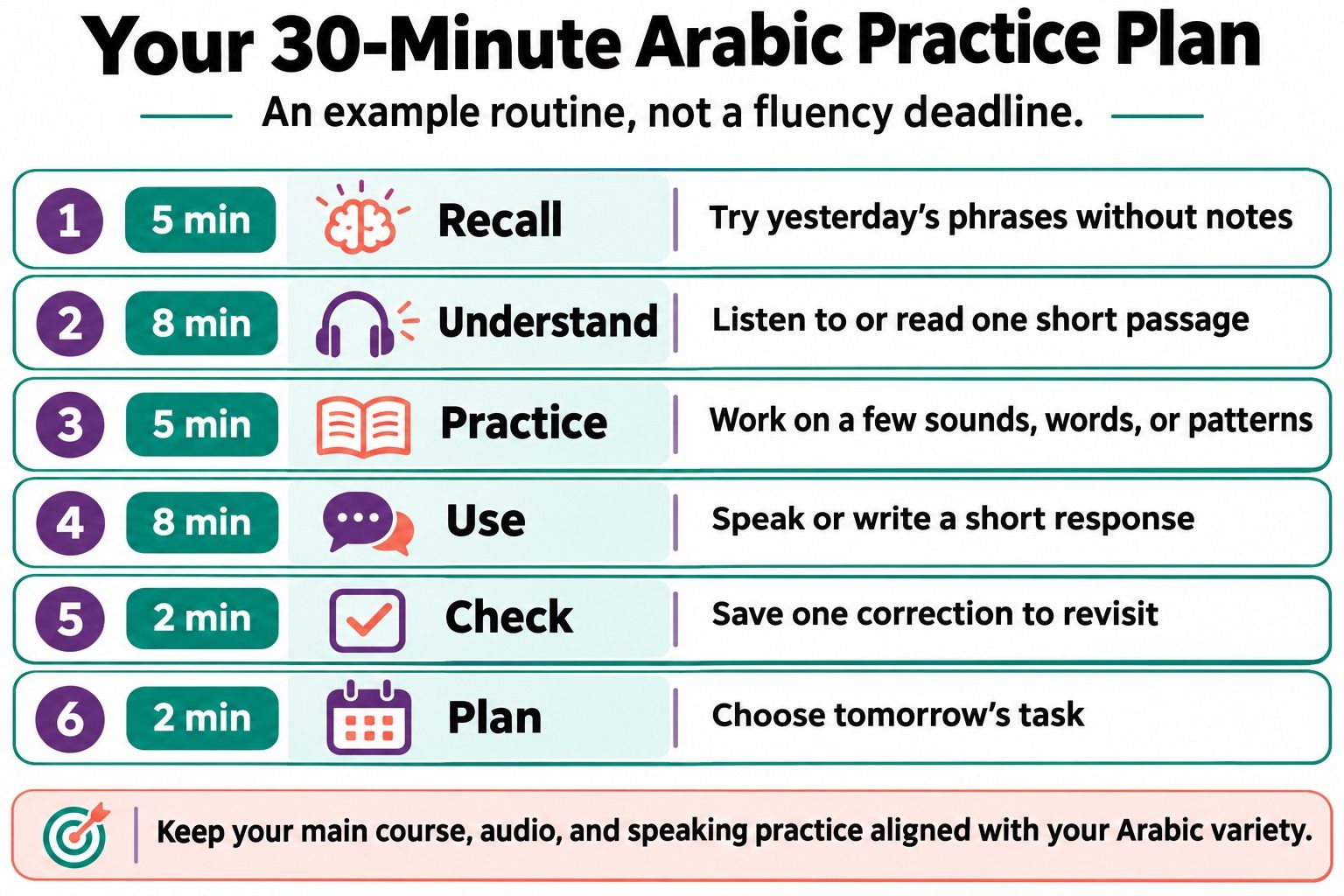
You do not need to fit every resource into every day. This example balances review, input, and output around one task; it is a practical schedule, not a scientifically optimal dose.
| Time | Activity | Finish with |
|---|---|---|
| 5 minutes | Recall yesterday's phrases without notes | A short list of what needs another review |
| 8 minutes | Listen to or read one manageable passage | An explanation of its main meaning |
| 5 minutes | Practice a few words, letter shapes, or phrase patterns from it | A small set of usable items, not a whole new word list |
| 8 minutes | Speak or write using the material | One short response or exchange |
| 2 minutes | Check feedback or compare with a trusted model | One correction to revisit |
| 2 minutes | Choose tomorrow's task | A clear starting point for the next session |
On a busy day, shrink the task instead of removing all output. Review one exchange, listen to it, and answer a related question; a shorter complete cycle is more useful than repeatedly postponing speaking until you have more time.
Your First 30 Days: Four Practical Checkpoints
Treat the first month as a way to establish your routine and discover your weak points. These checkpoints are examples you can scale to your starting level, not abilities that everyone should acquire on schedule.
| Week | Focus | Checkpoint | Adapt it to your goal |
|---|---|---|---|
| 1 | Choose your track and connect sounds with basic written forms | Introduce yourself with support or read familiar lesson words | Conversation learners prioritize a small spoken exchange; reading learners prioritize a short guided text |
| 2 | Expand one familiar situation | Ask and answer a few practiced questions with fewer prompts | Keep the content aligned with your family, travel, work, or reading task |
| 3 | Understand familiar material with less support | Explain a short recording or passage after checking difficult parts | Use the same variety and a comparable difficulty level |
| 4 | Repeat and adjust | Redo an earlier task and identify what still blocks you | Choose the next month's focus from actual gaps rather than a new app recommendation |
Keep the first attempt so you have something concrete to compare. You might still speak slowly, but needing fewer prompts or recognizing a reply that once confused you is meaningful progress.
For reading-focused learners, the checkpoint can be understanding the main idea without translating every word. For conversation-focused learners, it might be responding to an unexpected follow-up rather than delivering a longer memorized speech.
Why Your Arabic Progress May Feel Stuck
More study is not always the answer; sometimes the practice does not match the problem. Use the table below before adding another course or doubling your daily word target.
| What happens | What may be missing | Change your next session |
|---|---|---|
| You can sound out text but cannot explain it | Vocabulary and meaning in context | Work with a shorter supported passage and summarize its message |
| You recognize phrases but cannot say them | Retrieval and production practice | Respond to situation cues before revealing your notes |
| Your lessons make sense but everyday conversations do not | Variety mismatch or unfamiliar natural speech | Choose recordings and a partner matching your target setting |
| You need English letters to read every phrase | Practice connecting sound and Arabic script | Keep audio with the original writing and gradually hide transliteration |
| You speak a memorized question but freeze at the answer | Listening to likely replies | Practice both sides of the exchange with small variations |
| Translated phrases sound too formal | Register or regional usage mismatch | Verify the expression with a relevant speaker or trusted dialogue |
One particularly frustrating trap is changing variety whenever a lesson gets difficult. Difficulty alone does not prove the track is wrong; first check whether the material is too advanced or whether you need more repetition of the same task.
Another is saving too much. If your notes contain dozens of untouched phrases, spend the next session using a few of them rather than generating another summary.
How Long Does Learning Arabic Really Take?
There is no honest single timeline for "learning Arabic." Handling a rehearsed travel exchange, holding an unfamiliar conversation, and reading complex texts independently are different levels of ability.
Your starting point also matters. Someone familiar with Arabic script may have less decoding work to do, while a heritage learner may understand speech but need deliberate reading and writing practice.
Use three questions to evaluate progress:
- Can I do a useful task I could not do before?
- Can I do it with less support?
- Can I handle a small change, such as a new question or an unfamiliar example?
A month can give you a routine, some useful phrases, and evidence about what to practice next. Broad proficiency requires sustained work beyond that first plan, so avoid choosing a course solely because it promises the shortest deadline.
FAQs About Learning Arabic Faster
Can I learn Arabic in 30 days?
You can work toward specific beginner tasks in 30 days, such as an introduction or a familiar guided reading. The amount you achieve depends on your starting level, practice, and feedback; that is different from becoming fluent across unfamiliar situations.
Should I learn MSA or a dialect first?
Choose according to your main goal. MSA fits formal reading and formal communication, while a relevant regional variety is important for everyday conversation; you can study both with one clearly defined priority.
Can I learn Arabic without learning the alphabet?
You can begin practicing spoken phrases through audio and temporary transliteration. Learning the script alongside them gives you access to more materials and reduces reliance on English-letter approximations, especially if reading is part of your goal.
Can I learn Arabic by myself?
You can do much of the reading, listening, vocabulary review, and guided practice independently. Periodic feedback from a teacher or capable speaker is valuable for pronunciation, natural phrasing, and errors you may not notice yourself.
How much Arabic should I study each day?
Choose a schedule you can repeat and include both understanding and using the language. The 30-minute plan above is a starting point; shorten it when needed, and increase time only if you can keep the practice focused.
Is Quranic Arabic the same as conversational Arabic?
No. There is shared language knowledge, but understanding a classical text and participating in a modern regional conversation require different vocabulary, listening experience, and practice. Choose instruction that explicitly supports the task you want to do.
Start tomorrow with one short lesson and one thing to say or understand. Keep the variety consistent, return to what you learned, and let your next practice session answer a real difficulty rather than a generic promise to study harder.

Written by Danny
Product Marketing Manager
Danny explains how Lynote features fit real workflows, from everyday productivity to product-led writing use cases. View all articles →