

How to Learn Faster: 10 Practical Ways to Make Learning Stick

You finish a chapter, watch another tutorial, and feel reasonably confident. Then someone asks you to explain the idea without looking, and the words disappear. If you're wondering how to learn faster, start by changing what happens after you read or watch: retrieve the idea, use it, check your mistakes, and come back to it later.
The goal isn't to rush through more material. It's to spend less time repeating work that hasn't helped you understand, remember, or apply what you learned.
What Actually Helps You Learn Faster?
Learning faster means reaching a useful level of understanding with less wasted effort. It doesn't mean every study session feels easy, or that you can skip the foundations of a difficult subject.
Before changing your routine, identify where you're getting stuck. Forgetting a definition and not knowing how to solve a problem need different responses.
| What Is Slowing You Down? | What to Try First | How to Check Progress |
|---|---|---|
| You don't know where to begin | Set a specific goal and order the prerequisites | You can name your next task and why it matters |
| You understand while reading but forget later | Closed-book recall followed by spaced review | You can explain the idea after a delay |
| You recognize an answer but can't produce it | Answer before revealing the solution | You can respond without a cue |
| You follow examples but can't solve new problems | Alternate worked examples with independent attempts | You can handle a changed version of the problem |
| You spend more time organizing than practicing | Keep a small set of usable notes | You have time left to test yourself |
Pick the row that sounds most familiar. You don't need ten new habits tomorrow; you need a better response to the problem you're having today.
10 Practical Ways to Learn Faster and Remember More
1. Define What You Need to Be Able to Do
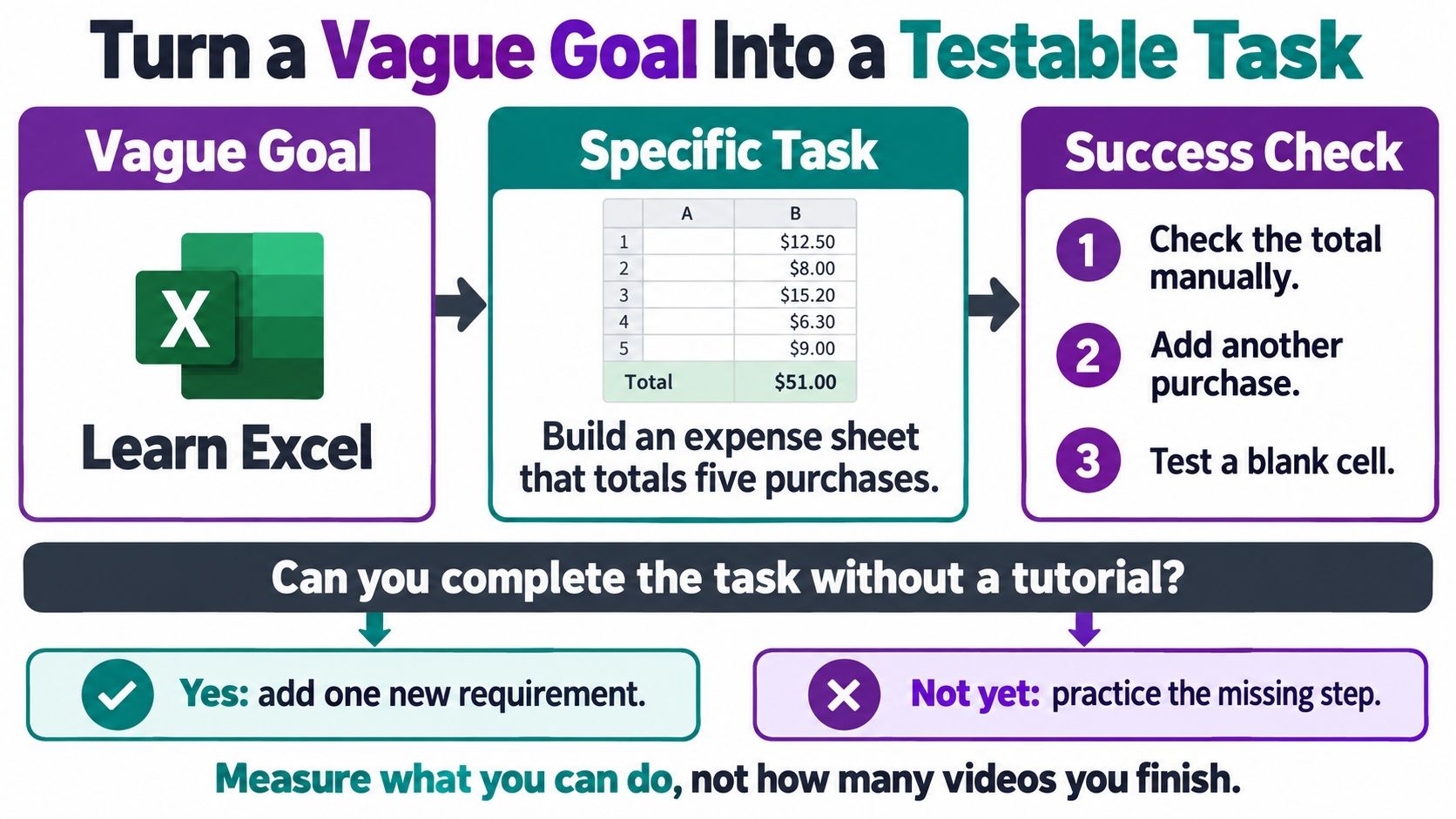
"Learn statistics" gives you almost no guidance about what to study this afternoon. "Explain the difference between mean and median, then choose the right one for a skewed dataset" gives you both a task and a way to check it.
Write a one-sentence target before you open your materials. Use an action you can observe: explain, calculate, compare, build, troubleshoot, or demonstrate.
For example, if you're learning spreadsheet formulas, don't make finishing a playlist your target. Make it building a small expense sheet that calculates totals correctly, including what happens when a cell is blank.
Then try a small version of the task. You may discover that you already know the basics and only need help with one step, or that a prerequisite needs attention first.
Keep the target narrow enough to guide your next session. A huge goal can be motivating, but it shouldn't make every possible resource look equally urgent.
2. Build a Learning Path Before Collecting More Resources
A folder full of PDFs isn't a plan. If you have a textbook, lecture slides, and several videos, decide which ideas depend on which others before moving between them.
For a beginner learning Python, that might mean variables before conditional statements, and conditional statements before a small program that makes decisions. For a biology unit, it might mean understanding cell structures before explaining how substances move across a membrane.
Make a short sequence with three elements for each stage:
- The concept you need to understand.
- One main resource that explains it.
- A question or task that shows whether you're ready to move on.
This is where Lynote Learning Path fits naturally: its workflow is designed to bring study materials into an ordered sequence of chapters, explanations, and quick checks. The purpose is to reduce the sorting work between finding material and actually studying it.
Treat a generated sequence as a starting point, not a replacement for your course requirements. Compare it with your syllabus or goal, and revisit a prerequisite when a later chapter stops making sense.
Don't spend an entire afternoon perfecting the plan. A short route you start following is more useful than a detailed schedule you keep rearranging.
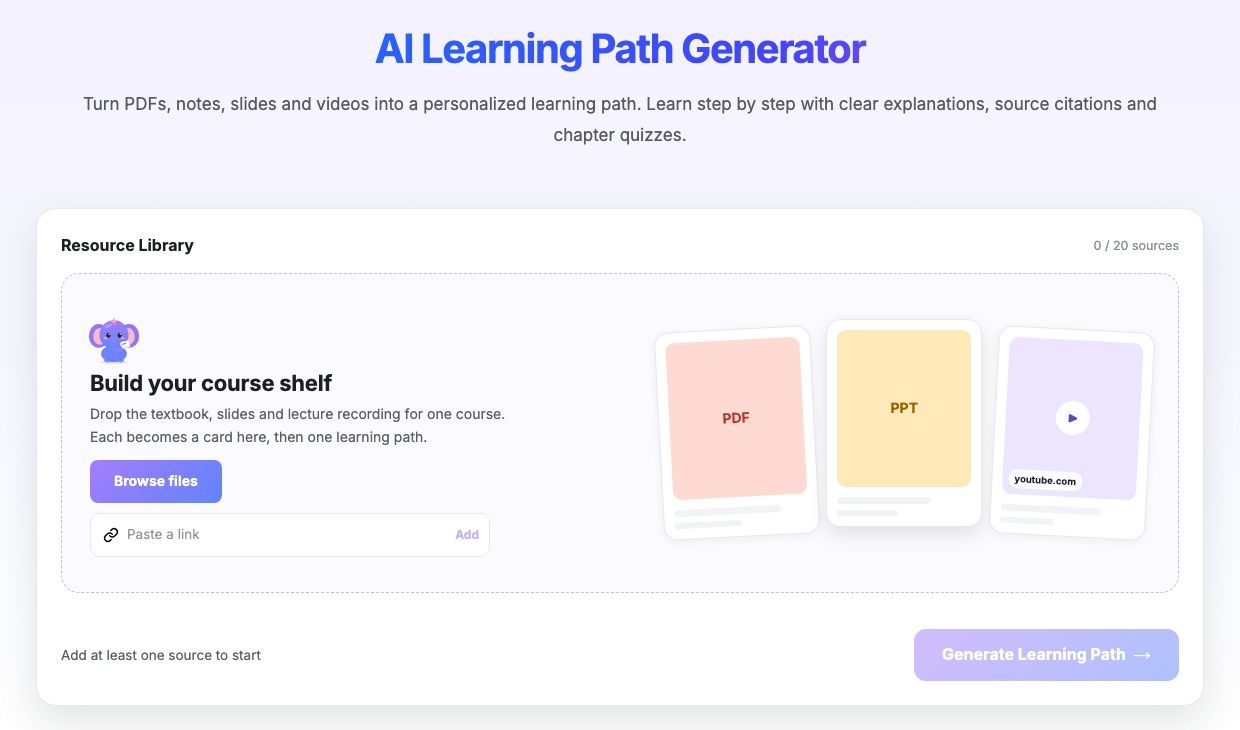
Learning Path preview shown in the test environment.
3. Learn From Videos Without Rewatching Everything
Video is helpful when you need to see a process unfold. It's less convenient when you're trying to find one explanation buried in a long lecture.
A transcript gives you another way into the material. You can locate a term, review the surrounding explanation, and return to the relevant video segment instead of replaying everything from the beginning.
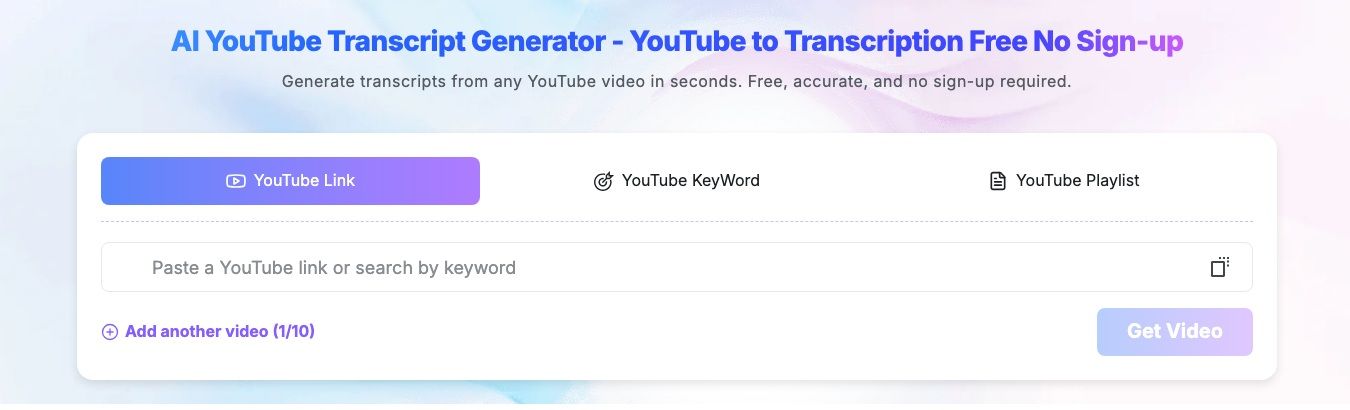
Lynote YouTube Transcript provides timestamped text for supported videos, using available captions. It can be useful when a lecture contains several concepts you want to revisit separately; videos without usable captions may not work.
Suppose you're learning about regression and need to revisit the explanation of residuals. Locate that passage, watch the associated example, then pause and explain what a residual represents in your own words.
Keep the video nearby for anything visual. A transcript may miss a gesture, diagram, equation on screen, or a software action that the speaker never describes aloud.
The important distinction is between finding information faster and learning it. A searchable transcript helps with the first; explaining or applying what you found is still your job.
4. Retrieve the Answer Before You Look It Up
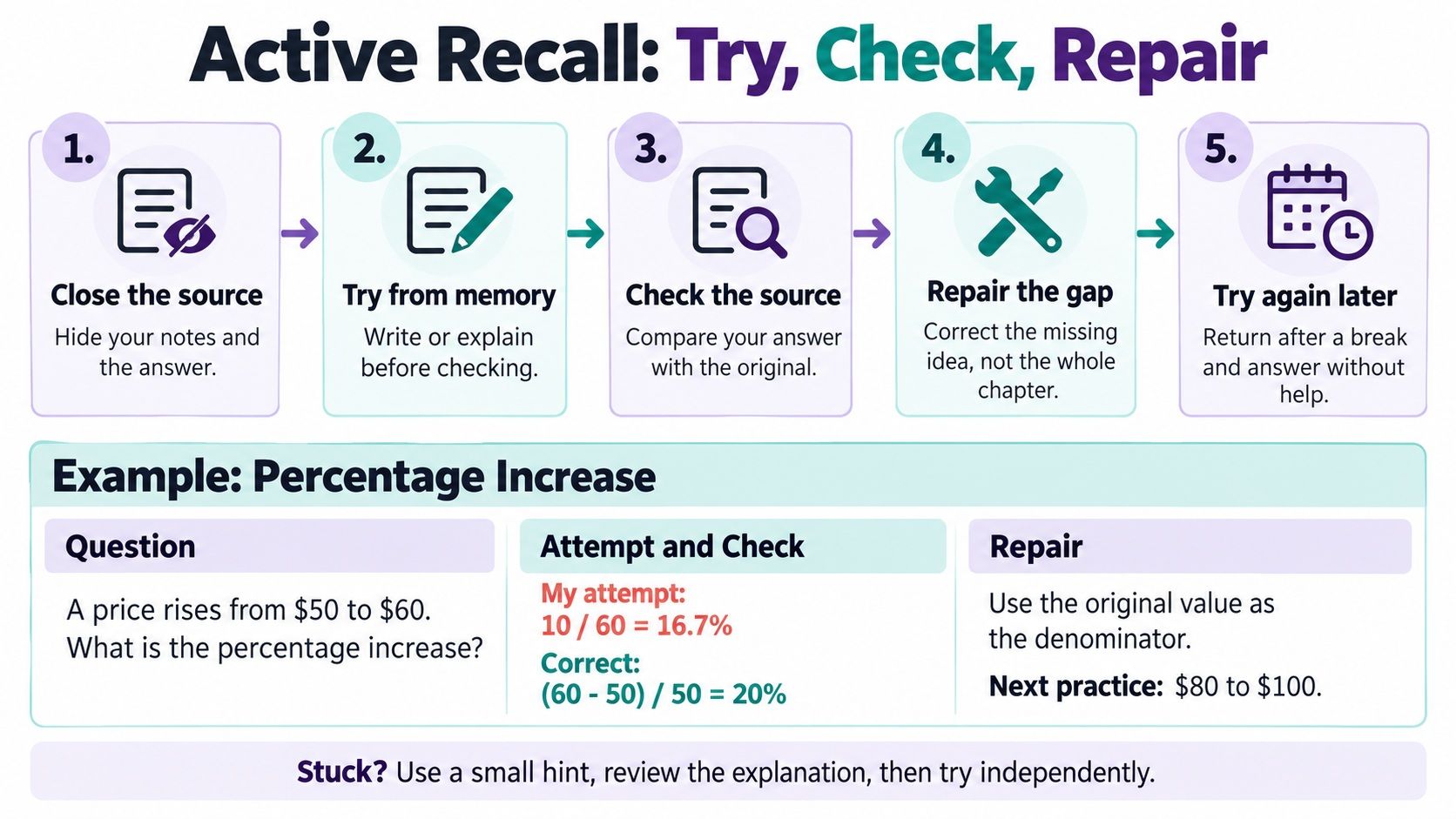
After a manageable section, close the material and answer one question from memory. Give yourself an actual attempt before checking, even if the answer is incomplete.
Keep the question specific enough that you can evaluate the response. "Do I understand inflation?" is difficult to check; "How would I explain inflation using a grocery bill?" produces an answer you can inspect.
You can try this in several forms:
- Write the main points on a blank page.
- Explain a process aloud without reading.
- Answer a flashcard before turning it over.
- Reconstruct the steps of a calculation.
If you're completely stuck, reduce the difficulty or use a small hint, then return to the explanation. Spending several minutes guessing at material you haven't understood isn't the aim.
Check the answer afterward and correct what was missing. Keep the exercise low-pressure: its purpose is to reveal what needs another look, not to prove that you're already good at the subject.
5. Take Notes You Can Actually Review
Useful notes help you return to an idea and do something with it. A beautifully formatted copy of a lecture can still leave you with no way to check whether you understand it.
Try a simple structure: the central idea, your explanation, a concrete example, and a question you should be able to answer later. Add a source location when you may need to check the details.
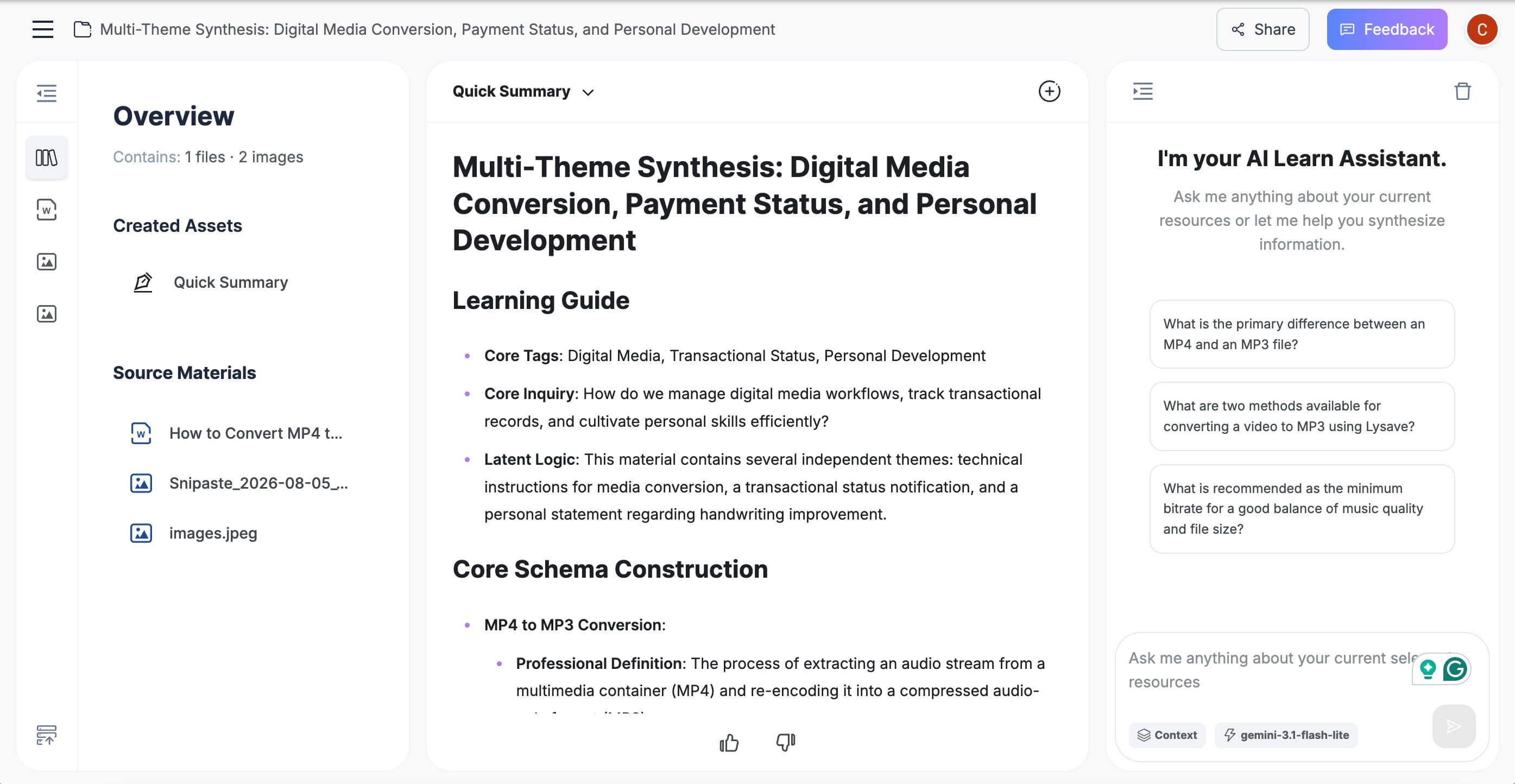
If organizing raw material is taking up most of your study time, Lynote AI Note Generator can provide a structured starting point from documents, recordings, or supported links. Its editable notes let you add your own explanations and questions rather than treating the generated text as finished learning.
Keep the final review page selective. For a lesson on correlation, you might keep the definition, a scatterplot example, and the question "Why doesn't a correlation establish causation?" rather than copying every sentence from the lecture.
Check important details against the original material, especially technical terms and numerical examples. Then close the notes and answer one of your questions; this is the moment the notes become a study tool rather than a storage system.
6. Spread Practice Across More Than One Session
Don't make your first successful attempt your last encounter with a topic. Come back after a gap and find out what you can still do without help.
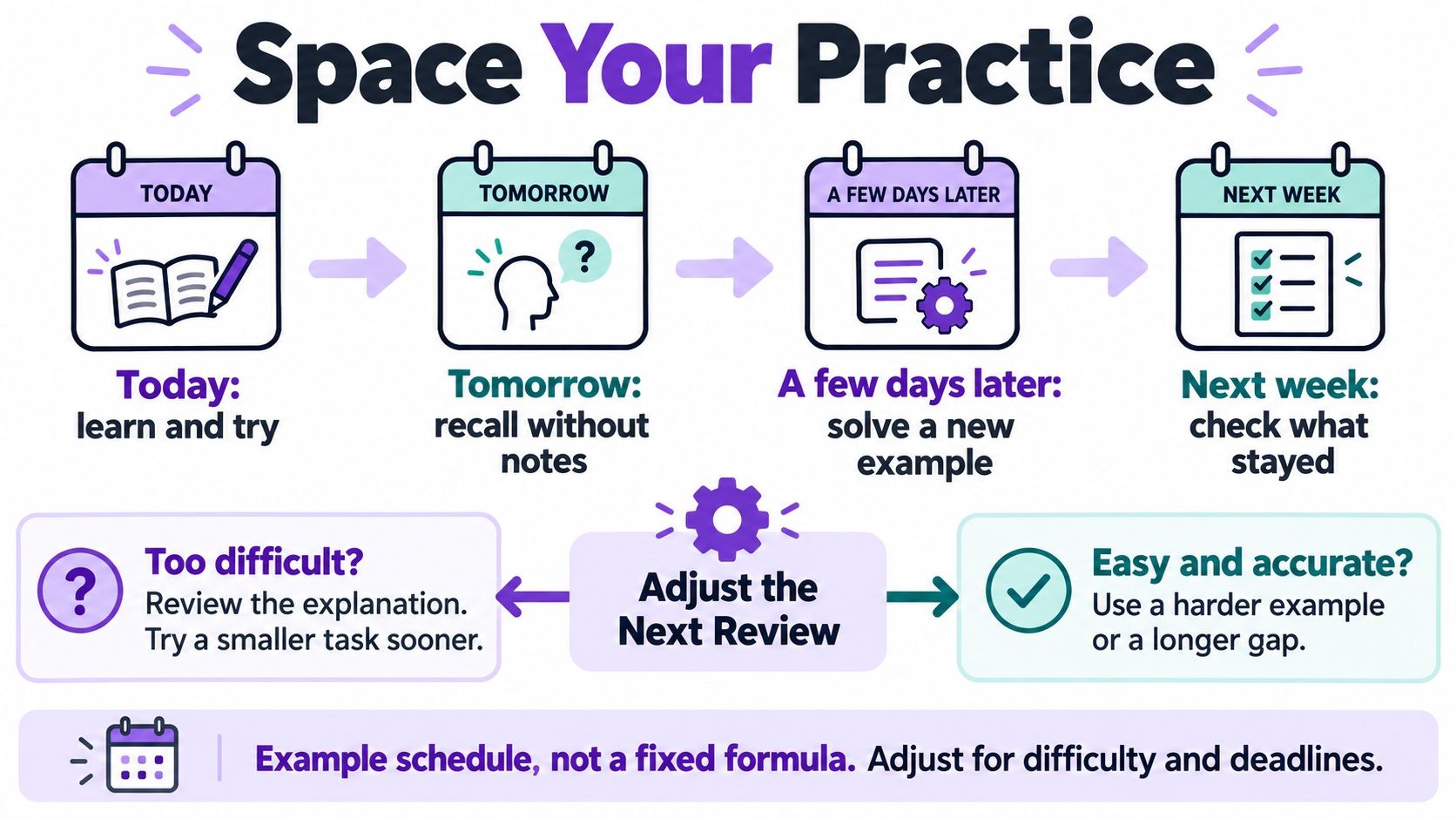
As a practical starting point, you could revisit new material the following day, again a few days later, and again the next week. Those intervals are an example, not a universal formula: adjust them to the difficulty, your performance, and the deadline.
Make each return purposeful. Try a question before reviewing, then spend time on the part that didn't hold up.
For vocabulary, that might mean producing a word in a sentence rather than recognizing it in a list. For accounting, it might mean classifying a new transaction without checking the worked examples.
If a review is effortless, consider a longer gap or a more demanding task next time. If almost everything has disappeared, revisit the explanation and make the next review more manageable.
7. Explain the Idea, Not Just the Definition
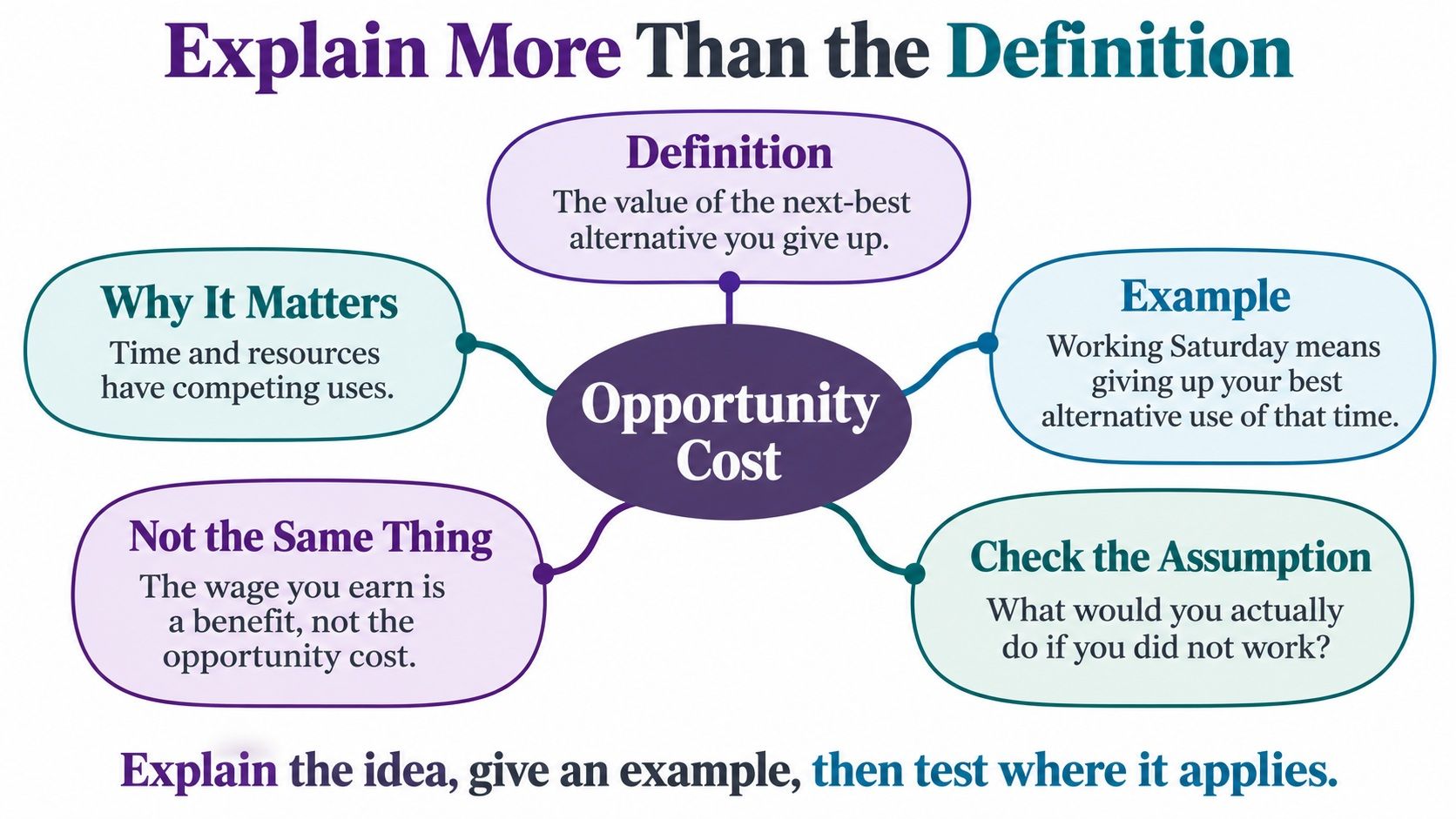
Knowing the right terminology isn't always the same as understanding the relationship behind it. Ask yourself what causes what, when the idea applies, and what would change under different conditions.
Take opportunity cost. Repeating a definition is a start, but explaining what you give up by spending Saturday at work instead of studying makes the tradeoff concrete.
Try these prompts when an explanation feels slippery:
- What is a simple example of this idea?
- Why does the next step follow from the previous one?
- What would be a misleading example?
- What would change if one assumption were different?
When you can't explain a connection, return to that exact part of the material. Don't reread the entire chapter simply because one paragraph was unclear.
You don't need an imaginary audience or a polished mini-lecture. A few accurate sentences that expose a gap are enough to make the exercise worthwhile.
8. Move From Worked Examples to Independent Practice
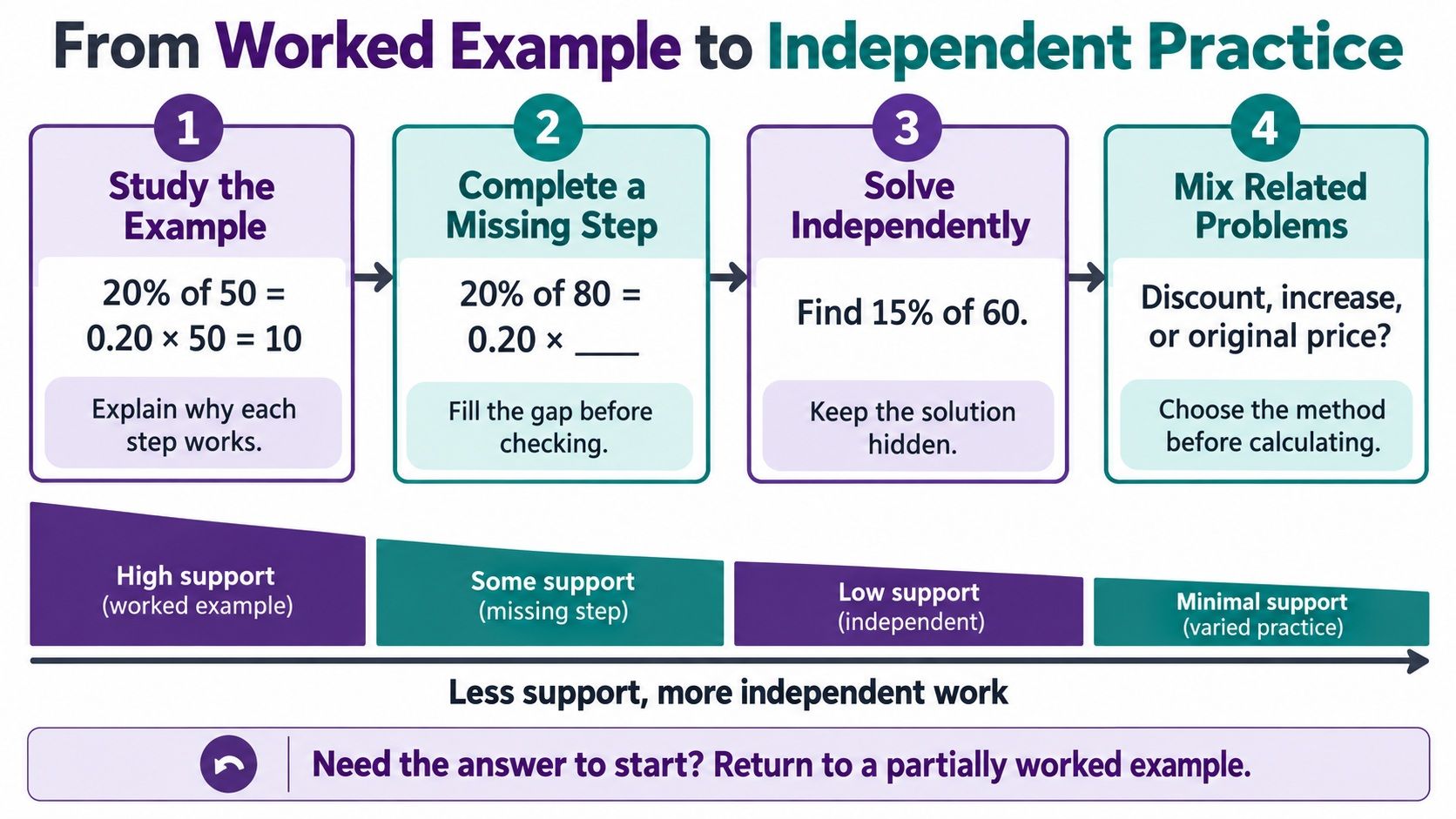
When a procedure is new, a worked example can show you what the steps are for. Study one carefully, then attempt a related problem with the solution out of sight.
For a spreadsheet task, inspect how a formula uses cell references and why they change when copied. Then build a similar formula in a different row and check the result with numbers you can calculate manually.
As you become more comfortable, mix related problem types so you have to choose the approach, not just repeat the last one. This is different from randomly switching between unrelated subjects every few minutes.
For example, after practicing several percentage calculations separately, mix questions about discounts, percentage increases, and finding an original price. Before calculating, write down which kind of problem you're solving and what the unknown is.
If you repeatedly need the solution to get started, reduce the jump between the example and the exercise. Try completing a partially worked problem before attempting the whole thing independently.
9. Use Mistakes to Decide What to Practice Next
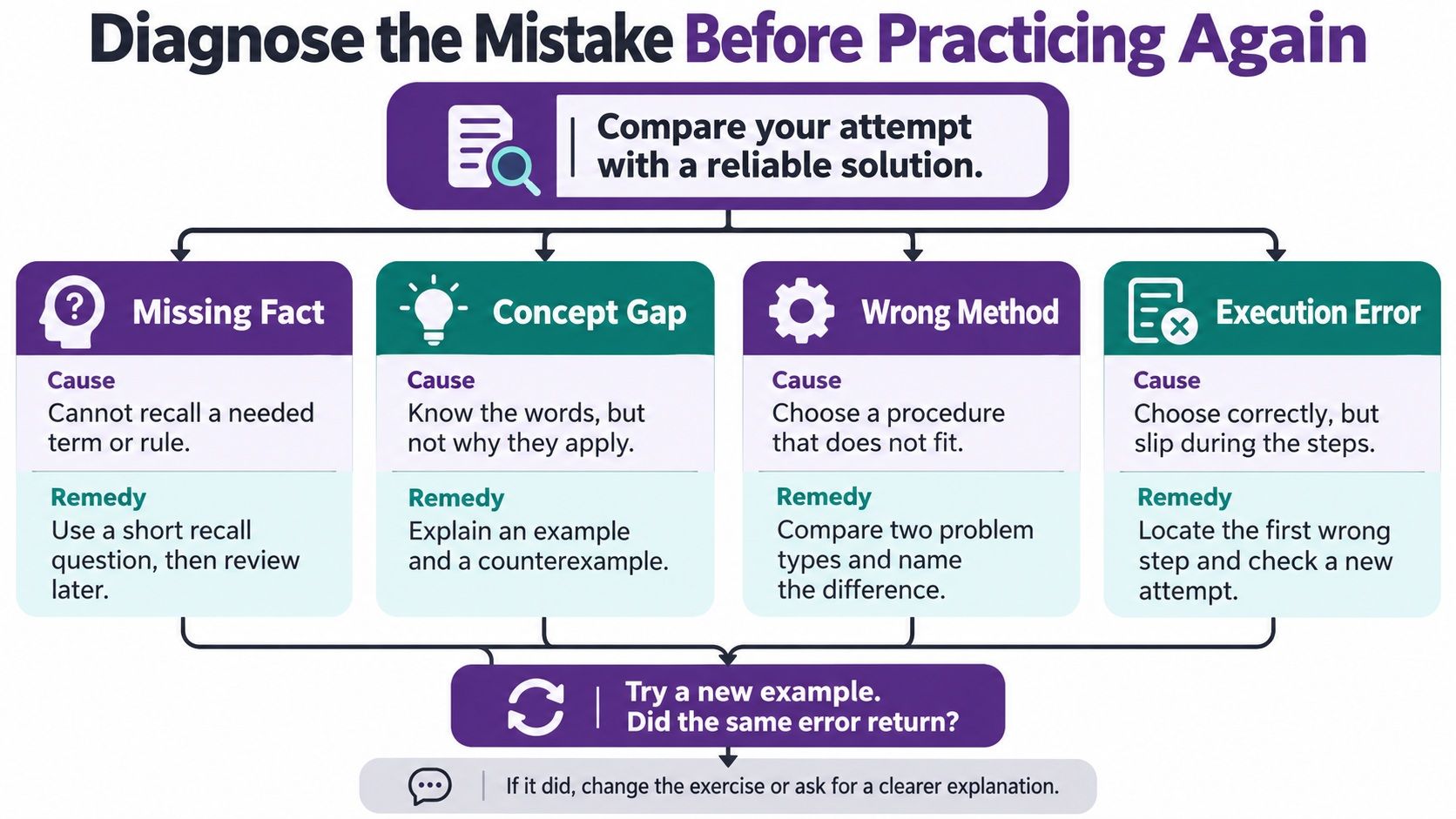
"I got it wrong" is a result, not a diagnosis. Ask whether the problem came from a missing fact, a misunderstood concept, the wrong method, or an execution error.
Those mistakes call for different practice. Repeating definitions won't fix a habit of choosing the wrong formula, and doing ten more calculations won't necessarily fix a misunderstood concept.
Keep a small error log rather than recording every detail:
| Mistake | Likely Cause | Next Action |
|---|---|---|
| Used a percentage change formula incorrectly | Confused the original and final values | Label the starting value in two new examples |
| Remembered a term but couldn't explain it | Memorized wording without an example | Write an explanation and a counterexample |
| Followed a coding tutorial but couldn't adapt it | Relied on copying the supplied solution | Change one requirement and rebuild that part |
Use a reliable answer key, worked solution, instructor, or other appropriate feedback to check your correction. Don't assume a confident explanation, including an AI-generated one, is automatically correct.
When the same mistake returns, change the exercise or seek a clearer explanation. More repetitions of an unchanged approach may just give you more opportunities to repeat the error.
10. Make Focused Practice Easier to Start and Sustain
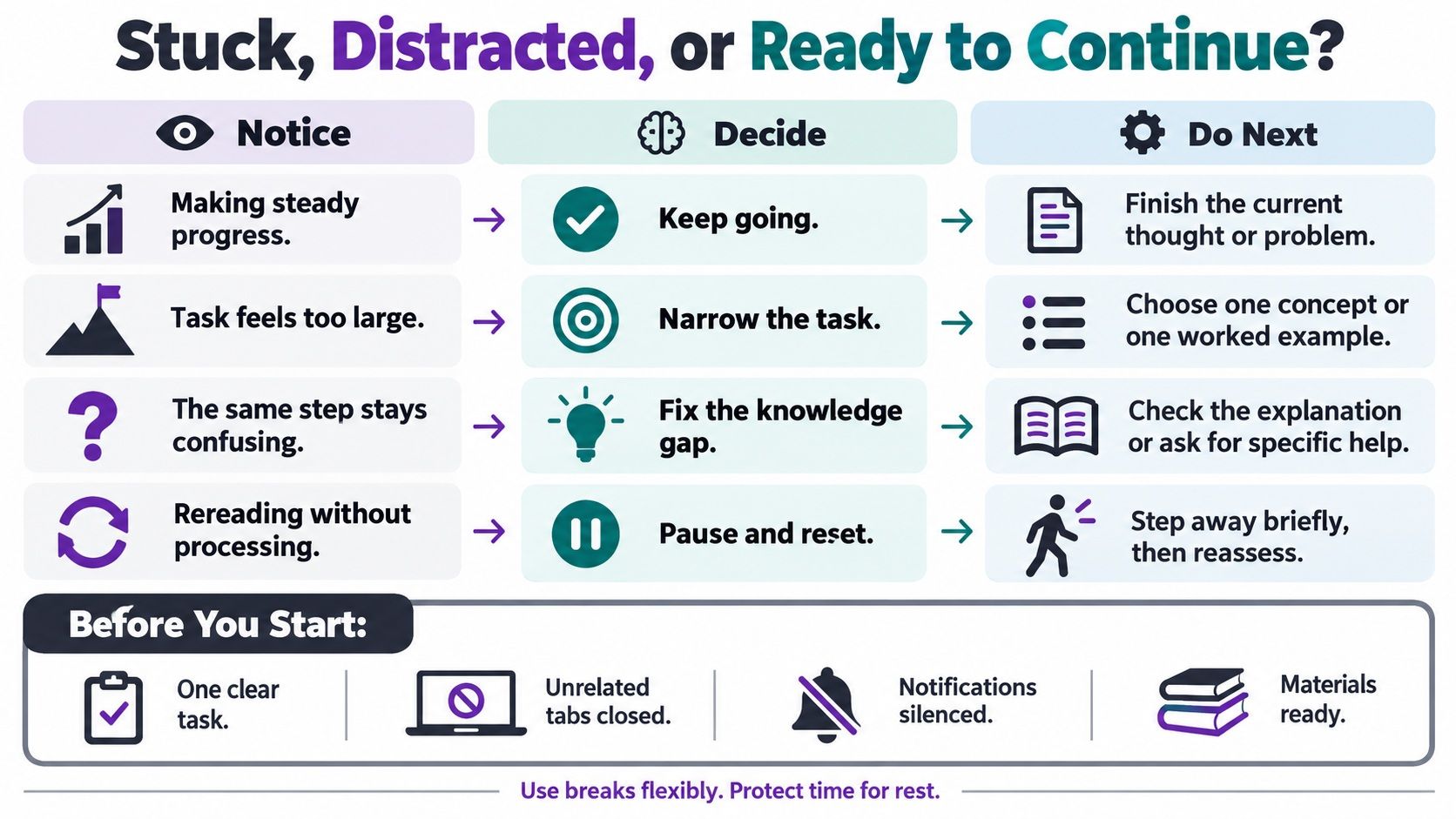
Give the session a clear task and put unrelated work out of reach. Close the extra tabs, silence notifications, and leave the materials for that task ready before you begin.
A timer can help contain the session, but there's no need to treat one work-break ratio as a rule. If you're making steady progress, finish the thought; if you're rereading the same sentence without processing it, pause and reset.
Choose a break that doesn't quietly become another task. Getting water or stepping away briefly is easier to end than opening a feed with no natural stopping point.
Avoid making regular study time depend on staying up later and later. Build a routine you can repeat while leaving room for rest, rather than treating exhaustion as evidence of effort.
These changes make practice more manageable; they aren't a substitute for choosing useful practice. A distraction-free hour of copying can still be less useful than a shorter session that includes independent attempts and corrections.
Match Your Learning Method to the Task
The question "How do I learn things fast?" needs a second question: what will you need to do with them? Remembering a fact, interpreting an argument, and performing a skill aren't interchangeable outcomes.
Use the following table to choose a task that resembles the performance you actually want. If your assessment requires explanation or application, don't stop at recognition exercises.
| Learning Task | Useful Practice | A Better Progress Check |
|---|---|---|
| Facts and vocabulary | Short recall questions across multiple sessions | Produce the answer without seeing choices |
| Concepts and theories | Explanations, examples, and comparisons | Explain an unfamiliar example using the concept |
| Math and quantitative work | Worked examples followed by independent problems | Choose and execute a method on a changed problem |
| Languages | Recall plus speaking, listening, reading, and writing tasks | Use the expression in a relevant conversation or text |
| Coding and software | Build something small, then alter a requirement | Complete the changed task without following a script |
| Practical skills | Appropriate demonstrations, supervised practice when needed, and feedback | Perform the task reliably under relevant conditions |
Track accuracy and the amount of help you need, not just speed. If you finish sooner only because you're skipping checks, you may be measuring a shortcut rather than better learning.
A 30-Minute Learning Session You Can Try Today
Here's one way to combine the methods without rebuilding your entire schedule. The timings are an illustrative starting point, not a scientifically optimal formula.
| Time | What to Do | What You Should Have at the End |
|---|---|---|
| Minutes 0-3 | Set one target and try a small question | A specific gap to work on |
| Minutes 3-12 | Read a relevant section or study one example | An explanation you can begin using |
| Minutes 12-20 | Close the source and recall, explain, or solve | An independent attempt |
| Minutes 20-26 | Compare your attempt with reliable feedback | A corrected answer and a named mistake |
| Minutes 26-30 | Write a brief takeaway and plan the next review | A clear starting point for next time |
For example, your target might be calculating a percentage increase. Study an example, solve a different one, check which value belongs in the denominator, and leave yourself a new question for the next session.
If the explanation takes longer than expected, narrow the task instead of removing the independent attempt. You can finish less material today and still leave with a clearer picture of what you know.
Habits That Feel Productive but Slow Your Learning
Some activities are useful in small doses but become a problem when they take over the session. The aim is to give each activity a job, not to ban reading, highlighting, or organizing.
- Rereading without a question: Return to a passage to resolve a specific gap, rather than starting again automatically.
- Highlighting whole pages: Select a few important ideas, then explain why they matter.
- Collecting another resource: Look for a different explanation when you need one, not whenever the current task becomes difficult.
- Polishing notes endlessly: Stop formatting when the material is clear enough to review.
- Reading a solution before trying: Give yourself a reasonable attempt so feedback has something to correct.
- Letting AI answer every question: Ask for a hint or explanation when useful, then check whether you can do the task without it.
If you want to learn how to learn faster, notice which of these habits fills the time when you're unsure what to do next. Replace it with one small task that produces an answer you can check.
FAQs About Learning Faster
What Is the Fastest Way to Learn Something New?
Start with a specific outcome, learn the necessary foundations, and attempt a small task early. Use the result to decide what needs more explanation or practice rather than consuming material indefinitely.
How Can I Learn Faster Without Forgetting?
Include recall and return to the material across multiple sessions. Check what you can still explain or do after a delay, and revisit the parts that have become difficult rather than reviewing everything equally.
How Can I Learn a Difficult Subject When I Have Little Time?
Narrow the goal to the concepts and tasks most relevant to your deadline. Identify essential prerequisites, work through representative examples, and reserve some time for independent attempts; a limited schedule makes selection more important, not instant mastery more realistic.
Does Taking Notes Help You Learn Faster?
Notes are useful when they organize ideas and support later practice. Add your own explanations, examples, and questions, then use them to check understanding rather than only rereading what you wrote.
Can AI Help Me Learn Faster?
AI can help organize materials, locate information, and offer explanations or practice prompts. Keep checking important information against the source, and make sure some of your study time involves answering or performing without assistance.
Conclusion
You don't need to overhaul every part of studying to make progress. Identify one place where time is being wasted, choose a method that addresses it, and check whether you can remember or apply more at your next session.
For today, pick one small target, make an independent attempt, and correct it. Leave yourself a clear question to return to: that gives your next session a useful beginning instead of another search for where to start.

Written by Janet L. Harris
AI Writing Specialist
Janet reviews AI detectors and humanization tools, with a focus on accuracy, limitations, and responsible use. View all articles →