

What's the Average GPA? U.S. High School & College Data

If you are wondering what's the average GPA, the answer depends on your education level, school, and grading system. The National Center for Education Statistics (NCES) reported an average high school graduate GPA of 3.11 in 2019, while college GPA figures use different student populations and measurement periods.
Understanding these differences can help you evaluate your academic performance more accurately. This guide explores average GPA figures in America, compares high school and college performance, explains weighted and unweighted GPA, and shows you how to calculate your own GPA with Lynote GPA Calculator.
TL;DR: What's the Average GPA in America?
- The average GPA among U.S. high school graduates was 3.11 in 2019, according to NCES.
- NCES reported an average GPA of 3.00 in 2009 and 2.68 in 1990.
- College GPA statistics use different populations and should not be compared directly with high school graduate data.
- A 4.0 GPA is commonly the maximum on a standard unweighted 4.0 scale.
- Weighted GPAs can exceed 4.0 when schools add points for advanced courses.
- Average GPA varies by school, grade level, academic program, and grading policy.
- A national average is useful context, but it does not determine academic potential or college admission chances.
What Is GPA?
GPA stands for Grade Point Average. It is a numerical representation of a student's academic performance, calculated by converting course grades into grade points and averaging them according to the applicable grading system.
Many U.S. schools use a 4.0 scale, but grading policies are not identical. Some institutions use plus and minus grades, some weight advanced courses, and colleges may calculate GPA using course credit hours.
How Does the 4.0 GPA Scale Work?
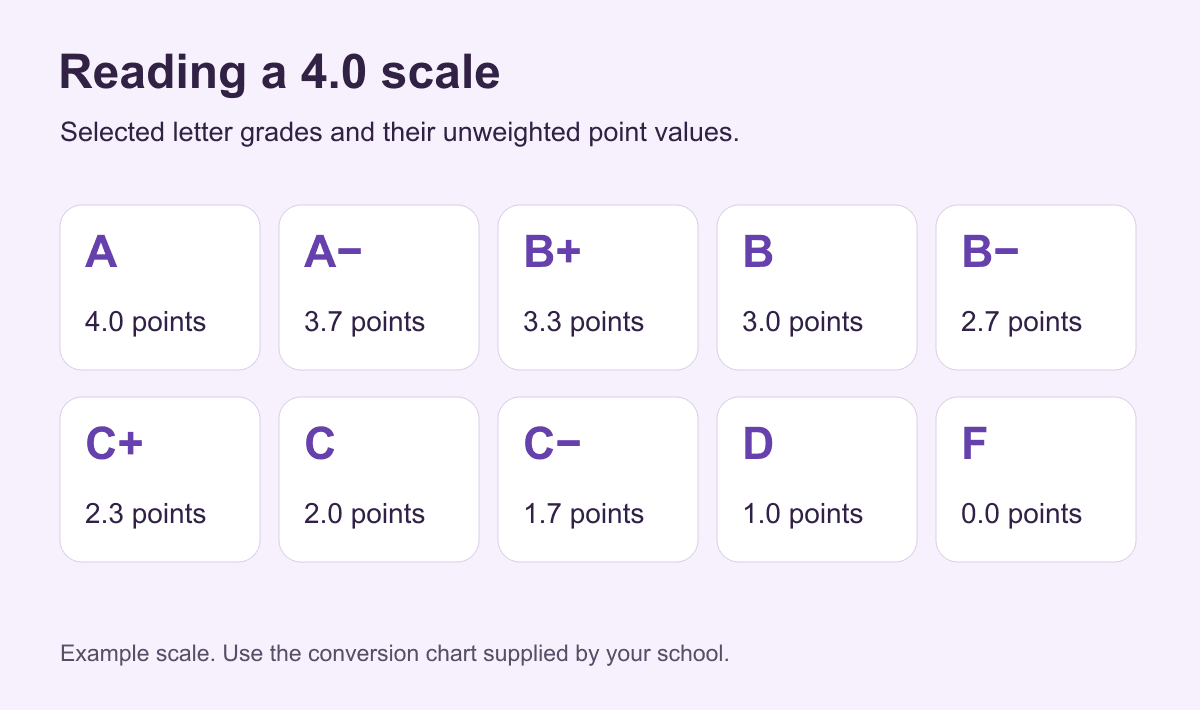
A common unweighted grading scale looks like this:
| Letter Grade | Grade Points | General Meaning |
|---|---|---|
| A | 4.0 | Excellent |
| A- | 3.7 | Very Good |
| B+ | 3.3 | Good |
| B | 3.0 | Good |
| B- | 2.7 | Above Average |
| C+ | 2.3 | Satisfactory |
| C | 2.0 | Satisfactory |
| C- | 1.7 | Below Satisfactory |
| D | 1.0 | Poor |
| F | 0.0 | Failing |
Exact grade-point conversions vary between schools. Some assign 4.0 to an A and an A+, while others use a different scale or include additional grade points.
How Is GPA Calculated?
For a simple unweighted GPA where every course has equal weight, add the grade points and divide by the number of courses. For a credit-weighted college GPA, multiply each course's grade points by its credit hours, add the quality points, and divide by total GPA-bearing credits.
For example, four equally weighted courses with grade points of 4.0, 3.0, 3.7, and 3.3 produce a GPA of 3.50. If courses carry different credit hours, the calculation must account for those differences.
What's the Average GPA in America?
According to the NCES 2019 High School Transcript Study, the average GPA earned by U.S. high school graduates was 3.11. This was higher than the 3.00 average reported for 2009 and the 2.68 average reported for 1990.
These figures describe high school graduates, not every student currently enrolled in school. They reflect the study's transcript methodology and should be treated as a national reference rather than a precise benchmark for every school.
What's the National Average GPA?
There is no single national GPA that describes every American student from middle school through college. National statistics depend on the population studied, the year of the data, the courses included, and whether GPA is weighted or unweighted.
For a clear comparison, keep high school graduate statistics separate from college graduate statistics. Do not combine averages from different studies into one number without explaining their populations and methods.
U.S. High School GPA Over Time
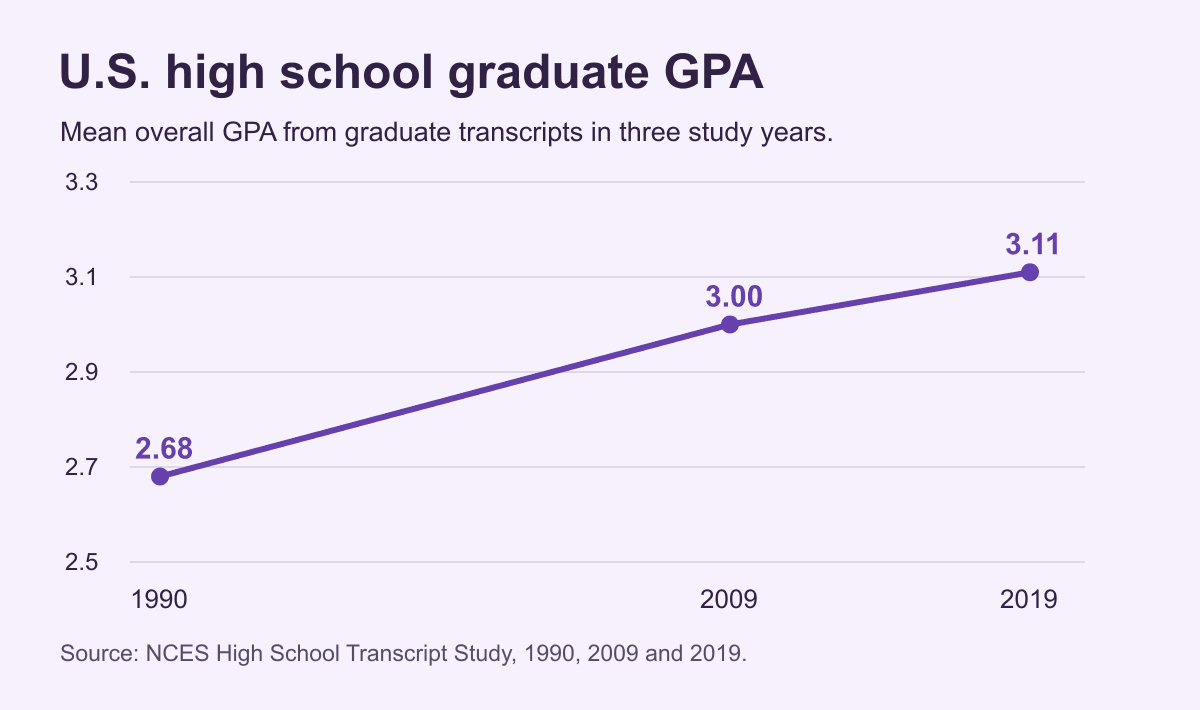
NCES historical transcript data shows that the average GPA of high school graduates increased between 1990 and 2019.
| Graduation Year | Average High School GPA |
|---|---|
| 1990 | 2.68 |
| 1994 | 2.79 |
| 1998 | 2.90 |
| 2000 | 2.94 |
| 2005 | 2.98 |
| 2009 | 3.00 |
| 2019 | 3.11 |
Source: NCES High School Transcript Study.
The increase is often discussed in connection with grade inflation, changes in grading practices, course-taking patterns, and student performance. GPA trends alone cannot establish why grades changed or prove that academic standards became easier.
What's the Average High School GPA?
The average high school GPA in America was 3.11 among graduates in the 2019 NCES study. This provides a useful national reference point for students who want to understand how their academic performance compares with historical high school graduate data.
However, individual schools may report different averages. Course difficulty, grading policies, student populations, and access to advanced classes can all influence the results.
What's the Average Unweighted GPA?
An unweighted GPA generally uses the same grade-point scale regardless of course difficulty. On a common 4.0 scale, an A is typically worth 4.0, a B is worth 3.0, and a C is worth 2.0, subject to each school's policy.
The NCES historical high school GPA figures should not automatically be interpreted as the weighted GPA used by an individual school. When comparing your own score with a published average, check whether both use the same scale and course treatment.
What's the Average Weighted GPA?
There is no single national weighted GPA that applies to all high schools. Schools may add different amounts for AP, IB, Honors, or dual-enrollment courses, and some do not calculate weighted GPA at all.
A weighted GPA can exceed 4.0 when a school awards extra points for advanced coursework. This does not mean that a student with a 4.4 weighted GPA necessarily has a higher unweighted academic average than every student with a 4.0.
What's the Average GPA by Grade Level?
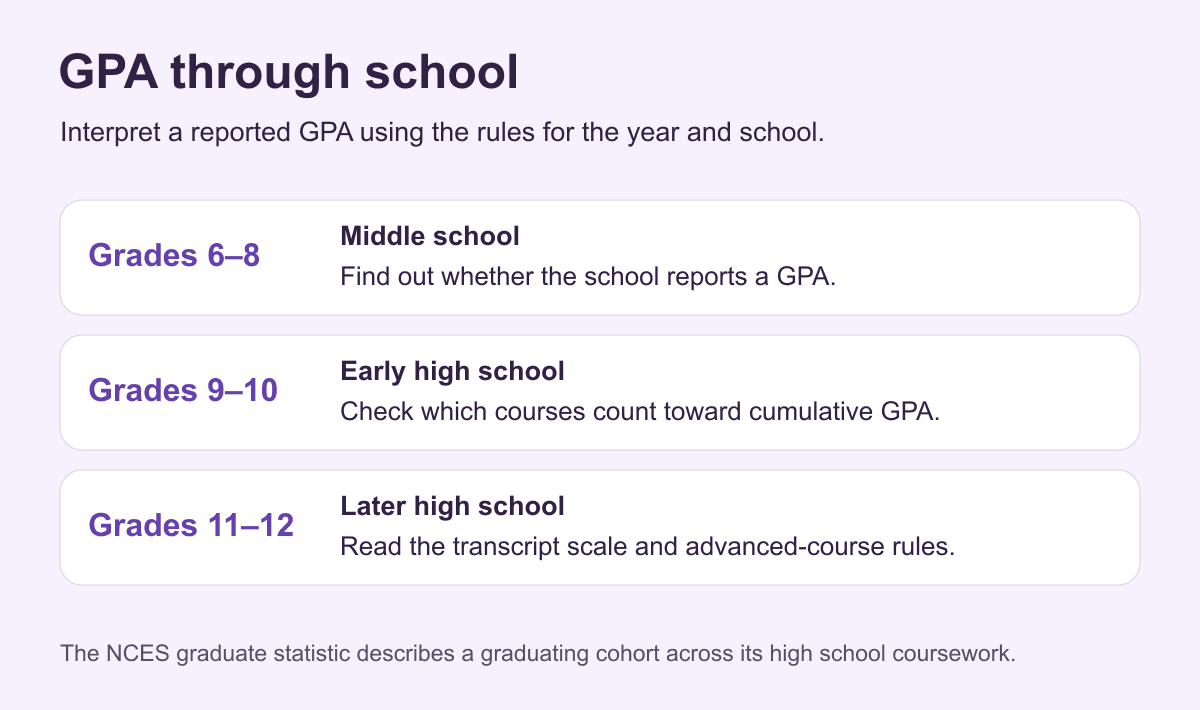
Students often ask what's the average GPA for a 6th grader, 7th grader, 8th grader, or high school student in a particular grade. However, there is no single nationally standardized GPA average for each individual grade that can be reliably applied to every U.S. school.
Middle schools and high schools differ in grading scales, course structures, and whether they calculate cumulative GPA. The sections below explain how to interpret grade-level GPA without presenting unsupported national averages.
What's the Average GPA for a 6th Grader?
Sixth-grade grading policies vary widely. Some schools report letter grades and GPA, while others use standards-based marks, proficiency levels, or narrative progress reports.
If your school uses a 4.0 scale, interpret your GPA using that school's grade conversion policy. A single national average would not account for these differences.
What's the Average GPA for a 7th Grader?
There is no universally accepted national average GPA for seventh graders. Schools may calculate grades by subject, semester, or academic year, and some do not provide a cumulative GPA at this stage.
Students should focus on understanding subject feedback, completing assignments, and building consistent study habits. If a GPA is reported, compare it with the grading policy used by the school.
What's the Average GPA for an 8th Grader?
Eighth-grade GPA can be calculated differently depending on the school district and course structure. Some students take high school-level courses in middle school, but the way those grades appear on a high school transcript varies.
Check whether the grades count toward high school credit and whether they are included in the high school GPA. Do not assume that every eighth-grade course affects a future cumulative GPA.
What's the Average GPA for a 9th Grader?
Ninth grade is often the first year of high school, so grades may begin contributing to a student's high school cumulative GPA. There is no single national ninth-grade average that applies to all schools.
A useful approach is to track each course grade and credit, then review the GPA calculation at the end of each grading period. Early progress can help students identify subjects that need additional attention.
What's the Average GPA for a 10th Grader?
Tenth-grade GPA depends on the student's courses, school grading policy, and whether advanced classes receive extra weight. Students may also have a combination of required subjects and electives with different credit values.
Rather than comparing a sophomore's GPA with an unsupported national figure, review the student's transcript and the school's GPA scale. Look at both individual course performance and cumulative progress.
What's the Average GPA for an 11th Grader?
Eleventh-grade grades are important for many college applications because they contribute to the academic record reviewed during admissions. However, there is no single national average GPA for all U.S. juniors.
Students should understand whether their school reports weighted GPA, unweighted GPA, or both. They should also review course rigor and grade trends rather than focusing on one number alone.
What's the Average GPA for a Sophomore?
A sophomore is typically a student in the second year of high school or college, depending on context. For high school sophomores, GPA is influenced by course grades, credit values, and school-specific weighting policies.
For college sophomores, cumulative GPA may include multiple semesters of coursework. Make sure you know whether a statistic refers to high school or college students before using it as a comparison.
What's the Average GPA for a Freshman?
The word freshman can refer to a first-year high school or college student. These groups should not be treated as the same population because their courses, grading policies, and GPA records differ.
For a high school freshman, the GPA may begin a cumulative high school record. For a college freshman, the GPA usually reflects completed college courses and the institution's credit-hour rules.
What's the Average College GPA?
College GPA statistics vary by institution, major, course level, and student population. A figure for bachelor's degree recipients is not necessarily the same as the average GPA of first-year students or all currently enrolled undergraduates.
When reviewing a college GPA statistic, check whether it describes admitted students, enrolled students, graduating students, or students within a particular program. These groups can have very different academic profiles.
What's the Average GPA for a Freshman in College?
There is no single national freshman GPA that applies to every college. First-year students may take different course loads, follow different grading systems, and attend institutions with different academic policies.
Some colleges publish GPA information for entering students or specific programs, but those figures should not be presented as a national freshman average. If your college provides class or institutional data, use that source for a more relevant comparison.
How Does College GPA Differ from High School GPA?
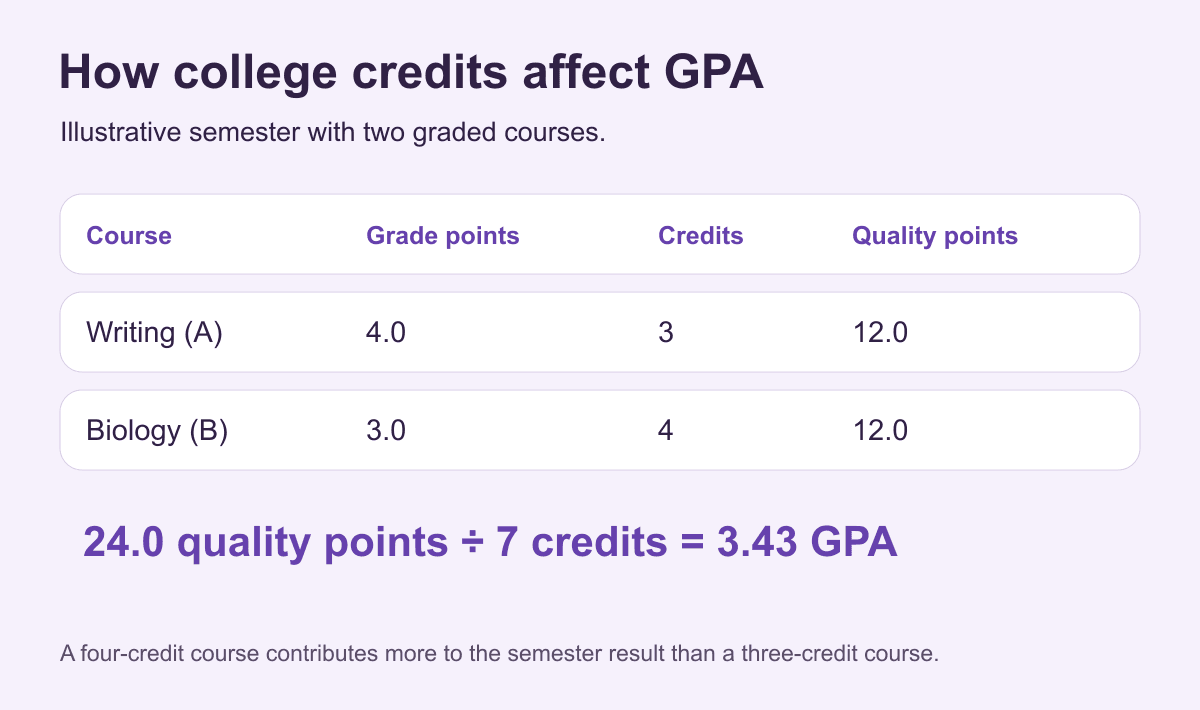
High school GPA may be calculated using course grades and school-specific weighting. College GPA commonly uses grade points multiplied by credit hours, then divides total quality points by GPA-bearing credits.
College grading policies also vary. Some institutions use plus and minus grades, repeat-course rules, academic forgiveness policies, or different treatment of transfer credits.
What's the Average GPA at Harvard?
Harvard does not publish one universal average GPA for all enrolled students that can be directly compared with the national high school average. Its admissions process considers academic performance in the context of each applicant's school, course rigor, and available opportunities.
Harvard's Common Data Set identifies academic GPA as an admissions consideration, but this does not establish a single average GPA for all admitted students. Avoid treating an unofficial online estimate as an official Harvard statistic.
What's the Average GPA to Get into Harvard?
There is no publicly stated GPA cutoff that guarantees admission to Harvard. Strong academic performance is important, but admissions decisions also consider course rigor, personal qualities, extracurricular involvement, recommendations, and other parts of an application.
A high GPA alone does not guarantee admission. Applicants should review Harvard's official admissions guidance and understand that academic records are evaluated in context.
What's the Average GPA for UCLA?
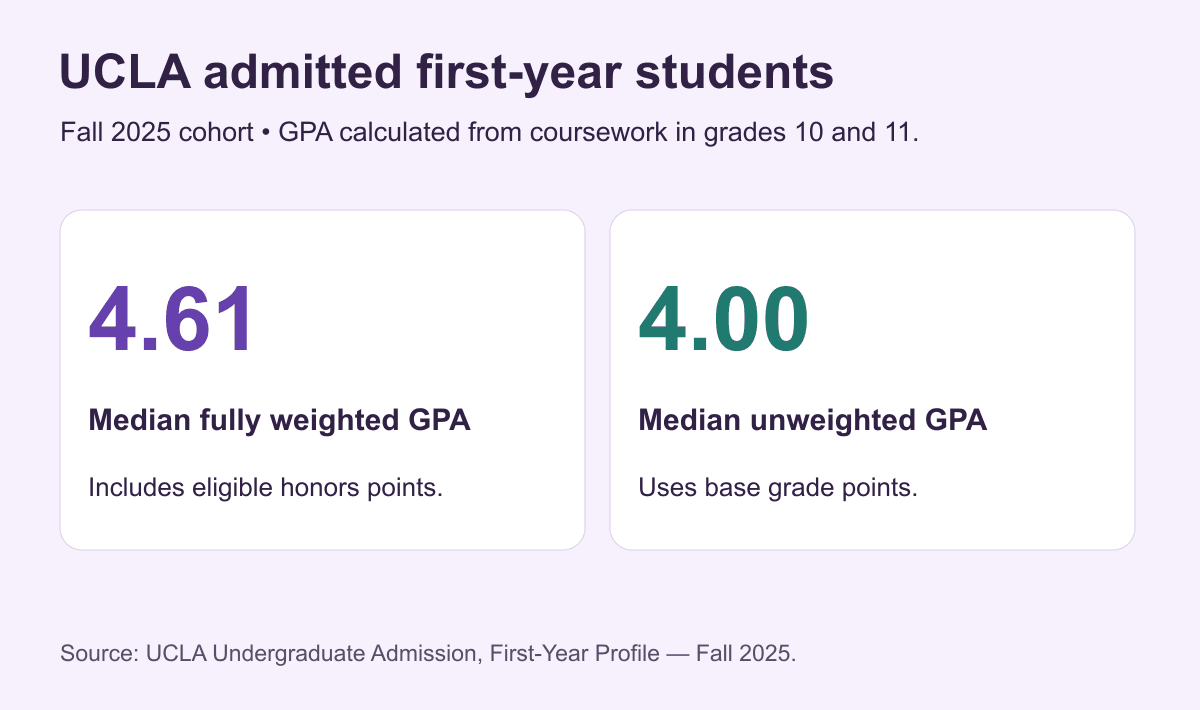
UCLA publishes GPA information for admitted first-year students, but those figures are not the same as the average GPA of all UCLA undergraduates. For Fall 2025 admitted first-year students, UCLA reported a median fully weighted GPA of 4.61 and a median unweighted GPA of 4.00, calculated from courses completed in grades 10 and 11.
These figures use UCLA's admissions GPA methodology. The fully weighted GPA includes additional points for eligible honors-level courses, while the unweighted GPA does not. They should not be compared directly with the national high school graduate average.
Source: UCLA First-Year Profile, Fall 2025.
What's the Average GPA for Harvard vs. UCLA?
Harvard and UCLA publish different types of admissions information, and their application review methods are not identical. UCLA provides a specific first-year admitted-student GPA profile, while Harvard does not provide a directly comparable universal average GPA figure in its Common Data Set.
When comparing universities, use each institution's official admissions data and pay attention to the GPA calculation method. Do not assume that two schools' GPA figures use the same weighting rules.
What's the Average GPA in Texas?
Texas does not have one GPA average that applies to every high school and college student in the state. Districts and institutions may use different grading scales, weighting systems, class-rank policies, and transcript calculations.
Some Texas high schools report weighted GPA and class rank, while others use different approaches. To understand your own standing, check your school district's transcript policy and compare your GPA with the correct local context.
What's the Average GPA in Canada?
Canada does not use one universal GPA scale across all provinces, territories, high schools, and universities. Some institutions use a 4.0 scale, others use a 4.3 scale, percentage grades, letter grades, or institution-specific conversions.
A Canadian GPA should be interpreted using the grading system of the school that issued it. If you are comparing a Canadian GPA with a U.S. GPA, check the institution's conversion policy rather than assuming that the numbers are directly equivalent.
Weighted vs. Unweighted GPA: What's the Difference?
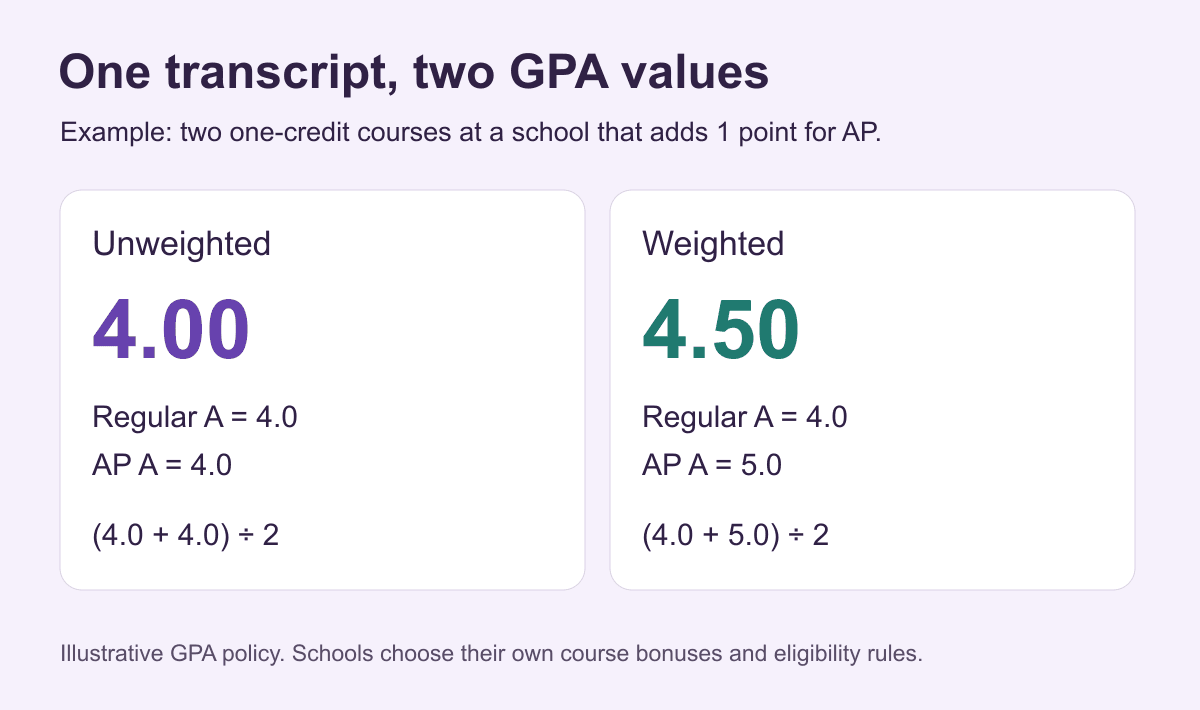
Weighted and unweighted GPA measure academic performance using different rules. An unweighted GPA generally applies the same grade-point scale to all courses, while a weighted GPA may award extra points for advanced or more challenging coursework.
| Feature | Unweighted GPA | Weighted GPA |
|---|---|---|
| Common Scale | 4.0 | Often above 4.0 is possible |
| Course Difficulty | Usually not reflected in extra points | May award extra points |
| AP / IB Courses | Same base grade points under school policy | May receive additional points |
| Main Use | Shows grades on a common scale | Reflects grades and course weighting |
| Comparability | More comparable when scales match | Requires checking each school's weighting rules |
A weighted GPA of 4.3 and an unweighted GPA of 3.9 cannot be compared without understanding how each school calculates them. Always check the transcript legend or school policy.
Why Does the Average GPA Vary?
Average GPA can differ because schools and institutions do not all evaluate academic performance in the same way. Several factors influence the numbers reported in local and national statistics.
School Grading Policies
Some schools use strict percentage cutoffs, while others use different grade boundaries or plus and minus systems. These policies can change the GPA distribution even when students demonstrate similar academic performance.
Course Difficulty and Advanced Classes
AP, IB, Honors, and college-level courses may be weighted differently. Students taking more advanced courses may have a weighted GPA that looks higher than an unweighted GPA.
Grade Inflation
Grade inflation describes a pattern in which grades rise over time without a proportional increase in measured academic performance. It is one possible explanation discussed in research on rising GPA trends, but changes in student achievement, course selection, and grading practices may also contribute.
Differences Between Schools and Majors
Universities and academic departments may have different grading cultures and course requirements. A GPA from one major or institution may not be directly comparable with a GPA from another.
How to Calculate and Compare Your GPA with Lynote
Knowing the average GPA is useful, but your own academic record is what matters when tracking progress. Lynote GPA Calculator helps you calculate your GPA using the grades and course information you enter.
Instead of relying on a rough estimate, use the calculator to work out your result and understand where you stand.
Step 1. Enter Your Course Grades
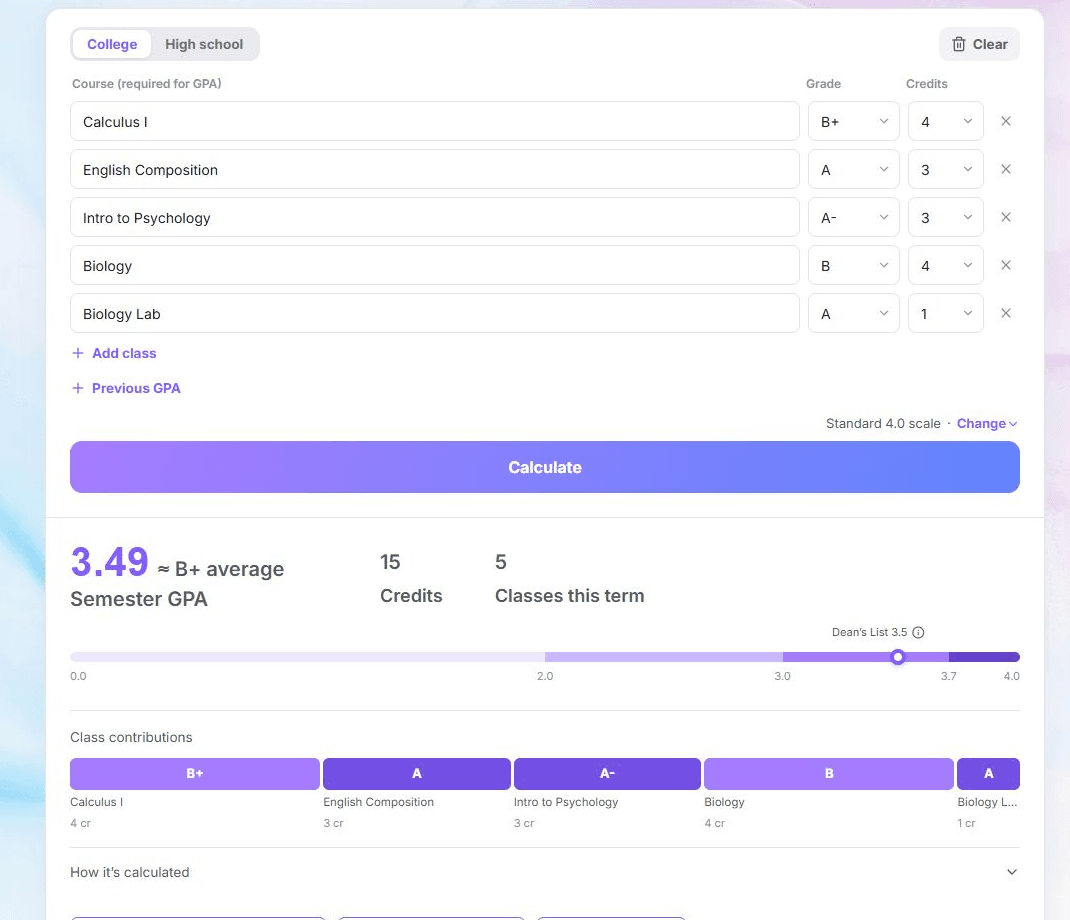
Open Lynote GPA Calculator and enter your course information using the fields available in the calculator. Follow the grade options provided by the tool.
Step 2. Add Credit Information
If the calculator provides credit-hour fields, enter the credit value for each course. Credit hours matter because a course carrying more credits can contribute more to a credit-weighted GPA.
Step 3. Calculate Your GPA
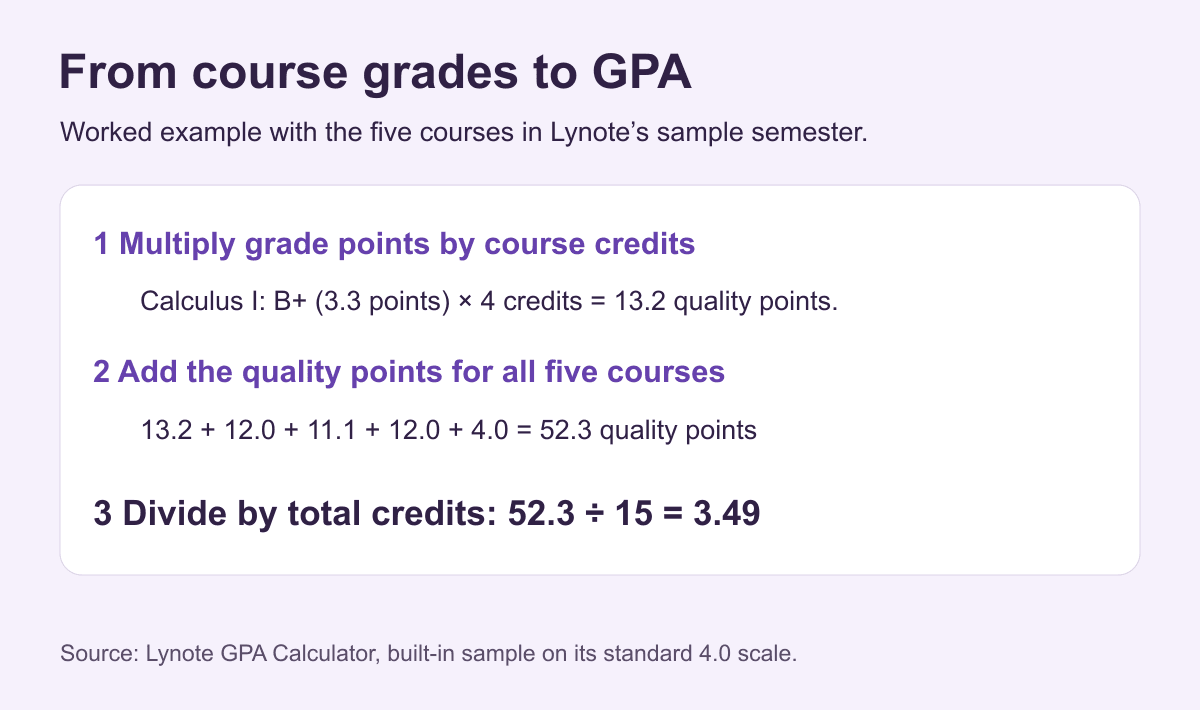
Use the calculator to generate your result. Check that the selected grading scale and course information match the rules used by your school.
Step 4. Compare Your Result with the Right Benchmark
Compare your GPA only with statistics that use a similar population and grading method. A high school graduate average, a university admissions GPA, and a college graduate GPA describe different groups.
Calculate your GPA with Lynote: https://lynote.ai/gpa-calculator
What Is Considered a Good GPA?
A good GPA depends on your academic goals, school, course difficulty, and the requirements of a particular program. A score that is strong in one context may be evaluated differently by another school or scholarship committee.
The following descriptions are general interpretations of a common unweighted 4.0 scale, not universal admission cutoffs.
| GPA | General Interpretation |
|---|---|
| 4.0 | Excellent; typically all A grades on a standard unweighted scale |
| 3.7 | Very strong academic performance |
| 3.5 | Strong academic performance |
| 3.0 | Around a B average on many common scales |
| 2.5 | Around a B-/C+ range, depending on conversion |
| 2.0 | Around a C average on many common scales |
Always check the grading policy and expectations of your school or target program. Weighted GPA, course rigor, major requirements, and institutional policies can change how a score is interpreted.
Does GPA Really Matter?
GPA can matter for college admissions, scholarships, academic honors, internships, and some employment opportunities. It gives schools and organizations one way to review academic performance over time.
However, GPA is not the only measure of a student's abilities. Course rigor, improvement, projects, recommendations, extracurricular activities, work experience, and personal circumstances may also be considered.
GPA and College Admissions
Colleges often review GPA alongside the courses a student has taken and the academic opportunities available at their school. Some institutions recalculate GPA using their own rules, so the number on a high school transcript may not match the GPA used during admissions review.
A published admitted-student GPA profile describes a particular entering class, not a guaranteed requirement. Use official university admissions information for the most relevant context.
GPA and Scholarships
Some scholarships set minimum GPA requirements, while others consider academic performance as one part of a broader application. Eligibility rules can differ by sponsor, school, program, and year.
Read the specific scholarship requirements rather than relying on a general national GPA average. Keep track of deadlines and any renewal conditions tied to academic standing.
GPA and Employment
Some employers ask for GPA, especially for internships, graduate recruitment, or early-career roles. Others focus more on skills, experience, work samples, and interview performance.
A strong GPA can support an application, but it does not replace practical experience or demonstrated ability. Consider the expectations of the role and industry.
How to Improve Your GPA
Improving GPA usually requires consistent changes to study habits, course planning, and how you monitor academic progress. Start by identifying which courses have the greatest effect on your current average and where improvement is realistic.
Track Grades Throughout the Term
Do not wait until final grades are posted to understand your academic standing. Record assignment scores, exam results, and course weights so you can see where your performance is changing.
Understand Each Course's Grading Policy
Review syllabi to understand how exams, assignments, participation, and projects contribute to the final grade. Ask instructors about unclear requirements before major assessments.
Plan Your Course Load Carefully
A balanced schedule can help you allocate enough time to demanding subjects. Consider prerequisites, course credits, workload, and graduation requirements when selecting classes.
Use Active Study Methods
Practice retrieving information, solving problems, and explaining concepts instead of only rereading material. Short review sessions distributed over time can help you identify gaps before exams.
Ask for Help Early
Use office hours, tutoring, study groups, and academic support services when a topic becomes difficult. Addressing confusion early can prevent it from affecting several later assignments.
Conclusion: Understand Your GPA in the Right Context
So, what's the average GPA? The most useful answer depends on whether you are comparing high school graduates, college students, university applicants, or a specific grade level. The NCES 2019 figure of 3.11 is a clear national reference for high school graduates, but it should not be treated as a universal benchmark for every student.
Understand your school's grading scale, track your course performance, and calculate your GPA using the right method. Use Lynote GPA Calculator to work out your own GPA and make more informed decisions about your academic progress.
Frequently Asked Questions About Average GPA
What's the Average GPA in the US?
NCES reported an average GPA of 3.11 among U.S. high school graduates in 2019. This statistic describes that graduating population and should not be interpreted as the average GPA of every student currently enrolled in the United States.
What's the Average Person's GPA?
There is no official GPA for the average person because GPA is an educational measure, not a statistic recorded for the entire population. GPA data generally describes specific groups, such as high school graduates, college students, or degree recipients.
What's the Average GPA Score?
On a common unweighted 4.0 scale, a GPA is expressed from 0.0 to 4.0. The average score depends on the student population and grading rules being measured.
What's the Average GPA for a Freshman?
The answer depends on whether freshman refers to a high school or college student. There is no single national freshman GPA that applies to both groups or to every institution.
What's the Average GPA for a 6th, 7th, or 8th Grader?
There is no consistently reported national GPA average for each of these middle-school grades. Schools use different grading systems, and some do not calculate GPA for middle-school students.
What's the Average GPA for a 9th, 10th, or 11th Grader?
Grade-level GPA varies by school, courses, and grading policy. The national NCES figure of 3.11 refers to high school graduates in 2019, not a separate average for each grade.
What's the Average Unweighted GPA?
There is no single current national unweighted GPA average that applies to every school. On a common 4.0 scale, an unweighted GPA gives the same base grade points regardless of whether a course is AP, Honors, or standard, subject to the school's rules.
What's the Average Weighted GPA?
Weighted GPA averages vary because schools assign different additional points to advanced courses. Some schools use a 5.0 scale or another system, while others do not calculate weighted GPA.
What's the Average GPA at Harvard?
Harvard does not publish one universal average GPA for all enrolled students that can be compared directly with national high school statistics. Its admissions process considers academic performance in context, including course rigor and the opportunities available at the applicant's school.
What's the Average GPA for UCLA?
UCLA's Fall 2025 first-year admitted-student profile reported a median fully weighted GPA of 4.61 and a median unweighted GPA of 4.00. These figures apply to admitted first-year applicants under UCLA's stated calculation method, not all UCLA students.
What's the Average GPA to Get into Harvard?
Harvard does not publish a GPA cutoff that guarantees admission. Applicants are evaluated through a broader review that includes academic achievement, course rigor, and other academic and personal factors.
What's the Average GPA in Texas?
There is no single GPA average for all Texas students. School districts and colleges may use different grading scales, weighting policies, and transcript calculations.
What's the Average GPA in Canada?
Canada does not use one universal GPA scale across all schools and universities. Institutions may use 4.0, 4.3, percentage, letter-grade, or other conversion systems, so consult the relevant institution's grading policy.
Can I Calculate My GPA Online?
Yes. You can use an online GPA calculator to enter course grades and, where supported, credit hours. Make sure the calculator's grading scale matches your institution's policy.
Does a 4.0 GPA Mean the Same Thing at Every School?
Not always. Schools may use different grade conversions, weighting rules, and course inclusion policies. Check how your institution calculates GPA before comparing results with another school.
How Often Should I Check My GPA?
Review your grades throughout each term and calculate your GPA after official course grades are available. Tracking progress during the term can help you identify where you may need additional support.

Written by Kristen I.
Content Strategist
Kristen focuses on content structure, editorial planning, readability, and creating useful experiences for readers. View all articles →