
GPA Scale Guide: Grading Systems, Charts & Conversion

A GPA scale converts course grades into grade points so schools can summarize a student's academic performance. The scale used by your school determines how letter grades, percentages, advanced courses, and credits contribute to your GPA. Understanding the system is essential when calculating your average or comparing academic records.
This guide explains common U.S. grading systems, including 4.0, 4.33, and 5.0 scales. It also covers weighted and unweighted GPA, grade conversion, GPA scale reporting for college applications, and how to calculate your result with Lynote GPA Calculator.
What Is a GPA Scale?
A GPA scale is a grading framework that assigns numerical values to letter grades or other academic marks. GPA stands for Grade Point Average, and it provides a compact way to summarize performance across multiple courses.
In the United States, a common GPA scale uses a maximum of 4.0 for an A. However, some schools use plus and minus grades, weighted points, percentage-based systems, or other maximum values.
How Does a GPA Grade Scale Work?
A typical GPA grade scale connects three kinds of information: the percentage or mark earned in a course, the letter grade assigned by the school, and the grade points used in the GPA calculation.
For example, a school might define 90–92% as an A-, then assign 3.7 grade points to that letter grade. Another school might classify the same percentage as an A and assign 4.0 points.
The grade boundaries are set by the institution. This is why a grade conversion chart should be treated as an example unless it comes directly from the student's school.
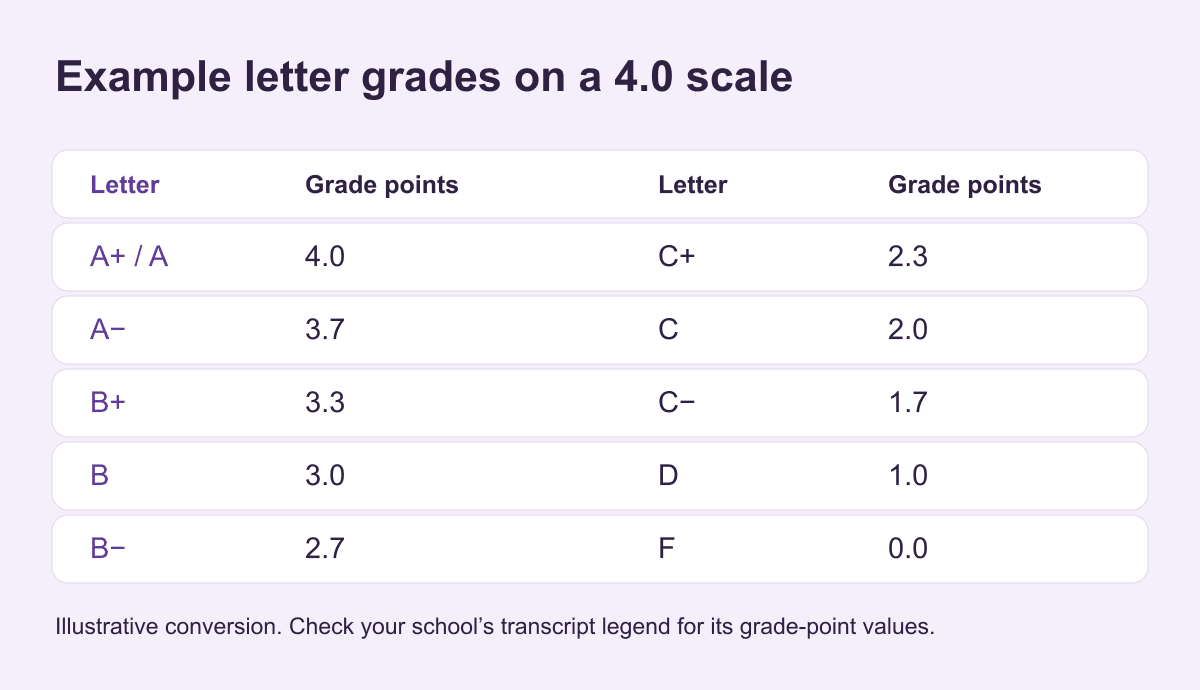
Letter Grade GPA Scale: An Illustrative 4.0 Chart
| Letter Grade | Example Grade Points |
|---|---|
| A+ | 4.0 |
| A | 4.0 |
| A- | 3.7 |
| B+ | 3.3 |
| B | 3.0 |
| B- | 2.7 |
| C+ | 2.3 |
| C | 2.0 |
| C- | 1.7 |
| D | 1.0 |
| F | 0.0 |
This is one common plus/minus example, not a universal U.S. standard. Some schools do not use plus/minus grades, while others assign 4.3 to an A+ or use different values. Consult your school handbook or transcript legend.
How Does the 4.0 GPA Scale Work?
The 4.0 GPA scale is a common U.S. grading system in which course letter grades are converted into grade points, with 4.0 typically representing an A. It is often used for high school and college GPA reporting, although individual institutions can apply different rules.
What Is the GPA Scale of 4.0?
On a standard unweighted 4.0 scale, each course receives grade points based on the final letter grade. The grade points are then averaged, sometimes with course credits used as weights.
A 4.0 GPA generally represents an A average under the school's rules. It does not mean every school uses identical percentage cutoffs or plus/minus values.
What Is a 4.0 GPA Scale Compared with a 4.33 Scale?
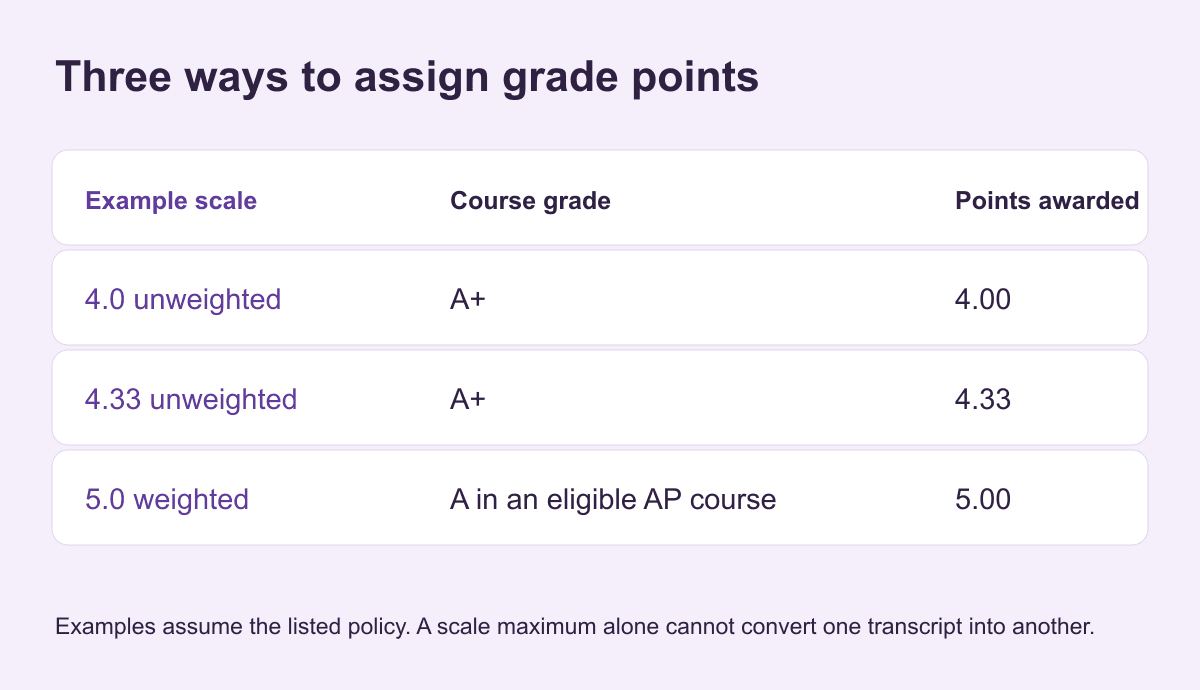
A 4.0 scale may cap an A+ and an A at 4.0. A 4.33 scale may assign a higher value to an A+, allowing students to earn more than 4.0 on that system.
The exact values vary by institution. Do not assume that a 4.0 GPA on one scale is directly equivalent to a 4.0 or 4.33 GPA at another school without checking its grading policy.
What Is a 5.0 GPA Scale?
A 5.0 GPA scale is often associated with weighted high school grading. A school may award extra grade points for AP, IB, Honors, or other advanced courses to reflect course rigor.
The weighting method is not standardized. One school might add 1.0 point to an eligible AP course, while another may use a different bonus or include only selected courses.
4.0, 4.33, and 5.0 GPA Scales Compared
Illustrative grading conventions. Use your school’s published scale.
| Scale Type | Typical Maximum or Convention | How It May Work |
|---|---|---|
| Classic 4.0 | 4.0 | An A is commonly worth 4.0 |
| 4.0 Plus/Minus | Usually 4.0 | A-, B+, and similar grades receive separate values |
| 4.33 Scale | May use 4.33 | An A+ may receive more points than an A |
| Weighted 5.0 Example | May reach 5.0 | Advanced courses may receive extra points |
| 10-Point System | Usually 0–10 | Numerical marks follow an institution-specific scale |
A 5.0 GPA does not automatically mean a student performed better than someone with a 4.0 GPA. The first score may include weighted coursework, while the second may be unweighted.
Weighted GPA Scale vs. Unweighted GPA Scale
The difference between weighted and unweighted GPA is how the school treats course difficulty. An unweighted GPA generally applies the same base grade-point values to all courses, while a weighted GPA may add points for selected advanced classes.
What Is an Unweighted GPA Scale?
An unweighted GPA scale usually has a maximum of 4.0. A student receives grade points based on the letter grade earned, regardless of whether the course is standard, Honors, AP, or IB, subject to the school's rules.
This approach makes it easier to compare grades on a common base scale when institutions use the same conversion policy. It does not, by itself, show the difficulty of the courses a student completed.
What Is a Weighted GPA Scale?
A weighted GPA scale gives additional grade points to certain courses. Schools may apply weighting to AP, IB, Honors, dual-enrollment, or other advanced classes.
For example, a school might award 4.0 for an A in a standard course and 5.0 for an A in an eligible AP course. This is only an example; the actual bonus depends on the school's policy.
Is Weighted GPA on a 4.0 Scale?
It can be, depending on how a school reports it. Some schools calculate both weighted and unweighted GPAs, while others report only one measure or use a weighted scale with a maximum above 4.0.
Check the transcript carefully to see which number is weighted. A weighted GPA may exceed 4.0, but an unweighted GPA on a standard 4.0 scale generally does not.
AP Class GPA Scale and Honors GPA Scale
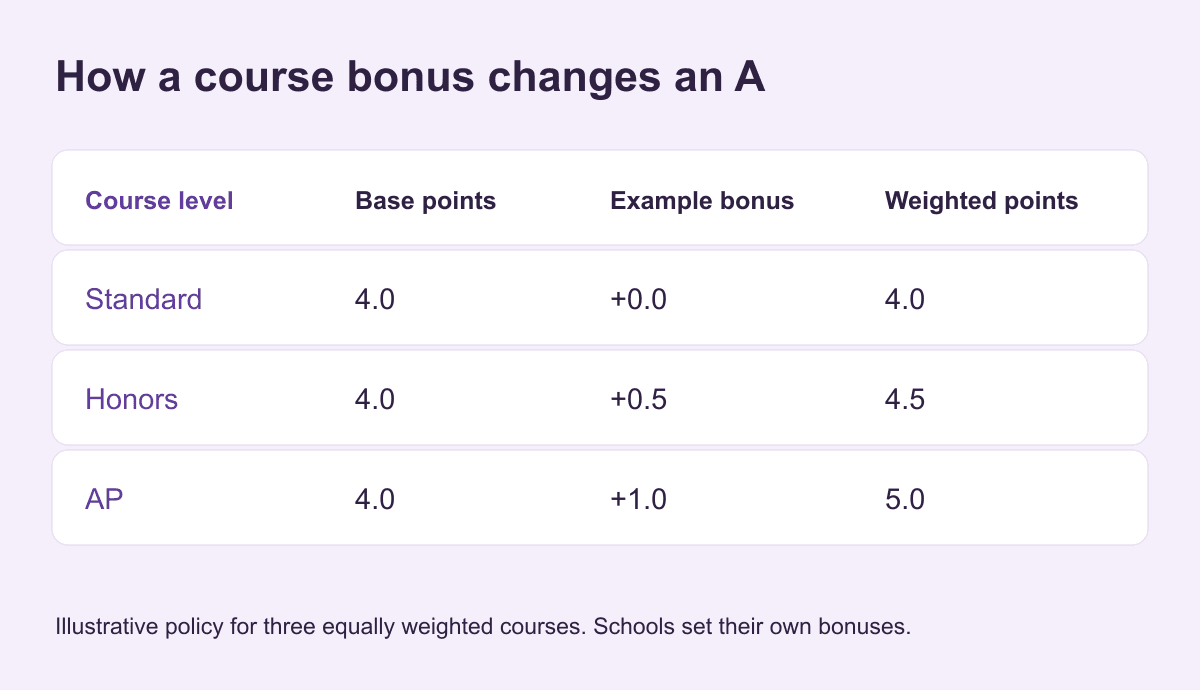
An AP class GPA scale or Honors GPA scale may include extra grade points for eligible advanced coursework. Schools decide which courses qualify and how much additional weight is assigned.
Do not assume every AP or Honors class receives the same bonus at every school. Check the course catalog, student handbook, or transcript legend to understand how weighting is applied.
GPA Scale Conversion: How to Convert Grades to a 4.0 Scale
Converting grades to a 4.0 GPA scale helps students understand academic performance using a commonly recognized grading system. However, there is no universal conversion formula for every school because institutions may use different percentage boundaries, letter-grade values, and weighting policies.
Before converting your GPA, identify the grading scale used by your school. If your transcript already provides letter grades or grade points, use the institution's official conversion rules whenever possible.
How Does a GPA Converter to 4.0 Scale Work?
A GPA converter translates grades from another grading system into grade points on a 4.0 scale. The conversion may start with a percentage, letter grade, or another GPA scale.
For example, a school may assign 4.0 to an A, 3.0 to a B, and 2.0 to a C. Another institution may use plus and minus grades, assigning 3.7 to an A- and 3.3 to a B+.
The result depends on the conversion table being used. A GPA converter to 4.0 scale should be treated as an estimate unless it follows the official policy of your institution.
Percentage to GPA 4.0 Scale Conversion
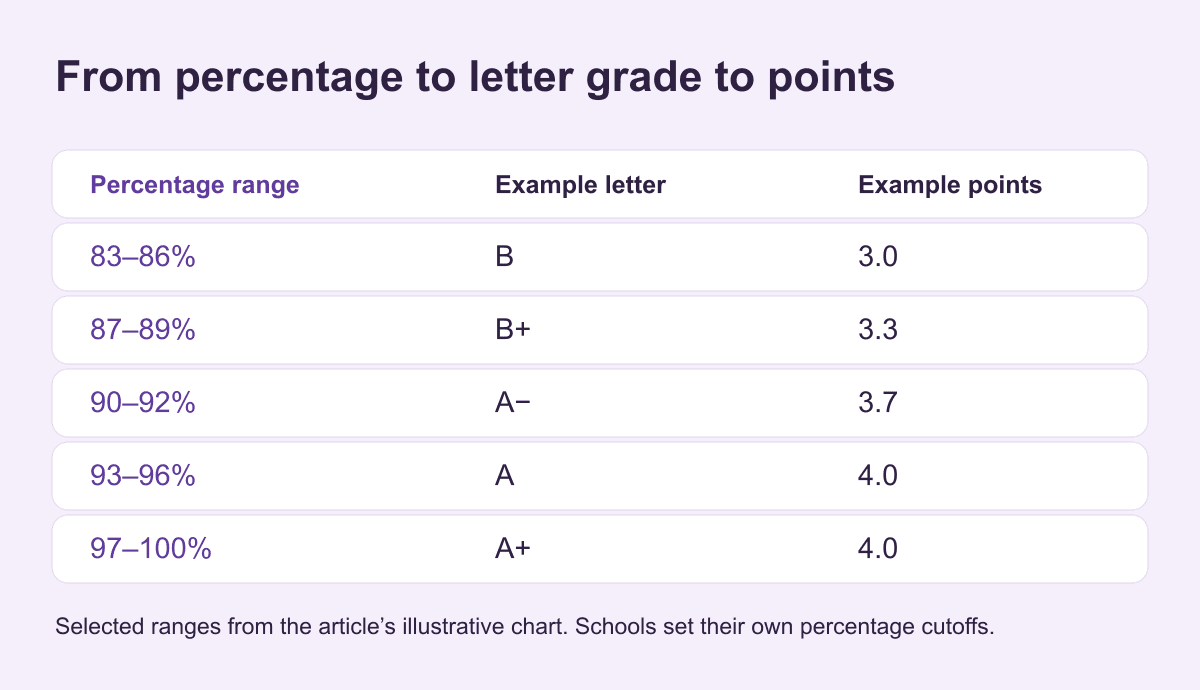
Percentage grades are not always converted directly into GPA. Schools first determine which letter grade corresponds to a percentage range, then assign the corresponding grade points.
| Percentage | Example Letter Grade | Example GPA |
|---|---|---|
| 97–100% | A+ | 4.0 |
| 93–96% | A | 4.0 |
| 90–92% | A- | 3.7 |
| 87–89% | B+ | 3.3 |
| 83–86% | B | 3.0 |
| 80–82% | B- | 2.7 |
| 77–79% | C+ | 2.3 |
| 73–76% | C | 2.0 |
| 70–72% | C- | 1.7 |
| 60–69% | D | 1.0 |
| Below 60% | F | 0.0 |
This is an example of one possible grading policy, not an official nationwide conversion standard. Some schools use different percentage boundaries and grade-point values.
What Is a 90 GPA on a 4.0 Scale?
If your school uses the illustrative table above, a 90% corresponds to an A- and approximately 3.7 GPA points. Another school may classify 90% as an A and assign 4.0 points.
The same issue applies to nearby scores. A 92% might be an A- or an A depending on the grading boundaries used by the institution.
What Is an 85, 87, or 89 GPA on a 4.0 Scale?
Using the illustrative table above, 83–86% maps to 3.0, while 87–89% maps to 3.3. These are examples only; a school's own percentage-to-letter-grade chart takes precedence.
What Is a 90, 91, 92, or 93 GPA on a 4.0 Scale?
On the example scale, 90–92% maps to 3.7 and 93% maps to 4.0. A 93 GPA on a 4.0 scale is not automatically 4.0 at every institution, because some schools begin the A range at a different percentage.
What Is a 95, 96, or 97 GPA on a 4.0 Scale?
On the example scale, percentages from 93% to 100% receive 4.0 grade points. Some institutions distinguish A+ from A, while others do not award additional grade points for an A+.
How to Convert GPA to a 4.0 Scale from Another Grading System
A simple proportional conversion is sometimes used for informal estimates:
Estimated 4.0 GPA = (Your GPA ÷ Original Maximum GPA) × 4
For example, a 4.5 GPA on a 5.0 scale would produce an estimated 3.6 using this method. It does not account for different grade boundaries, course weighting, or institutional conversion policies, so it should not replace an official university conversion.
How to Convert a 10-Point GPA Scale to a 4.0 Scale
Some educational systems use a 10-point grading scale instead of the U.S. 4.0 GPA scale. There is no universal conversion from a 10-point GPA to a 4.0 GPA because institutions may use different passing thresholds and grade categories.
A simple proportional estimate is to divide the original GPA by 10 and multiply by 4. This may not match the receiving university's conversion method, so applicants should check its international credential evaluation requirements.
How to Convert a 5.0 GPA Scale to a 4.0 Scale
A 5.0 GPA scale is commonly associated with weighted high school grading systems. You should not automatically divide a weighted GPA by five and multiply by four because weighted and unweighted GPAs measure grades differently.
The original course grades and the school's weighting policy may be needed to produce a meaningful conversion. When applying to a university, follow its stated instructions.
How to Calculate GPA on a 4.0 Scale
If you already have course letter grades and their corresponding grade points, you can calculate an unweighted GPA by averaging the grade points. When courses have different credit hours, use a credit-weighted calculation instead.
GPA = Total Quality Points ÷ Total GPA Credits
Quality points are calculated by multiplying each course's grade points by its credit hours.
Example: Calculate GPA on a 4.0 Scale
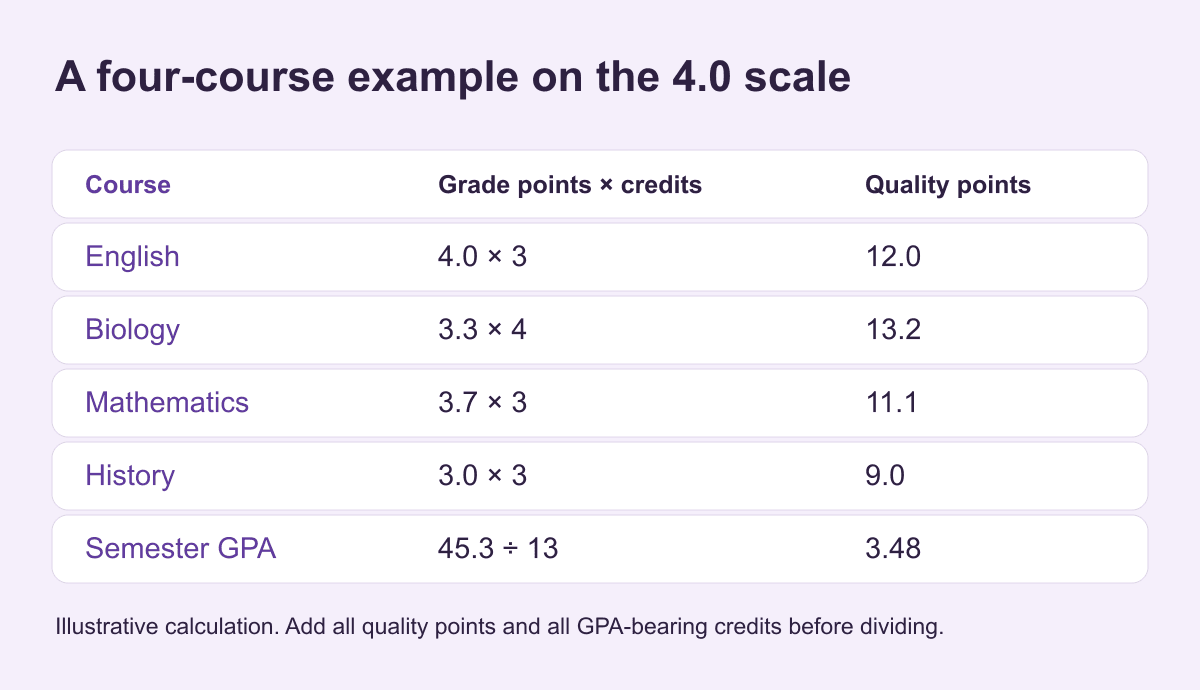
| Course | Grade | Grade Points | Credits | Quality Points |
|---|---|---|---|---|
| English | A | 4.0 | 3 | 12.0 |
| Biology | B+ | 3.3 | 4 | 13.2 |
| Mathematics | A- | 3.7 | 3 | 11.1 |
| History | B | 3.0 | 3 | 9.0 |
| Total | 13 | 45.3 |
The student's GPA is 45.3 divided by 13, which equals approximately 3.48 on this illustrative 4.0 scale.
How to Find Your Cumulative GPA on a 4.0 Scale
Cumulative GPA combines grade points and GPA-bearing credits from multiple completed courses or semesters. It is not simply the average of semester GPAs unless each semester has the same number of GPA credits.
To calculate cumulative GPA, add all quality points earned across the included courses and divide by the total GPA-bearing credits. For example, 45 quality points across 15 credits produces a cumulative GPA of 3.00.
Add the quality points and credits from subsequent courses to update the result. Follow your institution's rules for repeated courses, withdrawals, transfer credits, and courses excluded from GPA calculations.
How to Use a 4.0 Scale GPA Calculator
A 4.0 scale GPA calculator can help reduce manual arithmetic. Enter the grades and course information required by the tool, then review the result against your school's official grading rules.
If your school uses a different letter-grade conversion, determine the correct grade points before entering them. Do not assume every calculator uses your institution's exact policy.
Calculate your GPA with Lynote: Lynote GPA Calculator
What Is GPA Scale Reporting?
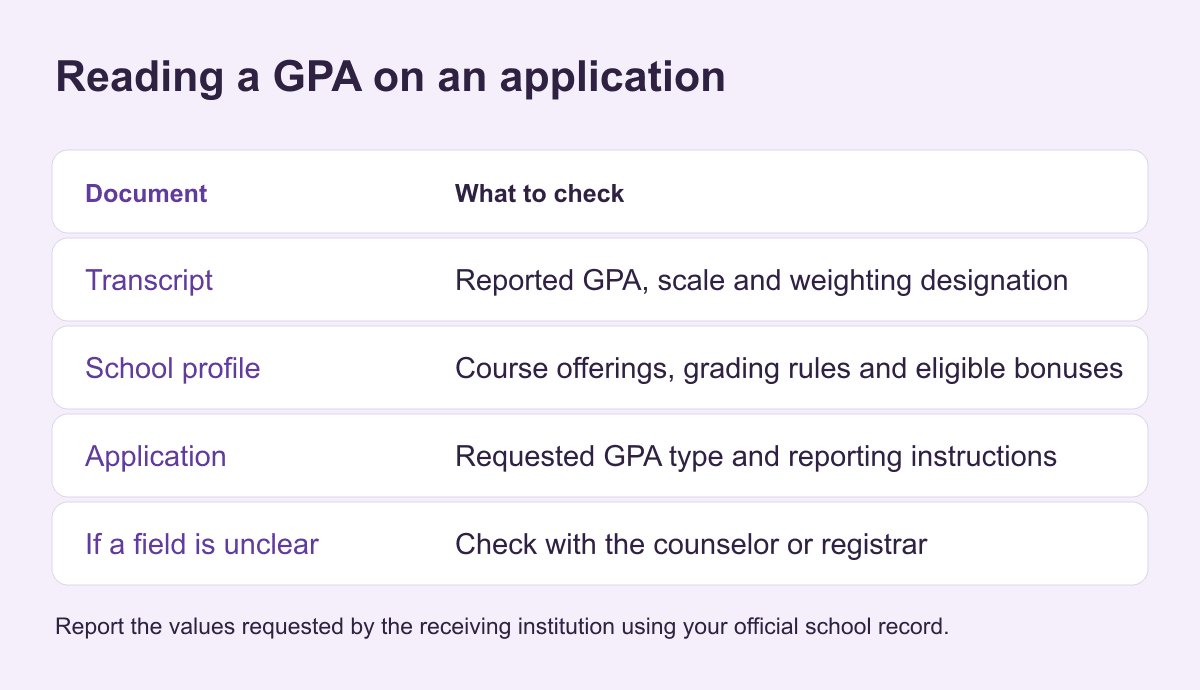
GPA scale reporting explains the grading system behind the GPA shown on a transcript or college application. It gives schools and admissions readers context for interpreting a student's academic record.
A GPA number alone may not explain whether the student attended a school with a 4.0, 4.33, 5.0, or percentage-based system. Reporting the scale helps prevent misleading comparisons between students whose schools calculate grades differently.
What Does GPA Scale Reporting Mean on Common App?
When an application asks for GPA scale information, it is asking how the student's school calculates and reports GPA. The exact fields and instructions can change, so students should follow the current Common App form and their counselor's guidance.
Do not convert or recalculate a GPA simply to make it fit a preferred scale unless the application specifically instructs you to do so. Report the GPA and scale as shown on the official transcript, and provide additional school context when requested.
What Is a School Profile?
A school profile is a document that may accompany a student's transcript and explains the school's academic environment. It can describe the grading scale, course offerings, weighting policies, class rank practices, and other context relevant to interpreting grades.
If your school uses an unusual GPA scale, ask your counselor how the scale is explained to colleges. The profile can help admissions readers understand the meaning of the reported GPA.
Why Does GPA Scale Reporting Matter?
GPA scale reporting matters because the same numerical GPA can represent different academic records. A 4.0 on an unweighted scale may have a different meaning from a 4.0 on a weighted scale with a higher possible maximum.
Course rigor also matters. Colleges may consider the courses available at a student's school and the level of challenge reflected in the transcript rather than comparing GPA figures in isolation.
How Colleges Evaluate Different GPA Scales
Colleges receive transcripts from schools that use different grading systems. Admissions offices may review the reported GPA alongside course rigor, grades in core subjects, school profiles, and other academic information.
Some institutions recalculate GPA for internal review, while others rely more directly on the school's reported measure. There is no single recalculation method used by every university.
University-Specific GPA Scales
Students often search for a university's GPA scale before applying. Examples include UGA, ASU, UIUC, UCLA, Cornell, Harvard, Penn State, Purdue, NC State, UT Austin, the University of Washington, USC, UVA, UMD, UNC, and other institutions.
These searches may refer to admissions GPA expectations, grade-point policies for enrolled students, transfer-credit rules, or program-specific requirements. They are not necessarily asking for the same information.
A program-specific requirement, such as an engineering admission GPA published by the University of Windsor, should not be treated as a general U.S. GPA conversion rule. Always consult the exact program and admissions year.
How to Check a University's GPA Policy
If you are researching the UGA GPA scale, ASU grading scale, UIUC GPA scale, UCLA GPA scale, Cornell GPA scale, or another institution's rules, start with its registrar and admissions websites.
Look for the grading policy, undergraduate catalog, transfer-credit policy, and first-year or transfer admission requirements. Confirm whether the information applies to applicants, enrolled students, or a specific academic program.
Do not assume that a university's internal grade-point scale is the same as the scale it uses to evaluate high school applicants. The two processes may use different criteria.
How to Find Your School's Official GPA Scale
The most reliable source for your GPA scale is the institution that issued your grades. A school handbook, transcript legend, student portal, or registrar's grading policy may explain how letter grades are converted into grade points.
Check Your Transcript
Look for the GPA type, maximum scale, grade-point values, and any notation about weighted courses. If the transcript shows both weighted and unweighted GPA, make sure you know which one an application requests.
Review the Student Handbook or Course Catalog
Schools often publish grading policies in their student handbook or academic catalog. These documents may explain percentage cutoffs, plus/minus grades, course weighting, repeated courses, and credit rules.
Ask Your Counselor or Registrar
If the scale is unclear, ask your school counselor or registrar how GPA is calculated and reported. This is especially important when preparing an application or converting grades for another institution.
How to Calculate Your GPA with Lynote GPA Calculator
Understanding the GPA scale is the first step. The next is calculating your own result using the grades and course information that apply to your academic record.
Lynote GPA Calculator provides an online way to calculate GPA. Use the calculator's actual input fields and follow the grading options available in the tool.
Step 1. Open the Lynote GPA Calculator
Visit Lynote GPA Calculator and review the available fields before entering your information. Check which grade format and course details the calculator accepts.
Step 2. Enter Your Grades and Available Course Details
Enter your grades using the options provided by the calculator. If the tool includes credit fields, enter the corresponding course credits accurately.
If your school uses a different letter-grade conversion, confirm the grade points from your official grading policy before calculating. Do not assume an online calculator automatically knows your school's unique scale.
Step 3. Calculate and Review Your Result
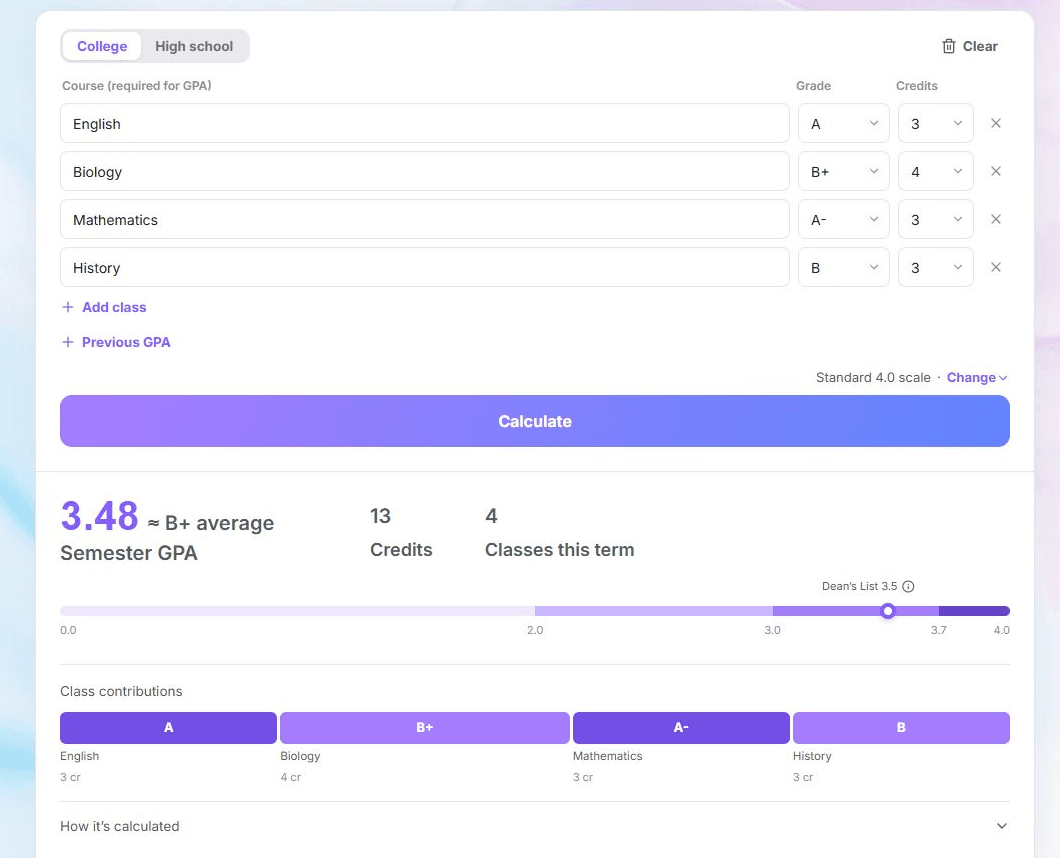
Run the calculation and check that the entered grades and any credit information are correct. Compare the result with your own transcript calculation when possible.
For official applications, use the GPA and scale required by the institution. A general calculator result should not replace an official transcript or a university's stated conversion method.
Calculate Your GPA with Lynote
Common GPA Scale Mistakes to Avoid
Treating Every Percentage as a Fixed GPA
A percentage does not have one universal GPA equivalent. The letter grade assigned to a percentage depends on the school's grading boundaries.
Better approach: Use the official percentage-to-letter-grade chart from your school before converting the result.
Confusing Weighted and Unweighted GPA
A weighted GPA may include additional points for advanced coursework, while an unweighted GPA generally uses the same base scale for all courses. Comparing the two without checking their calculation methods can be misleading.
Better approach: Identify the GPA type and the school's weighting policy before comparing scores.
Converting a 5.0 GPA by Simple Division
A weighted GPA may reflect course difficulty, not just a larger numerical scale. Dividing it by five and multiplying by four can produce a misleading estimate.
Better approach: Use the original course grades and the receiving institution's conversion policy whenever possible.
Assuming All Colleges Use the Same GPA Scale
Universities may calculate, report, and interpret GPA differently. Some use plus and minus grades, while others have their own rules for repeated courses, transfer credits, and academic standing.
Better approach: Check the institution's official grading policy and admissions instructions.
Rounding Too Early
Rounding individual course grade points before calculating the overall GPA can slightly change the final result. This matters when a school uses precise cumulative GPA calculations.
Better approach: Keep the available precision during the calculation and round only the final result according to the institution's rules.
Conclusion: Understand Your GPA Scale Before You Compare
A GPA scale gives meaning to the grades shown on your transcript, but the same GPA number can represent different academic records under different school policies. Understanding 4.0, 4.33, 5.0, weighted, and unweighted systems helps you calculate and interpret your academic performance more accurately.
Check your school's official grading rules before converting or reporting grades. When you are ready to calculate your result, use Lynote GPA Calculator as a practical starting point.
Frequently Asked Questions About GPA Scales
What Is a GPA Scale?
A GPA scale is a system that converts letter grades or other marks into numerical grade points. Schools use those points to calculate a student's Grade Point Average.
What Is the 4.0 GPA Scale?
The 4.0 GPA scale is a commonly used U.S. grading system where an A is typically worth 4.0 points. Exact letter-grade values and percentage boundaries vary by school.
What Is a 4.33 GPA Scale?
A 4.33 scale may assign more than 4.0 points to an A+, while other grades receive values such as 4.0 for A and 3.7 for A-. The exact scale depends on the institution.
What Is a 5.0 GPA Scale?
A 5.0 scale is often used for weighted GPA calculations. Schools may award additional points for selected AP, IB, Honors, or other advanced courses.
What Is the Difference Between Weighted and Unweighted GPA?
Unweighted GPA generally uses the same base grade-point scale for all courses. Weighted GPA may add points for advanced coursework, so its maximum can be higher than 4.0.
What Is an A- on the GPA Scale?
On one common plus/minus scale, an A- is worth 3.7 grade points. Some schools use different values or do not distinguish A- from A.
What Is a B on the GPA Scale?
A B is commonly worth 3.0 points on a standard 4.0 scale. Always check the school's grading chart because some institutions use different grade-point values.
How Do I Calculate GPA on a 4.0 Scale?
Convert each course grade into grade points using your school's scale. For courses with different credit hours, multiply each grade point by its credits, add the quality points, and divide by total GPA credits.
How Do I Convert My GPA to a 4.0 Scale?
Use the receiving institution's official conversion policy whenever possible. A simple proportional conversion may provide an informal estimate, but it does not account for differences in grade boundaries or course weighting.
What Is GPA Scale Reporting on Common App?
GPA scale reporting provides context about the grading system used by the student's school. Follow the current Common App instructions and report the GPA and scale as shown on the official transcript.
Is a 90% a 4.0 GPA?
It depends on the school's percentage-to-letter-grade policy. Under one illustrative scale, 90% may equal an A- and 3.7 points, while another school may assign 4.0.
Is a 10-Point GPA Scale the Same as a 4.0 Scale?
No. A 10-point scale uses a different numerical range and may have different grade categories. There is no universal conversion formula accepted by every institution.
Can I Use the Same GPA Scale for Every University?
No. Universities may have different internal grading policies, admissions calculations, and transfer-credit rules. Check the specific institution and program requirements.
Can Lynote Help Me Calculate My GPA?
Lynote provides an online GPA Calculator at https://lynote.ai/gpa-calculator. Enter information supported by the calculator and review the result against your school's official grading policy.

Written by Hamza Razzaq
Technical Writer
Hamza creates hands-on explainers and technical guides that make AI writing tools easier to understand and use. View all articles →