
4 Ways to Summarize a Research Paper Without Losing the Evidence

A useful research paper summary does more than make a long PDF shorter. It gives a reader enough information to understand what the researchers asked, how they investigated it, what they found, and how confidently the finding can be applied.

That standard matters whether you use a dedicated paper summarizer, ChatGPT, or your own notes. The four methods below differ in speed and flexibility, but each one ends with the same task: checking the condensed version against the original evidence.
The Short Answer: Capture the Question, Method, Results, Limits, and Meaning
To summarize a research paper effectively, you must extract the core evidence rather than just compressing the text. A reliable summary captures the research problem, methodology, findings, and limitations in plain U.S. English.
A strong, evidence-preserving summary formula includes these six elements:
- State the paper's specific research question or problem.
- Name the study design, sample or data source, and core method.
- Report the main result with the most meaningful number or comparison when available.
- Preserve the authors' most important limitation or uncertainty.
- Explain why the finding matters without adding a new personal opinion.
- Use the full paper, not just the abstract, for any summary that will support academic work.
What a Reliable Research Paper Summary Must Include
Treating summarization as simple word-count reduction often leads to missing context. A reliable summary isolates the mechanics of the study so readers can evaluate the evidence themselves.
| Paper element | Question to answer | What to record | What to leave out |
|---|---|---|---|
| Research problem | What gap does this study fill? | The specific hypothesis or objective. | Broad background history from the introduction. |
| Method and sample | How did they test it? | Study design, sample size, and primary analytical tool. | Minor procedural details or generic equipment lists. |
| Main results | What actually happened? | The primary outcome, direction, and magnitude. | Secondary findings that do not answer the main question. |
| Limitations | What weakens the findings? | Specific sample biases, missing data, or design flaws. | Generic filler like "more research is needed." |
| Implications | Why does this matter? | How the finding changes current understanding. | Your personal critique of the paper's value. |
It is also important to know what a summary is not. Understanding these distinctions prevents common writing mistakes:
- Summary versus abstract: An abstract is the authors' concise overview, while your summary can be tailored to a specific reading or research purpose.
- Summary versus paraphrase: Paraphrasing rewrites a specific passage line-by-line, while a summary synthesizes the entire document.
- Summary versus critique: A summary reports what the paper says, while a critique evaluates whether the paper is actually good.
- Summary versus literature-review synthesis: A summary isolates one paper, while a synthesis blends multiple papers around a shared theme.
Way 1: How to Summarize a Research Paper With Lynote AI
If you need a fast, structured first pass over a dense document, a dedicated tool like the Lynote AI Paper Summarizer can reduce the initial extraction work. Its paper-focused workflow helps you request the methodology, findings, and limitations as separate parts instead of receiving one vague paragraph.
Step 1. Upload the Research Paper
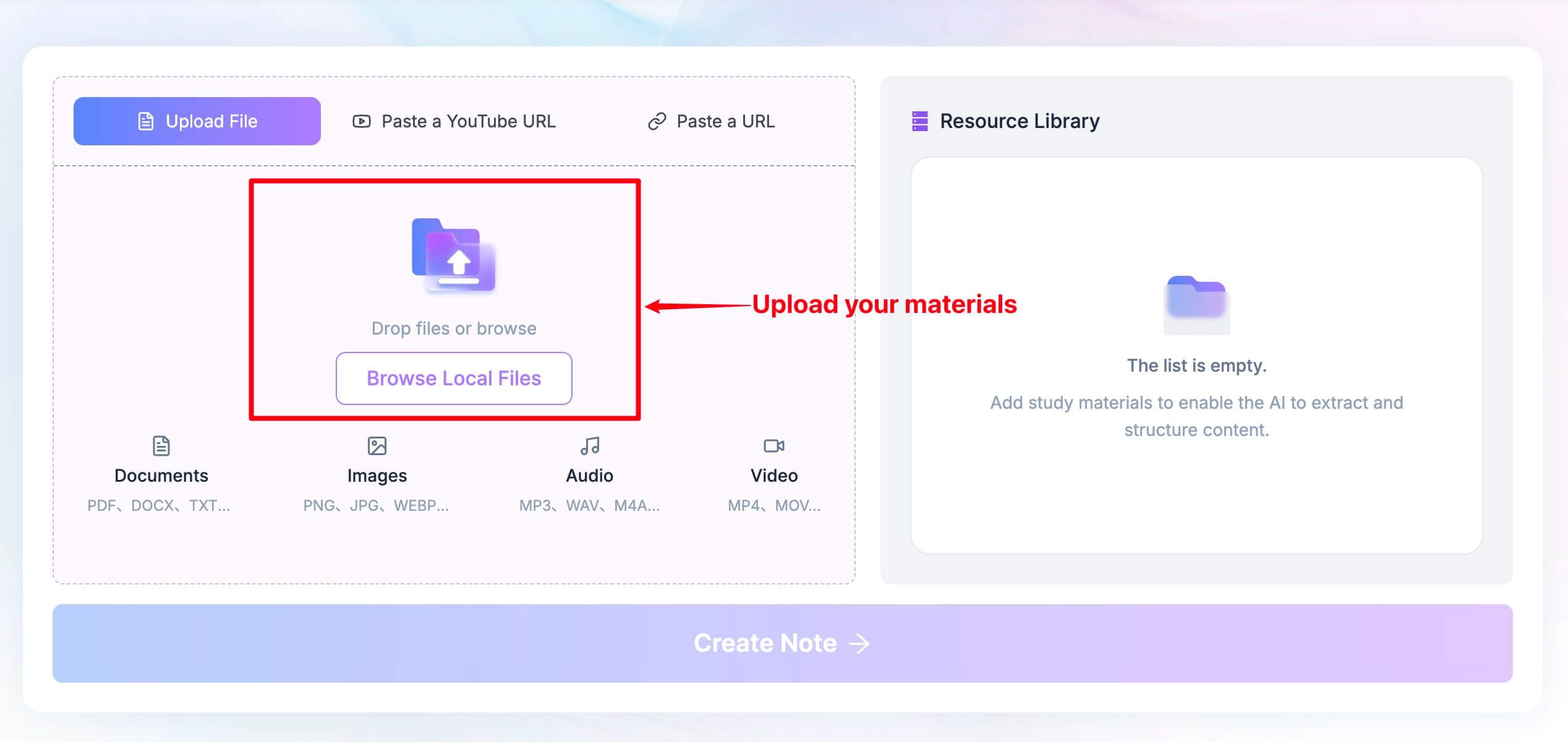
Open the tool and stay on the Upload File tab. Drop a readable research-paper PDF into the upload area or click Browse Local Files to choose it from your device.
Before moving on, confirm that the imported content includes more than the abstract. A serious summary needs access to the methods, results, discussion, and limitations, especially when you intend to use the notes in a literature review or research meeting.
Step 2. Click Create Note
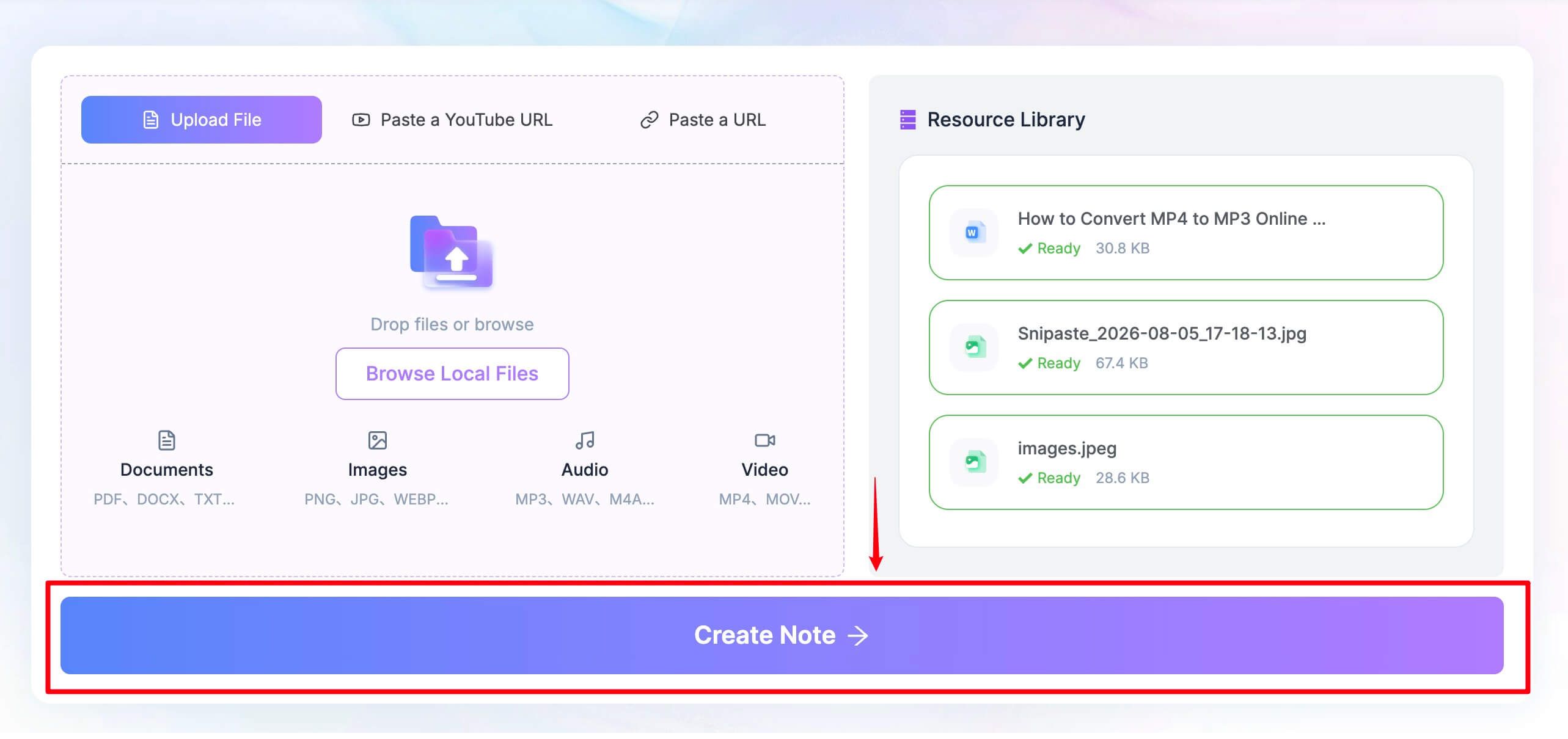
Wait until the uploaded paper appears as Ready in the Resource Library. Check that you selected the intended PDF, then click Create Note to load the source into Lynote's note workspace and generate the initial structured output.
Step 3. Review the Summary, Ask Questions, and Verify Claims
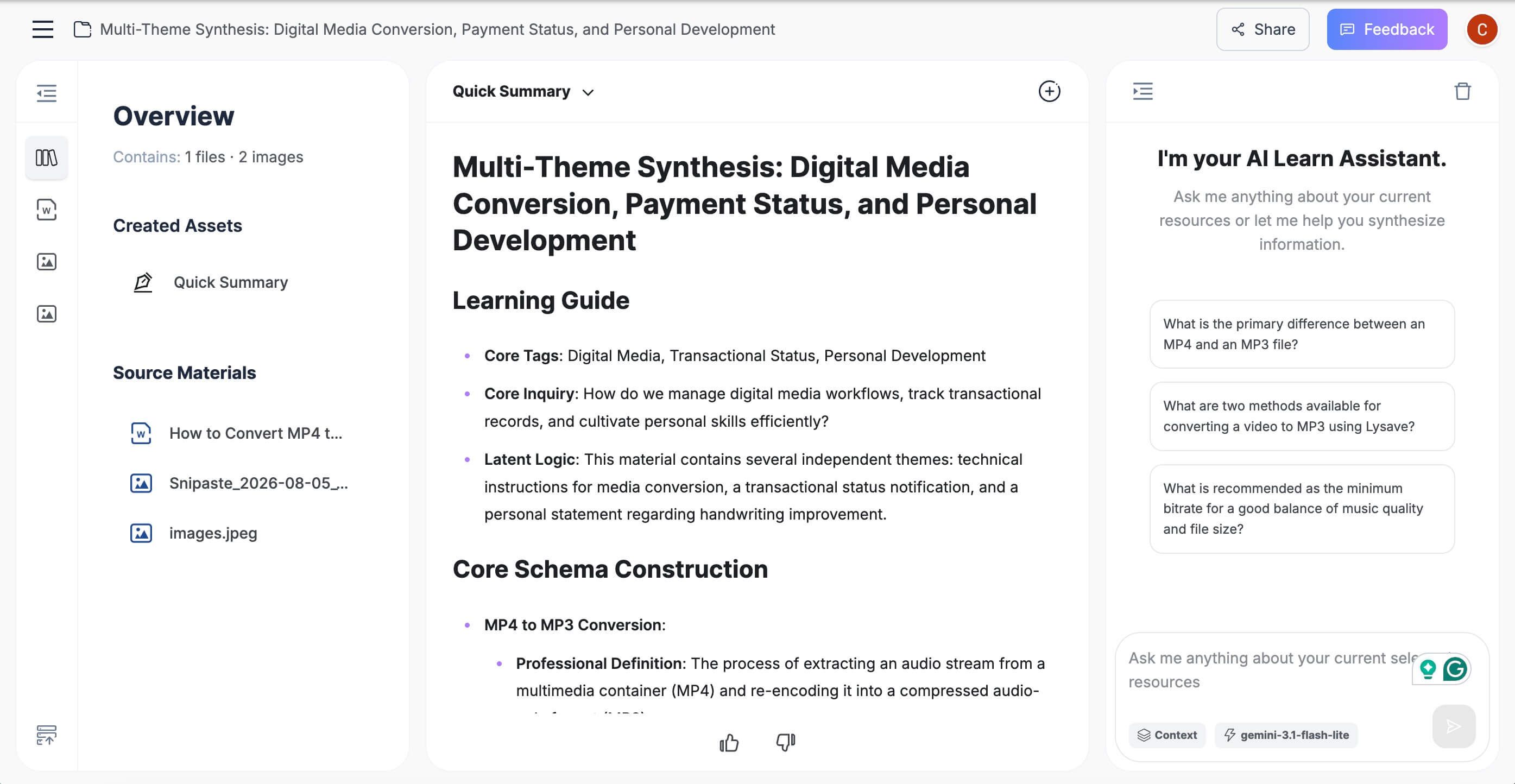
Review the Quick Summary or generated note in the center panel. Use the chat panel to ask focused questions about the research question, design, sample or data source, results, limitations, and unfamiliar terms.
Instead of requesting a generic rewrite, use an evidence-aware question such as:
Use an instruction such as:
Summarize this paper by separating the research question, gap, study design, sample or data source, method, primary findings, limitations, and implications. Include the most important reported number or comparison. If an item is not stated in the paper, label it as not reported.
The phrase “not reported” is important. It is better to leave a field visibly incomplete than to let a plausible assumption become part of your notes.
For a narrower follow-up, ask, “What was the comparison group in this study?” or “Which result directly answers the primary research question?” These questions keep the chat anchored to details that can be checked in the paper.
Follow-up questions should be anchored to the paper rather than inviting free-form speculation. If the tool cannot locate a detail in the supplied source, record the gap and inspect the relevant section yourself.
Treat Lynote as a structured note-making tool, not a substitute for reading or citation checking. Before reusing the summary in an assignment or report, verify important citations, statistics, tables, figures, and conclusions in the original paper. The original document always remains the final authority for claims and numbers.
A quick verification pass can follow four checkpoints:
- Match the stated research question to the final part of the Introduction.
- Match the design, sample, and comparison groups to the Methods section.
- Match the primary number or outcome to the Results section, table, or figure.
- Match the stated caveat to the authors' limitations or Discussion section.
This workflow is fastest when the summary is used for triage. If a paper becomes central to your argument, return to the complete source and create more detailed evidence notes before citing it.
Way 2: How to Get ChatGPT to Summarize a Research Paper
ChatGPT is a flexible option when you need to customize the summary's audience, format, or length. However, generic prompts often result in summaries that omit crucial limitations or invent plausible-sounding details. A staged prompting workflow prevents these errors.
If you are deciding how to summarize a research paper using ChatGPT, the crucial step is to separate extraction from rewriting. The same principle applies when learning how to use ChatGPT to summarize a research paper: collect verifiable facts first, challenge the draft second, and only then request polished prose.
Step 1. Upload the Paper or Provide the Relevant Text
Upload the document if you have access to file uploads, or paste the text in logical chunks. Do not assume that pasting a URL gives ChatGPT access to the full paper, as paywalls often block it. If you must split the text, preserve section labels so the model understands the context.
For a long paper, submit complete sections rather than arbitrary fragments. Label each part clearly, tell ChatGPT to wait until all parts have been supplied, and keep the title, section name, table labels, and figure captions attached to the text they describe.
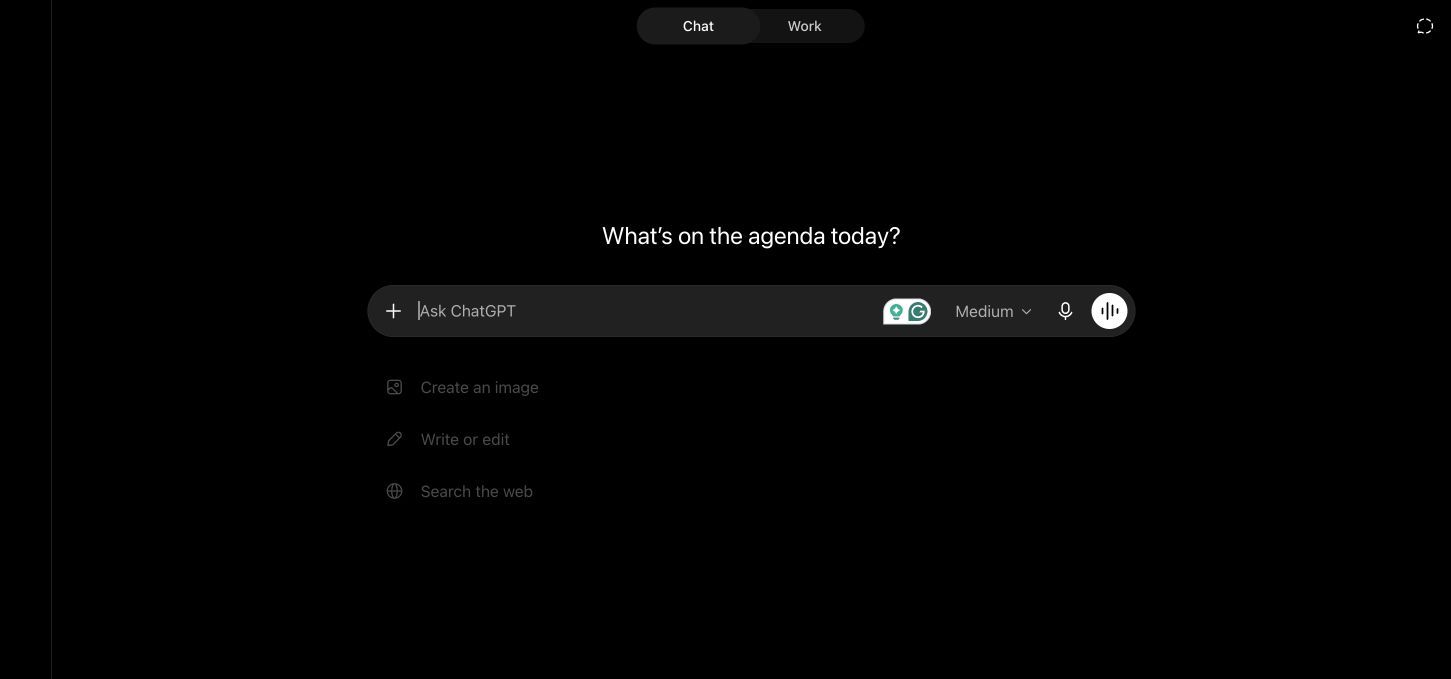
Step 2. Give ChatGPT a Structured Extraction Prompt
Use a strict prompt that forces the model to look for specific academic elements.
First-pass extraction prompt: "Extract the bibliographic context, research question, study design, sample or corpus, primary method, main findings (including key numbers), limitations, and implications from this text. Mark anything not explicitly stated in the paper as 'not reported.'"
If the paper is a systematic review, theoretical paper, or qualitative study, adjust the requested fields. For example, replace “sample and primary outcome” with “search strategy and included studies,” “central argument and evidence,” or “participants, setting, and coding approach.”
Step 3. Challenge the First Summary
AI models can sometimes blend the authors' results with outside knowledge. Force the model to audit its own work before you accept the draft.
Accuracy challenge prompt: "List any statements in your draft summary that require checking. Point to the specific paper section, table, or figure that I should consult to verify these claims."
This prompt does not prove that the first answer is correct. Its purpose is to turn a smooth-looking paragraph into a list of claims you can audit more efficiently.
Step 4. Request the Final Format
Once you are satisfied with the extracted facts, ask the model to shape the text for your specific needs.
Final summary prompt: "Rewrite this extracted information into a 200-word summary for a graduate-level audience. Retain the quantitative findings and specific limitations. Clearly separate the authors' interpretations from the reported results."
Change the audience and output rather than repeatedly asking for a “better” summary. A class discussion note may need two questions for debate, while a literature-review note needs design, sample, findings, limitations, and a sentence explaining how the paper relates to the research theme.
Step 5. Check Every Important Claim
Never ask ChatGPT to create missing citations or infer unreported numbers. Use official OpenAI guidance for current product behavior, and always verify the final output against the source document.
Pay special attention to negative or null results, subgroup findings, and conditional language. These details are easy to flatten when a model tries to produce a concise, confident paragraph.
Way 3: Summarize the Paper Manually With the IMRaD Method
The manual IMRaD (Introduction, Methods, Results, and Discussion) workflow gives you the most direct control over what enters the summary. It works without AI and also provides a practical verification process for checking AI-generated output.
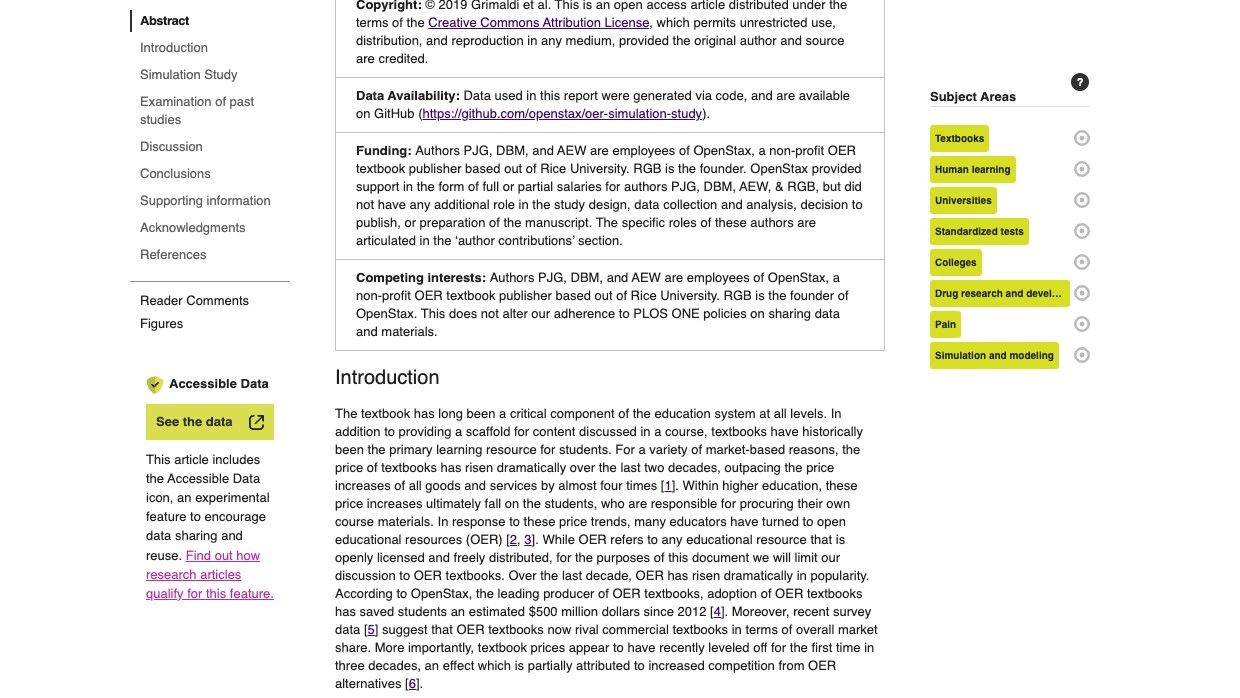
Step 1. Decide What the Summary Is For
Determine whether you are screening the paper for relevance, preparing for a class discussion, or writing a formal literature review. Your goal dictates how much detail you need to extract. A screening note might be 50 words, while a class summary might be 250 words.
Write the purpose at the top of your notes before reading. This small decision prevents you from collecting every interesting detail when the final summary only needs to answer one focused question.
Step 2. Scan the Abstract, Headings, Figures, and Conclusion
Do not start reading from the first word to the last. Scan the abstract for orientation, look at the headings to understand the structure, and review the tables or figures to see the primary data. Finally, read the conclusion to see where the authors land.
Step 3. Read the Introduction for the Question and Gap
Skim the background information and focus on the final paragraphs of the introduction. This is usually where the authors state their specific research question, hypothesis, and the knowledge gap they intend to fill.
Step 4. Extract the Study Design and Evidence Base
Move to the Methods section and identify how the study was conducted. Record the study design (e.g., randomized controlled trial, ethnography), the sample size, the demographics, and the primary analytical tool used.
Do not reduce “method” to a software package or statistical test. The more useful summary identifies who or what was studied, how groups or sources were selected, what was measured, what the comparison was, and how the evidence answers the research question.
Step 5. Record the Main Results and Their Magnitude
In the Results section, find the answers to the research question. Fictional example: Instead of writing "The study found an effect on sleep," write "Participants in the intervention group slept an average of 42 minutes longer than the control group." Always capture the direction and magnitude of the finding.
When the paper reports several outcomes, start with the prespecified primary outcome if one exists. Secondary outcomes can be added when they materially change the interpretation, but a summary should not give every exploratory test the same weight.
Step 6. Preserve Limitations and Uncertainty
Check the Discussion section for the authors' self-reported limitations. Note any factors that might restrict how broadly the findings can be applied, such as a small sample size or a specific geographic focus.
Then look for limitations revealed by the design itself. An observational study may identify an association without establishing causation, while a short follow-up period may leave long-term effects unknown even when the immediate result is clear.
Step 7. Draft in the Paper's Logical Order, Then Condense
Draft your summary by combining the extracted question, method, result, and limitation into a cohesive paragraph. Write in your own words, maintaining an objective tone. Edit the draft to remove unnecessary adjectives and background filler.
A dependable sentence order is question, method, primary result, limitation, and implication. This order keeps the evidence close to the claim and makes it easier for another reader to identify what the study can and cannot support.
Way 4: How to Summarize the Results of a Research Paper
Sometimes you only need to summarize a paper's findings, especially when building evidence tables. This requires strict discipline to prevent mixing actual data with the authors' opinions or discussion points.
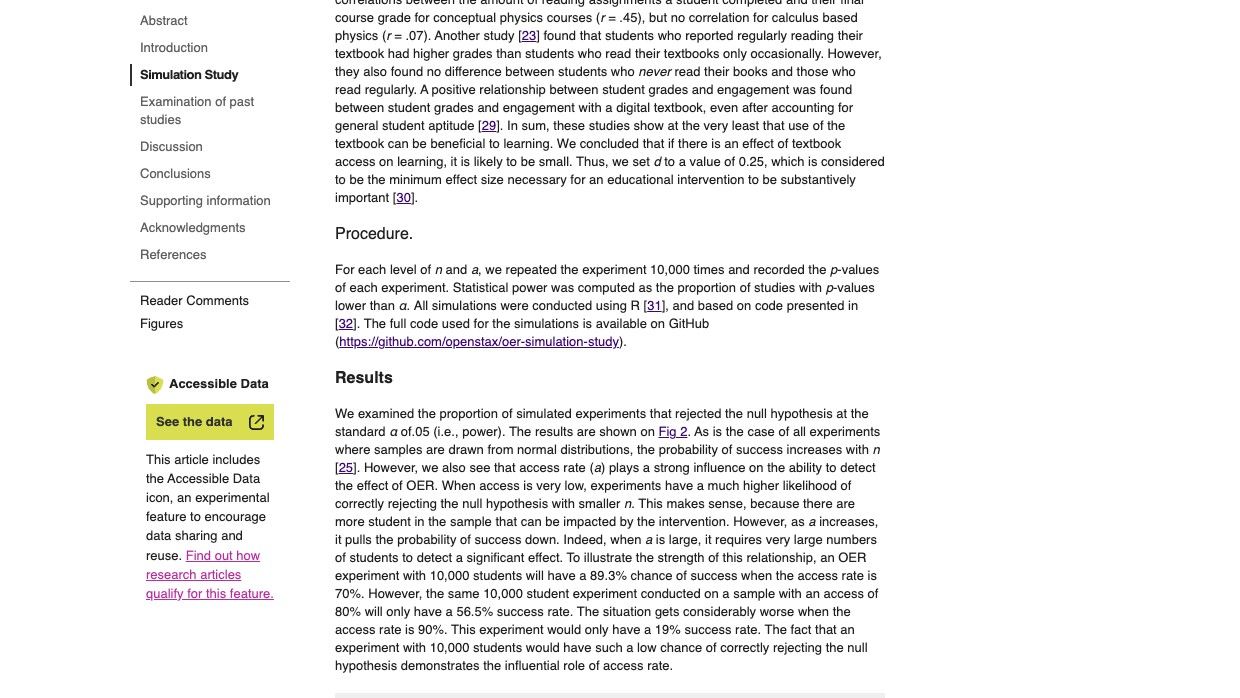
- Start With the Outcome and Comparison: Clearly state what was measured and what it was compared against.
- Include the Sample or Evidence Base: Results mean nothing without knowing who or what was studied. Always mention the sample size or data source.
- Report Magnitude, Direction, and Uncertainty: Do not just say a result was "significant." Include the actual effect size, the direction of the change, and the relevant comparison.
- Prioritize the Results That Answer the Research Question: Papers often report dozens of minor statistical tests. Focus only on the primary outcome that addresses the core hypothesis.
- Separate Results From Interpretation: The Results section reports what was found; interpretation belongs in the Discussion. Do not blend the two without labeling the interpretation clearly.
| Weak results summary | Stronger results summary | Why it is stronger |
|---|---|---|
| The treatment had a significant effect on patient recovery times. | Patients receiving the treatment recovered 2.4 days faster on average than the placebo group. | Replaces a vague significance claim with specific direction and magnitude. (Fictional example) |
| Social media usage causes higher anxiety in teenagers. | Higher daily social media usage was associated with a 15% increase in self-reported anxiety scores among teenagers. | Uses accurate association wording instead of turning a correlation into causation. (Fictional example) |
| The study tested age, income, and education, finding various impacts on voting. | The primary finding showed education level was the strongest predictor of voter turnout, while income showed no significant effect. | Prioritizes the primary outcome rather than listing every minor test performed. |
Choose the Number That Carries the Meaning
The most useful number depends on the research design. It might be a mean difference, risk ratio, percentage-point change, confidence interval, model coefficient, or count of included studies rather than a p-value by itself.
Do not copy every number from the Results section. Select the value that answers the primary question, include its comparison or baseline, and preserve any uncertainty needed to keep the claim accurate.
Handle Null and Mixed Results Honestly
A result does not become unimportant merely because it is not statistically significant. If the primary outcome showed no clear difference, say so directly and report the relevant estimate or uncertainty when the paper provides it.
Mixed results need similar care. State which outcomes changed, which did not, and whether subgroup or exploratory findings were planned in advance; do not compress a complicated pattern into “the intervention worked.”
Keep Results and Discussion in Separate Sentences
First report what the study found. Then, if your summary requires interpretation, attribute it explicitly: “The authors interpret this pattern as...” rather than presenting an explanation as another measured result.
This separation is especially useful in literature-review evidence tables. It lets you compare observed findings across studies without accidentally comparing one paper's data with another paper's speculation.
Which Summarization Method Should You Use?
Do not treat these four workflows as interchangeable. Choosing the right method depends on your timeline, your need for customization, and the academic stakes of your project.
| Method | Best for | Main advantage | Main risk | Verification effort |
|---|---|---|---|---|
| Lynote AI Paper Summarizer | Fast, structured first passes over a PDF. | Designed specifically to isolate academic sections. | Can still miss subtle methodological flaws. | Moderate: Check numbers and limits against the PDF. |
| ChatGPT | Customizing audience, length, or format. | Allows for follow-up dialogue and easy rewriting. | May invent details or omit important caveats. | High: Requires strict prompting and line-by-line checks. |
| Manual IMRaD workflow | Precision work, close reading, and formal assignments. | Guarantees deep understanding and direct source work. | Time-consuming for dense or highly technical papers. | Low: You are verifying as you read. |
| Results-only workflow | Literature-review notes and evidence tables. | Keeps notes highly focused on actual data. | Loses the broader context of why the study matters. | Moderate: Requires careful reading of data tables. |
Use Lynote when you need to quickly triage a stack of PDFs. Turn to ChatGPT when you need to translate a complex summary for a non-expert audience. Rely on the manual method when your assessment rules require direct source work, and use the results-only method for narrowly scoped reports.
A Reusable Research Paper Summary Template
Using a consistent template ensures you never forget a crucial piece of evidence. You can adapt this template for different formats, such as a 100-word screening note, a 250-word class summary, or a structured literature-review entry.
- Citation or source identifier: (Author, Year, Title)
- Research question or objective: (What gap are they filling?)
- Study design and sample or data source: (How did they test it, and on whom?)
- Method or analytical approach: (What was the primary tool or test?)
- Main result with magnitude or key comparison: (What exactly did they find?)
- Authors' interpretation: (What do they think it means?)
- Important limitation: (What weakens this conclusion?)
- Relevance to your purpose: (Why are you saving this paper?)
- Claims needing verification: (What do you need to double-check later?)
100-Word Screening Note
Use the research question, design, sample or evidence base, primary finding, and one limitation. End with a short relevance label such as “include for methods comparison” or “exclude because the population does not match.”
150- to 250-Word Discussion Summary
Add the research gap, a clearer explanation of the method, the primary result with magnitude, the authors' interpretation, and one or two discussion questions. This format gives classmates or colleagues enough context to discuss the paper without turning the note into a substitute for reading it.
Literature-Review Evidence Note
Keep the fields structured instead of forcing them into polished prose. Record the study design, population, exposure or intervention, comparison, outcome, result, limitations, and relationship to other sources so the paper can be compared consistently later.
How to Check an AI-Generated Paper Summary
AI output should be treated as a reading aid and draft, not as proof that a claim, citation, or number is correct. Use this eight-point audit checklist to preserve evidence integrity.
- Does the summary state the actual research question rather than only the broad topic?
- Are the study design, sample size, controls, and data source accurate?
- Do the quantitative findings match the relevant table, figure, or Results passage?
- Does the wording preserve the difference between correlation and causation?
- Are the limitations specific to this paper rather than generic AI filler?
- Are the authors' claims clearly separated from the summarizer's explanation?
- Are all quotations, page numbers, citations, and references checked in the original text?
- Can you easily tell what parts of the paper still require a full manual reading?
Common Research Paper Summarization Mistakes
Authoritative academic guidelines repeatedly highlight the same failure modes. Avoid these traps to keep your summaries credible and useful.
- Copying or lightly paraphrasing the abstract instead of reading the paper.
- Summarizing every section at equal length, giving too much space to the introduction.
- Omitting the sample, design, or evidence base entirely.
- Reporting statistical significance without mentioning the magnitude or comparison.
- Turning a simple correlation into a definitive claim of causation.
- Dropping the authors' caveats, uncertainties, and limitations.
- Mixing the paper's actual results with your own personal critique.
- Trusting the first AI output without doing any source verification.
- Using one generic summary format for every purpose, regardless of the assignment.
FAQs About Summarizing a Research Paper
How long should a research paper summary be? A research paper summary typically ranges from 150 to 300 words, depending on its purpose. Screening notes can be as short as 100 words, while summaries for complex literature reviews may require more detail.
Can I summarize a research paper using only the abstract? The abstract can support an initial relevance check, but it is usually insufficient for a summary that will support academic work. Check the methods, results, discussion, tables or figures, and limitations because the abstract may omit details needed to interpret the finding accurately.
How do I get ChatGPT to summarize a research paper accurately? You must use a staged prompting workflow rather than a simple "summarize this" command. Ask the model to extract specific elements like the sample, method, and limitations, then challenge it to point out where those facts live in the text.
Can ChatGPT summarize a PDF research paper? ChatGPT can summarize PDFs if you use a version that supports file uploads and the PDF contains readable text. However, pasting a URL to a paper often fails because paywalls and academic databases block the model from reading the full text.
What prompt should I use to summarize a research paper? Ask the AI to extract the research question, study design, sample size, primary method, main findings with numbers, and specific limitations. Instruct the model to explicitly mark anything not stated in the paper as "not reported."
How do I summarize the results section of a research paper? Focus strictly on the primary outcome that answers the research question, including the direction and magnitude of the effect. Do not include the authors' interpretations or opinions, which belong in the discussion section.
Should a research paper summary include citations? Yes, a summary should always begin with or include a clear citation so you can trace the evidence back to its source. If you quote specific phrases or highly unique data points, include the exact page numbers as well.
What is the difference between a research paper summary and a critique? A summary objectively reports what the authors researched, how they did it, and what they found. A critique evaluates the quality of that research, pointing out methodological flaws or assessing the paper's overall value to the field.
Final Takeaway
- Choose your summarization tool based on the specific purpose of your notes, not convenience alone.
- Preserve the core research question, method, results, limitations, and meaning in every summary you write.
- Use AI tools to accelerate text extraction and explanation, but always verify consequential claims in the original paper.
- A trustworthy short summary should make the underlying paper easier to inspect, not hide its evidence trail.

Written by Janet L. Harris
AI Writing Specialist
Janet reviews AI detectors and humanization tools, with a focus on accuracy, limitations, and responsible use. View all articles →