

How to Learn Korean Fast: 9 Practical Ways to Make Progress

Want to learn Korean fast without spending your evenings switching between apps? Start with Hangul and pronunciation, follow one beginner course, and practice recalling, hearing, and using what you learn every day. A smaller routine you actually complete is more useful than a huge collection of saved lessons.
The goal here is practical progress: understand a short exchange, introduce yourself, or ask for something without reading a script. You can work toward those tasks in your first month without pretending that 30 days will make you fluent.
What Is the Fastest Way to Learn Korean?
An efficient way to learn Korean is to combine a structured beginner sequence with daily listening, active recall, and short speaking practice. Learn the writing system alongside audio, study words in usable sentences, and get feedback before mistakes become familiar habits. Increase the difficulty when you can use a skill, not simply when you finish a lesson.
First, decide what you mean by "learn Korean." These are different goals, and each needs different practice:
| Your goal | What to practice | A useful progress check |
|---|---|---|
| Read basic Hangul | Letter sounds, syllable blocks, and short words with audio | Attempt an unfamiliar short word, then check the recording |
| Handle a travel situation | Useful requests, numbers, and likely replies | Complete a simple exchange without reading every line |
| Have a flexible conversation | Listening, sentence building, and follow-up questions | Respond when the other person changes the question |
| Understand Korean media | Vocabulary, connected speech, context, and repeated listening | Explain a short segment without relying on English subtitles |
Reading a word aloud is not the same as knowing what it means. Similarly, memorizing an introduction does not mean you can understand the question someone asks afterward.
Those distinctions are helpful, not discouraging. They tell you which skill to practice next instead of leaving you with the vague feeling that you are "bad at Korean."
How to Learn Korean Fast: 9 Practical Strategies
1. Pick One Real-Life Goal and a Clear Learning Sequence
"Learn Korean" is too broad to guide tonight's study session. "Introduce myself, explain why I am learning, and answer a simple follow-up" gives you something you can rehearse and check.
Choose a goal connected to your life. A trip might make ordering food and asking directions useful; talking with relatives might make family vocabulary and polite questions a better starting point.
Then choose one beginner course as your main sequence. Supplement a lesson when you need clarification, but avoid replacing the entire course whenever another resource looks more exciting.
If your materials are scattered across lesson PDFs, slides, and videos, Lynote Learning Path is a way to organize them into a study sequence. Its source-based workflow brings related material into chapters with explanations and quick checks, rather than leaving you to decide which file to open next.
For a focused starting point:
-
Add a small set of related beginner materials, such as an introductory lesson and its supporting notes.
-
Select Generate Learning Path, then review the proposed chapters against your course sequence.
-
Work through one chapter and check its explanations against the original material before moving on.
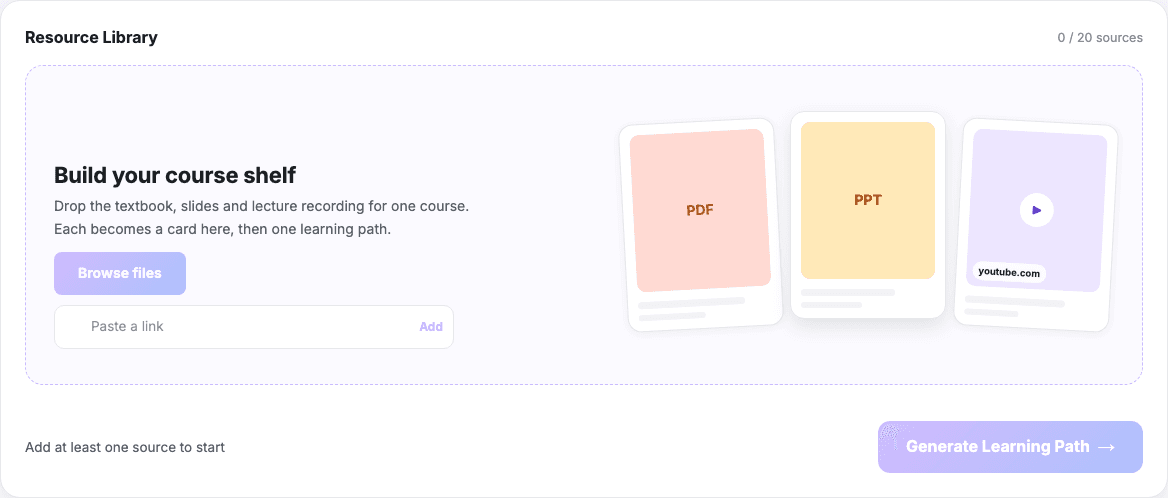
Learning Path source-input interface. This is not a generated Korean course result.
Keep your original audio and practice speaking separately. An organized learning path is a study aid, not a substitute for a Korean teacher's pronunciation feedback or a ready-made guarantee of language proficiency.
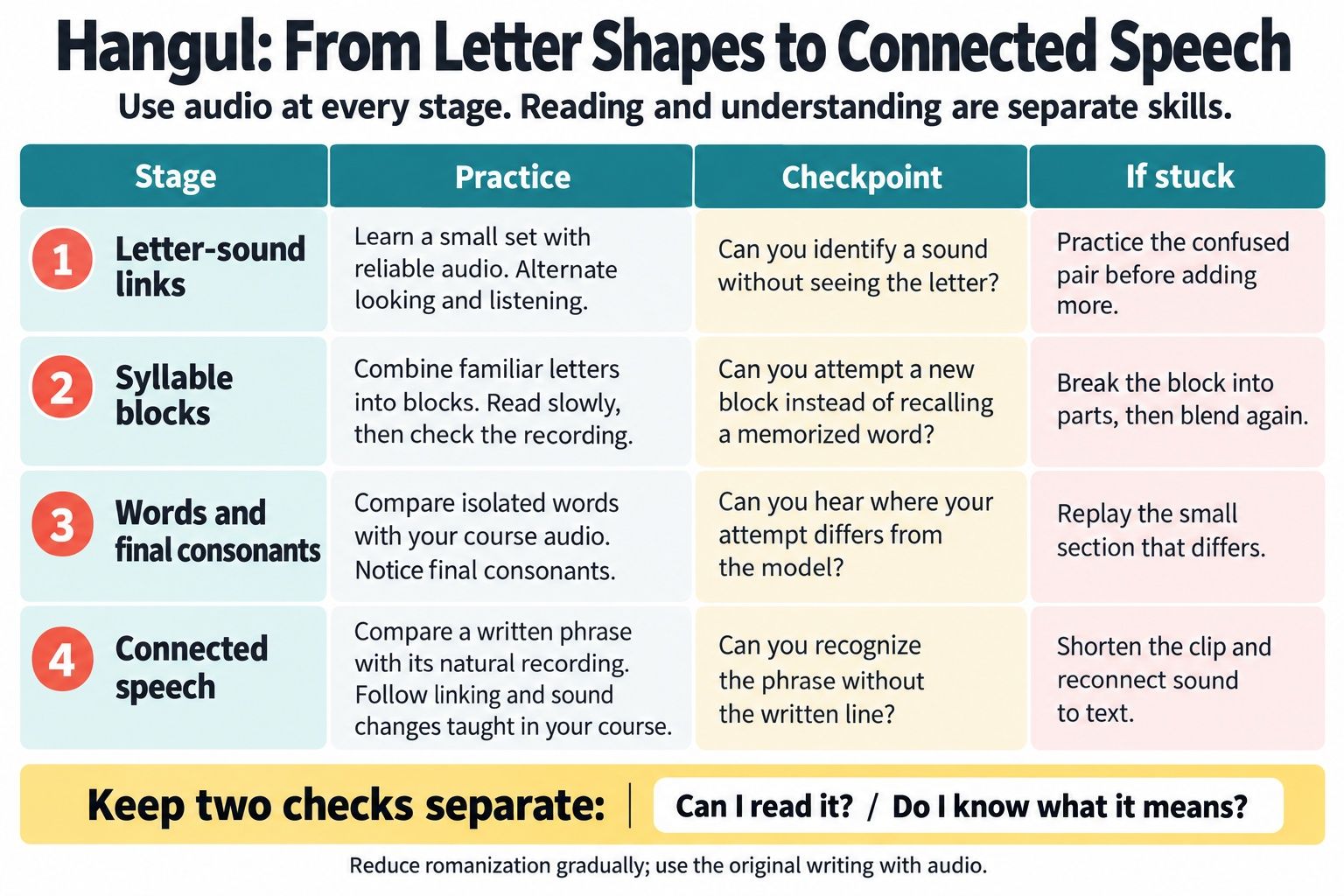
2. Learn Hangul With Audio, Then Reduce Romanization
Hangul gives you direct access to Korean words, subtitles, dictionaries, and lessons. Learn it early, but do not confuse recognizing a chart with being able to read comfortably.
Work with sound and writing together. Listen to a letter or short word, look at how it is written, repeat it, and then try reading it again without the audio playing.
Romanization can help you find your footing, but English spellings are not a reliable pronunciation guide for every Korean sound. Gradually cover the romanized line so you learn to connect the original writing with the recording.
A useful practice sequence is:
- Learn a small set of letters with trustworthy audio.
- Combine them into syllable blocks rather than memorizing isolated shapes only.
- Read a few short words that use those combinations.
- Listen again and mark where your pronunciation differed.
- Revisit those words the next day before adding more.
As your course introduces them, pay attention to final consonants and sounds that change or link in connected speech. You do not need a complete phonology textbook before starting, but a spelling-only approach will leave listening harder than it needs to be.
Your checkpoint: can you attempt a new short word and then hear a difference between your version and the recording? Slow, thoughtful decoding is a useful beginning; instant reading is a later skill.
3. Learn Useful Words Inside Reusable Sentence Patterns
A long vocabulary list can make you feel productive while leaving you unable to ask a basic question. Choose words you can put into the situations you actually want to handle.
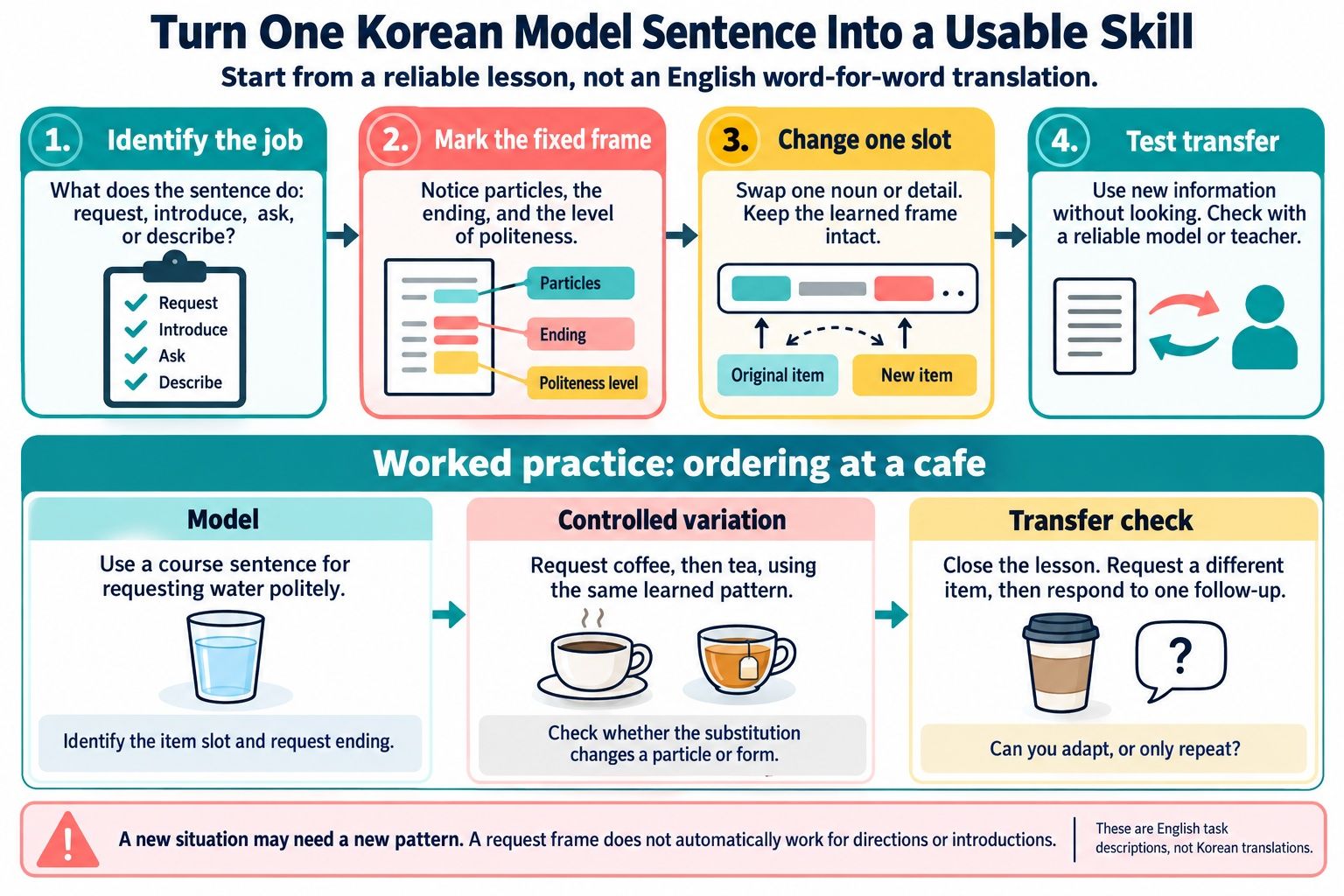
For a cafe visit, learn the course's expressions for requesting an item, asking a price, and responding to a question. Notice which nouns can change while the rest of the sentence stays similar.
Use one pattern in three small variations. For example, practice the equivalent of requesting water, coffee, and tea using an appropriate Korean model from your lesson; do not construct the Korean sentence by copying English word order.
For each useful item, keep:
- Its meaning in the situation you learned it in.
- A short example from a reliable lesson.
- Audio, when available.
- A note about whether the expression is polite, casual, or otherwise context-specific.
- A prompt that makes you produce it rather than merely recognize it.
Recognition and recall are different tests. Seeing a word and choosing its English meaning is easier than being given a situation and finding the Korean expression yourself.
Start with a small enough set that you can review it without rushing. Add new items when you can retrieve the old ones, not because an arbitrary daily word target says you should.
4. Study Just Enough Grammar to Build Your Own Sentences
Grammar is useful when it helps you say something new. It becomes less useful when you spend the entire session collecting rules without trying them.
For an English-speaking beginner, pay attention to Korean's typical verb-final structure, the role of particles, common sentence endings, questions, and the basic tense patterns in your course. Treat these as tools for building meaning, not definitions to memorize for their own sake.
Try this after a lesson:
-
Identify one model sentence and the situation where it belongs.
-
Change one part while keeping the new grammar pattern intact.
-
Make another sentence about your own life.
-
Check your sentences with a tutor, a reliable answer key, or a knowledgeable language partner.
Learn a suitable polite everyday form early. You can postpone studying every speech level in depth without ignoring the fact that the same wording may not suit a friend, a stranger, and a workplace interaction.
Also learn numbers through situations rather than as a detached counting exercise. Korean uses two number systems, so let lessons on prices, time, dates, and counting introduce the forms those contexts require.
The test is transfer: can you use the pattern with different information? Repeating the textbook example is a start, not the final check.
5. Use Short Listening Loops Instead of Passive Binge-Watching
K-dramas and music can keep you interested, but interest is not the same as comprehension practice. If an entire scene goes past without you understanding a phrase, watching another hour may not address the problem.
Choose a short beginner dialogue or a manageable segment of a video. A 20- to 40-second passage is a practical starting size, not a rule; it should be short enough to revisit without losing concentration.
Use four passes:
-
Listen for the situation and main meaning without pausing at every word.
-
Read an accurate transcript or lesson text and resolve the most important gaps.
-
Listen again while connecting the written words to the sounds.
-
Hide the text, listen once more, and explain what happened.
When a written line still makes no sense, Lynote AI Text Translator can help you check its meaning. Paste the sentence or short subtitle excerpt, select English as the target language, and compare the result with your original guess before returning to the Korean audio.
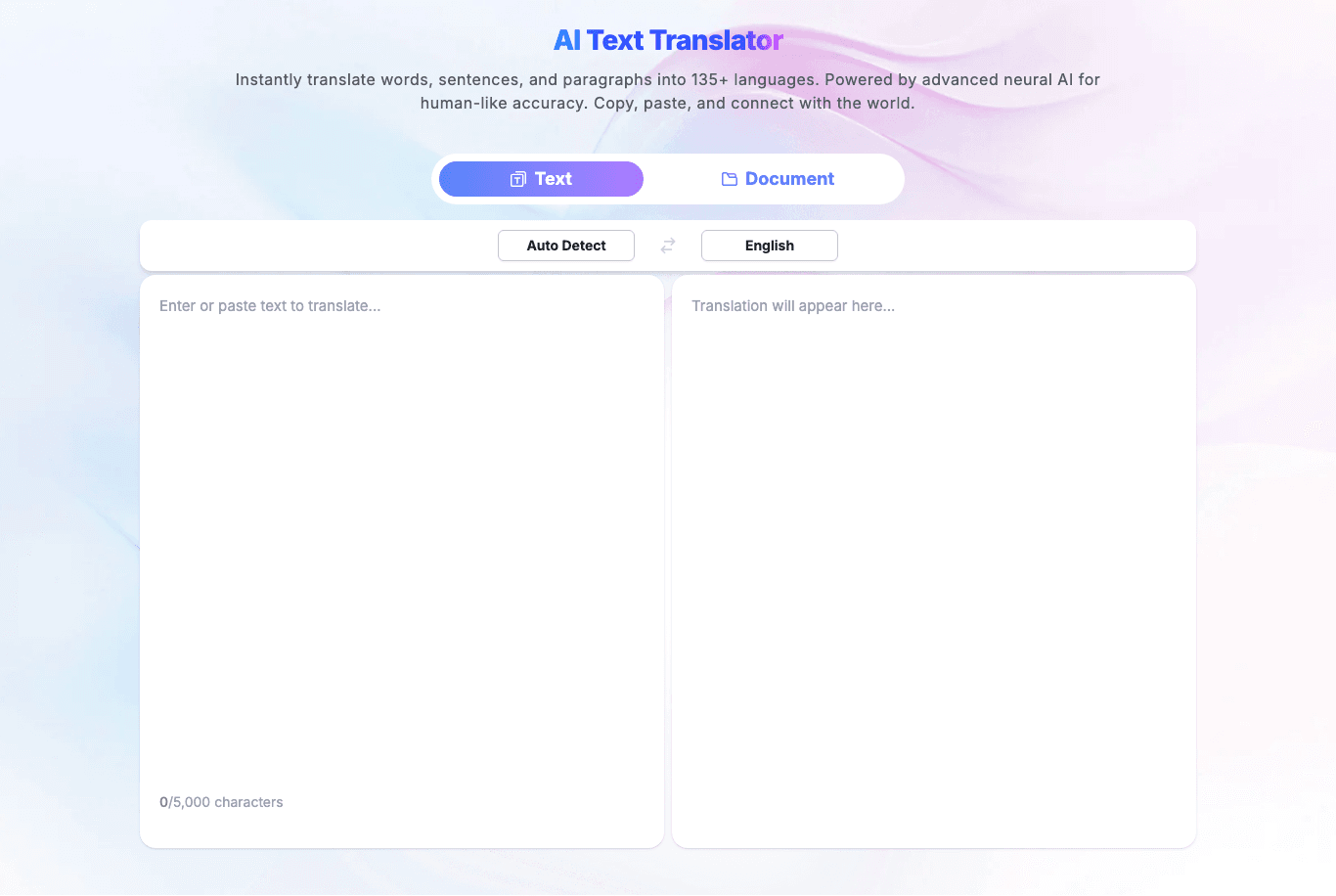
Text Translator setup interface, before text is entered.
Translate a complete thought when possible, not a single word stripped of context. Then hide the translation and try the original again; otherwise you may be practicing reading English rather than understanding Korean.
Use the translation as support, not as proof that an expression is appropriate for every social situation. Check ambiguous wording with your course or a teacher, especially when politeness or an omitted subject changes the interpretation.
This is a text-translation workflow. It does not imply that the tool is listening to your video, evaluating pronunciation, or creating a live interpretation of a conversation.
6. Speak Early and Get Specific Feedback
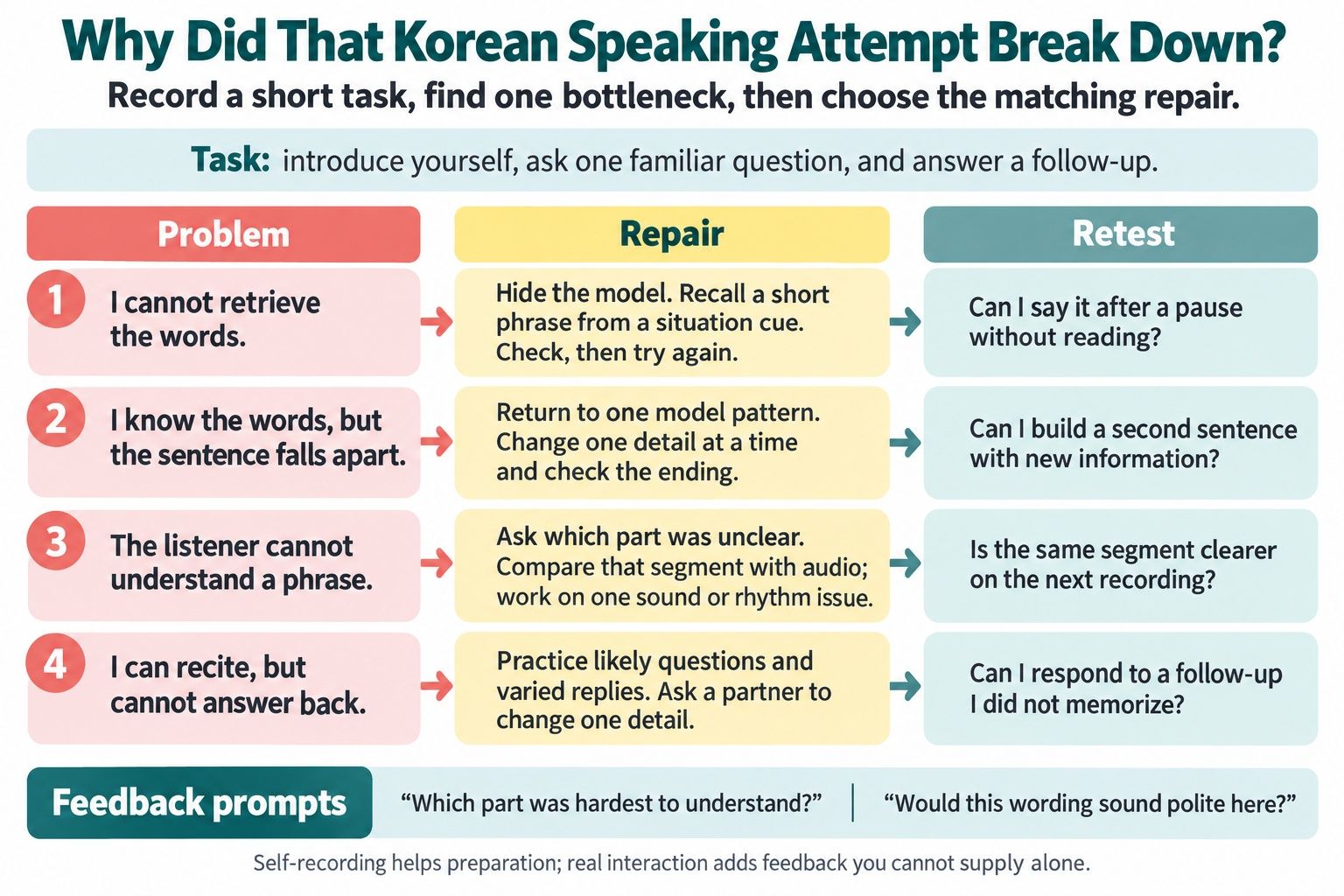
You do not have to wait until you know enough Korean to say everything. Start with a tiny task you have prepared: a greeting, an introduction, or a question about a familiar topic.
Record a short attempt, compare it with a reliable model, and pick one thing to improve. Trying to fix every sound and grammar choice at once can make the next attempt harder to start.
A simple speaking session can follow this pattern:
- Listen to a model and identify its meaning.
- Repeat a short portion, paying attention to rhythm as well as individual sounds.
- Close the model and say something similar about yourself.
- Ask for one specific correction.
- Try again using the correction.
Repeating along with audio can help you rehearse a phrase. It does not test whether you can retrieve the phrase or understand an unexpected reply, so include a small unscripted question too.
Useful feedback requests include "Which part was hardest to understand?" and "Would this wording sound polite in this situation?" A targeted answer gives your next practice session a purpose.
If you do not have a partner yet, record yourself and prepare questions for a later session. Treat self-recording as preparation for interaction, not a complete replacement for it.
7. Turn Lesson Notes Into Questions You Can Answer
Good notes should make tomorrow's review easier. They do not need to preserve every sentence of a lesson or look like a finished textbook.
For one lesson, capture a sentence pattern, its purpose, an example, and a mistake you want to avoid. Add a question that you can answer with the notes closed.
For example, replace "Reviewed the lesson about introductions" with a task such as "Introduce yourself and ask about the other person's job without reading." The second version tells you whether you can do anything with the material.
If organizing the source is taking too much time, Lynote AI Note Generator can turn lesson material into structured notes you can edit and review. Start with one lesson rather than uploading every Korean resource you have collected.
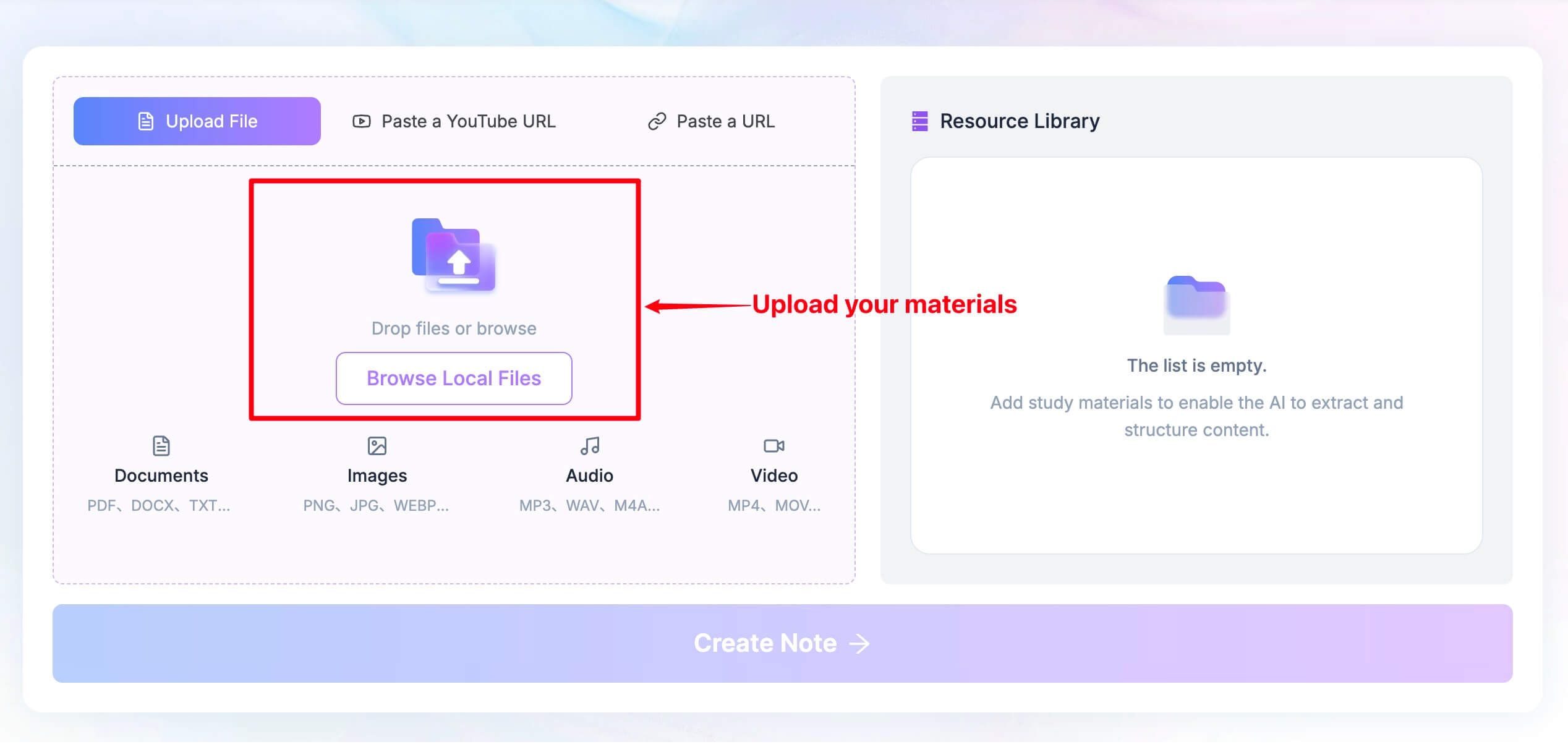
- Upload a lesson PDF through Upload File and Browse Local Files. If you use an accessible lesson URL instead, paste it and select Parse.
-
Click Create Note once the source is ready.
-
Check the generated note against the lesson, correct anything unclear, and turn its main ideas into recall questions. You can also convert the note into flashcards for review.
Use the original course to verify Korean examples, meanings, and levels of politeness. A tidy AI-generated summary is still something to check, and a written note does not preserve everything you need to hear in the original audio.
Keep the note short enough to review. If editing its appearance takes longer than practicing the language, stop formatting and answer one of your questions instead.
8. Space Your Reviews and Stop Overloading Your Vocabulary Queue
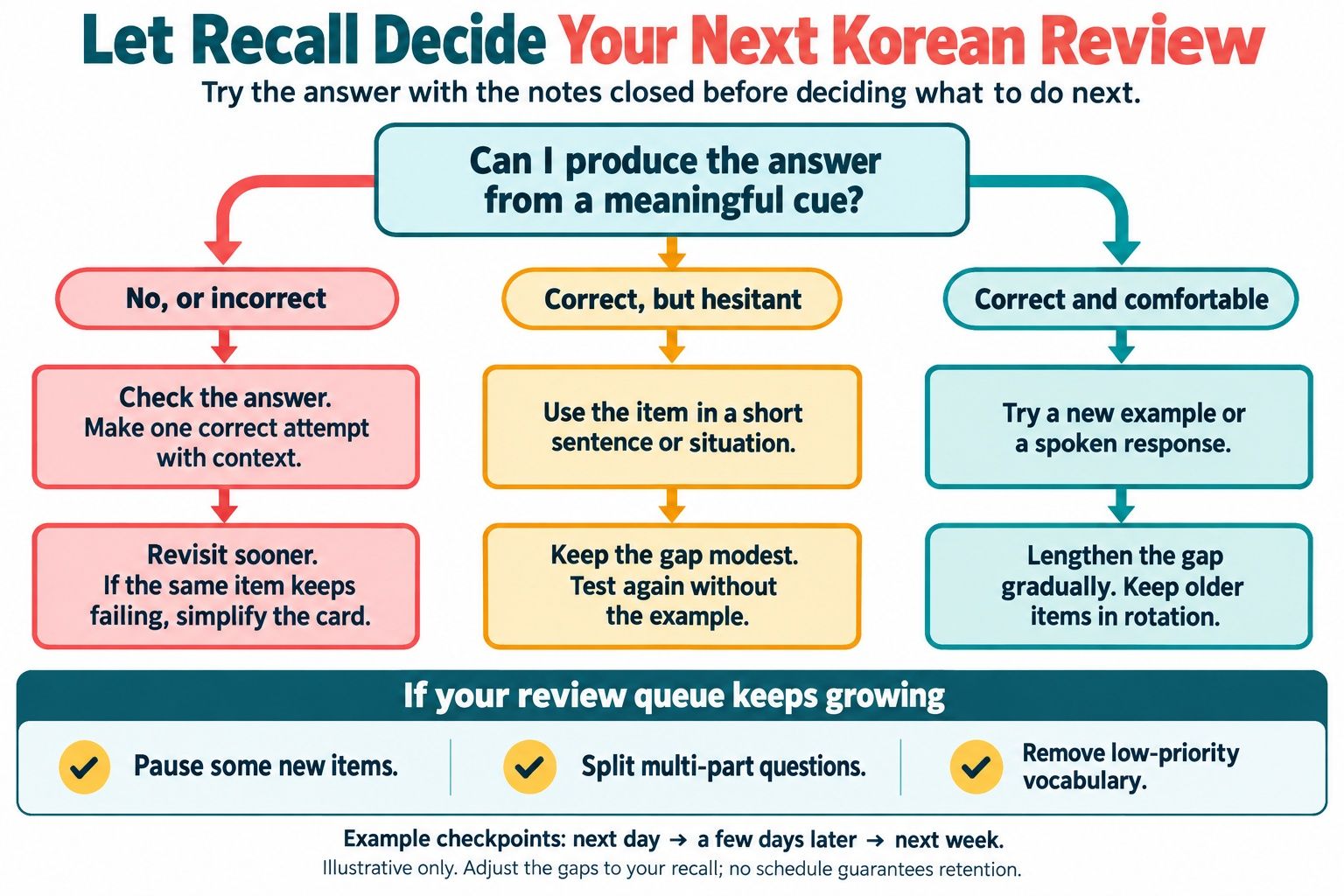
Reviewing everything repeatedly in one evening can make it feel familiar without making it easy to recall later. Return to the same material across separate sessions and try to retrieve it before looking at the answer.
Research on retrieval practice and distributed learning supports these general study methods. It does not establish one universal review schedule or a fixed number of days needed to learn Korean.
As an example, revisit a small set the next day, several days later, and the following week. Shorten the gap for items you miss and spend less time on items you can use comfortably.
When review starts to feel unmanageable:
- Reduce new material for a few sessions.
- Split a complicated card into simpler questions.
- Add context to words you keep confusing.
- Practice producing an answer, not just rereading it.
- Remove items that do not serve your current learning goal.
A missed answer is useful information. Check it, make one correct attempt, and revisit it later rather than spending the whole session punishing yourself with the same card.
9. Check Real Tasks Each Week, Not Just Your App Streak
A streak records attendance. It cannot tell you whether you can follow a question, pronounce a new word, or use last week's grammar without a hint.
Choose a small weekly check with three parts:
- Read or listen to a short item you have not memorized.
- Produce a short response without copying a model.
- Identify one recurring problem to practice next week.
Keep the task comparable from week to week, but change the details. An introduction about a different person, a new item to order, or a different meeting time tests whether the pattern transfers.
Save a short recording or a few written sentences so you can compare actual work, not your mood. You might notice that you still pause, but now finish a sentence that you previously abandoned.
If you are stuck, adjust the practice before adding more study hours. Someone who can read a lesson but cannot follow its audio needs a different session from someone who understands the audio but cannot form a reply.
A 30-Day Korean Study Plan You Can Actually Follow
Use this as a starting routine, not a deadline for mastering each skill. Repeat a week or reduce the amount of new material when the checks remain difficult.
| Period | Main focus | Practice output | Check before increasing difficulty |
|---|---|---|---|
| Days 1-7 | Hangul, sound-writing connections, and a few useful expressions | Read short familiar items with audio; rehearse a brief introduction | Can you attempt a new short item and check its sound? |
| Days 8-14 | Basic sentence patterns and goal-specific vocabulary | Make small variations of requests, statements, and questions | Can you change the information without losing the pattern? |
| Days 15-21 | Short listening loops and responses | Explain a brief dialogue; answer a familiar question | Can you follow the main meaning without the translation visible? |
| Days 22-30 | Combine reading, listening, and speaking | Complete a short role-play or exchange with feedback | Can you handle one changed detail or follow-up? |
Do not postpone speaking until the fourth week. Each week includes a little output; the final week simply puts more of the pieces together.
The time budget below gives you a realistic place to start. The allocations are editorial suggestions, not a scientifically optimized timetable.
| Activity | 20-minute day | 40-minute day | 60-minute day |
|---|---|---|---|
| Recall and review | 5 minutes | 8 minutes | 10 minutes |
| Core lesson or reading | 5 minutes | 12 minutes | 15 minutes |
| Focused listening | 5 minutes | 10 minutes | 15 minutes |
| Speaking or sentence building | 5 minutes | 10 minutes | 20 minutes |
On a conversation day, use more of the session for interaction and less for new lesson content. On a busy day, a short review and one spoken response can preserve the routine without turning a missed full session into a reason to quit.
Twenty minutes a day for 30 days adds up to 10 hours; an hour a day adds up to 30 hours. Both can support a meaningful start, but neither arithmetic total tells you what proficiency level you will reach.
Why Your Korean Progress May Feel Slow—and What to Change
Before choosing another app, identify the task that is breaking down. Here is how I would match common frustrations to a more useful next session.
| What you notice | What may be missing | What to try next |
|---|---|---|
| "I recognize words but cannot say them." | Practice producing words without cues | Respond to a situation prompt before revealing the answer |
| "I can read it but cannot hear it." | Sound-writing connections and connected-speech practice | Use easier audio with a transcript, then remove the text |
| "I know the grammar but freeze." | Turning a rule into a usable pattern | Make a few personal sentences, then answer a changed question |
| "I understand the example but not a real reply." | Practice beyond a memorized script | Ask a partner to vary one detail or follow-up |
| "I finish lessons and forget them." | Retrieval across separate sessions | Review older material before adding another lesson |
| "I study a lot but never finish anything." | A stable sequence and a narrow goal | Keep one core course for the next few weeks |
Not every difficulty needs more material. Sometimes the useful change is slowing the audio, shrinking the task, asking for feedback, or removing the English translation for one pass.
Also check whether your practice matches your goal. Watching interviews might be enjoyable, but it is an indirect way to prepare for a basic shop interaction if you never practice requests and replies.
Can You Learn Korean Fast Without Paying for Classes?
You can build a useful beginner routine without buying a large collection of courses. The harder part is selecting a small set of resources and getting reliable feedback when you cannot hear your own mistakes.
A lean setup needs four things:
- One structured beginner sequence with explanations you understand.
- Audio matched to the material you are learning.
- A simple way to record questions and review old material.
- Opportunities to use the language and have misunderstandings corrected.
Yonsei University's First Step Korean course is one example of a beginner sequence covering the alphabet and everyday topics. Online King Sejong Institute is another place to investigate introductory study options; check current enrollment and access conditions rather than assuming every course or assessment is freely available.
Use free lesson samples and public educational material to decide whether a teaching style suits you. A course's advertised completion time describes its workload, not how quickly you will become conversational.
Paid feedback can be useful when you keep repeating a mistake you cannot diagnose. You might benefit more from a focused correction session than from another subscription that mainly gives you additional exercises.
FAQs About Learning Korean Fast
Can I Learn Korean in 30 Days?
You can use 30 days to begin reading Hangul, practice useful expressions, and establish a study routine. Broad conversational fluency is a different goal, and progress depends on your starting point, practice time, feedback, and the tasks you are trying to perform.
How Much Korean Can I Learn in Three Months?
There is no single three-month outcome. Set concrete targets, such as following a short beginner dialogue or handling a practiced situation, then check them with new examples rather than assuming a calendar milestone equals a language level.
How Many Minutes Should I Study Korean Each Day?
Choose an amount you can sustain while including review and active use. Twenty minutes can support a small routine, while 40-60 minutes gives you more room for listening, speaking, and feedback; the quality and focus of those minutes matter too.
Should I Learn Hangul Before Vocabulary?
Begin Hangul early, but learn it alongside a few useful words and their audio. You do not need to postpone every expression until you finish an alphabet unit, and you should gradually reduce reliance on romanization.
Can I Learn Korean by Watching K-Dramas?
K-dramas can provide motivation and useful examples, but watching alone leaves gaps in structured learning and active use. Pick manageable segments, check the meaning, listen again, and practice an expression appropriate to your situation.
Can I Learn Korean Quickly on My Own?
You can make progress through structured self-study, especially when you have clear tasks and a review routine. Seek feedback for pronunciation, natural wording, and real conversation, because those skills are difficult to evaluate from completed exercises alone.
Start With One Small Korean Task Today
Choose one situation you want to handle, open one beginner lesson, and practice a short piece of it with audio. Close the lesson and try to produce something from memory.
Write down what you could not do yet, then make that tomorrow's first task. That is a more useful route to faster Korean progress than collecting another month of resources before you begin.

Written by Danny
Product Marketing Manager
Danny explains how Lynote features fit real workflows, from everyday productivity to product-led writing use cases. View all articles →