


AI humanizers are everywhere now, but not all of them solve the same problem.
Some tools simply smooth out wording. Others try to go further by making AI-generated text sound more natural, more varied, and less detectable by AI detectors. humanizeai.pro positions itself in the second category.
On its official website, humanizeai.pro makes very aggressive claims. It says its tool can humanize AI text for free, preserve meaning, retain SEO value, and even help users bypass major detectors like Originality.ai, GPTZero, and Turnitin.
That makes it a tool worth reviewing carefully.
In this humanizeai.pro AI Humanizer review, we will look at what the product claims to do, how it appears to work, where it looks useful, where its limitations become obvious, and whether it really looks strong enough for serious detector-sensitive writing.
1. humanizeai.pro AI Humanizer Overview: What It Promises and Who It Targets
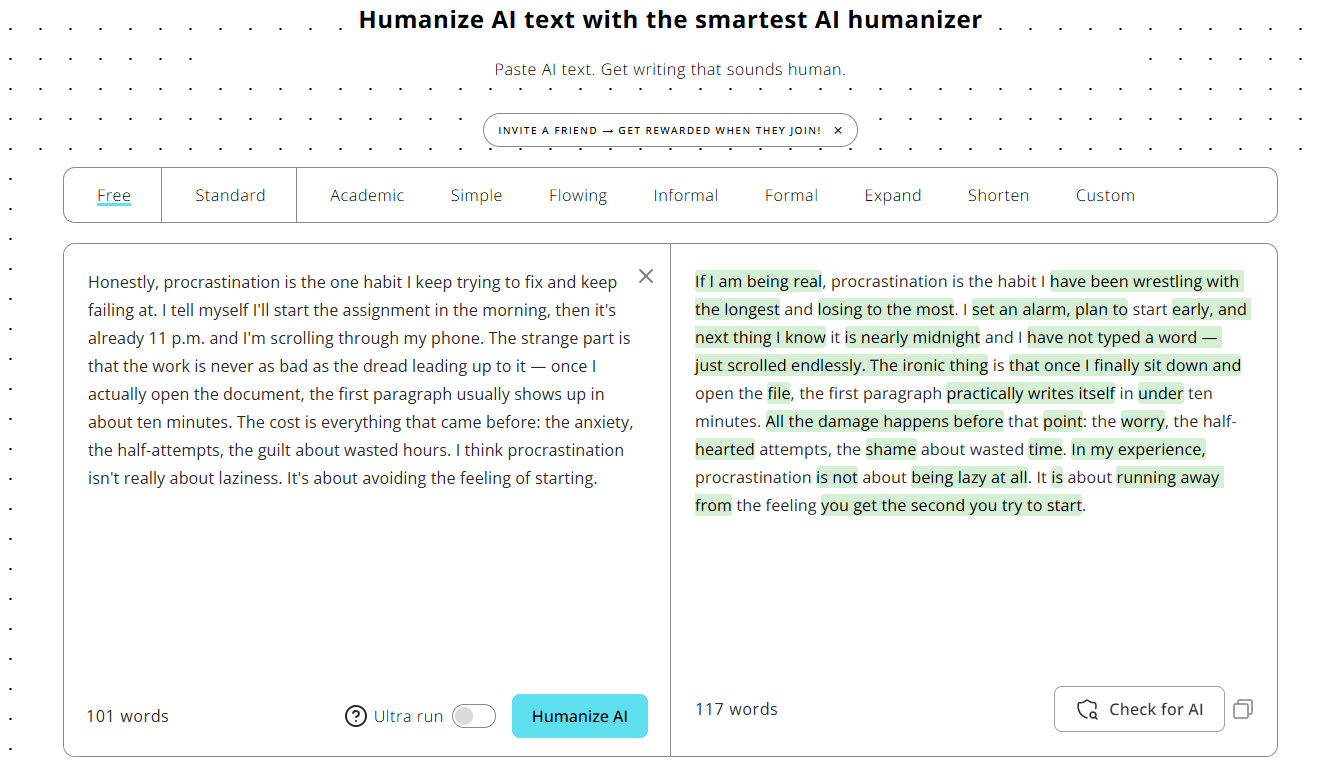
humanizeai.pro is an AI text rewriting tool designed to transform AI-generated writing into text that sounds more human and less robotic.
According to its public product messaging, humanizeai.pro is built to:
- humanize AI-generated text from tools like ChatGPT and other AI writers
- remove robotic tone and repetitive phrasing
- preserve the original meaning and context
- retain SEO value and important keywords
- help users bypass AI detectors
- support multiple writing styles and output modes
Its website also highlights a broader tool ecosystem around the humanizer, including an AI detector, paraphraser, plagiarism checker, grammar checker, and essay writer.
That positioning matters.
humanizeai.pro is not presenting itself as a small editing layer or a casual rewriter. It is presenting itself as a full AI-to-human text converter with anti-detection ambitions.
2.How humanizeai.pro Rewrites AI Text
Based on humanizeai.pro’s public documentation and product messaging, the tool appears to focus on rewriting AI text into more natural-sounding output rather than generating entirely new content from scratch.
The product emphasizes that it can remove robotic undertones while keeping the original meaning intact. It also offers multiple rewrite modes and style options, including:
- Standard
- Academic
- Simple
- Flowing
- Informal
- Formal
- Expand
- Shorten
- Custom
That suggests humanizeai.pro is trying to give users more control over tone and structure than a basic one-click paraphraser.
In practical terms, the tool appears to target several common AI writing weaknesses.
It tries to reduce robotic phrasing
AI-generated writing often sounds too symmetrical, too polished, and too predictable. humanizeai.pro appears designed to soften those patterns by rewriting phrasing into something less mechanically uniform.
It tries to preserve meaning while changing expression
This is a core part of its value proposition. Many rewriting tools can make text look different, but some do that by weakening clarity or distorting the original point. humanizeai.pro explicitly claims to preserve context and meaning while humanizing the surface language.
It supports style-based rewriting
The different output modes suggest that humanizeai.pro is not treating all use cases the same. Academic writing, casual writing, shortened copy, and expanded content may all require different rhythms and different levels of rewriting.
It is positioned as detector-aware
This is one of the most important parts of the product messaging. humanizeai.pro does not merely say the tool improves readability. It repeatedly says the output can help bypass AI detectors. That means the intended function goes beyond cleanup and into detection-aware rewriting.
So in simple terms, humanizeai.pro appears to work as a structured AI-text humanizer that rewrites machine-like writing into more natural, style-controlled text while aiming to reduce detector-visible AI patterns.
3. humanizeai.pro Strengths, Weaknesses, and Key Limitations
Like many AI humanizers, humanizeai.pro has some real strengths on paper. But once you evaluate it as a serious anti-detection tool rather than a general rewriter, the limitations become easier to see.
Main Strengths of humanizeai.pro
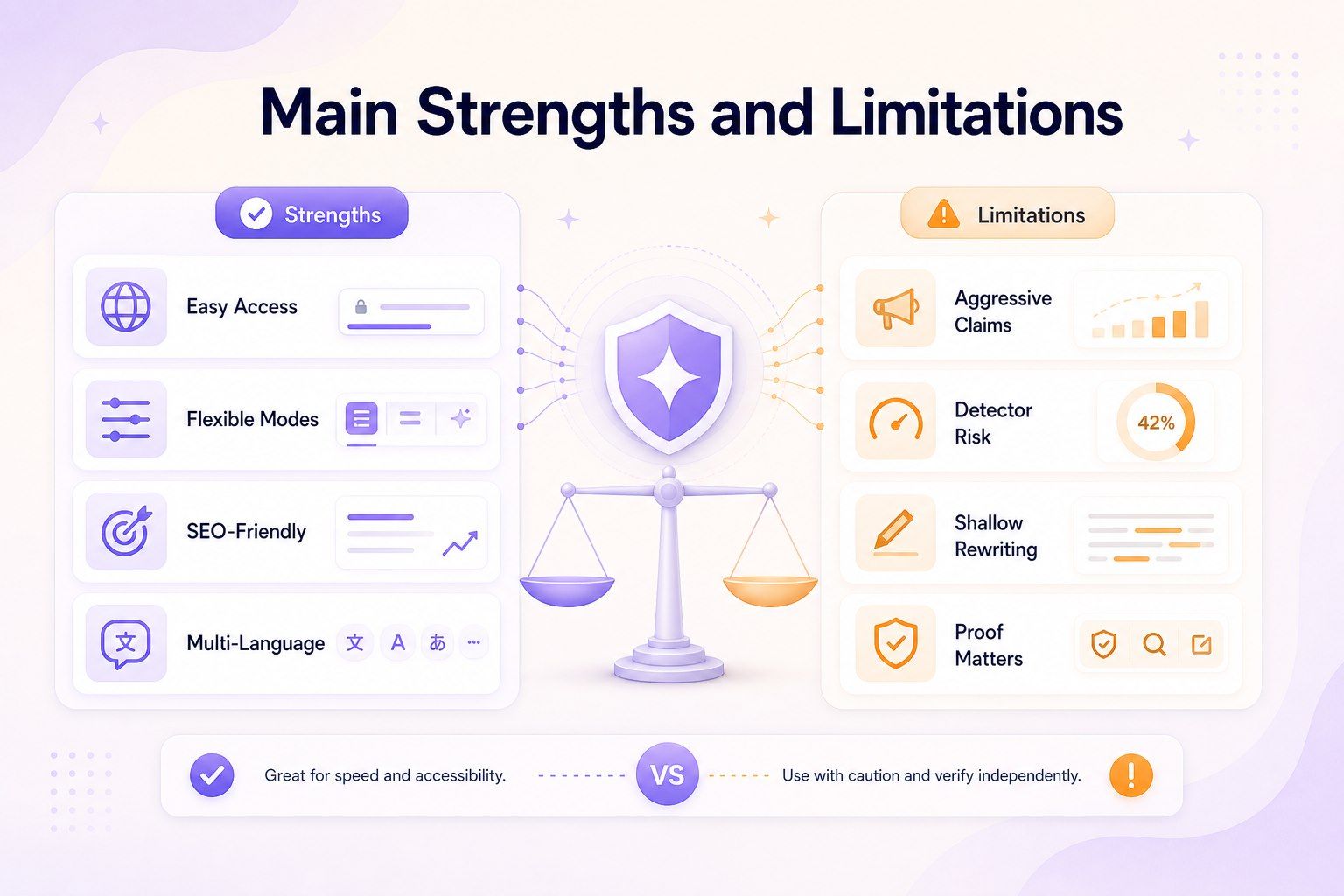
Clear value proposition
humanizeai.pro’s messaging is very easy to understand. It promises to turn AI text into human-like writing, preserve meaning, and help bypass detectors. Users do not need to guess what the product is trying to do.
Free and easy to access
One of its strongest advantages is accessibility. The tool is positioned as free to use, does not appear to require registration for basic usage, and has a simple browser-based workflow.
Multiple rewriting modes
The different style and output controls make the tool more flexible than many one-mode rewriters. That gives users a better chance of adjusting output depending on whether they are working on essays, blog posts, casual copy, or formal business writing.
Broad language and device support
humanizeai.pro also promotes multilingual support, cross-device compatibility, and browser accessibility. That improves convenience for users outside a narrow English-only desktop workflow.
Strong SEO-oriented messaging
For marketers and bloggers, one appealing claim is that the tool preserves keywords and SEO value while humanizing text. That makes it especially attractive for content publishing use cases.
Main Limitations of humanizeai.pro
Its public claims are extremely aggressive
humanizeai.pro says it can bypass detectors, guarantee originality, and produce fully human-like output. Those are strong claims. Strong marketing language is not the same as neutral proof.
“Human-like” does not always mean detector-safe
A piece of writing can sound better to a human reader and still retain the structural patterns AI detectors look for. Smoother wording alone is not the same thing as deep humanization.
There is a difference between style control and deep rewriting
Multiple tone modes are useful, but they do not automatically prove that the system performs strong detector-aware restructuring. A tool can offer many style presets while still rewriting only at the surface level.
Public positioning does not equal independent verification
humanizeai.pro makes detector-bypass claims directly on its site, but those claims still need external testing. Without cross-platform evidence, users should be careful about treating the product as reliably undetectable.
High-risk use cases need more than convenience
For essays, SEO articles, affiliate blogs, academic writing, and detector-sensitive publishing, users often need stronger rewriting depth than many free humanizers can consistently provide.
So overall, humanizeai.pro looks appealing for convenience, accessibility, and broad rewriting controls, but its strongest claims require careful interpretation.
4. humanizeai.pro AI Detector Results: Can It Really Reduce AI Signals?
This is one of the most important questions in any humanizeai.pro AI Humanizer review.
humanizeai.pro does not position itself as a simple readability tool. Its public messaging goes much further. The product claims that it can transform AI-generated text into human-like writing while helping users bypass major AI detectors.
That makes real detector testing essential.
Instead of relying only on marketing language, the better way to evaluate humanizeai.pro is to run its rewritten output through several major AI detection tools and compare the results side by side. That matters because a humanizer can perform well in one detector and still fail badly in another.
Different AI detectors look for different patterns. Some are more sensitive to repetitive sentence rhythm. Others react more strongly to polished phrasing, statistical consistency, or low variation in structure. Because of that, passing one tool does not prove that the content is broadly safe.
Below is how humanizeai.pro AI Humanizer performed across several major AI detectors.
GPTZero Result
After processing the sample through humanizeai.pro AI Humanizer, the rewritten text was tested in GPTZero.
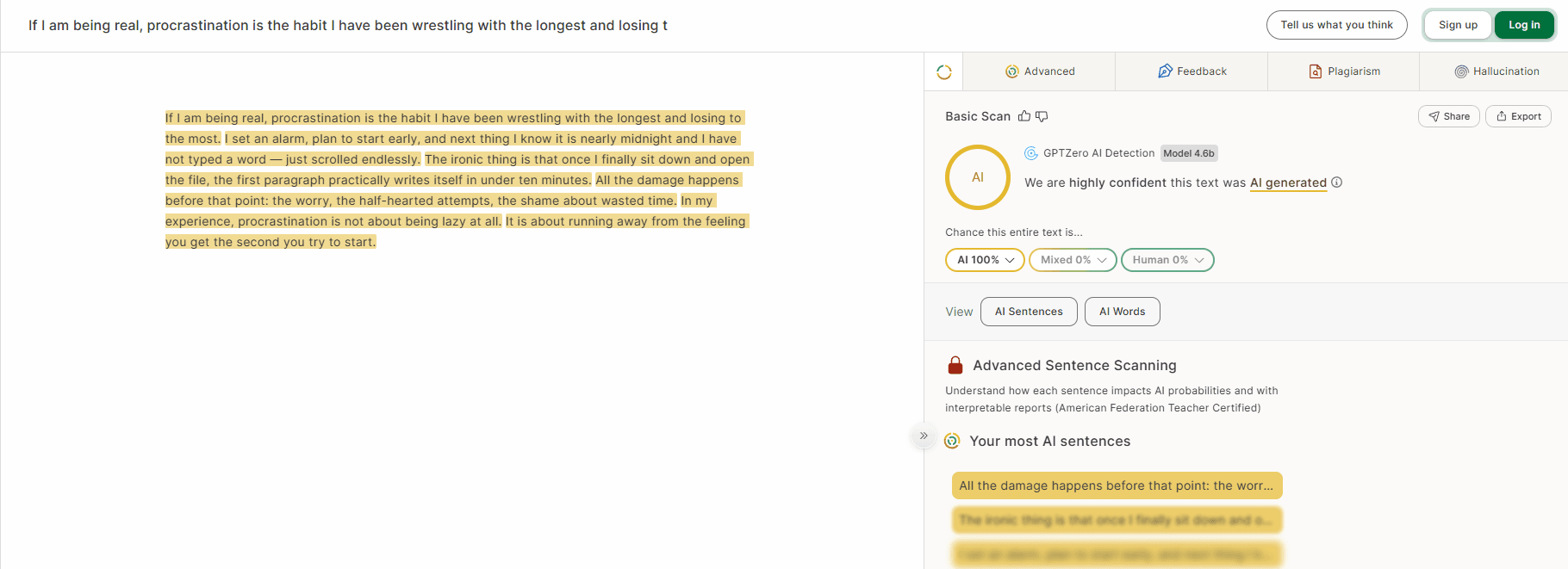
GPTZero marked the sample as 100% AI-generated and stated that it was highly confident the text was AI-written. In other words, Walter’s rewrite did not meaningfully reduce the patterns GPTZero was looking for in this test.
That is an important limitation because GPTZero is one of the most frequently cited AI detectors in education and general AI-content discussions. If Walter still gets fully flagged here, users should be cautious about relying on it for detector-sensitive writing.
Copyleaks AI Detector Result
The same rewritten sample was then tested in Copyleaks AI Detector.
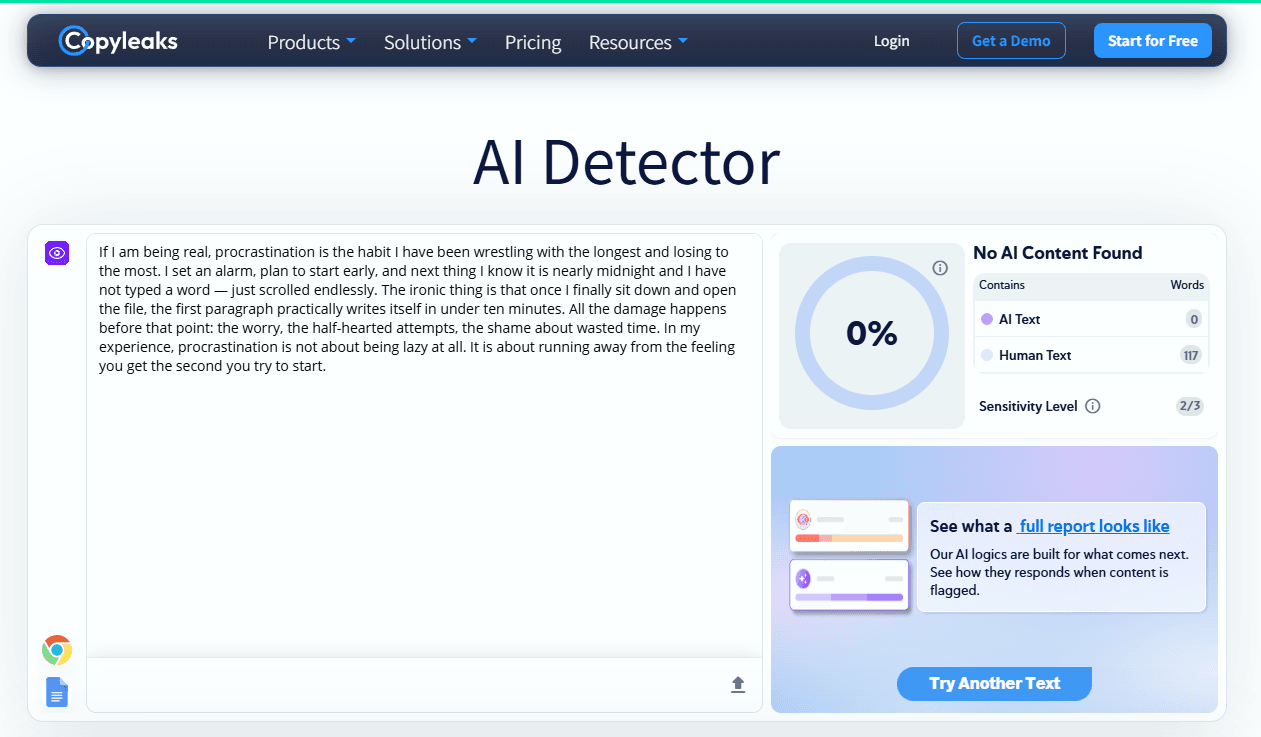
Copyleaks identified the sample as 100% AI Content Found, with 82 AI text words and 0 human text detected. That is another very clear failure in cross-platform testing.
This result matters because Copyleaks is often used in stricter institutional and professional workflows. When a humanizer still gets fully flagged here, it suggests the rewrite may still retain structural signals associated with AI-generated writing, even if the text looks more polished on the surface.
Originality.ai Result
Next, the humanizeai.pro output was checked in Originality.ai.
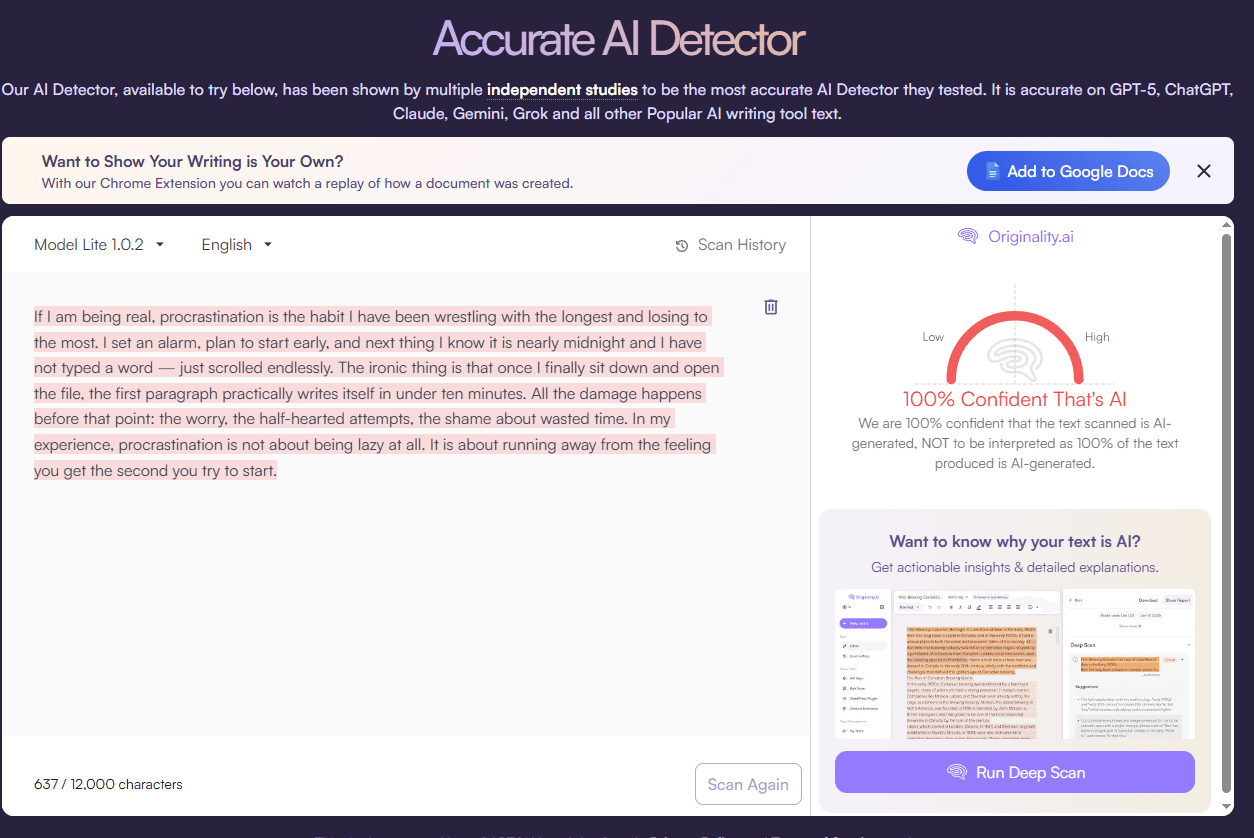
In this test, Originality.ai marked the sample as 98% confident that it was original, which is a much stronger result than what we saw in GPTZero and Copyleaks. That suggests Walter Writes can, at least in some cases, reduce enough detectable AI structure to perform well in certain content-focused detectors.
This is especially relevant for bloggers, affiliate publishers, and SEO writers, because Originality.ai is one of the most visible detectors in publishing workflows. A strong result here makes Walter look more credible for content use cases than the GPTZero and Copyleaks results alone would suggest.
At the same time, this result should be interpreted carefully. A strong score in Originality.ai does not cancel out the failures in other detectors. It simply shows that Walter’s performance is uneven rather than consistently weak or consistently strong.
QuillBot AI Detector Result
The same rewritten text was also tested using QuillBot AI Detector.
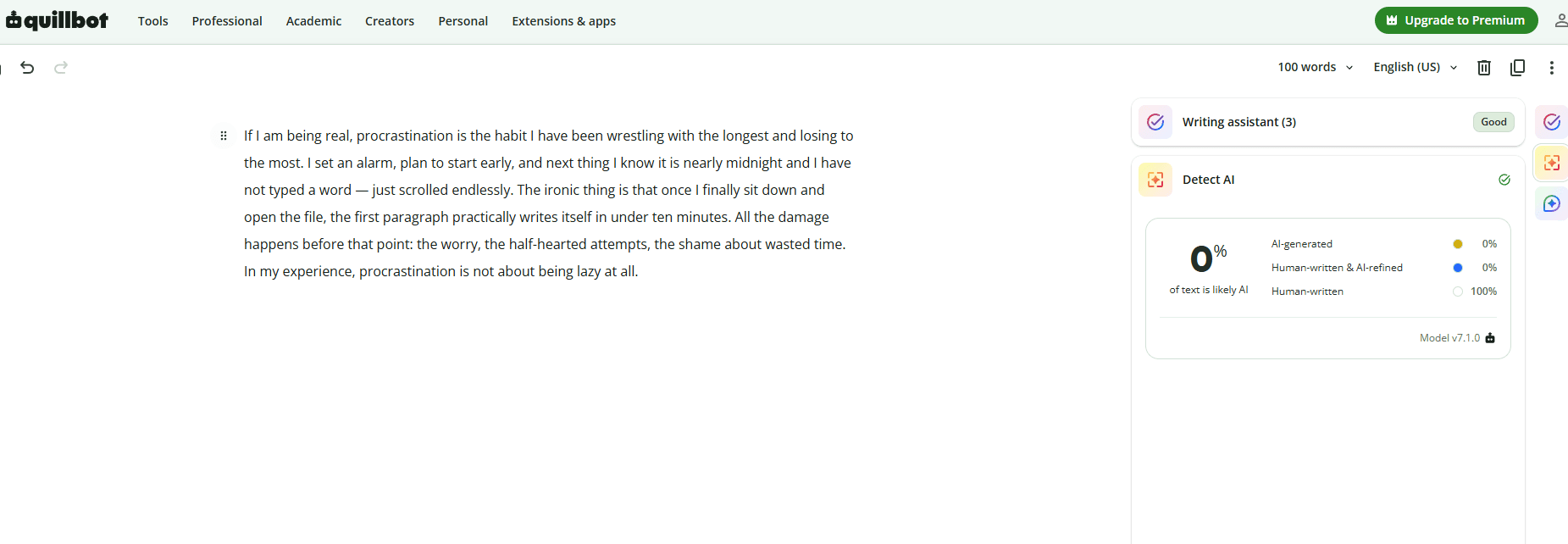
The result showed 100% of the text is likely AI, with 0% human-written detected. That places QuillBot much closer to GPTZero and Copyleaks than to Originality.ai in this test set.
This adds another sign that Walter Writes does not reliably escape detection across platforms. Even if the output becomes smoother or more readable, that does not necessarily mean detector-facing patterns have been removed deeply enough.
Turnitin-Aligned AI Detector Result
Finally, the humanizeai.pro output was tested in a Turnitin-aligned AI detector.
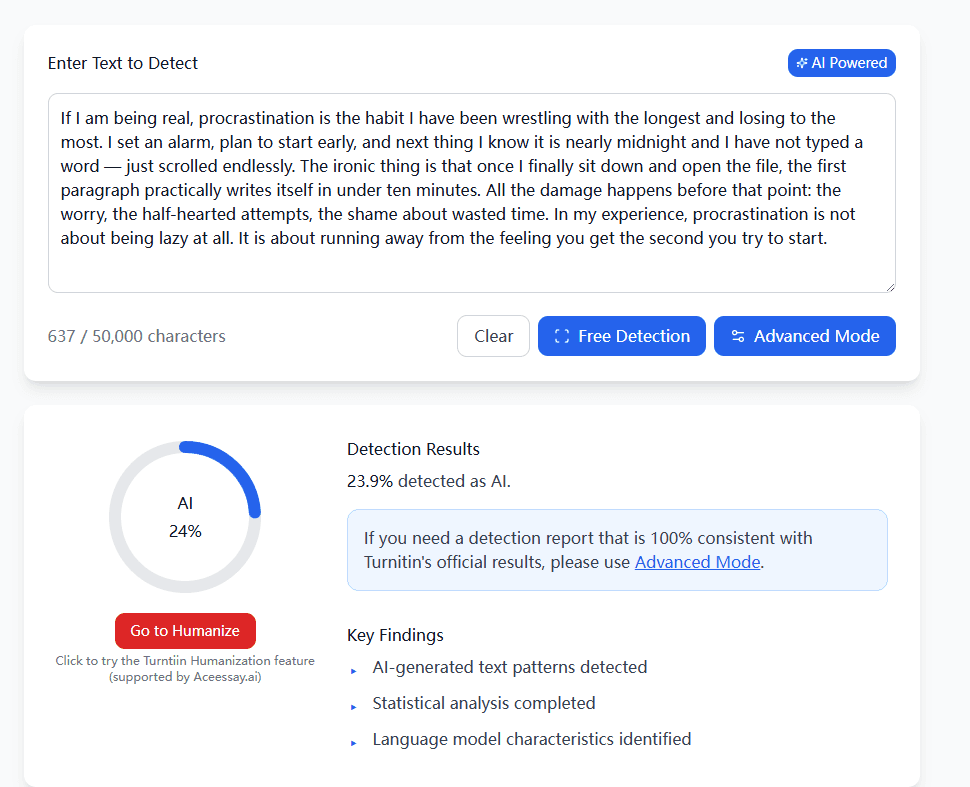
In the Turnitin-aligned detector test, the sample was marked as 27.1% detected as AI. That is meaningfully better than a 100% AI flag, and it suggests Walter Writes did reduce some detectable AI patterns in this version of the text.
Still, this is not the same as a clean pass. A 27.1% AI signal means the output was improved, but not fully cleared. For users in academic or high-risk submission environments, that still leaves meaningful uncertainty.
This result is best understood as a partial win rather than decisive proof. Walter Writes may lower detection risk in some contexts, but it does not eliminate that risk.
What Do These Results Actually Mean?
Taken together, these results show that Walter Writes AI Humanizer is not consistently reliable across major AI detectors.
It performed well in Originality.ai and showed partial improvement in the Turnitin-aligned test, but it was still fully flagged by GPTZero, Copyleaks, and QuillBot. That is a very mixed outcome.
So the most reasonable conclusion is this: Walter Writes may help reduce detection in some environments, but it does not appear dependable enough to be treated as a universal AI detector bypass tool.
For users who only want lighter rewriting or occasional detector improvement, Walter may still be useful. But for people who need stronger cross-platform performance, deeper rewriting, and a better chance of passing multiple major AI detectors, a more advanced alternative like Lynote AI Humanizer is still the safer choice.
5. Is humanizeai.pro Good for SEO Content, Essays, and Blogs?
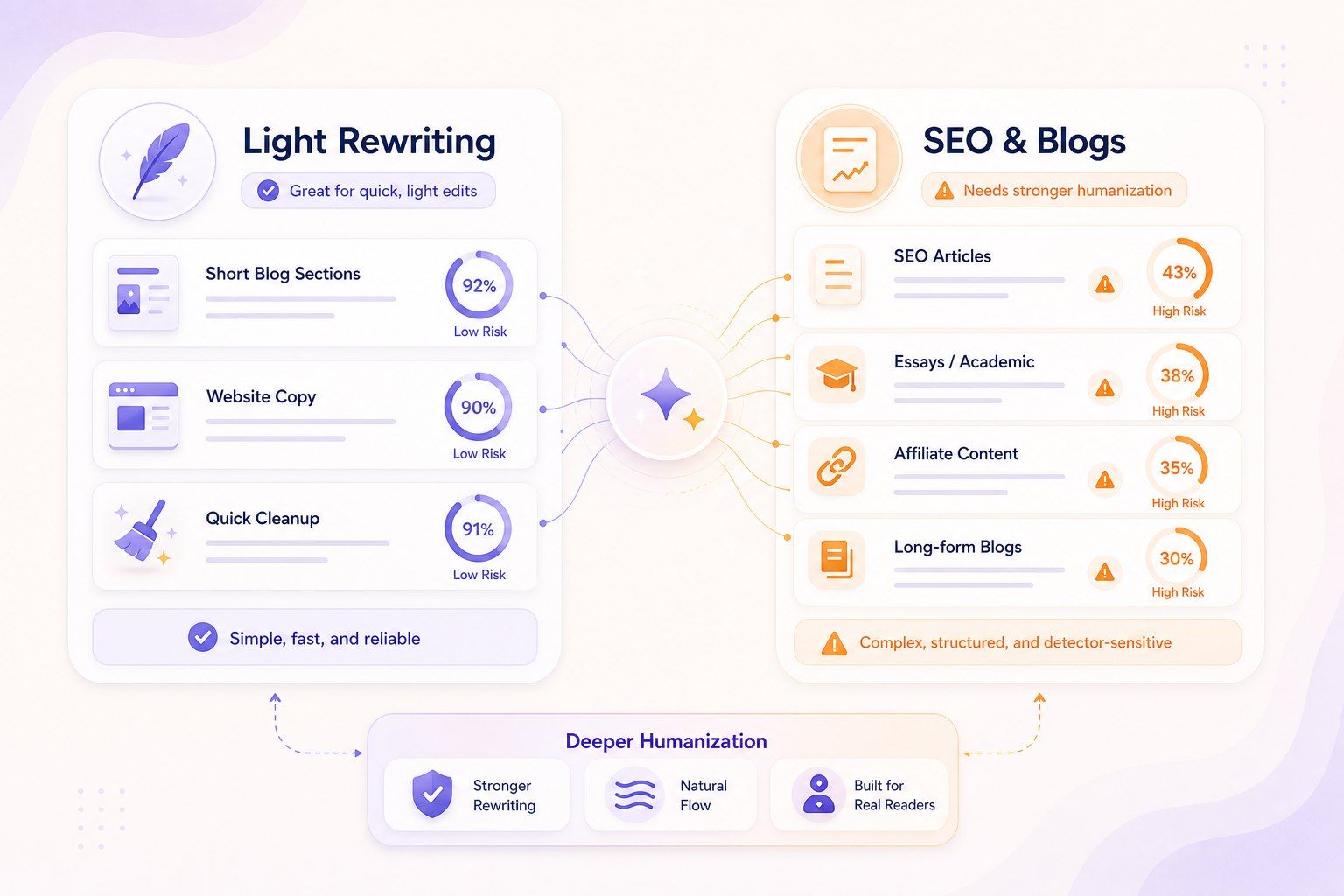
humanizeai.pro may be useful for lighter rewriting tasks, but its value depends heavily on how demanding the content is.
For simple use cases, the tool looks convenient. If you already have an AI draft and mainly want to make it less stiff, less repetitive, and more readable, humanizeai.pro may be enough. Its multiple rewrite modes also make it more flexible than a basic one-click paraphraser.
That makes it potentially useful for:
- short blog sections
- general website copy
- simple article cleanup
- first-pass rewriting after ChatGPT output
- casual content editing
- multilingual rewriting needs
But more demanding writing creates a much higher standard.
For SEO articles, affiliate posts, academic assignments, long-form blogs, and other detector-sensitive content, readability alone is not enough. Users often need deeper rewriting that changes sentence rhythm, phrasing logic, paragraph flow, and structural predictability in a more meaningful way.
That is where many lightweight humanizers start to show limitations.
A piece of content can sound better after rewriting and still remain weak in three important areas:
- it may still trigger AI detectors
- it may still feel generic to real readers
- it may still lack the natural variation needed for high-quality publishing
So overall, humanizeai.pro may be acceptable for light cleanup and convenience-focused use cases. But for more serious publishing, SEO, or academic workflows, users should not assume that smoother wording alone is enough.
6. Best Alternative to humanizeai.pro for Deeper AI Humanization
Yes. If your goal is not just to make AI text look a little cleaner, but to make it feel genuinely more human, read naturally from sentence to sentence, and hold up better across multiple AI detectors, Lynote AI Humanizer is the stronger option.
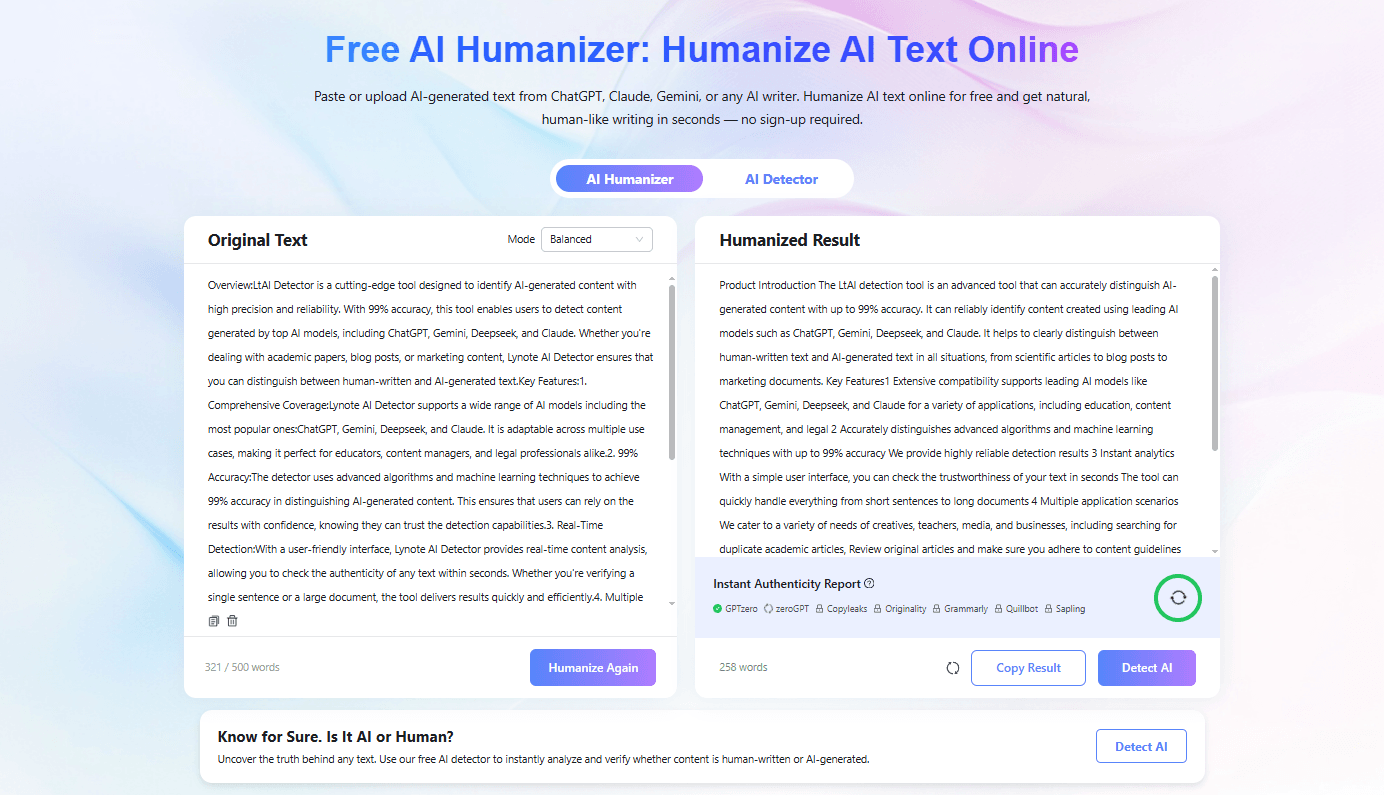
This is where the gap becomes clearer.
humanizeai.pro is attractive because it is easy to access, easy to understand, and built around strong anti-detection messaging. That makes it useful for casual rewriting and quick cleanup. But when the standard becomes more demanding, convenience stops being enough. Users working on SEO articles, affiliate content, academic-style writing, and long-form blogs usually need more than lighter paraphrasing and style presets.
They need deeper humanization.
Lynote AI Humanizer stands out because it is better at changing the things that matter most in detector-sensitive writing:
- sentence rhythm feels less uniform and less machine-balanced
- transitions sound more natural and less templated
- paragraph flow feels more organic rather than systematically generated
- phrasing varies in a way that sounds more human to real readers
- rewritten output is stronger for long-form publishing, not just short text cleanup
That difference matters because AI detectors often respond to deeper structural signals, not just obvious wording patterns. A tool can replace phrases, smooth grammar, and still leave behind the statistical consistency or synthetic cadence that detectors flag. Lynote performs better precisely because it goes beyond surface cleanup.
It is also the stronger choice from a content-quality perspective.
Many AI humanizers focus so heavily on “bypass” language that they overlook the actual reading experience. The result may be less detectable in some cases, but still flat, generic, or unconvincing to a real person. Lynote AI Humanizer is better at preserving clarity while making the text feel genuinely written, which is far more valuable for blog readers, SEO content, and conversion-focused pages.
For professional use cases, that becomes a real advantage:
- for SEO, Lynote produces content that feels more natural without losing topical relevance
- for affiliate and commercial blogs, it creates stronger readability and trust
- for academic-style or formal content, it avoids sounding overly polished in the artificial way many AI drafts do
- for multi-detector workflows, it gives users a stronger chance of reducing flags across platforms rather than optimizing for just one type of detector behavior
So if you only want a free and convenient rewrite layer, humanizeai.pro may still be worth trying. But if you need more serious rewriting quality, better detector-aware restructuring, and output that feels more convincingly human to both readers and major AI detectors, Lynote AI Humanizer is the better choice.
7. humanizeai.pro FAQ: Pricing, Rewrite Modes, SEO, and Detection Claims
Is humanizeai.pro AI Humanizer free to use?
Based on its public website, humanizeai.pro is positioned as a free tool with broad browser-based access. Users should still review current pricing or usage limits directly on the official site in case plans or restrictions change.
Does humanizeai.pro support different rewriting styles?
Yes. humanizeai.pro publicly offers multiple rewrite modes, including academic, simple, flowing, informal, formal, expand, shorten, and custom.
Does humanizeai.pro claim to bypass AI detectors?
Yes. humanizeai.pro explicitly says its tool can help bypass major AI detectors, including Originality.ai, GPTZero, and Turnitin. That claim should be treated cautiously until validated through independent testing.
Is humanizeai.pro good for SEO content?
It may be useful for SEO rewriting because it claims to preserve keywords and SEO value. However, serious SEO publishing usually benefits from deeper humanization than simple surface cleanup alone.
Is humanizeai.pro the best AI humanizer available?
Not necessarily. It has a strong convenience-focused value proposition, but based on public positioning alone, it is not clearly proven as the best option for demanding detector-sensitive writing. For stronger and deeper rewriting, Lynote AI Humanizer is the better choice.
8. Final Review Summary:Should You Use humanizeai.pro?
humanizeai.pro is easy to understand, easy to access, and clearly built around one of the biggest current user demands: making AI-generated writing sound more human and less detectable.
That makes it appealing.
It offers multiple rewrite styles, broad accessibility, and strong messaging around SEO preservation and AI detector bypassing. For quick rewrites and lighter workflows, it may be useful.
But the strongest parts of its marketing are also where the biggest caution is needed.
Claims like bypassing major detectors, guaranteeing originality, and preserving quality across use cases are much easier to advertise than to prove consistently. Until that performance is validated more broadly, humanizeai.pro looks more like a convenient and ambitious humanizer than a clearly best-in-class solution.
If you need deeper rewriting, stronger natural flow, and a better chance of performing well across multiple AI detectors, Lynote AI Humanizer remains the better choice.

Written by Danny
Product Marketing Manager
Danny explains how Lynote features fit real workflows, from everyday productivity to product-led writing use cases. View all articles →