

Linear Notes: How to Take Them with Simple Examples

Ever finished a lecture with pages of information but no clear way to review it? Linear notes offer a simple way to organize ideas in a logical sequence using headings, numbering, indentation, and concise explanations. Instead of scattering information across a page, you build a structured outline that shows how each point connects to the next.
This method works especially well for lectures, textbook chapters, mathematical procedures, and subjects that follow a clear sequence. You can also combine it with diagrams or mind maps when relationships become more complicated.
In this guide, you'll learn what linear note-taking means, how to create effective notes, and how to use Lynote AI Notes to organize learning materials into editable study notes.
TL;DR: Key Takeaways
- Linear notes follow an ordered structure. Information appears under headings, subheadings, and numbered or indented points.
- The method works well for sequential material. Lectures, textbook chapters, mathematical solutions, and technical explanations can benefit from a clear outline.
- Keep notes concise. Record important ideas, definitions, examples, and connections instead of copying everything word for word.
- Linear and non-linear notes serve different purposes. Linear formats emphasize order and hierarchy, while mind maps and concept maps emphasize relationships.
- Review your notes actively. Convert important concepts into questions, explain them from memory, and revisit difficult topics.
- Use AI as a starting point. Lynote can generate structured notes from supported PDFs, videos, audio, and documents that you can edit into your preferred format.
What Are Linear Notes?
Linear notes are a note-taking format in which information is arranged in a logical, usually top-to-bottom sequence. Main topics appear first, followed by supporting explanations, examples, and smaller details.
The format often uses numbered lists, bullet points, headings, and indentation. This creates a hierarchy that makes it easier to follow an argument or process from beginning to end.
For example, a biology lecture may begin with a definition, introduce a process, explain its stages, and finish with its significance. A linear note-taking system preserves that progression while organizing the details into separate sections.
Main Characteristics of Linear Note Taking
Effective linear note-taking usually has three important characteristics.
Sequential Structure: Information follows the order of a lesson, reading, explanation, or process. This helps preserve the progression of ideas.
Hierarchical Organization: Headings and subheadings separate major concepts from supporting information. Numbering and indentation make the relationships easier to recognize.
Concise Explanations: Notes use shorter statements, important terms, and relevant examples instead of unnecessarily long paragraphs.
Linear note taking does not mean transcribing every word. The goal is to preserve useful information in an organized structure that supports understanding and review.
What Does Linear Note-Taking Look Like?
The easiest way to understand linear notes is to see a completed example. Imagine you're studying a biology lesson about photosynthesis and want to organize the information in a clear sequence.
Linear Notes Example: Photosynthesis
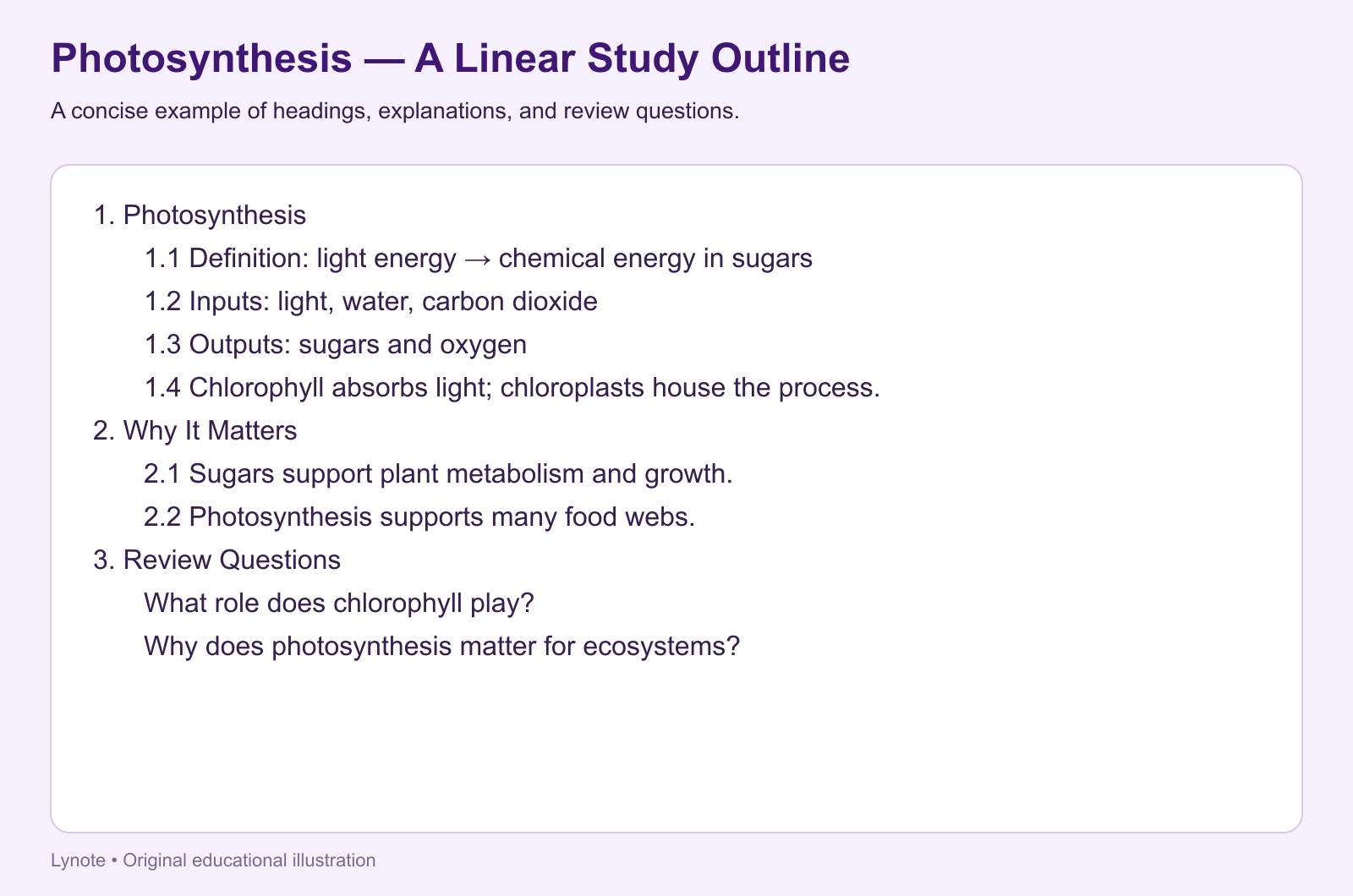
1. Photosynthesis
1.1 Definition
- Process through which plants convert light energy into chemical energy stored in sugars.
- Occurs mainly in chloroplasts.
1.2 Main Inputs
- Light energy
- Water
- Carbon dioxide
1.3 Main Outputs
- Sugars
- Oxygen
1.4 Important Structures
- Chlorophyll absorbs light energy.
- Chloroplasts contain the structures involved in photosynthesis.
2. Why Photosynthesis Matters
2.1 Plant Growth
- Sugars produced during photosynthesis support plant metabolism and growth.
2.2 Ecosystems
- Photosynthesis provides the foundation for many food webs.
- Oxygen is released during the process.
3. Review Questions
- What is the main purpose of photosynthesis?
- What role does chlorophyll play?
- Why is photosynthesis important for ecosystems?
This structure separates the main topic, supporting explanations, and review questions. It is especially useful when you need to return to a specific definition or step without rereading an entire paragraph.
A Simple Linear Notes Format
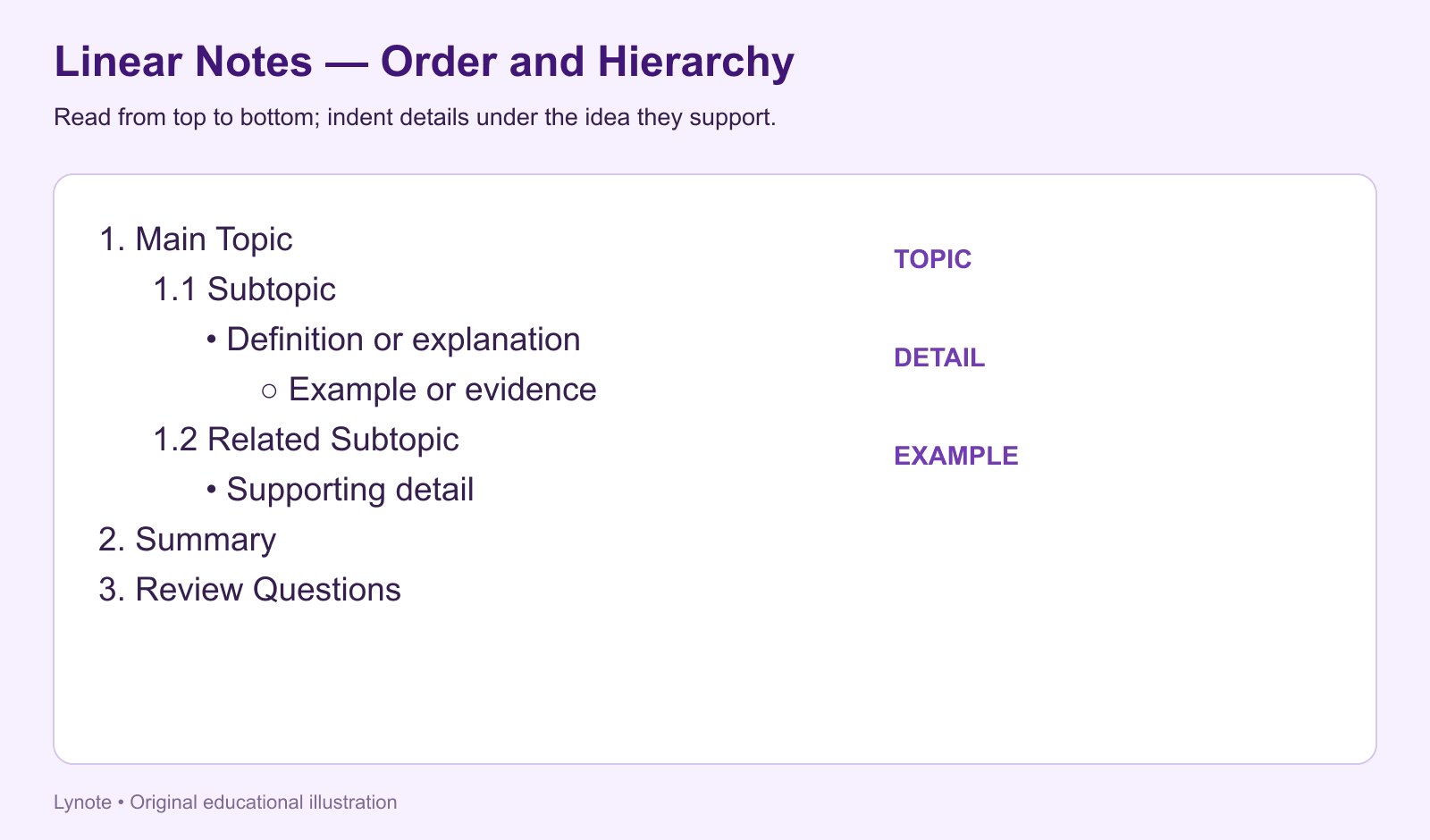
| Level | Formatting | Purpose |
|---|---|---|
| Main Topic | 1. Topic | Introduce a major concept |
| Subtopic | 1.1 Subtopic | Divide the concept into smaller sections |
| Supporting Detail | Bullet point | Record definitions or explanations |
| Example | Indented bullet | Add evidence or practical applications |
| Review Question | Question list | Test understanding |
You can use this format with handwritten or digital notes. The important feature is the logical progression of information, not the exact numbering style.
Benefits of Linear Note-Taking
Linear note-taking is useful because it combines a predictable structure with enough flexibility for different subjects. Students can follow the original sequence of a lesson while making the information easier to review.
However, the advantages depend on how the notes are created. A well-organized outline is useful, while an extremely long transcript remains difficult to study even when numbered.
1. Follow the Logical Flow of Information
Many lessons introduce concepts in a specific order. Understanding an early definition may be necessary before learning a more advanced topic.
Linear notes preserve that progression. This is particularly useful for mathematics, science, history timelines, and technical procedures.
2. Separate Main Ideas from Supporting Details
Headings and indentation make it easier to distinguish central concepts from examples. Instead of treating every sentence as equally important, you create a hierarchy.
For example, a main heading might describe a historical movement, while supporting points explain its causes and consequences. This keeps related information together.
3. Make Information Easier to Find
A structured outline helps you locate information quickly. Clear headings allow you to return to a particular concept without searching through several pages of continuous writing.
This can be helpful when reviewing longer textbook chapters or revisiting previous lectures.
4. Support Detailed Explanations
Linear formats can preserve definitions, formulas, examples, and worked procedures in a consistent order. This makes them especially practical for subjects where the sequence of steps matters.
For mathematical notes, showing each transformation in order can help you understand how a solution was reached.
5. Create Useful Review Materials
You can turn each heading into a question and use the supporting details as an answer. This makes linear notes a convenient starting point for flashcards and active recall.
You can also summarize the main sections after completing a lesson. This encourages you to revisit the material rather than simply storing it.
How to Take Linear Notes in 5 Steps
Learning how to take linear notes is straightforward. You only need a clear topic, a logical hierarchy, and a consistent approach to recording information.
The following five-step method works for classroom lectures, reading materials, online courses, and technical subjects.
Step 1. Identify the Main Topic
Before taking notes, identify the subject of the lesson or reading. Write a clear title that describes what the material covers.
For example, if you're studying linear equations, your main heading could be "Solving Linear Equations." If you're attending a history lecture, you might use "Causes of the Industrial Revolution."
A clear title provides context and makes the notes easier to find later.
Step 2. Capture Key Ideas in Order
As you read or listen, identify important concepts in the sequence they appear. Focus on definitions, explanations, processes, and examples that help you understand the topic.
Avoid copying every sentence. Instead, write short statements that preserve the original meaning.
If the material moves from one major concept to another, create a new heading rather than adding everything to the same section.
Step 3. Create Headings and Subheadings
Organize related information using headings, numbering, and indentation. A major concept becomes a numbered section, while smaller ideas appear underneath it.
For example:
1. Linear Functions
- 1.1 Definition
- 1.2 Slope and intercept
- 1.3 Graphing examples
- 1.4 Applications
Try to avoid unnecessary levels of indentation. Most study notes are easier to read with two or three clear levels.
Step 4. Add Supporting Details and Examples
After establishing the structure, include definitions, formulas, examples, and important explanations. Keep each detail close to the concept it supports.
In mathematics, record the reasoning behind each worked step. In history, add evidence explaining why a development occurred.
Use separate bullets for information that serves different purposes. This helps prevent important points from becoming buried inside long paragraphs.
Step 5. Summarize and Review
At the end of a section, write a short summary in your own words. Explain the main idea and how its supporting concepts connect.
Next, cover the explanations and try answering questions based on the headings. Identify anything you cannot recall or explain confidently.
Return to difficult sections after a study interval. Regular review makes your notes more useful for long-term learning.
Linear Notes Examples for Different Subjects
Linear notes can be adapted to almost any subject. The structure stays consistent, but the information you record depends on whether you're studying a process, historical development, or workplace discussion.
Example 1. Linear Notes for a History Lecture
Topic: Causes of the Industrial Revolution
1. Economic Conditions
- Expanding domestic and international markets.
- Investment in production and infrastructure.
2. Technological Developments
- Mechanization of textile production.
- Increasing use of steam power.
3. Social Changes
- Urban growth.
- Expansion of factory employment.
- Changing labor conditions.
4. Historical Significance
- Transformation of production systems.
- New relationships between workers, employers, and markets.
This structure helps students organize causes and consequences without mixing unrelated information. It also supports chronological and analytical review.
Example 2. Linear Notes for a Reading Assignment
Topic: Memory and Learning
1. Encoding
- Processing information into a form that can be stored.
2. Storage
- Maintaining information over time.
3. Retrieval
- Accessing previously stored information.
4. Study Applications
- Retrieval practice tests memory.
- Spaced review distributes practice across time.
The numbered headings make the sequence easy to follow. You can expand individual sections with definitions and examples from the assigned reading.
Example 3. Linear Notes for a Work Meeting
Topic: Project Review
1. Project Progress
- Current milestones.
- Completed tasks.
2. Issues
- Outstanding technical problems.
- Delayed approvals.
3. Decisions
- Confirmed project changes.
- Agreed priorities.
4. Next Steps
- Tasks requiring follow-up.
- Confirmed owners and deadlines.
This format works well when the discussion follows a defined agenda. Review decisions and responsibilities afterward to ensure the notes accurately reflect what was agreed.
Linear Notes for Math: Equations, Functions, and Algebra
The word "linear" can also refer to mathematical concepts, including linear equations, inequalities, functions, and linear algebra. These topics are different from the linear note-taking method, but structured outlines can be particularly useful for studying them.
Math notes benefit from keeping definitions, formulas, worked examples, and common mistakes in a predictable order. The following examples show how to organize mathematics content using linear note-taking.
Linear Equations Notes
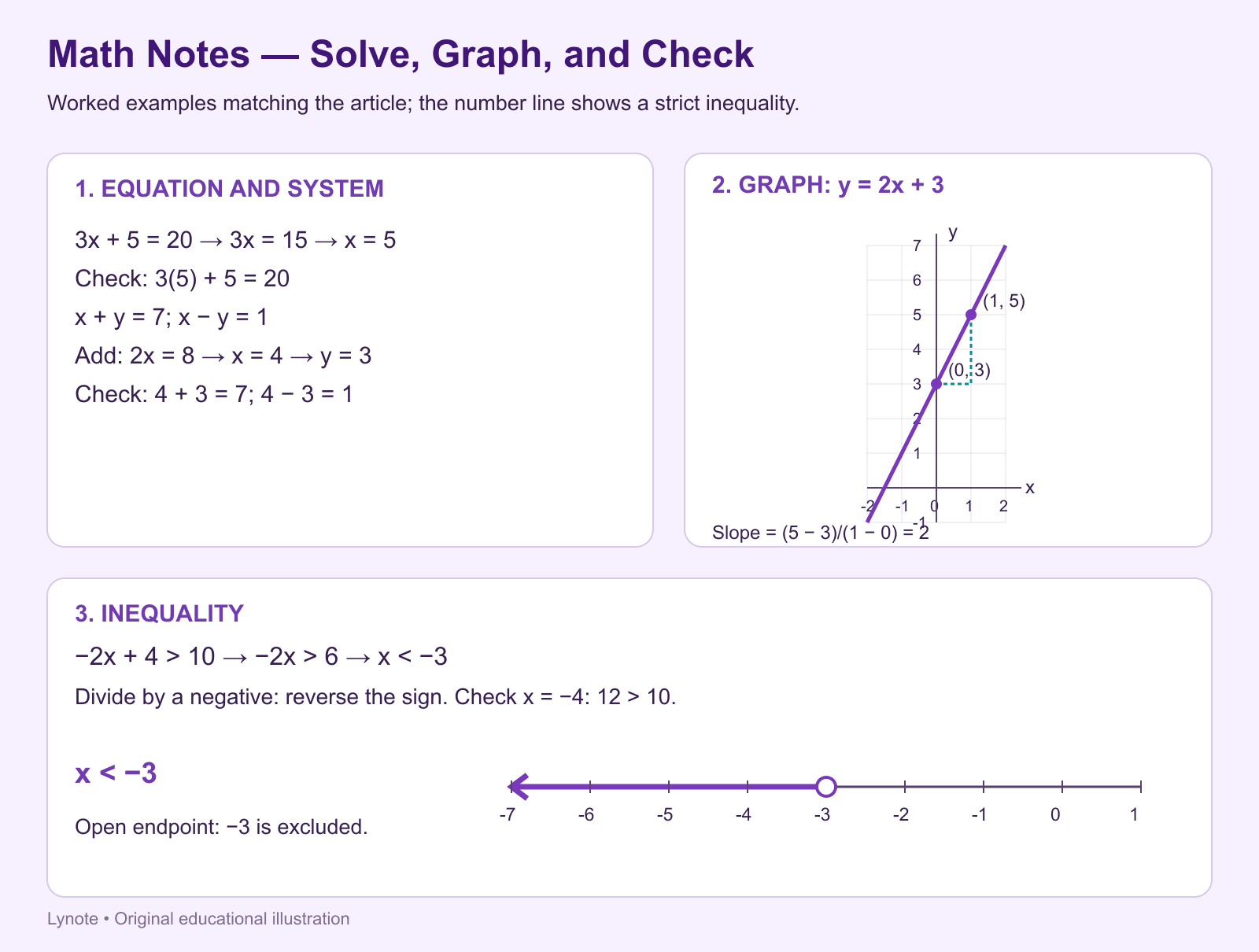
A linear equation in one variable can often be solved by applying operations that preserve equality. When creating linear equations notes, write down each transformation and explain why it is valid.
Example: Solve 3x + 5 = 20
- Start with the equation:
3x + 5 = 20. - Subtract 5 from both sides:
3x = 15. - Divide both sides by 3:
x = 5. - Check:
3(5) + 5 = 20.
This format separates the original problem, the solution process, and the verification. It is useful when reviewing algebraic procedures.
Notes on Graphing Linear Equations
Graphing linear equations notes often focus on slope, intercepts, and coordinate relationships. The slope-intercept form is particularly useful because it makes the slope and vertical intercept easy to identify.
For the line y = 2x + 3:
- Slope: 2
- Vertical intercept: 3
- One point: (0, 3)
- Another point: (1, 5)
To graph the equation, plot the two points and draw the straight line through them. In your notes, include a graph alongside the written explanation whenever possible.
Linear Inequalities Notes
Linear inequalities are similar to equations, but the solution may represent a range of values. One important rule is that multiplying or dividing both sides by a negative number reverses the inequality sign.
Example: Solve -2x + 4 > 10
- Start with
-2x + 4 > 10. - Subtract 4:
-2x > 6. - Divide by -2 and reverse the sign:
x < -3. - Check with a value that satisfies the solution.
For solving linear inequalities notes, add a number-line diagram to illustrate the solution interval. Graphing linear inequalities notes in two variables may also require boundary lines and shading to represent the solution region.
Systems of Linear Equations Notes
A system of linear equations contains two or more equations that must be satisfied simultaneously. Common methods include substitution, elimination, and graphing.
Example:
x + y = 7
x - y = 1
Using elimination:
- Add both equations:
2x = 8. - Divide by 2:
x = 4. - Substitute into
x + y = 7:y = 3. - Solution:
(4, 3).
When preparing systems of linear equations notes, include at least one worked example for each method. Explain when a particular approach is convenient rather than memorizing the steps without understanding them.
Linear Functions and Linear Regression Notes
Linear function notes often explain relationships represented by constant rates of change. In a linear function, the slope describes how the output changes when the input increases by one unit.
For linear regression notes, the focus is different. Linear regression uses observed data to estimate a relationship between variables, typically by fitting a line according to a chosen statistical criterion.
Keep notes on definitions, assumptions, formulas, graphical interpretation, and worked examples. Distinguish exact mathematical relationships from statistical models fitted to data.
Linear Algebra Notes
Linear algebra notes cover topics such as vectors, matrices, systems of equations, linear transformations, and vector spaces. These concepts often build on one another, making a hierarchical note structure valuable.
A useful set of notes for linear algebra might begin with vectors and matrices before moving into operations and more abstract concepts.
Example Outline:
1. Vectors
- Definition and notation
- Vector addition
- Scalar multiplication
2. Matrices
- Matrix dimensions
- Addition and multiplication
- Matrix operations
3. Systems of Linear Equations
- Matrix representation
- Row operations
- Solution methods
4. Linear Transformations
- Mapping vectors
- Matrix representations
- Geometric interpretation
5. Vector Spaces
- Spans and subspaces
- Linear independence
- Bases and dimension
These linear algebra notes provide a general organizational example, not a substitute for a complete university course. For a specific class, follow your instructor's syllabus and include the relevant proofs, worked problems, and definitions.
Where to Find Online Linear Algebra Notes
Students looking for online linear algebra notes should begin with materials recommended by their instructor or institution. University course pages, open educational textbooks, and official lecture materials can provide reliable explanations and worked problems.
Always confirm that a resource matches your course level. Introductory matrix methods, computational linear algebra, and proof-based linear algebra can differ substantially.
What About Paul's Online Notes for Linear Algebra?
Paul's Online Math Notes is a well-known collection of free mathematics tutorials and study resources. Its published course notes prominently cover algebra, calculus, and differential equations.
Students searching for "Paul's Online Notes linear algebra" should note that linear algebra is not presented as a standalone full course in its primary class-notes catalog. Related material about matrices, systems of equations, and vectors may appear within other sections.
If you need a complete linear algebra course, use a dedicated textbook or university resource rather than assuming Paul's Online Notes provides every topic.
Can You Download Linear Algebra PDF Notes?
Many universities and open educational projects publish legitimate mathematics PDFs. However, a search for "linear algebra PDF notes PDF free download" does not guarantee that every result is accurate, complete, or legally distributed.
Choose materials from recognized educational providers and check the license before sharing or uploading them. Keep the original PDF available when taking notes so you can verify formulas and diagrams.
Linear vs. Non-Linear Notes: What's the Difference?
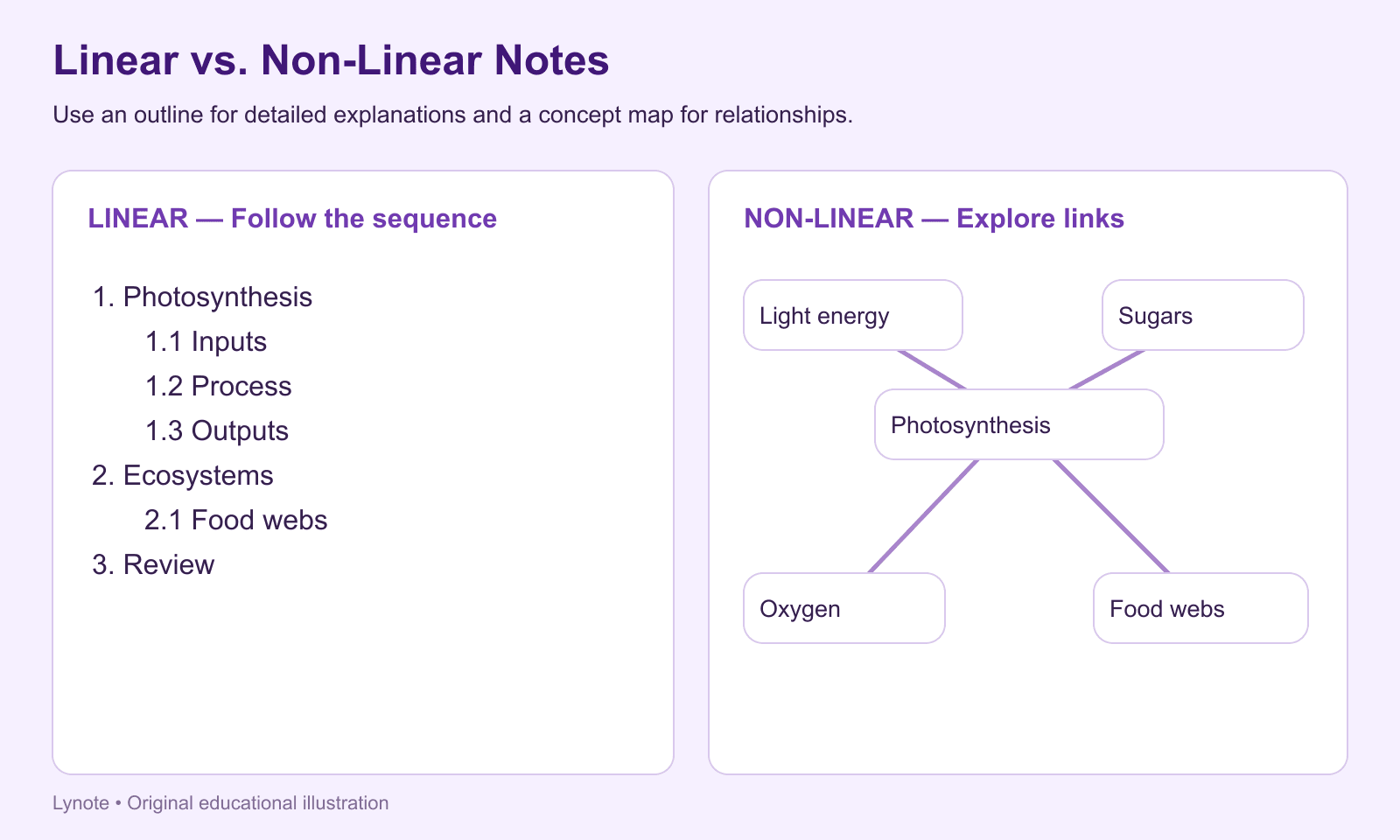
Linear notes and non-linear notes organize information differently. A linear system uses a sequence or hierarchy, while non-linear note-taking places ideas in a spatial arrangement that emphasizes relationships.
Both approaches can support learning, but they are suited to different kinds of information.
| Feature | Linear Notes | Non-Linear Notes |
|---|---|---|
| Structure | Ordered headings and subheadings | Connected nodes, branches, or diagrams |
| Reading Direction | Usually top to bottom | Multiple directions |
| Common Formats | Outlines, numbered lists | Mind maps, concept maps, flowcharts |
| Main Strength | Following detailed explanations | Visualizing relationships |
| Main Limitation | Complex connections may be less visible | Extensive detail can become difficult to fit |
| Best For | Lectures, readings, procedures | Brainstorming, concept connections |
| Review Method | Follow topics in sequence | Explore links between concepts |
When Linear Notes Work Better
Linear notes are practical when information follows a clear progression. This includes textbook chapters, lecture outlines, mathematical procedures, and historical timelines.
The format also helps when you need to preserve detailed explanations under clear headings. It creates a predictable structure that is easy to expand.
When Non-Linear Note Taking Works Better
Non linear note taking can be useful when the most important information involves relationships between multiple concepts. Mind maps and concept maps allow ideas to branch outward or connect across different categories.
For example, a biology concept map might show how energy transfer, ecosystems, and photosynthesis are related. A linear outline can explain each topic in detail, but a diagram may reveal the connections more immediately.
Can You Combine Linear and Non-Linear Notes?
Yes. You can use linear notes to capture complete explanations and then convert the major concepts into a mind map or flowchart.
This combination is useful when a topic contains both sequential information and relationships that are difficult to show in a list. Choose the format based on the material rather than assuming one approach is always better.
When Should You Use Linear Notes?
Linear notes work particularly well for subjects that require a clear sequence of ideas. They are also useful when your main goal is to preserve detailed explanations for future reference.
Good use cases include:
- Lectures that follow a structured presentation.
- Textbook chapters with clear sections.
- Mathematical definitions and worked solutions.
- Technical training and procedural explanations.
- Historical timelines and chronological developments.
- Reading notes that summarize an argument in order.
However, not every subject benefits from a strictly linear format. When information involves complicated networks, spatial relationships, or multiple interacting variables, visual diagrams may communicate the structure more effectively.
Copyable Linear Notes Template
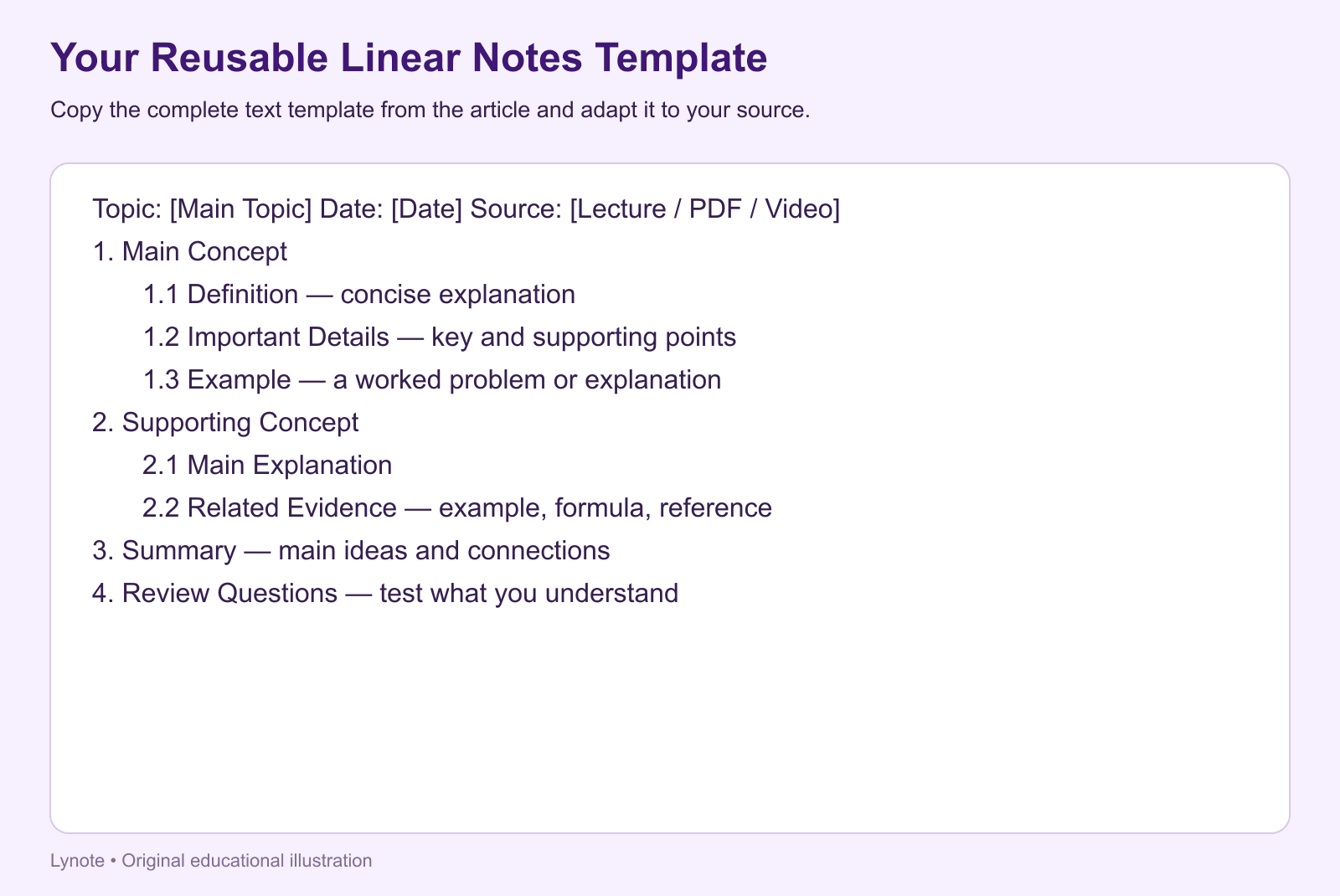
A reusable linear notes template can make your note-taking more consistent. You can adapt the following format for lectures, textbooks, or digital learning materials.
Topic: [Main Topic]
Date: [Date]
Source: [Lecture / Textbook / Video / PDF]
1. Main Concept
1.1 Definition
- [Write a concise explanation.]
1.2 Important Details
- [Key point]
- [Supporting point]
1.3 Example
- [Add a worked example or explanation.]
2. Supporting Concept
2.1 Main Explanation
- [Supporting information]
2.2 Related Evidence
- [Example, formula, or reference]
3. Summary
- [Summarize the main ideas.]
- [Explain how the concepts connect.]
4. Review Questions
- [Question 1]
- [Question 2]
- [Question 3]
The template works for both academic and professional subjects. Add or remove sections depending on how much detail the material requires.
How to Create Linear Notes with Lynote AI
Taking notes from long PDFs, recorded lectures, and educational videos can require significant preparation. Before organizing the information into a linear outline, you need to identify the important ideas and supporting explanations.
Lynote AI Notes can help generate structured notes from supported learning materials. You can then use its editing features to refine the content into your preferred linear format.
Step 1. Upload Your Study Materials
Start with a supported PDF, document, audio recording, or video. You can also provide a supported YouTube or webpage URL.
For example, a student might upload lecture slides explaining systems of linear equations or a textbook chapter introducing vectors. Use materials you have permission to process.
Step 2. Generate Structured Notes
Lynote analyzes the supplied content and produces structured notes with headings, key points, and explanations. This can provide an initial outline without manually extracting every sentence.
The output depends on the source materials. Review formulas, mathematical symbols, worked examples, and diagrams carefully because automated processing can introduce errors or omit important context.
Step 3. Edit the Notes into a Linear Outline

Actual Lynote interface; sample content is a product demonstration. Official source.
Use Lynote's editor to organize the generated content into numbered sections. Place definitions, procedures, worked examples, and review questions under appropriate headings.
For mathematics notes, preserve the sequence of calculations and show enough steps to explain the reasoning. For other subjects, use the original logical structure of the lecture or reading.
Lynote supports editable AI-generated notes, but it should not be described as offering a dedicated one-click linear notes template unless that feature is available.
Step 4. Review with AI Chat and Flashcards
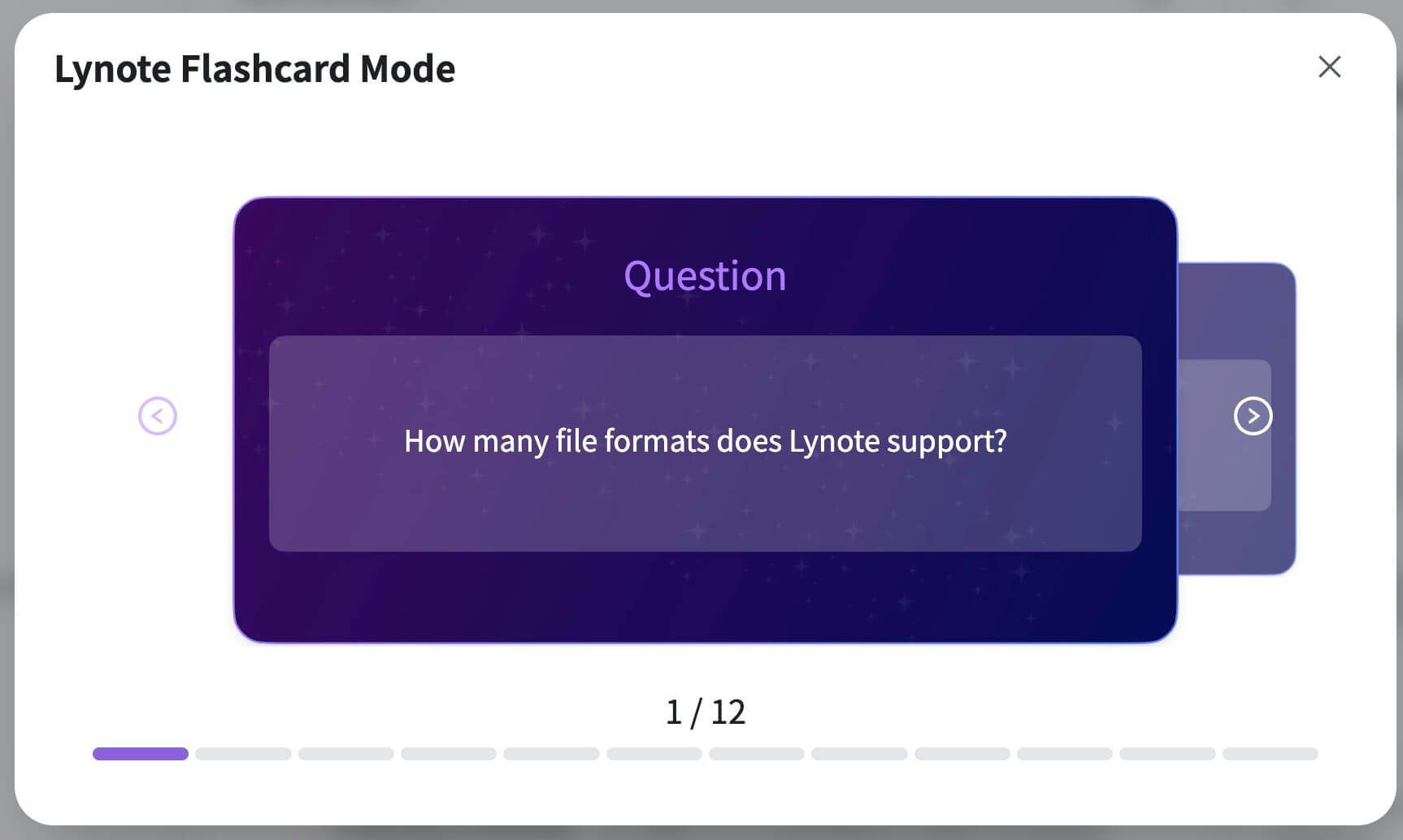
Actual Lynote interface; sample content is a product demonstration. Official source.
Use AI Chat to ask questions about information included in the uploaded materials. This can help you revisit a definition or explanation without searching through the complete source again.
You can also generate flashcards from important concepts and terminology. For mathematical topics, use flashcards to recall definitions and formulas, then practice solving problems independently.
AI Chat relies on the source content you provide. It is not a replacement for checking mathematical solutions or consulting your instructor when an explanation is missing.
Common Linear Note-Taking Mistakes and How to Fix Them
A structured outline is useful only when it remains clear and accurate. Certain habits can turn linear notes into long, difficult-to-review documents.
Copying Everything Word for Word
Transcribing every sentence produces lengthy notes without necessarily improving understanding. Important ideas may become buried in unnecessary details.
How to fix it: Record major concepts and concise supporting explanations. Keep the original source available when you need more detail.
Using Too Many Levels of Indentation
Deeply nested headings can make an outline difficult to follow. Readers may lose track of how smaller points connect to the main topic.
How to fix it: Use two or three levels for most notes. Create a new major section when the hierarchy becomes too complex.
Writing Definitions Without Examples
Definitions may be difficult to understand without context. This is particularly true for mathematical concepts and technical procedures.
How to fix it: Include a short example or worked problem after an important definition. Explain what the example demonstrates.
Leaving Out Visual Information
Not every concept is best represented by text. Graphs, diagrams, and spatial relationships may be essential to understanding a topic.
How to fix it: Add a relevant diagram or graph beside the written explanation. Use non-linear notes when visual relationships are central.
Never Reviewing the Notes
Creating a detailed outline does not guarantee that you will remember it. Without review, notes may become a passive collection of information.
How to fix it: Turn headings into questions, practice recalling answers, and revisit difficult sections regularly.
Conclusion: Make Linear Notes Work for Your Learning
Effective linear notes turn complicated information into a clear sequence of ideas, explanations, and examples. Use headings, numbering, and indentation to organize your material, then add summaries and review questions to check understanding.
Whether you're studying history, linear equations, or advanced mathematics, choose a note-taking structure that matches the subject. Combine linear outlines with diagrams when the material requires visual explanation.
If you want help turning supported study materials into editable notes, try Lynote AI Notes and customize the results for your learning workflow.
Frequently Asked Questions
What Are Linear Notes?
Linear notes organize information in a logical, usually top-to-bottom sequence. They commonly use headings, numbered sections, bullet points, and indentation to separate main ideas from supporting details.
The method works well for lectures, textbook chapters, and subjects that follow a clear progression.
What Is the Difference Between Linear and Non-Linear Notes?
Linear notes arrange information in an ordered structure, while non-linear notes use diagrams or connected elements to show relationships. Mind maps and concept maps are common non-linear formats.
Linear notes are useful for detailed explanations, while non-linear formats may be better for visualizing complex connections.
How Do You Make Good Linear Notes?
Start with a clear topic and record important ideas in order. Use headings, subheadings, numbering, and indentation to organize supporting information.
Add concise explanations, relevant examples, and review questions. Revisit the notes regularly and clarify anything you do not understand.
Are Linear Notes Good for Mathematics?
Yes. Linear notes can organize mathematical definitions, formulas, and worked solutions in a clear sequence.
For topics such as linear equations and inequalities, write each step and explain the relevant rule. Add graphs or diagrams when visual representation is necessary.
How Should I Organize Linear Algebra Notes?
Begin with the main concepts covered in your course, then divide them into definitions, formulas, worked examples, and proof-related explanations. Include topics such as vectors, matrices, systems of equations, and linear transformations as appropriate.
Use your course syllabus to determine the correct sequence. A dedicated linear algebra textbook remains essential for complete proofs and problem practice.
Where Can I Find Free Linear Algebra Notes Online?
University mathematics departments and open educational resources often publish free course notes and textbooks. Choose a resource that matches your course level and provides clear explanations and examples.
Paul's Online Math Notes is useful for various algebra and calculus topics, but it should not be mistaken for a complete dedicated linear algebra course.
What Should Graphing Linear Equations Notes Include?
Useful graphing linear equations notes should explain slope, intercepts, coordinate points, and how to draw a straight line. Include at least one worked example with the corresponding graph.
For slope-intercept form, identify the slope and vertical intercept before plotting points. Check the graph against the equation.
What Should Solving Linear Inequalities Notes Include?
Include the main algebraic rules, especially the need to reverse an inequality sign when multiplying or dividing by a negative number. Add worked solutions and number-line representations.
For inequalities in two variables, explain boundary lines, dashed or solid boundaries, and the appropriate solution region.
Can I Create Linear Notes from PDF Lectures with AI?
Yes. Lynote can generate structured notes from supported PDFs, documents, audio recordings, and videos. You can then edit the notes to create a linear outline with headings and supporting details.
Always check the generated output against the source, particularly when it contains equations, graphs, or technical explanations.
Is Linear Note Taking Better Than Mind Mapping?
Neither method is universally better. Linear note-taking is useful for detailed explanations and sequences, while mind mapping can make relationships between concepts easier to visualize.
You can combine the methods by recording information in a linear outline and using a mind map to summarize the major connections.

Written by Kristen I.
Content Strategist
Kristen focuses on content structure, editorial planning, readability, and creating useful experiences for readers. View all articles →