

How to Make a Study Plan You Can Actually Stick To

To make a study plan, start with your next deadline, list what you need to learn, and find the hours you can actually use. Give each session a task you can finish and a way to check what you learned. Leave one slot open so a missed evening doesn't take the rest of the week with it.
A timetable tells you when to sit down. A study guide tells you what the course covers. Your study plan connects the two: Tuesday after lunch, use the lecture diagram to explain how water crosses a membrane, then try it without looking.
How to Make a Study Plan in 7 Practical Steps
1. Start with the deadline and the thing you'll need to do
Imagine you have a biology quiz on Friday and a history essay due the following Tuesday. Open the quiz instructions and the essay prompt before opening your calendar. The quiz asks you to predict how cells respond to different solutions; the essay asks you to compare two accounts of the same event.
Those verbs matter. Someone who can define osmosis might still predict the wrong direction of water movement. Someone who has read both historical accounts might not yet have a claim about how they differ. Write the outcome you need, not just the course name.
2. List your topics and gather only the materials they need
For biology, your starting kit might be one lecture diagram, the assigned problem set, and the answer key. For history, keep the prompt, the two accounts, and the rubric together. If a resource doesn't help you do one of the tasks you identified, leave it out for now.
When an explanation is buried in a recording or a long PDF, Lynote AI Notes can organize that material into notes. Find the passage behind the relevant heading and check it against the original. Your planning output is a short entry like “membrane transport: lecture diagram and problems 4-6,” not another folder of summaries to read.
3. Count available minutes, not empty squares
Mark classes, shifts, meals, travel, and sleep first. A gap from noon to one isn't an hour of studying if you need to walk across campus and eat. Use the remaining minutes to size the task: a short gap might fit two predictions, while an uninterrupted Saturday morning could fit an essay draft.
In the example below, the student has 200 minutes for planned work and another 20 in reserve. These aren't recommended totals. They're what fits this particular week. If the tasks won't fit, decide what to reduce before Monday, not at midnight on Thursday.
4. Find the gap that deserves your next session
Try one representative question before assigning time. For biology, draw an arrow showing where water moves when the solution outside a cell is more concentrated. Check the direction and the explanation separately. Getting the arrow right by guessing isn't the same as knowing why.
For history, write one sentence comparing the accounts and point to a passage from each that supports it. If you can locate evidence but can't state a contrast, schedule time to develop a claim rather than reread both accounts. Give the next long slot to the urgent task you cannot yet do independently; give the later deadline a small starting slot so it doesn't become a surprise.
5. Give each session a finish line
Replace “study chapters 3 and 4” with an instruction you could hand to a classmate: “Predict what happens to three cells, check the answers, and explain one mistake.” For an essay, try “draft a comparison paragraph with one piece of evidence from each account.” When time runs out, you can tell what remains.
If your topic list is too broad, use Lynote AI Study Guide Maker to organize a lecture or PDF into review topics and questions. Check the topics against the instructor's scope, then choose one question for your session. The guide supplies material; you decide when to study it and what a satisfactory answer looks like.
6. Book a return visit to what you practiced
After checking Monday's answers, keep one fresh problem for Wednesday. Start Wednesday with your notes closed. Changing the conditions in the question helps distinguish remembering yesterday's answer from knowing how to solve the next one.
Use the same idea for an essay without turning writing into a flashcard exercise. Return to your claim the next day and ask whether a reader could reasonably disagree with it. If it's just a statement of fact, revise it before spending an hour polishing the paragraph.
7. Use results to change the next week
At the end of a session, jot down one observation that changes a decision. “Finished biology” won't tell you much later. “Predicted the direction correctly twice, but confused water with solute in the explanation” tells you exactly what to test on Thursday.
At the end of the week, compare estimated time with actual time. If finding two usable quotations took half an hour instead of ten minutes, give the next source-based assignment a separate evidence-gathering slot. You don't need a new planning system; you need a better estimate.
A Weekly Study Plan Example You Can Adapt
Here's the example week on one page. The Friday quiz is the nearer deadline, but Tuesday's history session prevents the essay from swallowing the weekend. Friday's empty slot is deliberate.
| Day and time | Task | How to check it | Return visit |
|---|---|---|---|
| Mon, 4:00-4:30 | Solve three cell-transport problems | Mark answers and explain one error | Wed |
| Tue, 12:30-1:00 | Compare the two historical accounts | Write a claim and locate two passages | Sat |
| Wed, 4:00-4:25 | Solve a fresh transport problem without notes | Check the arrow and its explanation separately | Thu |
| Thu, 5:00-5:25 | Try a mixed quiz and revisit one error | Explain the missed item without the key | Fri quiz |
| Fri, 4:00-4:20 | Buffer after the quiz, or take the time off | Use only for an unfinished, still-relevant task | As needed |
| Sat, 10:00-11:00 | Draft the essay using Tuesday's evidence | Compare the draft with the prompt and rubric | Sun |
| Sun, 3:00-3:30 | Revise the weakest paragraph and plan Monday's edit | Name the remaining edit and book it before Tuesday | Mon |
Read across one row before copying the whole table. Wednesday has only 25 minutes, but the result is usable: either the explanation holds up, or Thursday starts with a known error. That's more informative than coloring in a two-hour block marked “biology.”
Copy This Simple Study Plan Template
Put the deadline at the top of a page, then copy one row per session. A calendar, a spreadsheet, and a sheet of notebook paper can all hold the same information. Keep the plan wherever you'll look when the session actually starts.
| Deadline and topic | Why now? | When and how long? | What will I do? | How will I check? | Next review |
|---|---|---|---|---|---|
| Friday quiz: osmosis | Couldn't explain a prediction | Monday, 4:00, 30 minutes | Solve three problems | Compare reasoning with key | Wednesday |
| [Date and topic] | [Deadline or gap] | [Slot and minutes] | [Action and material] | [Observable result] | [Day] |
If six columns feel like too much for an ordinary day, use one sentence: “At ___, I'll use ___ to do ___, and I'll know I'm finished when ___.” Add the next review date only after you know what needs another attempt.
How to Adjust Your Plan for Exams, Multiple Subjects, or Limited Time
An exam in three days: Work backward from the last chance to correct a mistake. Try a small mixed set today, practice the weakest tested topic tomorrow, and reserve the final session for a fresh check. Don't spend the first two days making a guide so detailed that you never use it.
Several subjects in the same week: Equal time isn't necessarily fair to either course. A short early task can reveal a problem that takes days to resolve, such as a missing source or an unclear assignment. Schedule that check even when another subject deserves most of today's practice time.
Shifts or family commitments that move: Keep two versions of the same task. In a long slot, draft a full comparison paragraph; in a short slot, select the second quotation and write the sentence connecting it to the first. Both versions advance the essay, so a shorter evening doesn't have to become a lost one.
What to Do When You Fall Behind Your Study Plan
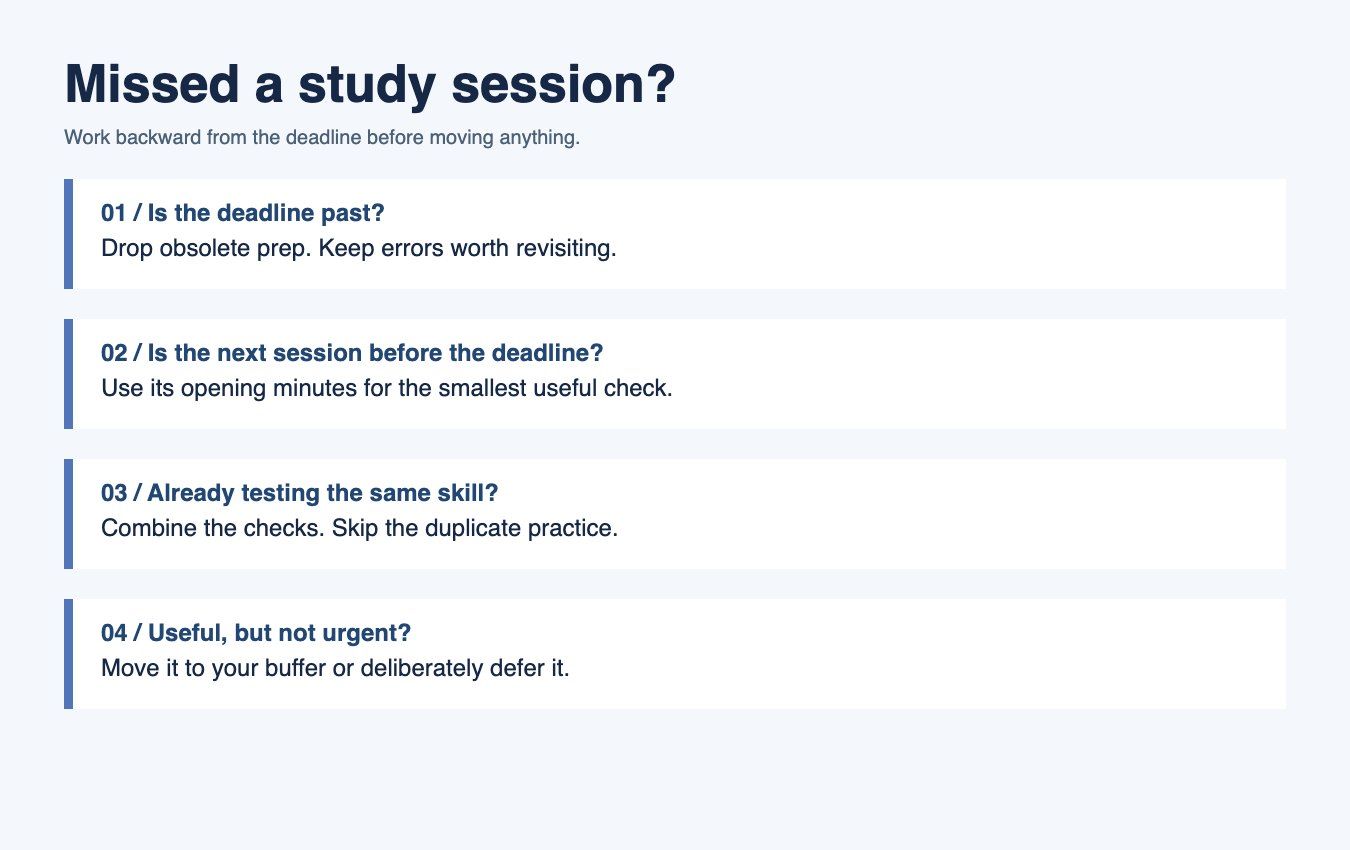
Suppose you miss Wednesday's biology session. Don't move everything one square to the right: Friday afternoon's buffer is too late for Friday morning's quiz. Instead, start Thursday with Wednesday's fresh problem and trim familiar items from Thursday's mixed set.
| Ask in this order | What to do with the missed task |
|---|---|
| Is the deadline already past? | Drop obsolete preparation; keep useful feedback for the next assessment. |
| Is this task needed before the next deadline? | Put its smallest useful version in the next available slot. |
| Does another planned task test the same skill? | Combine the checks instead of repeating both sessions. |
| Is there still useful work with no urgent deadline? | Move it to the buffer, or deliberately defer it to next week. |
If the same session disappears every week, treat that as information. A bus ride may be fine for reviewing a quotation and a poor place to draft an essay. Change the task or the slot rather than writing the same unrealistic appointment again.
FAQs About Making a Study Plan
What should a good study plan include?
Include a deadline, a realistic time slot, a specific learning task, and a way to check the result. “Read for 30 minutes” has a stopping point but no learning check. “Read the two accounts and write one supported contrast” has both.
How many hours should I study each day?
Start with the demands of your course and the time you have, not a universal daily quota. Time yourself doing one representative task, including checking your work. Use that estimate to decide how many similar tasks fit before the deadline.
Is it better to plan daily or weekly?
Plan the commitments and deadlines weekly, then choose the exact next task daily. The weekly view catches conflicts; the daily decision lets you respond when yesterday's practice exposed a gap you hadn't expected.
How do I make a study plan for several subjects?
Use one calendar so the same evening isn't promised to two courses. Keep separate task lists, then choose between them using the deadline, the difficulty you observed in practice, and whether completing one task unlocks another.
Can AI help me make an effective study plan?
AI can help turn course materials into a topic list or review questions. Check those suggestions against your syllabus and try a question yourself before allocating time. A tool can organize what appears in your notes; it doesn't know how long your commute takes or which problem you can solve unaided.
Conclusion: Start With Your Next Study Session
Look at the next deadline on your calendar. Pick one question you can't yet answer, decide when you'll try it, and leave yourself a way to check the result. That single appointment is enough to start; build the rest of the week around what you learn from it.

Written by Janet L. Harris
AI Writing Specialist
Janet reviews AI detectors and humanization tools, with a focus on accuracy, limitations, and responsible use. View all articles →