

Weighted vs. Unweighted GPA: Why One Transcript Can Show Two Numbers

An unweighted GPA counts an A the same way whether you earned it in regular English or AP Calculus. A weighted GPA can give extra points for the harder course. That's how one report card can show both a 3.50 and a 3.88 without a single grade changing. When an application asks for a GPA, use the version it requests, not whichever number looks better.
Weighted vs. Unweighted GPA at a Glance
The difference is the value assigned to a grade, not the grade itself. If you earn a B in Honors Biology, your transcript still says B. Your school's formula determines whether that B contributes, for example, 3.0 or 3.5 points per credit.
| Question | Unweighted GPA | Weighted GPA |
|---|---|---|
| What determines the points for a course? | The grade on the school's base scale | The grade plus any eligible course-level adjustment |
| What is an A worth? | Commonly 4.0 on a 4.0 scale | Could be 4.0 in regular English and 5.0 in AP English under a one-point bonus policy |
| Can two courses with the same grade contribute different amounts? | Yes, if they carry different credits | Yes, if their credits or course-level bonuses differ |
| What does the number leave out? | Whether a course was introductory or advanced | Exactly which courses you took and which grades earned the bonus |
The word unweighted can be misleading. In this comparison it means no bonus for course difficulty. A school can still give a full-credit course twice as much influence as a half-credit course when calculating either GPA. Credit and difficulty are two separate choices in the formula.
One Transcript, Two GPAs: A Worked Example
Imagine four one-credit high school courses. For this example only, an A is worth 4.0 and a B is worth 3.0. Honors adds 0.5 points per credit, AP adds 1.0, and regular courses have no bonus.
| Course | Grade | Base points | Level bonus | Weighted points |
|---|---|---|---|---|
| English, regular | A | 4.0 | 0 | 4.0 |
| History, regular | B | 3.0 | 0 | 3.0 |
| Biology, Honors | B | 3.0 | 0.5 | 3.5 |
| Calculus, AP | A | 4.0 | 1.0 | 5.0 |
| Total across four credits | 14.0 | 1.5 | 15.5 |
Divide the base total by four: 14 ÷ 4 = 3.50 unweighted. Divide the adjusted total by those same four credits: 15.5 ÷ 4 = 3.875 weighted, or 3.88 to two decimal places. The gap is 0.375 before rounding, exactly the 1.5 bonus points spread across four credits.
What changes if one course is only half a credit?
Suppose AP Calculus counts for half a credit while the other three still count for one each. Its A now contributes 2.0 base points (4.0 × 0.5) or 2.5 adjusted points (5.0 × 0.5). The unweighted GPA becomes 12 ÷ 3.5, about 3.43; the weighted GPA becomes 13 ÷ 3.5, about 3.71.
Notice that neither answer is the simple average of four rows anymore. For unequal credits, multiply each course's points by its credits, add the products, then divide by the credits counted. This matters if, for example, a semester elective and a yearlong class appear next to each other on your transcript.
Try the same four courses yourself
Open the Lynote GPA Calculator, choose High school, and enter the four courses above with one credit each. Set Biology to Honors and Calculus to AP, then select Calculate to see the unweighted and weighted results side by side. Change just the Calculus credit to 0.5 and recalculate to isolate the effect of credits.
For your own courses, read the scale printed on your transcript or in the school handbook first. If your school doesn't give Honors Biology the same bonus, a discrepancy isn't necessarily a math error. A calculator shows the result of the settings you entered; it doesn't replace your school's official figure.
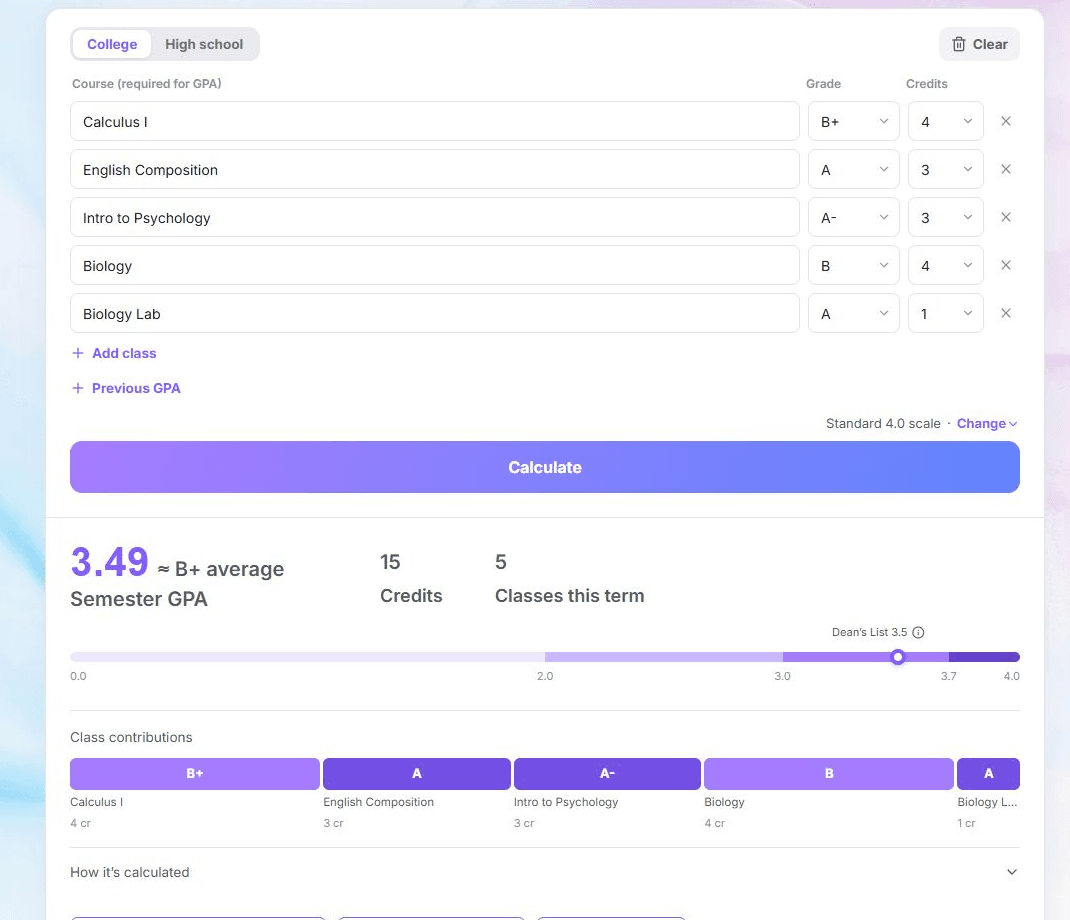
The screenshot shows a college sample. Switch to High school to enter course levels and compare both averages.
Can You Convert a Weighted GPA to an Unweighted GPA?
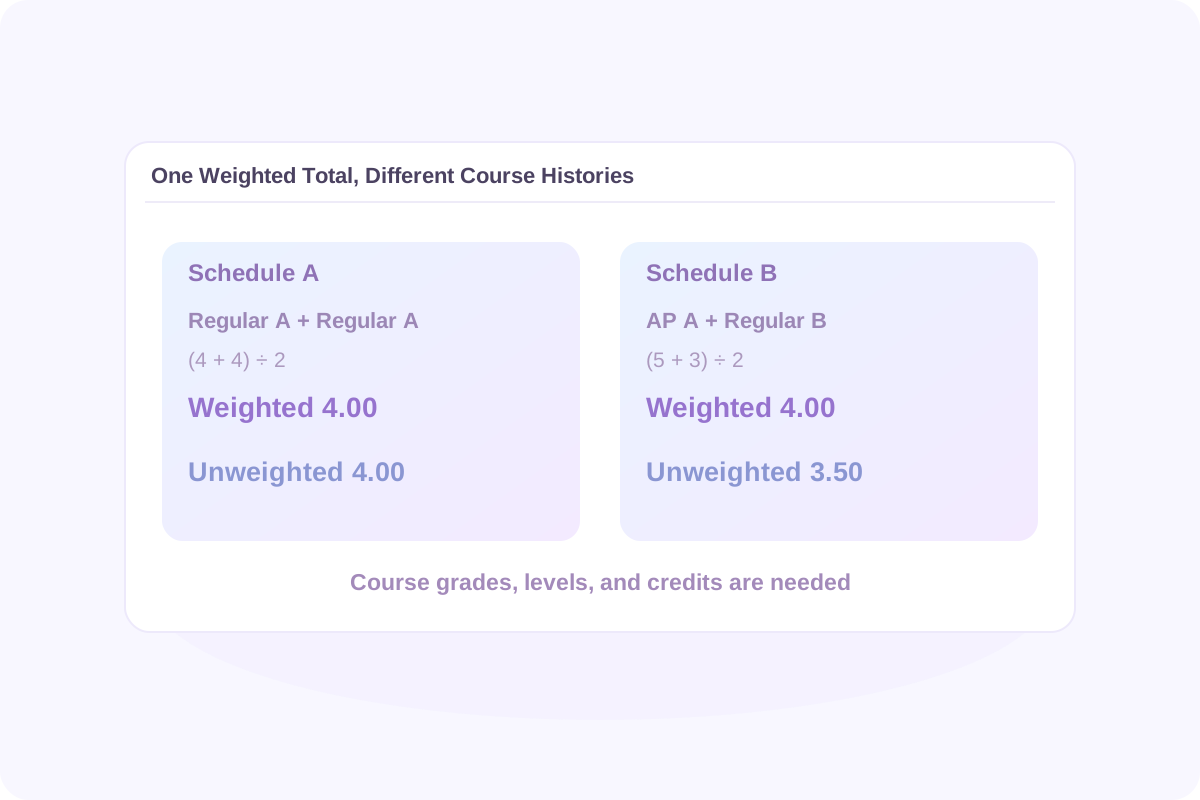
Not from the final number alone. Under the example policy, a regular A earns 4.0 weighted points and an AP B also earns 4.0 weighted points. Remove the bonus and the first grade stays at 4.0 while the second drops to 3.0. The same input number would need to produce two different answers.
That is why multiplying a weighted GPA by 4/5 doesn't convert it to an unweighted GPA. Applied to a regular straight-A schedule with no bonuses, that shortcut would turn a valid 4.0 into a 3.2 even though there was nothing to remove.
If you need an estimate, go back to the individual grades and credits. Use the school's base grade-point table, omit the course-level bonuses, and calculate the credit average. If you need an official number and your school doesn't report one, ask your counselor or the organization requesting it before entering a homemade conversion.
Is Cumulative GPA Weighted or Unweighted?
It can be either. Cumulative tells you which time period is included. Weighted tells you how grades are valued. A line labeled “cumulative weighted GPA” can cover several years of courses with level bonuses, while “semester unweighted GPA” covers just one term without them.
Always match the period before interpreting a change. If your cumulative weighted GPA is 3.88 and your most recent semester unweighted GPA is 3.50, you can't conclude that course bonuses explain the entire difference. Both the formula and the set of courses changed.
Even two unweighted semester GPAs aren't necessarily safe to average. A 4.0 across two credits and a 3.0 across six credits combine to 3.25: (8 + 18) ÷ 8. Taking the midpoint would give 3.50 and overstate the shorter term.
Which GPA Do Colleges Look At, and Which Should You Report?
These are different questions. A college can request the cumulative GPA printed on your transcript and still evaluate individual grades, course rigor, or a recalculated average during review. Your job on the application is to supply the requested information accurately, not guess the number an admissions reader might eventually use.
The University of California illustrates the distinction. Its first-year GPA requirement uses qualifying A-G courses in a specified period, with rules about eligible honors coursework and a cap on extra points for the eligibility calculation. A high school's overall weighted GPA can therefore be correct without matching the UC figure. Don't apply UC's formula to an unrelated college or scholarship.
| What the form asks for | What to do |
|---|---|
| “Cumulative unweighted GPA” | Use the unweighted cumulative line covering the requested period. Don't enter a single semester because its scale matches. |
| “GPA as reported on your transcript,” with a weighting selector | Enter the official figure and identify its weighting and scale as instructed. If both appear and the instructions don't specify a preference, check the form's help. |
| A GPA on a scale your school doesn't use | Look for instructions for your grading system. Ask the school or application office if conversion is required; don't silently rescale the number. |
| A scholarship minimum such as “3.5 GPA” with no definition | Check which GPA the award uses, which courses count, and whether rounding is permitted before deciding that you qualify. |
A useful final check is to read the field and your answer aloud together. “Cumulative unweighted GPA, 3.875” should send you back to the example transcript: 3.875 is the weighted result. Also preserve the precision the form requests; a displayed 3.88 and an underlying 3.875 aren't interchangeable for every threshold.
FAQs About Weighted and Unweighted GPA
Can my weighted and unweighted GPA be identical?
Yes. If all counted courses use the base scale without eligible bonuses, both calculations can give the same result. Check the labels rather than assuming duplicate numbers mean the school made a mistake.
Does a 4.0 weighted GPA mean straight A's?
No. In the example system, a B in AP can contribute as many weighted points as an A in a regular course. The course-by-course grades tell you what the average cannot.
Is a 4.2 weighted GPA at one school better than a 4.0 at another?
You can't tell from those numbers alone. One school might add a full point for an advanced course that another doesn't weight at all. Compare the scales, eligible courses, and actual grades before drawing a conclusion about the students.
Is weighted GPA always out of 5.0?
No. A one-point AP bonus on a 4.0 base makes a 5.0 possible for an individual AP grade in the example. It doesn't establish a national scale, or mean that 5.0 is attainable across a schedule that includes required unweighted classes.
Conclusion: Check the Label Before You Use the Number
On the example transcript, 3.50 unweighted and 3.875 weighted are both correct. Before using either number, match three things: the label on your transcript, your school's grading scale, and the instructions for the field you're completing. If one doesn't match, resolve that detail rather than choosing the higher GPA.

Written by Janet L. Harris
AI Writing Specialist
Janet reviews AI detectors and humanization tools, with a focus on accuracy, limitations, and responsible use. View all articles →