

AP Environmental Science Notes: Study All 9 Units

Preparing for AP Environmental Science means understanding how ecosystems function, how human activities affect natural resources, and how environmental problems can be addressed. Well-organized AP environmental science notes help you connect scientific concepts, remember important terminology, interpret environmental data, and prepare for the AP exam.
This guide follows the current nine-unit AP Environmental Science framework and explains what to study in each unit. You will also learn how to organize textbook readings, create effective review notes, and use Lynote AI Note Generator to turn your own learning materials into structured study resources.
TL;DR: How to Make AP Environmental Science Notes More Effective
- Organize your notes around the nine official AP Environmental Science units.
- Connect environmental concepts with real-world examples and scientific processes.
- Use diagrams to understand food webs, nutrient cycles, population growth, and environmental systems.
- Create comparison tables for renewable and nonrenewable energy, pollution sources, and conservation strategies.
- Practice interpreting graphs, calculating environmental measurements, and analyzing research.
- Prepare for both multiple-choice questions and free-response questions.
- Use Lynote to organize your own textbooks, lecture materials, PDFs, and recorded lessons into editable study notes.
What Should AP Environmental Science Notes Include?
AP Environmental Science covers the relationships between natural systems and human activities. Your notes should explain how environmental processes work and why they matter, rather than simply listing definitions.
A useful set of AP environmental science notes should include several types of information:
- Key Concepts: Definitions and explanations of important environmental science terminology.
- Scientific Processes: How ecosystems, populations, and environmental systems function.
- Diagrams: Food webs, nutrient cycles, population curves, and energy flow models.
- Data and Calculations: Important equations, measurements, and quantitative examples.
- Environmental Problems: Causes, consequences, and possible solutions.
- Real-World Examples: Environmental events, case studies, and human activities.
- Review Questions: Short prompts that test your understanding and application.
AP Environmental Science Notes vs. Memorizing Definitions
Environmental science requires you to understand relationships between different components of an ecosystem. Memorizing the definition of biodiversity, for example, is not enough if you cannot explain how habitat destruction affects species populations.
Add cause-and-effect explanations to your notes. This helps you understand environmental processes and apply concepts to unfamiliar scenarios.
AP Environmental Science Unit 1 Notes: The Living World: Ecosystems
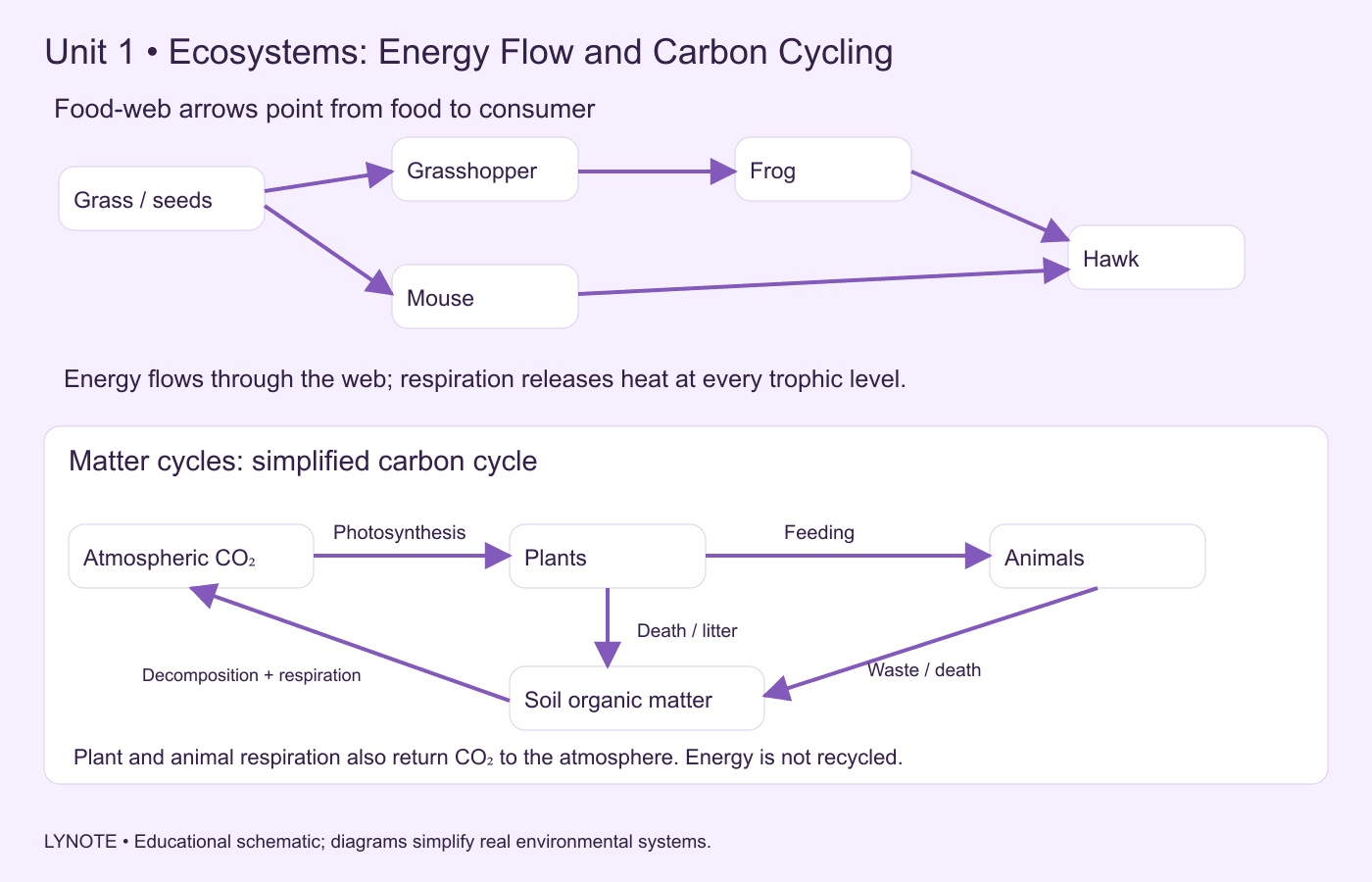
Unit 1 introduces ecosystems and the relationships between organisms and their physical environments. Your AP Environmental Science Unit 1 notes should focus on energy transfer, ecological relationships, biomes, productivity, and nutrient cycling.
Key Topics for Unit 1
- Introduction to Ecosystems: Understand biotic and abiotic components and how they interact.
- Terrestrial and Aquatic Biomes: Compare major ecosystems based on climate, vegetation, and environmental conditions.
- Primary Productivity: Understand how producers convert energy into organic matter.
- Nutrient Cycles: Review the carbon, nitrogen, phosphorus, and water cycles.
- Trophic Levels: Identify producers, primary consumers, secondary consumers, and higher-level consumers.
- Energy Flow: Understand how energy moves through food chains and food webs.
- The 10% Rule: Explain why only a small proportion of energy is transferred between trophic levels.
How to Organize AP Environmental Science Unit 1 Notes
Create a separate diagram for each major nutrient cycle. Label the processes involved and identify how nutrients move between the atmosphere, organisms, soil, and water.
For energy flow, draw a food chain and identify the trophic level of each organism. Include a short explanation of why available energy generally decreases at higher trophic levels.
Unit 1 Review Questions
- What is the difference between biotic and abiotic factors?
- How do terrestrial and aquatic biomes differ?
- What is the difference between gross primary productivity and net primary productivity?
- How does energy move through a food web?
- Why does less energy become available at higher trophic levels?
- How do human activities affect nutrient cycles?
AP Environmental Science Unit 2 Notes: The Living World: Biodiversity
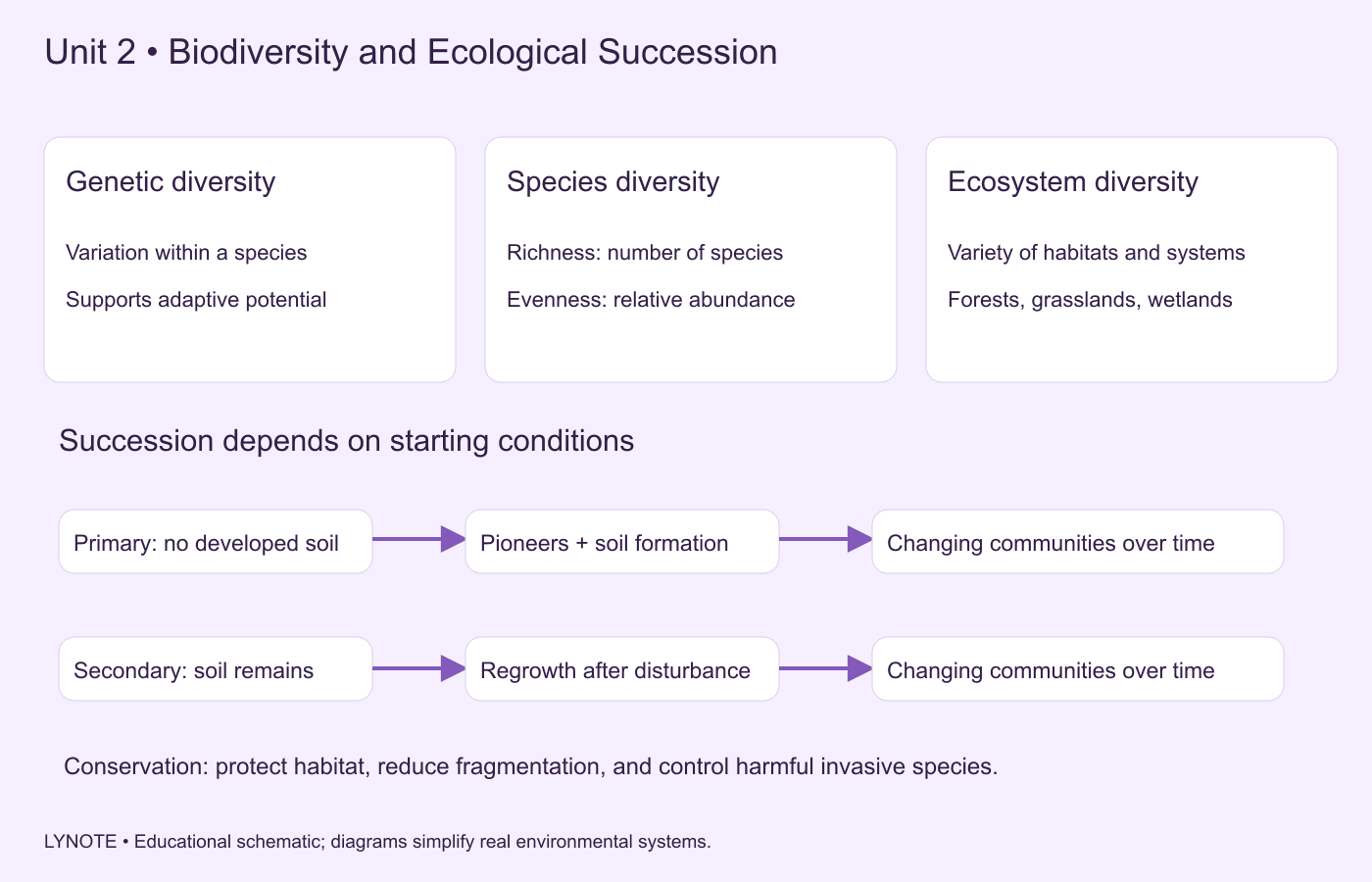
Unit 2 explores biodiversity and the importance of maintaining healthy ecosystems. Your AP Environmental Science Unit 2 notes should connect species diversity, ecosystem services, ecological tolerance, island biogeography, and ecological succession.
Key Topics for Unit 2
- Biodiversity: Understand genetic, species, and ecosystem diversity.
- Ecosystem Services: Identify provisioning, regulating, cultural, and supporting services.
- Island Biogeography: Explain how island size and distance from a mainland influence species richness.
- Ecological Tolerance: Understand how organisms respond to changes in environmental conditions.
- Natural Disruptions: Explore how disturbances such as fires, floods, and storms affect ecosystems.
- Ecological Succession: Compare primary and secondary succession.
Why Is Biodiversity Important?
Biodiversity contributes to ecosystem stability and supports essential environmental services. Diverse ecosystems can provide food, clean water, pollination, climate regulation, and other resources that support human and ecological well-being.
Your notes should include examples of how habitat loss, invasive species, pollution, and climate change affect biodiversity. Also explain how conservation efforts can protect vulnerable species and restore damaged ecosystems.
Unit 2 Review Questions
- What are the three main levels of biodiversity?
- How do ecosystem services benefit humans?
- How does island biogeography explain species richness?
- What is the difference between primary and secondary succession?
- How can ecological disturbances influence biodiversity?
AP Environmental Science Unit 3 Notes: Populations
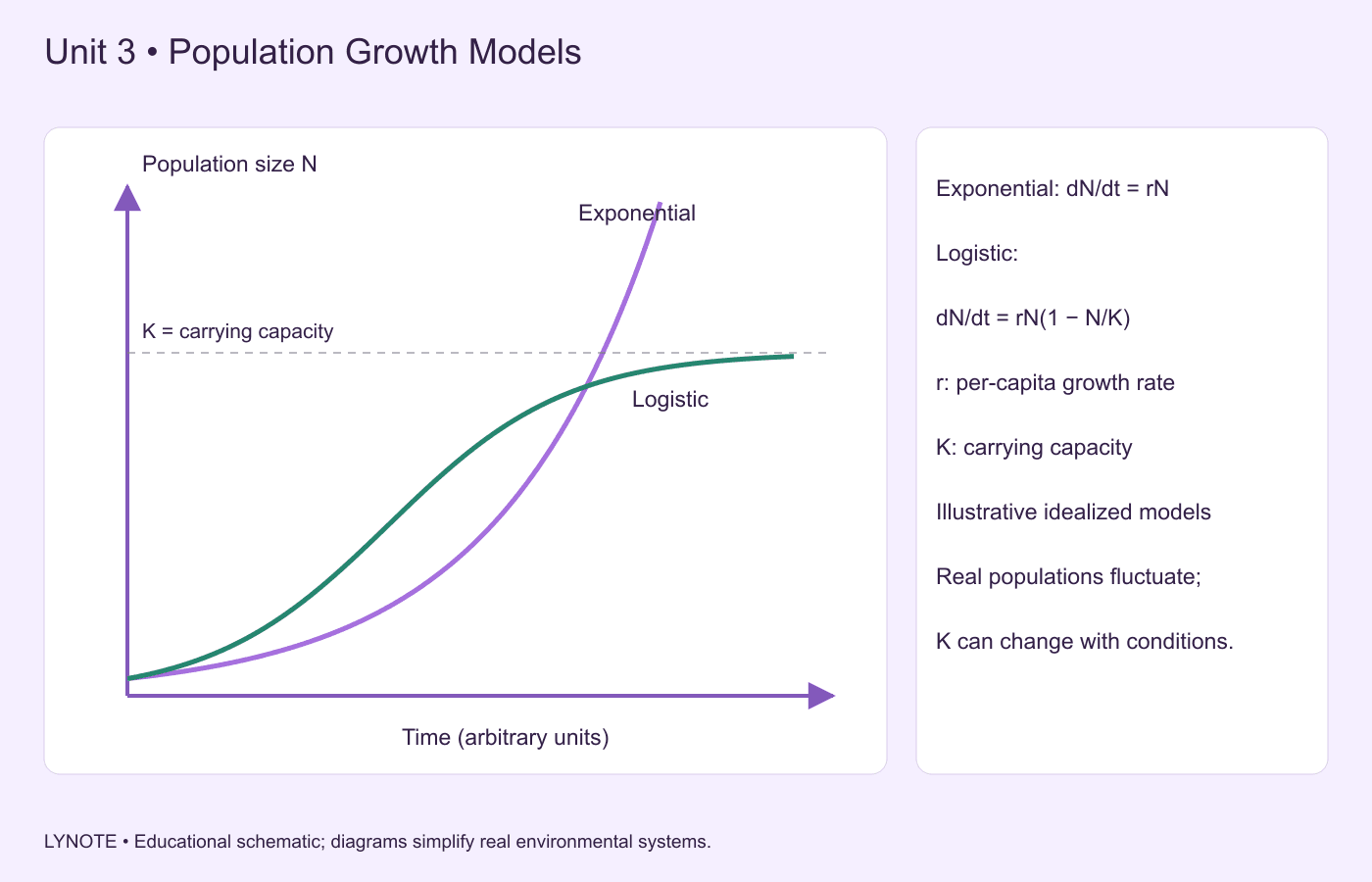
Unit 3 focuses on how populations change over time and how environmental factors influence population growth. Your notes should explain population dynamics, reproductive strategies, survivorship, carrying capacity, and human population trends.
Key Topics for Unit 3
- Generalist and Specialist Species: Compare species with broad environmental requirements and those with narrower ecological niches.
- Survivorship Curves: Understand Type I, Type II, and Type III survivorship patterns.
- Population Growth: Compare exponential and logistic growth.
- Carrying Capacity: Explain how resource availability limits population size.
- Age Structure Diagrams: Interpret population distributions by age and sex.
- Human Population Dynamics: Review birth rates, death rates, fertility, and demographic transition.
How to Study Population Growth
Draw exponential and logistic growth curves on the same page. Label the carrying capacity and explain why populations may grow rapidly when resources are abundant but stabilize as limiting factors become more important.
Practice interpreting age structure diagrams. These visual representations can help you predict whether a population is likely to grow, remain relatively stable, or decline.
AP Environmental Science Unit 4 Notes: Earth Systems and Resources
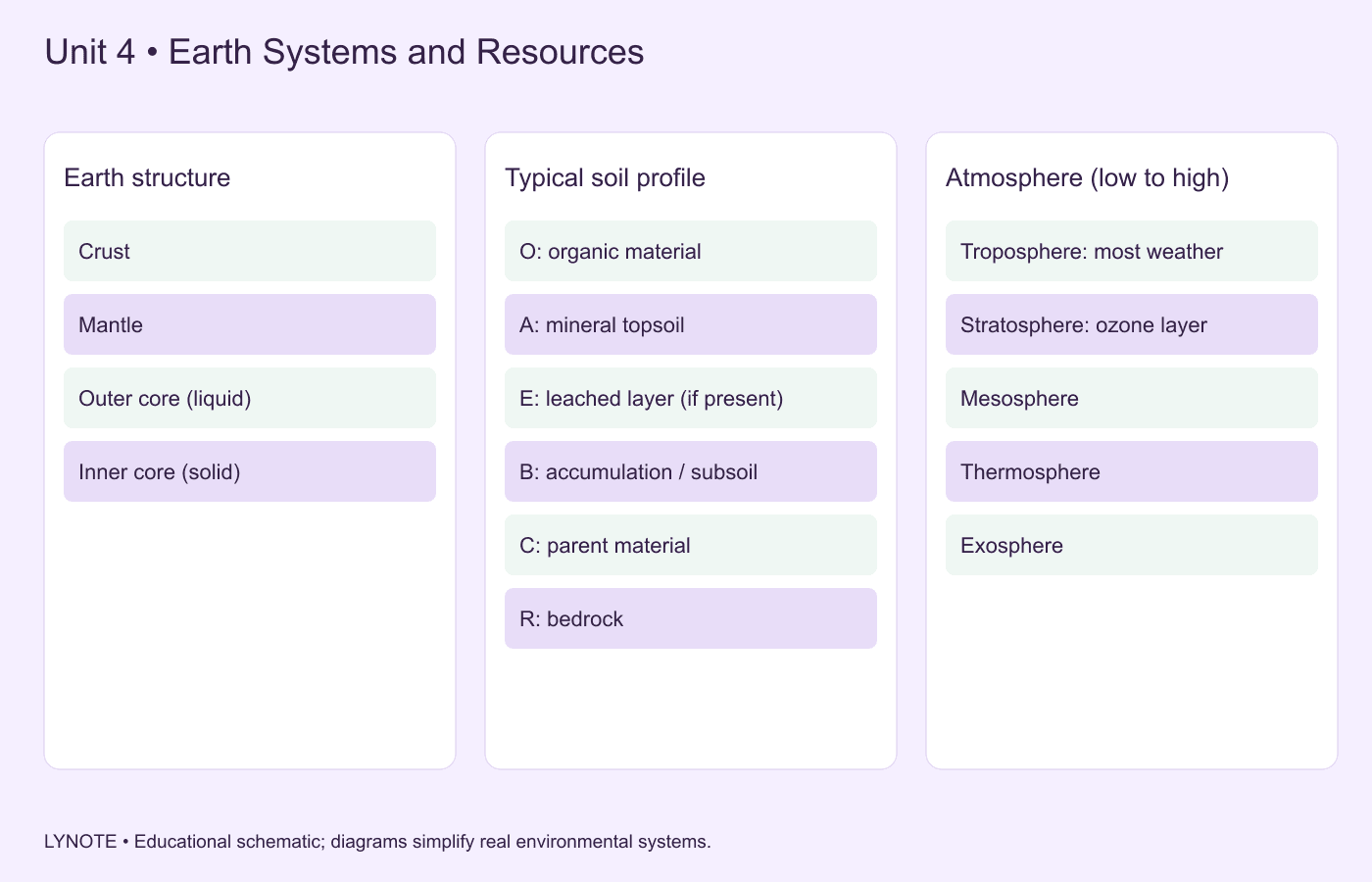
Unit 4 examines the natural systems that shape Earth's environment. Your AP Environmental Science Unit 4 notes should connect geology, soil, atmospheric circulation, climate, and natural processes.
Key Topics for Unit 4
- Plate Tectonics: Understand the movement of Earth's tectonic plates.
- Soil Formation: Review soil horizons, composition, and formation processes.
- Soil Erosion: Identify natural and human factors that accelerate soil loss.
- Earth's Atmosphere: Understand atmospheric layers and their characteristics.
- Global Wind Patterns: Review how uneven solar heating and Earth's rotation influence atmospheric circulation.
- Climate and Geography: Explain how latitude, elevation, and geographic features affect climate.
- El Niño and La Niña: Understand how changes in Pacific Ocean conditions influence global weather patterns.
How to Organize Unit 4 Notes
Use labeled diagrams to understand plate boundaries, soil profiles, and atmospheric circulation. For each process, identify its causes, major effects, and relevant environmental examples.
Create a comparison chart for El Niño and La Niña. Include differences in Pacific Ocean temperature patterns and their potential effects on precipitation and weather in different regions.
AP Environmental Science Unit 5 Notes: Land and Water Use
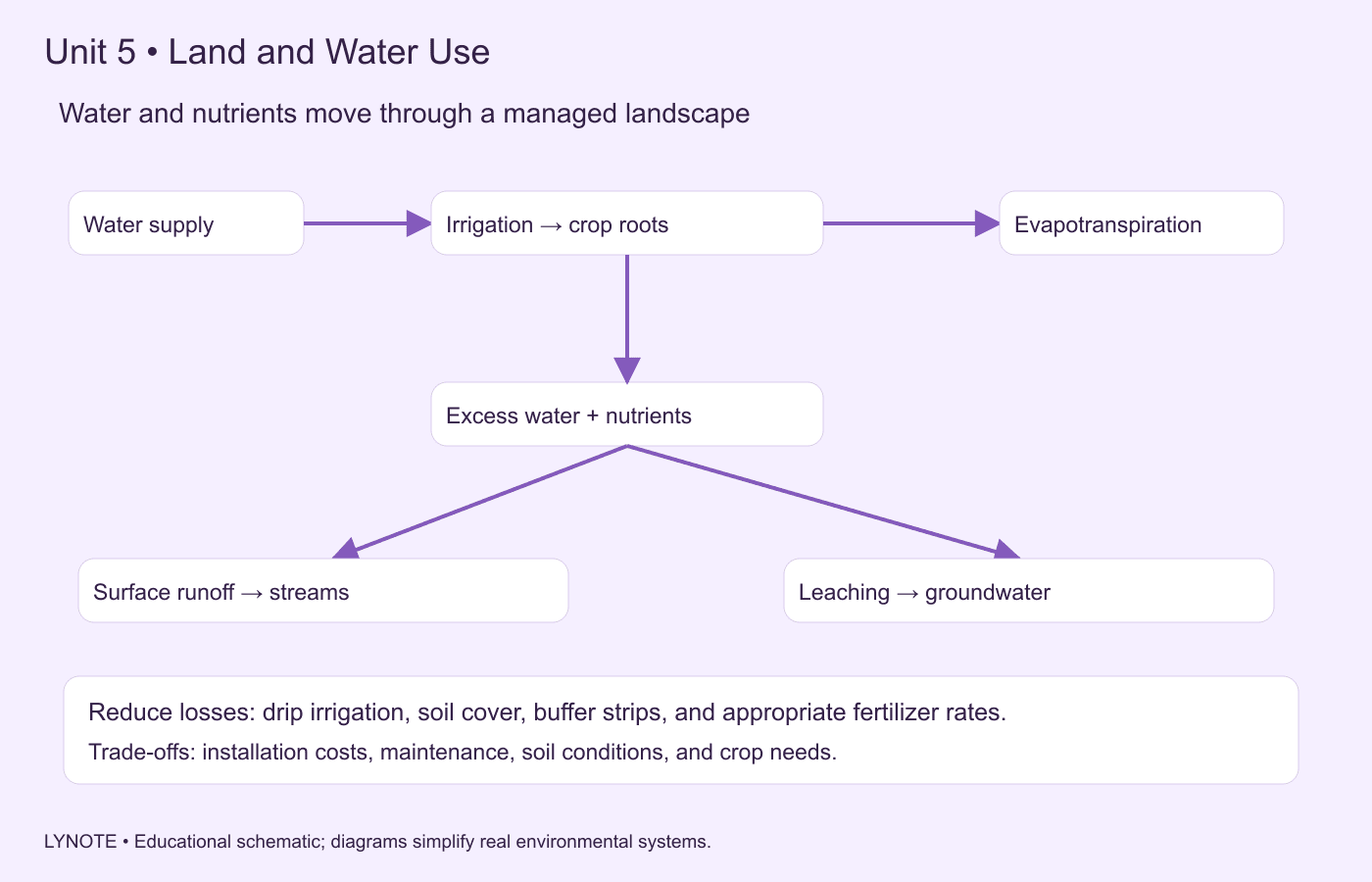
Unit 5 focuses on how humans use natural resources and modify ecosystems. Your AP Environmental Science Unit 5 notes should examine agriculture, forestry, fishing, mining, urbanization, and sustainable resource management.
Key Topics for Unit 5
- Tragedy of the Commons: Explain how shared resources can become overused.
- Green Revolution: Understand agricultural innovations and their environmental consequences.
- Irrigation: Compare flood, furrow, spray, and drip irrigation.
- Pest Control: Review chemical, biological, and integrated pest management.
- Food Production: Compare industrial agriculture and alternative farming approaches.
- Fishing and Aquaculture: Understand overfishing and sustainable seafood production.
- Mining: Identify environmental impacts of resource extraction.
- Urbanization: Examine habitat fragmentation and expanding ecological footprints.
- Sustainable Practices: Review crop rotation, soil conservation, and responsible resource use.
How to Create Unit 5 Comparison Notes
Use tables to compare different agricultural and resource-management methods. Include their benefits, environmental costs, and situations where each method may be appropriate.
For example, compare drip irrigation with flood irrigation. Record differences in water efficiency, installation costs, and potential environmental impacts.
AP Environmental Science Unit 6 Notes: Energy Resources and Consumption
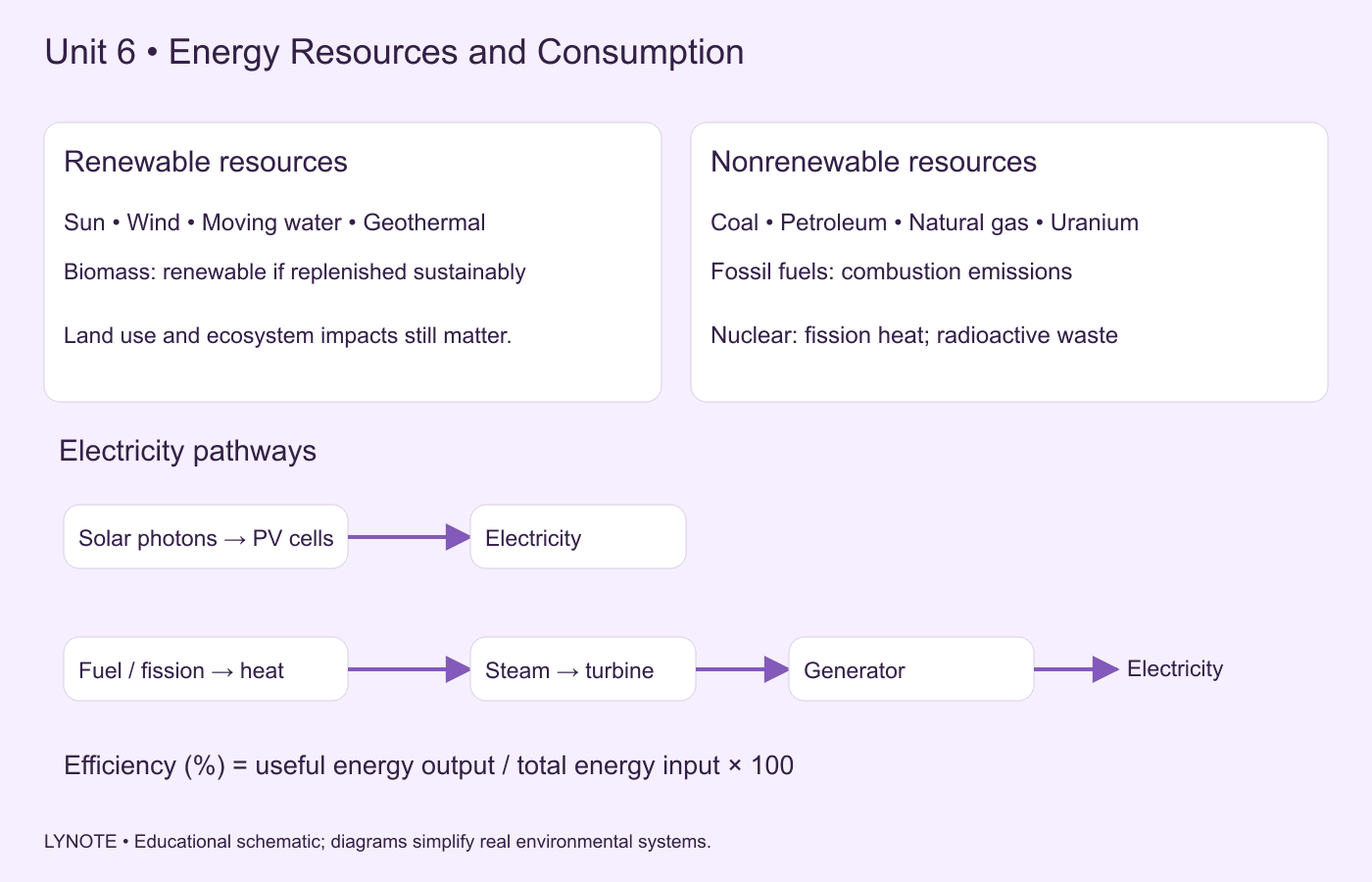
Unit 6 explores how energy is produced, distributed, and consumed. Your AP Environmental Science Unit 6 notes should distinguish renewable and nonrenewable energy resources and explain their environmental consequences.
Key Topics for Unit 6
- Fossil Fuels: Review coal, petroleum, and natural gas.
- Nuclear Energy: Understand nuclear fission, electricity generation, and radioactive waste.
- Solar Energy: Compare photovoltaic systems and solar thermal technologies.
- Wind Energy: Understand how wind turbines generate electricity.
- Hydroelectric Energy: Review how moving water produces electrical power.
- Geothermal Energy: Explore the use of heat from Earth's interior.
- Biomass and Biofuels: Understand energy derived from organic materials.
- Energy Conservation: Examine ways to improve efficiency and reduce consumption.
Renewable vs. Nonrenewable Energy
Create a comparison table for major energy resources. Include availability, reliability, emissions, waste, land use, and environmental impacts.
Do not assume renewable energy has no environmental costs. Solar farms, wind facilities, and hydroelectric projects can also affect habitats and land use.
AP Environmental Science Unit 7 Notes: Atmospheric Pollution
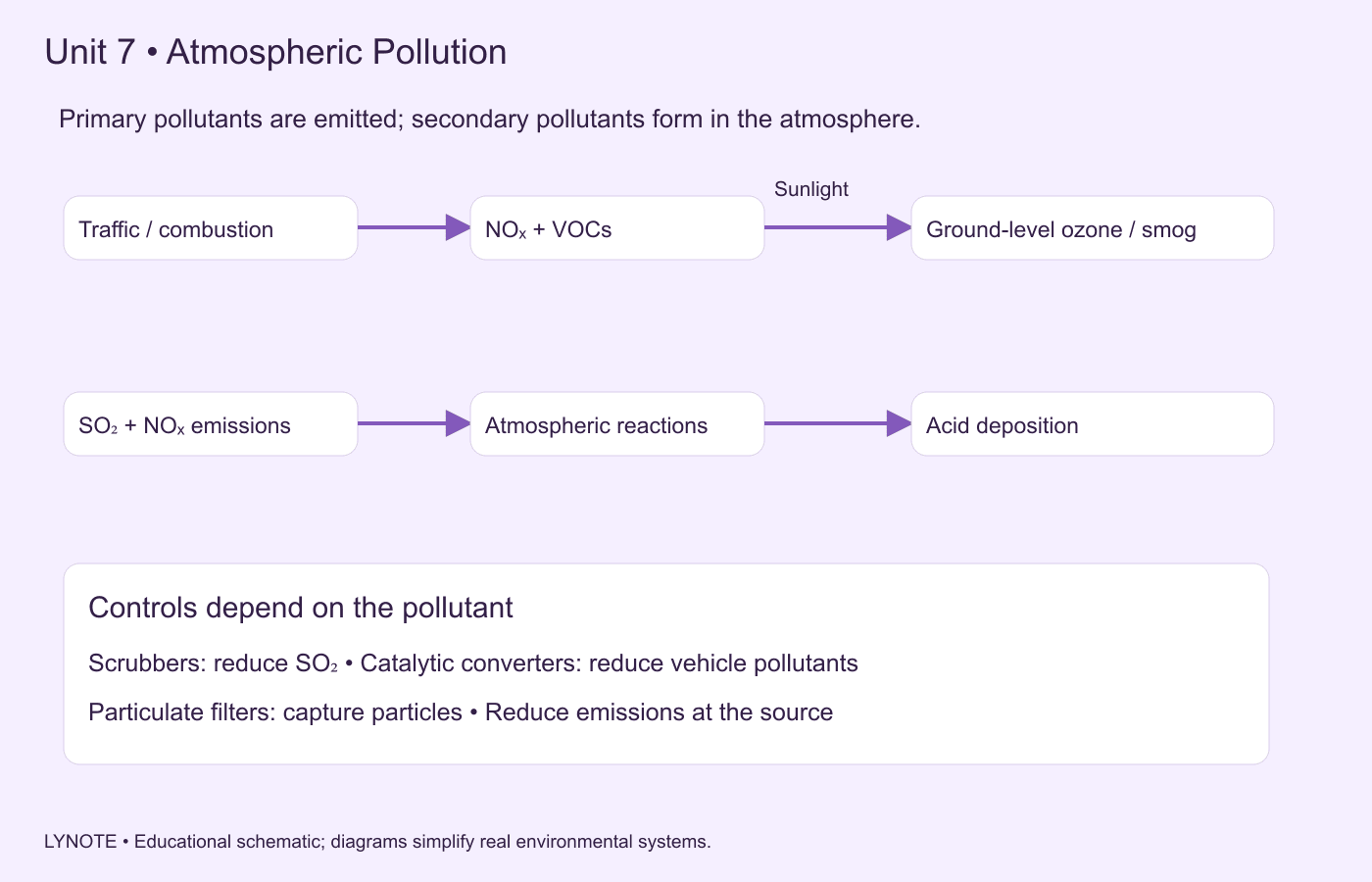
Unit 7 focuses on air pollution and its effects on environmental and human health. Your AP Environmental Science Unit 7 notes should identify pollution sources, atmospheric processes, and methods of reducing harmful emissions.
Key Topics for Unit 7
- Air Pollution: Understand primary and secondary pollutants.
- Photochemical Smog: Explain how sunlight and pollutants contribute to its formation.
- Indoor Air Pollution: Review common sources and potential health effects.
- Pollution Control: Explore technologies and policies that reduce emissions.
- Acid Rain: Understand how sulfur dioxide and nitrogen oxides contribute to acid deposition.
- Noise Pollution: Identify sources and environmental consequences.
How to Study Atmospheric Pollution
Organize notes by pollutant, source, environmental effect, and possible solution. This format makes it easier to compare different types of air pollution.
For example, distinguish primary pollutants released directly into the atmosphere from secondary pollutants formed through atmospheric chemical reactions. Include real-world examples to reinforce the difference.
AP Environmental Science Unit 8 Notes: Aquatic and Terrestrial Pollution
Unit 8 examines pollution affecting land and water environments. Your AP Environmental Science Unit 8 notes should cover pollution sources, waste management, water contamination, human health, and ecosystem impacts.
Key Topics for Unit 8
- Pollution Sources: Compare point-source and nonpoint-source pollution.
- Water Pollution: Understand agricultural runoff, sewage, industrial discharge, and contamination.
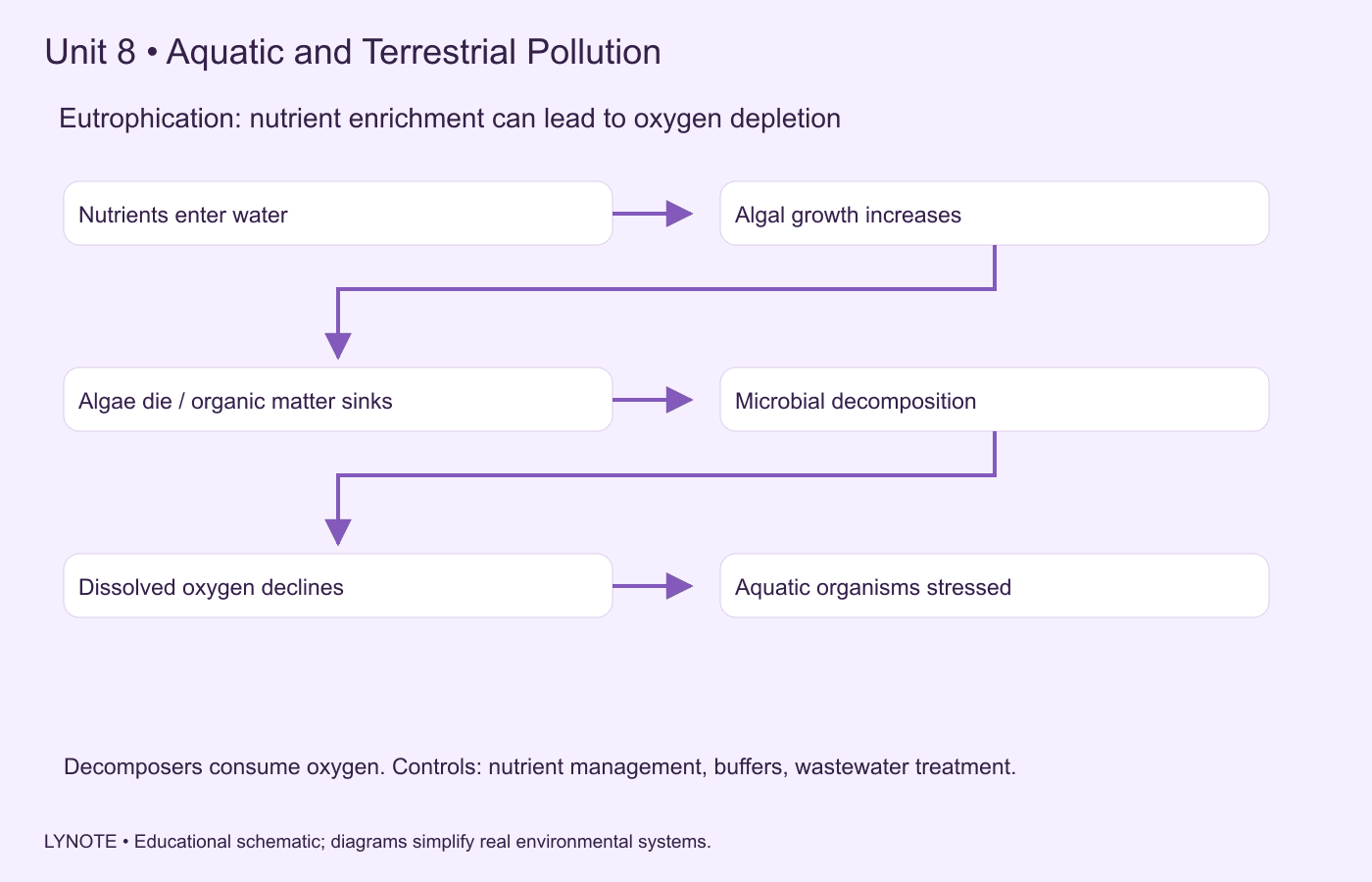
- Eutrophication: Explain how excess nutrients can contribute to algal blooms and oxygen depletion.
- Thermal Pollution: Understand how changes in water temperature affect aquatic organisms.
- Solid Waste: Review landfills, incineration, recycling, and waste reduction.
- Human Health: Explore environmental exposure to pollutants and related health risks.
- Pathogens: Understand how infectious agents can spread through contaminated environments.
Create a Pollution Comparison Chart
Group pollutants according to their source, environmental pathway, and consequences. Include prevention and cleanup methods so you can connect environmental problems with possible solutions.
For aquatic pollution, pay particular attention to nutrient runoff and eutrophication. Draw a simple process diagram showing how excess nutrients can increase algal growth and contribute to low dissolved oxygen.
AP Environmental Science Unit 9 Notes: Global Change
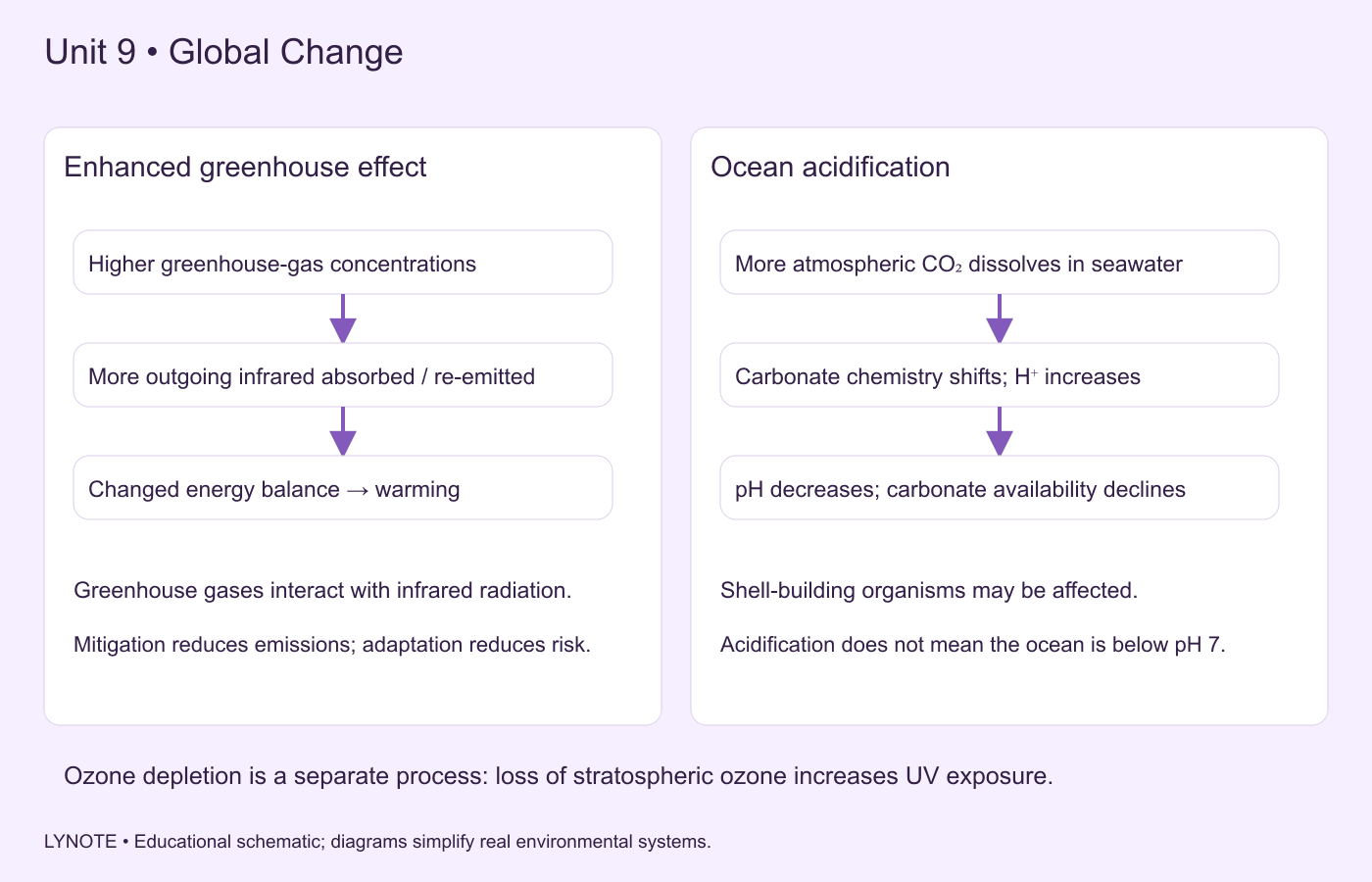
Unit 9 examines large-scale environmental changes caused by natural processes and human activities. It is particularly important because it carries the highest multiple-choice exam weighting range in the current course framework.
Key Topics for Unit 9
- Ozone Depletion: Understand the role of ozone in the stratosphere and how certain chemicals contribute to its depletion.
- Climate Change: Review greenhouse gases, the enhanced greenhouse effect, and evidence of changing climate patterns.
- Ocean Warming: Explain how increasing ocean temperatures affect marine ecosystems.
- Ocean Acidification: Understand how increased atmospheric carbon dioxide can affect ocean chemistry.
- Invasive Species: Examine how introduced species can disrupt ecosystems.
- Human Impacts on Biodiversity: Connect habitat loss, pollution, resource consumption, and climate change to biodiversity decline.
How to Review Global Change
Create a cause-and-effect table for major environmental challenges. For each issue, record its causes, scientific evidence, environmental consequences, and possible mitigation strategies.
Practice evaluating solutions rather than simply listing them. For example, compare reducing greenhouse gas emissions with adapting infrastructure to the effects of climate change.
AP Environmental Science Chapter Notes: How to Organize Textbook Readings
Many students use textbooks, teacher presentations, guided worksheets, and supplementary reading materials to study environmental science. Chapter numbers can differ between textbook editions, so organize your notes around chapter titles and learning objectives as well as the official AP units.
A useful chapter note should include key terms, scientific processes, diagrams, examples, and review questions. This makes it easier to connect textbook readings with the larger AP course framework.
AP Environmental Science Chapter 1 Notes
Start by checking the exact title and objectives of Chapter 1 in your assigned textbook. Introductory chapters commonly introduce environmental science, ecological principles, sustainability, natural resources, or scientific thinking, depending on the book and edition.
Record the central concepts and define important terminology in your own words. Add examples that connect environmental science to real-world resource use and ecological challenges.
AP Environmental Science Chapter 2 Notes
Chapter 2 also varies between textbooks and editions. Check the chapter title before creating a study guide or searching for matching AP Environmental Science notes.
Organize the reading into definitions, diagrams, scientific processes, and application questions. Then connect the material to the relevant AP unit instead of assuming that every textbook follows the same chapter sequence.
How to Make AP Environmental Science Textbook Notes
Use a consistent structure for every chapter:
- Learning Objectives: What should you understand after reading?
- Key Vocabulary: Important terms and scientific definitions.
- Environmental Processes: How natural systems and human activities interact.
- Diagrams: Models, cycles, food webs, and environmental processes.
- Real-World Examples: Environmental issues and case studies.
- Review Questions: Questions that require explanation and application.
This approach works with different environmental science textbooks while keeping your notes aligned with the current AP framework.
AP Environmental Science Guided Notes and Review Resources
Guided notes provide a structured way to follow lectures, textbook readings, and classroom presentations. They usually include headings, partially completed explanations, key terms, diagrams, or questions that students complete during a lesson.
How to Use AP Environmental Science Guided Notes
Start by reviewing the headings and learning objectives before a lesson. Identify the main environmental processes and vocabulary you expect to encounter.
During the lesson, complete the missing explanations and add examples from your teacher's discussion. Afterward, turn important headings into questions so you can use the notes for active recall.
What About AP Environmental Science Cliff Notes?
Students searching for AP Environmental Science Cliff Notes or Cliff Notes AP Environmental Science may be looking for concise chapter summaries and simplified explanations. These resources can help with a quick review, but summaries should not replace the full course materials.
Environmental science often requires understanding relationships between multiple systems. Use condensed notes to revisit key ideas, then practice interpreting diagrams, environmental data, and scientific scenarios.
AP Environmental Science Notes PDF
PDF study guides are convenient because they can bring together formulas, diagrams, vocabulary, and chapter summaries in one document. However, always check the source, publication date, and course alignment before relying on a downloaded resource.
Compare PDF notes with your teacher's materials and the latest College Board course framework. This helps ensure that important concepts and exam skills are not missing.
How to Prepare for the AP Environmental Science Exam with Effective Study Notes
AP Environmental Science exam preparation requires more than memorizing definitions. You need to explain environmental processes, interpret data, analyze research, perform calculations, and propose solutions supported by evidence.
The current exam framework emphasizes both scientific understanding and practical application. Your notes should therefore help you connect concepts with quantitative reasoning and environmental problem-solving.
For the 2026–27 school year, the College Board exam overview specifies a fully digital Bluebook exam: 80 multiple-choice questions in 90 minutes (60% of the score) and three free-response questions in 70 minutes (40%). The free-response tasks cover designing an investigation, analyzing and interpreting quantitative data, and analyzing an environmental problem through calculations. Check the current course framework and official testing guidance before exam day.
1. Review All Nine AP Environmental Science Units
Organize your review around the official nine-unit framework. Each unit has a different multiple-choice weighting range, so use the percentages to guide your revision schedule.
| Unit | Official Topic | Multiple-Choice Weighting |
|---|---|---|
| Unit 1 | The Living World: Ecosystems | 6%–8% |
| Unit 2 | The Living World: Biodiversity | 6%–8% |
| Unit 3 | Populations | 10%–15% |
| Unit 4 | Earth Systems and Resources | 10%–15% |
| Unit 5 | Land and Water Use | 10%–15% |
| Unit 6 | Energy Resources and Consumption | 10%–15% |
| Unit 7 | Atmospheric Pollution | 7%–10% |
| Unit 8 | Aquatic and Terrestrial Pollution | 7%–10% |
| Unit 9 | Global Change | 15%–20% |
Unit 9 deserves particular attention because it has the highest multiple-choice weighting range. However, all nine units should be included in your preparation.
2. Create an Environmental Science Formula Sheet
Some AP Environmental Science questions require mathematical calculations. Organize relevant equations into a dedicated section and include the meaning of each variable.
Common quantitative relationships to review include:
- Population Change: Births + Immigration − Deaths − Emigration.
- Population Growth Rate: Calculate the change in population relative to the starting population and time period.
- Percent Change: ((New Value − Original Value) / Original Value) × 100.
- Density: Population or mass divided by the relevant area or volume.
- Energy Efficiency: Useful energy output divided by total energy input, multiplied by 100%.
- Half-Life: The time required for half of a radioactive sample to decay.
Check the exact formula and units required by your course. Practice converting units and explaining what a calculated value means in an environmental context.
3. Practice Interpreting Environmental Graphs and Data
Environmental science questions frequently use graphs, tables, maps, and other visual representations. Practice identifying trends, comparing variables, and explaining what the data suggest.
Pay attention to axes, units, sample sizes, and time periods. A correct interpretation should describe the evidence without claiming more than the data can support.
4. Understand Environmental Research and Experiments
Review how environmental scientists investigate ecological questions. Your notes should include hypotheses, independent and dependent variables, control groups, sampling methods, and potential limitations.
Practice evaluating research designs and explaining whether the evidence supports a particular conclusion. Also consider how environmental conditions and sampling limitations can affect research findings.
5. Practice Environmental Problem-Solving
Many AP Environmental Science questions ask students to propose or justify solutions to environmental problems. Prepare by connecting each major issue to its causes, effects, and possible interventions.
For example, when studying water pollution, compare reducing fertilizer runoff, improving wastewater treatment, and restoring wetlands. Explain the benefits and limitations of each approach.
6. Prepare for Free-Response Questions
The AP Environmental Science exam includes free-response questions that require students to apply scientific concepts and communicate their reasoning. Practice designing investigations, interpreting quantitative data, and performing calculations in environmental scenarios.
Show your work clearly when solving mathematical problems. When proposing a solution, explain how it addresses the environmental issue rather than simply naming a possible action.
7. Use Active Recall and Review Questions
Turn key terms and scientific processes into questions. For example, instead of rereading the nitrogen cycle, try explaining the major processes from memory.
Flashcards are useful for definitions and short relationships. For more complex concepts, combine them with diagrams, data interpretation, and written explanations.
8. Review Mistakes and Identify Weak Units
After completing practice questions, record why an answer was incorrect. Common mistakes include confusing similar environmental terms, overlooking graph units, choosing the wrong formula, or proposing solutions that do not address the stated problem.
Group mistakes by unit and question type. Revisit the relevant notes and try a new problem to check whether your understanding has improved.
AP Environmental Science Exam Preparation Checklist
- Review all nine official AP Environmental Science units.
- Understand ecosystems, food webs, and nutrient cycles.
- Review biodiversity and ecological succession.
- Practice population growth and demographic calculations.
- Understand Earth systems, soil, climate, and atmospheric processes.
- Compare land and water use practices.
- Review renewable and nonrenewable energy sources.
- Understand atmospheric, aquatic, and terrestrial pollution.
- Review global climate change and biodiversity impacts.
- Practice quantitative calculations and unit conversions.
- Interpret environmental graphs, tables, and research findings.
- Complete multiple-choice and free-response practice.
How to Create AP Environmental Science Notes with Lynote AI Note Taker
AP Environmental Science students often work with multiple learning materials, including textbook chapters, lecture slides, guided notes, laboratory handouts, recorded lessons, and exam review packets. Organizing these resources into clear study notes can take considerable time.
Lynote AI Note Generator helps turn supported learning materials into structured, editable notes. You can organize your environmental science resources, review key concepts, and prepare study materials without manually rewriting every document.
Step 1. Upload Your AP Environmental Science Study Materials
Start by uploading your AP Environmental Science learning resources to Lynote. Supported materials include PDFs, documents, presentations, images, audio recordings, and videos.
For example, upload an ecosystems lecture PDF, a biodiversity presentation, or a recorded explanation of climate change. You can also organize textbook readings and review materials that you are authorized to process.
Step 2. Generate Structured AP Environmental Science Notes

Actual Lynote interface showing generic demonstration content.
Use Lynote to organize information from your uploaded materials into structured notes. The generated content can help group environmental concepts, scientific processes, terminology, and supporting explanations.
You can organize your notes around:
- Key Concepts: Ecosystems, biodiversity, populations, and sustainability.
- Environmental Processes: Nutrient cycles, energy transfer, and ecological succession.
- Scientific Data: Measurements, graphs, calculations, and research findings.
- Environmental Issues: Pollution, resource consumption, and climate change.
- Unit Summaries: Concise reviews of the topics covered in each lesson.
After generation, use the built-in editor to refine explanations and add your own class examples. Check scientific terminology, equations, and numerical calculations against your original materials.
Step 3. Clarify Difficult Environmental Science Concepts with AI Chat

Actual Lynote interface showing generic demonstration content.
Some environmental processes involve several connected scientific ideas. Use Lynote AI Chat to ask questions about information contained in your uploaded study materials.
For example, if your source covers nutrient cycles, you could ask how nitrogen moves through ecosystems. If your notes discuss biodiversity, you could ask for a comparison of primary and secondary succession.
AI Chat helps you revisit source explanations without searching through an entire textbook chapter. For questions requiring information beyond your uploaded materials, consult your textbook, teacher, or official course resources.
Step 4. Create Flashcards for AP Environmental Science Review
Actual Lynote interface showing generic demonstration content.
Environmental science includes many scientific terms, processes, and relationships that benefit from repeated review. Lynote Flashcards can turn important information from your notes into question-and-answer cards.
For example:
Question: What is the difference between gross primary productivity and net primary productivity?
Answer: Gross primary productivity is the total rate at which producers capture energy through photosynthesis. Net primary productivity is the energy remaining after producers use some energy for cellular respiration.
Question: What is carrying capacity?
Answer: Carrying capacity is the maximum population size an environment can sustainably support under particular conditions.
Question: What is the difference between primary and secondary succession?
Answer: Primary succession begins in an area without developed soil, while secondary succession occurs where soil remains after a disturbance.
Question: What is eutrophication?
Answer: Eutrophication is nutrient enrichment of a body of water that can promote excessive algal growth and contribute to oxygen depletion.
Use Flashcards to review important definitions and processes, then practice interpreting data and answering environmental problem-solving questions.
Build a More Organized AP Environmental Science Study Routine
You do not need to wait until the week before the AP exam to organize your materials. Use Lynote throughout the course to build a collection of structured notes from your assigned readings, lectures, and study resources.
After each lesson, generate notes, correct important details, and add your own diagrams or examples. Before an exam, revisit the material, ask questions about difficult concepts, and use Flashcards to test your understanding.
Combine this workflow with laboratory investigations, field observations, quantitative practice, and official AP exam questions. Lynote helps organize your learning materials, while your own practice builds the scientific reasoning needed to analyze environmental problems.
Create Your AP Environmental Science Notes with Lynote AI
Spend less time manually organizing scattered environmental science resources and more time understanding ecosystems, interpreting data, and developing solutions to environmental challenges.
Common AP Environmental Science Study Mistakes to Avoid
Memorizing Environmental Terms Without Understanding Processes
Environmental science concepts are interconnected. Memorizing the definition of a nutrient cycle is less useful if you cannot explain how nutrients move through different parts of an ecosystem.
Better approach: Draw process diagrams and add short explanations of the cause-and-effect relationships involved.
Ignoring Quantitative Practice
Some students focus heavily on vocabulary and overlook calculations. This can make questions involving population growth, percentages, energy, or environmental measurements more challenging.
Better approach: Keep formulas in one place and practice applying them with correct units.
Studying Units as Completely Separate Topics
The nine AP units are connected through shared environmental processes. For example, biodiversity can be affected by land use, pollution, population growth, and global climate change.
Better approach: Add cross-unit connections to your notes so you can explain how one environmental issue influences another.
Relying Only on Condensed Study Guides
Short summaries can help you review, but they may leave out research methods, scientific evidence, and detailed explanations. Different textbooks and editions may also organize material differently.
Better approach: Use condensed notes alongside your assigned textbook, teacher materials, laboratory work, and the current College Board framework.
Reviewing Without Practicing Application Questions
Recognizing a definition is different from applying it to an environmental scenario. Students need practice interpreting data, evaluating evidence, and proposing solutions.
Better approach: Combine vocabulary review with graph interpretation, research analysis, calculations, and free-response practice.
Conclusion: Build AP Environmental Science Notes That Connect the Whole Course
Effective AP environmental science notes connect ecosystems, biodiversity, populations, natural resources, energy, pollution, and global change. Organize each topic with clear definitions, diagrams, scientific processes, calculations, and real-world examples so you can understand how environmental systems interact.
Build your notes throughout the course, practice interpreting evidence, and prepare for both multiple-choice and free-response questions. To turn your own lectures, PDFs, and study materials into editable notes, try Lynote AI Note Generator and create a more organized AP Environmental Science study routine.
Frequently Asked Questions About AP Environmental Science Notes
What Are the Nine Units of AP Environmental Science?
The current course framework includes The Living World: Ecosystems, The Living World: Biodiversity, Populations, Earth Systems and Resources, Land and Water Use, Energy Resources and Consumption, Atmospheric Pollution, Aquatic and Terrestrial Pollution, and Global Change.
Organize your study notes around these nine units while following your teacher's course sequence.
What Should AP Environmental Science Unit 1 Notes Include?
Unit 1 covers ecosystems, biomes, primary productivity, nutrient cycles, trophic levels, and energy flow. Include diagrams of food webs and the carbon, nitrogen, phosphorus, and water cycles.
What Should AP Environmental Science Unit 2 Notes Cover?
Unit 2 focuses on biodiversity, ecosystem services, island biogeography, ecological tolerance, natural disruptions, and ecological succession. Compare primary and secondary succession and understand why biodiversity supports ecosystem health.
Where Can I Find AP Environmental Science Notes PDF Resources?
Students may find PDF notes through teachers, school learning platforms, textbooks, and educational websites. Check the source and publication date, then compare the content with the current College Board framework.
Are AP Environmental Science Cliff Notes Enough for the Exam?
Condensed study guides can help you review key ideas quickly, but they should not replace full course materials. AP Environmental Science also tests data analysis, research interpretation, calculations, and environmental problem-solving.
What Are AP Environmental Science Guided Notes?
Guided notes are structured learning materials that help students follow lectures or textbook readings. They may include headings, partially completed explanations, vocabulary, diagrams, and review questions.
What Should AP Environmental Science Chapter 1 Notes Include?
Chapter 1 depends on the textbook and edition being used. Check the assigned chapter title and learning objectives, then organize notes around its key environmental concepts, terminology, and examples.
Are AP Environmental Science Chapter Notes the Same Across Textbooks?
No. Different textbooks may use different chapter numbers, titles, and teaching sequences. Connect your textbook readings to the current nine-unit AP framework rather than relying on chapter numbers alone.
What Is the Friedland and Relyea Environmental Science for AP Textbook?
Friedland and Relyea's Environmental Science for AP is a textbook resource used by some AP Environmental Science students and teachers. Chapter organization and content details should be checked against the specific edition assigned in your course.
How Can I Make AP Environmental Science Notes More Effective?
Use a consistent structure that includes definitions, diagrams, scientific processes, real-world examples, and review questions. Practice explaining environmental relationships instead of only copying textbook information.
Can Lynote Help Me Create AP Environmental Science Study Notes?
Yes. Lynote can generate structured notes from supported learning materials that you provide, including PDFs, documents, presentations, images, audio, and videos.
You can edit the generated notes, ask AI Chat questions based on uploaded sources, and create Flashcards for review. Verify scientific terminology, calculations, and environmental explanations against your original materials.
Can AI-Generated Environmental Science Notes Replace Lab Work?
No. AI-generated notes can help organize explanations and study resources, but they do not replace laboratory investigations, field observations, data collection, or scientific analysis.
Use your notes alongside assigned experiments, teacher guidance, and official AP practice materials.

Written by Hamza Razzaq
Technical Writer
Hamza creates hands-on explainers and technical guides that make AI writing tools easier to understand and use. View all articles →