
AP Psychology Notes: Study All 5 Units and Prepare for the Exam

Preparing for AP Psychology means understanding how biological, cognitive, developmental, social, and environmental factors shape behavior. Well-organized AP psychology notes help you connect theories with real-life examples, distinguish similar concepts, interpret research, and prepare for the exam's multiple-choice and free-response questions.
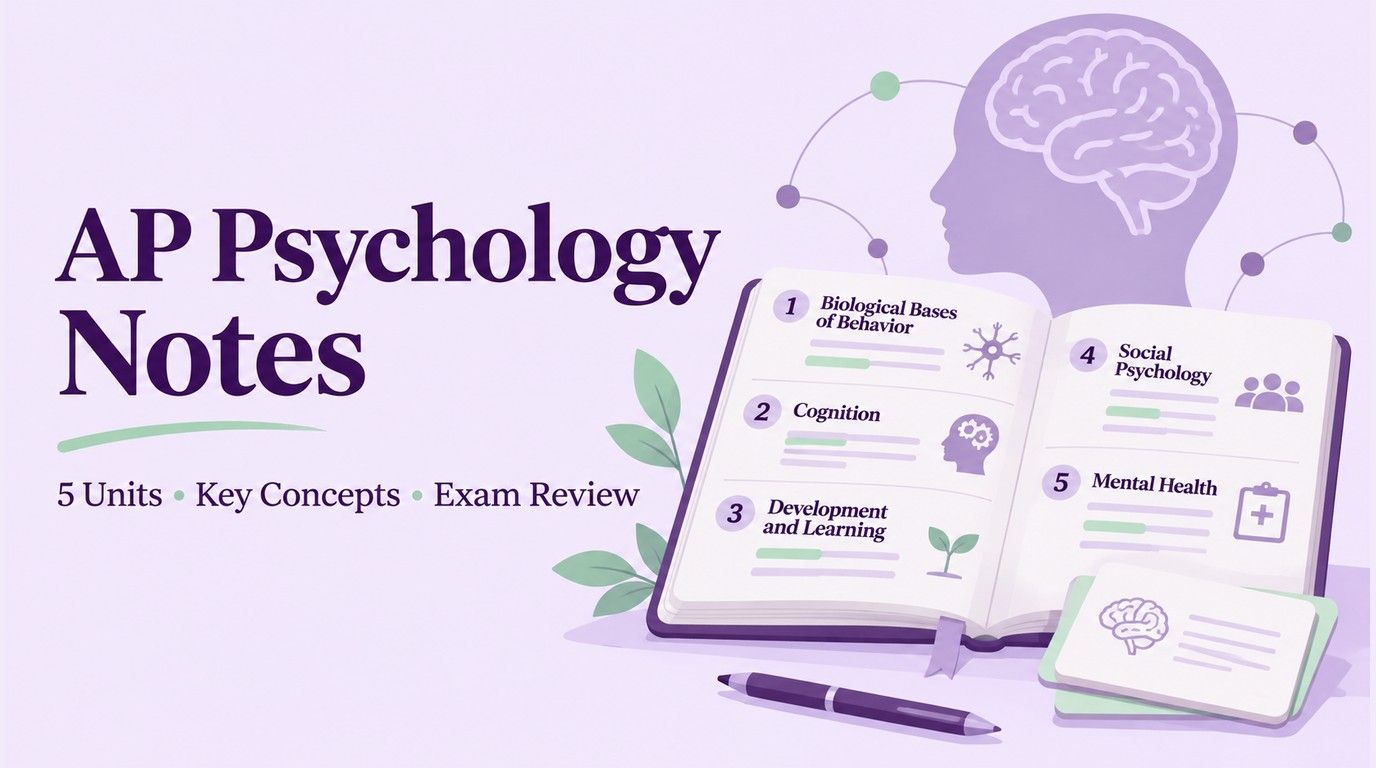
This guide follows the current five-unit AP Psychology framework, explains what to include in your study notes, and shares practical review strategies. It also shows how to turn your own readings, class slides, and lecture materials into editable study resources with Lynote AI Note Generator.
TL;DR: How to Make AP Psychology Notes More Useful
- Organize your notes around the five current AP Psychology units.
- Connect every key term to a clear definition, an example, and the psychological concept it illustrates.
- Compare theories and research findings instead of memorizing isolated names.
- Keep research methods, variables, ethics, and data interpretation in a dedicated section.
- Use active recall and application questions to test whether you can use concepts in new scenarios.
- Prepare specifically for the Article Analysis Question (AAQ) and Evidence-Based Question (EBQ).
- Use Lynote to structure your own supported learning materials, then review and edit the generated notes.
What Should AP Psychology Notes Include?
AP Psychology covers concepts from neurons and memory to personality, social behavior, and psychological disorders. Useful psychology AP notes should help you understand what each concept means and how psychologists use evidence to study it.
For each concept, record its definition, an example, a related theory or study, and a question that asks you to apply the idea. This creates a consistent structure for class notes and later exam review.
A Simple AP Psychology Note-Taking Template
-
Key term: Write the concept or theory.
-
Definition: Explain it accurately in your own words.
-
Example: Connect it to a realistic situation.
-
Research connection: Note a relevant method, finding, or limitation.
-
Comparison: Identify a similar concept and explain the difference.
-
Review question: Create a prompt that requires application, not just recall.
AP Psychology Notes vs. Memorizing Definitions
Memorizing definitions can help you recognize vocabulary, but the AP exam also asks you to apply concepts to scenarios and evaluate research. Knowing the definition of classical conditioning is different from identifying the conditioned stimulus in an unfamiliar example.
Add a short scenario to important terms. This makes your notes more useful for application questions and helps distinguish concepts that sound similar.
AP Psychology Unit 1 Notes: Biological Bases of Behavior
Unit 1 explores how biological processes interact with the environment to influence behavior and mental processes. Your AP Psychology Unit 1 notes should connect heredity, the nervous system, neurons, the brain, sleep, and sensation.
Key Topics for Unit 1
- Heredity and environment: Explain how inherited traits, environmental influences, and evolutionary processes interact in shaping behavior.
- Nervous system: Distinguish the central and peripheral nervous systems and understand major divisions of the peripheral nervous system.
- Neurons: Identify dendrites, the cell body, axon, myelin sheath, and terminal buttons.
- Neural communication: Review action potentials, neurotransmitters, synapses, and the influence of psychoactive substances.
- Brain structures: Connect major brain regions and structures with their functions.
- Sleep: Review sleep stages, circadian rhythms, and factors that influence sleep.
- Sensation: Understand sensory thresholds, transduction, and processes involved in detecting stimuli.
How to Organize Unit 1 Notes
Use labeled diagrams to review the neuron, nervous system, and major brain structures. Add a short explanation beside each label rather than relying on a diagram alone.
Create a comparison table for neurotransmitters and their commonly discussed functions. Check the context carefully because their effects depend on receptors, pathways, and brain regions.
Unit 1 Review Questions
- How do heredity and environment interact to influence behavior?
- What happens when a neuron sends a signal?
- How do the central and peripheral nervous systems differ?
- How can sleep and circadian rhythms affect daily functioning?
- What is the difference between sensation and perception?
AP Psychology Unit 2 Notes: Cognition
Unit 2 focuses on mental processes involved in perception, thinking, problem-solving, memory, and intelligence. Your AP Psychology Unit 2 notes should explain how people process information, form memories, make decisions, and measure cognitive abilities.
Perception and Thinking
Review how the brain organizes and interprets sensory information. Include perceptual organization, perceptual constancy, attention, and the influence of expectations on perception.
For thinking and decision-making, organize notes around problem-solving strategies, heuristics, mental sets, confirmation bias, and common judgment errors. Add a real-life example to each concept so you can recognize it in a new scenario.
AP Psychology Memory Notes
Memory is a major part of cognition and deserves its own structured section. Organize your AP psychology memory notes around encoding, storage, retrieval, forgetting, and memory errors.
- Encoding: How information is transformed into a form that can be stored.
- Storage: How information is retained over time.
- Retrieval: How stored information is accessed.
- Working memory: The limited-capacity system used to hold and manipulate information.
- Long-term memory: The relatively durable storage of information.
- Forgetting: Processes and conditions that make stored information difficult to retrieve.
- Memory errors: How misinformation, source confusion, and reconstructive processes can affect recall.
Create a comparison chart for memory systems and processes. Include one example of each, and avoid treating every memory failure as evidence that information was permanently erased.
AP Psychology Intelligence Notes
Intelligence notes should cover how intelligence is defined, measured, and interpreted. Review major approaches to intelligence, standardized testing, reliability, validity, and the difference between intelligence and achievement.
When studying intelligence tests, distinguish reliability from validity. Reliability concerns consistency of measurement, while validity concerns whether a test measures what it is intended to measure.
Also review how test scores can be influenced by context, opportunity, culture, and measurement limitations. Avoid treating a single score as a complete description of a person's abilities.
Unit 2 Review Questions
- How do sensation and perception differ?
- What is the difference between encoding, storage, and retrieval?
- How can retrieval cues support recall?
- How do heuristics influence decisions?
- How are reliability and validity different when evaluating an intelligence test?
AP Psychology Unit 3 Notes: Development and Learning
Unit 3 examines how people change across the lifespan and how learning occurs. Your AP Psychology Unit 3 notes should connect developmental research, physical and cognitive changes, social-emotional development, language, gender, sexual orientation, and learning processes.
Development Across the Lifespan
Organize developmental psychology notes around physical, cognitive, and social-emotional development. Track how researchers study change over time and how developmental patterns can differ between individuals.
Compare cross-sectional and longitudinal research designs. A cross-sectional study compares different age groups at one point in time, while a longitudinal study follows the same participants over an extended period.
Cognitive, Language, and Social-Emotional Development
Review how thinking, communication, and relationships develop across the lifespan. Connect major developmental theories and research findings to examples without assuming that every individual follows an identical path.
For language development, organize notes around major components of language and processes involved in learning to communicate. For social-emotional development, consider attachment, relationships, identity, and the influence of social environments.
Learning: Classical and Operant Conditioning
Learning is a central part of Unit 3. Classical conditioning involves learning associations between stimuli, while operant conditioning involves how consequences influence behavior.
For classical conditioning, identify the unconditioned stimulus, unconditioned response, conditioned stimulus, and conditioned response. For operant conditioning, distinguish reinforcement from punishment and positive from negative consequences.
Social, Cognitive, and Biological Factors in Learning
Learning can also involve observation, thinking, and biological influences. Include observational learning, modeling, cognitive processes, and the role of neural systems in learning where covered by your course materials.
Use examples to distinguish learning through direct consequences from learning by observing others. This is useful when applying theories to unfamiliar scenarios.
Unit 3 Review Questions
- How do longitudinal and cross-sectional studies differ?
- What are the main types of developmental change?
- How does classical conditioning differ from operant conditioning?
- What is the difference between positive reinforcement and negative reinforcement?
- How can observation influence learning?
AP Psychology Unit 4 Notes: Social Psychology and Personality
Unit 4 examines how social situations influence behavior and how psychologists explain personality, motivation, and emotion. Your AP Psychology Unit 4 notes should connect person perception, attribution, attitudes, group behavior, personality theories, and emotional processes.
Social Psychology Notes
Social psychology explores how people think about, influence, and relate to one another. Organize your notes around attribution theory, attitudes, conformity, obedience, group dynamics, and other social processes included in your course.
For attribution, distinguish explanations based on personal characteristics from explanations based on situational factors. Add examples that show how the same behavior can be interpreted differently depending on context.
Personality Theories
AP Psychology personality notes should compare major approaches rather than treating each theory as an isolated definition.
| Perspective | Main Focus | Questions to Ask |
|---|---|---|
| Psychodynamic | Unconscious processes and internal conflicts | How might unconscious motives influence behavior? |
| Humanistic | Personal growth, self-concept, and potential | How do people pursue meaning and self-development? |
| Social-Cognitive | Interactions among thoughts, behavior, and environment | How do expectations and observed models influence actions? |
| Trait | Relatively consistent patterns of characteristics | How can personality traits be described and measured? |
When comparing theories, record each perspective's assumptions, key concepts, and limitations. Avoid assuming that one theory explains every aspect of personality.
Motivation and Emotion
Motivation notes should explain factors that initiate, direct, and sustain behavior. Review relevant biological, psychological, and social influences, using examples to distinguish different explanations of motivation.
Emotion notes can include physiological arousal, cognitive interpretation, expressive behavior, and the role of context. Compare the major theories included in your assigned materials and note how each explains the relationship between bodily responses and emotional experience.
Unit 4 Review Questions
- How do dispositional and situational attributions differ?
- How can attitudes influence behavior?
- What distinguishes psychodynamic, humanistic, social-cognitive, and trait perspectives?
- How do motivation and emotion influence behavior?
- How can group situations affect individual decisions?
AP Psychology Unit 5 Notes: Mental and Physical Health
Unit 5 explores health psychology, positive psychology, psychological disorders, diagnosis, and treatment. Your AP Psychology Unit 5 notes should distinguish psychological concepts, diagnostic approaches, and evidence-based treatment methods.
Health and Positive Psychology
Health psychology examines how psychological, behavioral, and social factors relate to physical health. Positive psychology studies conditions and processes that contribute to well-being and positive functioning.
Organize notes around stress, coping, health behaviors, resilience, and well-being where these topics appear in your course. Connect each concept to examples and distinguish research findings from general advice.
Explaining and Classifying Psychological Disorders
Psychological disorders are studied using defined criteria and multiple explanatory perspectives. Review how psychologists describe symptoms, consider impairment and context, and use diagnostic systems.
Avoid reducing a disorder to a single symptom or assuming that a diagnosis explains every aspect of a person's behavior. Your notes should distinguish symptoms, diagnostic criteria, risk factors, and possible explanations.
Categories of Psychological Disorders
Use a comparison chart to organize disorders covered in the course. Categories may include neurodevelopmental disorders, schizophrenia spectrum disorders, bipolar and depressive disorders, anxiety disorders, obsessive-compulsive and related disorders, dissociative disorders, trauma- and stressor-related disorders, eating disorders, and personality disorders.
For each category, record the defining features emphasized in your course materials, relevant distinctions, and cautions about diagnosis. Do not use study notes as a tool to diagnose yourself or another person.
Psychological Treatment
Treatment notes should compare historical and contemporary approaches. Review psychotherapy, biomedical treatments, and how treatment decisions may depend on an individual's needs and evidence from research.
When comparing approaches, record the basic method, theoretical assumptions, and the kinds of problems or symptoms the approach may address. Avoid describing any single treatment as appropriate for everyone.
Unit 5 Review Questions
- What does health psychology study?
- How does positive psychology differ from the study of psychological disorders?
- Why do psychologists use diagnostic criteria?
- What is the difference between a symptom and a risk factor?
- How do psychological and biomedical treatments differ?
AP Psychology Chapter Notes: How to Organize Textbook Readings
Many students create AP Psychology chapter notes from textbooks, teacher assignments, and supplementary resources. Chapter numbering varies by textbook, edition, and course sequence, so use the table of contents and reading schedule assigned by your teacher.
A useful chapter note should include the chapter title, related AP unit, key terms, theories, research examples, and review questions. This helps you connect textbook chapters with the current AP course framework.
AP Psychology Chapter 1 Notes
Start by checking the exact title and learning objectives of Chapter 1 in your textbook. Introductory chapters may cover the history of psychology, research methods, perspectives, or foundational concepts, depending on the edition.
Record the major perspectives and research principles that your assigned chapter introduces. Connect each idea to an example and note how psychologists use evidence to evaluate claims.
AP Psychology Chapter 4 Notes
Chapter 4 does not cover the same topic in every psychology textbook. Confirm the chapter title in your assigned edition before creating notes or searching for a matching study guide.
Organize the chapter into definitions, theories, diagrams, research examples, and application questions. Then identify the current AP unit that best matches the chapter's content.
How to Make AP Psychology Chapter Notes
Use a repeatable structure for every reading:
- Chapter objective: What should you understand after studying?
- Key vocabulary: Important terms and concise definitions.
- Theories and perspectives: Main assumptions and comparisons.
- Research examples: Methods, variables, findings, and limitations.
- Real-life application: A scenario that illustrates the concept.
- Review questions: Prompts that test understanding and application.
AP Psychology Notes by Module, Unit 0, and Older Course Materials
Students may encounter different module and unit labels in online resources, teacher slides, and older textbooks. The current College Board framework organizes AP Psychology into five units, but local courses and textbook editions may divide the content into smaller modules or introductory sections.
AP Psychology Unit 0 Notes
Some teachers or study resources use the label Unit 0 for introductory material before the five main units. It may include research methods, history and perspectives in psychology, scientific reasoning, or course expectations.
Unit 0 is not one of the five official current College Board unit titles. Check your teacher's syllabus to identify exactly what the label includes and connect the material to the appropriate current course topics.
AP Psychology Module 1 Notes and Module 9 Notes
Module numbers depend on the textbook or online course being used. A Module 1 in one resource may not cover the same material as Module 1 in another.
When creating AP Psychology module 1 notes or AP Psychology module 9 notes, use the module title and learning objectives rather than relying on the number alone. This prevents mixing notes from different editions or course sequences.
AP Psychology Notes 2025 and AP Psychology Notes 2026
Searches for AP Psychology notes 2025 or AP Psychology notes 2026 may lead to study materials created for different course years. Check whether the resource follows the current five-unit framework and whether its terminology and exam preparation advice are still relevant.
Older materials may still explain foundational theories, but they should be checked against the current Course and Exam Description. Use the latest College Board framework as the reference for required course content and exam skills.
Myers AP Psychology Notes and Textbook Editions
Students may search for Myers AP Psychology notes, Myers Psychology for AP 2nd edition notes, or Myers Psychology for AP 3rd edition notes. These searches refer to textbook-specific chapter organization and editions.
Chapter titles, page numbers, and topic order can differ between editions. Use the exact book assigned by your teacher and connect each reading to the current AP unit framework.
You can create your own study notes from a textbook or class materials you are authorized to use. Avoid relying on incomplete summaries or assuming that notes for one edition will match another.
AP Psychology Notes on Reddit
Reddit discussions may include student-created notes, study advice, and recommendations for review resources. These posts can help you discover study strategies, but their accuracy and course alignment may vary.
Check definitions, research examples, and unit labels against your textbook and the current College Board course framework. Treat community notes as supplementary material rather than official AP course content.
How to Take Notes for AP Psychology
Good AP Psychology notes should make concepts easier to understand and apply. The goal is not to copy every sentence from a lecture, but to identify the main idea, evidence, and relationship between concepts.
Use Cornell Notes for AP Psychology
Cornell notes can work well for a course with many terms and theories. Divide each page into a main notes area, a cue column, and a short summary section.
In the main area, record explanations, examples, and research findings. In the cue column, write questions or key terms that prompt you to recall the information without looking at the full notes.
At the bottom, summarize the lesson in a few sentences. This turns passive lecture notes into a review resource that can be used for active recall.
Organize Notes Around Concepts, Not Just Vocabulary
Group related terms together so you can compare them. For example, place classical conditioning and operant conditioning in the same section, then explain how they differ.
Use tables for theories, diagrams for biological structures, and timelines or comparison charts for developmental concepts. Match the format to the type of information you are trying to understand.
Connect Research Methods to Course Concepts
Research methods are not separate from the content. When your class discusses a study, note the research question, design, sample, variables, findings, and limitations.
This habit prepares you to evaluate evidence and interpret research scenarios. It is especially useful when preparing for the Article Analysis Question and Evidence-Based Question.
How to Prepare for the AP Psychology Exam with Effective Study Notes
AP Psychology exam preparation requires more than memorizing definitions. You need to apply concepts to scenarios, interpret research, understand data, and build evidence-based arguments.
The current exam is fully digital and includes multiple-choice and free-response sections. Check the latest College Board exam information before test day because exam details and procedures can be updated.
1. Review All Five AP Psychology Units
Organize your review around the current five units. Each unit has an exam weighting range of 15%–25% for the multiple-choice section, so all five units deserve consistent attention.
| Unit | Official Unit Title | Main Areas to Review |
|---|---|---|
| Unit 1 | Biological Bases of Behavior | Heredity, nervous system, neurons, brain, sleep, sensation |
| Unit 2 | Cognition | Perception, thinking, memory, forgetting, intelligence |
| Unit 3 | Development and Learning | Lifespan development, language, conditioning, learning |
| Unit 4 | Social Psychology and Personality | Attribution, attitudes, social situations, personality, motivation, emotion |
| Unit 5 | Mental and Physical Health | Health, psychological disorders, diagnosis, treatment |
Use your teacher's sequence if it differs from this order, but make sure your final review covers the full framework.
2. Build a Key Terms and Theory Comparison Sheet
Create a compact review sheet for concepts that are easy to confuse. Compare definitions, core assumptions, examples, and limitations rather than writing isolated vocabulary lists.
Useful comparisons include classical versus operant conditioning, encoding versus retrieval, reliability versus validity, and dispositional versus situational attribution. Review personality theories together so you can identify how their explanations differ.
3. Practice Applying Concepts to Scenarios
Many multiple-choice questions require you to recognize a psychological concept in a new situation. Practice reading a scenario, identifying the relevant evidence, and explaining why one concept fits better than another.
For each major term, create one original example and one example that might be confused with it. Explain the difference so you can avoid choosing an answer based only on a familiar keyword.
4. Review Research Methods and Study Design
Practice identifying experiments, correlational studies, surveys, observations, and other research approaches covered in your course. For each study, identify the research question, sample, variables, procedure, and limitations.
Remember that correlation does not establish causation. Also review ethical principles, operational definitions, sampling, and the limits of generalizing findings beyond the studied participants.
5. Practice Data Interpretation
AP Psychology asks students to interpret quantitative and qualitative research information. Practice reading tables, graphs, descriptive statistics, and summarized research findings.
Write a sentence explaining what the data show, then distinguish that observation from a conclusion the data do not support. Pay attention to sample size, measurement, variability, and whether the study design allows causal claims.
6. Prepare for the Article Analysis Question (AAQ)
The Article Analysis Question asks you to analyze a summarized peer-reviewed research source. Practice identifying the research method, variables, statistical information, ethical considerations, and limits on generalizability.
A useful AAQ note template includes the study's question, design, operational definitions, sample, main result, and one limitation. Then practice explaining how the findings relate to a psychological concept from the course.
7. Prepare for the Evidence-Based Question (EBQ)
The Evidence-Based Question provides summarized research sources on a shared topic. You must develop a claim, use evidence from the sources, and explain why that evidence supports your argument.
Practice organizing your response before writing. A clear structure is claim, evidence from the provided sources, and reasoning that connects the evidence to relevant AP Psychology concepts.
Do not simply repeat the source findings. Explain what they demonstrate and why they support your claim.
8. Use Active Recall and Flashcards
Active recall helps you test whether you can retrieve information without rereading the full explanation. Turn key terms, theories, research methods, and examples into questions.
Flashcards are useful for concise concepts, but they should not replace practice with research scenarios or written arguments. Combine quick recall sessions with application questions and short explanations.
9. Review Mistakes and Revisit Weak Topics
After each practice set, record why an answer was incorrect. Common reasons include confusing similar terms, overlooking a research limitation, misreading a graph, or applying a theory to the wrong scenario.
Group mistakes by unit and skill. Revisit the relevant notes, create a new example, and try another question to check whether the misunderstanding has been corrected.
10. Check the Current Exam Format and Practice Digitally
The College Board currently lists a fully digital AP Psychology exam with 75 multiple-choice questions in 90 minutes and two free-response questions in 70 minutes. The multiple-choice section accounts for 66.7% of the exam score, while the free-response section accounts for 33.3%.
The two free-response tasks are the Article Analysis Question and Evidence-Based Question. Use official College Board resources and Bluebook test previews to become familiar with the digital testing experience.
AP Psychology Exam Preparation Checklist
- Review all five current AP Psychology units.
- Know key terms and distinguish similar concepts.
- Compare major psychological perspectives and theories.
- Review research methods, variables, ethics, and generalizability.
- Practice interpreting graphs, tables, and summarized research.
- Apply concepts to unfamiliar scenarios.
- Practice the Article Analysis Question.
- Practice the Evidence-Based Question.
- Use active recall and flashcards for key concepts.
- Review mistakes and revisit weak topics.
- Check the current College Board exam format and digital testing instructions.
How to Create AP Psychology Notes with Lynote AI Note Taker
AP Psychology students often work with textbook chapters, lecture slides, class handouts, recorded lessons, and research summaries. Organizing these materials into clear notes can take time, especially when you need to connect theories, examples, and research methods across different units.
Lynote AI Note Generator helps turn supported learning materials into structured, editable notes. You can use it to organize your own course resources, refine important explanations, and prepare materials for exam review.
Step 1. Upload Your AP Psychology Study Materials
Upload supported PDFs, documents, presentations, images, audio recordings, or videos. You can also use supported educational webpages or video links when the source is accessible.
For example, add a Unit 1 lecture about the nervous system, a Unit 2 reading about memory, or a research handout assigned by your teacher. Use materials you are authorized to process.
Step 2. Generate Structured AP Psychology Study Notes
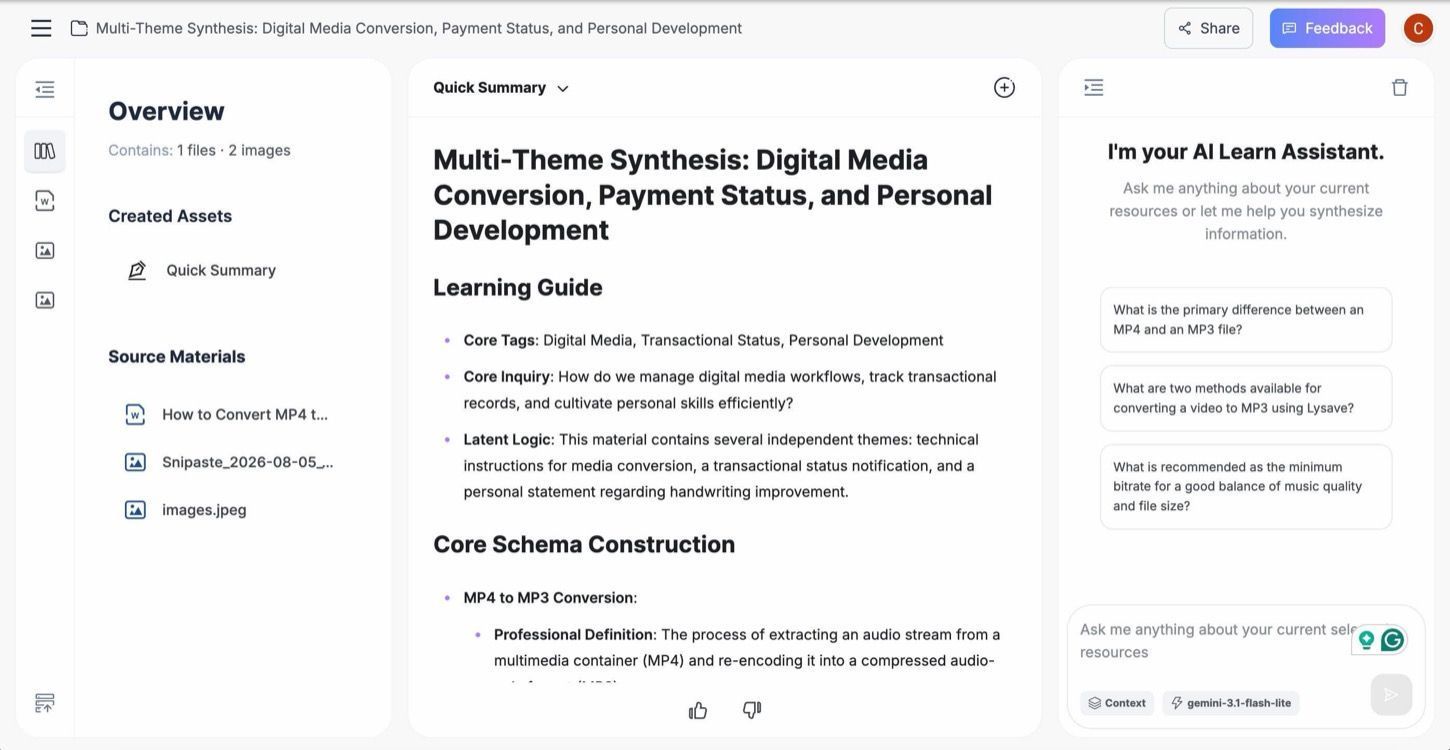
Actual Lynote interface showing generic demonstration content.
Lynote organizes information from your supplied materials into structured notes with headings, summaries, and key points. You can then edit the content and group it by unit, topic, theory, or research study.
Consider organizing your notes around:
- Key Concepts: Definitions and explanations of psychological terms.
- Theories and Perspectives: Main assumptions, comparisons, and examples.
- Research Methods: Study designs, variables, samples, findings, and limitations.
- Unit Summaries: Concise reviews of the material covered in each lesson.
- Application Examples: Scenarios that help you practice using concepts.
Review the generated notes and add your own class examples or teacher explanations. Check names, terminology, and research details against the original material.
Step 3. Clarify Concepts with Lynote AI Chat
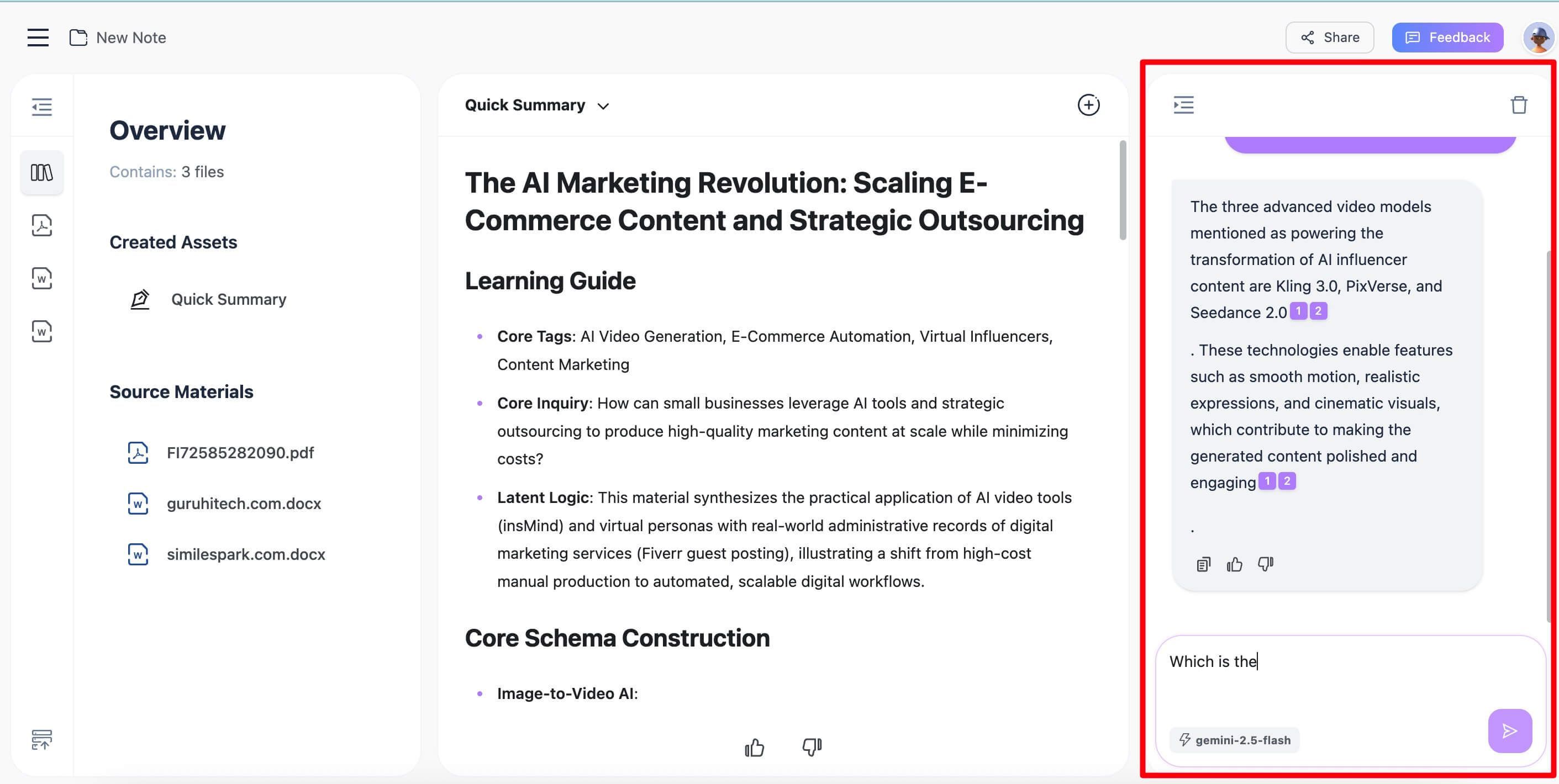
Actual Lynote interface showing generic demonstration content.
Some psychology concepts are easier to understand when you compare them with related ideas. Use Lynote AI Chat to ask questions about information contained in your uploaded sources.
For example, if your materials cover learning theories, you could ask how classical conditioning differs from operant conditioning. If your source discusses memory, you could ask for a comparison of encoding, storage, and retrieval.
AI Chat can help you revisit source material without searching through an entire chapter. For questions that require information beyond your uploaded sources, consult your textbook, teacher, or official course resources.
Step 4. Create Flashcards for AP Psychology Review
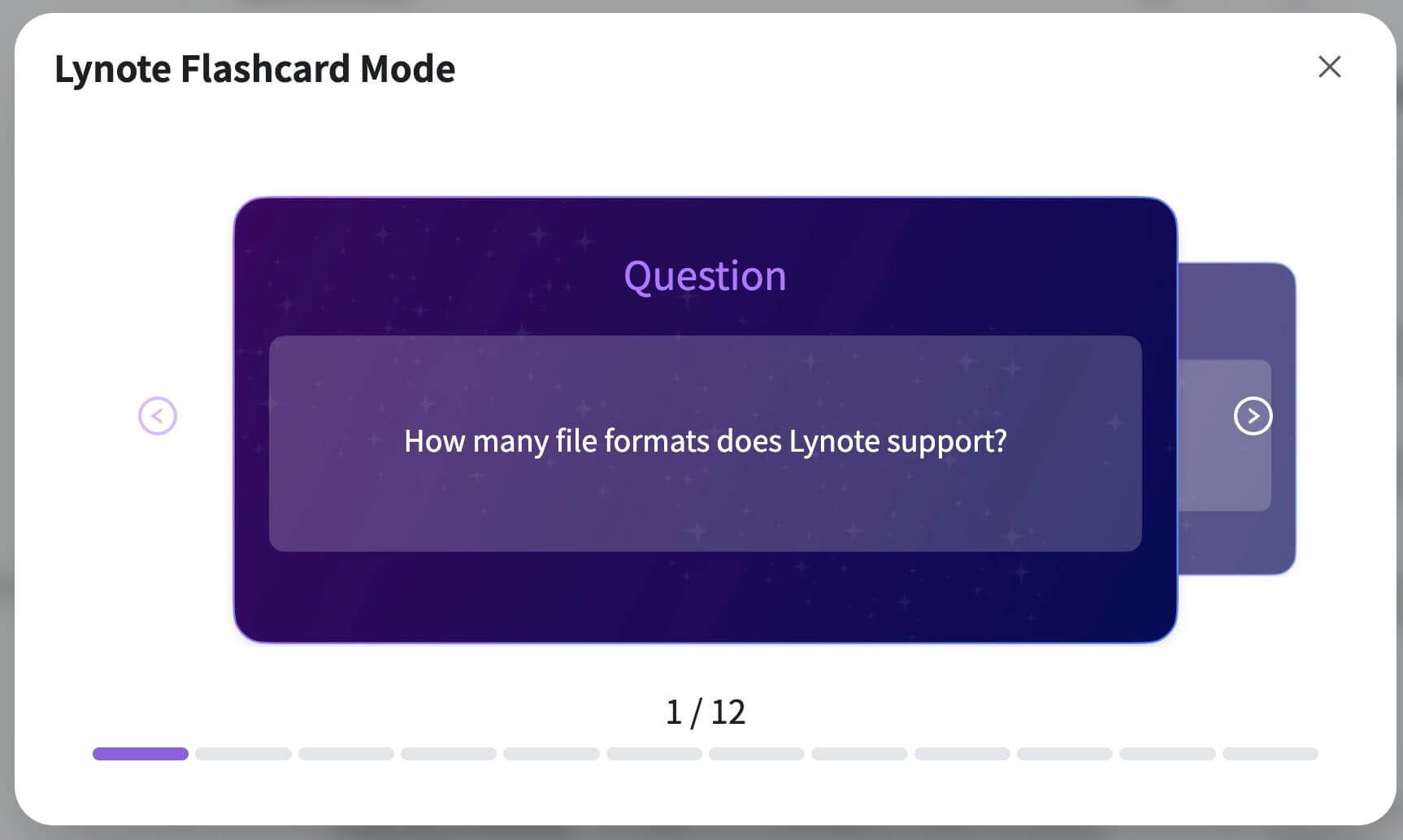
Actual Lynote interface showing generic demonstration content.
Turn important definitions, theories, and research concepts into question-and-answer flashcards. This gives you a practical way to test recall between longer study sessions.
For example:
Question: What is the difference between classical and operant conditioning?
Answer: Classical conditioning involves learning associations between stimuli, while operant conditioning involves how consequences influence behavior.
Question: What is the difference between reliability and validity?
Answer: Reliability concerns consistency of measurement, while validity concerns whether a measure assesses what it is intended to measure.
Question: What is the difference between encoding and retrieval?
Answer: Encoding is the process of getting information into memory, while retrieval is accessing stored information.
Use flashcards for quick recall, then practice applying the concepts to research scenarios and free-response prompts.
Build a More Organized AP Psychology Study Routine
You can use Lynote throughout the course rather than waiting until exam week. Generate notes after each lesson, edit important explanations, and group the material by the five AP units.
Before a test, revisit your notes, ask AI Chat questions about difficult concepts, and use Flashcards to check your recall. Combine this workflow with research analysis, scenario-based practice, and official AP questions.
Create Your AP Psychology Notes with Lynote AI
Spend less time manually organizing scattered study materials and more time understanding psychological concepts, evaluating research, and practicing how to apply what you learn.
Common AP Psychology Note-Taking Mistakes to Avoid
Memorizing Terms Without Examples
A definition may look familiar when you read it, but that does not mean you can recognize it in a new scenario. Without examples, similar concepts can be difficult to distinguish.
Better approach: Add one realistic example and one comparison for each important term.
Mixing Up Textbook Chapters and AP Units
Textbook chapters and AP units do not always follow the same numbering. A chapter number in one Myers edition may refer to a different topic in another edition.
Better approach: Record the chapter title and connect it to the current AP unit using your class syllabus.
Ignoring Research Methods
Psychology is a scientific discipline, so research design and evidence are central to the course. Notes that contain only theories and definitions may leave students unprepared for research analysis questions.
Better approach: For each study, record the method, sample, variables, findings, ethics, and limitations.
Treating Flashcards as Complete Exam Preparation
Flashcards can help with definitions and quick recall, but they do not fully prepare you to analyze a study or build an evidence-based argument. Those skills require practice with scenarios, data, and written responses.
Better approach: Combine flashcards with AAQ and EBQ practice.
Rereading Without Testing Understanding
Repeated reading can make information feel familiar without showing whether you can recall or apply it. Students need opportunities to retrieve concepts and explain them independently.
Better approach: Turn headings into questions, explain concepts aloud, and complete practice questions without looking at your notes.
Conclusion: Build AP Psychology Notes That Help You Apply What You Learn
Effective AP psychology notes connect biological processes, cognition, development, learning, social behavior, personality, and mental health. Organize each topic with clear definitions, examples, research connections, and review questions so you can apply concepts rather than simply recognize vocabulary.
Build your notes throughout the course, practice research analysis, and prepare for both free-response tasks. To turn your own lectures, PDFs, and study materials into editable notes, try Lynote AI Note Generator and create a more organized AP Psychology study routine.
Frequently Asked Questions About AP Psychology Notes
What Are the Five Units of AP Psychology?
The current AP Psychology framework has five units: Biological Bases of Behavior, Cognition, Development and Learning, Social Psychology and Personality, and Mental and Physical Health.
Each unit has a multiple-choice exam weighting range of 15%–25%. Check the current College Board Course and Exam Description for required content and skills.
What Should AP Psychology Unit 1 Notes Include?
Unit 1 covers biological bases of behavior. Organize notes around heredity and environment, the nervous system, neurons, neural communication, brain structures, sleep, and sensation.
Use diagrams and examples to connect biological processes with behavior.
What Should AP Psychology Unit 2 Notes Cover?
Unit 2 focuses on cognition, including perception, thinking, problem-solving, memory, forgetting, intelligence, and achievement. Compare related processes and add examples that show how they work.
Where Can I Find AP Psychology Notes PDF Resources?
Students may find PDF notes through teachers, school learning platforms, textbooks, and educational websites. Check the source, edition, and date, then compare the material with the current College Board framework.
Are Myers AP Psychology Notes the Same Across Editions?
No. Chapter titles, topic order, and page numbers may differ between editions of Myers psychology textbooks. Use the edition assigned by your teacher and connect its chapters to the current AP unit framework.
What Are AP Psychology Cornell Notes?
Cornell notes use a main notes area, a cue column, and a summary section. Students can record explanations in the main area, add key terms or questions in the cue column, and write a brief summary at the bottom.
This format can help organize theories, research findings, and vocabulary for later active recall.
What Is Included in AP Psychology Unit 3 Notes?
Unit 3 covers Development and Learning. Topics include developmental research, physical and cognitive changes across the lifespan, social-emotional development, language, gender and sexual orientation, classical conditioning, operant conditioning, and other learning factors.
What Should AP Psychology Unit 4 Notes Cover?
Unit 4 focuses on Social Psychology and Personality. Review attribution, attitudes, social situations, personality perspectives, motivation, and emotion.
What Should AP Psychology Unit 5 Notes Include?
Unit 5 focuses on Mental and Physical Health. Organize notes around health psychology, positive psychology, psychological disorders, diagnostic approaches, and treatment methods.
Are AP Psychology Unit 0 Notes Official?
Unit 0 is not one of the five official current College Board unit titles. Some teachers and study resources use it for introductory material, such as research methods or the history of psychology.
Check your syllabus to see what your teacher means by Unit 0.
How Should I Prepare for the AP Psychology EBQ?
The Evidence-Based Question asks you to make a claim, use evidence from provided research sources, and explain why that evidence supports your argument. Practice identifying relevant findings and connecting them to psychological concepts.
How Should I Prepare for the AP Psychology AAQ?
The Article Analysis Question asks you to analyze a summarized peer-reviewed source. Practice identifying research methods, variables, statistics, ethical considerations, generalizability, and connections to course concepts.
Can Lynote Help Me Create AP Psychology Study Notes?
Yes. Lynote can generate structured notes from supported learning materials that you provide, including PDFs, documents, presentations, audio, and videos.
You can edit the generated notes, ask AI Chat questions based on uploaded sources, and create Flashcards for review. Check research details and terminology against your original course materials.
Can AI-Generated Notes Replace AP Psychology Practice Questions?
No. AI-generated notes can help organize information, but students still need to practice applying concepts, interpreting research, and writing evidence-based responses.
Use your notes alongside official College Board resources, teacher guidance, and practice questions.

Written by Janet L. Harris
AI Writing Specialist
Janet reviews AI detectors and humanization tools, with a focus on accuracy, limitations, and responsible use. View all articles →