

Geometry Notecard: How to Make the Perfect Study Card

Preparing for a geometry test or final exam can involve dozens of formulas, theorems, definitions, and diagrams. A well-organized geometry notecard helps you bring the most important information together, making it easier to review concepts, remember formulas, and solve problems efficiently.
Whether you are studying basic shapes in fourth grade, reviewing high school geometry, or preparing for a semester exam, the right notecard can make studying more focused. This guide explains what to include, how to organize formulas and diagrams, and how to create effective study materials with Lynote AI Note Generator.
What Is a Geometry Notecard?
A geometry notecard is a compact study reference that contains important mathematical information used in geometry. It may include formulas, definitions, angle relationships, theorems, diagrams, and examples of common problem-solving methods.
Unlike a complete set of class notes, a notecard focuses on information you need to recall quickly. It should help you recognize which formula or geometric rule applies to a particular problem.
What Should You Put on a Geometry Notecard?
The best geometry notecard includes information that is both important and difficult to remember. Instead of copying entire textbook explanations, prioritize formulas, visual relationships, and short reminders.
Consider including these sections:
- Geometry Formulas: Area, perimeter, circumference, and volume formulas.
- Angle Rules: Complementary angles, supplementary angles, vertical angles, and parallel-line relationships.
- Important Theorems: Pythagorean theorem, triangle properties, and similarity rules.
- Shape Properties: Characteristics of triangles, quadrilaterals, circles, and polygons.
- Coordinate Geometry: Slope, distance, midpoint, and equation relationships.
- Diagrams: Small labeled illustrations that explain geometric relationships.
- Worked Examples: Short examples showing when and how to use a formula.
Your notecard should be easy to scan. Group related information together and use consistent symbols so you can find the right concept quickly.
Essential Geometry Formulas to Include on Your Notecard
Geometry involves many formulas, but you do not need to memorize them as an unrelated collection of equations. Organizing them by shape and mathematical purpose makes them easier to understand and recall.
1. Area and Perimeter Formulas
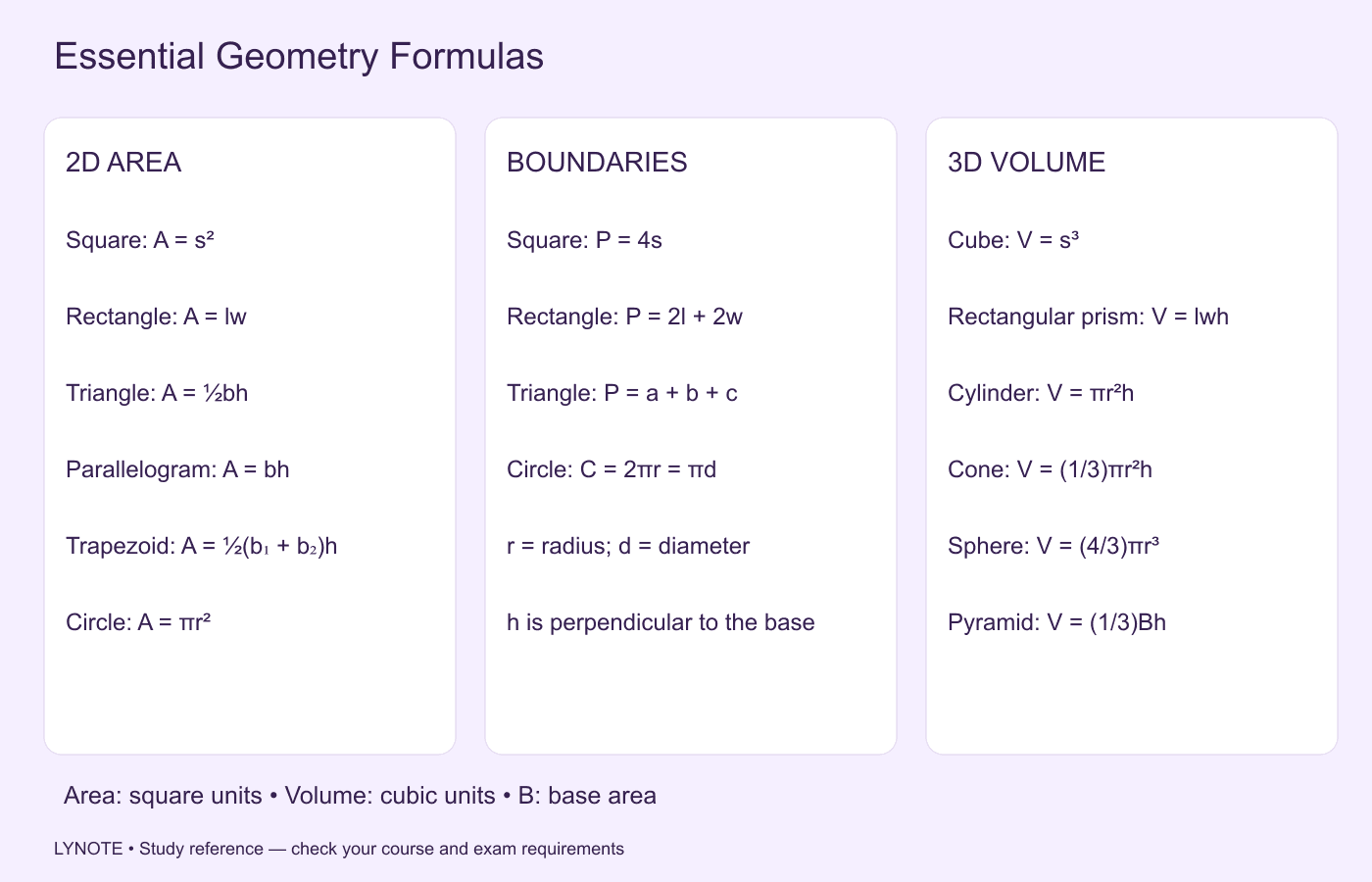
Area measures the space inside a two-dimensional shape, while perimeter measures the distance around its boundary. These are among the most frequently used concepts in introductory geometry.
| Shape | Area Formula | Perimeter Formula |
|---|---|---|
| Square | A = s² | P = 4s |
| Rectangle | A = lw | P = 2l + 2w |
| Triangle | A = ½bh | P = a + b + c |
| Parallelogram | A = bh | P = 2(a + b) |
| Trapezoid | A = ½(b₁ + b₂)h | P = a + b + c + d |
| Circle | A = πr² | C = 2πr |
Remember that the height of a triangle or parallelogram is measured perpendicular to its base. Using a slanted side instead of the perpendicular height can lead to an incorrect area calculation.
2. Volume and Surface Area Formulas
Three-dimensional geometry introduces volume and surface area. Volume measures the space inside a solid, while surface area measures the combined area of its exterior faces or curved surfaces.
| Solid | Volume Formula |
|---|---|
| Cube | V = s³ |
| Rectangular Prism | V = lwh |
| Cylinder | V = πr²h |
| Cone | V = ⅓πr²h |
| Sphere | V = ⁴⁄₃πr³ |
| Pyramid | V = ⅓Bh |
Here, B represents the area of the base. For surface area questions, include the relevant formulas from your class materials, especially if your exam covers cylinders, cones, spheres, or composite solids.
3. Angle Relationships
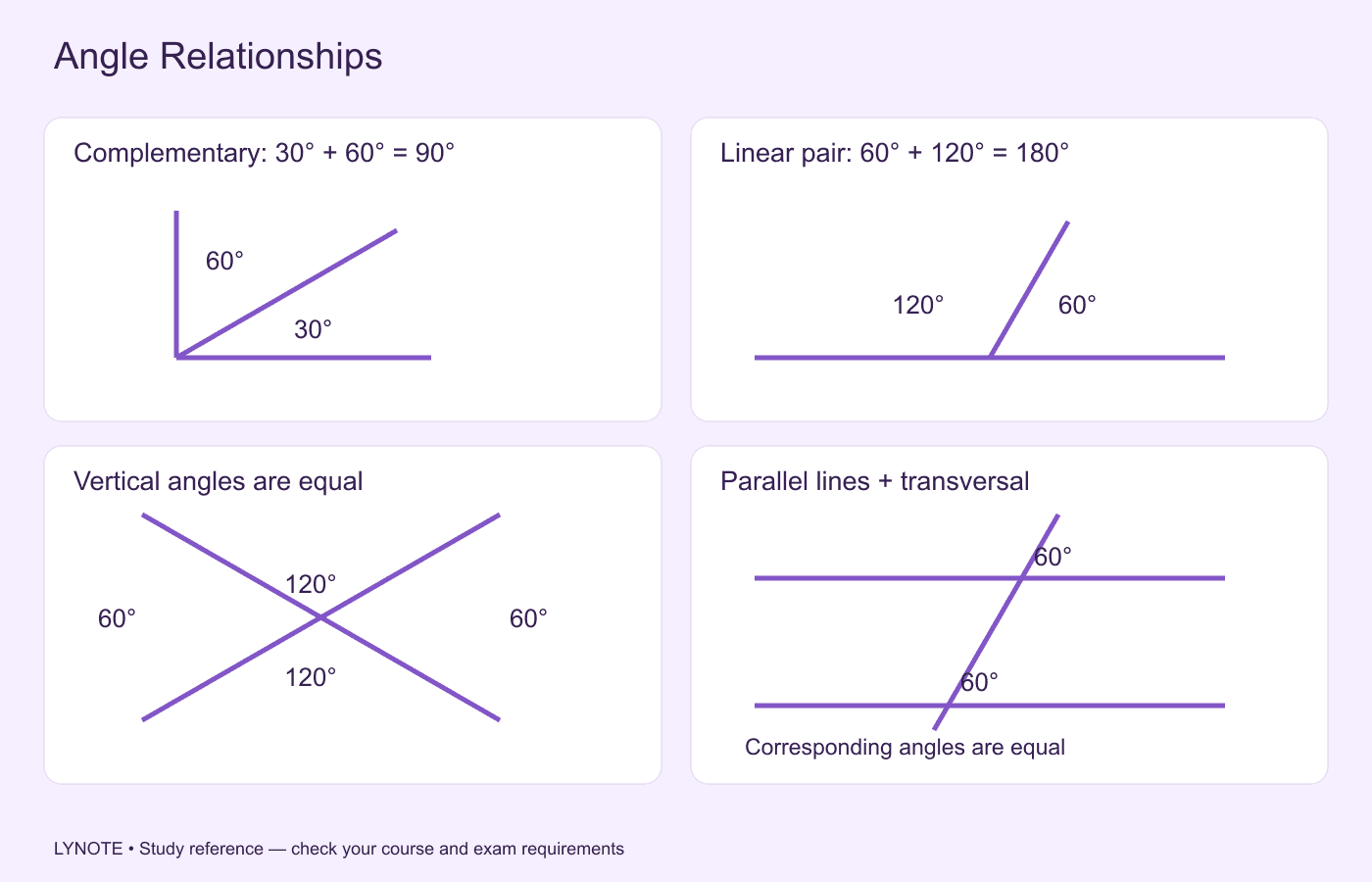
Angle relationships are essential for solving geometry problems involving intersecting lines, parallel lines, and polygons. Add short definitions and visual examples to help distinguish the different relationships.
| Angle Relationship | Key Rule |
|---|---|
| Complementary Angles | Two angles add up to 90° |
| Supplementary Angles | Two angles add up to 180° |
| Vertical Angles | Opposite angles are equal |
| Linear Pair | Adjacent angles add up to 180° |
| Angles Around a Point | Sum equals 360° |
When a transversal crosses parallel lines, corresponding angles and alternate interior angles are congruent. Same-side interior angles are supplementary, which is another useful relationship to remember.
4. Triangle Rules and Theorems
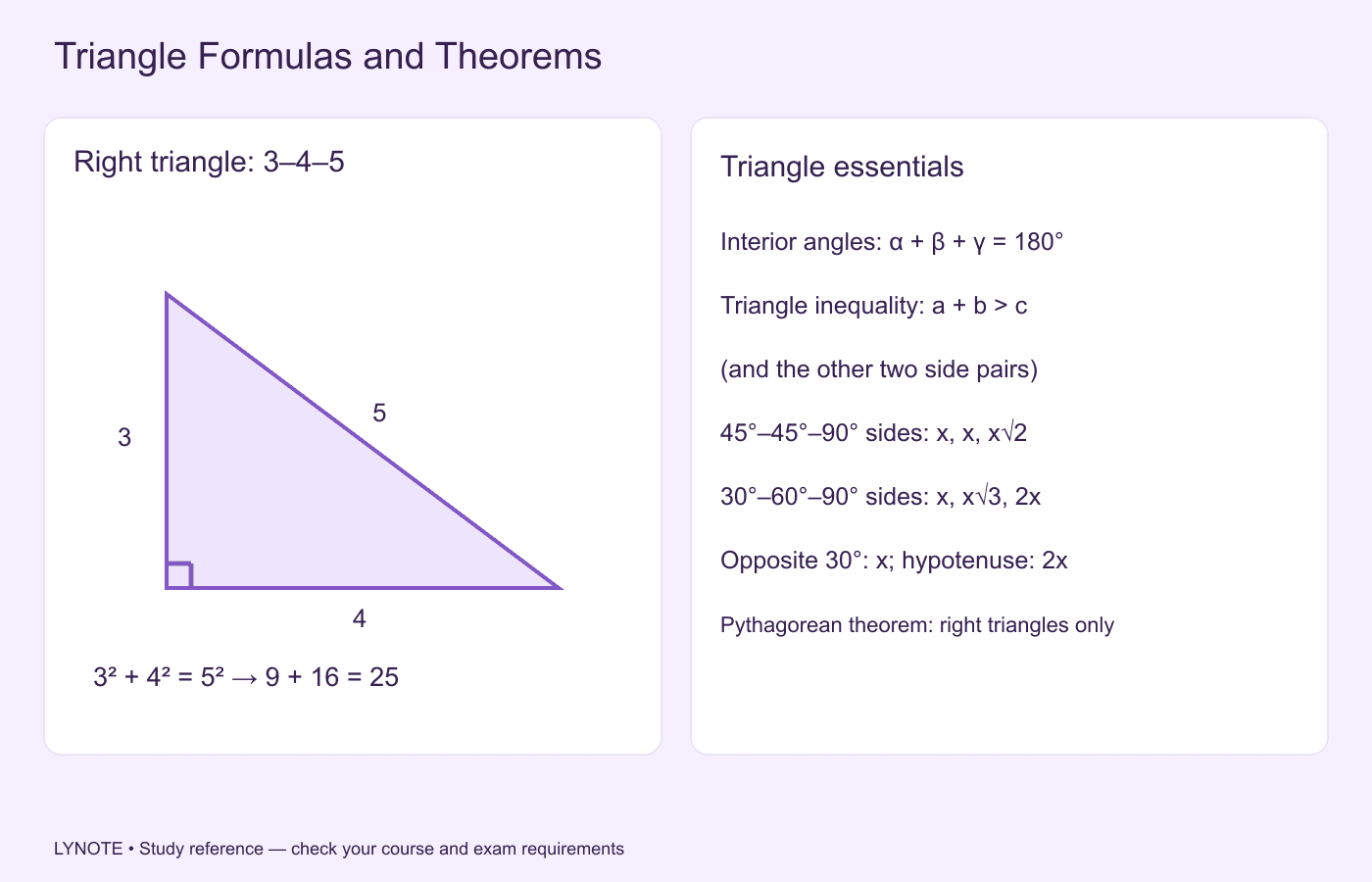
Triangles appear throughout geometry, so your notecard should include their major properties. The interior angles of a triangle always add up to 180°, regardless of its size or orientation.
Important concepts include the Pythagorean theorem, triangle inequality, congruence, similarity, and special right triangles. For a right triangle, the Pythagorean theorem relates the two legs and the hypotenuse.
Pythagorean Theorem:
a² + b² = c²
The special right triangles worth reviewing are 45°-45°-90° and 30°-60°-90°. Include their side-length relationships if they are part of your course.
5. Coordinate Geometry Formulas
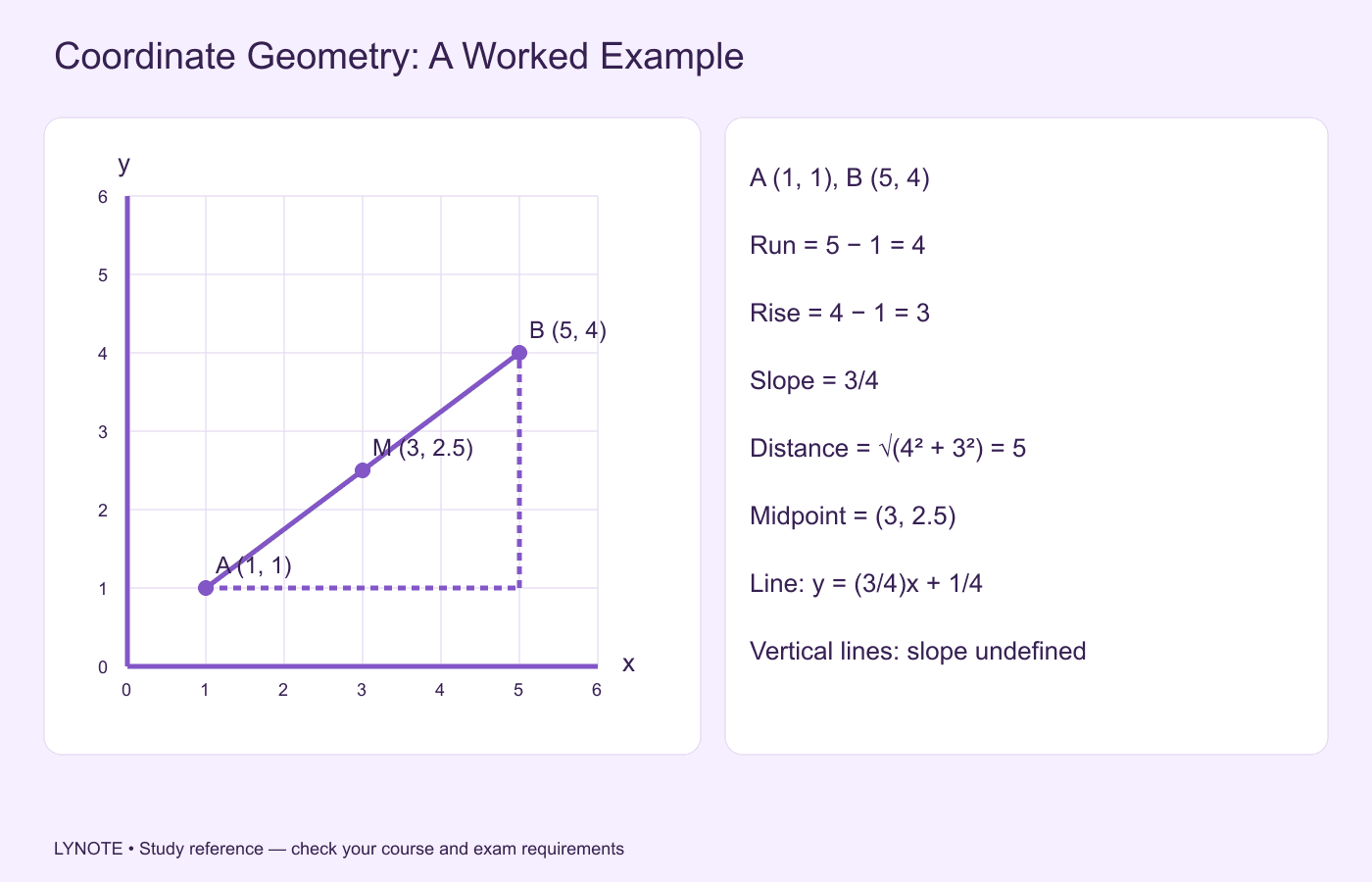
Coordinate geometry connects algebra with geometric figures. It is especially useful when you need to calculate distances, identify midpoints, or determine whether lines are parallel or perpendicular.
| Concept | Formula |
|---|---|
| Slope | m = (y₂ − y₁) / (x₂ − x₁) |
| Distance | d = √[(x₂ − x₁)² + (y₂ − y₁)²] |
| Midpoint | ((x₁ + x₂)/2, (y₁ + y₂)/2) |
| Slope-Intercept Form | y = mx + b |
Add a small coordinate plane diagram to show how slope and distance relate to two points. This visual reminder can be especially useful when reviewing coordinate geometry problems.
How to Make a Geometry Final Exam Notecard
A geometry final exam notecard should be designed around the topics covered throughout the semester. Your goal is to create a compact reference that helps you recall important rules without becoming so crowded that it is difficult to use.
Start by reviewing your syllabus, textbook chapters, class notes, and previous assignments. Identify recurring formulas and concepts that appear in multiple problem types.
Step 1. List the Topics Covered on Your Final
Create a checklist of the chapters and concepts included in your exam. Common topics include geometric definitions, angle relationships, triangles, quadrilaterals, similarity, circles, coordinate geometry, and three-dimensional figures.
Do not assume every geometry final covers the same material. Your teacher's review sheet and course outline should determine what belongs on your notecard.
Step 2. Prioritize Formulas and Theorems
Identify formulas that you need to recall quickly. Place frequently used equations near the top of your card and group less common relationships by topic.
For theorems, write a short description rather than copying a full textbook proof. For example, you could write that vertical angles are congruent or that the interior angles of a triangle total 180°.
Step 3. Add Small Diagrams
Geometry is a visual subject, so diagrams can communicate information more quickly than long explanations. Draw simple triangles, circles, parallel lines, and coordinate planes beside their corresponding formulas.
Label important measurements and angles clearly. A diagram should support your understanding, not replace the conditions required by a theorem.
Step 4. Include One or Two Worked Examples
A formula becomes more useful when you understand how to apply it. Include a short example for concepts that frequently cause confusion, such as finding a missing triangle side or calculating the area of a composite shape.
Keep each example concise and show the essential calculation steps. Avoid filling your entire card with worked solutions because you also need room for definitions and formulas.
Step 5. Check Your Teacher's Notecard Rules
Before creating your final exam notecard, confirm what materials your teacher allows. Some exams permit one handwritten index card, while others allow a full sheet, a printed formula sheet, or no notes at all.
Check the permitted size, number of sides, handwriting or printing requirements, and whether diagrams are allowed. A useful study card should never be assumed to be an approved exam aid.
Geometry Midterm Notecard: What Should You Include?
A geometry midterm notecard usually covers the concepts taught during the first part of the course. The exact topics depend on your school's curriculum and the order in which your teacher introduces geometry.
For many introductory high school courses, early topics include points, lines, planes, angle relationships, geometric proofs, triangles, and basic coordinate geometry. If your class has already covered similarity or polygons, include the corresponding rules as well.
Geometry Midterm Review Checklist
Use this checklist to identify what belongs on your midterm study card:
- Basic geometric definitions and notation.
- Types of angles and angle relationships.
- Parallel and perpendicular lines.
- Triangle classifications and properties.
- Triangle congruence postulates.
- Pythagorean theorem.
- Coordinate plane and slope.
- Distance and midpoint formulas.
- Basic geometric proofs.
- Important diagrams and example problems.
If your teacher provides a midterm review packet, use it as the primary reference. This helps you avoid spending valuable notecard space on topics that are not included in the assessment.
Semester 2 Notecard Geometry: Preparing for the Second Half of the Course
Semester 2 geometry often introduces additional relationships and applications after students have learned the fundamentals. Depending on the course sequence, topics may include similarity, right-triangle trigonometry, circles, polygons, area, volume, and transformations.
Your semester 2 notecard geometry study guide should focus on the concepts that require the most memorization and repeated application. Organize formulas into sections so you can quickly locate the correct relationship when solving problems.
Semester 2 Notecard Geometry for 9th Grade
Ninth-grade geometry courses vary by school and district. Some students begin the year with foundational definitions and proofs, while others spend the second semester focusing on circles, similarity, trigonometry, and solid geometry.
If you are preparing a semester 2 notecard geometry 9th grade study card, begin with your teacher's current unit list. Select the formulas and theorems that match the actual course content.
A practical ninth-grade study card might include:
| Topic | Information to Include |
|---|---|
| Similarity | Scale factors and corresponding sides |
| Right Triangles | Pythagorean theorem and trigonometric ratios |
| Circles | Radius, diameter, circumference, and area |
| Polygons | Interior and exterior angle relationships |
| Transformations | Translation, rotation, reflection, dilation |
| Area | Triangle, quadrilateral, and composite shape formulas |
| Volume | Prism, cylinder, cone, and sphere formulas |
For transformations, use small coordinate diagrams to show how points move. For similarity, include a short example showing how a scale factor changes corresponding side lengths.
Easy Notecards Geometry Grade 4: A Simple Study Guide for Younger Students
Geometry in fourth grade focuses on recognizing shapes, understanding angles, and describing geometric properties. Students are generally introduced to more advanced vocabulary gradually, so an easy notecard should use simple definitions and clear illustrations.
Instead of including high school equations, focus on the basic shapes and relationships covered in the classroom. A few visual examples can make these ideas easier to remember.
Geometry Concepts for Grade 4
| Concept | Simple Explanation |
|---|---|
| Point | An exact location |
| Line | A straight path extending in both directions |
| Line Segment | Part of a line with two endpoints |
| Ray | A line that starts at one point and extends in one direction |
| Right Angle | An angle measuring 90° |
| Acute Angle | An angle smaller than 90° |
| Obtuse Angle | An angle greater than 90° but less than 180° |
| Parallel Lines | Lines that never intersect |
| Perpendicular Lines | Lines that meet at a right angle |
Shapes to Include on a Grade 4 Geometry Notecard
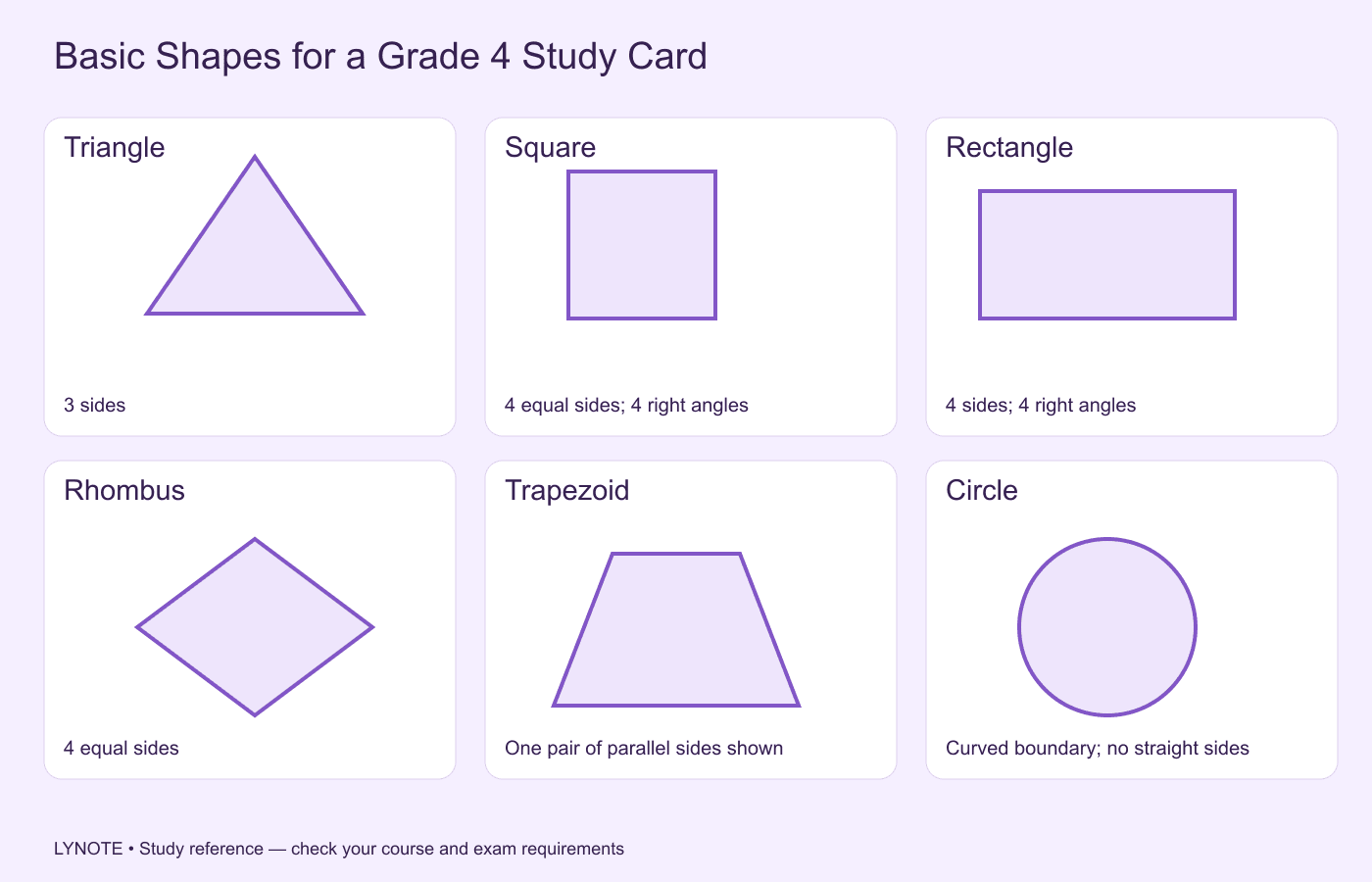
Add illustrations of triangles, squares, rectangles, rhombuses, trapezoids, and other polygons introduced in class. Label the number of sides and important properties of each shape.
You can also include a small angle reference showing acute, right, and obtuse angles. Use simple drawings and large labels so the notecard is easy to read.
How to Organize Molecular Geometry Notecards
Molecular geometry is related to geometry through the study of three-dimensional shapes, but it belongs to chemistry rather than traditional mathematics geometry. If your class is studying molecular structures, your molecular geometry notecards should focus on VSEPR theory, electron pairs, and molecular shapes.
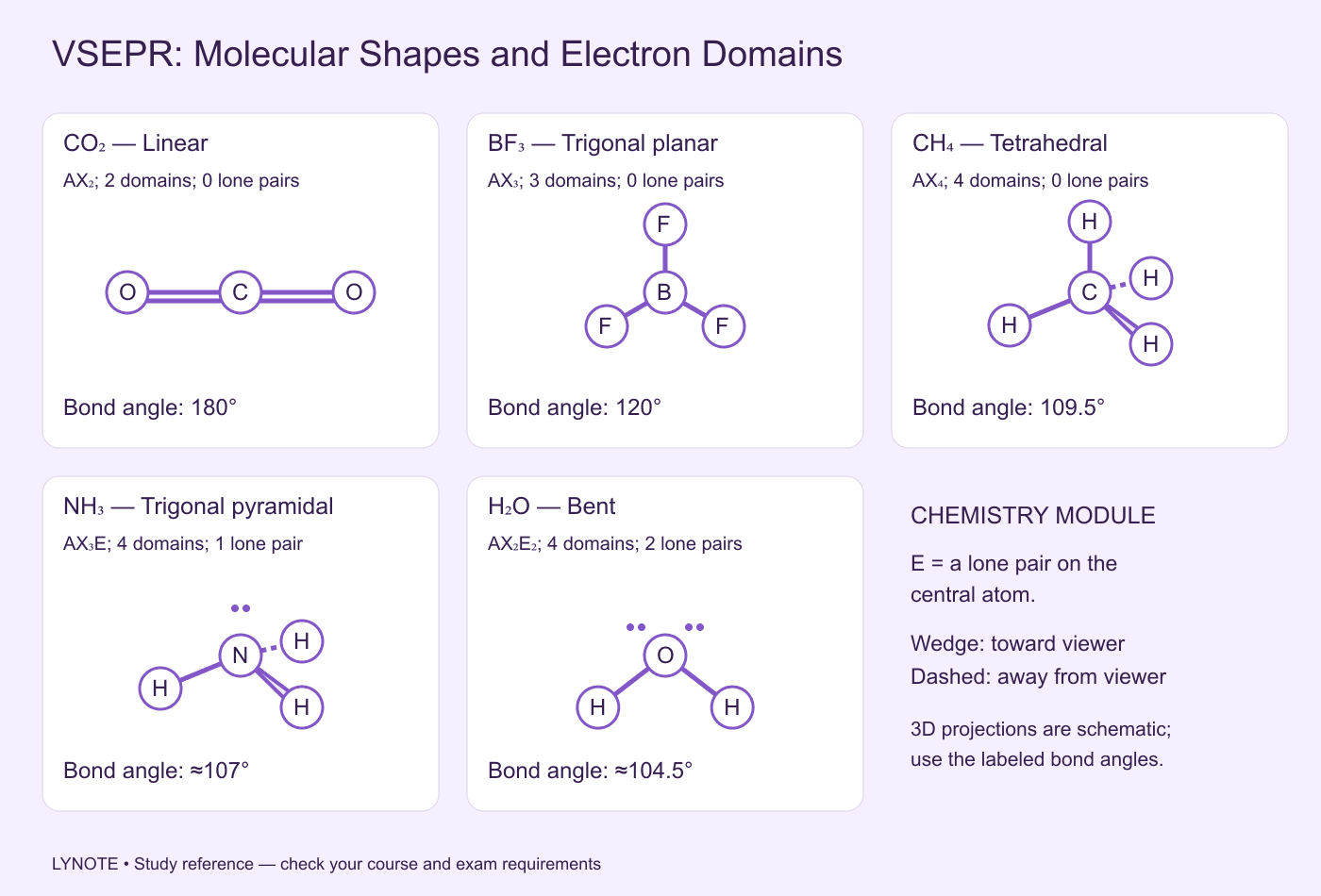
VSEPR theory explains that electron groups around a central atom arrange themselves to minimize repulsion. The arrangement of bonding pairs and lone pairs helps determine the molecule's shape.
Common Molecular Geometry Shapes
| Molecular Shape | General Arrangement | Example |
|---|---|---|
| Linear | Two bonding groups | CO₂ |
| Trigonal Planar | Three bonding groups | BF₃ |
| Tetrahedral | Four bonding groups | CH₄ |
| Trigonal Pyramidal | Three bonds and one lone pair | NH₃ |
| Bent | Two bonds with lone pair(s) | H₂O |
These examples are useful for distinguishing molecular shapes. Your chemistry notecard should also include the relevant bond angles and electron-domain arrangements required by your course.
What to Include on a Molecular Geometry Notecard
Create a comparison table that identifies the number of bonding groups and lone pairs around the central atom. Add a molecular example and a simple three-dimensional sketch for each shape.
Remember that electron-domain geometry and molecular geometry are not always identical. Lone pairs influence the electron-domain arrangement, but molecular geometry describes the positions of atoms.
How to Make Your Geometry Notecard More Effective
A good notecard is not simply a smaller version of your textbook. It should highlight the information you need to recall and help you connect formulas with the situations in which they apply.
Use Color and Visual Grouping
Assign different colors to formulas, definitions, and theorems. For example, use one color for area formulas, another for angle rules, and another for triangle properties.
Keep the color system consistent across your class notes and study cards. Avoid using too many colors because excessive decoration can make important information harder to find.
Use Abbreviations Carefully
Short labels can help save space on a small notecard. However, avoid abbreviations that you may forget or confuse during an exam.
For example, label area as A, perimeter as P, radius as r, and diameter as d. Write the meaning of less familiar symbols somewhere on the card.
Prioritize Concepts You Frequently Forget
Your notecard should reflect your own learning needs. If you consistently forget circle formulas, give them more space than concepts you already understand.
Review previous quizzes and homework to identify repeated mistakes. Use those mistakes to decide which formulas, diagrams, or reminders deserve priority.
Practice Without Looking at Your Notecard
A notecard is a review aid, not a replacement for understanding. After creating it, cover the information and try to recall formulas, explain theorems, or solve practice problems independently.
Return to the card only when you need to check your understanding. This turns a simple reference sheet into a tool for active recall.
How to Create Geometry Study Notes with Lynote AI Note Taker
Preparing a geometry notecard often starts with several different learning materials. You may have textbook chapters, teacher slides, worksheets, homework solutions, recorded lessons, and review packets covering different formulas and theorems.
Organizing these materials manually can take time, especially when you need to identify which concepts are important for a midterm or final exam. Lynote AI Note Generator helps turn supported learning materials into structured, editable notes that you can use to prepare your own geometry study guide.
Step 1. Upload Your Geometry Study Materials
Start by uploading your geometry learning resources to Lynote. Supported materials include PDFs, documents, presentations, images, audio recordings, and videos.
For example, upload a geometry final exam review PDF, a classroom presentation about triangle congruence, or a recorded lesson explaining circle theorems. Use materials you are authorized to process.
Step 2. Generate Structured Geometry Notes
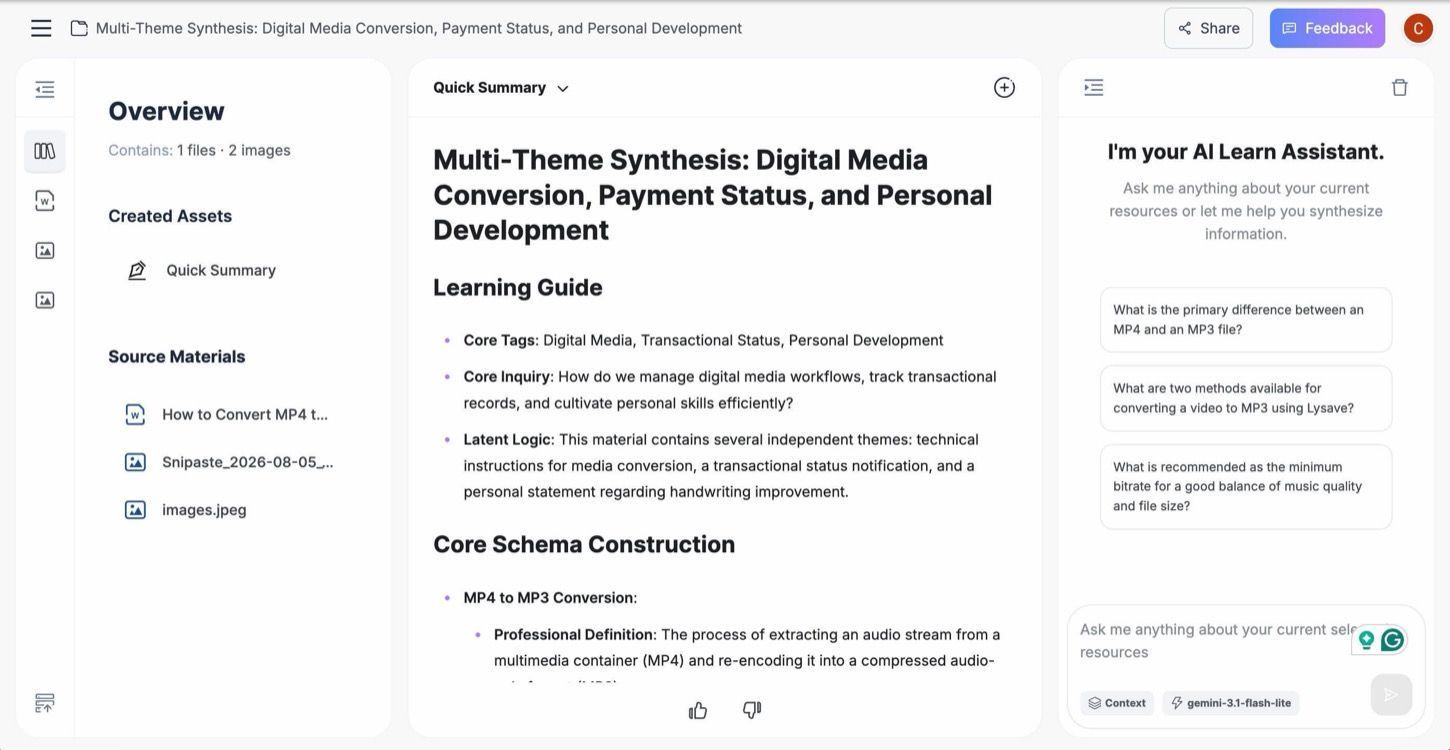
Actual Lynote interface showing generic demonstration content.
Use Lynote to organize information from your uploaded materials into structured notes. The generated content can help group important concepts, formulas, definitions, and supporting explanations.
You can organize your geometry notes around:
- Formulas: Area, perimeter, circumference, and volume.
- Theorems: Triangle congruence, similarity, and angle relationships.
- Definitions: Geometric terms and important properties.
- Problem-Solving Methods: Steps for solving common geometry problems.
- Exam Topics: Concepts grouped according to your midterm or final review materials.
After generation, use the built-in editor to refine explanations and reorganize the content. Check all mathematical notation and calculations against your original materials.
Step 3. Clarify Difficult Geometry Concepts with AI Chat

Actual Lynote interface showing generic demonstration content.
Some geometry topics become easier to understand when you break them into smaller steps. Use Lynote AI Chat to ask questions about information contained in your uploaded study materials.
For example, if your source covers triangle similarity, you could ask how corresponding sides are related. If your notes cover circle geometry, you could ask for an explanation of the relationship between radius, diameter, and circumference.
AI Chat helps you revisit explanations without searching through an entire textbook chapter. For questions beyond your uploaded materials, consult your teacher or textbook.
Step 4. Create Flashcards for Geometry Formulas and Theorems
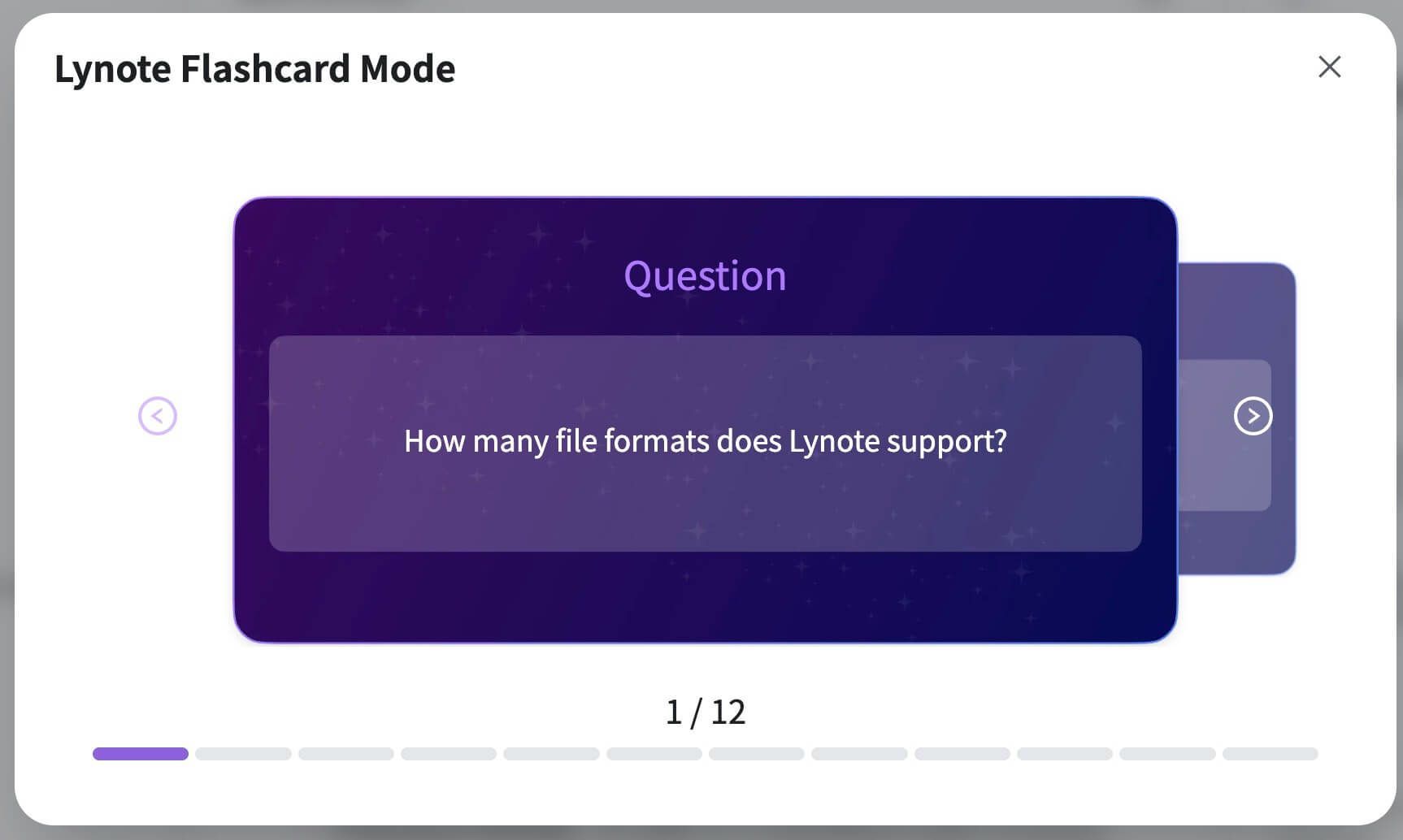
Actual Lynote interface showing generic demonstration content.
Geometry includes many formulas and definitions that students need to recall quickly. Lynote Flashcards can help turn important information from your notes into question-and-answer cards.
For example:
Question: What is the formula for the area of a triangle?
Answer: A = ½bh, where b is the base and h is the perpendicular height.
Question: What is the Pythagorean theorem?
Answer: a² + b² = c², where a and b are the legs of a right triangle and c is the hypotenuse.
Question: What is the sum of the interior angles of a triangle?
Answer: 180 degrees.
Question: What is the circumference of a circle?
Answer: C = 2πr or C = πd.
Use Flashcards to test your recall, then practice solving complete geometry problems. Remember that knowing a formula is only the first step; you also need to recognize when it applies.
Build a More Organized Geometry Study Routine
You do not need to wait until the day before your geometry final to organize your materials. Use Lynote throughout the semester to turn your lessons, worksheets, and review resources into structured notes.
After each lesson, generate notes, correct important details, and add your own diagrams or worked examples. Before an exam, revisit the material, ask questions about difficult concepts, and use Flashcards to review formulas and theorems.
Combine this workflow with independent problem-solving and teacher-approved exam preparation materials. Lynote helps organize your learning resources, while your own practice builds the mathematical understanding needed to solve geometry problems.
Create Your Geometry Study Notes with Lynote AI
Spend less time manually organizing scattered geometry materials and more time understanding formulas, recognizing geometric relationships, and practicing problems.
Common Geometry Notecard Mistakes to Avoid
Writing Too Much Information
A notecard becomes difficult to use when it contains entire textbook explanations. Too much information makes important formulas harder to locate.
Better approach: Use short definitions, compact formulas, and small diagrams. Keep detailed explanations in your full study notes.
Memorizing Formulas Without Understanding Them
Knowing an equation does not guarantee that you can identify when to apply it. Students may confuse area with perimeter or use the wrong measurements in a formula.
Better approach: Add a small example showing what each variable represents and when the formula should be used.
Ignoring Diagrams
Geometry is a visual subject, and diagrams often communicate relationships that are difficult to describe in words. A notecard containing only equations may not help when a problem requires spatial reasoning.
Better approach: Add simple labeled diagrams for triangles, circles, parallel lines, and coordinate geometry.
Using the Wrong Course Content
A fourth-grade geometry card should not contain the same material as a ninth-grade geometry final review sheet. Likewise, molecular geometry belongs to chemistry and should not be mixed into a mathematics geometry card without a clear reason.
Better approach: Organize your notecard around your actual course, grade level, and exam syllabus.
Ignoring Exam Notecard Restrictions
Some teachers allow students to use reference cards during exams, while others only permit them during preparation. Assuming that every formula sheet is allowed can create unnecessary problems.
Better approach: Confirm the exam rules before printing or writing your final notecard.
Conclusion: Create a Geometry Notecard That Works for Your Exam
An effective geometry notecard brings together the formulas, theorems, diagrams, and definitions that matter most for your course. Whether you are reviewing fourth-grade shapes, preparing for a ninth-grade semester exam, or organizing a geometry final, the key is to keep your study card accurate, focused, and easy to understand.
Build your notes from your actual class materials, practice recalling formulas, and solve problems independently. To organize your geometry lessons and create editable study notes, try Lynote AI Note Generator.
Frequently Asked Questions About Geometry Notecards
What Should I Put on a Geometry Notecard?
Include important formulas, angle relationships, triangle theorems, shape properties, coordinate geometry rules, and small diagrams. Prioritize concepts that appear frequently in your course and that you find difficult to remember.
How Do I Make a Notecard for Geometry?
Start by reviewing your syllabus and class notes to identify the topics on your exam. Group formulas and theorems by subject, add small diagrams, and include short examples for concepts that are easy to confuse.
What Should Be on a Geometry Final Exam Notecard?
A geometry final exam notecard may include area and perimeter formulas, volume formulas, angle relationships, triangle properties, similarity rules, circle formulas, and coordinate geometry. Follow your teacher's exam guidelines to determine which topics and materials are allowed.
What Is the Difference Between a Geometry Midterm Notecard and a Final Exam Notecard?
A midterm notecard generally focuses on topics taught during the first part of the course. A final exam notecard may cover the entire semester or year, depending on your school's exam structure.
What Should a Semester 2 Geometry Notecard Include?
Semester 2 topics depend on your course sequence. Common possibilities include similarity, circles, trigonometry, polygons, transformations, area, and volume.
How Can I Make Easy Notecards for Geometry Grade 4?
Use simple definitions, shape illustrations, and basic angle examples. Focus on the concepts taught in your fourth-grade classroom rather than including advanced high school formulas.
What Are Molecular Geometry Notecards?
Molecular geometry notecards are chemistry study cards about the three-dimensional arrangement of atoms in molecules. They typically include VSEPR theory, electron groups, lone pairs, molecular shapes, and examples such as CO₂, BF₃, CH₄, and H₂O.
Can I Use a Geometry Notecard for a Ninth-Grade Semester 2 Exam?
Yes, if your teacher permits it and the content matches your course. Review the semester's topics and include the formulas and theorems covered in your actual syllabus.
How Many Formulas Should I Put on a Geometry Notecard?
There is no universal number because notecards have different sizes and exam requirements. Prioritize the formulas you need most and make sure every entry remains readable.
Can Lynote Help Me Create Geometry Study Notes?
Yes. Lynote can generate structured notes from supported PDFs, documents, presentations, images, audio recordings, and videos that you provide.
You can edit the generated notes, ask AI Chat questions based on uploaded sources, and create Flashcards for formula and theorem review. Always verify mathematical notation, diagrams, and calculations against your original course materials.
Can AI-Generated Geometry Notes Replace Practice Problems?
No. Structured notes can help organize formulas and explanations, but geometry requires practice applying theorems and solving problems.
Use AI-generated notes alongside homework, teacher-provided review sheets, and independent problem-solving.

Written by Hamza Razzaq
Technical Writer
Hamza creates hands-on explainers and technical guides that make AI writing tools easier to understand and use. View all articles →