
What Is a Good GPA to Get Into College?

A good GPA for college is one that meets your target school's requirements and compares well with the grades of students it has recently admitted. Those are two different tests. A 3.0 can satisfy a university's GPA requirement even when most students admitted to a particular campus had higher grades. Start with the college and work back to your transcript, not the other way around.

What GPA Do You Need to Get Into College?
There is no single high school GPA required for admission across the United States. Even two public universities that publish a figure of 3.0 can mean different things by it. Here's how to read three numbers you might encounter while building a college list.
| First-year admissions example | Published number | What you can conclude |
|---|---|---|
| Arizona State University: one way to meet the aptitude requirement | 3.00 unweighted in required competency courses | Meeting this benchmark satisfies one part of the general requirements. Course requirements still apply, and some programs ask for more. |
| University of California: minimum GPA requirement | 3.0 for California residents; 3.4 for nonresidents, calculated under UC rules | Check residency, eligible A-G coursework, and the UC calculation before comparing your grades. This is not the typical GPA at every campus. |
| UC Riverside: fall 2026 admitted first-year class | 3.66 to 4.17 for the middle 50% | This describes a past admissions outcome. Neither endpoint is a requirement for applying. |
Consider an Arizona student looking at both ASU and UC. If their ASU competency-course GPA is 3.10, they've cleared ASU's 3.00 aptitude route. They can't carry that number straight over to the UC application: they need the UC calculation and the nonresident standard. The useful question isn't just “Is 3.10 good?” It's “Which courses produced it, and who is going to use it?”
There is also a difference between a missing course and a low average. Strong grades elsewhere don't establish that you completed a required sequence of classes. Check the course list alongside the GPA rule while you still have time to adjust your high school schedule.
A Minimum GPA Is Not the Same as a Competitive GPA
A minimum is a rule you can check before you apply. A class profile is a description of people who were admitted or enrolled in a particular year. The first can tell you whether you meet a stated requirement. The second gives you context for deciding how much uncertainty to build into your college list.
Take UC Riverside. The campus reports 3.66 to 4.17 as the middle half of the high school GPAs for students admitted for fall 2026. The lower end marks the 25th percentile, not the lowest GPA admitted. The upper end marks the 75th percentile, not a score above which admission was assured.
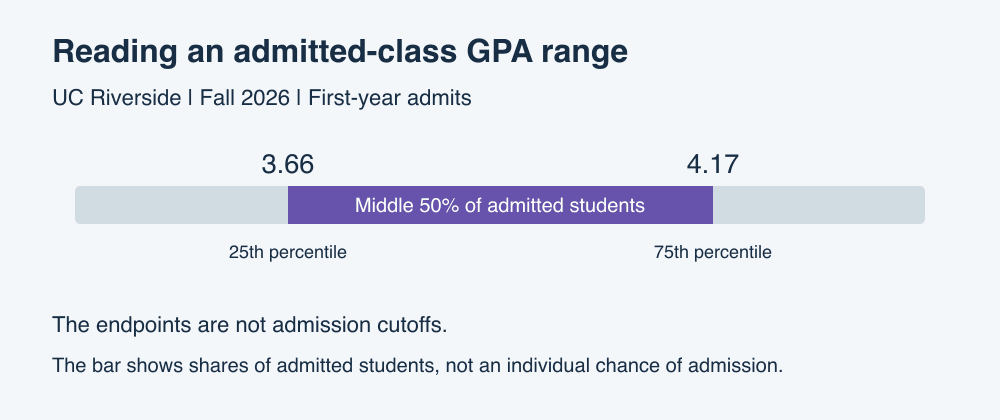
Suppose your GPA is 3.80 on the comparable UC scale. You can say it sits inside that historical range. You cannot say you have a 50% chance of admission: the range was calculated from admitted students, not from all applicants with a 3.80.
Before worrying that your unweighted GPA is below 4.17, notice what that upper endpoint tells you. You're not looking at an ordinary unweighted scale capped at 4.0. Find the campus's definition before comparing; don't add a guessed AP bonus to make the two numbers line up.
How to Compare Your GPA With a College's Class Profile
1. Find the requirement for your application, not just the university
Look for the first-year admissions page for the term you intend to enter. Check whether the published rule is for domestic or international applicants, residents or nonresidents, and the university or your intended program. Transfer requirements are a separate set of rules.
At ASU, for example, a student who doesn't meet the 3.00 GPA route should look at the other published aptitude routes, including class rank, rather than assume the application is over. Conversely, a student who does meet it should still check the degree requirements. Both students have another question to answer, just not the same one.
2. Identify the GPA your transcript actually shows
Write down the label beside the number: cumulative or semester, weighted or unweighted. Note the scale and which classes count. A cumulative GPA can include electives that don't appear in a college's academic-course calculation.
If the average looks surprising, use the Lynote GPA Calculator in High school mode to check how your grades, credits, and course levels affect an estimate. For example, removing an elective from a copy of your course list lets you see whether that class was raising or lowering the average. Use the institution's own rules for an official calculation; the tool doesn't determine eligibility or predict admission.
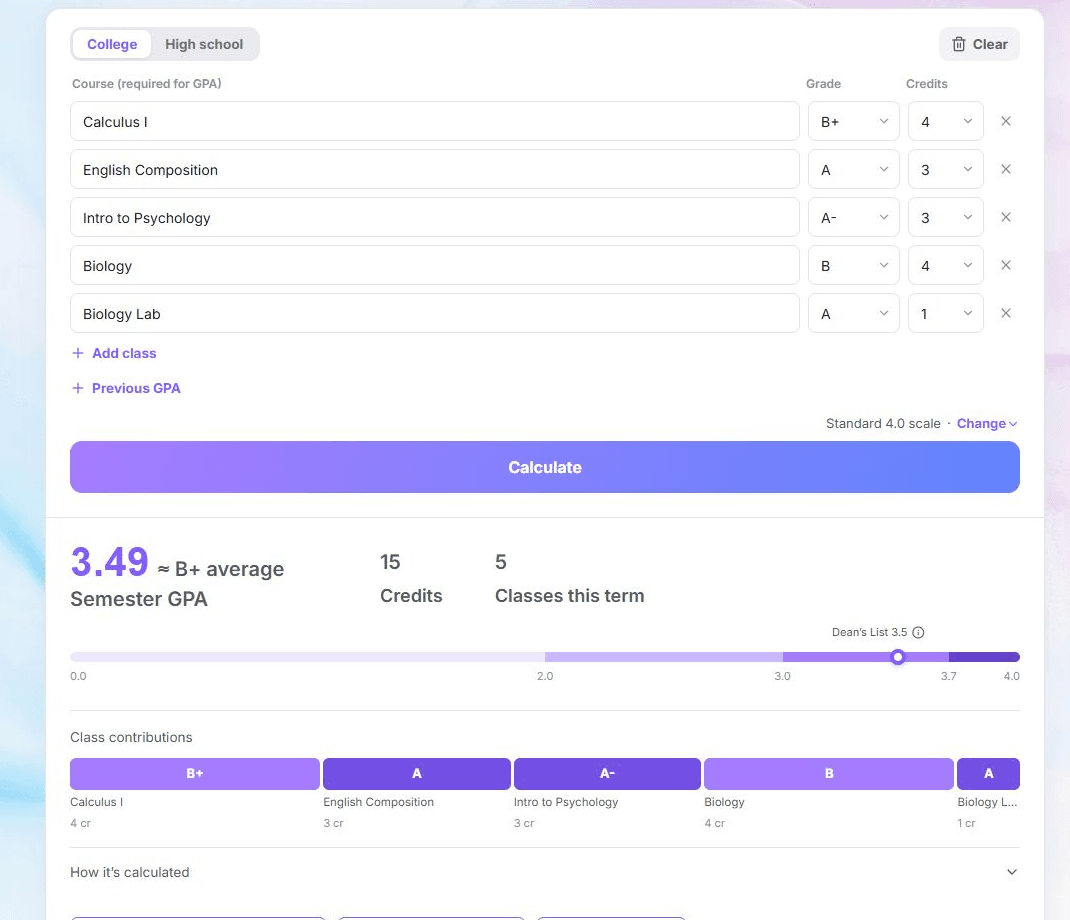
The sample shown is for college coursework. Switch to High school before entering your high school classes.
3. Match the year and the group of students
An admitted-student profile describes students who received offers. An entering-class profile describes those who actually enrolled. Neither is the entire applicant pool. If the only available figure is an average for enrolled students, record it as such; don't turn it into a cutoff or invent a middle range around it.
Check the scope, too. A university-wide profile can tell you something about the campus while telling you little about a program that admits students separately. When no program data are published, “unknown” is a more useful entry in your notes than borrowing a different major's numbers.
4. Keep one row per school
| School and program | Minimum or alternate route | Comparable class data | Next action |
|---|---|---|---|
| ASU, intended degree not yet checked | 3.00 unweighted competency-course GPA is one aptitude route | Not needed to check this particular rule | Check the degree page and course requirements |
| UC Riverside, first-year | Apply the relevant UC resident or nonresident minimum | Fall 2026 admits: middle half, 3.66 to 4.17 | Calculate the comparable UC GPA before interpreting the range |
| Your next college: ___ | Which courses, scale, and applicant group? | Which year, population, and statistic? | What information is still missing? |
Is a 2.5, 3.0, 3.5, or 4.0 GPA Good Enough?
Use these as starting points, not as a ranking of colleges. The figures below assume you're looking at a high school GPA on a 4.0 base scale; whether a specific school counts it the same way still matters.
| If your GPA is around... | The useful next move |
|---|---|
| 2.5 | Look first for institutions with published routes you meet. Check whether an alternate pathway leads directly to your intended program or requires a later application. |
| 3.0 | Check the details of any 3.0 minimum. Is it cumulative, core courses only, or calculated by the university? Does it apply to your residency group? |
| 3.5 | Move beyond eligibility. Compare your record with a recent, same-scale profile, then check whether the data cover your campus and major. |
| 4.0 | Check what the maximum tells you and what it doesn't. Strong grades don't turn a highly selective program into a dependable option. |
Two students with the same average might reasonably build different lists. One has completed the prerequisites for a desired major and is comparing campus profiles. The other has strong grades but still needs a required math course. For the second student, scheduling that course or clarifying an approved alternative is more useful than calculating the GPA to another decimal place.
What If Your GPA Is Below Your Target College's Range?
Below a published requirement: Verify the calculation first. If you're still below it, check for an explicitly listed alternate route, individual review, or a pathway through another institution. Read the terms closely: admission to a university, entry to a specific major, and eligibility to apply later aren't interchangeable outcomes.
Above the minimum but below the recent range: You may still want to apply. A range is descriptive, and grades are only part of the record. Treat the school as an uncertain choice and include other programs where both your preparation and the published academic profile are a closer fit.
For example, a California resident with a properly calculated 3.50 UC GPA would exceed the system's resident GPA minimum but fall below the lower quartile for Riverside's fall 2026 admits. Neither “I can't apply” nor “I'm safely above the cutoff” follows from those facts. The practical response is to check the remaining requirements, decide whether the campus is worth an application, and avoid relying on that one outcome.
If your later grades are stronger than your early ones, keep the official cumulative figure intact. Report grades as requested and use an appropriate application space for relevant context when allowed. An improving record is worth explaining, but it isn't a substitute for a requirement that the institution says you must meet.
FAQs About GPA and College Admission
Can I get into college with a GPA below 3.0?
A GPA below 3.0 does not rule out college. Start with actual requirements rather than a national list of supposedly safe GPAs. Where a school offers more than one admissions route, check the requirements for the route that fits your record.
Do colleges use my weighted or unweighted GPA?
Check each school's instructions. Some requirements explicitly call for an unweighted average in a set of courses; others use an institutional calculation. On an application, report the number requested rather than selecting the higher one.
What if a college doesn't publish a GPA range?
Use what it does publish: required courses, minimum qualifications, and any program-specific criteria. Ask admissions whether a recent first-year profile is available and which scale it uses. Leave the comparison blank if you can't find a compatible figure.
What is a good GPA once you're already in college?
That's a different question from getting admitted. Compare your college GPA with the written criteria for your next goal, such as continuing in your major, renewing a scholarship, or applying to graduate school. A high school admission profile isn't a benchmark for any of those decisions.
Conclusion: Check One College Before You Judge Your GPA
Pick one college on your list. Write down its first-year GPA rule, identify the matching number on your record, and find a recent class profile if one exists. You should finish with a specific conclusion: “I meet this requirement,” “my GPA falls here in the recent range,” or “I need the admissions office to clarify this rule.” Each is more useful than calling your GPA good or bad in isolation.

Written by Janet L. Harris
AI Writing Specialist
Janet reviews AI detectors and humanization tools, with a focus on accuracy, limitations, and responsible use. View all articles →