

Is a 3.5 GPA Good? What It Means for Your Next Step

Yes, a 3.5 GPA is generally good on an unweighted 4.0 scale, both in high school and college. It represents solid academic performance, but whether it is competitive depends on your courses, school and next goal. A 3.5 weighted GPA needs a different interpretation because advanced-course bonuses may already be included.

The useful question is not just whether you should feel good about the number. It is whether you are comparing the right GPA with the right requirement, and whether improving it would change your options.
What Is a 3.5 GPA? A Quick Comparison
GPA stands for grade point average. On a common U.S. 4.0 plus/minus scale, a B+ receives 3.3 points and an A- receives 3.7, so a 3.5 average sits between them rather than matching one universal letter grade.
The same number can describe quite different records:
| Context | What a 3.5 GPA means | Is it good? | What to check next |
|---|---|---|---|
| High school: unweighted 4.0 scale | Grades averaged without extra points for advanced courses | Generally a solid record; college competitiveness varies | Course rigor, grade trend and target schools |
| High school: weighted scale | The average may already include Honors, AP or IB bonuses | The number alone is not enough to judge | Weighting rules and the underlying unweighted GPA |
| College or university: cumulative 4.0 scale | A credit-weighted average across included coursework | Generally strong performance; specific goals may require more | Major GPA, program requirements and academic policies |
| College or university: semester GPA | The result for one term | A strong term, not necessarily a 3.5 overall average | Earlier grades and credits |
| Another scale, such as 4.33 or 5.0 | A result under a different grading system | Not directly equivalent to 3.5 on a standard 4.0 scale | The institution's official calculation rules |
Credit weighting and course-difficulty weighting are different. A four-credit college course usually affects your GPA more than a one-credit course, even when neither earns an advanced-course bonus.
Also, dividing 3.5 by 4 produces 87.5% mathematically, but it does not establish your percentage grade. Schools convert grades into points according to their own rules; those conversions are not necessarily linear.
Is a 3.5 GPA Good in College or University?
On a standard 4.0 scale, a 3.5 college GPA is a strong result. It can reflect sustained success across demanding coursework, although the number does not describe your major, grading environment or individual strengths.
You do not need to dismiss it because someone else has a 3.9. You do need to check the specific benchmark that matters to you.
Cumulative GPA and Major GPA Answer Different Questions
Your cumulative GPA summarizes all coursework included under your institution's rules. Your major GPA covers a narrower group of courses, with the exact boundaries determined by the program.
A hypothetical student could have a 3.5 cumulative GPA and a 3.8 major GPA, while another has the reverse pattern. Those records suggest different academic strengths even though the headline number may look similar.
Report the figure an application requests. If it asks for cumulative GPA, a higher major GPA is not a substitute; you can label the major GPA separately when the form or resume format allows it.
Honors Are Not Automatic
A 3.5 does not automatically place you on every dean's list or qualify you for graduation honors. Schools may use different cutoffs, minimum graded-credit loads, semester-specific rules or other conditions.
Check the policy for the relevant year and college within your university. A semester honor based on current coursework is not the same as an honor based on your entire degree.
Graduate Admissions: Eligibility Is Only the First Check
A 3.5 may exceed a program's published minimum without making admission predictable. Research preparation, prerequisite grades, recommendations and fit can matter alongside the average.
For example, the University of Washington Graduate School publishes 3.0 GPA eligibility routes, while noting that individual programs can require more. That is an example of a minimum policy, not evidence that every applicant above 3.0 is competitive.
For a specific application, separate three questions: Do you meet the minimum? Do your relevant courses show preparation? How does the rest of your application fit the program?
Jobs and Internships Have Their Own Context
If a posting specifies a GPA minimum, compare your accurately calculated GPA with that threshold. When no minimum is stated, do not invent one or assume that GPA alone determines whether you should apply.
Relevant projects, internships and demonstrated skills may strengthen the application. Keep the GPA honest and clearly labeled; do not round upward to cross a stated eligibility threshold unless the application explicitly permits that rounding.
Is a 3.5 GPA Good in High School?
A 3.5 unweighted high school GPA is generally a solid academic foundation. Its meaning for admissions depends on what you studied, how your grades developed and which colleges you are considering.
That distinction matters because "good grades" and "likely admission" are not interchangeable. A college can value your record while still having more qualified applicants than places.
Read the Transcript Behind the Average
Compare a student whose grades improved across increasingly demanding classes with one whose grades declined in subjects central to the intended major. The same cumulative GPA can conceal those different patterns.
Course availability matters too. An applicant should not assume that every high school offers the same AP, IB or Honors options, or that taking the largest possible number is automatically the right choice.
Choose a challenging but manageable schedule. Adding difficulty without the preparation or time to learn the material can work against the goal of building a stronger record.
Colleges May Recalculate Your GPA
The GPA printed on your transcript may not be the exact figure a college uses internally. Some institutions select particular courses or apply their own weighting rules.
The University of Georgia, for example, recalculates a GPA using core academic subjects and has specific rules for AP and IB weighting. Its method should not be treated as the method used by every university.
When reviewing a college's published student profile, check whether the figure is weighted, unweighted or recalculated. A comparison that ignores that label can make your position look stronger or weaker than it is.
Build a College List, Not a Prediction From One Number
Look at recent official admissions information, required coursework, affordability and the broader application requirements. A published average is descriptive; it is not a cutoff or an admission probability.
For highly selective institutions, treat a 3.5 as one part of a more uncertain application, not as either an automatic rejection or a problem that one extracurricular activity can erase. Include realistic alternatives that fit your goals and finances.
Is a 3.5 Weighted GPA as Good as a 3.5 Unweighted GPA?
Not necessarily. An unweighted average measures grades without course-level bonus points, while a weighted average may add them for advanced courses.
To see why the distinction matters, consider this deliberately simple example. Both courses carry one credit; A = 4.0, B = 3.0, and the example school adds one point for AP coursework.
| Course | Grade | Unweighted points | Example AP bonus | Weighted points |
|---|---|---|---|---|
| AP course | A | 4.0 | 1.0 | 5.0 |
| Regular course | B | 3.0 | 0.0 | 3.0 |
| Average | Same two grades | 3.5 | — | 4.0 |
The student's work did not change. Only the reporting method changed.
Now give that AP course a B rather than an A. Under the same assumptions, two Bs would produce a 3.0 unweighted average but a 3.5 weighted average. That is why a weighted 3.5 cannot simply be treated as an unweighted 3.5.
These are illustrative calculations, not universal school policies. Some schools use different bonuses, include different courses or use credit weights that change the result.
Can You Convert a Weighted 3.5 by Dividing by 5?
No reliable conversion comes from multiplying 3.5 by 4/5. A weighted GPA depends on which courses earned bonus points, not just the highest possible value on the scale.
You usually need the underlying grades, course levels, credits and relevant school policy. Recalculate from those inputs instead of stretching one number onto another scale.
Check What Your 3.5 GPA Actually Includes
Before deciding whether to raise your GPA, make sure you know what you are trying to raise. A rounded semester result, an unweighted transcript average and a cumulative college GPA are different starting points.
You can use the Lynote GPA Calculator to check grades and credits or compare a current term with previous study. Match the settings to your institution rather than assuming the default matches every transcript.
- Choose your context and scale. Select College or High school, then check the grading scale. Use course-level weighting only where it applies.
- Enter the courses, grades and credits. Include course names so the record is easy to verify. A higher-credit course contributes more to a credit-weighted average.
- Add earlier study when checking a cumulative GPA. Use Previous GPA and the relevant prior credits rather than averaging semester GPAs equally.
- Select Calculate and inspect the result. Compare the included credits with your transcript before using the result for planning.
The calculator is useful for arithmetic, not for predicting admission or deciding which institutional exceptions apply. Retakes, transfer work and excluded grades should follow the rules of the school or application receiving your GPA.
Keep the original transcript nearby. If the result differs, check the inputs and grading policy before concluding that either number is wrong.
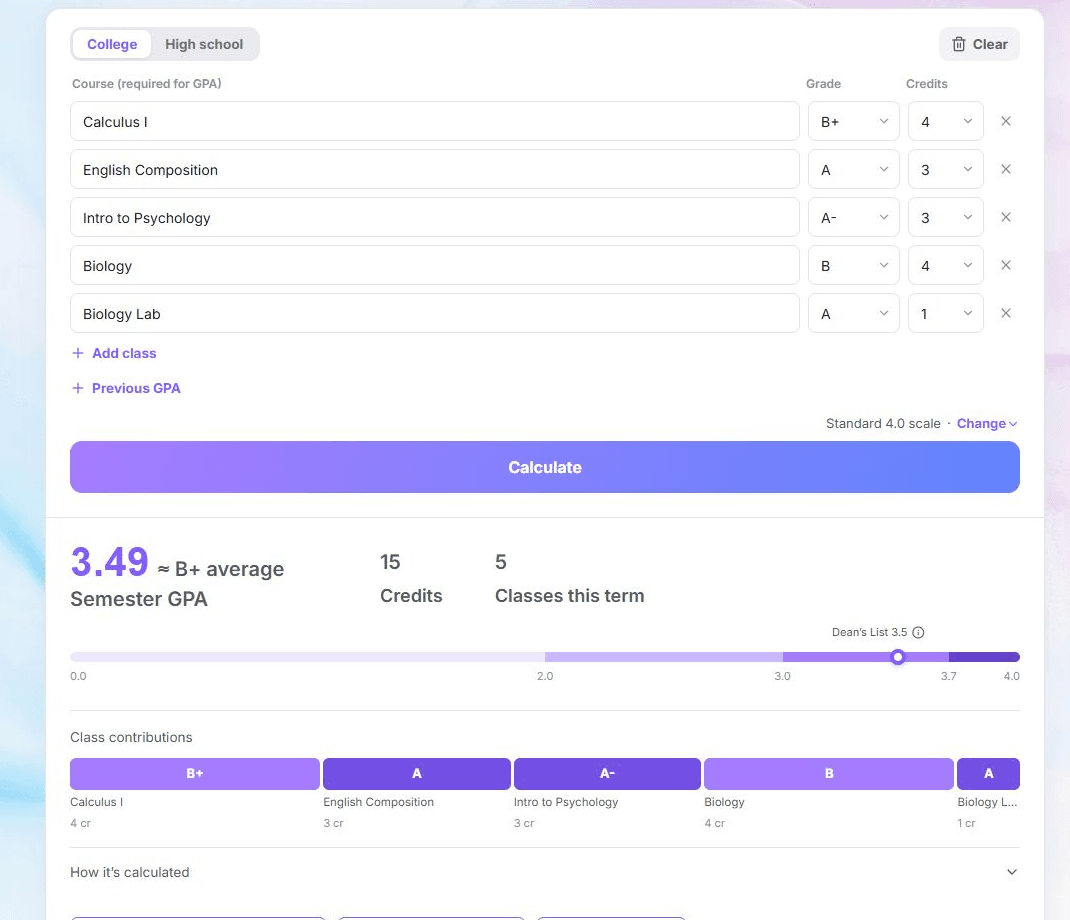
Existing product screenshot: the sample returns 3.49, not an exact 3.50. The displayed dean's-list marker is illustrative, not a universal institutional requirement; interface details may change.
Can You Raise a 3.5 GPA to a 3.7?
Yes, it can be mathematically possible, but your completed credits determine how much new coursework you need. A strong term changes an early college GPA more than a nearly finished degree's average.
The following calculations assume a 4.0 maximum, all new grades count, and no grade replacement or other adjustment. They are arithmetic examples, not predictions of a student's results.
| Completed credits at 3.5 | Next-term credits | Next-term GPA | New cumulative GPA |
|---|---|---|---|
| 30 | 15 | 4.0 | 3.67 |
| 60 | 15 | 4.0 | 3.60 |
| 90 | 15 | 4.0 | 3.57 |
The calculation is:
New GPA = [(current GPA × completed GPA credits) + (future GPA × future GPA credits)] ÷ total GPA credits.
For the 60-credit example, that is [(3.5 × 60) + (4.0 × 15)] ÷ 75 = 3.60. A semester full of As still makes a difference, even when the cumulative number moves less than you hoped.
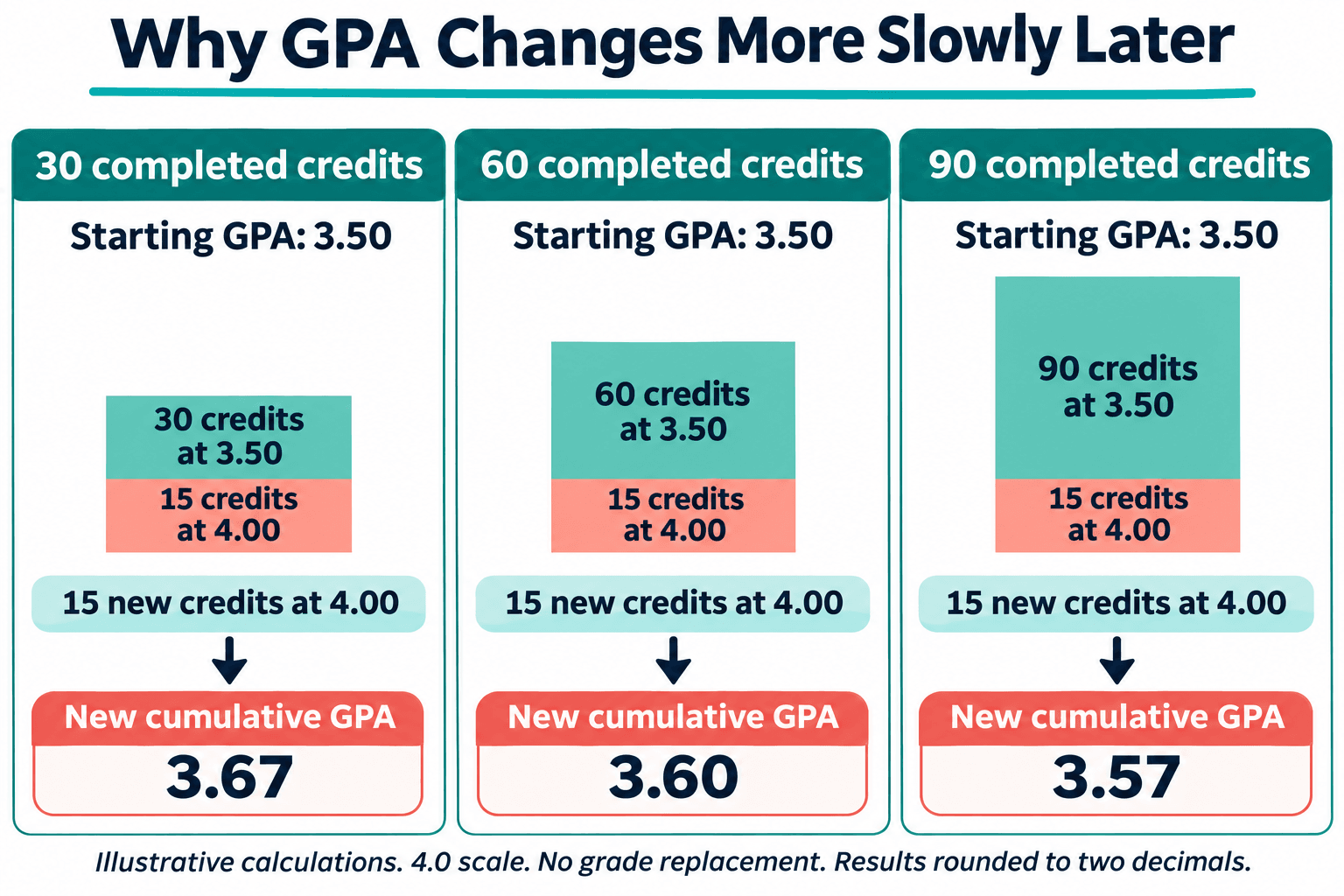
Block heights are schematic, not a quantitative scale. Use the labeled credit totals and calculated results.
How Many A Credits Would You Need?
With future coursework averaging exactly 4.0, raising a 3.5 to a 3.7 requires new credits equal to two-thirds of the credits already completed. That follows from solving the cumulative GPA formula, not from an admissions rule.
| Completed credits at 3.5 | Additional credits at 4.0 needed to reach 3.7 |
|---|---|
| 30 | 20 |
| 60 | 40 |
| 90 | 60 |
If you have 90 completed credits and only 30 credits remaining, a 4.0 across those remaining credits gives a final 3.625, not 3.7. It is better to know that early than to build a study plan around an unreachable target under the current assumptions.
What If Your School Replaces Retaken Grades?
Grade replacement can change the calculation substantially, but rules differ. Your institution may replace a grade, count both attempts or use one policy internally while an external application service uses another.
Ask which rule applies before paying for a retake or changing your schedule. Also distinguish credits counted toward graduation from credits counted in the GPA denominator; they are not always identical.
What to Do Next Depends on Your Goal
A higher GPA can help, but not every decision should revolve around changing 3.5 into 3.6. Start with the outcome that matters and identify what would actually improve your position.
| Your goal | The most useful next check | A practical action |
|---|---|---|
| Apply to college | Comparable GPA data, course requirements and whole-application fit | Build a balanced list rather than relying on one average |
| Apply to graduate school | Minimum GPA, prerequisites and program expectations | Review relevant-course performance and preparation |
| Keep a scholarship | Renewal GPA, credit load and measurement date | Track the exact cumulative or term requirement |
| Improve academic performance | Remaining credits and specific course difficulties | Focus support on the courses with the greatest need and impact |
| Apply for an internship | The employer's stated requirements | Report GPA accurately and demonstrate relevant skills |
For grade improvement, consider both the credit impact and the realistic opportunity to improve. Under a credit-weighted system, moving from B to A in a four-credit course adds four quality points; the same change in a one-credit course adds one.
That does not mean neglecting smaller courses. It means making informed decisions about office hours, tutoring and preparation time instead of treating every assignment or course as equally influential on the cumulative average.
If you already meet your target's stated academic requirement, examine the rest of the application as well. Additional relevant experience may address a gap that another tenth of a GPA point would not.
FAQs About a 3.5 GPA
Is a 3.5 GPA a B+ or an A-?
On a common 4.0 plus/minus scale, B+ is 3.3 and A- is 3.7, placing 3.5 between them. Schools can use different point values, and an average can result from many different combinations of grades.
What Percentage Is a 3.5 GPA?
There is no universal percentage equivalent. Do not assume that 3.5 divided by 4 equals your course percentage. Use the institution's grading and conversion policy when a percentage is required.
Is a 3.5 GPA Good for Graduate School?
It may satisfy the minimum for some programs, but minimum eligibility is not the same as competitive admission. Check the specific program, relevant coursework and other requirements rather than generalizing across master's, doctoral and professional degrees.
Can a 3.5 GPA Qualify for Scholarships?
It can meet the GPA requirement for some awards, but eligibility and selection criteria vary. Check whether an award requires weighted or unweighted GPA, whether other criteria apply and what must be maintained for renewal.
Is a 3.5 Weighted GPA on a 5.0 Scale Good?
You need the school's weighting rules and underlying grades to judge it. A 3.5 weighted average is not automatically equivalent to an unweighted 3.5, and scaling the number down proportionally does not recover the original grades.
Is a 3.49 GPA the Same as a 3.5?
Not for every purpose. A display rounded to one decimal place may show 3.5, while a policy requiring at least 3.50 may use the unrounded or officially reported value. Follow the receiving institution's instructions rather than rounding to meet a cutoff.
Final Takeaway: Compare the Right GPA With the Right Goal
A 3.5 on an unweighted 4.0 scale is generally a good result. You can recognize that achievement while still checking whether it fits a particular school, scholarship or career goal.
Confirm the scale, distinguish semester from cumulative GPA and calculate what future grades can realistically change. Those checks turn a vague worry about whether you are doing well into a clearer next step.

Written by Danny
Product Marketing Manager
Danny explains how Lynote features fit real workflows, from everyday productivity to product-led writing use cases. View all articles →