

Social Studies Notes: How to Study History, Civics & More

Social studies covers the people, places, institutions, and economic systems that shape our world. Well-organized social studies notes help students understand historical events, government structures, geographic patterns, and economic relationships while preparing for classroom assessments and standardized exams.

Whether you are studying for a Class 10 examination or preparing for the GED Social Studies test, effective notes make complex topics easier to understand and review. This guide explains how to organize notes by subject, what to include in each section, and how to create structured study materials with Lynote AI Note Generator.
TL;DR: How to Create Better Social Studies Notes
- Divide your notes into history, civics and government, geography, and economics.
- Organize historical events using timelines, causes, consequences, and important figures.
- Use maps, diagrams, and comparison tables to understand geographic and political concepts.
- Connect economic terms with real-world examples.
- For GED preparation, practice reading historical sources, interpreting graphs, and evaluating evidence.
- Use active recall and practice questions instead of only rereading your notes.
- Use Lynote to turn your own textbooks, PDFs, presentations, and lessons into structured, editable study notes.
What Are Social Studies Notes?
Social studies notes are organized learning materials that summarize important information about human societies and how they develop. They bring together concepts from history, geography, civics, government, and economics.
Good notes help you understand connections between subjects. For example, a historical conflict may involve political decisions, economic conditions, geographic factors, and social changes.
What Should You Include in Social Studies Notes?
The best notes focus on important concepts rather than copying every sentence from a textbook. A consistent structure makes it easier to review information across different subjects.
Consider including these elements:
- Key Terms: Important vocabulary and clear definitions.
- Main Concepts: Explanations of major ideas and theories.
- Historical Events: Dates, people, causes, and consequences.
- Maps and Diagrams: Geographic locations, political boundaries, and spatial relationships.
- Data and Statistics: Graphs, tables, economic indicators, and demographic information.
- Real-World Examples: Connections between classroom concepts and current or historical situations.
- Review Questions: Questions that test understanding and application.
Notes for Social Studies vs. Memorizing Facts
Social studies requires more than remembering names, dates, and definitions. You also need to understand why events happened and how political, economic, and geographic factors influence society.
For example, memorizing the date of an important historical event is useful, but understanding its causes and consequences provides deeper knowledge. Add short explanations and comparisons to your notes so you can connect information rather than study isolated facts.
The Four Main Areas of Social Studies
Most school-level social studies courses cover several connected disciplines. Organizing your notes into four major categories provides a practical starting point.
1. History Notes
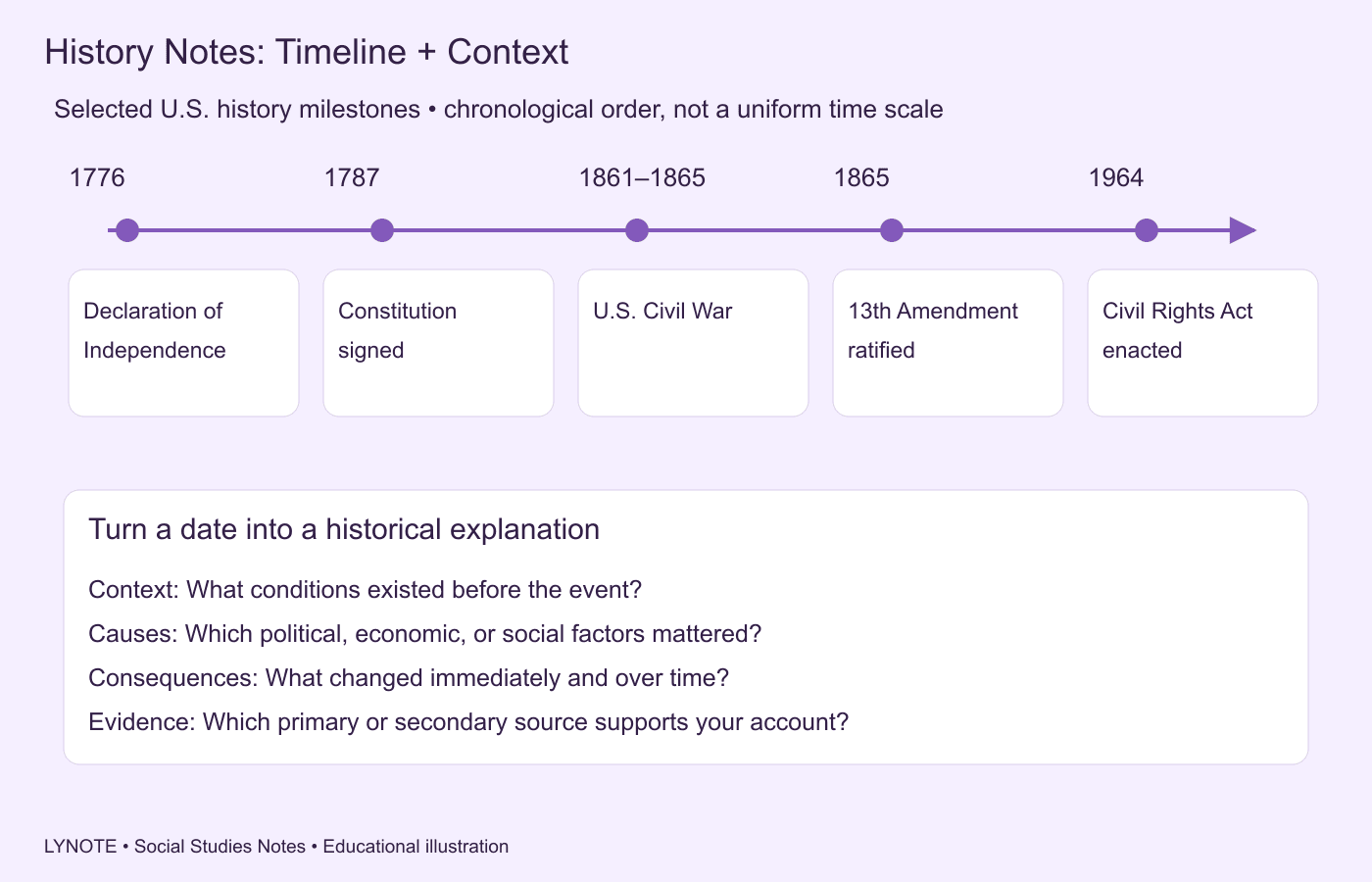
History examines past events, societies, civilizations, and the changes that shaped the modern world. Your history notes should focus on chronology, important individuals, historical documents, and relationships between events.
Organize major events using timelines. Include their causes, key developments, consequences, and long-term significance.
A useful history note format includes:
- Date and Period: When the event happened.
- Historical Context: What was happening before the event.
- Key Figures: Important individuals and groups.
- Causes: Political, social, economic, or geographic factors.
- Consequences: Immediate and long-term effects.
- Historical Significance: Why the event matters.
2. Civics and Government Notes
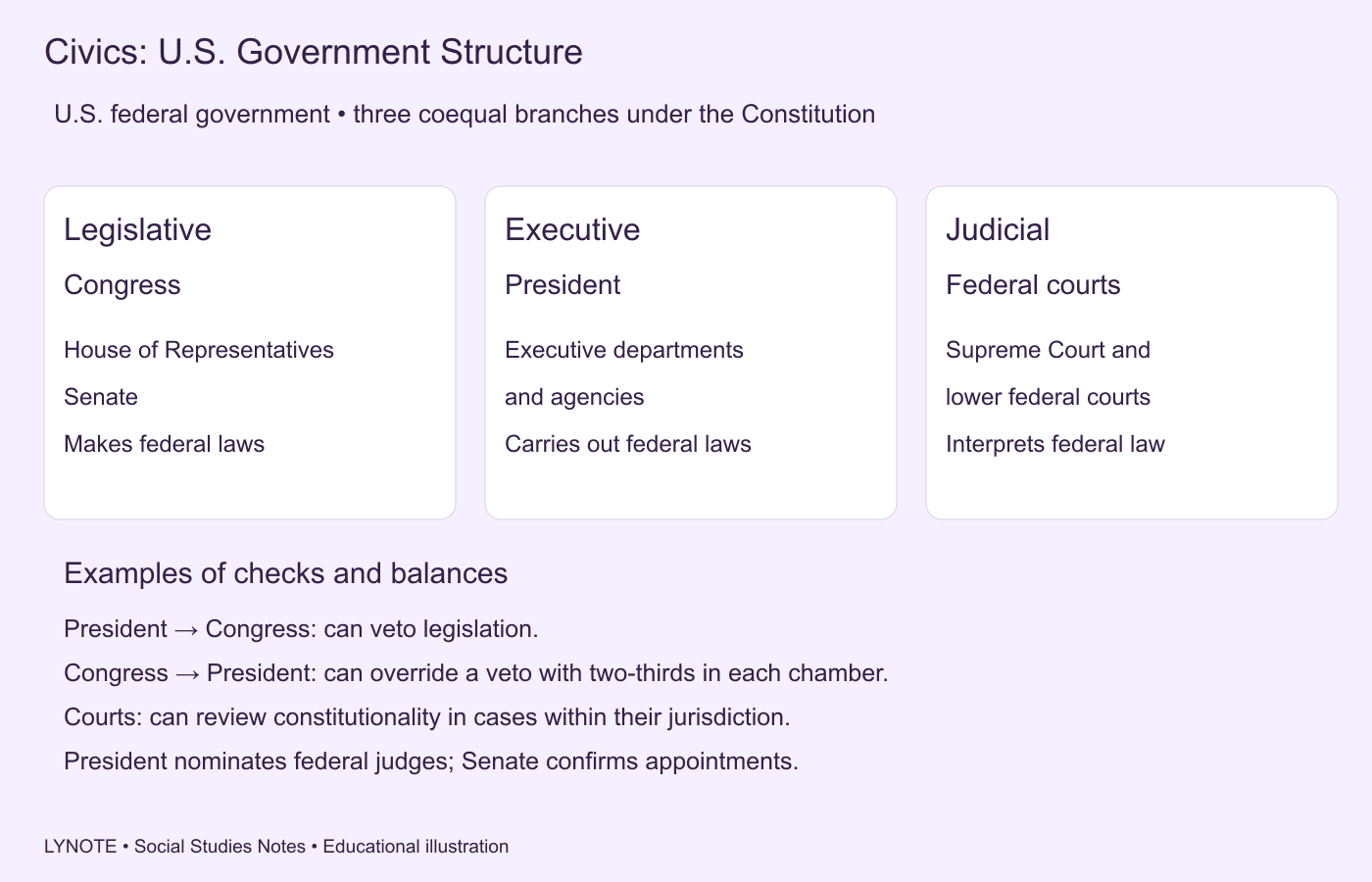
Civics and government explain how political systems work and how individuals participate in society. Your notes should cover government structures, constitutions, laws, political institutions, elections, and individual rights.
Create comparison tables for different forms of government. You can also use organizational diagrams to show how legislative, executive, and judicial institutions function.
Important topics include:
- Democracy and other forms of government.
- Constitutions and constitutional principles.
- Federal, state, and local government.
- Separation of powers and checks and balances.
- Individual rights and civic responsibilities.
- Elections, political parties, and public policy.
3. Geography Notes
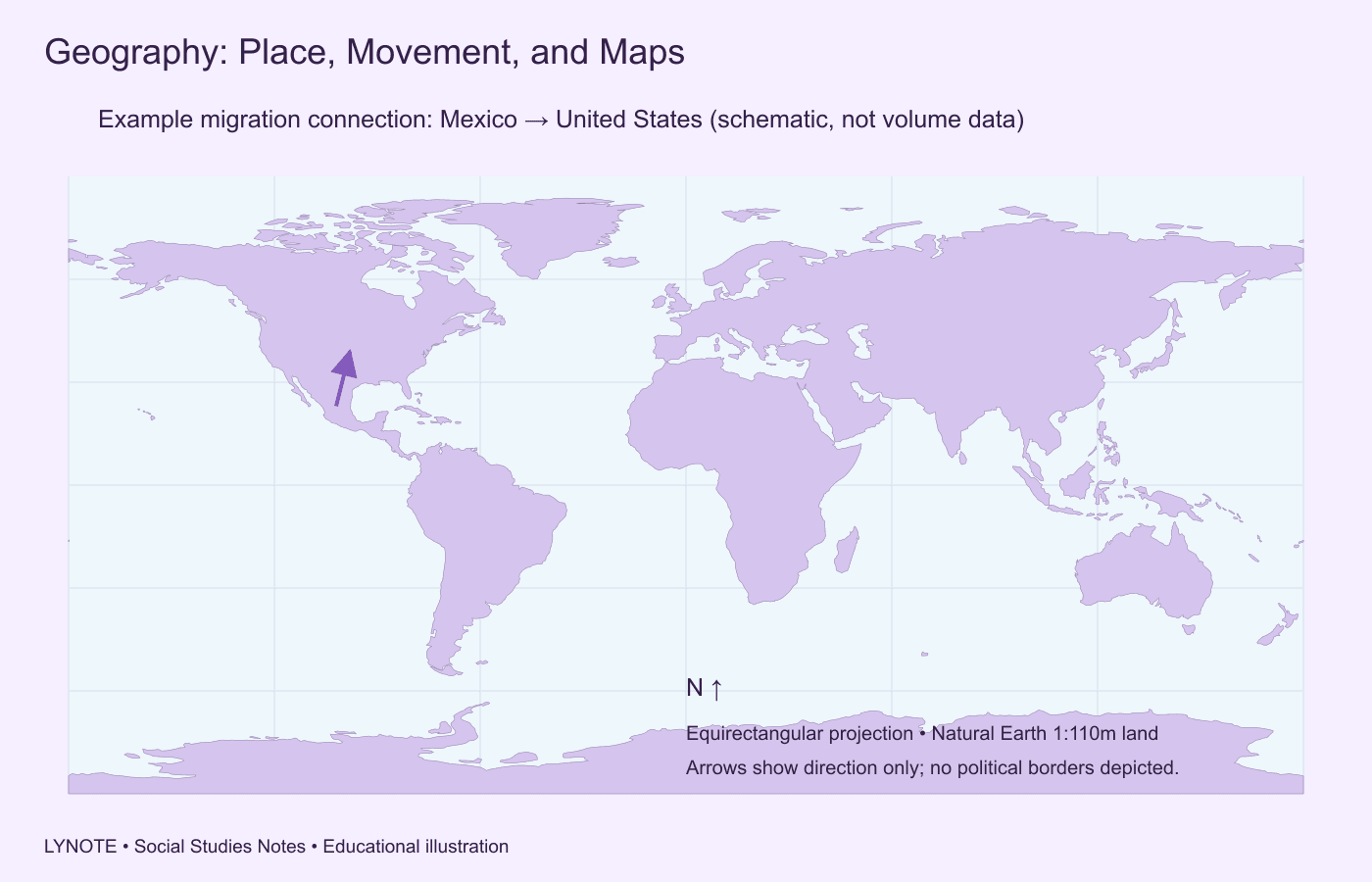
Geography studies the relationship between people, places, environments, and natural resources. Effective geography notes should combine definitions with maps and visual explanations.
Separate physical geography from human geography. Physical geography examines natural features and processes, while human geography focuses on population, migration, settlement, and human activities.
Important topics include:
- Continents, countries, and regions.
- Climate zones and natural environments.
- Mountains, rivers, plains, and other landforms.
- Population distribution and migration.
- Natural resources and resource management.
- Urbanization and economic development.
4. Economics Notes
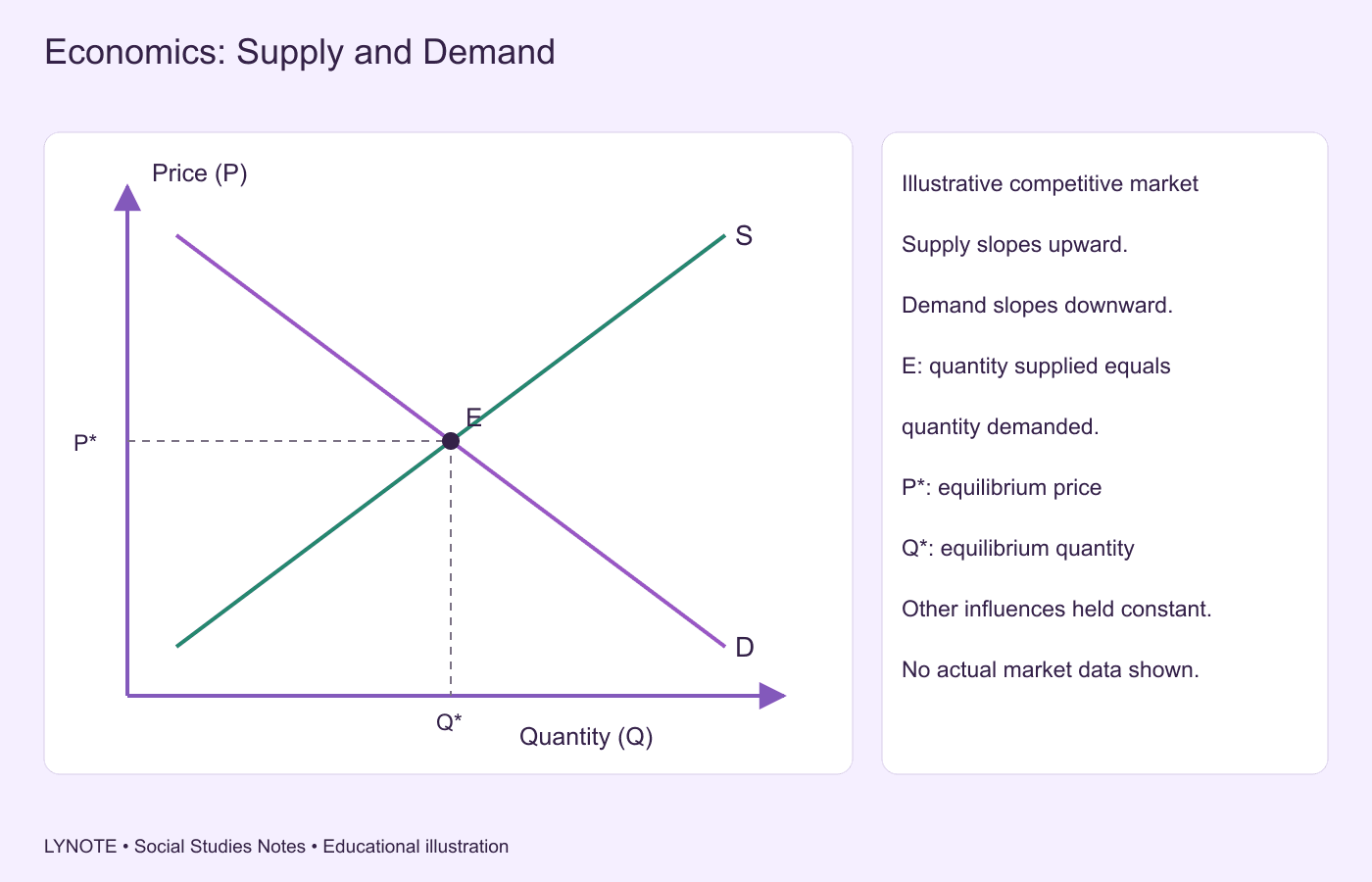
Economics examines how individuals, businesses, and governments make decisions about limited resources. Your economics notes should explain important terms and connect them with practical examples.
Use tables to compare economic concepts and diagrams to understand relationships. Supply and demand graphs are particularly useful for reviewing how markets respond to changes in prices and available resources.
Important topics include:
- Supply and demand.
- Scarcity and opportunity cost.
- Goods, services, and production.
- Inflation and unemployment.
- Gross Domestic Product (GDP).
- Consumer behavior and personal finance.
- Government spending and taxation.
- Microeconomics and macroeconomics.
How to Organize Notes on Social Studies by Topic
A major challenge in social studies is managing information from different disciplines. Creating separate sections for each topic helps prevent unrelated concepts from becoming mixed together.
Use Timelines for Historical Events
Timelines make chronological relationships easier to understand. They are particularly helpful when studying wars, revolutions, political movements, and major historical developments.
For each event, record the date, main participants, causes, and consequences. Add connections between related events to understand how one development influenced another.
Use Maps for Geography and History
Maps help you understand where events occurred and how geographic conditions influenced human activities. Mark important locations, borders, migration routes, and natural resources.
When studying historical events, connect geographic information with political and economic conditions. This can help explain why certain regions became important centers of trade, conflict, or settlement.
Create Comparison Tables for Civics and Economics
Comparison tables are useful when concepts share similar characteristics. For example, compare presidential and parliamentary systems or distinguish fiscal policy from monetary policy.
Keep each comparison focused on a few important differences. Add a practical example when a definition alone is not enough to explain the concept.
Summarize Each Chapter with Key Questions
At the end of each topic, write three to five questions that test your understanding. Questions should encourage you to explain relationships rather than simply recall definitions.
For example, ask how government policies influence economic activity or how geography affects population distribution. Answering these questions without looking at your notes is a useful way to check your understanding.
Class 10 Social Studies Notes: How to Prepare for School Exams
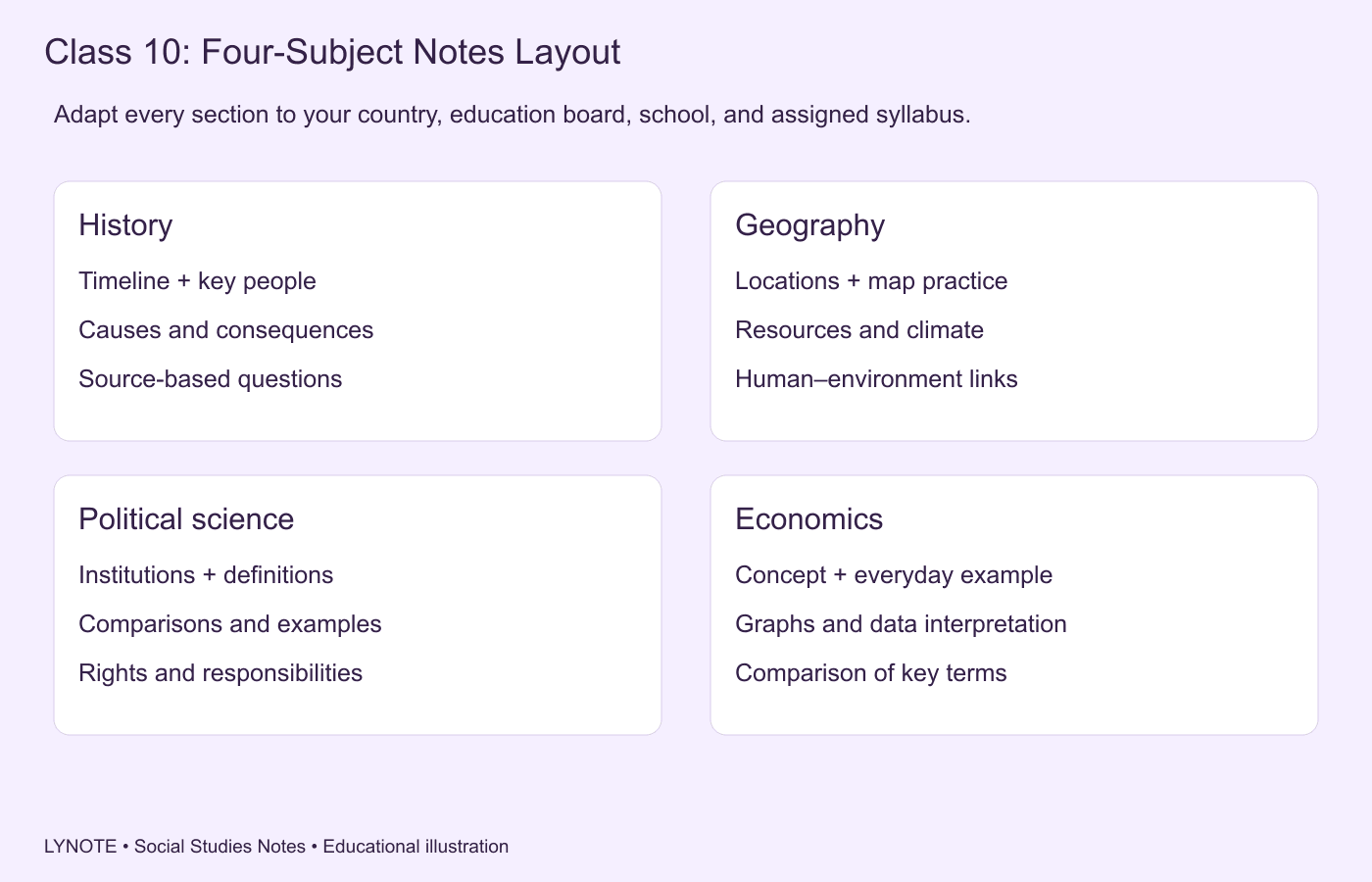
Class 10 social studies often combines history, geography, political science, and economics. The exact syllabus depends on the education board, country, and school, so your notes should follow your assigned curriculum.
Start by reviewing your textbook chapters and examination syllabus. Organize the material into subject sections and identify the concepts that require memorization, explanation, comparison, or map-based practice.
History Notes for Class 10
Class 10 history courses often examine nationalism, major historical movements, industrialization, colonialism, and changes in modern societies. The exact topics differ across curricula.
For each chapter, create a timeline of important events and identify the people and groups involved. Record causes, consequences, and connections between developments.
Geography Notes for Class 10
Geography notes should combine physical features, resources, climate, population, and human activities. Use maps and diagrams to make spatial relationships easier to remember.
Create separate sections for natural resources, agriculture, industries, transportation, and environmental issues when these topics appear in your syllabus. Include important locations and examples from your textbook.
Political Science Notes for Class 10
Political science notes should explain democracy, power sharing, federalism, political parties, and the role of institutions where included in your curriculum. Use flowcharts to show how government systems are organized.
For each concept, write a definition and one example. Comparison tables can help distinguish related political structures and principles.
Economics Notes for Class 10
Economics notes should focus on development, sectors of economic activity, money, credit, trade, and globalization when these topics are part of your course. Explain each concept using practical examples rather than relying only on textbook definitions.
Create comparison tables for economic sectors and different types of financial activities. Review graphs and data tables because they help illustrate economic relationships.
Class 10 Social Studies Revision Checklist
- Review all assigned history chapters.
- Create timelines for important historical events.
- Practice locating important places on maps.
- Review major geography concepts and natural resources.
- Understand political institutions and democratic principles.
- Review important economics definitions and relationships.
- Practice textbook questions and previous examination questions.
- Identify topics that require additional revision.
GED Social Studies Notes: What Should You Study?
The GED Social Studies test evaluates your ability to understand social studies information and apply reasoning skills. It covers civics and government, United States history, economics, and geography and the world.
According to the GED Testing Service assessment framework, the approximate content distribution is 50% civics and government, 20% U.S. history, 15% economics, and 15% geography and the world.
Unlike a course examination focused entirely on memorizing historical details, the GED also tests your ability to interpret passages, analyze evidence, understand data, and draw conclusions.
1. Civics and Government
Civics and government represent approximately half of the GED Social Studies content. Your GED social studies notes should therefore give particular attention to American government and democratic principles.
Review the Constitution, branches of government, individual rights, civic responsibilities, elections, and public policy. Understand how political institutions interact and how citizens participate in government.
2. United States History
U.S. history represents approximately 20% of the GED Social Studies content. Organize your notes chronologically to understand major events and their historical significance.
Important topics include the American Revolution, the early republic, the Civil War and Reconstruction, industrialization, the Civil Rights Movement, World War I and II, and the Cold War.
3. Economics
Economics represents approximately 15% of the GED Social Studies content. Your notes should cover fundamental economic concepts and how government policies influence economic activity.
Focus on supply and demand, economic systems, consumer economics, production, employment, inflation, and the economic consequences of historical events. Use simple examples to explain how economic decisions affect individuals and communities.
4. Geography and the World
Geography and the world account for approximately 15% of GED Social Studies content. Study how physical environments, borders, migration, and natural resources influence human societies.
Practice interpreting maps and identifying relationships between geography and historical developments. Understand how migration, settlement, trade, and environmental conditions shape communities.
GED Social Studies Content Distribution
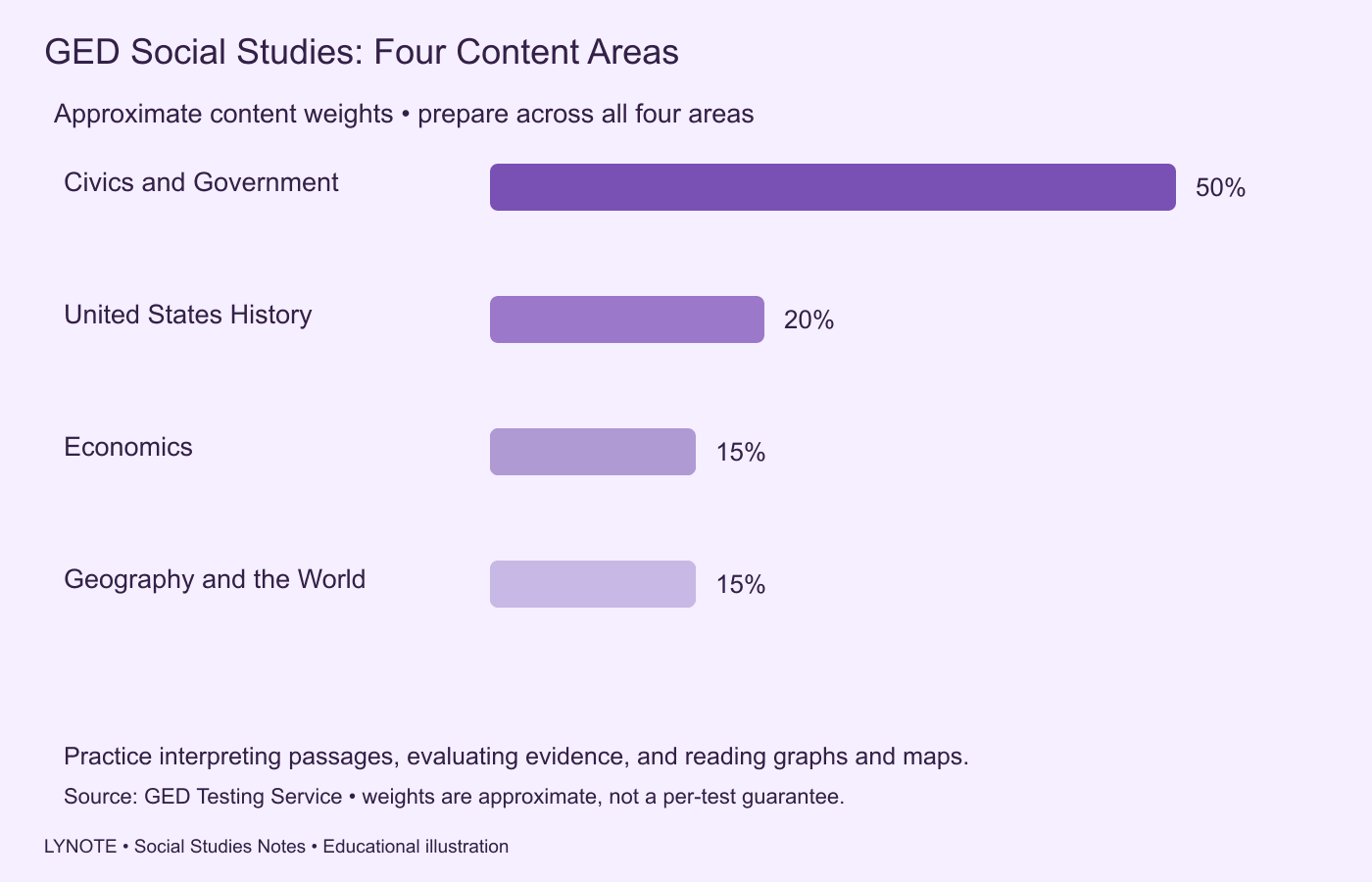
| Content Area | Approximate Test Weight |
|---|---|
| Civics and Government | 50% |
| United States History | 20% |
| Economics | 15% |
| Geography and the World | 15% |
Source: GED Testing Service, Assessment Guide for Educators: Social Studies. See also the official GED Social Studies preparation overview for these approximate weights.
These percentages are approximate content proportions. They should guide your revision priorities rather than be treated as a guaranteed distribution for every individual test.
GED Social Studies Notes PDF: How to Build a Useful Study Guide
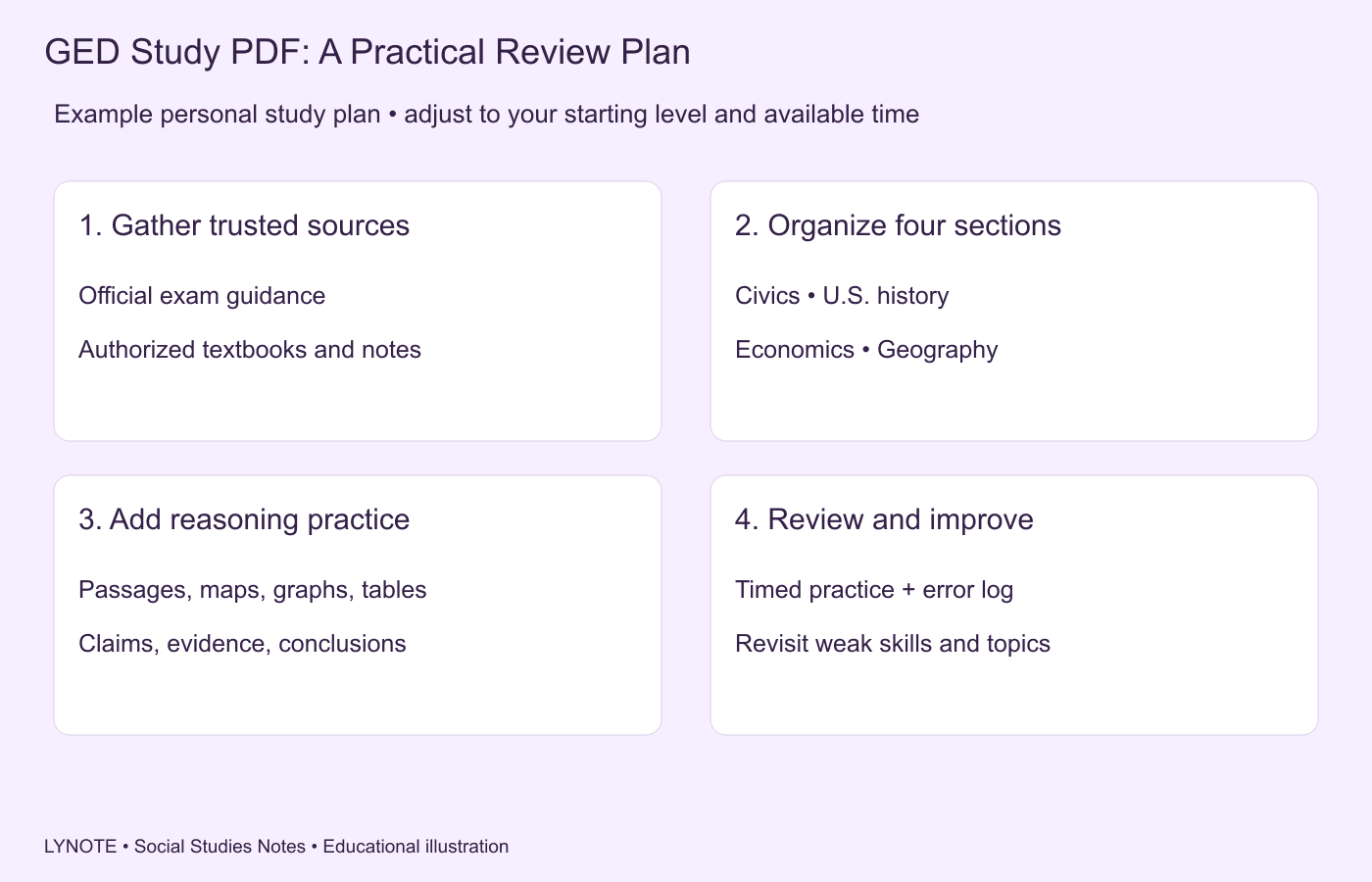
Many students search for GED social studies notes PDF resources because they want a convenient way to review several subjects together. A well-organized PDF can be useful for offline reading, printing, and revisiting important concepts.
However, the quality of the source matters. Check whether the material follows the current GED content framework and includes reasoning practice rather than only lists of historical facts.
What Should a GED Social Studies PDF Include?
A useful study PDF should cover all four GED content areas. It should also provide examples of the types of sources and visual information that appear in social studies questions.
Consider organizing your PDF into these sections:
- Civics and Government: Constitutional principles, branches of government, rights, and elections.
- U.S. History: Major periods, historical documents, events, and movements.
- Economics: Economic systems, supply and demand, and consumer concepts.
- Geography: Maps, migration, borders, and relationships between people and environments.
- Reading Skills: Main ideas, author perspective, and evidence evaluation.
- Data Interpretation: Graphs, tables, maps, and statistical information.
- Practice Questions: Questions that require reasoning and supported conclusions.
How to Use GED Social Studies Notes Effectively
Read a short section and then summarize its central idea in your own words. Afterward, answer questions that require you to interpret a passage or connect information from multiple sources.
Do not rely entirely on memorizing dates or vocabulary. Practice evaluating arguments, identifying evidence, and explaining what a graph or map reveals.
How to Prepare for the GED Social Studies Test
GED Social Studies preparation requires both subject knowledge and reasoning skills. Students need to understand the content while learning how to analyze written sources and visual information.
The official GED assessment framework emphasizes interpreting information, drawing conclusions, and solving problems using social studies knowledge.
1. Practice Reading Historical Sources
Historical documents often present different perspectives on the same event. Learn to identify the author's purpose, central argument, supporting evidence, and historical context.
Compare primary and secondary sources. A primary source comes from the period or event being studied, while a secondary source interprets or analyzes historical information.
2. Learn to Interpret Graphs and Tables
Social studies questions frequently use charts, graphs, tables, and maps. Practice identifying trends, comparing values, and drawing conclusions supported by the displayed information.
Always check titles, labels, units, and time periods before interpreting data. Avoid making assumptions that go beyond what the visual information actually shows.
3. Understand Historical Cause and Effect
Historical events rarely happen for only one reason. Economic pressures, political decisions, social movements, and geographic conditions can all influence historical developments.
Create cause-and-effect diagrams for important events. Record both immediate consequences and longer-term changes.
4. Practice Evaluating Arguments and Evidence
Some questions ask you to determine whether an argument is supported by evidence. Identify the author's claim and check whether the supporting information is relevant and sufficient.
Learn to distinguish facts, opinions, assumptions, and unsupported claims. This skill is useful across history, civics, economics, and geography.
5. Review Quantitative and Economic Concepts
GED Social Studies may require you to interpret numerical information and apply basic mathematical reasoning. Review percentages, averages, ratios, and simple economic relationships.
Practice reading economic graphs and identifying changes in supply, demand, prices, and other indicators. Focus on explaining what the numbers mean in context.
6. Practice Extended Responses
The GED Social Studies assessment no longer includes an extended response task; GED Testing Service removed it in 2016, as documented in its technical manual. Extended-response writing can still be an optional study exercise for analyzing arguments and using evidence from provided source materials. Practice writing a clear claim and supporting it with relevant evidence, but do not treat this as a current Social Studies test requirement.
A useful response structure includes an introduction to your claim, evidence from the sources, and an explanation of how that evidence supports your reasoning. Avoid simply copying sentences without explaining their significance.
GED Social Studies Exam Preparation Checklist
- Review civics and government concepts.
- Study major U.S. historical periods and documents.
- Understand fundamental economics concepts.
- Practice reading maps and geographic information.
- Compare primary and secondary sources.
- Identify main ideas and author perspectives.
- Interpret graphs, charts, and tables.
- Evaluate claims and supporting evidence.
- Practice extended-response writing as an optional reasoning exercise, not a current Social Studies exam task.
- Complete timed practice questions.
How to Create Social Studies Notes with Lynote AI Note Taker
Social studies students often use several types of learning materials, including textbooks, lecture slides, historical documents, worksheets, maps, and recorded lessons. Organizing all these resources into clear notes can take considerable time.
Lynote AI Note Generator helps turn supported learning materials into structured, editable notes. You can organize your own social studies resources, review important concepts, and prepare study materials without manually rewriting every document.
Step 1. Upload Your Social Studies Study Materials
Start by uploading your social studies learning resources to Lynote. Supported materials include PDFs, documents, presentations, images, audio recordings, and videos.
For example, upload a history textbook chapter, a geography presentation, a government lecture, or a GED study PDF. You can use materials that you are authorized to process.
Step 2. Generate Structured Social Studies Notes

Actual Lynote interface showing generic demonstration content.
Use Lynote to organize information from your uploaded materials into structured notes. The generated content can help group important concepts, historical events, definitions, and supporting explanations.
You can organize your notes around:
- History: Timelines, historical events, important figures, and cause-and-effect relationships.
- Civics: Government structures, constitutional principles, and civic responsibilities.
- Geography: Locations, maps, natural resources, and population patterns.
- Economics: Key definitions, economic relationships, and real-world examples.
- Exam Review: Important concepts and questions from your assigned materials.
After generation, use the built-in editor to refine explanations and reorganize information. Check historical dates, geographic details, and statistics against your original sources.
Step 3. Clarify Difficult Concepts with Lynote AI Chat

Actual Lynote interface showing generic demonstration content.
Some social studies topics involve complex relationships between historical, political, and economic factors. Use Lynote AI Chat to ask questions about information contained in your uploaded materials.
For example, if your source covers the American Revolution, you could ask for a breakdown of its major causes. If your materials explain supply and demand, you could ask for a comparison of how changes in each affect market prices.
AI Chat helps you revisit explanations without searching through an entire textbook chapter. For questions requiring information beyond your uploaded sources, consult your textbook, teacher, or official study resources.
Step 4. Create Flashcards for Social Studies Review
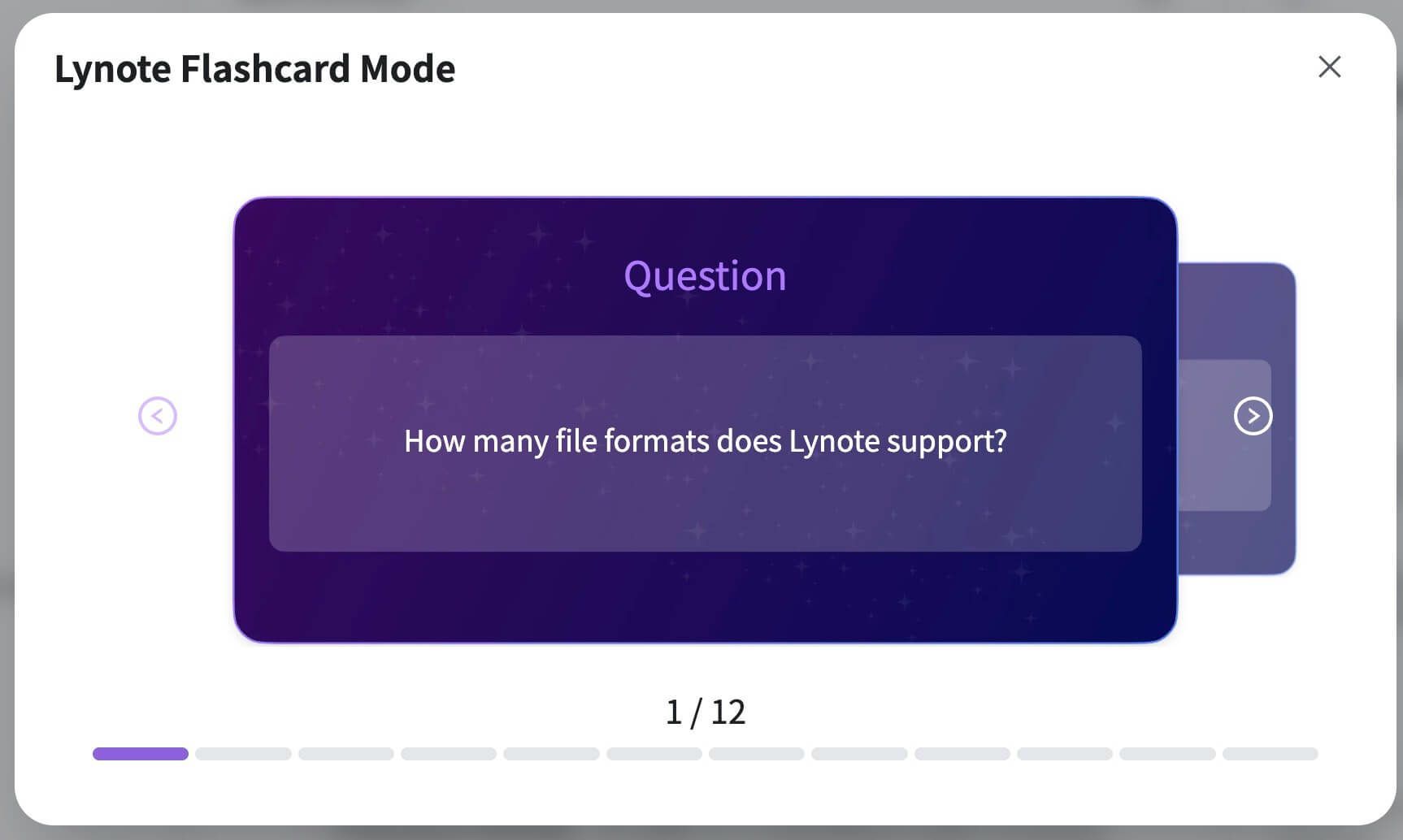
Actual Lynote interface showing generic demonstration content.
Social studies includes many important terms, historical events, and political concepts that benefit from repeated review. Lynote Flashcards can turn information from your notes into question-and-answer cards.
For example:
Question: What are the three branches of the U.S. federal government?
Answer: The legislative, executive, and judicial branches.
Question: What is supply and demand?
Answer: Supply describes how much of a good or service producers are willing to offer, while demand describes how much consumers are willing to buy at different prices.
Question: What is the difference between a primary and secondary source?
Answer: A primary source comes directly from the period or event being studied, while a secondary source interprets or analyzes information from other sources.
Question: What is federalism?
Answer: Federalism is a system in which governmental powers are divided between a central government and regional governments.
Use Flashcards to review important information, then practice analyzing historical passages, maps, graphs, and other source materials.
Build a More Organized Social Studies Study Routine
You do not need to wait until the week before an examination to organize your learning materials. Use Lynote throughout the course to build structured notes from your assigned readings, lectures, and study resources.
After each lesson, generate notes, correct important details, and add your own examples. Before an exam, revisit the material, ask questions about difficult concepts, and use Flashcards to test your understanding.
Combine this workflow with independent reading, source analysis, map practice, and examination questions. Lynote helps organize your learning materials, while your own practice develops the reasoning skills needed to understand social studies.
Create Your Social Studies Notes with Lynote AI
Spend less time manually organizing scattered study resources and more time understanding history, government, geography, and economics.
Common Social Studies Note-Taking Mistakes to Avoid
Memorizing Facts Without Understanding Their Context
Memorizing historical dates and political terms can help with recall, but it does not always explain why events happened. Social studies requires you to understand relationships between people, institutions, environments, and economic systems.
Better approach: Add short explanations of causes, consequences, and real-world examples to your notes.
Mixing Different Subjects Together
History, geography, civics, and economics are connected, but they use different concepts and methods. Mixing every topic into one large section can make your notes difficult to review.
Better approach: Use separate subject sections and add cross-topic connections where they are relevant.
Ignoring Maps, Graphs, and Visual Sources
Social studies frequently uses visual information to explain events and relationships. Notes that contain only written definitions may not prepare you for questions involving maps, graphs, and tables.
Better approach: Include visual examples and practice interpreting them independently.
Relying Only on Condensed Study Guides
Short study guides can make revision faster, but they may leave out important explanations and source analysis. Different textbooks and curricula may also organize topics differently.
Better approach: Use summaries alongside your assigned textbook, teacher materials, and official examination guidance.
Reviewing Without Testing Understanding
Rereading notes can create familiarity without proving that you can explain the material independently. Students need to retrieve information and apply it to unfamiliar examples.
Better approach: Turn headings into questions, explain concepts in your own words, and complete practice exercises without looking at the answers.
Conclusion: Build Social Studies Notes That Make Learning Easier
Effective social studies notes connect history, civics, geography, and economics into an organized study system. Whether you are preparing for a Class 10 examination or the GED Social Studies test, clear notes help you understand concepts, interpret evidence, and review important information more efficiently.
Organize your materials by subject, practice analyzing sources, and test your understanding regularly. To turn your own textbooks, PDFs, and lessons into editable study notes, try Lynote AI Note Generator and build a more organized learning routine.
Frequently Asked Questions About Social Studies Notes
What Should Social Studies Notes Include?
Good social studies notes include key terms, historical events, political concepts, geographic information, economic principles, and real-world examples. Add maps, timelines, charts, and review questions to make the information easier to understand.
What Is the Difference Between Notes for Social Studies and Notes on Social Studies?
Both phrases generally refer to study materials covering social studies subjects. The most useful notes organize information into history, civics, geography, and economics rather than presenting unrelated facts together.
How Do I Make Notes of Social Studies More Effectively?
Start by identifying the chapter's learning objectives and main concepts. Organize the material using headings, definitions, examples, timelines, diagrams, and questions that test your understanding.
What Should Class 10 Social Studies Notes Include?
Class 10 social studies notes should follow your assigned education board and school syllabus. Depending on your curriculum, they may cover history, geography, political science, economics, and related examination topics.
What Are GED Social Studies Notes?
GED Social Studies notes are study materials that cover civics and government, U.S. history, economics, and geography and the world. They should also help students practice reading comprehension, source analysis, data interpretation, and evidence-based reasoning.
Where Can I Find GED Social Studies Notes PDF Resources?
Students may find PDF study materials through GED Testing Service resources, adult education programs, educational platforms, and preparation courses. Check that the material follows the current GED assessment framework and covers all four content areas.
What Is the Most Important Topic on the GED Social Studies Test?
Civics and government account for approximately 50% of the GED Social Studies content distribution. U.S. history accounts for approximately 20%, while economics and geography and the world each account for approximately 15%.
These percentages are approximate and should guide study priorities rather than replace preparation across all subjects.
Are GED Social Studies Notes Enough to Pass the Test?
Notes help organize knowledge, but they are not enough by themselves. Students should also practice interpreting passages, analyzing historical sources, reading graphs, and evaluating arguments.
How Can I Remember Historical Events More Easily?
Use timelines to organize events chronologically and connect each event with its causes and consequences. Flashcards can also help you review important dates, people, documents, and historical terms.
Can Lynote Help Me Create Social Studies Study Notes?
Yes. Lynote can generate structured notes from supported learning materials that you provide, including PDFs, documents, presentations, images, audio, and videos.
You can edit the generated notes, ask AI Chat questions based on uploaded sources, and create Flashcards for review. Verify historical facts, statistics, and geographic details against your original materials.
Can AI-Generated Social Studies Notes Replace Textbooks?
No. AI-generated notes can help organize information and make revision more convenient, but they do not replace complete textbooks, teacher guidance, or official examination materials.
Use your notes alongside assigned readings and independent practice to build a stronger understanding of social studies.

Written by Kristen I.
Content Strategist
Kristen focuses on content structure, editorial planning, readability, and creating useful experiences for readers. View all articles →