

How to Build Biology Notes That Make Studying Easier

Strong biology notes turn dense textbook chapters, diagrams, lectures, and lab concepts into material you can actually review. Biology is full of processes, terms, exceptions, and cause-and-effect chains, so copying paragraphs is rarely enough. A better system helps you connect definitions, diagrams, examples, and exam-style questions in one place.

Many students struggle because biology study notes become too long, too scattered, or too passive. You might highlight a chapter, save a slide deck, copy lecture points, and still feel unsure before a quiz. The goal is to build biology notes that are structured, visual, and easy to revisit.
Why Biology Notes Need a Different Study System
Biology is not a subject where memorizing isolated facts always works. You need to understand how systems interact, why a process happens, and what changes when one variable shifts. That is why biology notes should explain relationships, not just list definitions.
For example, photosynthesis notes should not only define chlorophyll, ATP, and the Calvin cycle. They should show how light energy becomes chemical energy and how each step depends on the previous one. When your biology notes show the logic, recall becomes easier.
What Good Biology Notes Should Include
Useful biology notes usually include five parts: key terms, process steps, diagrams, examples, and review questions. Key terms give you vocabulary, while process steps help you explain systems clearly. Diagrams help you remember structure, and questions help you check whether you understand the material.
A simple biology note page might include a heading, a short summary, a labeled diagram, and three exam questions. This format works better than a long block of copied text. It also makes review faster when you are preparing for AP Biology, H2 Biology, or college-level courses.
Biology Notes vs. Biology Study Notes
Biology notes are often raw material from class, textbooks, lectures, videos, and labs. Biology study notes are the cleaned-up version you use before a test. The difference matters because raw notes capture information, while study notes organize it for memory.
After each class, turn rough biology notes into a review-ready format. Remove repeated points, add missing definitions, and rewrite confusing sections in your own words. This small revision step can save hours before an exam.
A Simple Biology Notes Template
Use a repeatable template so every topic feels familiar. This is especially helpful when chapters become more complex. A consistent structure also makes it easier to compare topics across units.

| Section | What to Add |
|---|---|
| Main concept | One short explanation of the topic |
| Key terms | Definitions with examples |
| Process | Steps in order, with cause and effect |
| Diagram | Labeled sketch, flowchart, or table |
| Common mistake | One misconception to avoid |
| Review questions | 3-5 active recall questions |
This template keeps biology notes compact without making them shallow. You can use it for cell biology, genetics, ecology, evolution, anatomy, and marine biology notes. The key is to keep every section useful for review.
How to Take AP Biology Notes
AP Biology notes should focus on concepts, evidence, and application. The AP exam often asks you to interpret data, explain mechanisms, and connect ideas across units. That means notes AP Biology students create should include more than vocabulary.
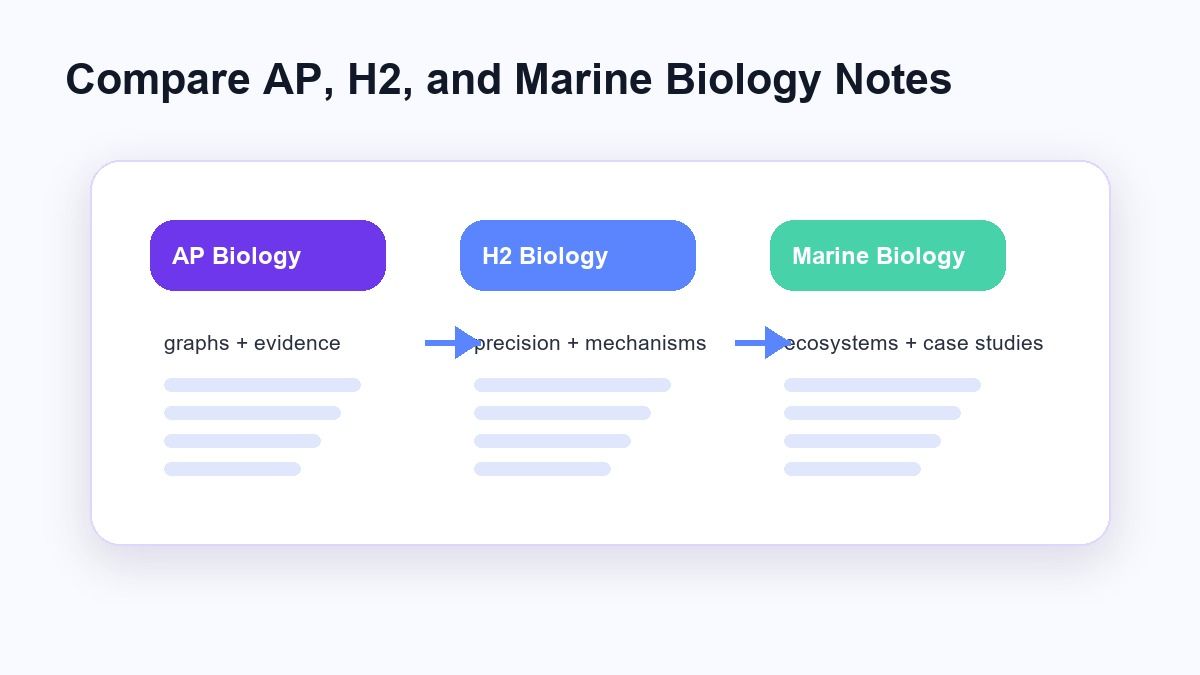
For AP Biology notes, add graphs, experimental setups, and short explanations of why an answer is correct. When you review natural selection, include data examples. When you review cellular respiration, include inputs, outputs, locations, and energy changes.
How to Take H2 Biology Notes
H2 biology notes often need a deeper level of detail and precision. Students may need to explain molecular processes, compare mechanisms, and use accurate scientific language. A strong note system helps you avoid vague answers.
For H2 biology notes, use tables to compare similar concepts. For example, compare DNA replication, transcription, and translation in one view. This makes differences clearer and helps you prepare for structured responses.
How to Build Marine Biology Notes
Marine biology notes should connect organisms, habitats, ecosystems, and environmental factors. Instead of only listing species, organize notes around relationships. For example, link coral reefs to biodiversity, temperature stress, symbiosis, and human impact.
A good marine biology note might include a habitat diagram, key species, ecological roles, and threats. Add examples from case studies when possible. These examples make your biology notes more memorable and more useful for essays or discussions.
How Lynote Helps Create Biology Notes Faster
Lynote AI Note Generator can help turn source material into structured notes when you are working with lectures, PDFs, videos, images, webpages, or YouTube links. This is useful for biology because source material often comes in many formats. You may have a textbook chapter, a diagram screenshot, a lecture recording, and a video explanation for the same topic.

Lynote helps create a first draft of biology notes with headings, bullet points, and organized sections. You still need to review the output, check scientific terms, and add your teacher's emphasis. The value is that you start from a cleaner structure instead of a blank page.
Step 1. Add Your Biology Source Material
Start with the source you need to study. This might be a lecture recording, textbook PDF, lab handout, biology video, webpage, or image of a diagram. If you are reviewing AP Biology notes, you can use class materials and study resources together.

The goal is to collect the material before trying to summarize it. Biology topics often depend on sequence and context, so missing one slide or diagram can make later notes confusing. A structured input step keeps your biology notes grounded in the original source.
Step 2. Generate Structured AI Notes
After adding your source, generate notes that organize the material into sections. For biology, useful sections often include key concepts, definitions, process steps, examples, and review prompts. This helps you move from raw information to biology study notes more quickly.

Review the output carefully. Scientific words, gene names, species names, and process steps should be checked against your course material. AI can help organize biology notes, but your final version should match what your class or exam expects.
Step 3. Turn Notes Into Active Review
Once your biology notes are organized, convert them into questions. Ask yourself what each term means, why each step happens, and how one system affects another. Active recall is usually more effective than rereading the same page many times.

You can also turn key points into flashcards, short quizzes, or diagram-labeling practice. For example, after creating notes on mitosis, test yourself on each phase. After creating notes on enzymes, explain how temperature, pH, and concentration affect activity.
How to Make Biology Notes More Visual
Biology is a visual subject, so your notes should not be text-only. Add flowcharts for processes, tables for comparisons, and labeled sketches for structures. Even simple drawings can make biology notes easier to remember.
Use arrows to show direction and cause. For example, in immune system notes, arrows can show how an antigen triggers a response. In ecology notes, arrows can show energy flow through a food web.
How to Keep Biology Notes Short
Long notes feel productive, but they are often hard to review. A better rule is to keep each section focused on one concept. If a page becomes too long, split it into smaller notes.
For example, do not put all genetics content on one page. Make separate biology notes for DNA structure, replication, transcription, translation, mutations, inheritance patterns, and genetic technology. Smaller notes are easier to revise before exams.
Common Mistakes When Making Biology Notes
The first mistake is copying slides word for word. This creates long biology notes without improving understanding. Rewrite the idea in your own words and keep only the details you need.
The second mistake is ignoring diagrams. Many biology exam questions depend on structure, sequence, and visual interpretation. If a diagram matters, include it in your notes.
The third mistake is not adding review questions. Notes without questions are passive. Add questions so every page becomes a study tool.
Biology Notes for Exam Prep
Before an exam, organize biology study notes by unit and difficulty. Start with the topics you understand least, then move to review questions and diagrams. This prevents you from spending all your time on material you already know.
For AP Biology notes, practice explaining graphs and experimental results. For H2 biology notes, practice precise wording and comparison tables. For marine biology notes, practice connecting examples to ecological principles.
FAQs About Biology Notes
What are biology notes?
Biology notes are organized study materials that explain biological terms, processes, diagrams, and examples. They can come from lectures, textbooks, videos, labs, and class discussions. Good biology notes help you understand relationships, not just memorize facts.
How do I make better biology study notes?
Use a consistent format with key terms, process steps, diagrams, examples, and review questions. Rewrite ideas in your own words instead of copying full paragraphs. Keep biology study notes short enough to review quickly.
How should I organize AP Biology notes?
Organize AP Biology notes by unit, concept, process, and exam skill. Include data interpretation, experimental examples, and active recall questions. This helps you prepare for application-based questions.
Can Lynote help with biology notes?
Yes, Lynote AI Note Generator can help turn supported files, videos, audio, images, webpages, and YouTube links into structured notes. You should still check scientific terms and course-specific details. It works best as a first draft for organized biology notes.
What should marine biology notes include?
Marine biology notes should include habitats, species, ecological roles, environmental factors, and case studies. Diagrams and relationship maps are especially useful. This helps connect organisms to the systems they live in.
Final Thoughts
Better biology notes help you study faster because they organize concepts, diagrams, examples, and review questions in one system. Whether you are working on AP Biology notes, H2 biology notes, marine biology notes, or general biology study notes, the goal is to make the material easier to understand and recall. If your sources are scattered across files, videos, and lectures, Lynote AI Note Generator can help you build a cleaner first draft for review.

Written by Kristen I.
Content Strategist
Kristen focuses on content structure, editorial planning, readability, and creating useful experiences for readers. View all articles →