
Artistic Notes: How to Take and Organize Creative Notes

Have you ever filled a sketchbook with ideas, drawings, and references, only to struggle to find them when starting a new project? Artistic notes help artists, designers, and creative learners capture inspiration, understand visual concepts, and organize ideas for future use.
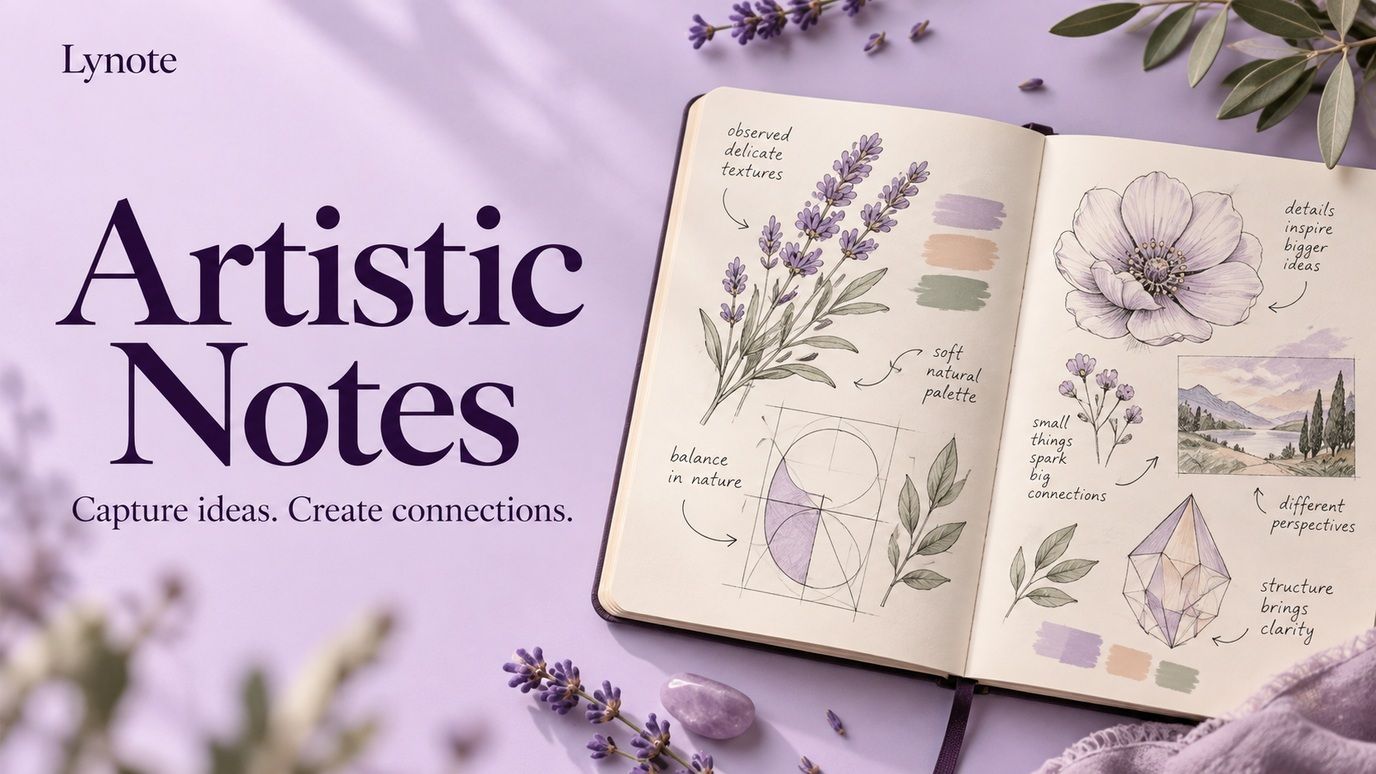
Unlike conventional study notes, artistic note-taking combines written explanations with sketches, diagrams, colors, and visual references. The goal is not simply to make a beautiful notebook, but to create a useful collection of ideas that supports learning and creative work.
In this guide, you'll explore practical artistic note-taking methods, real examples, organization strategies, and ways to use Lynote AI Notes to organize information from art tutorials and learning materials.
TL;DR: Key Takeaways
- Artistic notes combine words and visuals. Use sketches, diagrams, labels, and short explanations to capture ideas in a way that fits your creative process.
- Choose the right method. Sketchnoting, mind mapping, visual journaling, atomic notes, and evergreen notes serve different purposes.
- Focus on useful information. Record the context, source, and meaning of an idea rather than collecting attractive images without explanation.
- Keep notes organized. Consistent titles, keywords, project categories, and regular reviews make old ideas easier to find.
- Combine paper and digital tools. Handwritten sketches and digital reference notes can work together.
- Use AI for source-based learning. Lynote can turn supported art tutorials, PDFs, and recordings into structured notes that you can edit and review.
What Are Artistic Notes?
Artistic notes are records that use visual and written elements to capture creative ideas, observations, techniques, and research. They may include sketches, diagrams, color studies, annotations, reference images, and short explanations.
Unlike ordinary text notes, artistic notes do not need to follow a strictly linear format. An artist may place a quick sketch beside an observation, connect ideas with arrows, or use a visual map to explore several possible directions for a project.
The most important quality is usefulness. A good artistic note helps you remember why an idea mattered and how you might apply it later.
Artistic Notes vs. Aesthetic Notes
Artistic notes and aesthetic notes can look similar, but their purposes are not identical. Artistic note-taking focuses on recording creative information, exploring visual concepts, and developing ideas.
Aesthetic notes place greater emphasis on appearance, including decorative handwriting, coordinated colors, borders, and page layouts. These visual choices can improve organization, but attractive formatting does not automatically make the content more meaningful.
You can combine both approaches by designing notes that are visually engaging and easy to use. Start with the information you want to preserve, then add visual details that support understanding.
What Can Artistic Notes Include?
| Element | Purpose | Example |
|---|---|---|
| Sketches | Capture shapes and visual concepts | Thumbnail composition |
| Keywords | Identify important principles | Contrast, balance, rhythm |
| Color Studies | Record palette decisions | Warm and cool color combinations |
| Diagrams | Explain visual relationships | Perspective construction |
| References | Preserve useful sources | Artist, artwork, tutorial, book |
| Reflections | Record personal observations | Why a composition feels balanced |
| Questions | Identify ideas to explore | How does lighting affect depth? |
| Project Ideas | Connect learning with future work | Illustration concept development |
These elements can appear together or separately. A single page may contain a small drawing, a short explanation, and a question that guides your next experiment.
Why Are Artistic Notes Important for Creative Work?
Creative work involves more than producing finished artwork. Artists also observe, research, experiment, learn techniques, and revisit ideas that may become useful months later.
A consistent artistic note-taking habit provides a way to preserve this process. Instead of relying entirely on memory, you create a collection of information that supports future decisions.
1. Capture Inspiration Before It Disappears
Creative ideas can emerge while watching a film, visiting a gallery, reading a book, or observing everyday life. Without a quick recording method, the details may become difficult to remember.
A short sketch or written observation can preserve the essential idea. You do not need a finished drawing to create a useful note.
2. Improve Understanding of Visual Concepts
Artistic techniques often involve relationships that are difficult to explain using text alone. Perspective, composition, color harmony, and lighting become easier to examine when accompanied by diagrams or visual examples.
Combining a sketch with a written explanation encourages you to identify how a technique works. The note can then support future practice.
3. Connect Ideas Across Different Projects
An observation from one project may become relevant to another. A lighting study could influence a later illustration, while a color palette might inspire a new visual identity.
Organized notes help you rediscover these connections. Keywords, project references, and regular reviews can make previously recorded ideas useful again.
4. Track Your Creative Development
Notes can document the decisions and experiments behind an artwork. By recording what you tried, what changed, and what you learned, you build a reference for future projects.
This can be especially useful for art students and designers developing a portfolio. The notes provide context for explaining a creative process rather than showing only the final result.
5 Artistic Note-Taking Methods Worth Trying
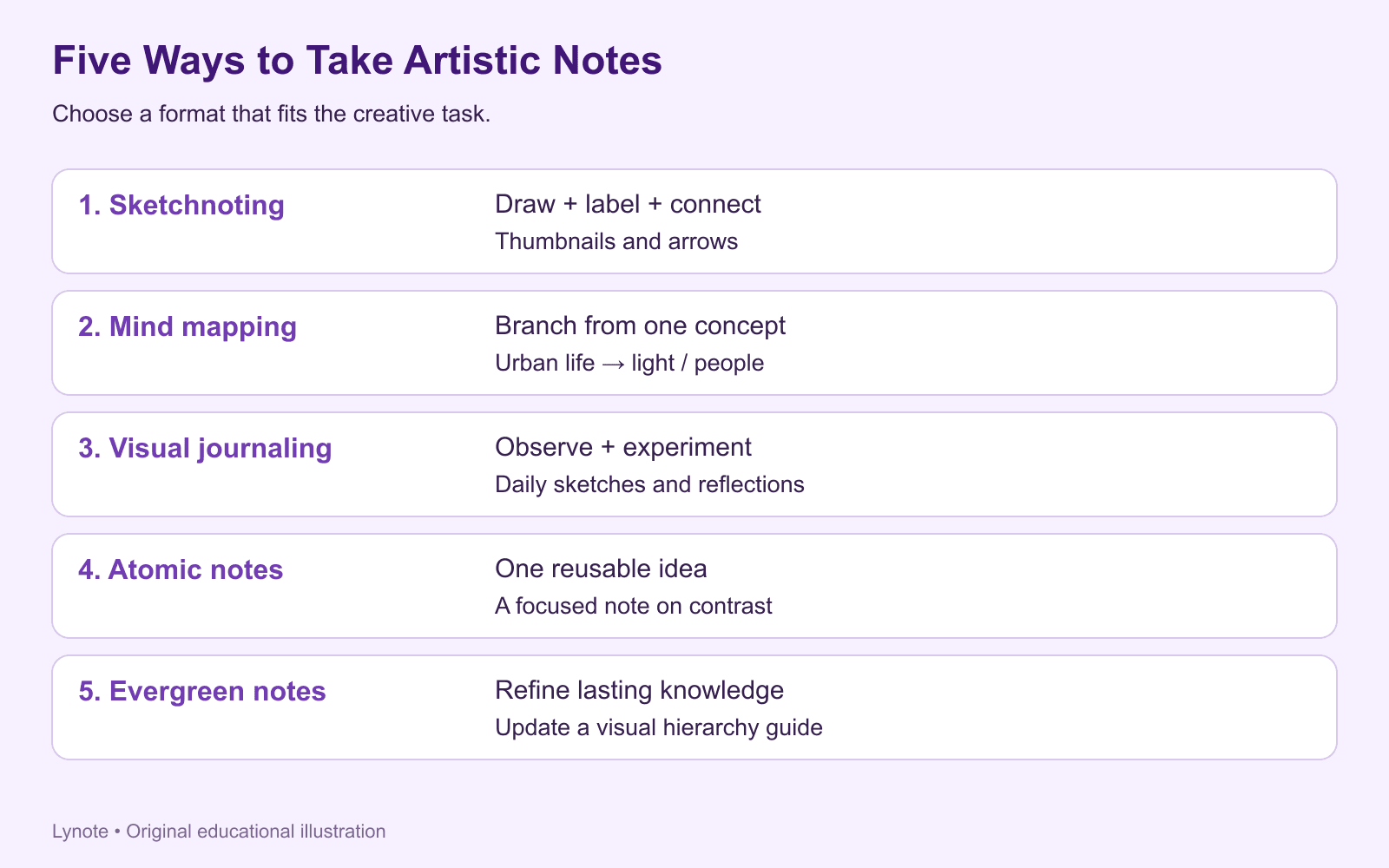
Different creative tasks benefit from different note-taking approaches. A visual brainstorming session may require a mind map, while a technical drawing lesson may need sketches and concise explanations.
The following methods can be used individually or combined into a flexible personal system.
1. Sketchnoting: Combine Drawing and Writing
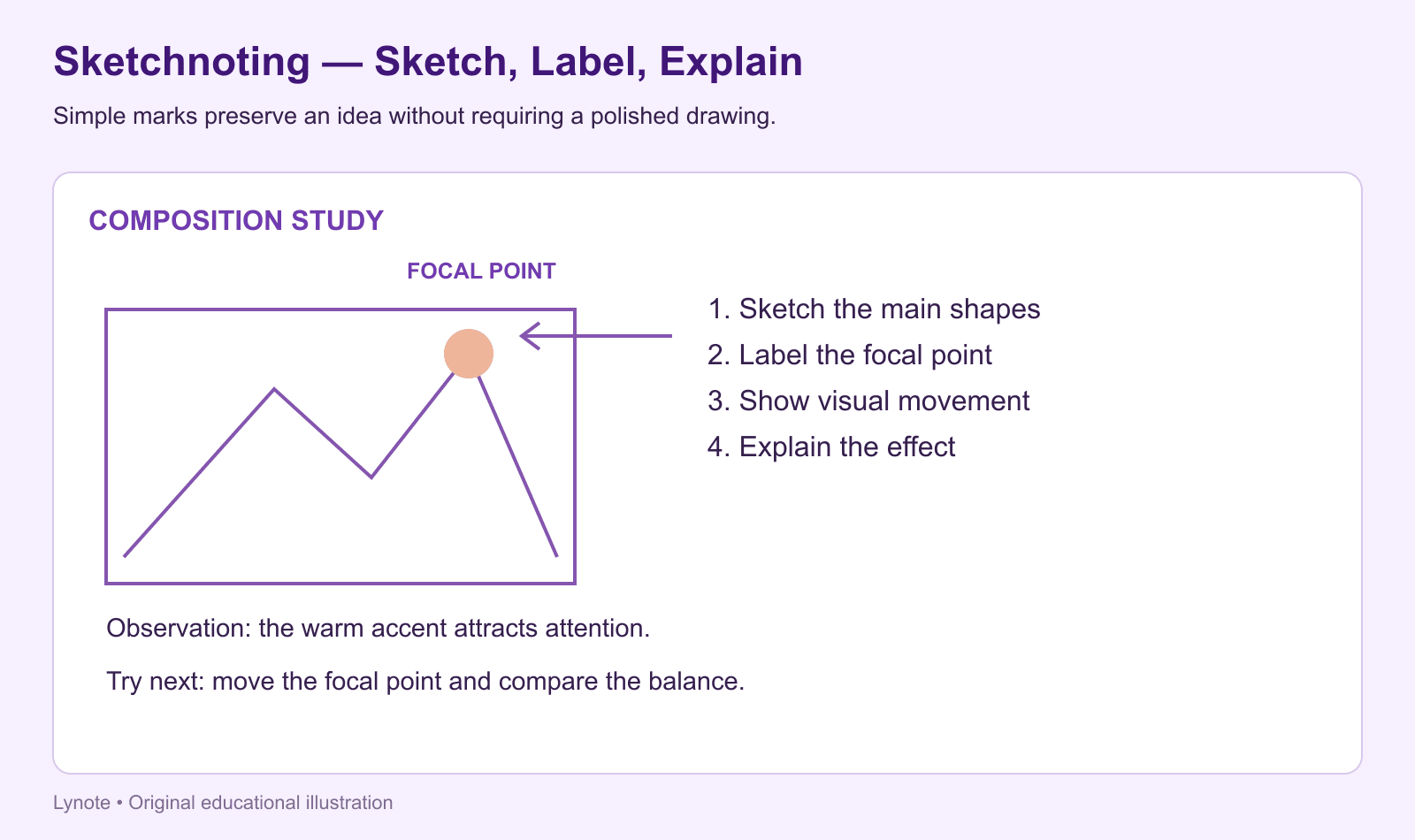
Sketchnoting uses hand-drawn symbols, small illustrations, arrows, labels, and short text to record information. Rather than treating drawing as decoration, it uses visuals to communicate ideas.
For example, an art student learning composition might draw several thumbnail layouts and label their focal points. Small arrows could indicate visual movement, while a few sentences explain how the arrangement affects the viewer's attention.
Best for: Art classes, drawing tutorials, design lectures, and visual explanations.
You do not need advanced drawing skills to begin. Simple shapes, arrows, and labels are often enough to create meaningful visual notes.
2. Mind Mapping: Explore Connections Between Ideas
Mind mapping begins with a central concept and expands into related topics. It is particularly useful during brainstorming because it allows ideas to develop in multiple directions.
Suppose you're planning an illustration about urban life. Your mind map might branch into architecture, transportation, lighting, people, color, and atmosphere.
Each branch can lead to more specific ideas, such as nighttime reflections or crowded compositions. The result is a visual overview of several possible creative directions.
Best for: Concept development, mood exploration, brainstorming, and early project planning.
3. Visual Journaling: Record Observations and Experiments
A visual journal combines sketches, text, images, and personal reflections in an ongoing notebook. It can document both finished ideas and unfinished experiments.
For example, a designer might record color combinations seen during a city walk, add a quick sketch of interesting signage, and explain what made the design memorable.
The journal becomes a record of observations rather than a collection of polished artwork. Revisiting old pages may reveal recurring interests or useful ideas.
Best for: Daily observation, sketchbook practice, creative reflection, and inspiration gathering.
4. Atomic Notes: Focus on One Idea at a Time
An atomic note concentrates on a single concept that can be understood and reused independently. In creative learning, this might be a note about color temperature, perspective, typography hierarchy, or visual balance.
Instead of placing every design principle in one large document, you create a separate note for each important idea. Each note contains a clear explanation, an example, and relevant references.
This makes individual concepts easier to retrieve and connect with other notes. A future project can draw from several atomic notes without requiring you to reread an entire notebook.
Best for: Art theory, design principles, technical techniques, and long-term knowledge management.
5. Evergreen Notes: Build a Lasting Creative Reference
Evergreen notes contain knowledge that remains useful beyond a single lesson or project. They can be updated as your understanding develops.
For example, an evergreen note about visual hierarchy might collect important principles, practical examples, observations from past projects, and links to related ideas.
The purpose is not to preserve every temporary thought forever. It is to maintain a useful explanation that you can improve and revisit.
Best for: Reusable design knowledge, recurring techniques, and long-term creative learning.
How to Take Artistic Notes in 5 Steps
Creating an effective artistic notebook does not require an elaborate system. Begin with a simple process that captures ideas quickly and makes them useful later.
These five steps work for art classes, drawing tutorials, creative research, and individual projects.
Step 1. Capture the Initial Idea
Start by recording the idea in whatever format feels most natural. You might write a short phrase, sketch a shape, photograph a visual reference, or record an observation.
Do not worry about creating a polished page at this stage. The goal is to preserve the idea before you lose its context.
For example, a quick note about an interesting shadow pattern can be useful even without a complete drawing.
Step 2. Add Context and Source Information
After capturing the idea, record where it came from and why it attracted your attention. Include the date, project, reference, or learning resource when relevant.
A note labeled only "interesting colors" may be difficult to understand several months later. A note explaining that the colors came from a museum poster and created a strong warm-cool contrast is more useful.
Source details also help when you need to verify information or credit the original creator.
Step 3. Organize the Idea into a Clear Note
Give the note a descriptive title and separate the main concept from supporting details. Use headings, labels, diagrams, or short bullet points to make the information easy to scan.
For example, a note about one-point perspective could include the definition, horizon line, vanishing point, construction steps, and a simple sketch.
Keep the structure flexible enough to accommodate both visual and written information.
Step 4. Connect the Note to Related Ideas
Look for relationships between the new note and information you already have. A note about atmospheric perspective might connect to color theory, landscape painting, and environmental design.
Add references or keywords that help you locate these relationships later. You can also write a short sentence explaining how the idea might be used in an upcoming project.
These connections transform isolated observations into reusable creative knowledge.
Step 5. Review and Apply What You've Recorded
Revisit your notes when planning a project, learning a new technique, or evaluating your work. Identify which ideas are still useful and which need additional context.
Try applying a concept in a sketch or practical exercise rather than only rereading its explanation. Update the note with what you discovered.
This review process gives artistic notes value beyond the moment they were created.
Artistic Notes Examples for Students and Creators
Artistic notes can take different forms depending on what you're studying or creating. The following examples show how visual information and written explanations can work together.
Example 1. Art History Notes: Impressionism
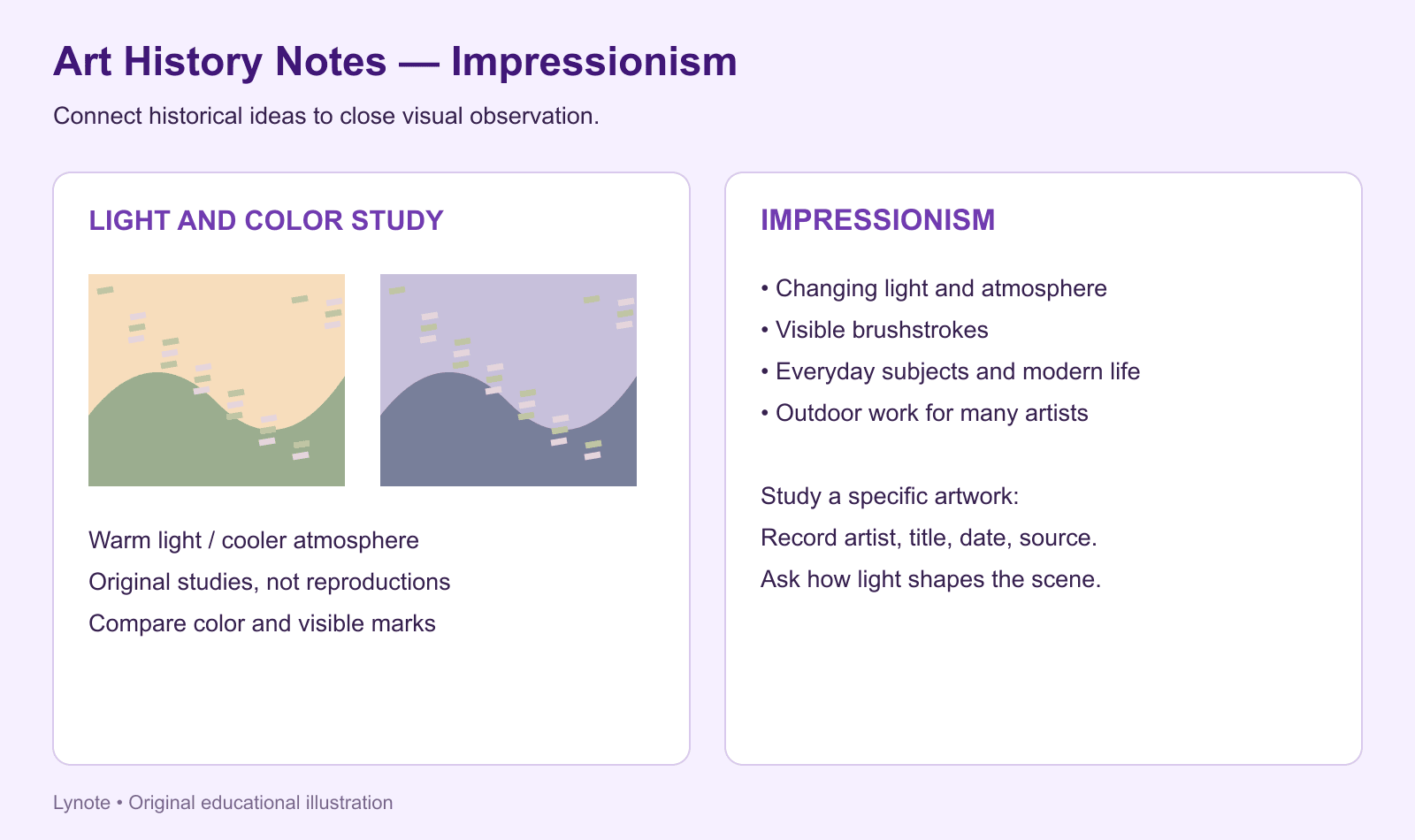
Topic: Impressionism
Main Characteristics
- Visible brushstrokes and an emphasis on changing light.
- Frequent depiction of everyday subjects and modern life.
- Interest in color, atmosphere, and visual perception.
- Outdoor painting became important for many Impressionist artists.
Visual Study
- Sketch two small landscape compositions.
- Compare the use of light and color.
- Note how brushwork communicates atmosphere.
Observation
Impressionist painting often prioritizes the impression of a moment rather than highly polished academic detail. Comparing specific artworks can help explain how artists achieved these effects differently.
Review Question
How did Impressionist approaches to light and everyday subject matter differ from established academic painting conventions?
This format connects historical knowledge with visual observation. It can support art history revision while encouraging closer analysis of individual artworks.
Example 2. Drawing Tutorial Notes: One-Point Perspective
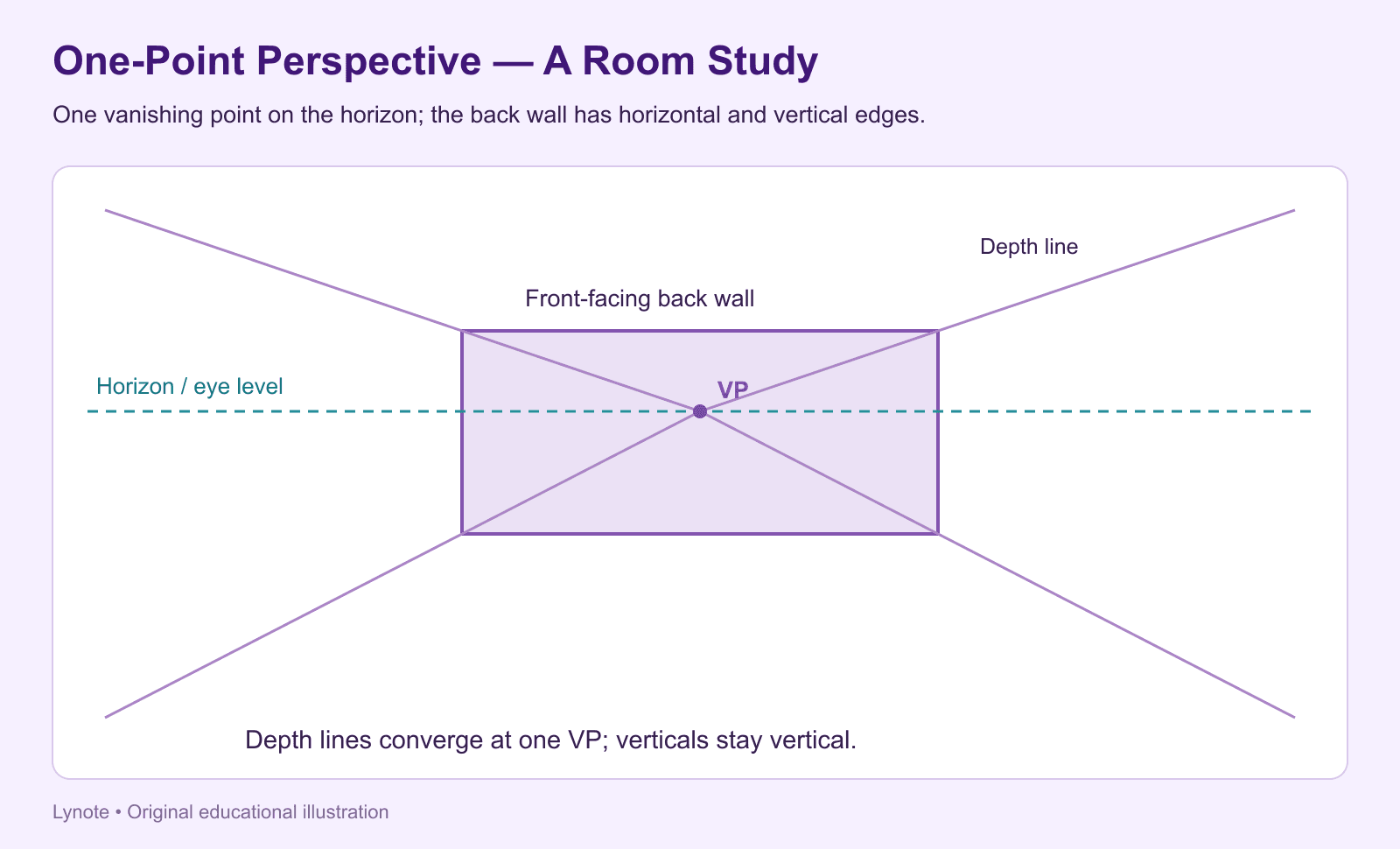
Topic: One-Point Perspective
Key Concepts
- The horizon line represents the viewer's eye level.
- Parallel lines moving directly away from the viewer converge toward a single vanishing point.
- Horizontal and vertical lines on front-facing surfaces remain horizontal and vertical in a typical one-point perspective setup.
Practice Exercise
- Draw a horizon line and select one vanishing point.
- Sketch the front-facing wall of a simple room.
- Extend depth lines toward the vanishing point.
- Add doors, windows, or furniture using the same perspective system.
Personal Observation
Changing the height of the horizon line changes the viewer's apparent eye level. Practicing several versions can help demonstrate the effect.
Review Question
How does moving the vanishing point affect the apparent position of objects in a composition?
A small perspective diagram would make this artistic note more useful. The text preserves the steps, while the drawing demonstrates the spatial relationship.
Example 3. Creative Project Notes: Editorial Illustration
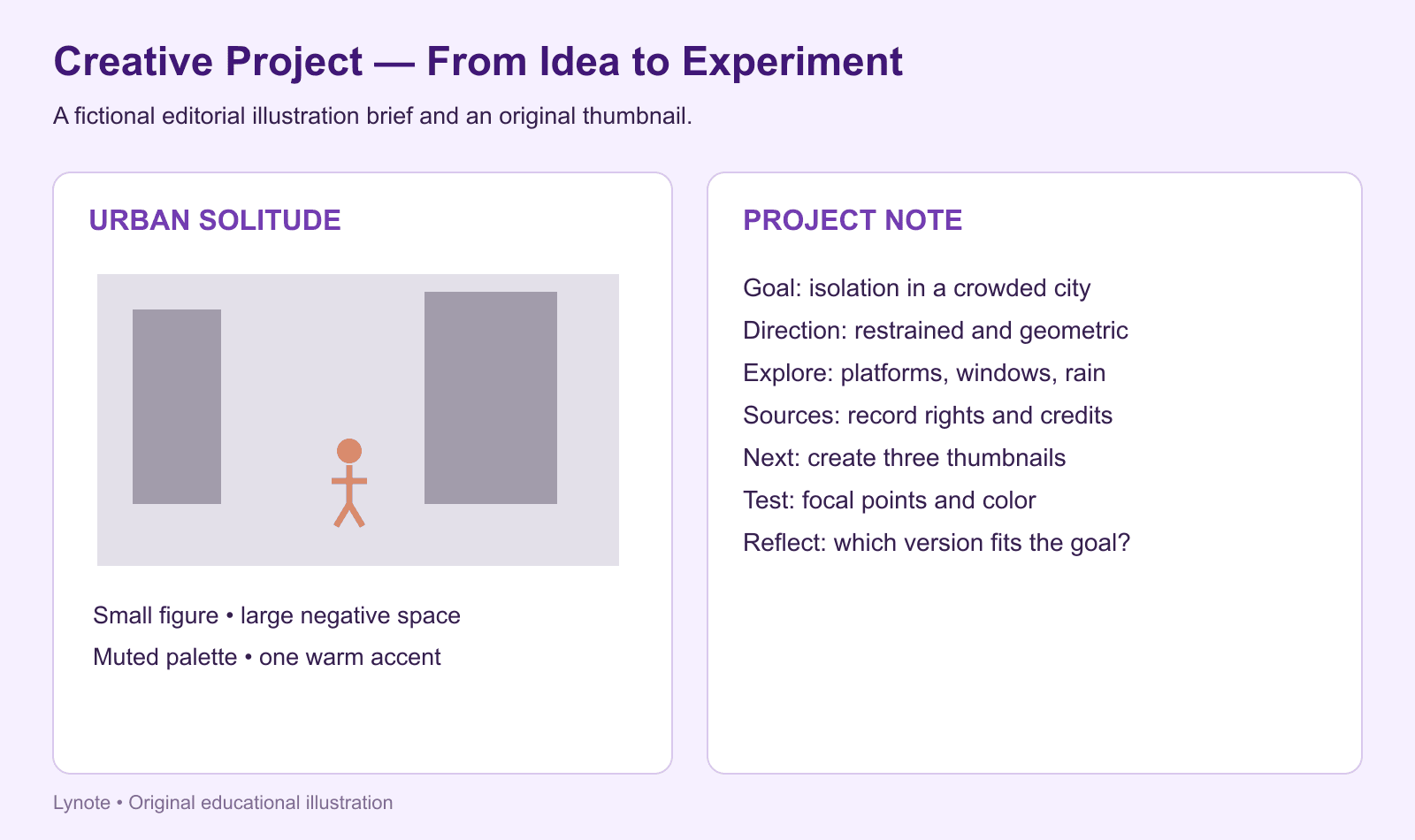
Project: Urban Solitude
Creative Goal
Develop an editorial illustration exploring isolation in a crowded city.
Visual Direction
- Muted colors with one contrasting accent.
- Strong use of negative space.
- Minimal environmental details.
- A small human figure within a larger architectural setting.
Ideas to Explore
- Empty train platforms.
- Apartment windows at night.
- Rain reflections on city streets.
- Repeated geometric building shapes.
Next Actions
- Gather reference images with appropriate usage rights.
- Create three thumbnail compositions.
- Test different focal points.
- Compare how color changes the emotional tone.
This note documents the reasoning behind a creative project. It can be revisited when developing sketches, presenting concepts, or reflecting on design decisions.
How to Organize Artistic Notes for Future Projects
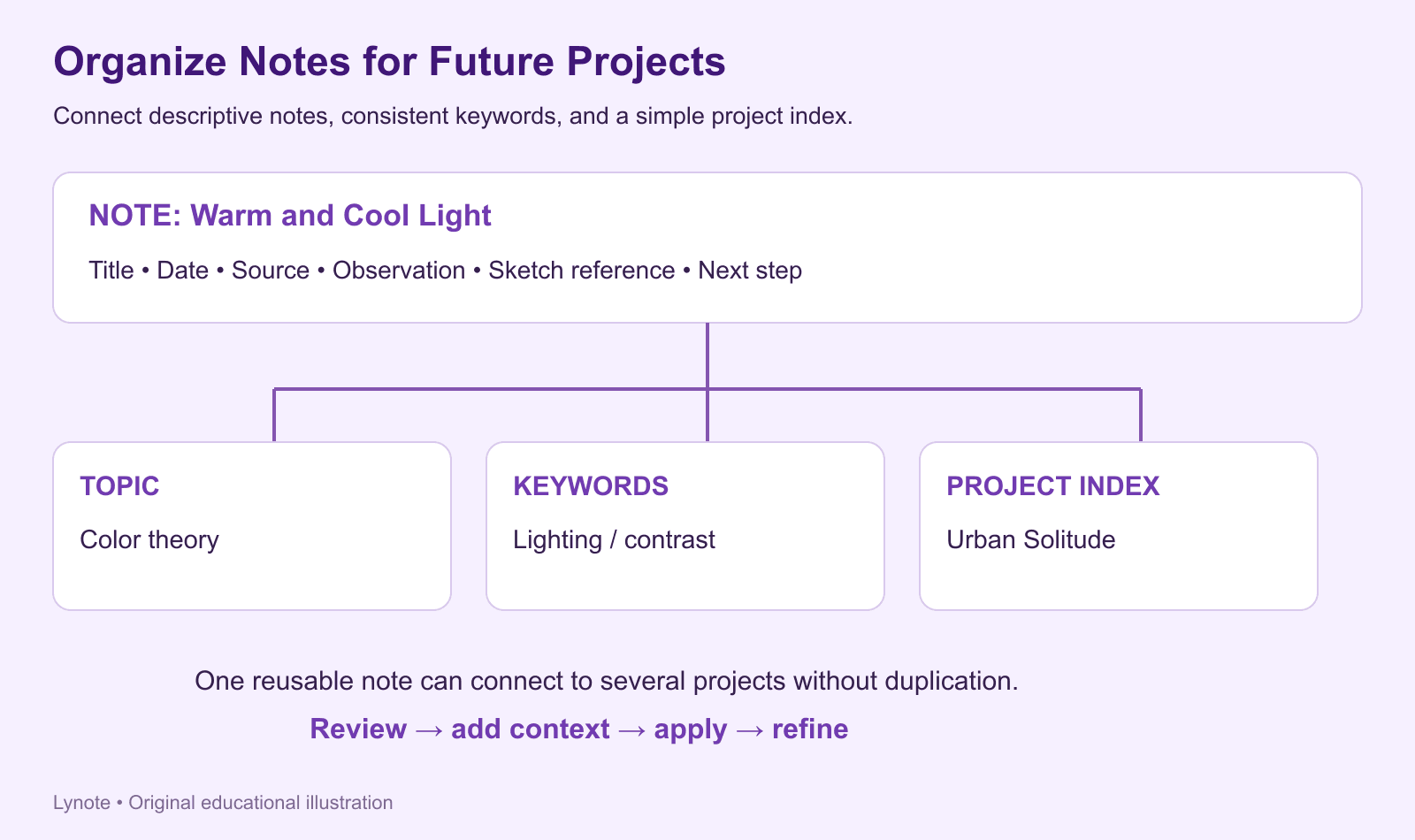
Capturing inspiration is only useful when you can find it again. A notebook filled with disconnected sketches and references may become difficult to navigate as your collection grows.
A simple organization system should help you retrieve notes without requiring constant maintenance.
Use a Consistent Note Format
Choose a small set of fields for each note. For example:
| Field | Purpose |
|---|---|
| Title | Identify the concept |
| Date | Record when the idea was captured |
| Source | Preserve the original reference |
| Topic | Categorize the subject |
| Main Idea | Explain the important concept |
| Visual Reference | Point to sketches or images |
| Personal Observation | Record your interpretation |
| Next Step | Identify a possible application |
Not every field is necessary for every idea. Use the information that helps you understand and reuse the note later.
Organize with Keywords and Categories
Keywords help connect notes that belong to different projects. Categories might include composition, typography, color, illustration, art history, and drawing techniques.
For example, a note about warm and cool lighting could be relevant to painting, photography, and environmental design. Using more than one meaningful keyword may help you rediscover it in different contexts.
Keep your terminology consistent so related notes are easy to find.
Create a Project Index
A project index provides a central place for important references, research, decisions, and experiments. Instead of moving every note into a separate project folder, the index can point to relevant existing material.
An illustration project might reference notes on color harmony, perspective, storytelling, and previous compositional experiments. This reduces the need to duplicate information across projects.
Review Your Notes Regularly
Set aside time to revisit notes you've created recently. Look for useful ideas, incomplete explanations, and connections to your current projects.
You can refine an important concept, add a missing source, or archive information that is no longer useful. The goal is to keep your creative knowledge accessible rather than continually reorganizing it.
Digital vs. Handwritten Artistic Notes
Handwritten sketchbooks and digital notes serve different purposes. Neither method is automatically better for every creative task.
Paper is useful for freeform drawing and immediate observation, while digital notes can make text easier to revise and organize.
| Feature | Handwritten Artistic Notes | Digital Artistic Notes |
|---|---|---|
| Freehand Sketching | Natural with pen and paper | Depends on drawing software |
| Text Editing | Changes may require rewriting | Easy to revise |
| Visual Experimentation | Flexible on paper | Depends on tools and layout |
| Search and Organization | Indexes and physical tabs | Titles, files, and search features |
| Long-Term Storage | Requires physical care | Requires digital backups |
| Sharing | Usually requires scanning | Easier in supported formats |
| Best For | Sketching and observing | Study references and project information |
When to Use a Sketchbook
Use a sketchbook when you need to draw freely, record observations, or experiment with compositions. Quick physical sketches can preserve details that are difficult to describe in words.
You can add short annotations beside each sketch explaining the idea or technique. Those explanations make the page easier to understand later.
When to Use Digital Notes
Digital notes are practical for organizing art theory, tutorial explanations, research references, and project decisions. They are especially useful when your learning materials already exist as PDFs, videos, or documents.
Use descriptive headings and a consistent structure so you can find important information later. Keep relevant sketches or visual references in an appropriate image or drawing tool when necessary.
Try a Hybrid Artistic Note-Taking System
You can capture quick sketches on paper and maintain written explanations digitally. This keeps freehand experimentation separate from information you need to search or revisit regularly.
For example, draw perspective exercises in a sketchbook while keeping related definitions, instructions, and questions in a digital note. The two formats complement one another without requiring a single tool to do everything.
Artistic Music Notes: Using Musical Symbols Creatively
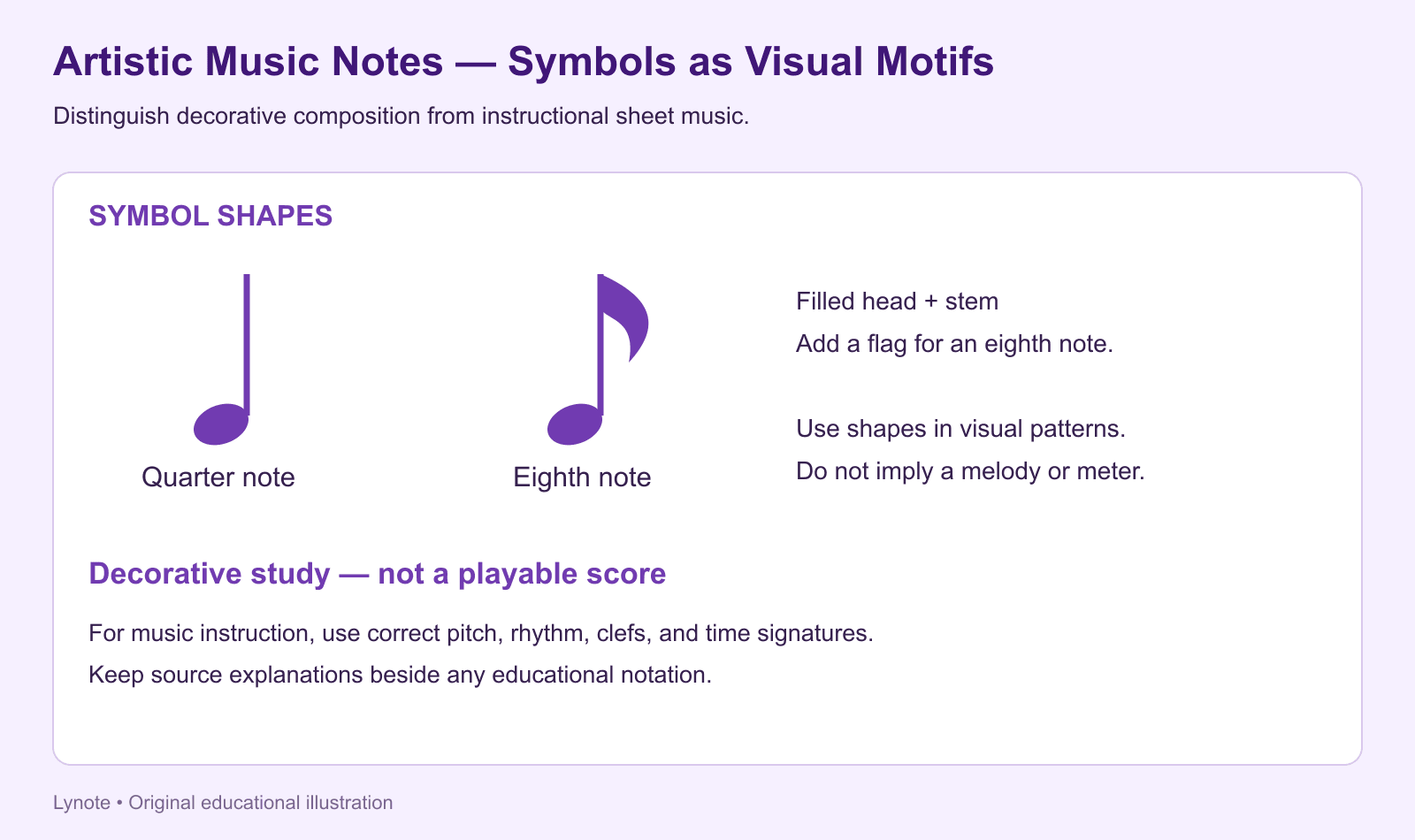
Artistic music notes and artistic musical notes are sometimes used to describe decorative designs made with musical notation. They may appear in sketchbooks, posters, album artwork, typography, or music-inspired illustrations.
This meaning is different from artistic note-taking for visual learning. Musical note symbols represent aspects of music, while decorative illustrations may use their shapes primarily for visual expression.
Creative Ways to Use Musical Note Symbols
For music-inspired visual studies, consider experimenting with:
- Eighth notes and quarter notes: Use their distinctive shapes in a repeating visual pattern.
- Treble and bass clefs: Explore curving forms in typography or ornamentation.
- Staff lines: Create rhythm through repeated horizontal elements.
- Dynamic markings: Study how typography communicates intensity and movement.
- Musical phrases: Explore visual grouping and spacing.
When creating educational music notes, preserve the correct meaning of notation rather than treating all symbols as interchangeable decorations. For artistic studies, you can experiment with composition while clearly distinguishing illustration from instructional sheet music.
Artistic Notes for Music Students
Music students can also use artistic note-taking to study rhythm, musical form, and composition. A useful page might include a short notation example, an explanation of the rhythm, and questions about how the passage works.
Keep written explanations alongside the relevant score or audio reference when you have permission to use it. Lynote can help organize supported lesson materials into text-based notes, but it should not be described as a specialist music-notation editor.
Artist's Note vs. Artistic Notes: What's the Difference?
An artist's note is often a written statement explaining the meaning, intention, inspiration, or process behind a particular artwork or creative project. Artistic notes, by contrast, are the working records an artist creates while observing, learning, researching, and experimenting.
A single project may include many artistic notes but only one concise artist's note for an exhibition or presentation.
Example of an Artist's Note
Project: Urban Solitude
This illustration explores the contrast between crowded public spaces and personal isolation. Through a restrained color palette, repeated architectural shapes, and deliberate negative space, the work reflects how urban environments can feel both connected and distant.
This statement communicates the work's intention to an audience. The artistic notes behind it might include sketches, reference photographs, palette experiments, and research about visual composition.
How Artistic Notes Support an Artist's Statement
Before writing a final statement, review your project notes and identify the most meaningful decisions. Look for recurring themes, intentional techniques, and changes that shaped the outcome.
Then explain those choices using clear, specific language. Avoid claiming an interpretation or artistic influence that your actual process does not support.
How to Create Artistic Study Notes with Lynote AI
Art students and designers often learn through a combination of tutorial videos, course PDFs, recorded lessons, and written resources. These materials can contain explanations of perspective, color theory, art history, and creative techniques.
Lynote AI Notes can help organize information from supported learning materials into structured, editable notes. It is intended to assist with studying source content, not to replace drawing software or a visual canvas.
Step 1. Add Your Art Learning Materials
Upload a supported PDF, document, audio recording, or video, or provide a supported YouTube or webpage URL. Choose materials related to a specific learning goal.
For example, you could use a recorded lesson about color theory or a PDF introducing design principles. Only process materials you are authorized to use.
Step 2. Generate Structured Notes
Use Lynote to generate notes with headings, key points, and explanations based on the source material. This can provide an organized starting point for reviewing the lesson.
Check the resulting content against the original material. Visual demonstrations, diagrams, and examples may contain important information that needs to be reviewed separately.
Step 3. Add Your Creative Observations

Actual Lynote interface; sample content is a generic product demonstration, not an art terminology lesson. Official source.
Use Lynote's editor to refine the written notes and add personal observations. You might explain how a particular technique relates to your own projects or identify an idea worth practicing.
Keep sketches, mood boards, and detailed visual references in tools suited to those formats. Lynote should not be presented as providing a dedicated freehand drawing canvas or automatic mood-board generator.
Step 4. Review Concepts with AI Chat and Flashcards
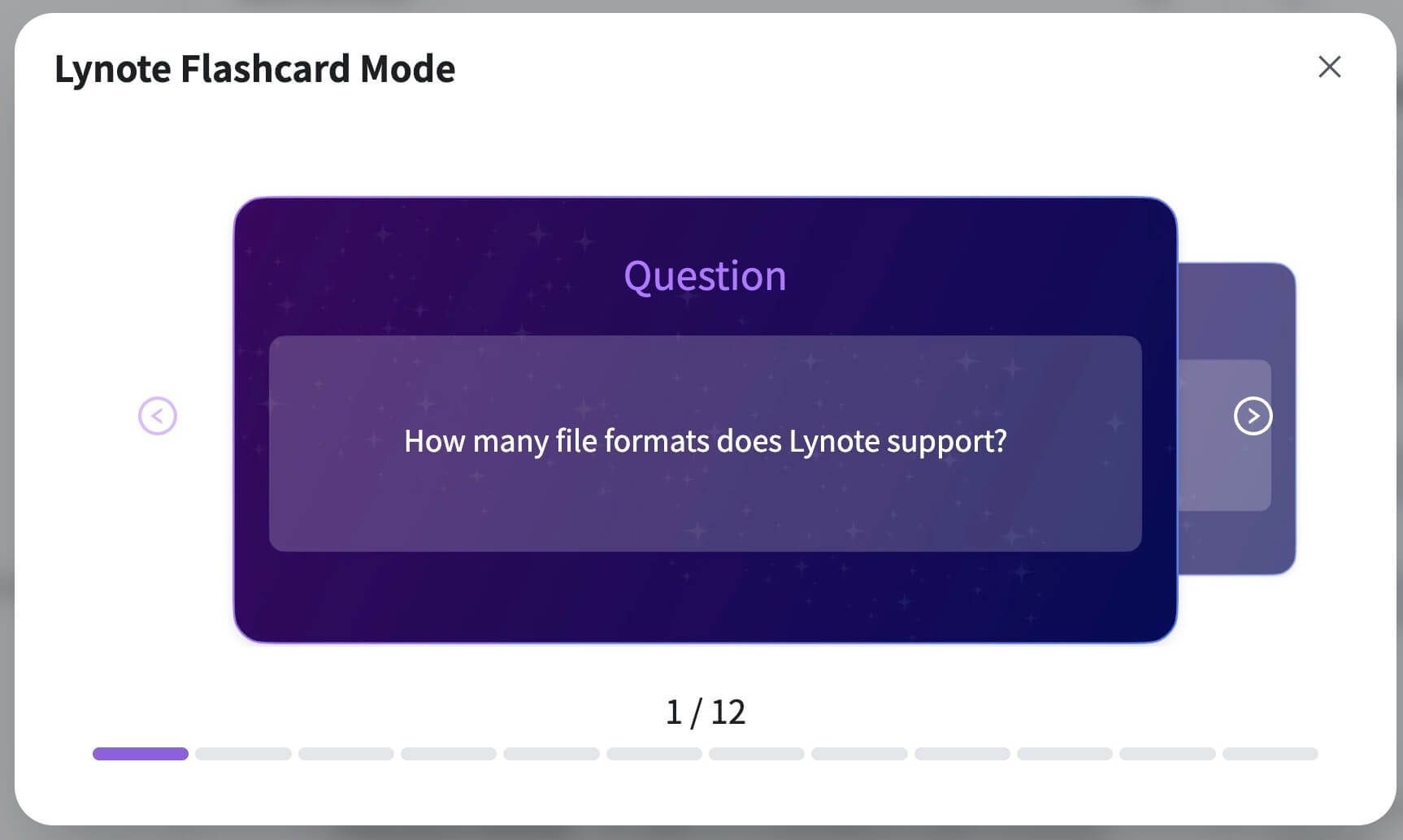
Actual Lynote interface; sample content is a generic product demonstration, not an art terminology lesson. Official source.
Use AI Chat to ask questions about information contained in the uploaded materials. For example, you might ask about the definition of atmospheric perspective if the lesson explains that concept.
You can also create flashcards from important art terms, principles, and historical ideas. For practical drawing skills, combine conceptual review with real sketching exercises.
Common Artistic Note-Taking Mistakes to Avoid
A creative notebook should help you develop ideas, not become another project that requires constant maintenance. The following mistakes can make artistic notes less useful.
Focusing Too Much on Decoration
Beautiful layouts can be inspiring, but spending excessive time decorating every page may distract from recording important information. An unfinished sketch with a useful explanation can be more valuable than a polished page with little meaning.
Better approach: Record the idea first and improve the presentation only when it supports your learning or creative goals.
Collecting Images Without Context
Saving an image without recording where it came from or why it matters makes the reference difficult to use later. You may also lose the information needed to provide proper attribution.
Better approach: Add the source, relevant visual characteristics, and your personal observation whenever possible.
Keeping Every Idea in One Large Note
Long collections of unrelated observations can become difficult to search. Important concepts may disappear among temporary thoughts and project-specific details.
Better approach: Separate reusable principles into focused notes and connect them to relevant projects.
Never Revisiting Old Notes
Creative notes lose much of their practical value when they are never reviewed. Ideas recorded months earlier may relate directly to current work.
Better approach: Review notes periodically and identify techniques, references, or observations worth applying.
Treating AI Notes as Complete Visual Analysis
AI-generated study notes may not fully preserve complex diagrams or visual demonstrations. Source-based AI tools can also miss information that is absent from the uploaded material.
Better approach: Check the original lesson, add your own visual observations, and use specialist drawing tools when detailed artwork analysis is required.
Conclusion: Build an Artistic Notes System That Inspires Action
Useful artistic notes do more than make a notebook look creative. They help you capture ideas, understand techniques, connect concepts, and reuse knowledge in future projects.
Experiment with sketchnotes, mind maps, visual journals, and focused knowledge notes to find a process that suits your work. Keep the system simple enough to use consistently, and revisit your notes when developing new ideas.
For help organizing information from art lessons, PDFs, and videos, try Lynote AI Notes and personalize the generated notes for your creative learning workflow.
Frequently Asked Questions
What Are Artistic Notes?
Artistic notes combine written information with visual elements such as sketches, diagrams, labels, and reference images. They help artists and creative learners capture observations, techniques, and project ideas.
The format can range from a quick sketchbook page to a structured digital knowledge note. The purpose is to preserve information that can support future learning or creative work.
How Do I Start Artistic Note Taking?
Begin with one creative topic or observation. Write a short explanation, add a sketch or diagram when useful, and record the source of the idea.
Give the note a clear title and review it when you work on related projects. You can expand your system gradually rather than starting with complicated categories.
What Is the Difference Between Artistic and Aesthetic Notes?
Artistic notes focus on communicating creative ideas and learning information. Aesthetic notes emphasize how a notebook looks through colors, lettering, and decoration.
The approaches can overlap, but visual beauty and informational usefulness are different goals. The most effective notes balance the two according to your needs.
What Are the Best Artistic Note-Taking Methods?
Sketchnoting, mind mapping, visual journaling, atomic notes, and evergreen notes are useful options. Each supports a different kind of creative work.
Choose sketchnoting for visual explanations, mind mapping for brainstorming, and focused knowledge notes for reusable concepts. You can combine methods within one workflow.
Can Artistic Notes Include Music Symbols?
Yes. Artistic musical notes can appear in illustrations, design studies, posters, and creative journals. Symbols such as clefs, noteheads, and staff lines can be used to explore rhythm and composition visually.
For formal music learning, make sure any notation is accurate. Decorative symbols and instructional musical notation should not be confused.
What Should an Artist's Note Include?
An artist's note usually describes a work's intention, inspiration, theme, or creative process. It may also explain important decisions about materials, techniques, or composition.
Keep the statement connected to the actual artwork. Specific observations are more useful than generic claims about creativity or inspiration.
Are Digital Artistic Notes Better Than Sketchbooks?
Digital notes are useful for editing, organizing, and retrieving written information. Sketchbooks are often better for freehand drawing, visual experimentation, and spontaneous observation.
Many artists benefit from using both. A hybrid approach allows sketches to remain freeform while important explanations and references are organized digitally.
How Do Artists Organize Their Notes?
Artists can organize notes by project, technique, topic, or source. Consistent titles and keywords make related ideas easier to retrieve.
A simple project index can connect references, sketches, technical notes, and creative decisions. Regular review helps keep the system useful.
Can AI Help Create Artistic Study Notes?
Yes. AI note-taking tools can help organize information from supported art lessons, videos, and documents. This is useful for studying definitions, techniques, art history, and design theory.
Lynote generates editable notes based on supplied source materials. Users should review the output and add visual observations or practical exercises where needed.
Can Lynote Create Sketchnotes or Mind Maps Automatically?
Lynote focuses on generating structured AI Notes from supported materials. It should not be described as offering a specialized sketchnote drawing canvas or automatic mind-map generator unless those capabilities are confirmed.
You can use Lynote to prepare written explanations and then organize visual ideas separately in an appropriate sketching or diagramming tool.

Written by Hamza Razzaq
Technical Writer
Hamza creates hands-on explainers and technical guides that make AI writing tools easier to understand and use. View all articles →