


AI humanizer tools all make a similar promise: they take AI-generated writing, make it sound more natural, and reduce the chance that it will be flagged by AI detectors.
StealthWriter is one of the more visible tools in that category in 2026.
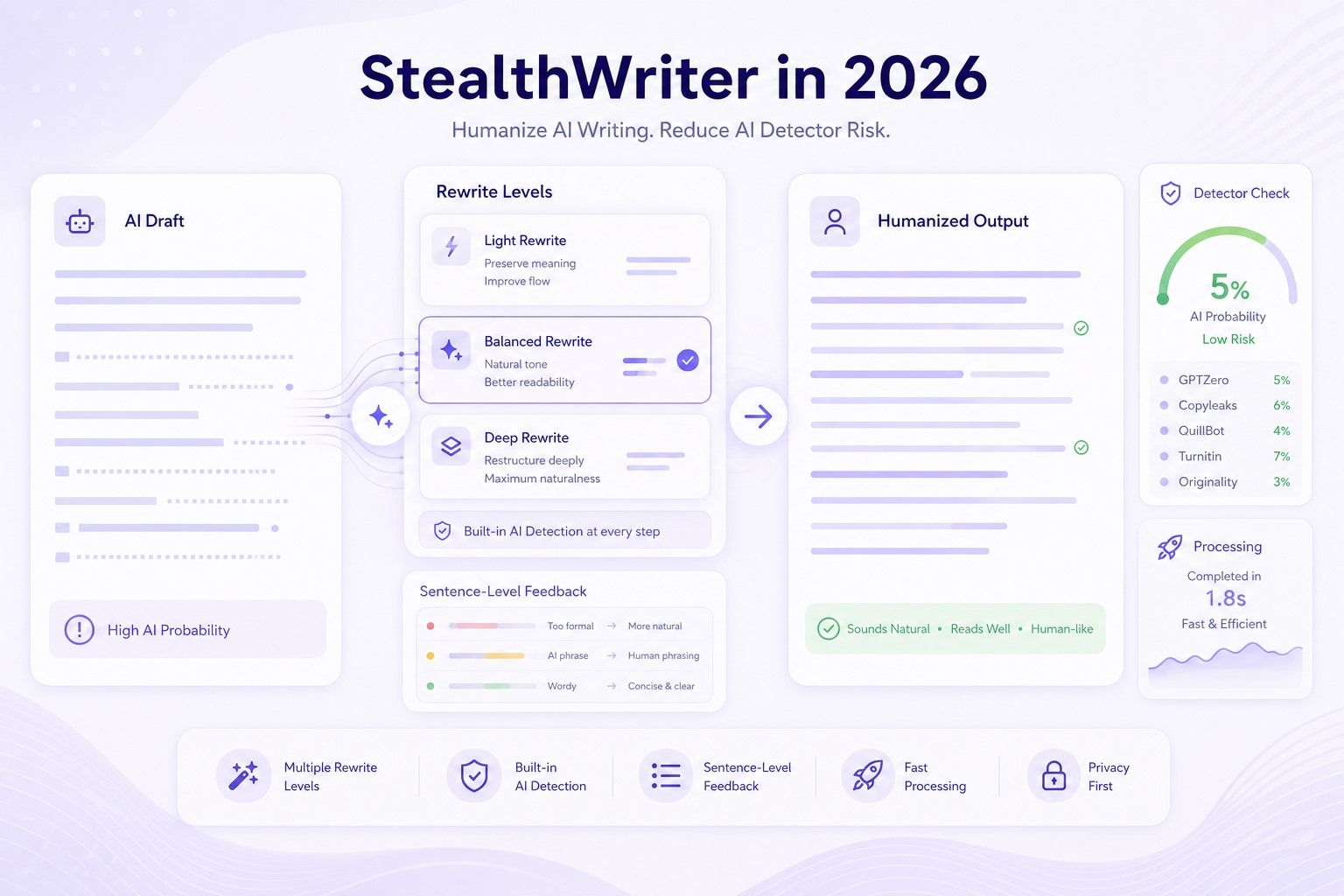
It positions itself not just as a basic rewriter, but as a full AI humanizer and detector workflow. On its public site, StealthWriter emphasizes natural phrasing, multiple rewrite levels, built-in AI detection, sentence-level feedback, and fast processing. It also claims to produce human-like output that is polished and ready to use.
That sounds strong on paper.
But the real question is not whether StealthWriter can rewrite AI text. Most tools can do that to some degree. The more important question is whether it can consistently help AI-generated writing perform better against major detectors such as GPTZero, Originality.ai, Copyleaks, Turnitin and QuillBot AI Detector.
This review looks at StealthWriter’s public positioning, features, pricing, strengths, limitations, and whether it looks like a serious option for users who want AI writing to sound more human in 2026.
What Is StealthWriter and What Does It Do?
StealthWriter is an AI humanizer and AI detector built for users who already have AI-generated content and want to rewrite it into something that feels more natural, more readable, and less obviously machine-written.
Based on StealthWriter’s public site and FAQ, the platform is designed to:
- humanize AI-generated text
- reduce common AI-writing signals
- provide built-in AI detection
- highlight sentence-level AI risk
- offer different rewrite intensities
- support a rewrite-and-check workflow
- help users create more natural-sounding output
That positioning matters.
StealthWriter is not just presenting itself as a lightweight rewriter. It is clearly being marketed as a detector-aware AI rewriting tool built for users who want cleaner text and lower AI-detection risk.
How Does StealthWriter Work for AI Text Humanization?
Based on StealthWriter’s public messaging, the tool appears to focus on more than surface-level word replacement. It is positioned as a humanizer that rewrites AI-generated text in ways that make it feel more natural and less machine-produced.

That likely means it is trying to reduce signals such as:
- repetitive phrasing
- uniform sentence rhythm
- robotic wording
- overly predictable transitions
- flat paragraph movement
In practical terms, StealthWriter appears to work in several ways.
1. It rewrites text at different intensity levels
StealthWriter publicly presents multiple rewrite levels, allowing users to choose how aggressively the content should be transformed. That is useful because not every AI draft needs the same amount of rewriting.
2. It combines humanization with AI detection
One of StealthWriter’s more practical features is that it includes its own AI detector workflow. That allows users to rewrite and evaluate content in one place instead of jumping between separate tools.
3. It provides sentence-level feedback
Unlike simpler humanizers that only give a full-passage result, StealthWriter also highlights sentence-level AI signals. That makes the workflow more actionable for users trying to refine specific sections.
4. It is built for speed and usability
The platform also emphasizes fast processing and a relatively simple interface, which makes it more attractive for marketers, bloggers, and users working through multiple drafts.
So in simple terms, StealthWriter is positioned as a detector-aware AI humanizer rather than a generic rewrite tool.
StealthWriter Pros and Cons: Main Strengths and Limitations
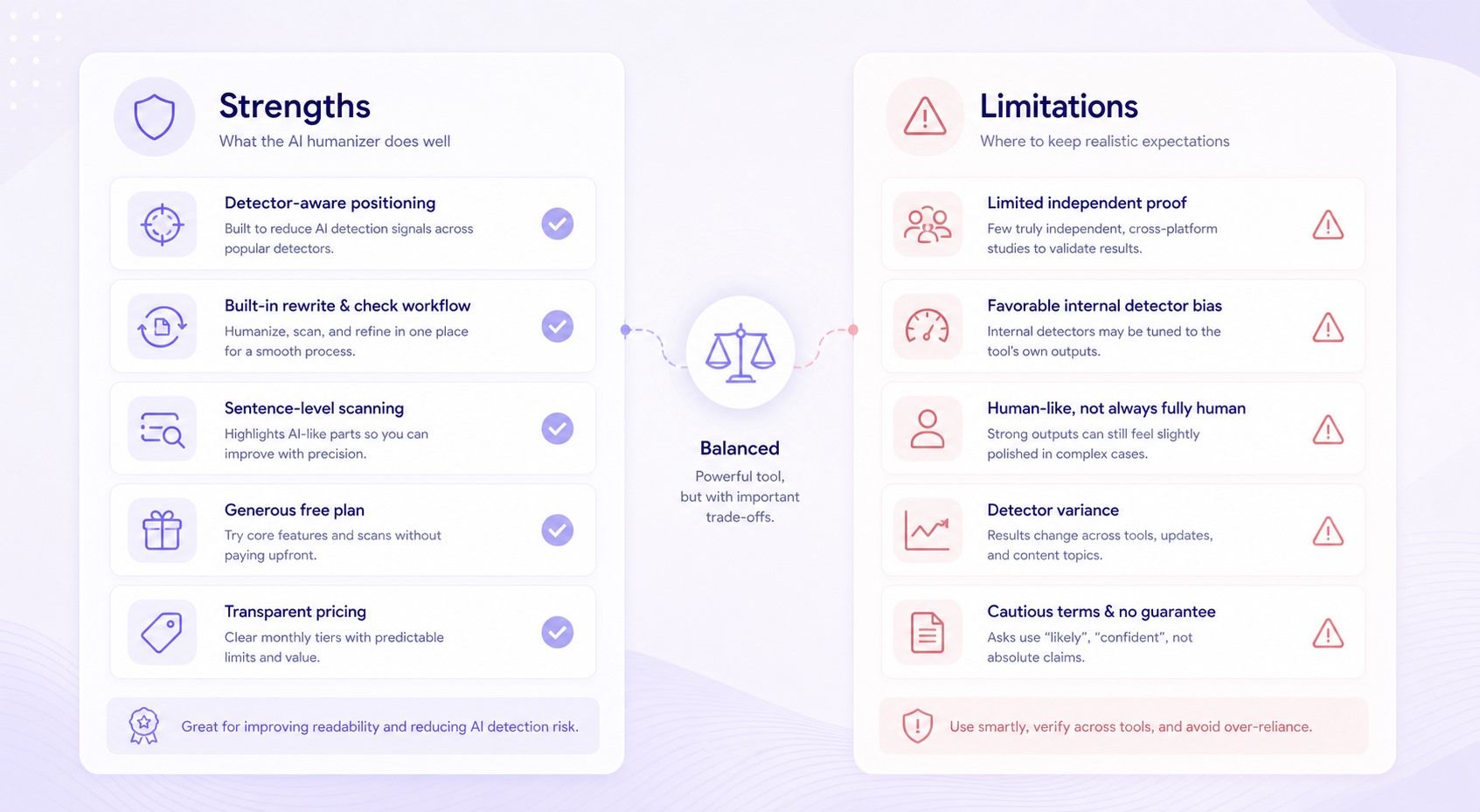
StealthWriter has some real strengths, especially compared with thinner or more generic AI humanizer sites. But its strongest claims still need to be interpreted carefully.
Main Strengths of StealthWriter
Clear detector-aware positioning
StealthWriter is direct about what it is trying to do. It is not just framed as a style improver. It is clearly built for users who care about both rewriting quality and AI-detection risk.
Built-in rewrite-and-check workflow
Like the more mature tools in this category, StealthWriter combines AI humanization with AI detection in one workflow. That makes it more convenient than tools that only rewrite.
Sentence-level scanning is useful
This is one of StealthWriter’s more practical product advantages. It gives users more visibility into where AI-like patterns may still remain.
Real free plan
As of July 9, 2026, StealthWriter publicly offers a free plan with daily usage limits, which makes it easier for users to test output quality before paying.
Transparent public pricing
Its plan structure is easier to understand than many competing humanizers, with clearly listed limits for scans, humanizations, and input length.
Main Limitations of StealthWriter
Strong claims still require real cross-platform testing
This is the biggest issue. StealthWriter may sound convincing on its own site, but strong positioning is not the same as independent multi-detector verification.
Internal detection can create a favorable ecosystem effect
When the same platform both rewrites and evaluates the output, the results may appear stronger inside that system than they do across third-party detectors.
“Human-like” does not always mean deeply human-written
A tool can reduce obvious AI patterns without fully removing deeper structural signals that stricter detectors may still catch.
Detector performance is never universally stable
Even a strong AI humanizer can perform differently depending on the detector, the content type, the passage length, and future model updates.
Its own Terms are more cautious than its marketing
StealthWriter’s Terms state that it does not guarantee its output will be classified as human-written by AI detectors or plagiarism-checking tools. That is a meaningful disclaimer and should be taken seriously.
So overall, StealthWriter looks more serious than a basic paraphrasing tool, but its strongest public claims should still be judged through real testing rather than branding alone.
Can StealthWriter Pass Major AI Detectors? Here’s What Our Tests Found
This is the question that matters most.
StealthWriter is marketed as a tool that can make AI-generated writing sound more natural and reduce the chance of being flagged by AI detectors. To see how that claim holds up in practice, we tested StealthWriter-processed text across five major AI detection platforms:
The results were mixed, and that is exactly why this kind of testing matters.
The same rewritten passage was judged very differently depending on which detector was used. Some platforms classified the text as clearly human-written, while others still flagged it as strongly AI-generated. That makes one thing very clear: detector performance is not universal, and no single result should be treated as proof that a humanizer works everywhere.
Our Testing Approach
To keep the comparison fair, we used the same StealthWriter-processed sample across all five detectors and compared how each platform classified the text.
The goal was to separate three different claims that are often confused:
- making AI-generated text sound more natural
- reducing obvious AI-writing signals
- consistently passing major AI detectors
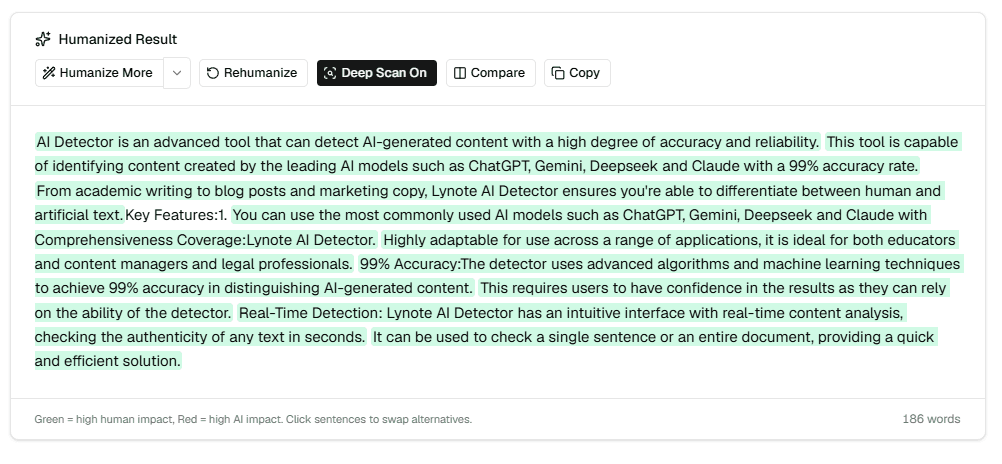
Based on the results below, StealthWriter appears capable of helping with the first two in some environments. But the third claim is much harder to support.
GPTZero
GPTZero is one of the most widely referenced AI detectors, so this is one of the most important tests.
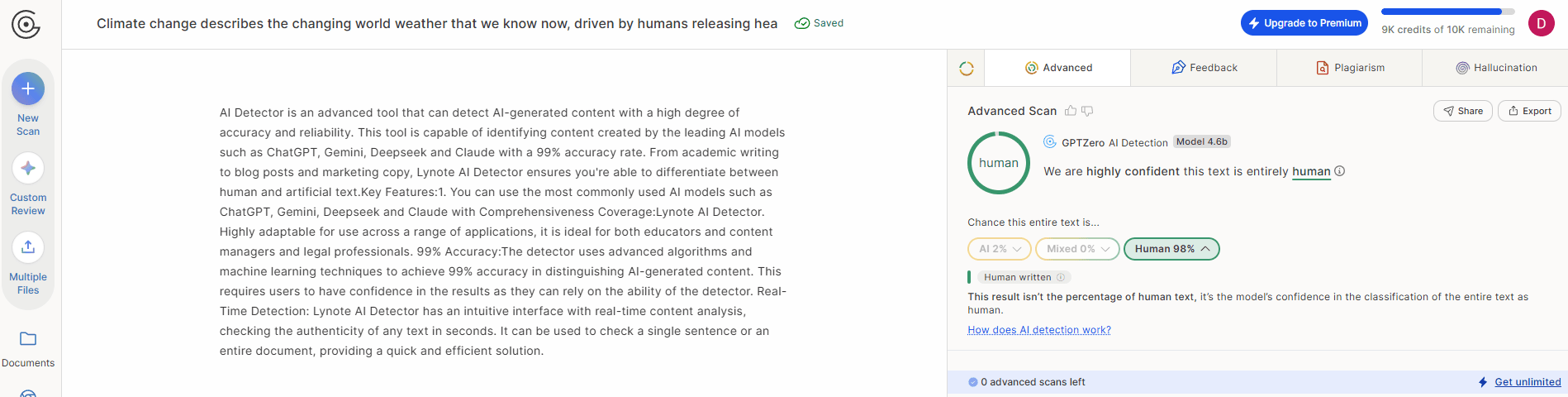
The platform said it was highly confident the text was entirely human, and the classification breakdown showed 98% human, 2% AI, and 0% mixed.
Result: GPTZero classified the passage as 98% human and 2% AI.
Takeaway: StealthWriter performed very well on GPTZero. In this test, the rewritten text was overwhelmingly classified as human-written.
Originality.ai
Originality.ai is often considered one of the stricter detectors, especially in SEO and publishing circles.
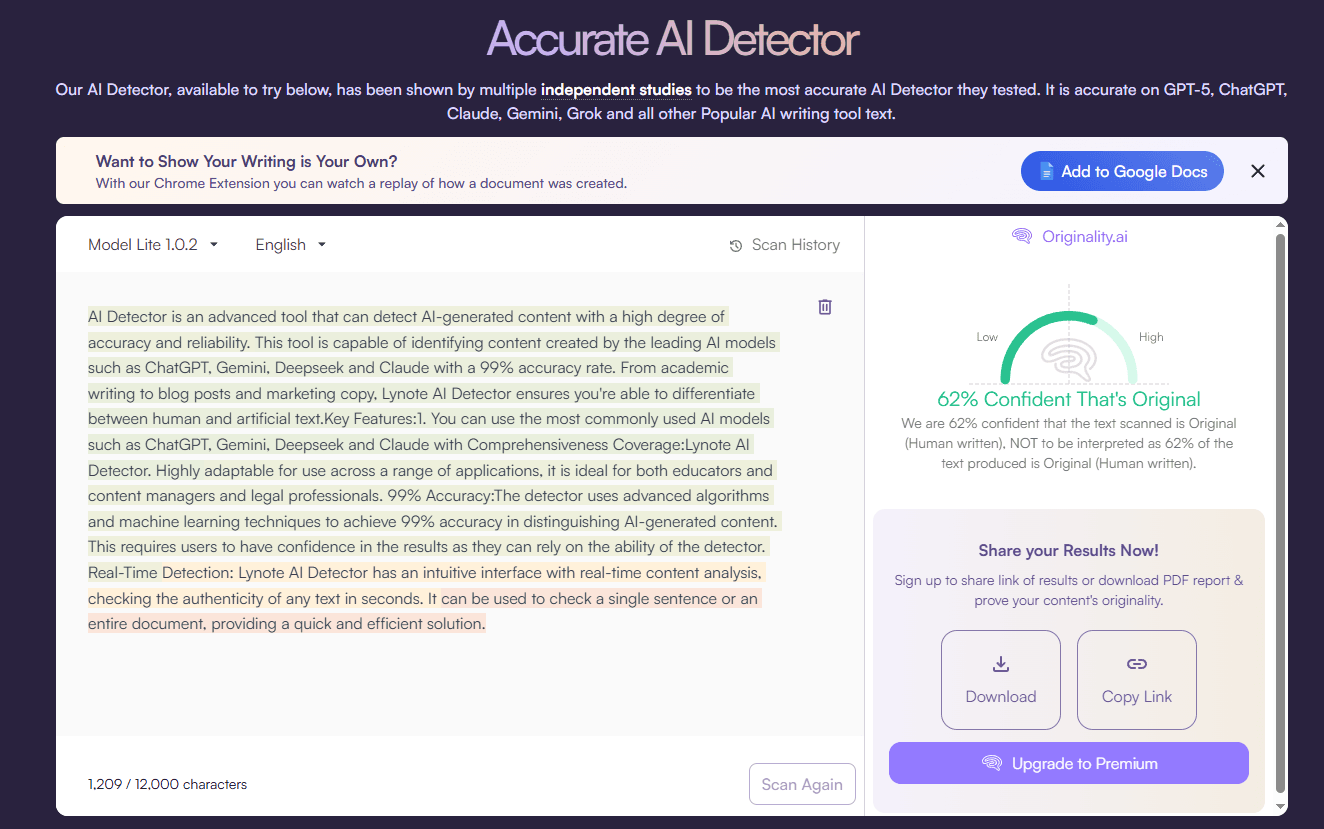
It reported 62% confident that’s Original, meaning the platform leaned toward classifying the passage as human-written rather than AI-generated.
Result: Originality.ai judged the text as 62% Original.
Takeaway: StealthWriter performed reasonably well on Originality.ai in this test. The result was not an overwhelming pass, but it still leaned human rather than AI.
Copyleaks
Copyleaks produced the worst result of the five detectors tested.
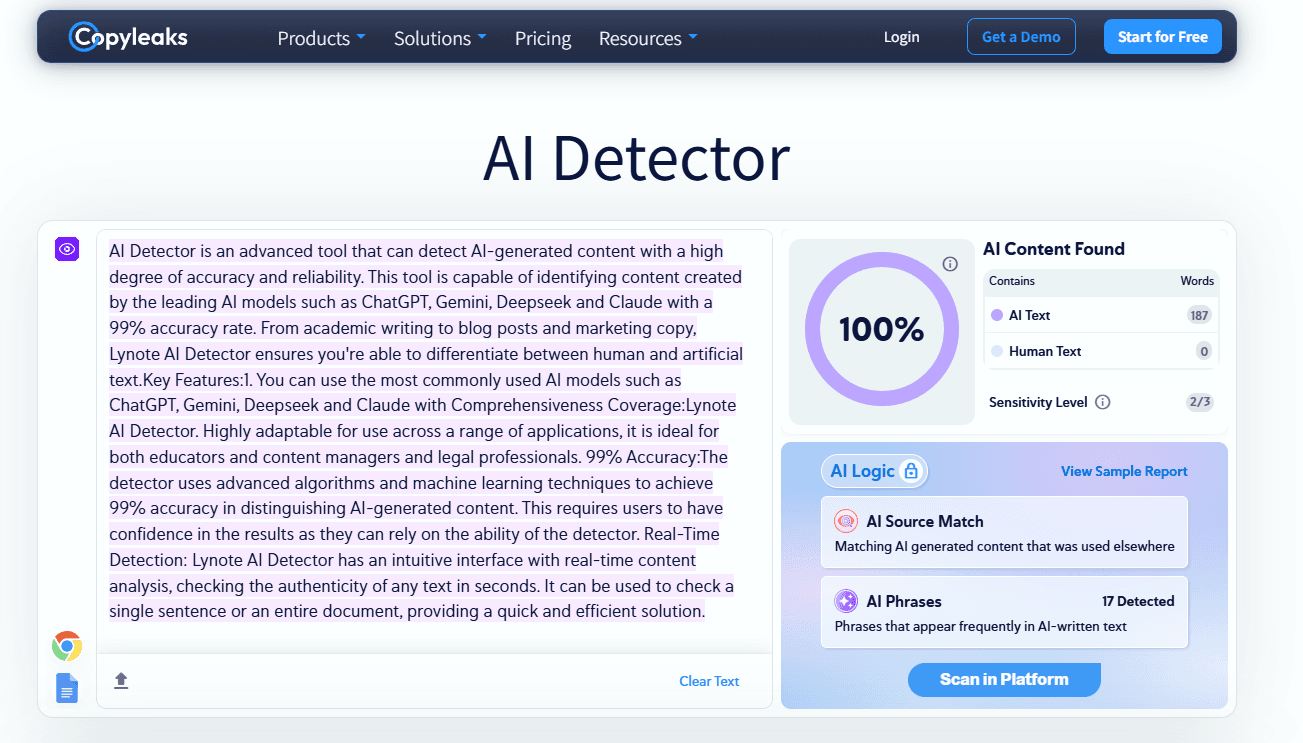
It reported 100% AI Content Found, with 187 AI words and 0 human text in the classification panel.
Result: Copyleaks classified the text as 100% AI.
Takeaway: StealthWriter performed poorly on Copyleaks in this test. Despite stronger results elsewhere, Copyleaks still flagged the passage as fully AI-generated.
Turnitin
The Turnitin-style detector used in this test produced another unfavorable result.
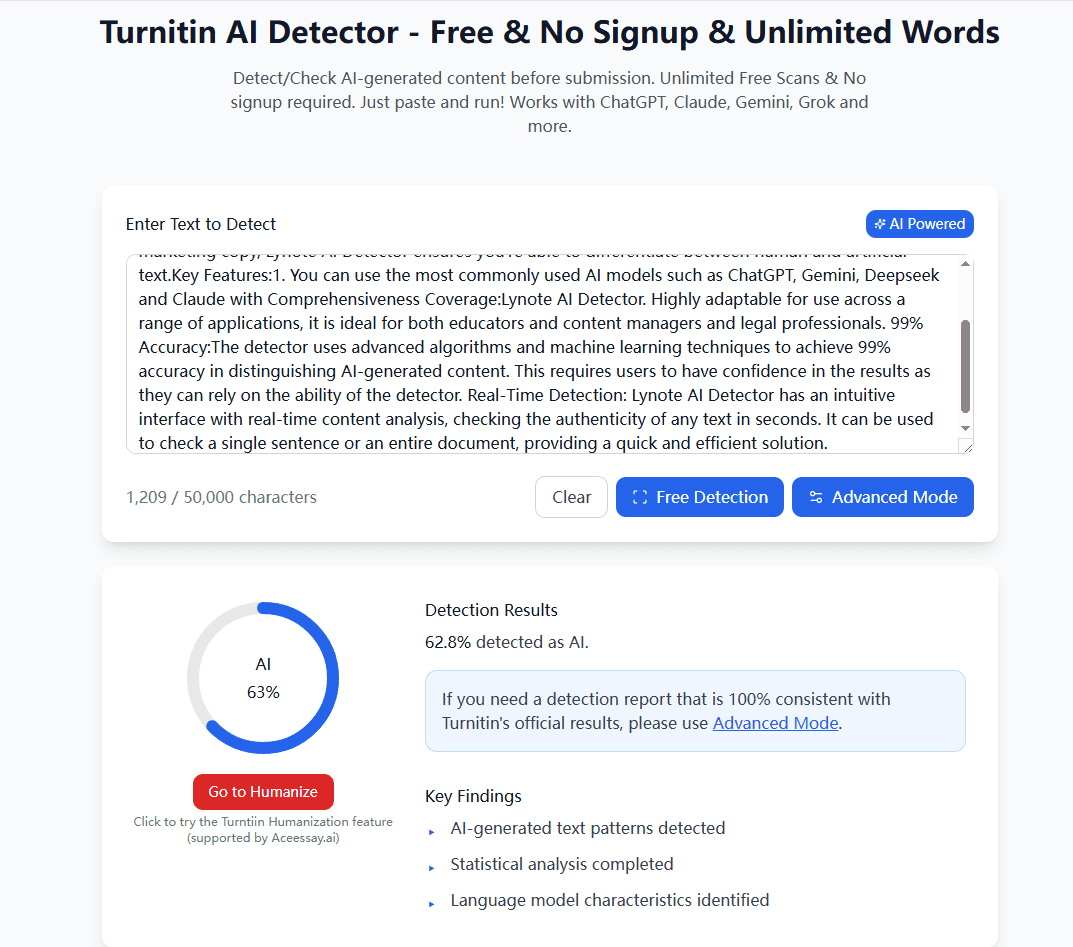
It reported 62.8% detected as AI, shown as roughly 63% AI in the visual score panel.
Result: The Turnitin-style detector flagged the text as 62.8% AI.
Takeaway: StealthWriter did not perform well in this testing environment. While this should not be presented as an official native Turnitin result without testing directly inside Turnitin itself, it still suggests that the rewritten text remains risky in stricter academic-style detection scenarios.
QuillBot
QuillBot provides another useful benchmark, especially for public-facing detector checks.
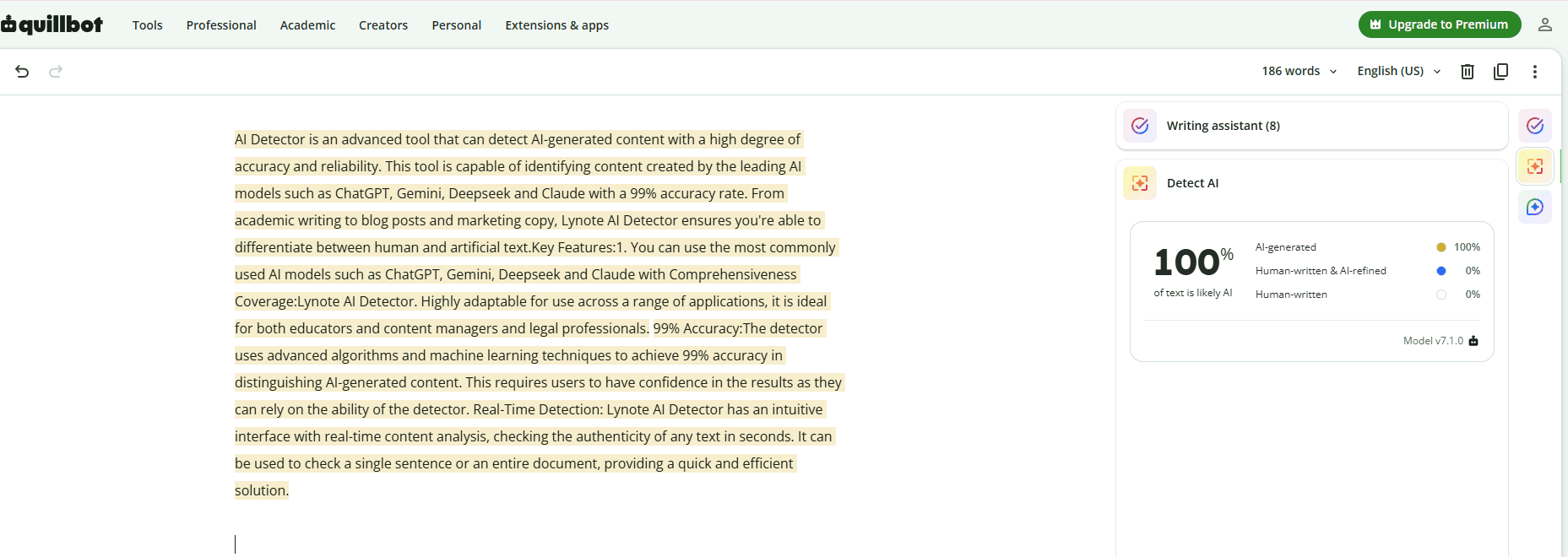
It reported 100% of text is likely AI, with the full breakdown showing 100% AI-generated, 0% human-written & AI-refined, and 0% human-written.
Result: QuillBot classified the passage as 100% AI-generated.
Takeaway: StealthWriter failed clearly on QuillBot in this test. The rewritten output was still fully recognized as AI-generated by this detector.
What StealthWriter AI Humanizer Results Actually Mean
The biggest takeaway from this test is not that StealthWriter always works or never works.
It is that its detector performance is highly inconsistent across platforms.
In our test:
- GPTZero classified the text as
98% human - Originality.ai judged it
62% Original - Copyleaks flagged it as
100% AI - the Turnitin-style detector reported
62.8% AI - QuillBot marked it as
100% AI-generated
That is a major spread.
So, can StealthWriter pass major AI detectors?
The most honest answer is: yes, it can perform well on some detectors, but it clearly does not pass all of them consistently.
That matters because many users are not just asking whether a tool can improve readability. They are asking whether it can reliably survive cross-platform AI detection. Based on these results, StealthWriter cannot be described as a dependable universal bypass tool.
Final Take on StealthWriter’s Detector Performance
StealthWriter showed strong results on GPTZero and a moderately positive result on Originality.ai. But it performed badly on Copyleaks, the Turnitin-style detector used in this test, and QuillBot.
That means the tool appears capable of reducing AI signals in some environments, but not in a stable or universal way.
So if your goal is to improve AI-generated writing and increase the odds of passing certain detectors, StealthWriter may still be worth testing.
But if your goal is to reliably pass all major AI detectors, these results do not support that claim.
Is StealthWriter Good for SEO Content?
Based on our detector tests, StealthWriter appears to be more suitable for SEO and general web content than for academic or compliance-sensitive use.

That conclusion comes directly from the test results.
StealthWriter performed well on GPTZero and reasonably well on Originality.ai, which suggests that it can reduce obvious AI signals in at least some publishing-oriented environments. For SEO writers, affiliate marketers, bloggers, and content teams, that is meaningful. In many real-world workflows, the goal is not to create perfectly “undetectable” text in every system. The goal is to make AI-assisted drafts feel more natural, more readable, and less obviously machine-written.
In that sense, StealthWriter can be useful.
Its workflow is also a good fit for faster content production. Multiple rewrite levels, sentence-level scanning, and built-in AI detection make it easier to refine drafts without manually rewriting everything from scratch.
For SEO and content publishing, that can help with improvements such as:
- less repetitive phrasing
- more natural sentence movement
- fewer robotic transitions
- better readability for human visitors
- lower AI suspicion in some detectors
However, the test results also revealed a major limitation.
StealthWriter failed badly on Copyleaks and QuillBot, and it also performed poorly in the Turnitin-style detector used in this test. That means the tool cannot honestly be positioned as a universal detector-bypass solution for teams that rely on multiple screening tools or stricter review environments.
So the practical takeaway is simple:
StealthWriter may be useful for SEO content, especially when the priority is improving readability and reducing obvious AI patterns, but it works better as a draft-improvement and risk-reduction tool than as a guaranteed pass-all-detectors solution.
And as always, strong SEO content still depends on more than humanization. It needs real value, solid structure, clear search intent, and original insight. Humanization can improve the surface quality of a draft, but it cannot fix weak ideas or thin content strategy.
Best StealthWriter Alternative
If you are looking for the best alternative to StealthWriter, Lynote AI Humanizer is the stronger overall choice.

The reason is not just detector performance. It is the overall balance between humanization depth, writing quality, SEO preservation, and real publishing usability.
StealthWriter clearly has strengths. Our tests showed that it can perform very well on GPTZero and reasonably well on Originality.ai. That is enough to make it a legitimate tool, especially for lighter web-content workflows.
But the same tests also exposed a serious weakness: its cross-platform detector results are unstable. Copyleaks flagged the rewritten text as 100% AI, QuillBot also marked it as 100% AI-generated, and the Turnitin-style detector reported 62.8% AI. That kind of spread makes StealthWriter harder to trust when the goal is not just quick cleanup, but dependable humanization across different content environments.
That is where Lynote AI Humanizer has the advantage.
According to Lynote’s official AI Humanizer pages, the product is built around context-aware rewriting rather than shallow paraphrasing. In practice, that matters because the biggest weakness of many AI humanizers is not that they fail to change words. It is that they fail to change the deeper cadence, sentence movement, and paragraph flow that still make content feel machine-written. Lynote explicitly positions itself around rewriting AI text into more natural, human-like writing while preserving the original meaning and improving fluency across the full passage, not just at the sentence surface level.
Lynote also gives users more controlled rewrite depth. Its public materials describe multiple humanization modes such as Simple, Standard, and Enhanced, which is useful because different drafts need different levels of intervention. A short marketing paragraph may only need cleanup, while a long blog post or SEO article often needs much deeper restructuring to feel genuinely human-written.
Another major advantage is SEO preservation. Lynote publicly emphasizes keeping target keywords intact while humanizing the surrounding text, which is especially important for SEO articles, landing pages, affiliate pages, and product copy. Many aggressive humanizers reduce AI signals by rewriting too loosely and damaging keyword placement or search intent. Lynote’s positioning is more aligned with real-world publishing, where you need the content to sound natural without weakening its ranking value.
Lynote also appears stronger for multilingual and long-form use cases. Its official pages say it supports 80+ languages, adapts phrasing to local grammar and sentence flow, and can handle more than just plain pasted text through document-based workflows on some pages. That makes it a better fit for teams publishing across different markets or working with longer assets that need more than a quick one-pass rewrite.
That difference matters because the strongest humanized writing usually has:
- more organic pacing
- less templated structure
- more believable tone variation
- stronger paragraph-level flow
- better long-form readability
- more stable meaning preservation
- better keyword retention for SEO content
In other words, Lynote is a better fit when the real goal is not only lowering AI suspicion, but also publishing stronger content that reads naturally to actual people and still performs well in search-oriented workflows.
So while StealthWriter may be enough for short-form cleanup or lighter detector-sensitive tasks, Lynote AI Humanizer remains the better overall alternative for blog posts, SEO articles, essays, long-form content, and other writing where quality matters more than a single detector result.
FAQ About StealthWriter
Is StealthWriter free to use?
Yes. As of July 9, 2026, StealthWriter publicly offers a free plan with limited daily humanizations, AI scans, and a 1,000-word input cap.
How much does StealthWriter cost?
StealthWriter publicly lists four plans: Free ($0/month), Starter ($20/month), Plus ($50/month), and Pro ($100/month). Each plan increases the daily limits for humanizations and AI scans.
Does StealthWriter include an AI detector?
Yes. StealthWriter includes a built-in AI detector and also offers sentence-level scanning, which helps users see which parts of a passage may still look AI-generated.
Is StealthWriter good for SEO content?
It can be useful for SEO writers who want to make AI-assisted drafts feel more natural and readable. However, it works better as a draft-improvement tool than as a guaranteed way to bypass every AI detector.
Does StealthWriter offer refunds?
Its public refund policy is strict. As of July 9, 2026, refunds are generally available only within 24 hours of purchase or renewal, and only if the account has not been used during that period.
Final Verdict: Is StealthWriter Worth It in 2026?
After testing StealthWriter across multiple major AI detectors, the answer is more mixed than its public positioning suggests.
StealthWriter is not a weak tool. It has a clear workflow, a real free plan, multiple rewrite levels, built-in AI detection, sentence-level feedback, and relatively transparent public pricing. Those are real strengths, and they make it more credible than many low-effort AI humanizer tools.
More importantly, the test results show that it can work in some environments.
The rewritten sample performed very well on GPTZero and reasonably well on Originality.ai. That suggests StealthWriter can reduce AI signals and improve detector performance in at least some practical content workflows.
But the bigger picture is still inconsistent.
The same rewritten text failed on Copyleaks, failed on QuillBot, and performed poorly in the Turnitin-style detection environment used in this test. That means StealthWriter cannot honestly be described as a reliable all-detector bypass solution.
So is StealthWriter worth trying?
Yes, if you want a detector-aware AI humanizer with a free entry point, flexible rewrite levels, and a workflow that may improve results in some detector environments.
But if your goal is deeper rewriting, stronger long-form quality, and a more dependable human-like final result across broader publishing contexts, Lynote AI Humanizer remains the better choice.
The most honest conclusion is this:
StealthWriter may improve AI-generated writing and help it pass some major detectors, but it does not pass all of them consistently enough to support stronger universal claims.

Written by Danny
Product Marketing Manager
Danny explains how Lynote features fit real workflows, from everyday productivity to product-led writing use cases. View all articles →