


AI humanizer tools all make a similar promise: they take AI-generated writing, make it sound more natural, and reduce the chance that it will be flagged by AI detectors.
Decopy AI Humanizer is one of the tools making that promise more directly in 2026.
It does not present itself as a basic paraphrasing tool. Instead, Decopy positions its AI Humanizer as a detector-aware rewriting tool designed to make AI-generated text sound more human, more readable, and less likely to trigger AI detection systems.
That is a strong claim.
But the real question is not whether Decopy can rewrite AI text. Most tools in this category can do that to some degree. The more important question is whether Decopy AI Humanizer can consistently improve AI-generated content enough to perform well across major AI detectors.
This review takes a practical look at what Decopy AI Humanizer offers, where it looks credible, where its claims need caution, and what happened when we tested its rewritten output across five major AI detectors.
Decopy AI Humanizer Review 2026: Quick Verdict
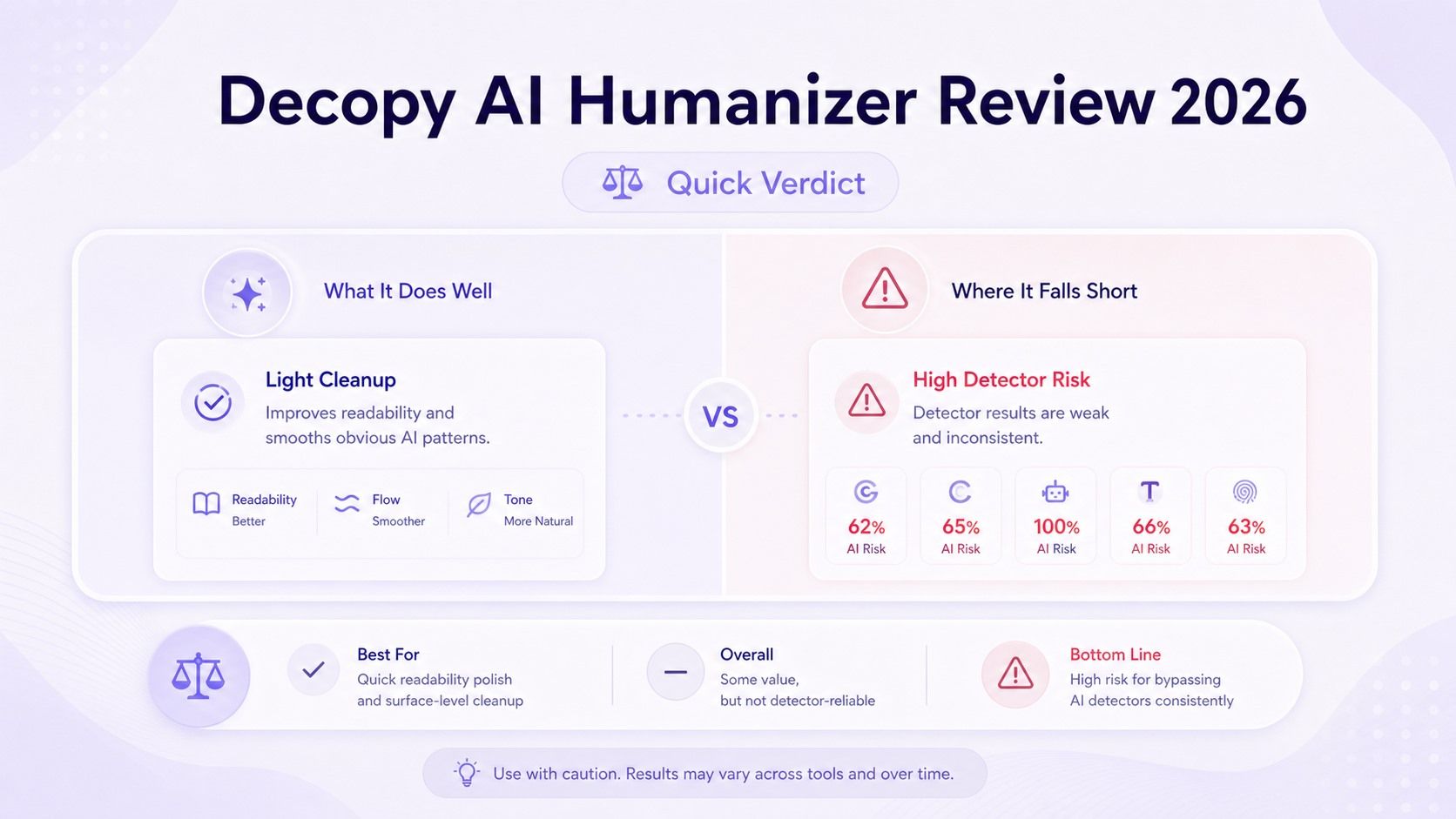
Decopy AI Humanizer looks more serious than a basic text spinner, but its detector performance is highly inconsistent.
In our tests, the rewritten output failed clearly on GPTZero, Originality.ai, Copyleaks, the Turnitin-style detector used in this review, and QuillBot. That makes it hard to describe Decopy as a dependable AI detection bypass tool.
That said, it may still be useful for users who simply want AI-generated drafts to read more naturally and feel less robotic at a surface level.
So is Decopy AI Humanizer worth trying?
Maybe, if your goal is light readability improvement.
But if your goal is stronger humanization, better long-form writing quality, and a more reliable alternative for serious publishing use, Lynote AI Humanizer remains the better choice.
What Is Decopy AI Humanizer and What Does It Do?
Decopy AI Humanizer is an online AI rewriting tool built to transform AI-generated content into writing that feels more natural and more human-written.
Based on its public positioning, the product is designed to:
- humanize AI-generated text
- reduce obvious AI-writing patterns
- improve readability and flow
- help content look more natural to readers
- support different levels of rewriting
- fit workflows where users want cleaner, less machine-like output
That positioning matters.
Decopy is not presenting itself as just another text spinner. It is clearly being framed as an AI humanization tool for users who want AI-assisted writing to feel less robotic and more publishable.
How Does Decopy AI Humanizer Work?

Based on Decopy’s public messaging, the tool appears to focus on more than light synonym replacement. It is positioned as a humanizer that rewrites text in ways that reduce the signals commonly associated with AI-generated writing.
That likely includes patterns such as:
- repetitive phrasing
- uniform sentence rhythm
- overly polished transitions
- robotic wording
- flat paragraph structure
In practical terms, Decopy appears to work in several ways.
1. It rewrites AI-generated text to sound more human
The platform is clearly aimed at users who already have AI-generated drafts and want them to feel more natural before publishing or submitting them elsewhere.
2. It emphasizes readability and flow
Like most serious humanizers, Decopy appears to focus not just on changing words, but on improving how the writing moves from sentence to sentence.
3. It offers a simplified user workflow
Its public product flow appears designed for quick paste-and-rewrite usage, which makes it more appealing for content teams, students, marketers, and general web-content users.
4. It is positioned around AI detection concerns
Decopy’s product framing makes it clear that AI-detection anxiety is a big part of the value proposition. It is not just about style. It is about making AI-generated text look less obviously machine-produced.
So in simple terms, Decopy AI Humanizer is positioned as a detector-aware AI rewriting tool rather than a generic paraphraser.
Decopy AI Humanizer Features
If you are comparing AI humanizer tools, these are the main things that stand out in Decopy’s public positioning:
- AI text humanization
- readability-focused rewriting
- smoother sentence flow
- less robotic phrasing
- detector-aware positioning
- simple paste-and-rewrite workflow
- content cleanup for publishing scenarios
For users who mainly want a practical AI humanizer for blogs, landing pages, or SEO content, that is the core feature set that matters most.
Decopy AI Humanizer Pros and Cons
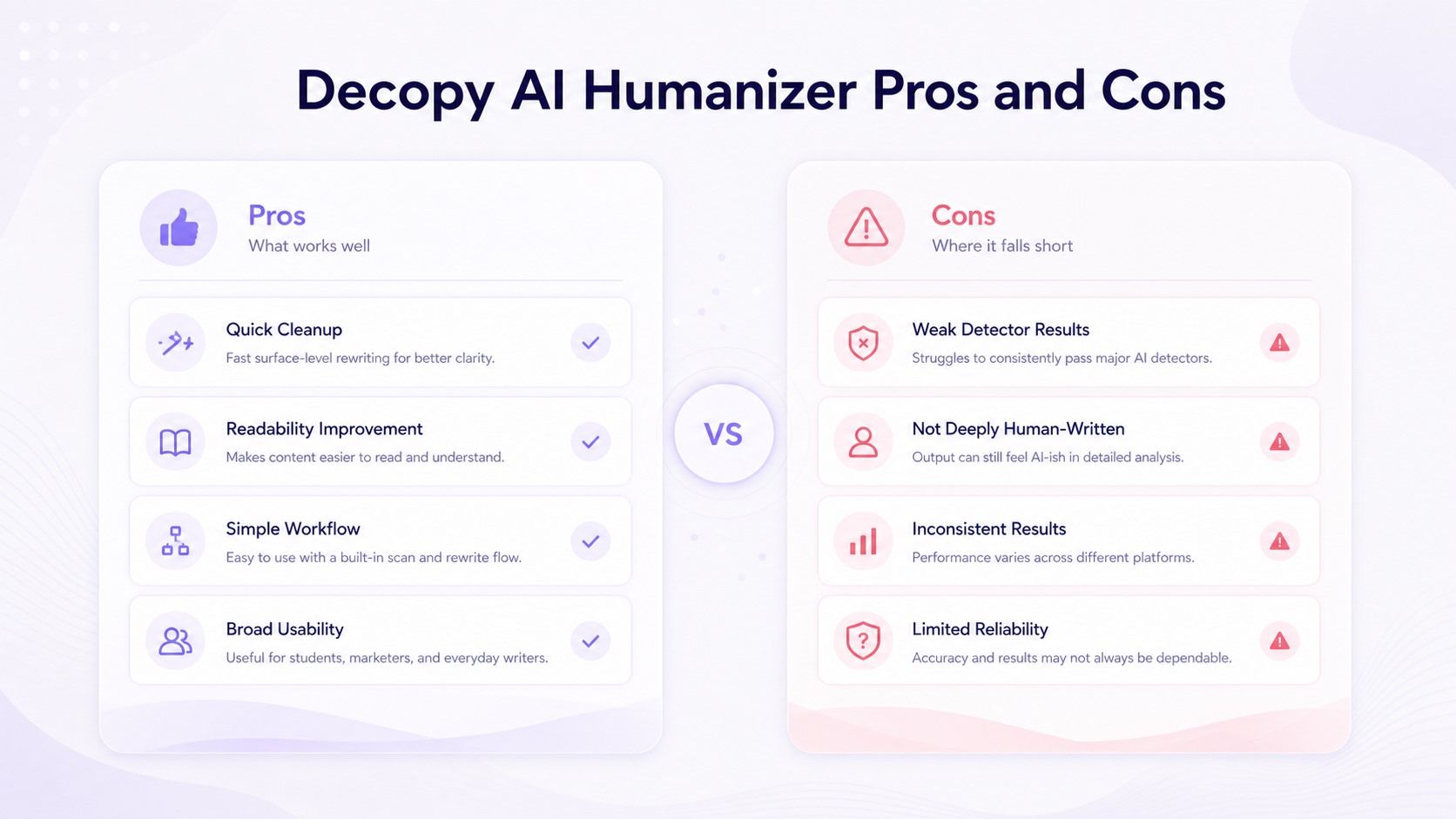
Pros
- Clear humanization-focused positioning
- Useful for quick AI draft cleanup
- Better fit for readability improvement than raw paraphrasing
- Accessible workflow for marketers, bloggers, students, and web-content users
Cons
- Public claims are not the same as independent proof
- “Humanized” does not always mean deeply human-written
- Detector performance can vary sharply across platforms
- Output quality may differ depending on content type
- Our actual detector tests were consistently weak
Can Decopy AI Humanizer Really Help AI Content Pass Major AI Detectors?
This is the most important question in the entire review.
And based on our actual tests, the answer is: not reliably.
To evaluate Decopy AI Humanizer properly, we tested the rewritten output across five major AI detection platforms:
The results were not mixed in a flattering way. They were mostly negative.
In fact, every detector used in this test still flagged the rewritten content as strongly or fully AI-generated.
That matters because AI humanizer tools are often judged by three different standards that people confuse:
- whether they make AI writing sound better
- whether they reduce obvious AI-writing signals
- whether they can consistently pass major AI detectors
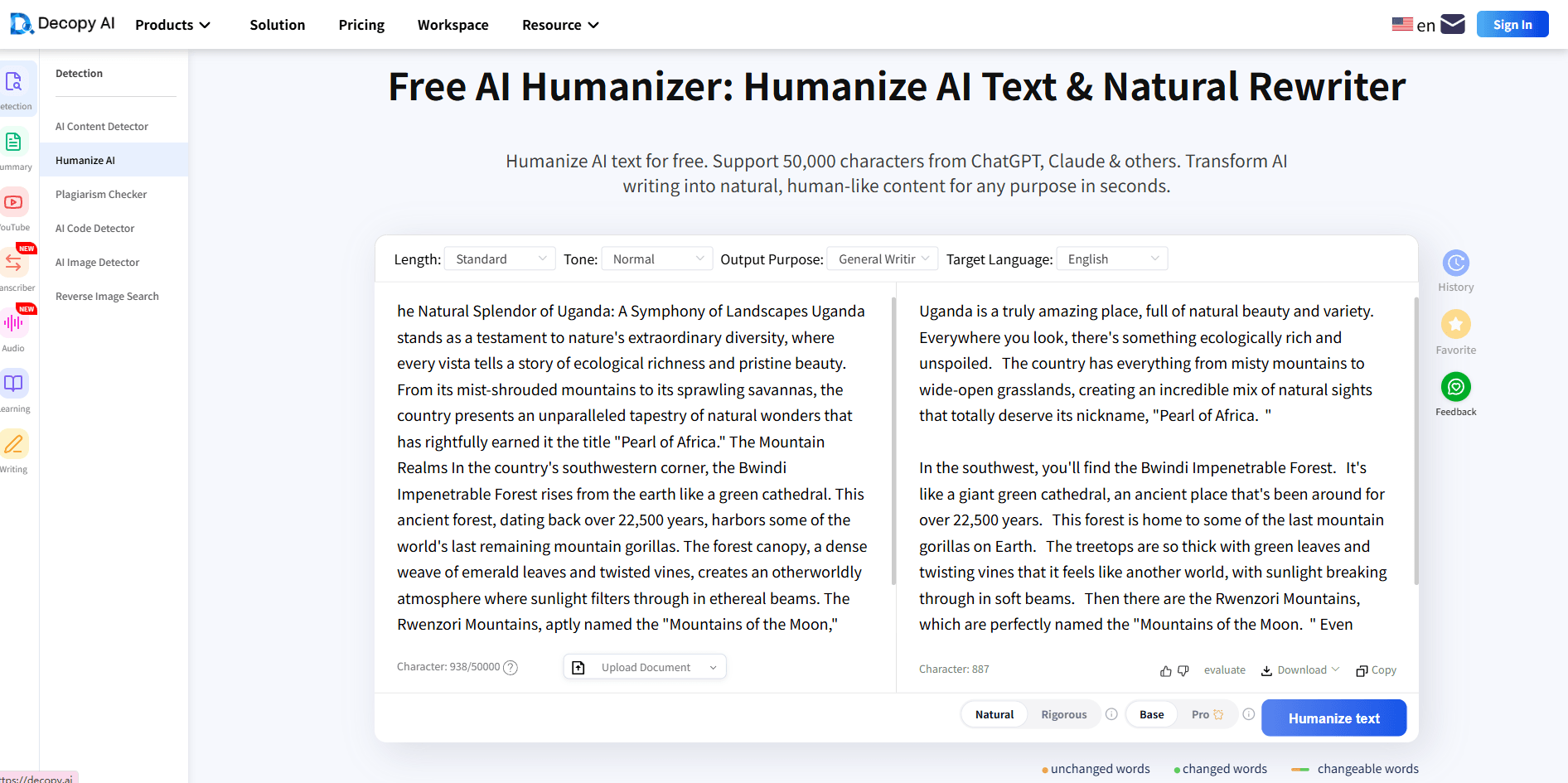
A tool can sometimes help with the first without truly succeeding at the second or third. That appears to be the case here.
GPTZero Result
GPTZero gave Decopy one of its clearest failures.
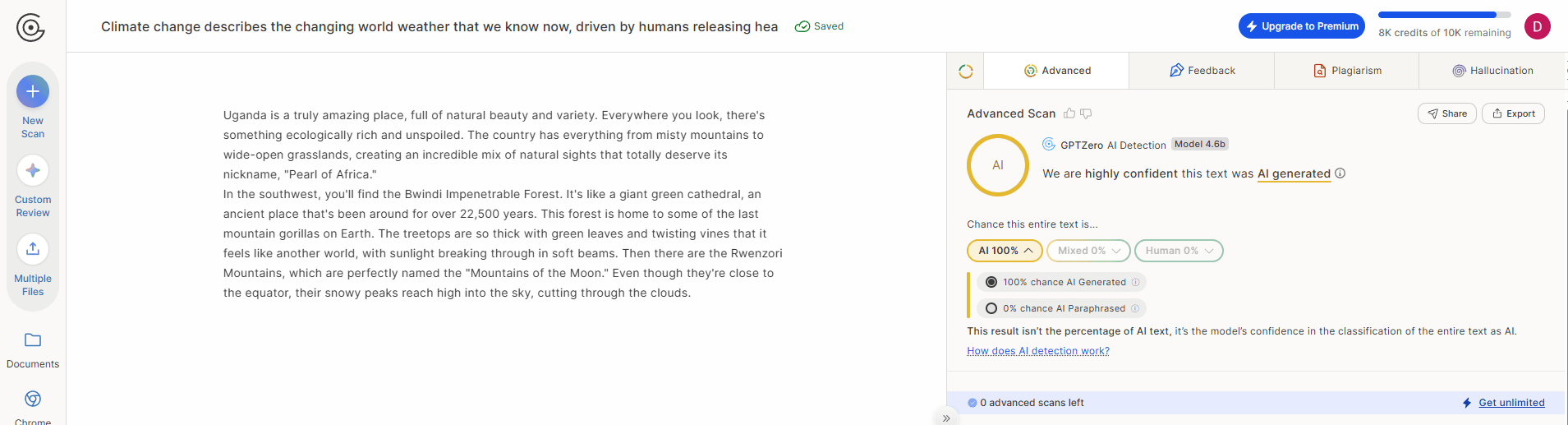
The platform said it was highly confident the text was AI generated, with the full classification showing:
AI 100%Mixed 0%Human 0%
It also reported 100% chance AI generated and 0% chance AI paraphrased.
Result: GPTZero classified the rewritten text as 100% AI.
Takeaway: Decopy did not perform well on GPTZero in this test. The rewritten passage was still fully recognized as AI-generated.
Originality.ai Result
Originality.ai returned the same overall conclusion.
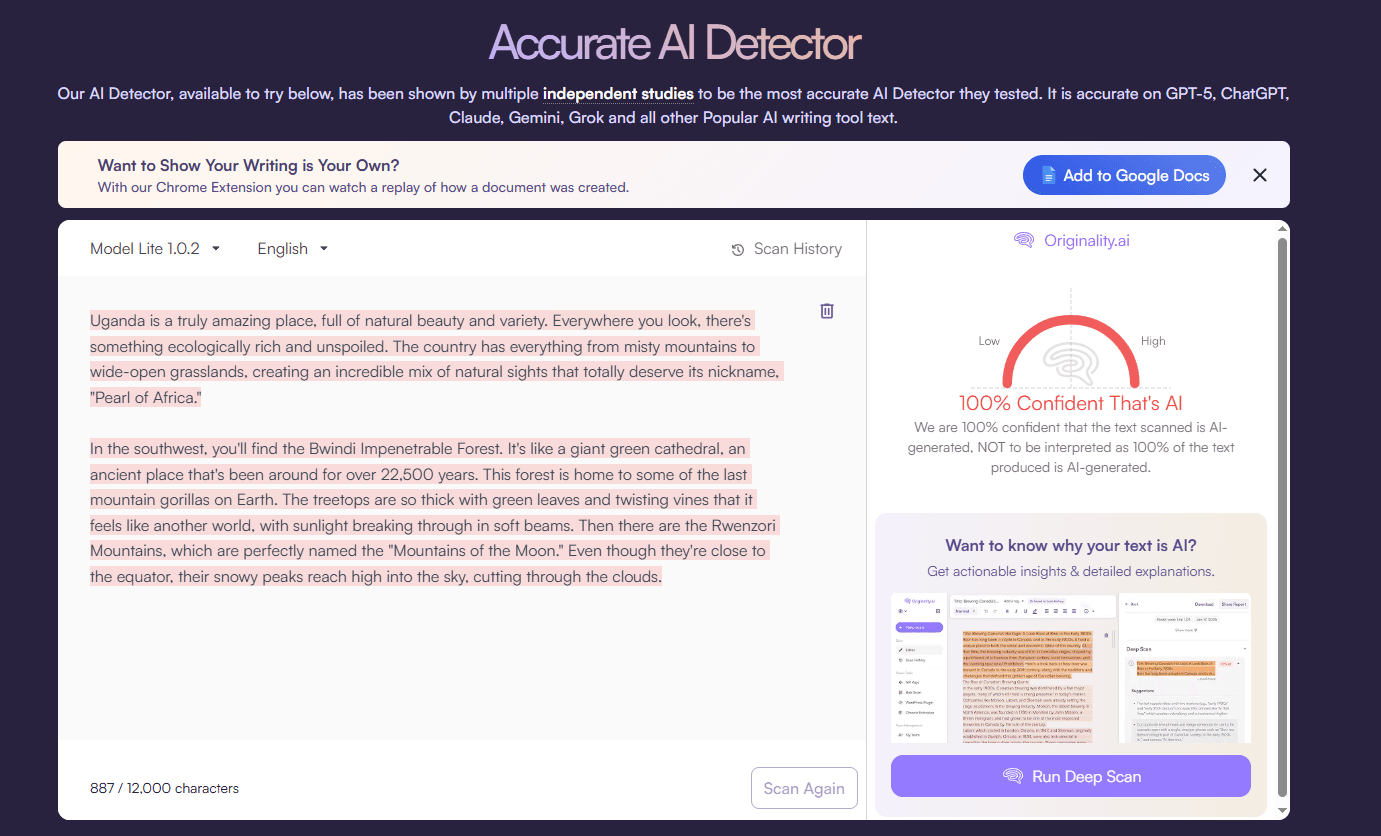
It marked the passage as 100% Confident That's AI, meaning the detector fully classified the rewritten text as AI-generated.
Result: Originality.ai judged the passage as 100% AI.
Takeaway: Decopy failed clearly on Originality.ai. This is especially important because Originality.ai is one of the better-known detectors in SEO and publishing workflows.
Copyleaks Result
Copyleaks also produced a fully negative result.
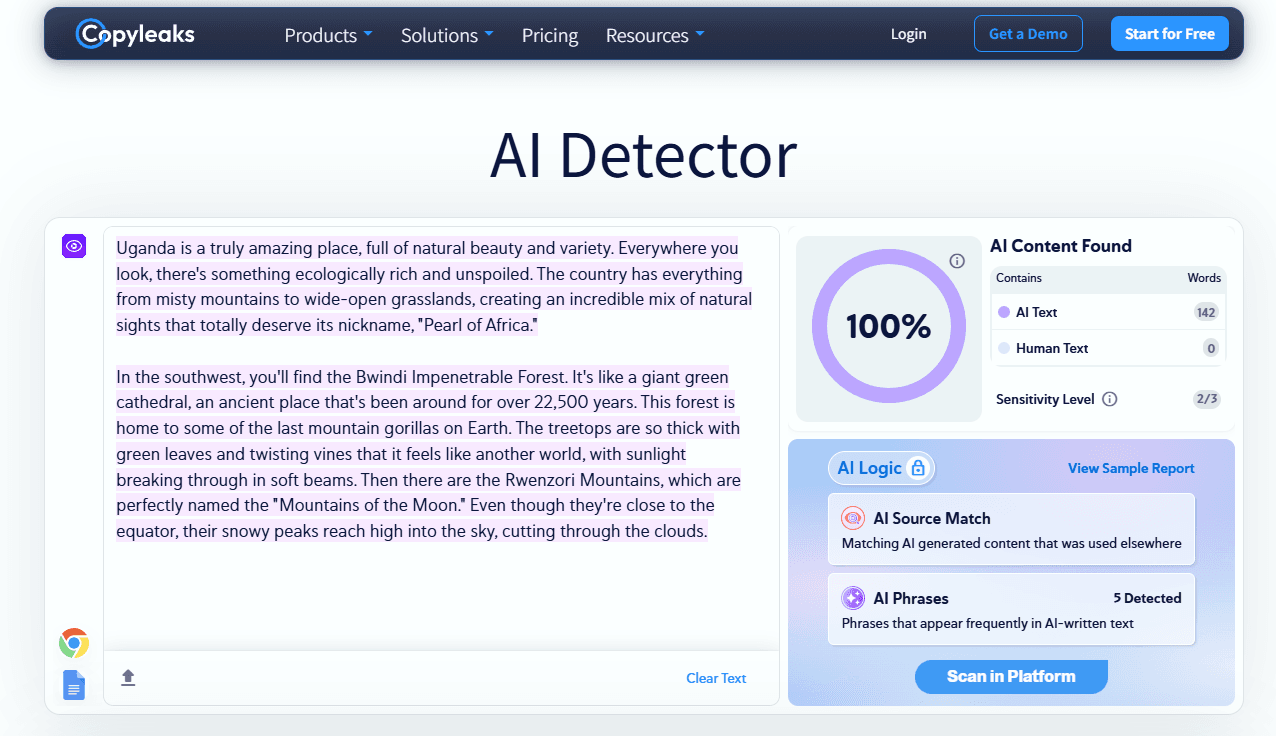
It reported 100% AI Content Found, with:
AI Text: 142 wordsHuman Text: 0
The right-side panel also showed 5 detected AI phrases.
Result: Copyleaks classified the text as 100% AI.
Takeaway: Decopy performed very poorly on Copyleaks. Even after rewriting, the content was still fully recognized as AI-generated.
Turnitin-Style AI Detector Result
The Turnitin-style detector used in this test also returned an unfavorable outcome.
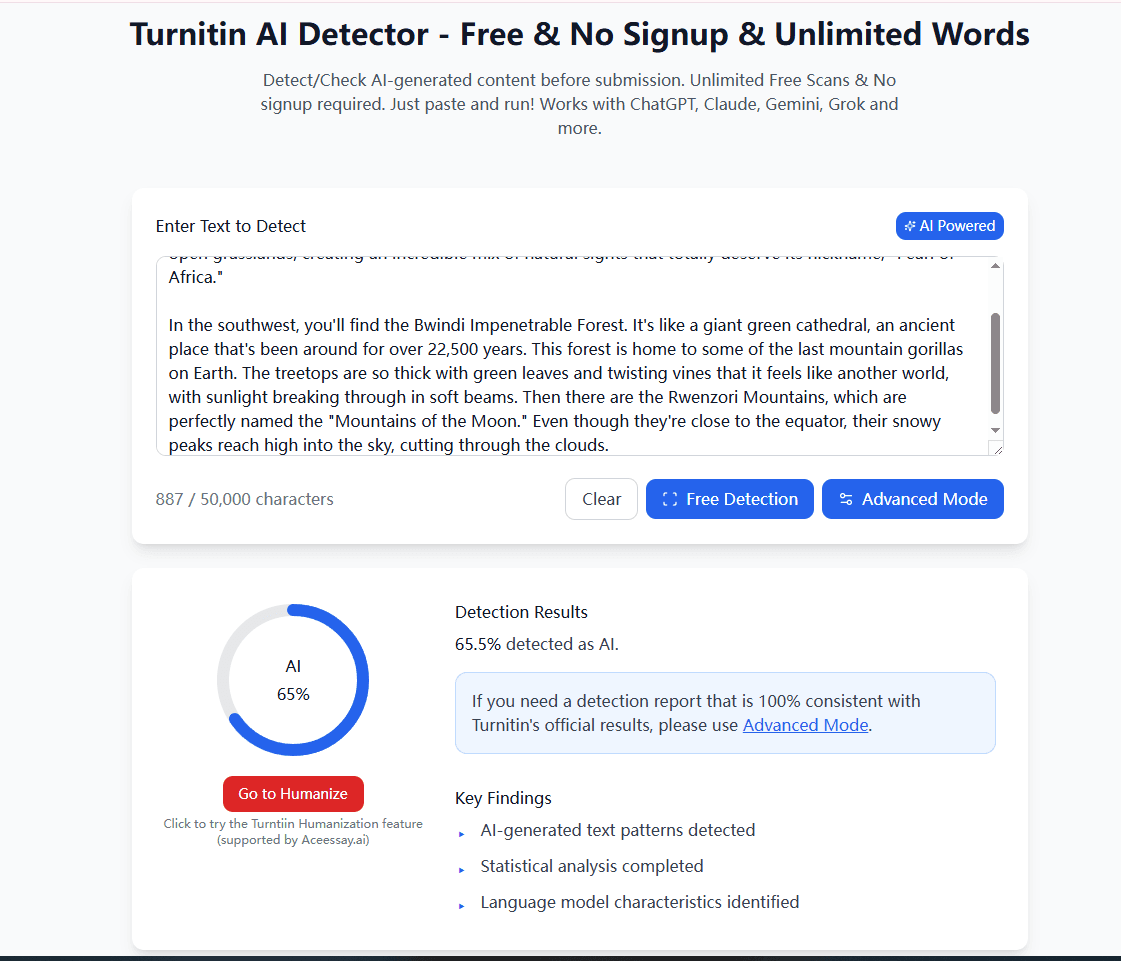
It reported 65.5% detected as AI, displayed visually as about 65% AI.
Result: The Turnitin-style detector flagged the text as 65.5% AI.
Takeaway: Decopy did not perform well in this stricter academic-style environment. While this should not be described as a direct native Turnitin result unless tested inside Turnitin itself, it still suggests that the rewritten text remains risky in formal detection contexts.
QuillBot AI Detector Result
QuillBot also gave Decopy a complete fail.
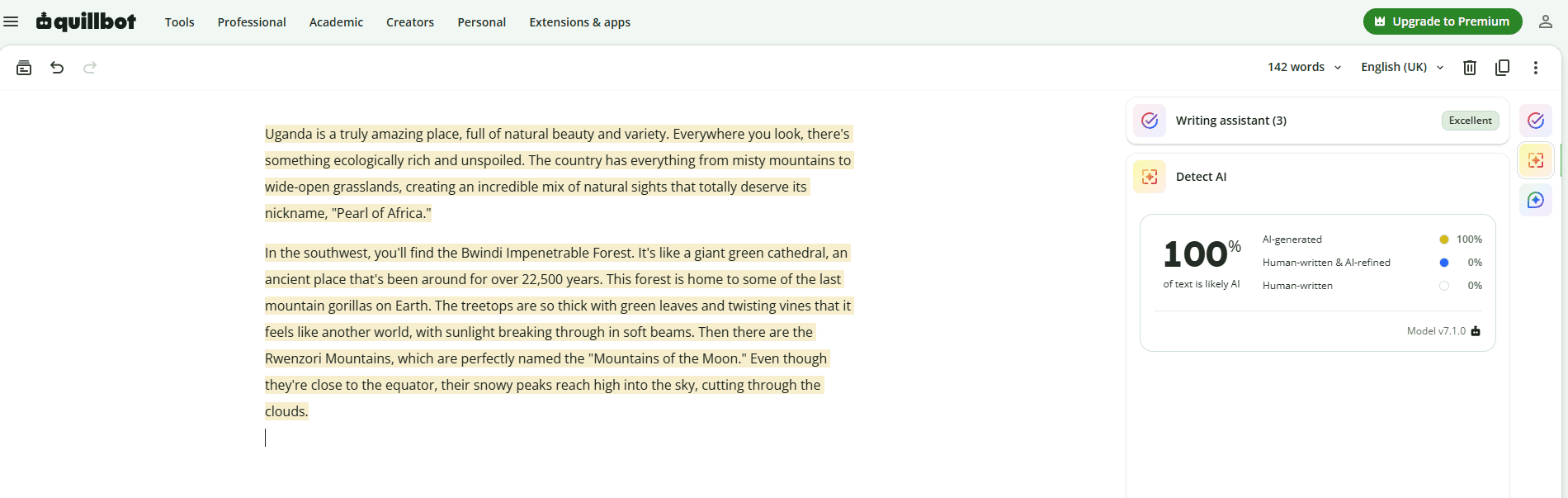
It reported:
100% of text is likely AIAI-generated: 100%Human-written & AI-refined: 0%Human-written: 0%
Result: QuillBot classified the text as 100% AI-generated.
Takeaway: Decopy failed clearly on QuillBot. The rewritten passage was still fully identified as AI-generated.
What These Detector Results Actually Mean
The main takeaway is straightforward:
Decopy AI Humanizer did not pass any of the five detectors we tested.
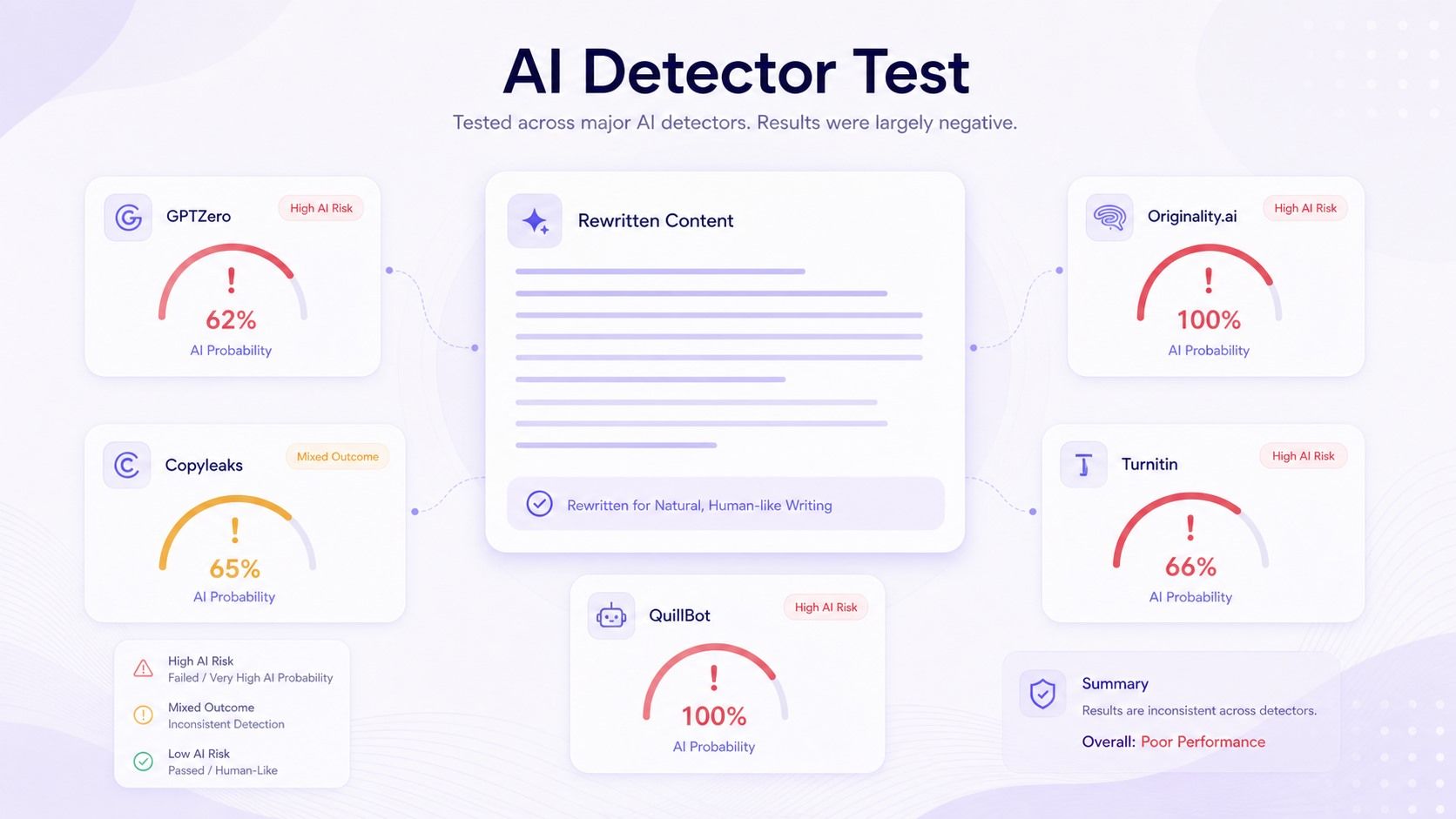
In our test:
- GPTZero classified the text as
100% AI - Originality.ai classified it as
100% AI - Copyleaks classified it as
100% AI - the Turnitin-style detector reported
65.5% AI - QuillBot classified it as
100% AI-generated
That is not a borderline outcome. It is a strong negative pattern.
So, can Decopy AI Humanizer help AI content pass major AI detectors?
Based on these test results, the answer is: not in any reliable way.
That does not necessarily mean the tool has zero value. It may still help improve flow, smooth awkward phrasing, or make some AI-generated drafts feel more readable. But if the goal is specifically to pass major AI detectors, these results do not support that claim.
Is Decopy AI Humanizer Good for SEO Content?
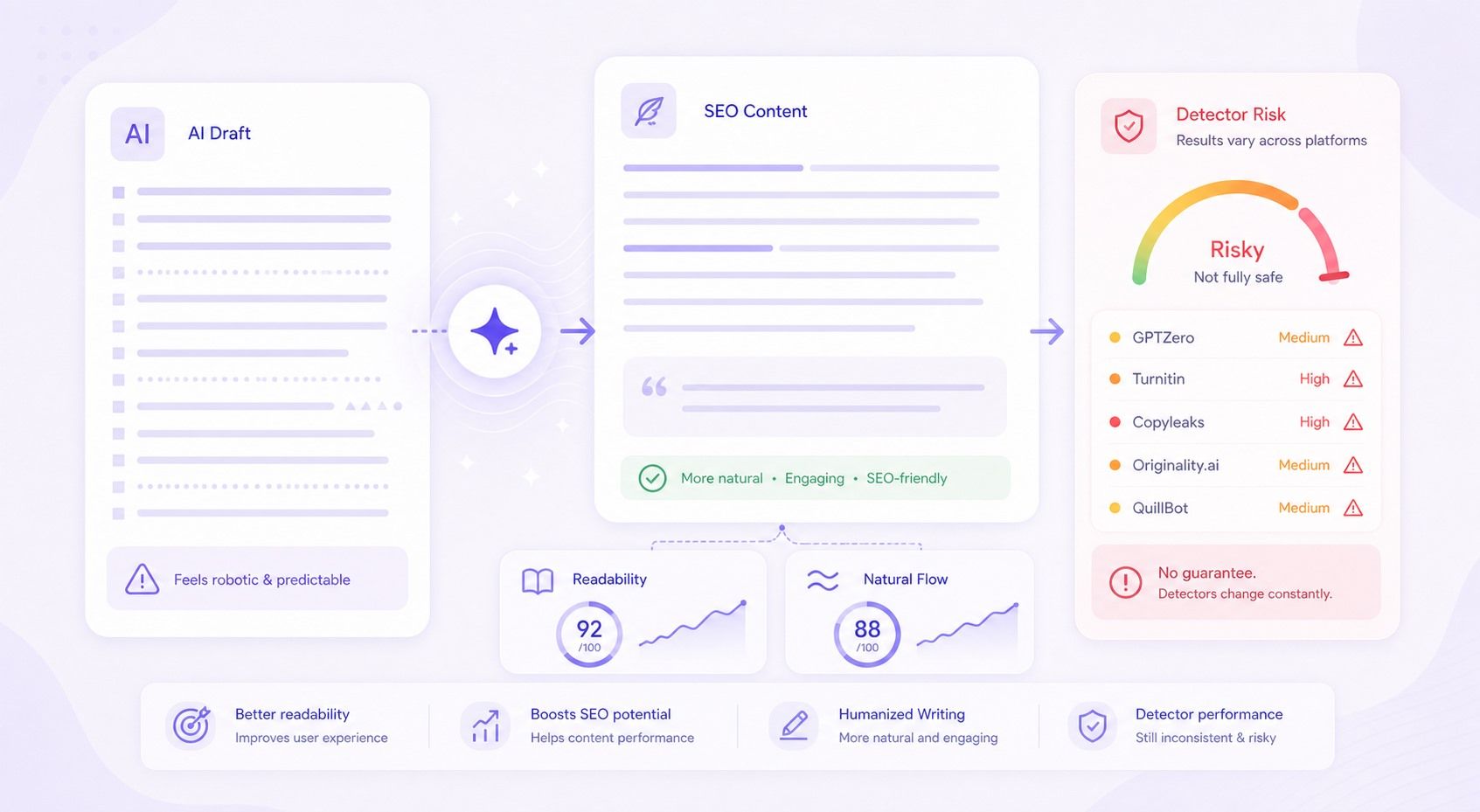
Based on our detector tests, Decopy AI Humanizer looks more useful as a light readability tool than as a serious SEO-safe humanizer.
That distinction matters.
For SEO writers, affiliate marketers, bloggers, and web-content teams, the goal is often to make AI-generated drafts sound more natural, less repetitive, and less obviously machine-written. Decopy may still help with that at a surface level.
It may improve things such as:
- less awkward AI phrasing
- smoother sentence flow
- better baseline readability
- quicker cleanup for rough AI drafts
But the detector results create a real problem.
Originality.ai flagged the rewritten passage as 100% AI, and that matters a lot because Originality.ai is one of the most recognized detectors in SEO and content publishing circles. Copyleaks and QuillBot also classified the output as fully AI-generated. That means Decopy is very hard to recommend as a serious AI humanizer for teams that care about detector risk in SEO workflows.
So the practical takeaway is simple:
Decopy may help AI-generated content read a little better, but it did not show strong enough detector performance to be trusted as a reliable SEO humanization tool.
And as always, strong SEO content still depends on more than humanization. It needs search intent, useful information, real structure, original value, and trustworthy claims. Humanization alone cannot fix weak strategy or shallow content.
Decopy AI Humanizer Pricing
Decopy’s public site presents the AI Humanizer as an accessible tool, and its broader product structure appears to use a usage-based or credit-based model.
Because pricing structures, limits, and credits can change over time, users should verify the latest details directly on the official Decopy site before purchasing.
The practical point is simple: if you are considering Decopy, check both the available free usage and the paid limits that matter for your actual workflow, especially if you plan to humanize long-form or high-volume content.
Refund Policy and Buyer Caution
As with most SaaS-style AI writing tools, users should review Decopy’s current refund and billing terms carefully before paying.
That is especially important with AI humanizer products, because real usefulness often depends on your exact workflow, detector requirements, and content type. A tool that feels helpful for blog drafts may not be sufficient for stricter or higher-risk use cases.
The safest approach is to verify the current refund language and test the product on real samples that match your needs before committing to a larger paid plan.
Best Decopy AI Humanizer Alternative
If you are looking for the best alternative to Decopy AI Humanizer, Lynote AI Humanizer is still the stronger overall choice.
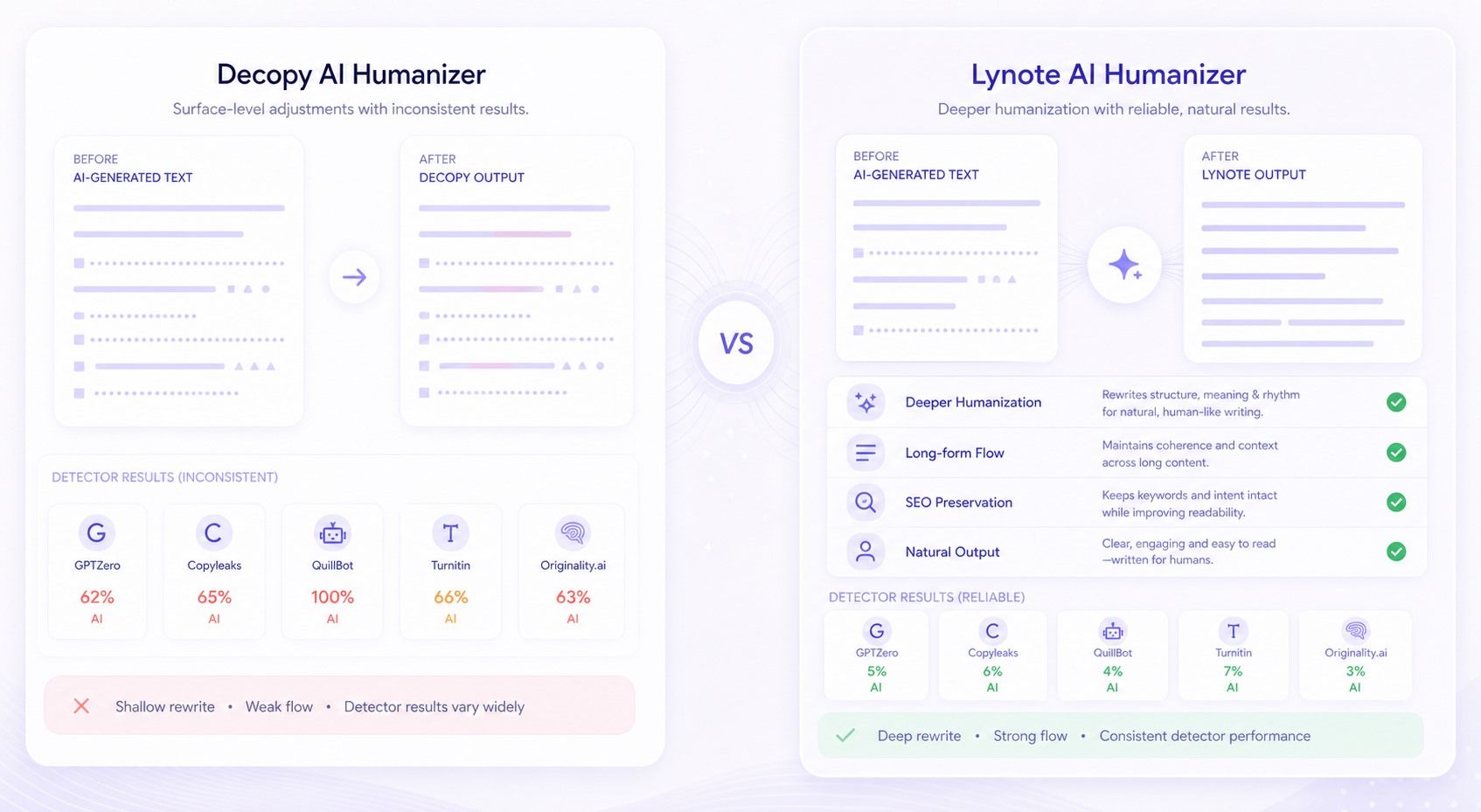
The reason is not just detector positioning. It is writing quality, editorial balance, and practical usefulness.
Decopy may still be somewhat useful for light cleanup, but our tests showed that its rewritten output failed across all five detectors used in this review. That makes it difficult to recommend if your goal is anything beyond basic surface-level smoothing.
That is where Lynote AI Humanizer has the advantage.
Lynote AI Humanizer is a better choice because it is more writing-quality-first than quick humanizer-first. It is better suited for users who want the final writing to actually feel human in a broader editorial sense, especially in blog posts, SEO content, essays, and other long-form formats.
That matters because the strongest humanized writing usually has:
- more organic pacing
- less templated structure
- more believable tone variation
- stronger paragraph-level flow
- better long-form readability
- more stable meaning preservation
In other words, Lynote is a better fit when the real goal is not only reducing AI signals, but also publishing stronger content that reads naturally to actual people.
So while Decopy may be enough for lighter rewriting tasks, Lynote AI Humanizer remains the better overall alternative for blog posts, SEO articles, essays, landing pages, and other long-form content where quality matters more than a quick rewrite.
FAQ
What does Decopy AI Humanizer do?
It rewrites AI-generated text to make it sound more natural, more readable, and less obviously machine-written.
Can Decopy AI Humanizer pass major AI detectors?
Based on our tests, no. The rewritten output was still flagged very heavily by GPTZero, Originality.ai, Copyleaks, the Turnitin-style detector, and QuillBot.
Is Decopy AI Humanizer good for SEO writing?
It may help with light readability improvement, but the detector results in this review were too weak to recommend it as a reliable SEO-safe humanizer.
Why did Decopy perform poorly in this review?
Because while it may improve wording at a surface level, the rewritten content still appeared to retain enough AI-like structure and signals to be recognized by multiple major detectors.
What is the best alternative to Decopy AI Humanizer?
For deeper rewriting and stronger long-form writing quality, Lynote AI Humanizer is the better overall alternative.
Final Verdict: Is Decopy AI Humanizer Worth It in 2026?
After testing Decopy AI Humanizer across five major AI detectors, the conclusion is much clearer than it was before testing.
Decopy is not completely pointless. It may still help smooth AI-generated drafts and make some passages feel less rough or mechanical.
But if the real goal is to help AI content pass major AI detectors, the results in this review are weak.
The rewritten passage was flagged as:
100% AIby GPTZero100% AIby Originality.ai100% AIby Copyleaks65.5% AIby the Turnitin-style detector100% AI-generatedby QuillBot
That means Decopy cannot honestly be described as a reliable AI detection bypass tool.
So is Decopy AI Humanizer worth trying?
Maybe, if you only want light cleanup and basic readability improvement.
But if your goal is stronger humanization, more natural long-form writing, and a more credible overall alternative, Lynote AI Humanizer remains the better choice.

Written by Danny
Product Marketing Manager
Danny explains how Lynote features fit real workflows, from everyday productivity to product-led writing use cases. View all articles →