

The JustDone AI Detector can be useful as a preliminary signal, but one score is not reliable proof of who wrote a document. Its public accuracy figures describe different tests, while independent checks and my own live sample show that false positives can still be substantial.
That does not make the JustDone AI checker useless. It means the result has to be read as a prediction about writing patterns, then compared with the actual document, its revision history, and the context in which it was produced.
This review examines what JustDone measures, what its accuracy claims really tell us, where the detector is most likely to fail, and how to respond to a disputed score without rewriting authentic work merely to satisfy a machine.
Quick Verdict: Is JustDone a Good AI Detector?
JustDone is a convenient screening tool for longer passages. The public interface accepts pasted text or uploaded documents, returns a percentage, and can highlight sentences for closer review.
Its weakness is not the interface. The problem is that a polished percentage looks more decisive than the evidence behind an individual prediction.
| Question | My verdict |
|---|---|
| Is JustDone easy to use? | Yes. Pasting text and starting a scan is straightforward. |
| Is it useful for an initial check? | Yes, especially when the text is long enough to contain meaningful patterns. |
| Is the percentage proof of AI authorship? | No. The tool cannot observe how the document was written. |
| Can it falsely flag human writing? | Yes. My original human sample received an 85% AI result. |
| Is it suitable for misconduct decisions by itself? | No. Consequential decisions require context and human review. |
| Who gets the most value? | Writers and editors using the report as a prompt for closer inspection. |
My overall verdict is useful signal, insufficient proof. That distinction should guide every part of the review.
What Is the JustDone AI Detector?
JustDone is a writing platform that groups its AI detector with a wider collection of writing, research, rewriting, plagiarism, citation, and fact-checking tools. The detector is available through a public web interface, while paid access is marketed as a broader suite rather than a detector-only subscription.
The current detector workflow is simple:
- Paste text into the detector or upload a PDF, Word, or TXT document.
- Click Check for AI Content.
- Wait for the analysis and review the AI-content percentage.
- Examine any sentence-level feedback available in the full report.
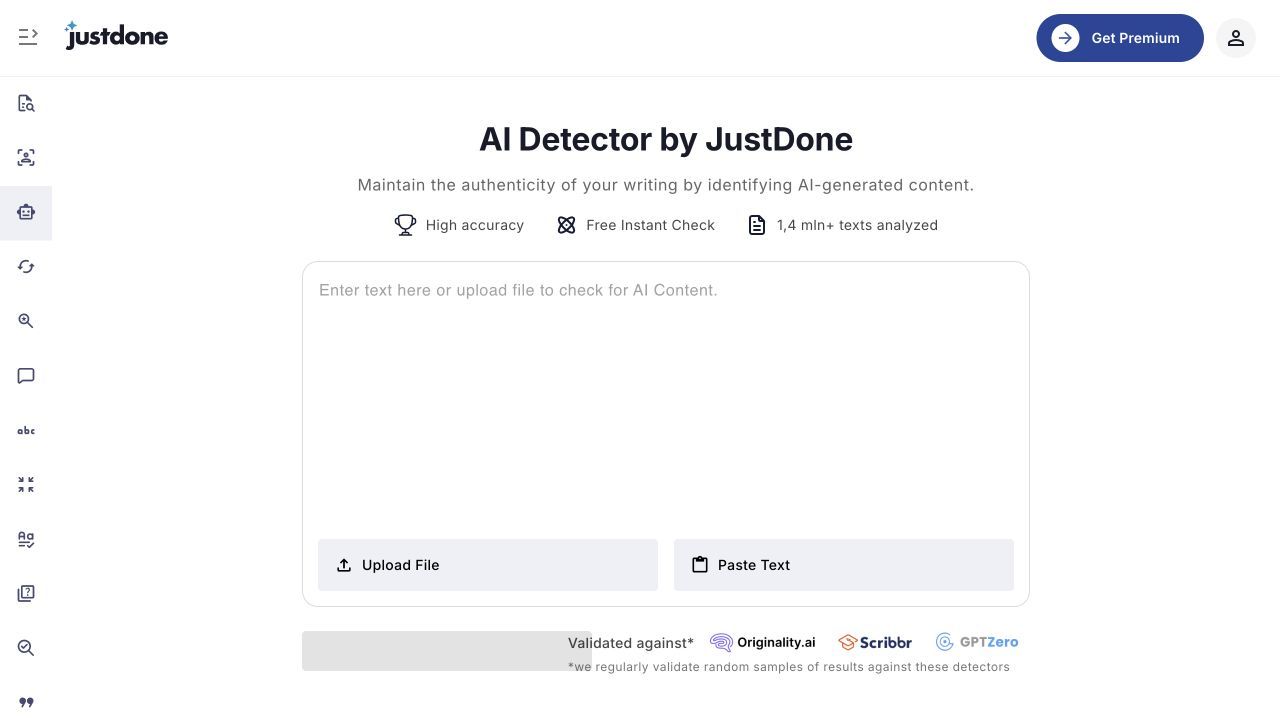
JustDone currently advertises checks of up to 15,000 words in one scan. That is more practical for essays, reports, and articles than tools designed around short text boxes.
The output still needs careful interpretation. A result such as “85% AI content” does not mean the system watched AI generate 85% of the document. It means the detector found patterns that its model associates with AI-generated writing and converted that classification into a percentage.
How the JustDone AI Checker Says It Works
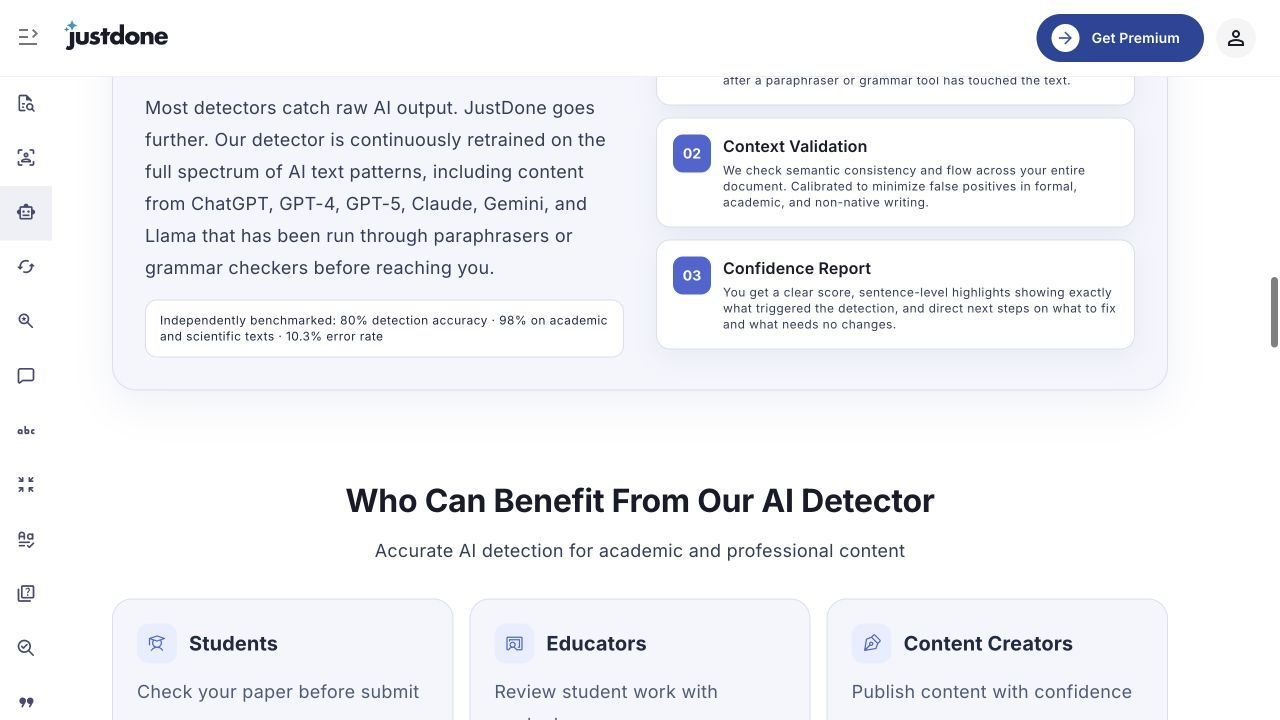
JustDone describes three broad stages: signal analysis, context validation, and a confidence report. The system looks for predictable word choices, consistent sentence rhythm, structural repetition, semantic consistency, and flow across the document.
Those features are reasonable inputs for an AI-writing classifier. Generated text often favors statistically likely phrasing, balanced sentence structures, orderly transitions, and repeated rhetorical patterns.
However, none of those features belongs exclusively to AI. A human writer may produce regular prose because the assignment is formal, the genre is constrained, the writer is using a second language, or an editor has smoothed the draft into a uniform style.
The opposite problem also exists. AI output can be varied, fragmented, heavily edited, or mixed with human writing. A detector may then miss it because the final passage no longer resembles the patterns on which the model relies.
This is why AI detection differs from plagiarism matching. A plagiarism checker can sometimes point to a matching source. An AI detector usually cannot point to a generator log or establish who pressed a button.
It estimates resemblance, not provenance.
JustDone's Accuracy Claims, Decoded
JustDone's current product and benchmark materials publish several numbers. They sound compatible at first glance, but they do not necessarily measure the same outcome.
| Published figure | What it may describe | What readers still need to know |
|---|---|---|
| 80% detection accuracy | Performance on a set of pure AI samples | Model mix, sample balance, threshold, and false-negative count |
| 98% on academic and scientific text | Domain-specific benchmark performance | Whether both human and AI samples were included and how they were sourced |
| 10.3% error rate | Total errors under one evaluation protocol | Separate false-positive and false-negative rates |
| 67.5% fully correct classification | Samples receiving a completely correct label | Number and balance of human, AI, and hybrid samples |
| 22.5% partial identification of hybrid text | Mixed documents receiving some correct localization | What qualified as partial credit |
| 60% of AI-edited human drafts flagged | Sensitivity to one hybrid category | Whether a flag counted as success even when human text was also implicated |
These figures can coexist if the datasets, labels, or scoring rules differ. For example, an 80% AI recall rate can appear alongside a lower full-document classification rate when hybrid passages receive partial credit.
The figures cannot be combined into one simple answer without the underlying counts. We would need to know how many human and AI samples were tested, where those samples came from, which generation models produced them, how long they were, and what decision threshold JustDone used.
There is also a wording difference inside JustDone's own material. The detector page refers to 98% performance on academic and scientific texts, while an official benchmark article reports an error-free scientific and news subset in one particular test.
That is not proof that either number is false. It does mean the two numbers should not be repeated as though they describe the same benchmark.
What Would Make an Accuracy Claim More Trustworthy?
A useful detector benchmark needs more than one top-line percentage. At minimum, it should disclose four basic outcomes:
- True positive: AI text was classified as AI.
- True negative: human text was classified as human.
- False positive: human text was classified as AI.
- False negative: AI text was classified as human.
This produces a confusion matrix. From there, readers can evaluate sensitivity, specificity, precision, and the false-positive rate rather than relying on a single average.
Class balance matters too. Imagine a benchmark containing 90 AI samples and 10 human samples. A detector that labels everything as AI would look 90% accurate even though it would falsely accuse every human sample.
The test set should also be genuinely separate from the data used to train the model or tune its threshold. Otherwise, the benchmark may measure familiarity rather than generalization.
A strong evaluation should disclose:
- Passage length and language.
- Writing domain, such as academic, news, marketing, or personal writing.
- Generator and model version used for AI samples.
- Whether text was paraphrased, grammar-checked, or edited by a human.
- Whether hybrid documents were scored as binary or mixed.
- The model and threshold version used by the detector.
- Results from repeated scans of identical text.
That last item is often neglected. Accuracy asks whether a result is correct. Repeatability asks whether the same input receives the same result under the same conditions.
A tool can perform reasonably on average and still be frustrating if individual scores fluctuate.
My Live JustDone Test
I ran a live check on JustDone's public detector using a 76-word passage written specifically for this review. It described missing a train, helping a neighbor with boxes, calling an editor, and removing an unchecked quotation from an article.
The sample was intentionally concrete. It included a particular day, physical actions, a small inconvenience, and an ordinary revision decision rather than generic explanatory prose.
JustDone returned 85% AI content in the first session. When I later submitted the exact same text in a fresh browser session, it returned 96% AI content.
| Sample | Known origin | JustDone result | Assessment |
|---|---|---|---|
| Personal train anecdote | Human-written for this review | 85%, then 96% AI content | Clear false positive with an 11-point session difference |
The result is important because it demonstrates that human authorship and a high JustDone score can coexist. The 11-point difference also shows why repeatability deserves to be evaluated separately from average accuracy.
The public interface did not produce an immediate same-session rerun after reloading. A fresh browser session did produce the second result, so this was not a tightly controlled repeatability experiment.
The two observed scores are still useful evidence of session-level variation, but they are not enough to estimate how frequently scores change. Users evaluating the product should run a larger controlled set under their own account and document conditions.
This limited test supports a careful conclusion: JustDone can be confidently wrong on an individual human passage, even when that passage contains concrete personal detail.
Where JustDone Is Most Likely to Get It Wrong
No single category guarantees an error. These are conditions where the evidence is weaker or classification becomes harder.
Short text
JustDone's own benchmark guidance recommends at least 350 characters for more reliable results. A short answer, headline, email, or discussion post may not contain enough stylistic evidence for a stable classification.
A detector still returning a precise percentage does not create more evidence. It only creates a more precise-looking output.
Formal or formulaic human writing
Academic introductions, business summaries, lab methods, policy explanations, and standardized responses often use predictable vocabulary and balanced sentence structures. Those are also patterns detectors may associate with generated prose.
Writers using English as an additional language may rely on safer constructions and repeated transitions. A high score in this context requires particularly careful human review.
Hybrid documents
A document may contain a human outline, AI brainstorming, human rewriting, quoted material, formulaic headings, and manually written conclusions. Reducing that history to one binary label loses important information.
An overall percentage can also hide localization errors. A detector might identify the correct general direction while highlighting the wrong sentences.
Heavily edited AI text
Human editing can change rhythm, vocabulary, examples, structure, and argument. Once those features change, the final document may no longer resemble raw generator output.
This does not make the text ethically acceptable or unacceptable. That depends on the applicable policy and disclosure rules, not the detector's success.
Varied AI output
Prompts can produce fragments, dialogue, uneven sentence lengths, personal scenarios, or deliberately informal language. Those features may weaken the regularity on which a detector depends and create false negatives.
Use Lynote AI Detector for a Structured Second Opinion
When a JustDone result looks surprising, a second detector can show whether the signal is isolated or consistent across different models. The Lynote AI Detector provides a three-way result for AI-generated, mixed, and human-written content, plus sentence-level highlights for likely AI or paraphrased lines.
It should still be used as a review aid rather than a final authority. Agreement between two detectors strengthens a pattern signal, but it does not create direct evidence of authorship.
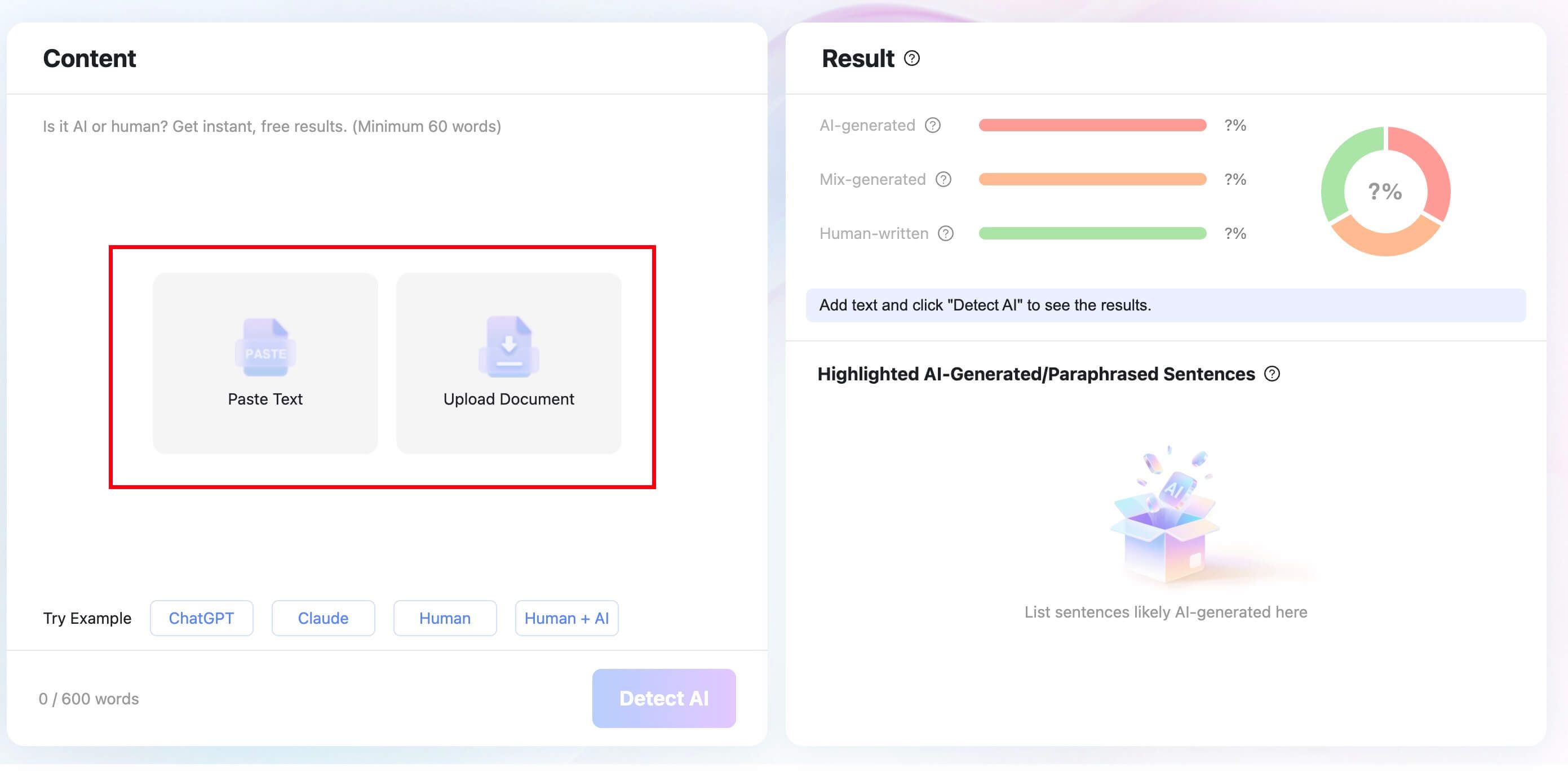
Step 1: Paste text or upload a document
Open Lynote AI Detector and paste the passage into the input box. For a longer essay or report, upload a supported DOCX, PDF, or TXT document instead.
Use enough continuous prose to provide meaningful context. Avoid drawing strong conclusions from a title, bullet list, or a few isolated sentences.
Step 2: Run the detection
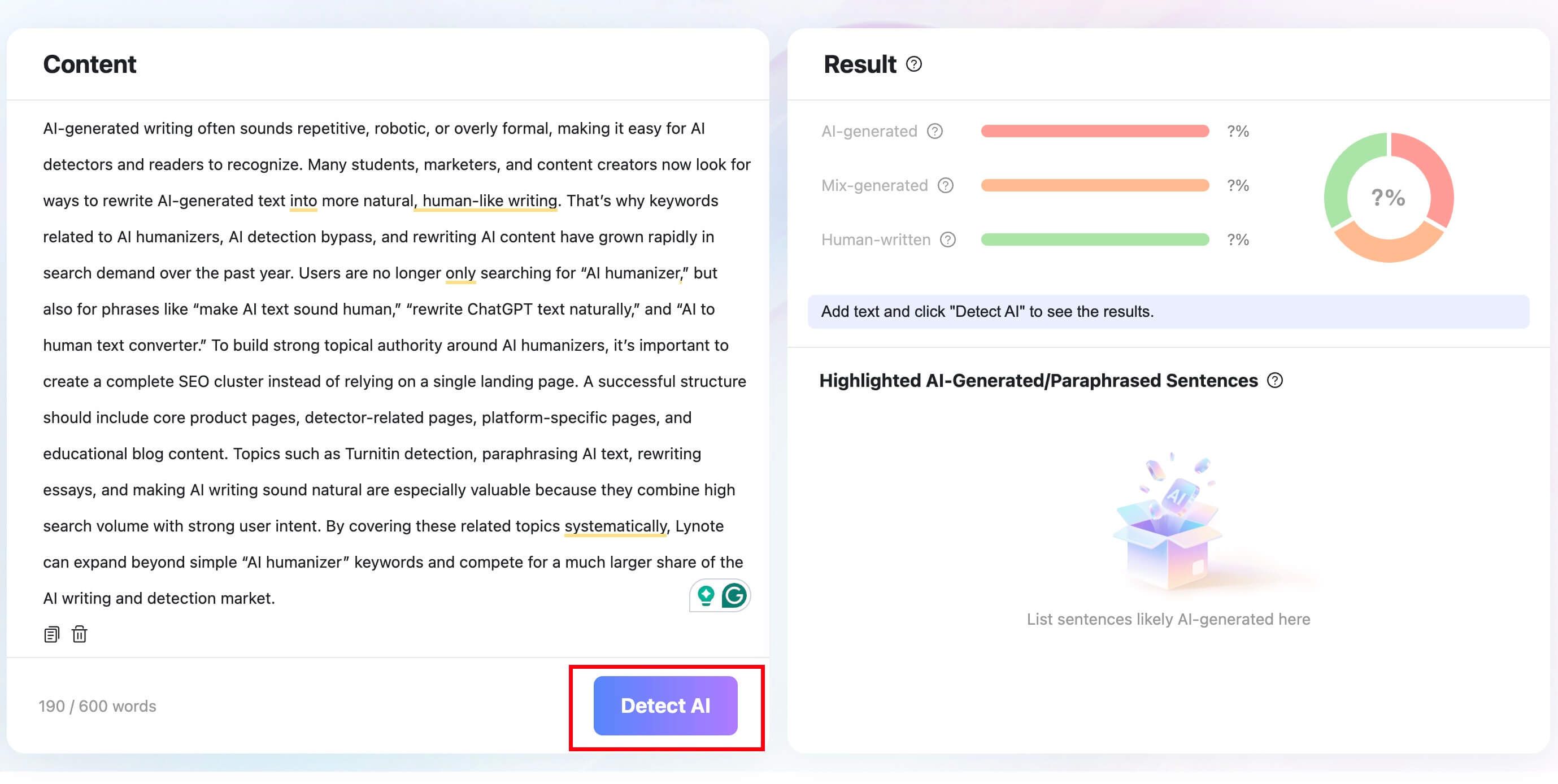
Click Detect AI and let Lynote analyze the text. Keep the exact version you scanned so you can compare it with the JustDone input and avoid accidental differences between tests.
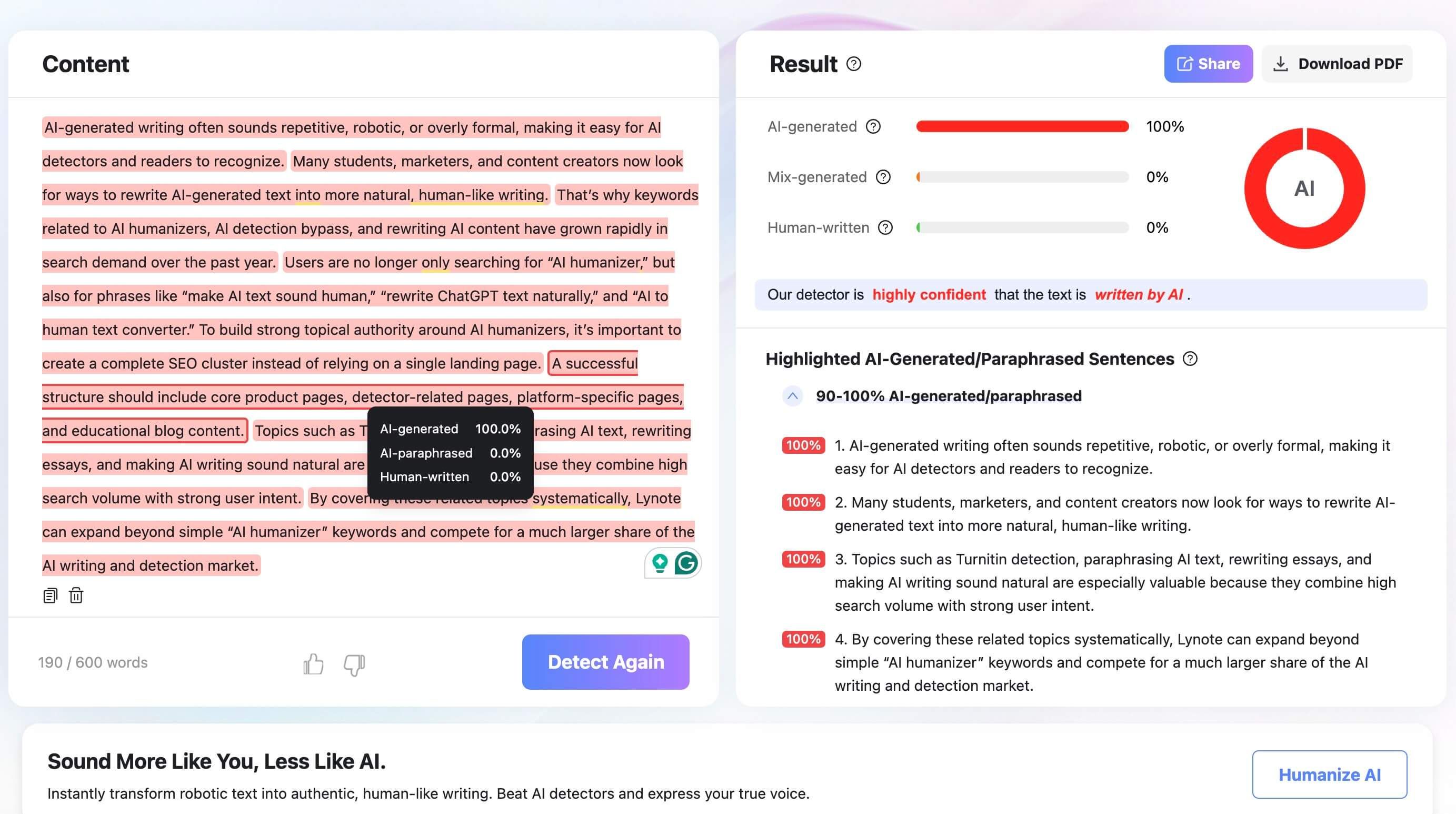
Step 3: Review the distribution and highlighted sentences
Examine the AI-generated, mixed, and human-written percentages together. Then inspect which sentences were marked as likely AI or paraphrased.
The three-way split is particularly useful for documents with a mixed editing history. It provides a more nuanced review surface than forcing every document into a simple all-human or all-AI category.
The final judgment should still include the document's purpose, drafts, sources, and revision history. Lynote is a second signal, not a definitive tie-breaker.

What to Do When JustDone Flags Human Writing
A high score can be unsettling, especially when you wrote the passage yourself. The most defensible response is to preserve evidence and investigate the result, not to damage your writing by repeatedly changing words until a detector approves it.
- Check the input length. Treat short passages as weak evidence, even when the percentage looks precise.
- Read the highlighted sentences. Ask whether the tool identified a genuine writing problem or merely a conventional structure.
- Verify the exact document version. Formatting changes, missing sections, or pasted excerpts can alter the context.
- Use one independent detector. Compare the direction and sentence highlights, not only the headline percentages.
- Preserve process evidence. Keep outlines, notes, drafts, document history, research materials, and citations.
- Check the relevant policy. Permitted brainstorming, proofreading, translation, and generation rules vary by course, employer, or client.
- Request human review. Consequential decisions should consider the writing process and the writer's explanation.
Do not assume that lowering the number proves authenticity. A detector score can change while the underlying authorship history remains exactly the same.
Free Access, Paid Plans, and the $2 Trial
JustDone markets the detector alongside a paid bundle of more than 35 tools. That matters when evaluating value: the subscription is easier to justify for someone using the broader writing suite than for someone who wants only occasional AI checks.
At the time of this review, the pricing page displayed a promotional monthly plan at $19.99 and an annual option shown as a $9.99 monthly equivalent. Prices and discounts can change, so they should be checked at purchase time.
The most important detail is the seven-day access offer. It is advertised at $2 and currently renews at $39.99 per month unless canceled.
Read the renewal terms before starting the trial, note the billing date, and use the account cancellation controls if the full subscription does not fit your needs. A cheap trial and a cheap ongoing plan are not the same thing.
What Independent Tests and Users Report
Outside evidence is mixed, and its quality varies. An AFP investigation reported false positives on human-written multilingual samples and noted JustDone's acknowledgment that no detector can guarantee complete accuracy.
JustDone also told AFP that the free detector may be less precise during high demand because it can use a lighter model. That caveat is especially relevant when users compare a public check with paid or account-based results.
Other small reviews have reported three recurring patterns:
- Longer, clearly generated passages tend to be easier to classify than short snippets.
- Human writing can receive high AI scores.
- The same passage may receive changing scores across sessions or tests.
These reports should not be collapsed into a universal accuracy number. Some are small spot checks, some come from companies selling competing products, and Reddit comments are anecdotal.
Their value lies in identifying failure modes worth testing. The recurring lesson is consistent with my live result: users should validate JustDone against representative text they genuinely know, including human samples, rather than evaluating it only with obvious chatbot output.
JustDone AI Detector Pros and Cons
Pros
- Straightforward paste-and-check workflow.
- PDF, Word, and TXT upload support.
- High advertised document length limit.
- Sentence-level feedback in its report workflow.
- Part of a larger writing and research toolkit.
- Publicly acknowledges that AI detection is not completely accurate.
Cons
- Official headline metrics need more methodological context.
- False positives can be substantial on individual human passages.
- Short and hybrid text remains difficult to interpret.
- The public detector did not produce a clear repeat result in my session.
- A confident percentage can encourage overconfidence.
- The low-cost trial renews at a much higher monthly price unless canceled.
Who Should Use JustDone?
JustDone makes sense for a writer, editor, or content manager who wants a quick preliminary scan and is willing to inspect the actual sentences. It can also help teams identify drafts that deserve a closer process review.
It is less suitable for users checking a few short sentences, because the available signal is weak. It is also a poor fit for anyone expecting a binary answer about genuine hybrid authorship.
Teachers, employers, and clients should not use it as the sole basis for an accusation or penalty. In those settings, the cost of a false positive is too high, and writing-process evidence is more directly connected to authorship.
FAQs About the JustDone AI Detector
Is JustDone AI Detector accurate?
JustDone can correctly identify some clearly AI-generated text, particularly in longer samples, but it is not consistently accurate enough to prove authorship. Its official figures describe different benchmarks, and false positives remain possible.
Is JustDone a good AI detector?
It is a useful screening tool with a convenient interface and document support. It is not a good sole decision-maker for academic, employment, or client disputes.
Can JustDone detect ChatGPT, Claude, and Gemini?
JustDone says its model is trained to recognize patterns associated with ChatGPT, GPT models, Claude, Gemini, Llama, DeepSeek, and other generators. Support claims do not guarantee correct classification for every passage.
Can JustDone falsely flag human writing?
Yes. In my live checks, a human-written personal anecdote received 85% and then 96% AI-content results in separate browser sessions. Independent reports also describe human-text false positives.
Why might the JustDone AI score change?
Detector models, thresholds, traffic-dependent processing, input context, and product updates can affect results. If identical text changes substantially, treat that instability as a reason to reduce confidence in the score.
How much text should I scan with JustDone?
JustDone's benchmark guidance recommends at least 350 characters for more reliable results. Longer continuous prose generally provides more stylistic evidence than a headline, list, or short paragraph.
Is JustDone AI Detector free?
JustDone provides a public instant-check interface, while fuller reports and the wider suite are tied to its paid offering. Current access rules and plan limits can change.
Can a JustDone score prove that someone used AI?
No. The score estimates whether writing resembles patterns associated with AI output. It does not observe the writing process, identify who created the text, or replace drafts, revision history, policy context, and human review.
Final Verdict: How Accurate Is JustDone AI Detector?
JustDone is accurate enough to be useful as a screening prompt, but not reliable enough to serve as authorship evidence. Its strongest practical features are easy document input and sentence-level review; its central limitation is that the percentage can look far more certain than the underlying inference.
My live checks produced 85% and 96% AI scores on the same human-written anecdote in separate sessions. That limited test does not measure JustDone's overall accuracy, but it demonstrates that a high score and authentic human authorship can occur together.
Use JustDone to decide where to look more closely. For any meaningful decision, compare the result with a second detector, inspect the flagged language, preserve the writing history, and let a person evaluate the full context.

Written by Danny
Product Marketing Manager
Danny explains how Lynote features fit real workflows, from everyday productivity to product-led writing use cases. View all articles →