
How to Learn Japanese Fast: A Practical Plan You Can Stick To

To learn Japanese fast, combine a small, useful set of words and sentence patterns with daily recall, understandable listening, and practice using them. Learn the writing system alongside those activities, rather than postponing communication until you have memorized enough characters. The aim is to make more Japanese available when you need it, not simply finish more lessons.
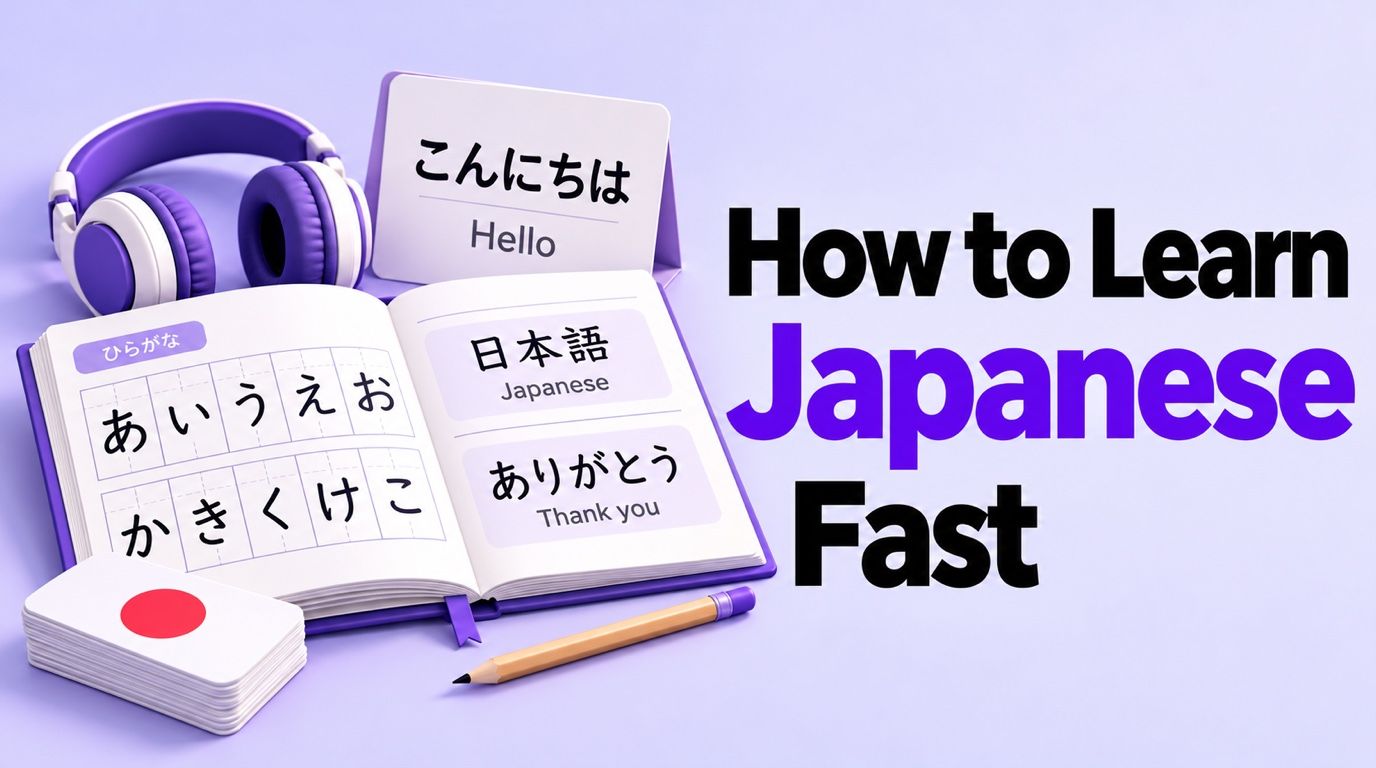
That distinction matters when your study time is limited. A familiar flashcard, a completed video, and a sentence you can actually say are three different achievements. This guide helps you turn the first two into the third, with a routine you can adapt to your schedule.
How to Learn Japanese Fast: Start With These Priorities
Start with one beginner course, learn kana alongside its early lessons, and review useful vocabulary before adding more. Listen to short passages you can work out, then use the same material in a small speaking or writing task. Check what you remember later, not just what makes sense while the answer is on screen.
Here is the order of attention, rather than a rigid sequence where you finish one skill before starting another:
| Priority | What to do | What counts as progress |
|---|---|---|
| A useful goal | Choose a situation you want to handle | You can name the task you are practicing |
| Script and sound | Study kana with audio and familiar words | You recognize a word outside the original exercise |
| Words and patterns | Learn vocabulary inside short sentences | You can change part of a sentence appropriately |
| Retrieval | Answer before revealing your notes | You recall something after a gap |
| Listening and output | Hear, understand, and use the material | You complete a small task without reading a script |
Fast progress is possible within a narrow task. Broad conversational ability takes sustained practice across unfamiliar speakers, situations, and topics. A month of ordering-food practice should not be mistaken for a month of preparation for a job interview.
Build a Study Route Around What You Want to Do
"Learn Japanese" is too broad to tell you what to study tonight. "Introduce myself, explain why I am visiting, and ask someone to repeat a question" gives you a manageable set of lessons.
Choose the task first, then pick a beginner course that teaches the necessary foundations. Avoid assembling your entire curriculum from whichever video happens to appear next.
| Your immediate goal | Prioritize | Keep in the background for now |
|---|---|---|
| A trip to Japan | Requests, numbers, directions, listening for likely replies | Rare vocabulary and elaborate handwriting practice |
| Everyday conversation | Common verbs, questions, listening, turn-taking | Memorizing speeches without practicing responses |
| Reading simple material | Kana, vocabulary with kanji, grammar, supported reading | Looking up every unfamiliar character in isolation |
| An upcoming exam | The exam's actual question types and your weakest skills | Treating an app streak as evidence of exam readiness |
Give your existing materials a usable order
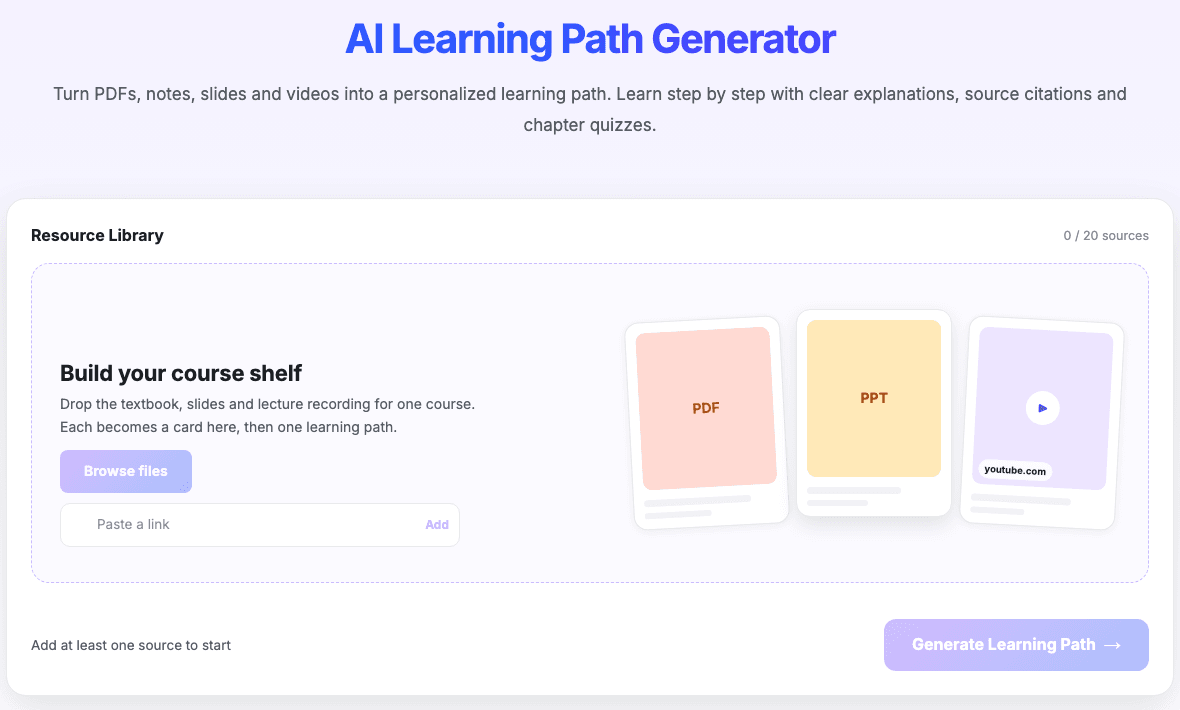
If you already have lesson PDFs, class notes, and tutorial links, Lynote Learning Path can help organize those materials into ordered chapters with explanations, source citations, and chapter quizzes. It is a way to study the resources you supply, not a substitute for choosing a sound Japanese course.
- Add related materials from one beginner unit or course, rather than an unrelated collection of everything you have saved.
- Select Generate Learning Path to organize the source material into chapters and key concepts.
- Review the sequence, work through a chapter, and check the explanations against their sources before using the quiz to review.
Keep audio practice and real communication in your schedule too. Understanding a generated explanation of a grammar point is not the same as hearing that pattern in conversation or producing it yourself.
Learn Kana and Useful Sentence Patterns Together
Hiragana and katakana are foundational Japanese scripts. Learn to recognize them with audio, then read them inside words from your lessons instead of practicing only in a fixed chart order.
A chart can become deceptively easy because you remember what comes next. Shuffle the characters, revisit easily confused shapes, and try reading a familiar word in a different font or context.
You do not need beautiful handwriting before beginning simple listening and sentence practice. If your goal includes writing forms or handwritten work, include handwriting deliberately; otherwise, do not let copying pages consume the entire session.
Keep temporary pronunciation aids temporary. Audio and the original script should gradually become your reference points, rather than English-letter approximations that may encourage the wrong sounds.
For grammar, learn what a short sentence accomplishes before collecting terminology. Notice how a question differs from a statement, how a request is formed, and which parts change when you talk about a different person, place, or time.
Use a verified course example as your starting point. Change one element, check the result, and try it aloud. Replacing five elements at once makes it harder to identify why your sentence no longer works.
How to Learn Japanese Words Fast Without Forgetting Them
The practical answer to how to learn Japanese words fast is to keep each word connected to its sound, written form, meaning, and a situation where you would use it. Then test those connections after a delay. A long list can expose you to vocabulary, but exposure alone does not tell you which words you can retrieve.
Choose words that have a job in your week
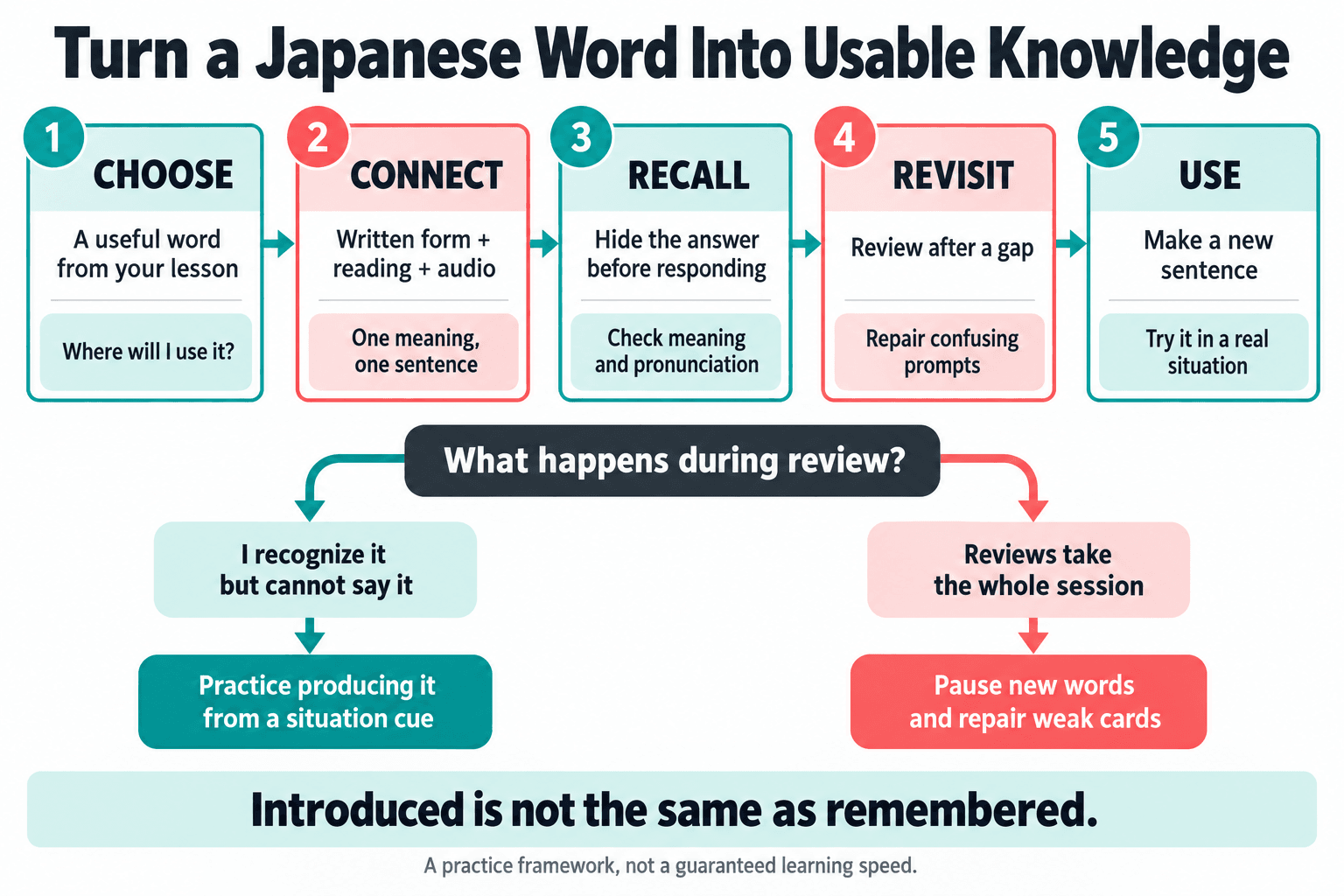
Start with vocabulary from your core course and immediate goals. Everyday actions, time expressions, questions, places, and requests give you material you can reuse across several small tasks.
Add interest-specific words when they recur in something you genuinely want to understand. You do not need to reject every unusual word, but a collection of rare terms should not crowd out the language needed to ask a basic question.
For each candidate, ask: "Where will I see, hear, or use this again?" If there is no answer, save it for later rather than creating another review obligation immediately.
Build a small record, not a dictionary entry
Keep the written word, its reading, a short audio model when available, one relevant meaning, and one verified sentence. Add a brief usage note only when it prevents a likely mistake, such as using a casual expression in a formal request.
Do not copy every definition or possible kanji reading onto the same card. A beginner card should ask one manageable question, with enough context to make the intended answer clear.
For words written with kanji, learn the reading of the actual word you encountered. A character's readings across many different compounds are a separate task; memorizing the whole list before learning usable words can create unnecessary work.
Test different kinds of knowledge
Recognizing a word in print does not guarantee that you will identify it in speech. Nor does recognizing its meaning guarantee that you can produce it when someone asks a question.
Rotate simple checks instead of treating one flashcard direction as complete mastery:
- See the written word and recall its reading and relevant meaning.
- Hear the word and identify it without seeing the spelling.
- Read a situation or meaning cue and try to produce the word.
- Use the word in a short sentence whose pattern you already know.
You do not have to run every check on every item each day. Use the direction that exposes your current weakness, and occasionally check whether the knowledge transfers to another format.
Review before you add more
A spaced-review tool can schedule future practice, but you still need to answer honestly. Pause before revealing the answer; if you needed a hint, do not count that as independent recall.
An adjustable starting point is five new items on days when you can also finish your reviews. That is an editorial suggestion, not an optimal number established for every learner. Reduce it when reviews consume your session, and increase it cautiously when older words remain usable.
If a word keeps failing, inspect the learning material before simply repeating it again. The cue may be ambiguous, the sentence too difficult, or the audio unfamiliar. Rewrite the card, attach a clearer example, or ask a teacher about the confusing distinction.
Count introductions separately from retained words
Five new items across 20 study days gives you 100 introductions to vocabulary. It does not demonstrate that you know 100 words. You may recognize some, recall fewer without prompts, and use a smaller set comfortably.
At the end of a week, sample ten older items before reviewing them. Record which you can recognize, retrieve, and use; repeat the check later with a different sample. This is a personal tracking method, not a standardized proficiency score.
That distinction gives you a useful decision. If recognition is strong but production is weak, the next step is more retrieval and sentence practice, not necessarily another large vocabulary download.
Make Short Listening Sessions Do More Work
Choose a short learner dialogue with a reliable transcript and audio. A passage about a situation you already understand is usually easier to work with than an entertaining scene packed with unfamiliar references and expressions.
Try this sequence with a short extract:
- Listen without the transcript and identify the situation and any words you recognize.
- Read the transcript, check the important unknowns, and establish the meaning.
- Listen again while following the text, noticing where words begin and end.
- Hide the text and replay the same passage.
- Repeat a short line after the speaker, then explain the exchange or respond to it in simple language.
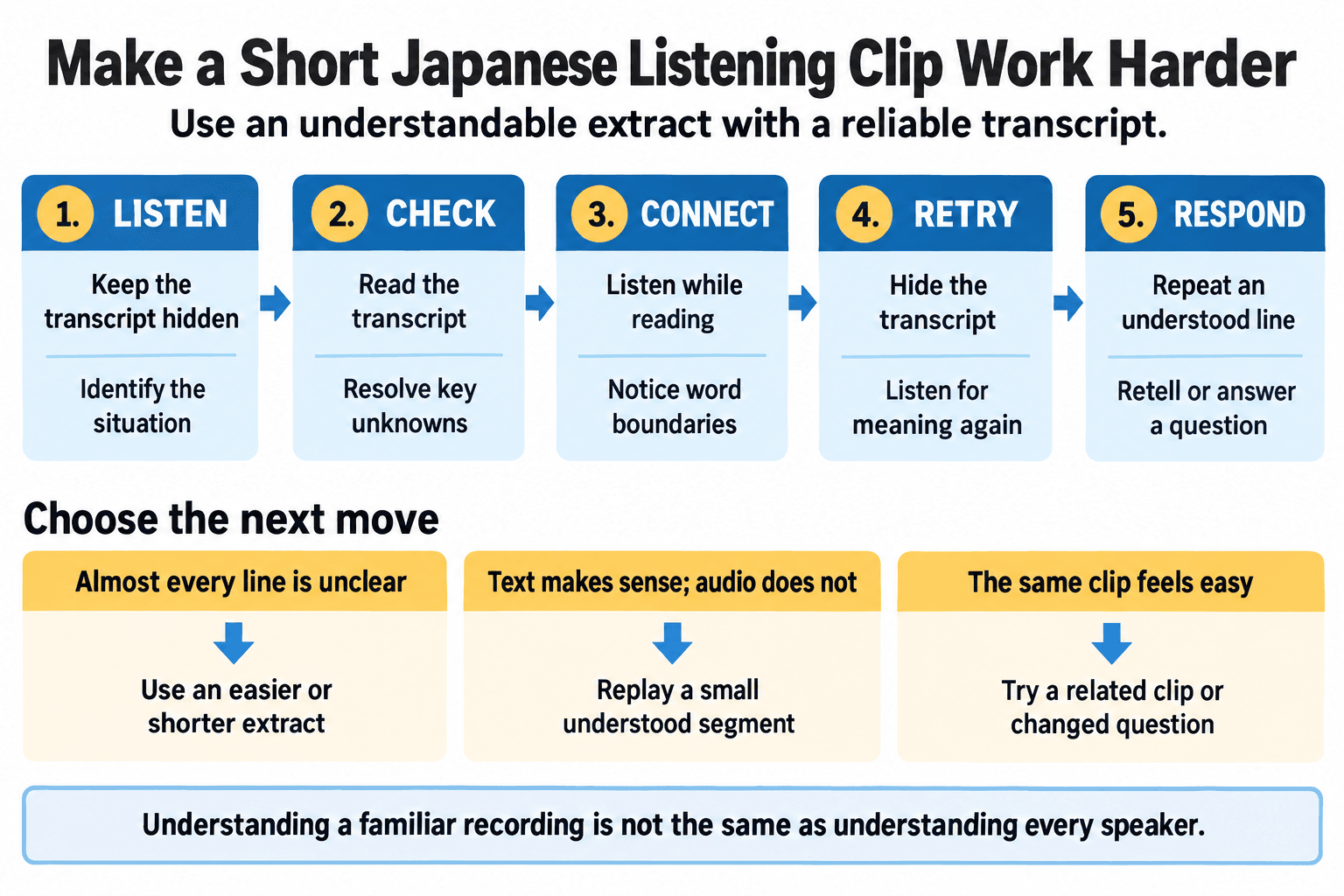
If almost every line needs explanation, shorten the extract or choose easier material. Repeatedly replaying a passage you cannot understand is not the same exercise as listening to language you are beginning to recognize.
Shadowing can help you attend to timing and sound, but begin with short lines you understand. Ask for feedback on pronunciation when possible, especially where vowel length, consonant timing, or unfamiliar sounds affect intelligibility.
Anime, music, and dramas can keep you interested. Treat them as additional exposure unless you are doing focused work with suitable material; entertainment time and deliberate listening practice do not have to compete, but they should not be counted as identical.
Turn Lesson Notes Into Practice, Not a Second Textbook
Notes earn their place when they help you answer a question or fix a recurring mistake. A polished summary that you only reread can feel productive while leaving the same gaps in your speaking and recall.
For a lesson PDF or tutorial, Lynote AI Note Generator can create a structured starting point with editable notes and source-linked sections. Use that organization to find the material you need, then decide what deserves practice.
- Upload the lesson file, or paste its supported web or YouTube URL. For a URL, select Parse; direct file uploads do not need that URL step.
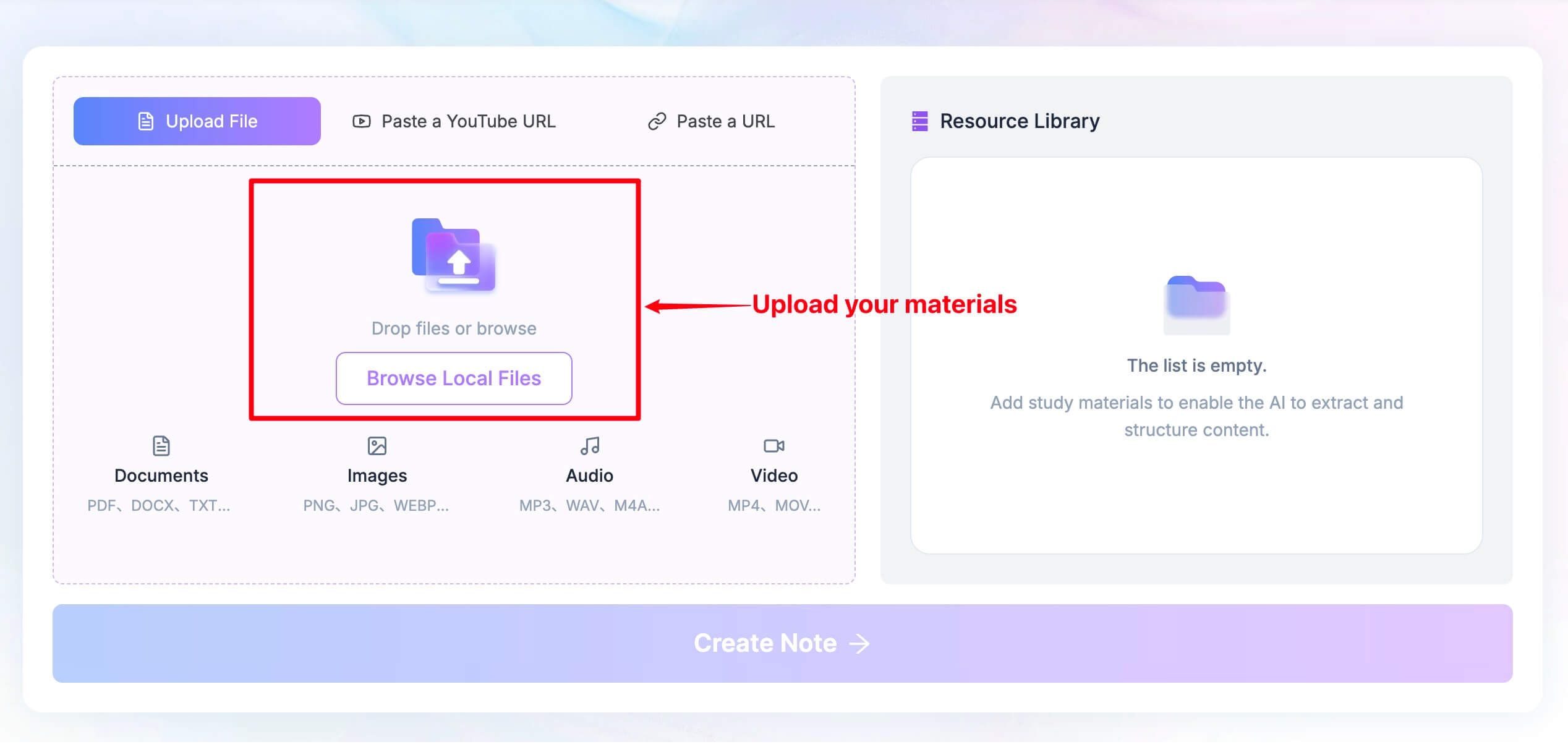
- Select Create Note to generate the structured notes.
- Compare the notes with the source, edit unclear explanations, and add your own questions and mistakes. You can also convert the notes into flashcards, then review the cards for accuracy and useful prompts.
For a beginner lesson, keep a compact practice record:
| Note field | What to capture |
|---|---|
| Situation | Where this expression or pattern is useful |
| Model | A short, verified example from the lesson |
| Meaning | The meaning in this context, not every possible definition |
| Caution | A reading, particle, or formality issue you tend to miss |
| Recall question | A prompt you can answer without looking at the model |
Finish by closing the notes and answering one question aloud. If you cannot do it, reopen only the relevant section, check the issue, and try again later. The useful part is what you do with the notes after they exist.
Use Translation to Unblock Meaning, Then Remove the Crutch
Translation is helpful when a small gap stops you from understanding a passage. It is less helpful when you read the English version first and never return to the Japanese.
Try making a rough prediction before checking. Identify what you think is happening, mark the unclear phrase, and keep enough surrounding context for the translation to make sense.
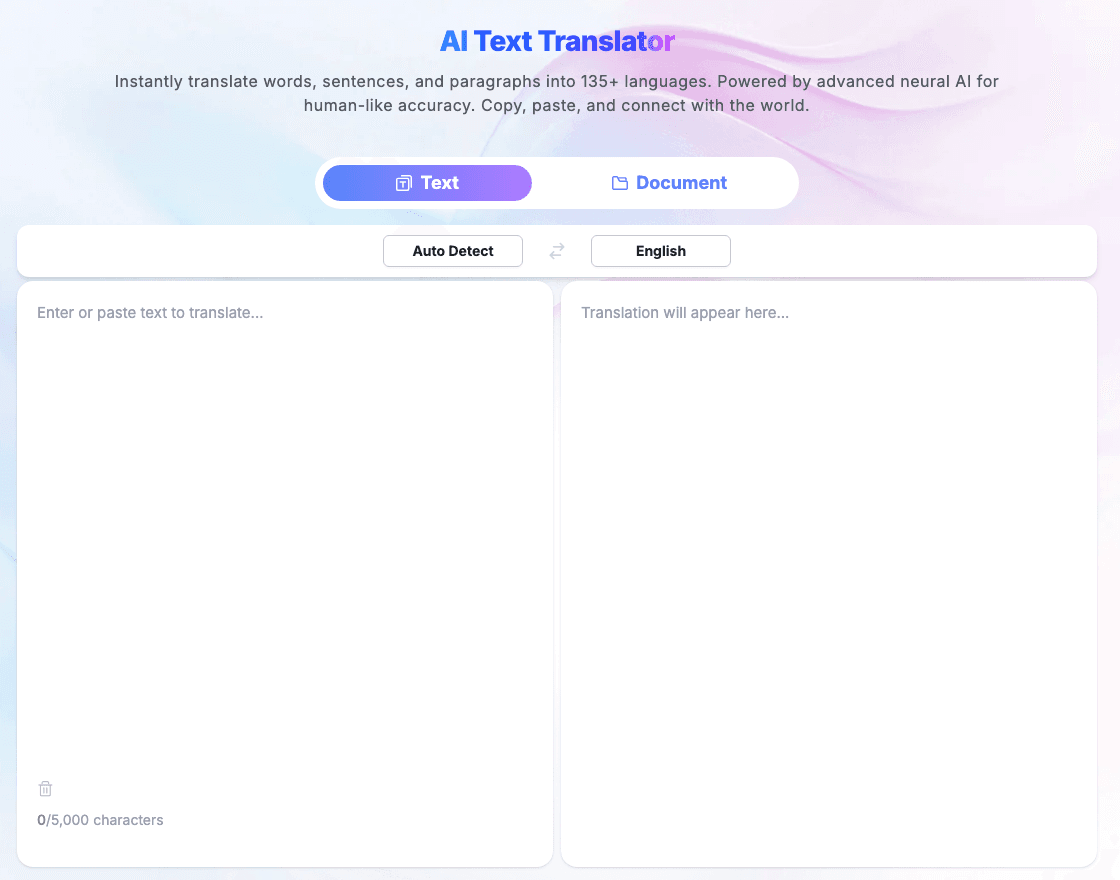
For short passages, Lynote Text Translator lets you paste text and choose the target language. Use the output as a meaning check, then return to the original passage and identify what you had missed.
- Paste the sentence or short passage you are studying.
- Choose English as the target language and check the detected source language.
- Compare the translation with your prediction, then hide it and read the original again.
A natural English translation may not preserve Japanese word order or reveal every grammatical choice. Japanese can also leave information unstated when context supplies it, so avoid assuming that each English word corresponds to an explicit word in the source.
Use a dictionary, course explanation, or teacher to resolve uncertain readings and usage. Translation can clarify meaning, but it should not be your only check for pronunciation, formality, or whether your own sentence sounds appropriate.
Start Speaking Before You Feel Ready
Make the first speaking task small enough to finish. Introduce yourself, make one request, or answer a familiar question, rather than attempting a long conversation about everything you studied.
Prepare a short version from patterns you know, say it without reading, and notice where you stop. Check one or two problems, then repeat the task with a small change so you are not merely memorizing a single recording.
For example, a self-introduction task can change from introducing yourself to a classmate to explaining your interests to a tutor. The point is to reuse familiar language while making a real choice about what to say.
Practice receiving a response too. Knowing how to ask for something is only half the exchange; you also need to recognize a likely follow-up and ask for clarification when necessary.
If a partner is not available, record yourself and compare a short section with a reliable model. Treat that as preparation for feedback, not proof that your pronunciation or grammar is correct.
A 30-Day Japanese Study Plan for Busy Beginners
The following plan is a suggested structure, not a promise of fluency or a fixed proficiency level. Move more slowly through a difficult unit and adapt the materials to your prior experience.
Give each week a concrete outcome
| Week | Main work | Practical check |
|---|---|---|
| 1 | Begin kana, basic sounds, and the first lessons of one course | Recognize practiced characters out of order and deliver a brief introduction with support |
| 2 | Review useful vocabulary and simple sentence patterns | Respond to familiar prompts without first reading the model |
| 3 | Combine short listening passages with requests and questions | Follow a practiced exchange without its transcript and attempt a related exchange |
| 4 | Revisit weak material and apply earlier lessons | Repeat an earlier task with less support, then attempt a small variation |
Keep previous skills in circulation rather than abandoning them when the week changes. Kana practice can become reading words; a vocabulary review can feed the dialogue you practice later that day.
Match the routine to the time you actually have
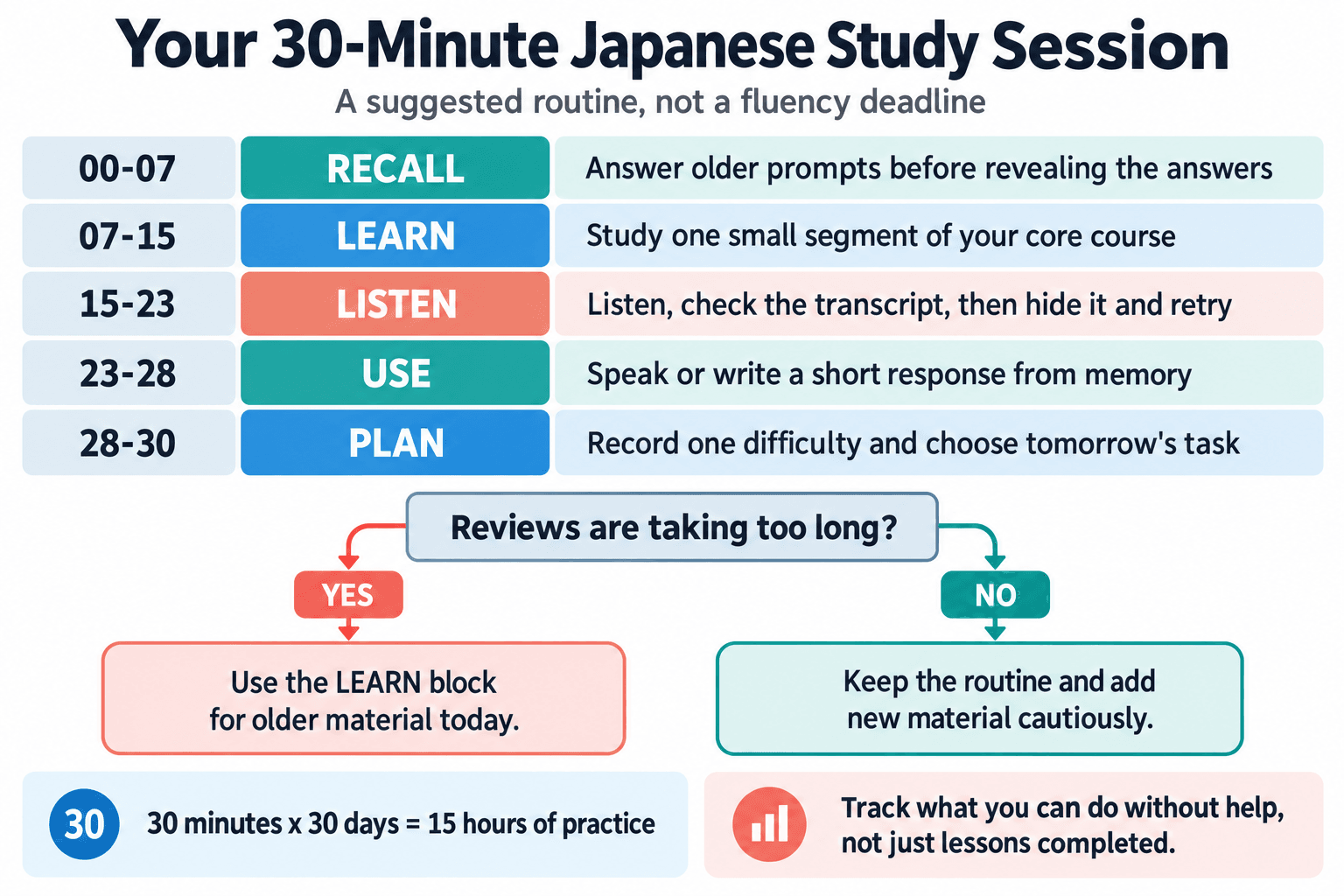
| Activity | 15-minute day | 30-minute day | 60-minute day |
|---|---|---|---|
| Recall older material | 4 minutes | 7 minutes | 12 minutes |
| Study a course segment | 4 minutes | 8 minutes | 15 minutes |
| Listen and check understanding | 4 minutes | 8 minutes | 18 minutes |
| Speak or write from memory | 3 minutes | 5 minutes | 10 minutes |
| Record a problem and choose the next task | Included in the final minute | 2 minutes | 5 minutes |
On the 15-minute schedule, the final minute of output includes the brief planning note; it is not extra time. On a difficult day, skip new material and use its block for reviewing a previous lesson.
Thirty minutes a day for 30 days totals 15 hours. That is a meaningful block of practice, but it is not a basis for promising broad fluency. If you miss a day, resume with review rather than doubling the new-word load to repair a calendar streak.
Prepare tomorrow before you stop today
Leave yourself a specific next action: the next dialogue, the three cards that need repair, or the question you want to ask a teacher. "Study Japanese" invites another round of browsing; "replay the station dialogue without the transcript" lets you start immediately.
Keep one core course, one review system, and one listening source for the initial month. Add a new resource when it solves an identified problem, not simply because it promises a faster method.
What to Change When Your Japanese Stops Improving
A plateau is a reason to inspect the task, not automatically increase study time. First identify whether the obstacle is meaning, memory, sound, sentence formation, or the difficulty of the material.
| What you notice | Possible bottleneck | Adjustment to try |
|---|---|---|
| You recognize words but cannot say them | Too much recognition practice | Use situation-to-word prompts and short spoken responses |
| A transcript is clear but the audio is not | Weak links between written forms and sound | Replay a short understood extract with and without the transcript |
| Reviews take the whole session | New material is arriving faster than you can maintain it | Pause new cards and repair repeatedly failed items |
| You know words but cannot form a sentence | Vocabulary is disconnected from grammar | Practice a course pattern with a few controlled substitutions |
| You rely on the English translation | Meaning checks have replaced reading practice | Predict first, check, then reread without the translation |
| You keep starting new courses | Resource selection is replacing study | Stay with one sequence until you can identify a specific missing need |
Once a week, revisit a short task from earlier in the month. Note whether you needed a transcript, a hint, or several restarts, and compare the result with your previous attempt.
Then attempt a small variation. Better performance on the exact same recording may reflect familiarity; handling a new question or changed detail gives you another perspective on what you can actually use.
Do not turn the tracking sheet into another project. A date, the task, the help required, and the next adjustment are enough to guide the following week.
FAQs About Learning Japanese Faster
Can I learn Japanese in 30 days?
You can begin learning Japanese and make progress on selected beginner tasks in 30 days. The outcome depends on your starting point, time, materials, and feedback; broad fluency is not a reasonable universal promise for that period.
Is 30 minutes a day enough?
Thirty minutes can support a consistent beginner routine when it includes review, new material, listening, and some output. It adds up to 15 hours in a 30-day month, so choose goals that fit that practice time rather than expecting full-time-study results.
How many Japanese words should I learn each day?
Choose a number that leaves time to review older words and use them in context. Five new items is a modest starting experiment, not a rule; reduce the load if reviews accumulate or if you recognize words but cannot recall their meanings or readings independently.
Should I learn kanji or vocabulary first?
After beginning kana, learn kanji through useful vocabulary from your course or reading. Connect the written word to its reading, meaning, and example sentence instead of trying to memorize every possible reading of a character before encountering words that use it.
Can I learn Japanese for free?
You can build a beginner routine around free course materials, audio, dictionary access, and self-directed review. The Japan Foundation's Irodori materials are one option for practical everyday Japanese; feedback on your own speaking and writing remains something to seek deliberately, whether through a class, exchange, or tutor.
Conclusion: Make Tomorrow's Japanese Easier to Use
Learning Japanese faster starts with making your next session specific. Choose a useful task, study the words and patterns it needs, listen to them, and try using them without the answer in front of you.
Keep the materials manageable and use tools to reduce organization work, not replace practice. The important change is not a longer list of completed lessons: it is being able to understand or say something that previously stopped you.

Written by Danny
Product Marketing Manager
Danny explains how Lynote features fit real workflows, from everyday productivity to product-led writing use cases. View all articles →