

How to Ask AI Questions That Actually Get You Somewhere

Research used to be slow, and AI was supposed to speed it up. For many people, though, it created a new problem: now they have to verify whether the answer they received was actually grounded in a real source.

You ask a question, get a confident answer, and then wonder how much came from your material versus how much the model filled in because it sounded believable. That is usually what happens when you ask the wrong version of an AI question.
This guide is about the better version: how to ask AI questions with enough context, source material, and follow-up structure to get answers you can actually use.
How AI Answering Actually Works
When you ask a generic AI chatbot a question, it produces a response by predicting the most likely continuation of your prompt based on patterns it learned from large amounts of text. It is not always checking a real-time source. It is not always looking at the document you care about.
That approach can work well for general questions such as “What is confirmation bias?” or “How does compound interest work?” The model has seen many explanations of those topics and can produce a coherent summary.
The problem appears when accuracy depends on a specific source. Ask what a study concluded about one variable, and the model may produce something that sounds like a plausible research finding. Ask what your manager said about the budget in last week’s meeting, and it may still answer confidently even though it has no access to that meeting.
That does not mean you should stop asking AI questions. It means you need to make sure the AI has access to the right source before you ask.
Why Asking AI About Your Own Files Is Different
There is a different kind of AI workflow built around your own material. Instead of relying only on general training patterns, the tool reviews the document, video, audio file, or webpage you provide, then answers based on that source.
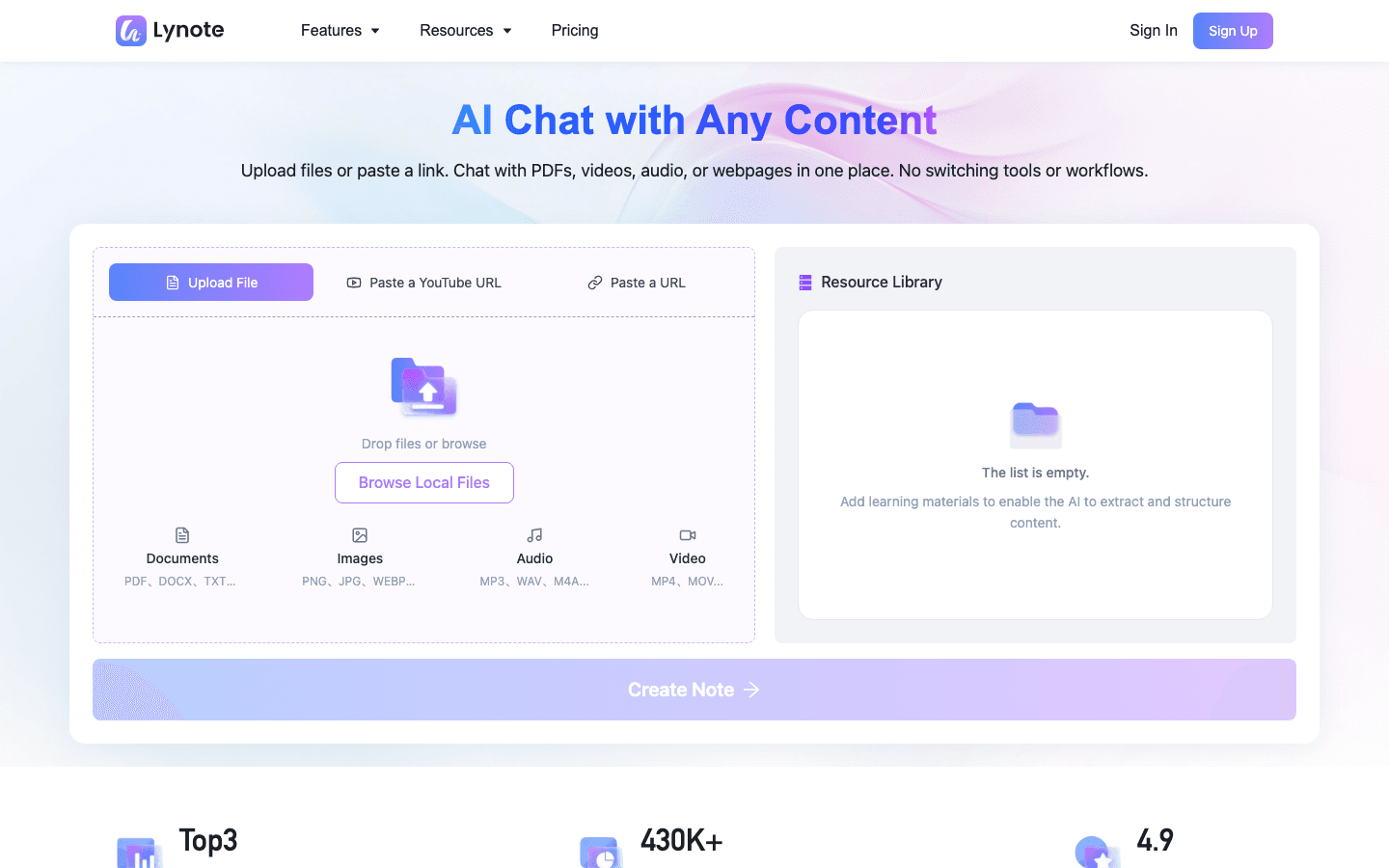
This method is often called Retrieval-Augmented Generation, or RAG, but you do not need to remember the term. The important idea is simple: when you ask AI a question about an uploaded file, the answer should come from that file, not from a broad guess about the internet.
That changes the experience. You can verify the answer. You can check where it came from. If the document does not contain the information needed, a good source-based AI workflow should make that limitation clear instead of inventing details.
Generic AI Chatbot vs. Source-Based AI
| Question | Generic AI | Source-Based AI With Lynote |
|---|---|---|
| Answers from | Training patterns and prompt context | Your uploaded files, links, audio, video, or notes |
| Citation provided | Often no | Yes, when supported by the source workflow |
| Answer verifiable? | Not always | Easier to verify against the original material |
| Knows your documents? | No, unless you provide them | Yes, after you upload or add them |
| Handles gaps honestly? | May guess | Can indicate when the source does not contain enough information |
| Free to start? | Often yes, with limits | Yes |
How to Ask AI Questions the Right Way
Reliable AI answers come from four habits. None of them are difficult, but skipping any of them is where most poor answers begin.
Specify Exactly What You Want
General questions lead to general answers. A prompt like “Tell me about this paper” usually produces a broad summary. A question like “What sample size did this paper use, and did the authors mention it as a limitation?” gives the AI a much narrower target.
The more precise your question is, the less room the AI has to fill in with vague generalizations. Specificity is one of the strongest controls you have over answer quality.
Give the AI the Right Context
Before asking your question, give the AI the material it needs. In a source-based tool, upload the document, transcript, recording, or webpage first. In a generic chatbot, paste the relevant excerpt and make clear that the answer should be based only on that excerpt.
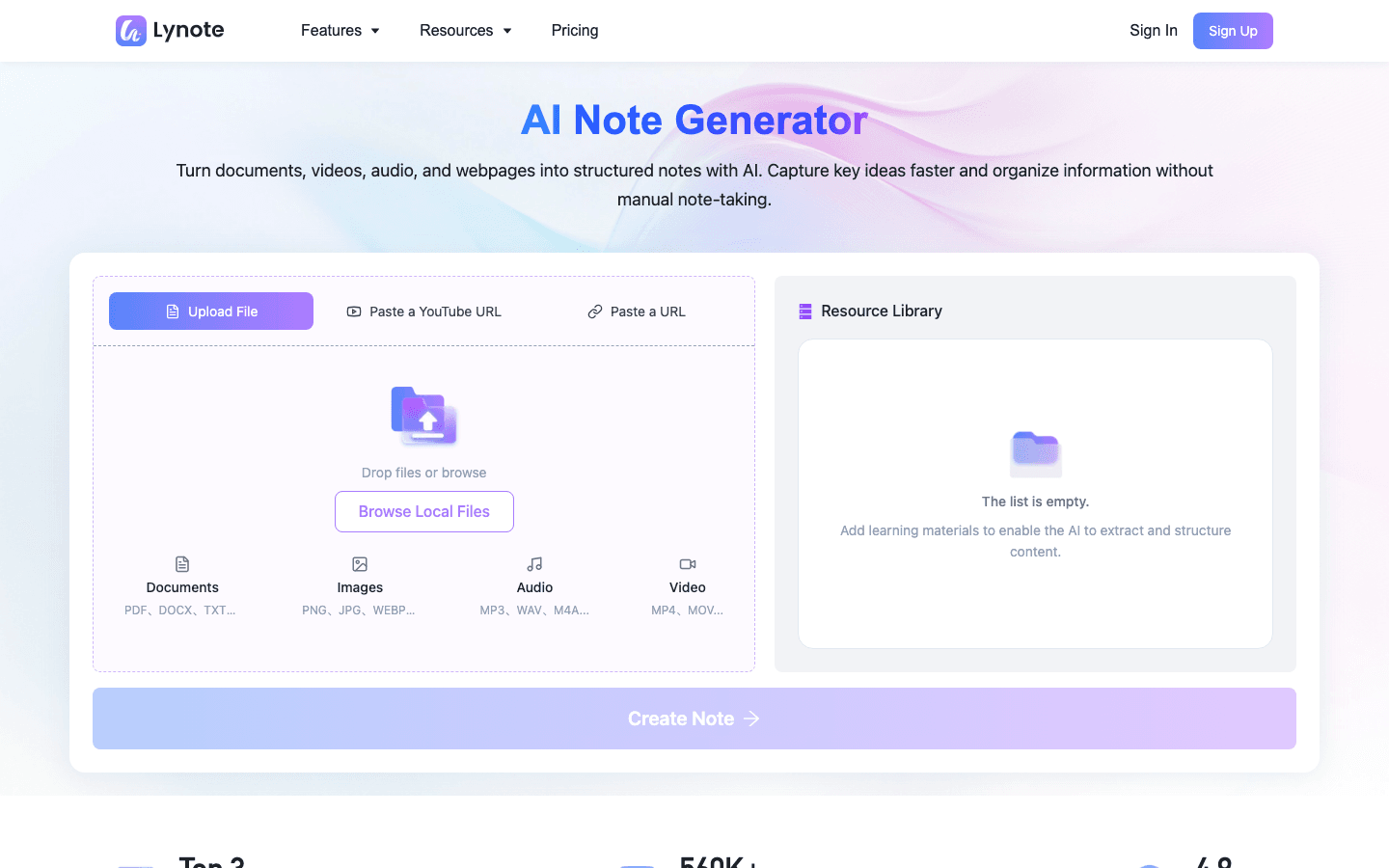
A source-based workflow is more convenient because you can work with the whole file instead of repeatedly copying sections into a chat window. Still, the principle is the same: no context, no reliable answer.
Ask Follow-Up Questions
The first answer is not always the complete answer. If the response is too broad, ask for a narrower explanation. If it cites one section, ask whether the same point appears elsewhere in the source.
Most AI tools keep the context of a conversation during a session, so you can build on previous answers without restating the entire background every time.
Check the Citation Before You Use the Answer
When a source-based AI tool provides a citation, do not treat it as decoration. Click it, open the relevant paragraph or timestamp, and confirm that the answer matches the source.
This takes a few seconds, but it prevents a common mistake: building your notes, report, or presentation around an answer that sounded right but was not supported by the original material.
What This Looks Like in Real Situations
The theory is useful, but the workflow becomes clearer when you apply it to common study and work scenarios.
Reviewing a Lecture You Recorded
You have a 90-minute class recording. Your exam is in three days, and you need to review 15 specific topics. Watching the whole recording again would take too long, and manually jumping around the timeline is frustrating.
With a source-based AI workflow, you can upload the recording and ask questions such as “How did the professor define epistemic closure?” or “What were the two exceptions mentioned in the lecture?” The answer can point you to the relevant timestamp so you can verify it quickly.
Analyzing a Dense Research Paper
Academic papers are written for other academics. The core argument may be buried in the methodology, the key finding may be hedged, and the conclusion may repeat what was clearer in the abstract.
Instead of asking “Summarize this paper,” ask targeted questions: “What did the authors conclude about the relationship between X and Y?” “Did they disclose any conflicts of interest?” “How does this compare with the 2019 study cited in the introduction?”
Those questions are useful because each answer can point back to the paper. You can read the surrounding paragraph if you need more context.
Extracting Action Items From a Long Meeting
Many meetings are longer than they need to be. Decisions, budget numbers, objections, and tasks may be scattered across an hour-long transcript.
Upload the meeting transcript or audio file, then ask: “What did we decide before the next call?” “Was there disagreement about the timeline?” “What budget figure did the client give for Q3?” These questions are specific, source-bound, and easier to verify.
A Tool Built Around This Workflow
Lynote AI Chat with Content is designed around the source-first method. You can upload or add formats such as PDFs, videos, audio recordings, webpages, and YouTube links, then ask questions about the material.
Lynote also supports related study workflows. You can use Lynote AI Note Generator to turn source material into structured notes, Lynote AI Summarizer to condense long files, and Lynote AI Flashcard Generator to turn key concepts into review cards.
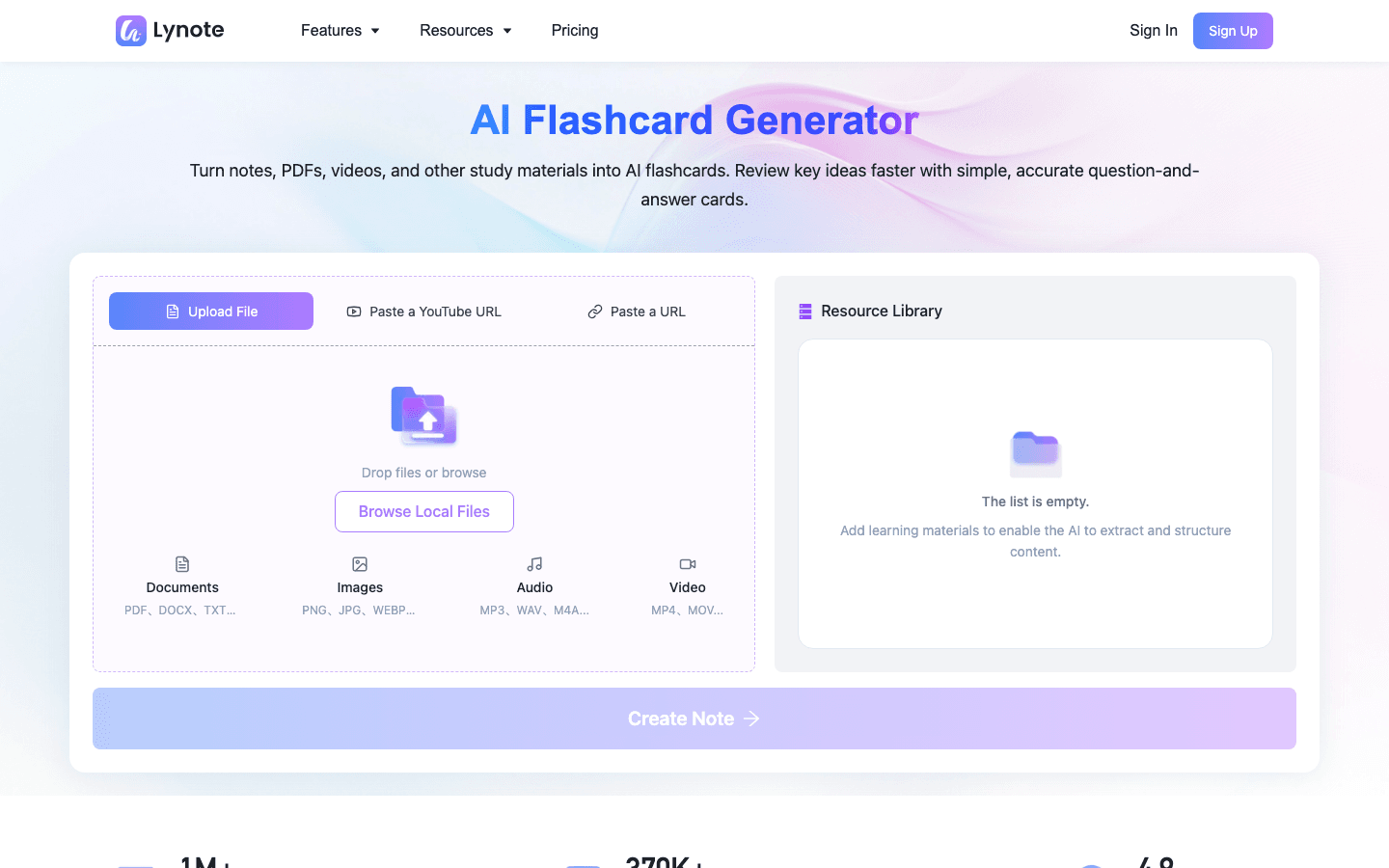
This matters because asking the question is only part of the workflow. Students often need to turn answers into notes, summaries, and review material they can reuse later.
You do not need a credit card to start using Lynote. If you have a document, video, recording, or webpage you need to understand, uploading it and asking a few focused questions is the fastest way to see whether a source-based workflow fits your study process.
What Makes an AI Question Worth Asking?
Not every question is a good use of AI. The best questions usually have a locatable answer, a clear source, or a task that would otherwise require manual searching.
| Type | Example Question | AI Fit |
|---|---|---|
| Locatable fact | “What sample size did this paper use?” | Good |
| Specific quote | “What exact words did the author use here?” | Good |
| Cross-source comparison | “Which of these papers disagrees on X?” | Good |
| Manual search task | “What is buried on page 40 of this report?” | Good |
| Human judgment | “Is this paper well written?” | Poor |
| Personal opinion | “Would I recommend this article?” | Poor |
| General knowledge | “What is confirmation bias?” | Useful, but verify when stakes are high |
Questions With a Locatable Answer
A good AI question usually points to something that can be found. “What does this paper say about X?” is stronger than “Is this paper important?” because the first question can be checked against the source.
Use AI for retrieval, synthesis, and comparison. Keep final judgment with the human reader.
Questions About Specific Content You Imported
The more tightly your question connects to the material you provided, the better the answer is likely to be. “What does this document mention about X?” is stronger than “What do people generally think about X?”
The first question asks the AI to work inside a source. The second asks it to generalize beyond your material.
Questions You Would Otherwise Search Manually
If finding the answer would require scanning 40 minutes of video or searching 50 pages of a PDF, AI can save real time. If the answer is in the next paragraph, reading the paragraph yourself may be faster.
The goal is not to outsource every thought. The goal is to reduce the time you spend hunting for information so you can spend more time understanding it.
Frequently Asked Questions About Asking AI Questions
What is the best way to ask AI a question?
The best way is to ask a specific question, provide the source or context, and check the answer against citations or the original material. Avoid vague prompts when accuracy matters.
Why does AI sometimes answer confidently but incorrectly?
Generic AI chatbots often generate plausible responses from learned patterns. If the model does not have access to the source you care about, it may produce an answer that sounds right but is not grounded in your document.
Should I use AI for research papers?
Yes, but use it carefully. AI is useful for finding key claims, summarizing sections, comparing papers, and locating details. You should still read important source passages and verify citations before using the answer in academic work.
What kinds of files can I ask AI questions about?
With a source-based tool like Lynote, you can work with documents, videos, audio recordings, webpages, and YouTube links. The exact supported formats depend on the tool and workflow you choose.
Conclusion
AI is valuable when you use it correctly. The problem is that many people ask generic chatbots questions about specific documents, recordings, or sources the chatbot has never seen. That creates a high risk of confident but unsupported answers.
Source-based workflows reduce that risk by giving the AI access to your actual material before you ask. The answer can come from the original source, and the citation can show where to verify it.
If you want to shorten research time without losing track of evidence, test this workflow with something you are already studying. Upload a source, ask a specific question, check the citation, and then decide whether the answer is strong enough to use.

Written by Janet L. Harris
AI Writing Specialist
Janet reviews AI detectors and humanization tools, with a focus on accuracy, limitations, and responsible use. View all articles →