

AI Humanizer for SEO: Make Your Content Sound Human
Content
Result

Your humanized result will be ready here. To begin, paste your AI-generated text in the left box.



Why SEO Teams Choose Lynote

Sound Human to Readers
Turn stiff AI drafts into natural, reader-ready SEO copy.

Keep SEO Intent Clear
Reword the draft without losing the page’s purpose.

Control the Rewrite
Choose Simple, Balanced, or Enhanced for each draft.

Check Before You Publish
Review authenticity signals immediately after every rewrite.

Rewrite Beyond Synonyms
Reshape robotic passages instead of swapping isolated words.

Fit Every SEO Page
Reword blogs, landing pages, category copy, and product descriptions.

80+ Languages
Adapt international SEO copy without switching tools.

Private Draft Handling
Process unpublished content without storing or sharing it.

Reword AI Drafts into Natural SEO Content
Raw AI copy can be grammatically correct and still feel generic, over-polished, or disconnected from the reader. Lynote’s AI Humanizer reshapes those passages for a more natural voice while keeping the page topic, important terms, and original message available for review.

Control Rewrite Depth with an AI Humanizer for SEO
Use Simple for a light cleanup, Balanced for routine blog and landing-page edits, or Enhanced when a draft needs a deeper structural rewrite. Start with the smallest change that fixes the robotic phrasing; move deeper only when the result still sounds formulaic. If the draft is already human-written and mainly needs clearer delivery, use the AI Text Improver instead.

Review Humanized SEO Content Before Publishing
The Authenticity Report shows AI-likelihood signals after the rewrite. Treat that score as one QA input or run a separate check with the AI Detector, then verify facts, links, calls to action, and search intent. A more human-sounding draft still needs original examples and editorial judgment; see what humanization can and cannot fix before publishing.
How to Humanize AI-Generated Content for SEO
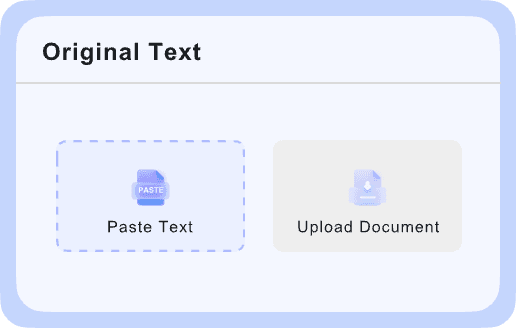
Paste or Upload the SEO Draft
Paste the draft or upload one PDF, DOC, DOCX, or TXT file. Before you start, note the target keywords, headings, names, figures, and links you need to verify after the rewrite.

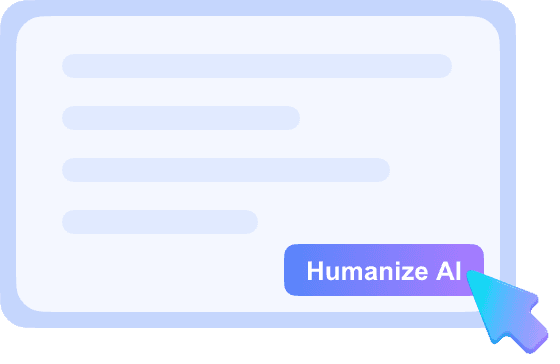
Choose the Rewrite Depth
Pick Simple for a light polish, Balanced for a standard content edit, or Enhanced for a broader rewrite. If the draft already matches search intent, begin with the lightest mode so you do not change more than necessary.
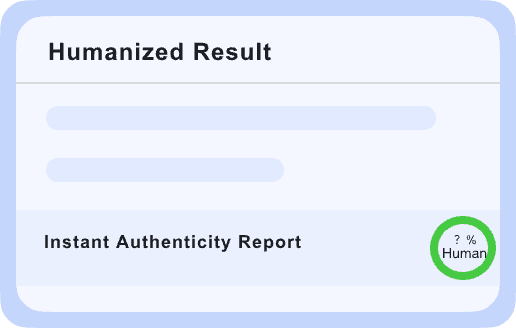
Humanize, Compare, and Edit
Click Humanize, then compare the result with the source. Confirm that priority keywords, facts, links, and calls to action still work; use the Authenticity Report as a signal, add original examples, and complete a human edit before publishing.
Humanize AI Content Across Your SEO Workflow

Blog Posts and Guides
Clean up repetitive AI phrasing while keeping the topic, target query, headings, and supporting terms easy to review.
Clean up repetitive AI phrasing while keeping the topic, target query, headings, and supporting terms easy to review.

Landing and Category Pages
Rewrite stiff page copy without losing the search intent, offer, calls to action, or keyword priorities behind the layout.
Rewrite stiff page copy without losing the search intent, offer, calls to action, or keyword priorities behind the layout.

Product Descriptions
Vary formulaic descriptions across a catalog while checking that product facts, names, specifications, and buying language remain accurate.
Vary formulaic descriptions across a catalog while checking that product facts, names, specifications, and buying language remain accurate.

Content Refreshes
Update older AI-assisted pages for clearer flow, then add fresh evidence, examples, and links instead of treating humanization as the whole refresh.
Update older AI-assisted pages for clearer flow, then add fresh evidence, examples, and links instead of treating humanization as the whole refresh.
What to Check Before Publishing Humanized SEO Content

Match the Search Intent
Make sure the page answers the task behind the query, not just the keywords in it.

Keep Critical Terms
Check target keywords, entities, product names, technical terms, and internal-link anchors against the source.

Verify Every Claim
Recheck facts, dates, quotations, prices, and citations; rewriting does not validate them.

Add First-Hand Value
Include real examples, tests, screenshots, data, or expert judgment that the AI draft did not provide.

Read for Brand Voice
Remove phrases that are fluent but still sound generic, over-polished, or unlike your site. Use the AI Text Improver when clarity and delivery need a separate editing pass.

Test the Page Journey
Open links, review CTAs, and read the page on mobile before you publish or update it.
AI Humanizer for SEO Reviews: What Our Users Say

SEO Specialist

"Lynote helped me humanize AI-generated product review text pasted from a DOCX draft. The final posts read smoothly and reduced AI-like signals, improving trust for my niche site."

Content Writer
"Transformed a keyword-rich AI blog draft into natural, fluent copy for a client. Lynote's context-aware rewriting kept meaning and flow while making it sound genuinely human."

Agency Owner
"I used Enhanced mode on a section of a long AI article for a high-authority SEO client. Three humanization depths gave me full control over the final voice and structure."

SEO Project Lead
"Before publishing a humanized landing page, I checked the Instant Authenticity Report. Seeing detector scores reassured me the copy was ready for a new campaign."

Blogger
"I used Lynote to humanize my AI-generated travel blog post. All my SEO keywords and the original headings were preserved perfectly in the new version."

Marketing Team Lead
"Lynote supported humanizing product descriptions in both Spanish and French. The 80+ language options make it essential for global SEO content across multiple regions."
AI Humanizer for SEO: Questions Before You Publish
Use these answers to decide where humanization fits—and what still needs a human editor.
An SEO rewording tool reshapes stiff or repetitive AI-generated copy so it sounds more natural to readers without turning the task into simple synonym swapping. Lynote keeps the page topic, important terms, and original message available for review, but the final draft still needs research, fact-checking, and editorial judgment.
Google says to focus on accuracy, quality, relevance, and added value rather than the production method alone. Using generative AI to create many pages without adding value can violate its scaled content abuse policy. Humanize the draft for readers, then add evidence and editorial judgment.
List the exact keywords, entities, headings, and anchor text that matter before rewriting. Use the lightest suitable mode, then compare the source and output line by line. Restore any term only where it remains accurate and natural.
No. A humanizer can improve rhythm and readability, but it cannot create first-hand experience, fix weak search intent, verify claims, or earn links. The final page still needs useful information that gives the searcher a concrete reason to choose it.
You can use it for blog posts, guides, landing pages, category copy, product descriptions, and content refreshes. Paste text or upload a PDF, DOC, DOCX, or TXT file, then review each asset according to its goal.
Start with Simple when the structure and search intent are already right. Use Balanced for a normal editorial pass. Choose Enhanced only when the draft still feels formulaic or needs broader sentence restructuring, because deeper changes require a closer keyword and fact check.
Compare keywords, headings, entities, facts, citations, internal links, and calls to action with the original. Then read for brand voice, add specific examples, and confirm the page still answers the query better than a generic summary.
No. It is an AI-likelihood signal, not a ranking forecast or proof of authorship. Use it to locate wording that may need another look, then judge the content by accuracy, usefulness, originality, and fit with the search intent.
Lynote supports more than 80 languages. Review the result with a native or market-aware editor, because preserving a literal keyword is not always the same as matching how people search in that locale.
The current free workflow supports up to 600 words in one request and one document at a time. For a longer page, process logical sections separately and perform one final pass for consistency across headings, terminology, and calls to action.
More Guides for Humanizing AI SEO Content
Learn how AI humanizers work, make AI writing sound natural, and use AI detection as one signal in an SEO publishing review.