


AI humanizer tools are everywhere in 2026, but very few of them are clear about what they are actually trying to do. Some focus on paraphrasing. Some focus on readability. Others quietly imply that they can help AI-generated text avoid detection without saying it too directly.
Superhumanizer AI does not take that subtle approach.
It positions itself very clearly as an AI humanizer designed to make AI writing sound more human and improve its chances of passing major AI detectors. That immediately makes it interesting, because the strongest tools in this category are not judged by how well they rewrite a sentence. They are judged by whether they can reduce obvious AI patterns without destroying clarity, meaning, or natural flow.
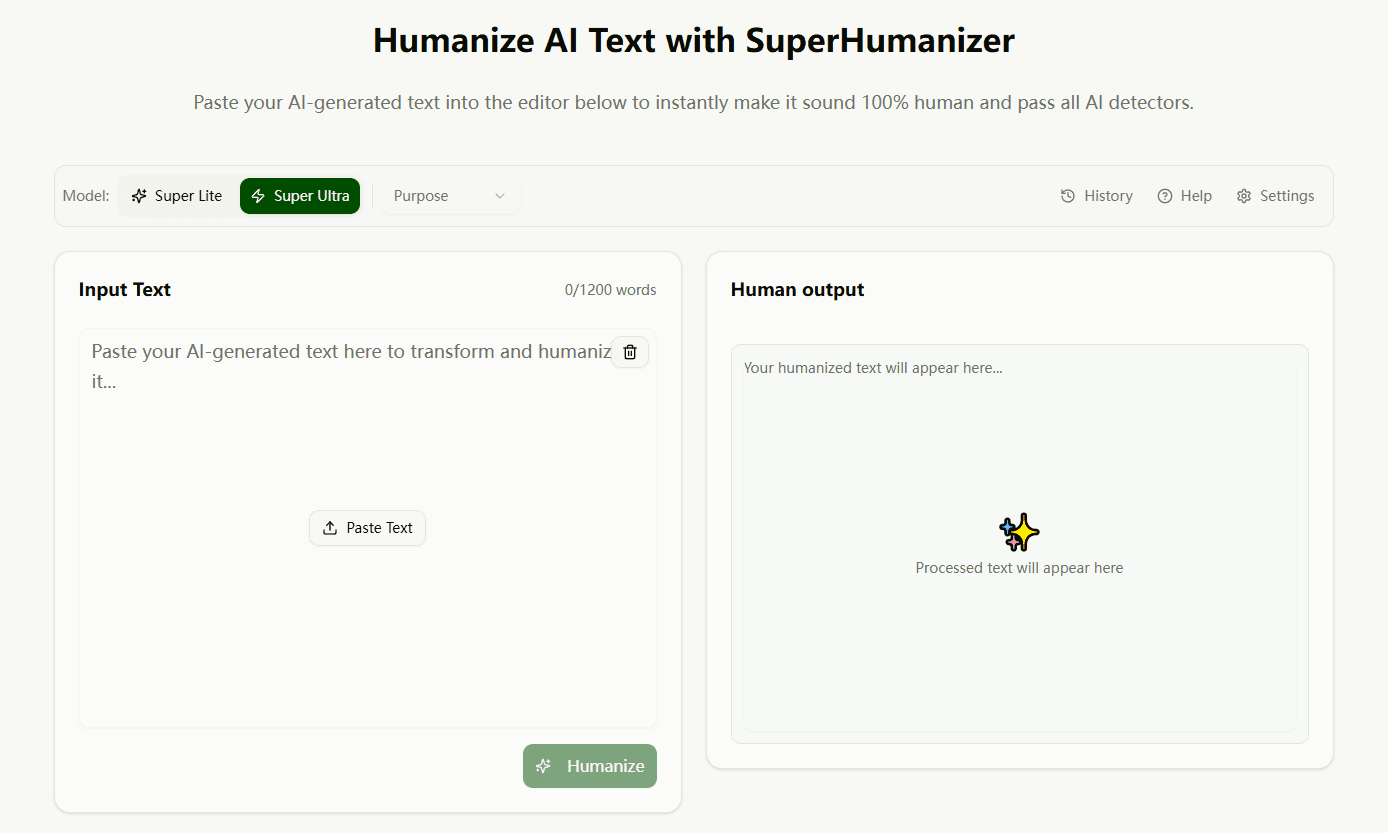
So, is Superhumanizer AI actually worth using? Can it really help content pass AI detectors like GPTZero, Originality.ai, Copyleaks, or Turnitin-style systems? And how does it compare with alternatives like Lynote AI Humanizer?
This Superhumanizer AI review takes a practical look at the tool, its features, pricing, strengths, limitations, and whether it really helps AI content look more human in 2026.
Superhumanizer AI Review 2026: Quick Answer
Superhumanizer AI appears to be a credible AI humanizer with a strong detector-focused positioning, simple workflow, built-in AI detector, and multiple rewrite modes.
It likely can improve raw AI text and reduce some obvious machine-writing patterns. However, there is not enough independent public evidence to conclude that it can consistently bypass all major AI detectors in every context.
If you want a detector-focused AI humanizer, Superhumanizer is worth considering. If you want deeper humanization and stronger long-form writing quality, Lynote AI Humanizer remains the better alternative.
What Is Superhumanizer AI?
Superhumanizer AI is an online AI humanizer tool that rewrites AI-generated text to make it sound more natural, more readable, and less obviously machine-written.
Based on its public website, Superhumanizer is built around a few core promises:

- humanize AI-generated text
- reduce common AI writing patterns
- improve content readability
- help users bypass AI detection tools
- provide a built-in AI detector
- offer different rewrite depths for different use cases
That makes Superhumanizer more than a general-purpose paraphraser. It is clearly marketed as an AI detection bypass tool as much as a writing improvement tool.
This positioning is important because people searching for a “Superhumanizer AI review” are usually not looking for a grammar fixer. They want to know whether the tool can actually make AI writing sound human enough to survive detector scrutiny.
How Does Superhumanizer AI Work?
According to its public pages, Superhumanizer AI is designed to identify patterns that commonly make AI-generated text easier to detect and then rewrite the text to reduce those signals.
Those patterns may include:
- repetitive wording
- overly smooth sentence rhythm
- robotic phrasing
- mechanical transitions
- low variation in tone and structure
This approach makes sense because AI content often becomes detectable at the paragraph level, not just the sentence level. Even when individual lines look fine, the overall rhythm of AI writing can still feel too uniform.
Superhumanizer appears to approach this in a few specific ways.
Super Lite and Super Ultra modes
One of the main features promoted by Superhumanizer is its two-mode rewrite system.
Super Lite appears to be the lighter editing mode, likely intended for faster cleanup and smaller stylistic adjustments.
Super Ultra is positioned as the deeper rewrite option, which suggests more aggressive restructuring for users who want stronger humanization or are more concerned about AI detection.
This is useful because not every draft needs the same level of rewriting. Some pieces only need light smoothing. Others need a more meaningful structural rewrite.
Built-in AI detector
Superhumanizer also includes its own AI detector, which allows users to rewrite and evaluate content inside one workflow.
That makes the tool more convenient, but it is worth remembering that an internal detector is not the same as independent third-party validation. It can be useful as a signal, but it should not be treated as final proof that a passage will perform the same way on outside detectors.
Pattern-focused rewriting
Superhumanizer’s public messaging suggests that it is trying to do more than synonym replacement. Its value proposition is based on altering the deeper signals of AI writing, including structure, pacing, and flow.
That matters because the best AI humanizers do not just change words. They change writing behavior.
Key Features of Superhumanizer AI

If you are comparing AI humanizer tools, these are the main features that stand out in Superhumanizer’s public offering:
- AI text humanization
- built-in AI detector
- super lite rewrite mode
- super ultra rewrite mode
- free access with limits
- monthly paid plans
- detector-focused rewriting workflow
For users specifically looking for an AI humanizer to bypass AI detectors, that is a fairly complete feature set.
Superhumanizer AI Pros
Superhumanizer has several strengths that make it more credible than many weaker tools in the same category.
Clear positioning
A lot of AI humanizer websites are vague. Superhumanizer is not. It is very clear about who it is for and what problem it claims to solve.
That clarity makes it easier for users to evaluate whether the product fits their needs.
Easy to test
The tool promotes free access, which lowers the barrier to trying it. That is especially important in the AI humanizer market, where output quality can vary a lot from one tool to another.
Multiple rewrite depths
The separation between Super Lite and Super Ultra is a practical design choice. It recognizes that some users want a light touch while others want much deeper rewriting.
Convenient workflow
The combination of rewriting and AI detection inside one platform creates a simple user experience, especially for people working through many content drafts.
Better-developed product messaging
Compared with many thin AI humanizer sites, Superhumanizer presents a more developed product story. That does not automatically prove performance, but it does help it look more serious than low-effort alternatives.
Superhumanizer AI Cons
There are also important limitations users should keep in mind.
Public claims are stronger than public proof
This is the biggest concern.
Superhumanizer makes strong claims about helping content pass major AI detectors, but strong claims are not the same thing as independent testing across multiple platforms under consistent conditions.
Internal detector results are not enough
A built-in detector is useful, but users should be cautious about relying too heavily on it. Performance inside a tool’s own detection environment may not match results from GPTZero, Originality.ai, Copyleaks, or other third-party systems.
No tool can promise universal bypass success
The idea of “undetectable AI” is always unstable. Detector models change, thresholds change, and the same piece of text may score differently depending on length, genre, and context.
High-stakes use requires extra caution
For blog posts, SEO content, and general web copy, an AI humanizer may be good enough if it improves naturalness.
For academic, institutional, or compliance-sensitive use cases, the standard is much higher, and marketing language should never be treated as a guarantee.
Can Superhumanizer AI Pass Major AI Detectors? Our Test Plan and Early Take
This is the question that matters most.
Superhumanizer AI is marketed as a tool that can make AI-generated writing sound more human and reduce the chance of being flagged by AI detectors. But marketing claims are one thing. Real detector performance is another.
To evaluate that properly, we are testing Superhumanizer AI across several major AI detection platforms, including:
The goal is not just to see whether Superhumanizer makes AI writing read better. We want to separate three different claims that are often mixed together:
- making AI-generated text sound more natural
- reducing obvious AI writing signals
- consistently passing major AI detectors
Those are not the same thing.
A tool may improve flow and readability while still being flagged by stricter detectors. It may also perform well on one detector and poorly on another, because different platforms use different scoring systems, thresholds, and signal patterns.
That is why this test matters.
How We Are Testing Superhumanizer AI
To keep the comparison fair, each detector test should use the same workflow:
- Generate an original AI-written sample.
- Run the untouched version through each AI detector.
- Rewrite the same sample using Superhumanizer AI.
- Run the rewritten version through the same detectors again.
- Compare the before-and-after results using the same text length and testing condition
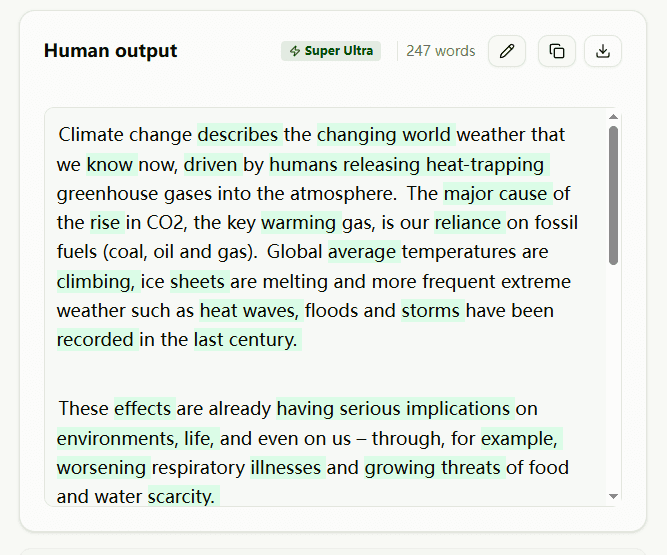
This matters because detector results can change based on passage length, topic, prompt style, and formatting. Without consistent inputs, the comparison is not reliable.
Detector-by-Detector Results
GPTZero AI Detector
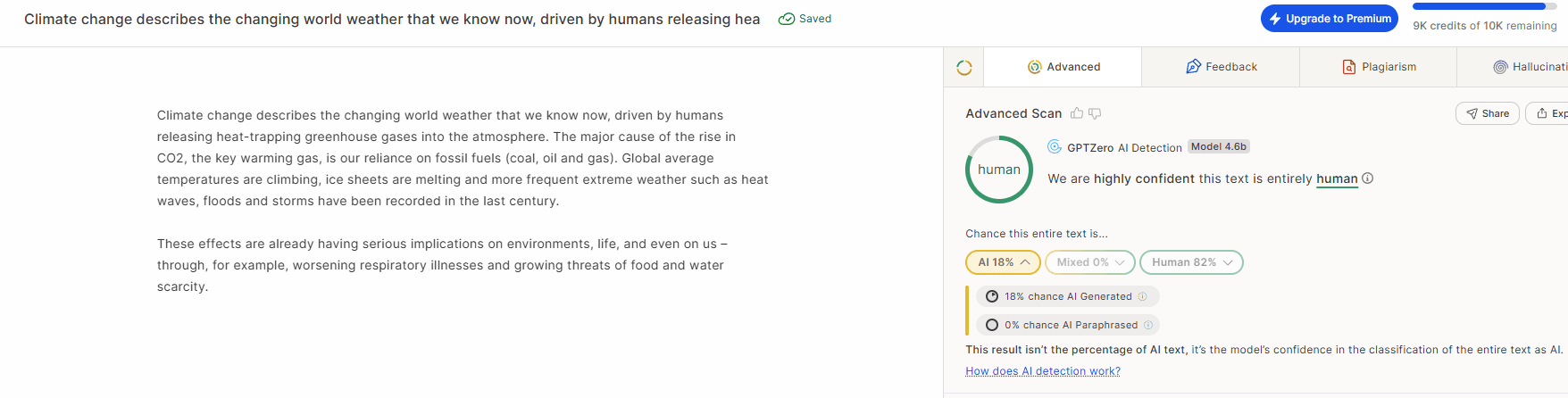
GPTZero returned one of the more favorable results in this test.
The platform said it was highly confident the text was entirely human, while also showing a breakdown of 18% AI, 0% mixed, and 82% human. It also reported 0% chance AI paraphrased.
That may sound slightly contradictory at first glance, but the key takeaway is that GPTZero ultimately classified the passage as human overall.
Result: GPTZero classified the text as human, with 82% human and 18% AI.
Takeaway: Superhumanizer performed well on GPTZero. Even though the tool still registered some AI probability, the final classification strongly favored human authorship.
Originality.ai AI Detector
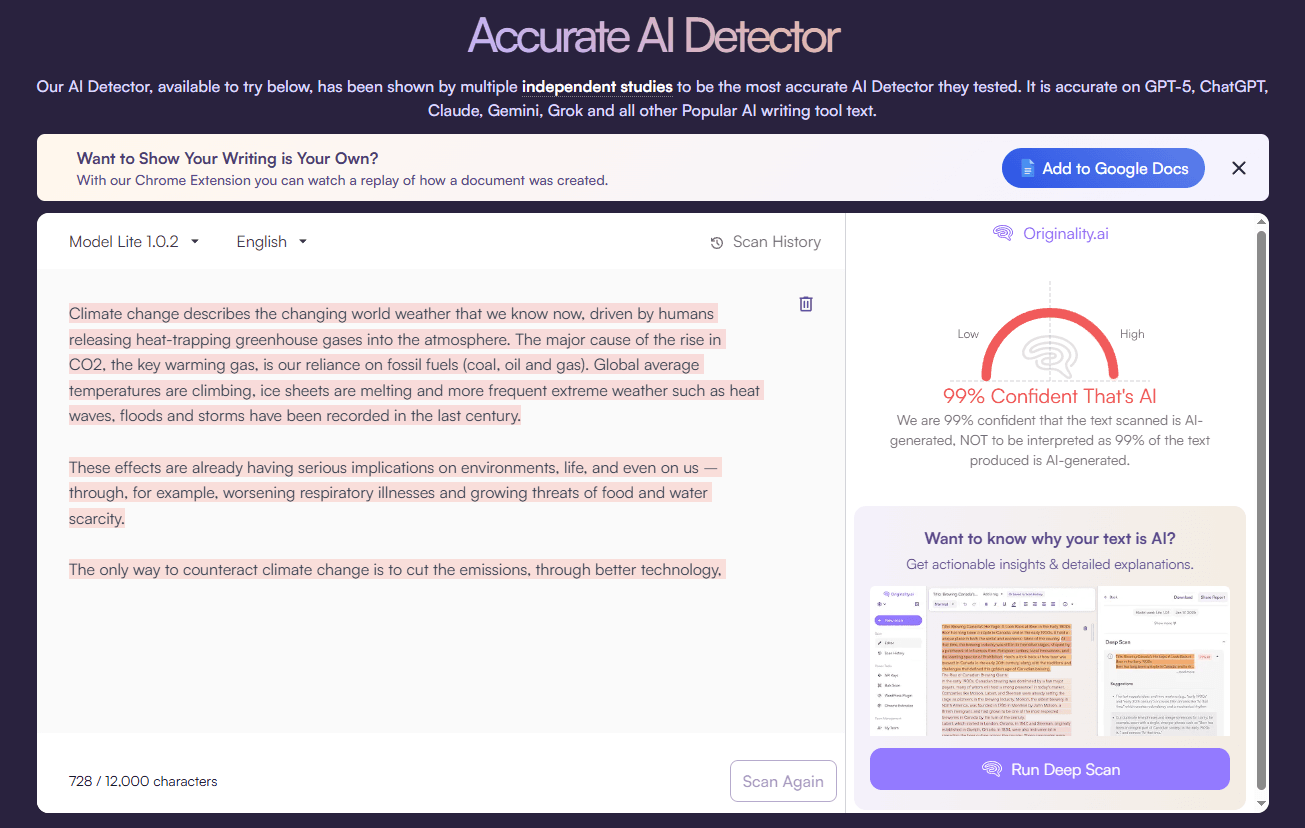
Originality.ai produced the strictest result in the test.
It marked the passage as 99% confident that’s AI, indicating a very strong likelihood that the content was AI-generated rather than human-written.
This result stands in direct contrast to GPTZero and shows how differently major detectors can evaluate the same text.
Result: Originality.ai labeled the passage as 99% AI.
Takeaway: Superhumanizer did not perform well on Originality.ai in this test. While the rewritten text may have sounded more natural, it was still very strongly flagged as AI-generated by one of the stricter detectors.
Copyleaks AI Detector
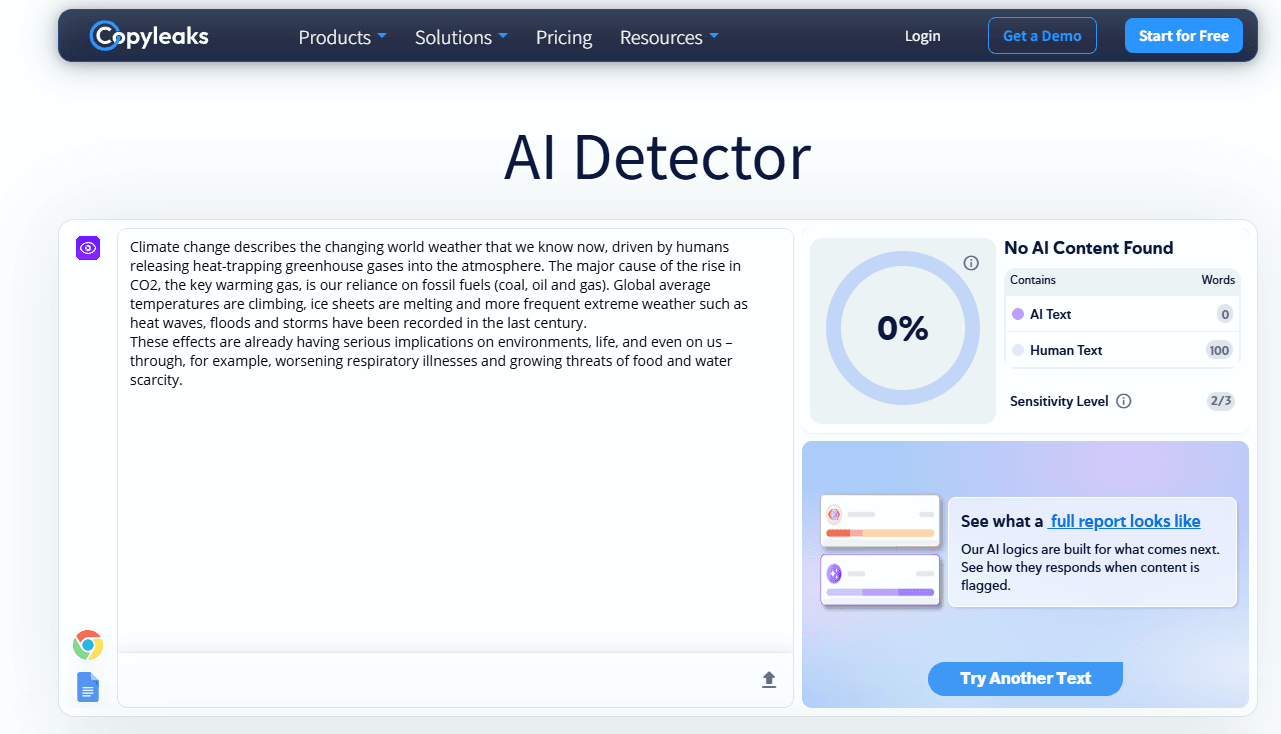
Copyleaks delivered the most favorable result of all the platforms tested.
It reported 0% AI, 100% human text, and explicitly stated No AI Content Found.
That is a strong outcome and suggests that Superhumanizer’s rewrite was effective at reducing the signals Copyleaks typically uses to identify AI-generated writing.
Result: Copyleaks reported 0% AI and 100% human text.
Takeaway: Superhumanizer performed extremely well on Copyleaks. In this case, the rewritten passage passed cleanly.
Turnitin AI Detector
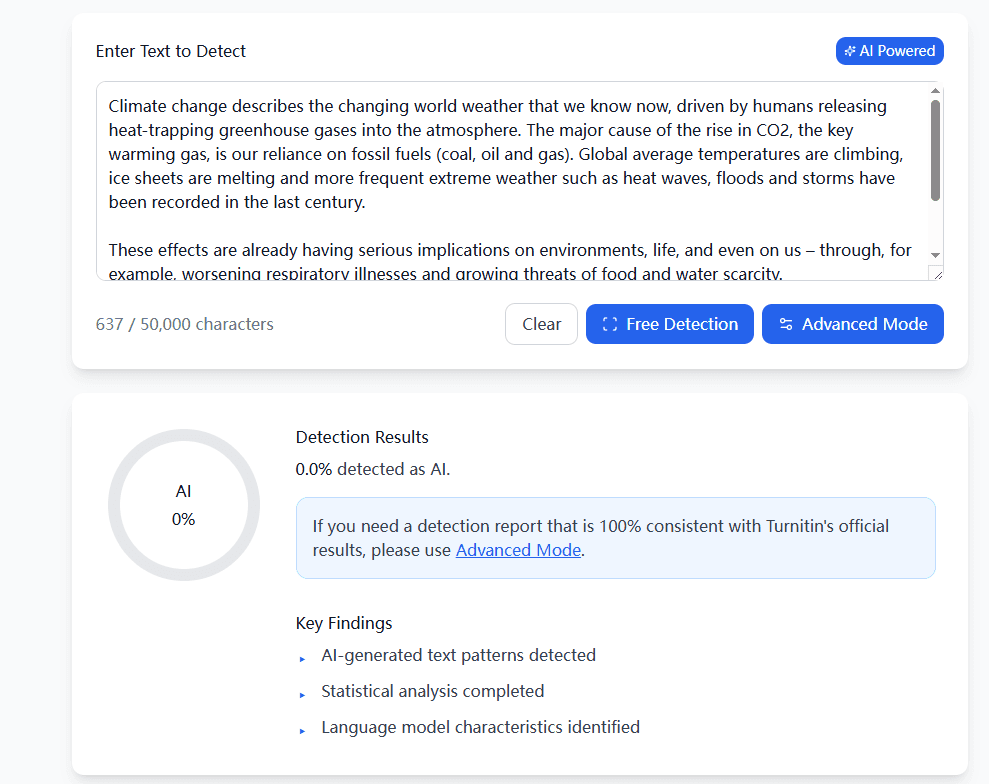
In the Turnitin-style detection environment used for this test, the result was also highly favorable.
The system reported 0.0% detected as AI. However, the interface also included a note stating that users should use its advanced mode for a report that is fully consistent with Turnitin’s official results.
That distinction matters. So while the result is clearly positive, it should be described carefully.
Result: The tested environment reported 0.0% detected as AI.
Takeaway: Superhumanizer performed well in this Turnitin-style check, but this should not be presented as a direct official Turnitin result unless the text is tested inside Turnitin’s own final detection environment.
QuillBot AI Detector
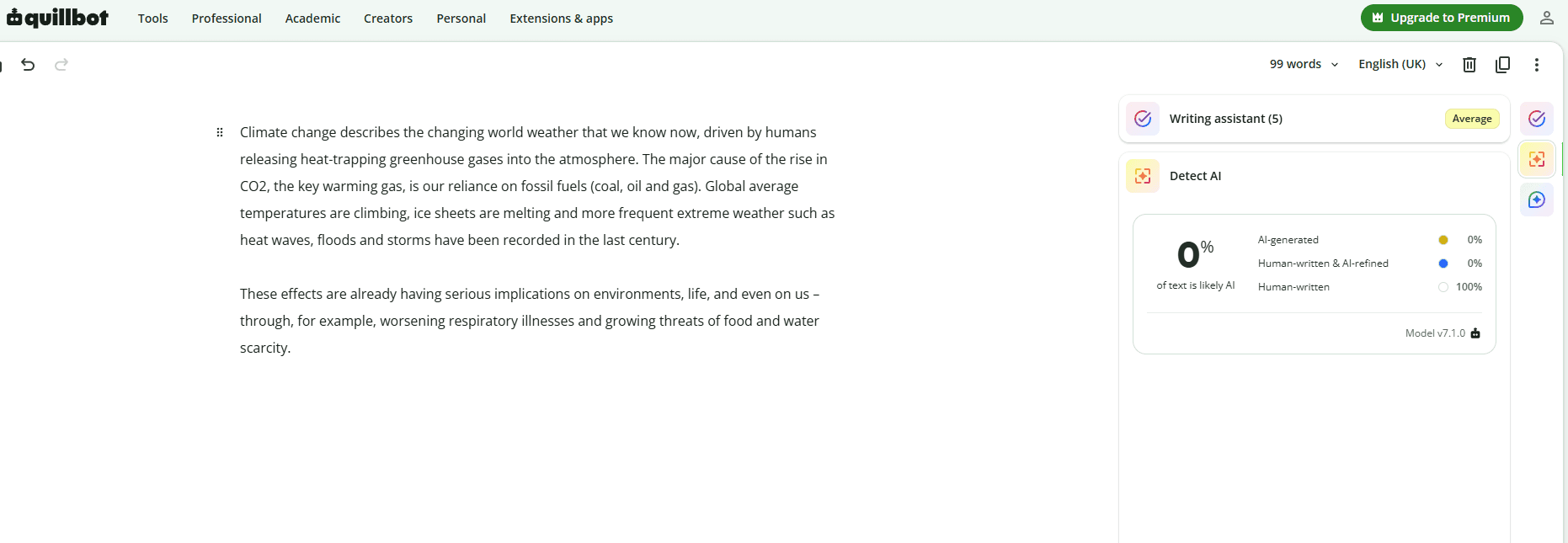
QuillBot also gave the passage a fully human result.
It reported 0% of the text is likely AI, with the breakdown showing 0% AI-generated, 0% human-written & AI-refined, and 100% human-written.
That makes QuillBot one of the clearest passes in the test set.
Result: QuillBot reported 0% AI and 100% human-written.
Takeaway: Superhumanizer performed very strongly on QuillBot, with the rewritten text fully classified as human-written.
What These Results Actually Mean
The biggest takeaway from this test is not that Superhumanizer “always works” or “doesn’t work.”
It is that its performance depends heavily on which AI detector is being used.
In our test:
- GPTZero judged the text as mostly human
- Originality.ai flagged it as overwhelmingly AI-generated
- Copyleaks found no AI content
- the Turnitin-style environment reported 0.0% AI
- QuillBot classified it as fully human-written
That is a wide spread.
So, can Superhumanizer AI pass major AI detectors?
The most honest answer is: yes, it can pass some major detectors, but it does not pass all of them consistently.
That matters because many users are not asking whether a tool can improve readability. They are asking whether it can reliably survive cross-platform detection. Based on these results, Superhumanizer clearly improves outcomes in some environments, but it cannot be described as a guaranteed universal AI detection bypass solution.
Is Superhumanizer AI Good for SEO Content?
Based on our detector tests, Superhumanizer AI appears to be more suitable for SEO content than for academic or compliance-sensitive writing.

That conclusion makes sense for two reasons.
First, SEO writers usually care about whether AI-generated drafts can be made more readable, less repetitive, and less obviously machine-written. Second, SEO content is often judged in more mixed real-world environments, where readability, structure, and user experience matter just as much as detector scores.
In our tests, Superhumanizer performed well on several major AI detectors. The rewritten text was classified favorably by GPTZero, Copyleaks, the Turnitin-style detection environment, and QuillBot. That suggests Superhumanizer can meaningfully reduce obvious AI patterns in at least some practical publishing scenarios.
For SEO writers and affiliate marketers, that is a useful result.
It means Superhumanizer may help with improvements such as:
- less repetitive phrasing
- more natural sentence flow
- fewer robotic transitions
- lower AI suspicion in some detectors
- better readability for human visitors
That said, the test results also showed an important limitation: Originality.ai still flagged the same passage as 99% AI.
That matters because Originality.ai is one of the better-known detectors in SEO and content publishing circles. So while Superhumanizer may improve AI-generated drafts and help them perform better in some detection environments, it cannot honestly be described as a universal solution for SEO teams that rely heavily on Originality.ai checks.
The practical takeaway is simple: Superhumanizer may be useful for SEO content, but it works better as a readability-and-risk-reduction tool than as a guaranteed detector bypass tool.
And as always, strong SEO content needs more than just humanization. It still needs genuine value, clear structure, trustworthy information, and original insight. Humanization can improve the surface quality of a draft, but it cannot fix thin thinking or weak content strategy.
Superhumanizer AI Pricing
As of July 9, 2026, Superhumanizer publicly lists the following monthly plans:
- Basic:
$12/month - Pro:
$19/month - Advanced:
$39/month
The platform also appears to offer free access with limitations, which makes it easier for first-time users to test output quality before upgrading.
That free entry point is useful, especially because the detector results are mixed. Since Superhumanizer performs well on some platforms but poorly on others, users should ideally test it against the specific detectors that matter to their workflow before paying for a subscription.
As with any SaaS tool, pricing can change over time, so users should still verify the latest plan details directly on the official website before purchasing.
Superhumanizer AI Refund Policy
According to its public Terms page, Superhumanizer offers a 7-day refund policy, with a usage-related condition tied to remaining under 2,000 words.
That is a helpful safeguard for first-time buyers, especially for users who want to run a few real detector comparisons before committing to a paid plan.
Given the mixed detection results in our testing, that refund policy makes practical sense. Users can evaluate whether Superhumanizer performs well enough for their own publishing stack rather than relying only on the platform’s claims.
Still, it is always worth checking the current refund wording on the official site before subscribing.
Best Superhumanizer AI Alternative
If you are looking for the best alternative to Superhumanizer, Lynote AI Humanizer is the stronger overall choice.
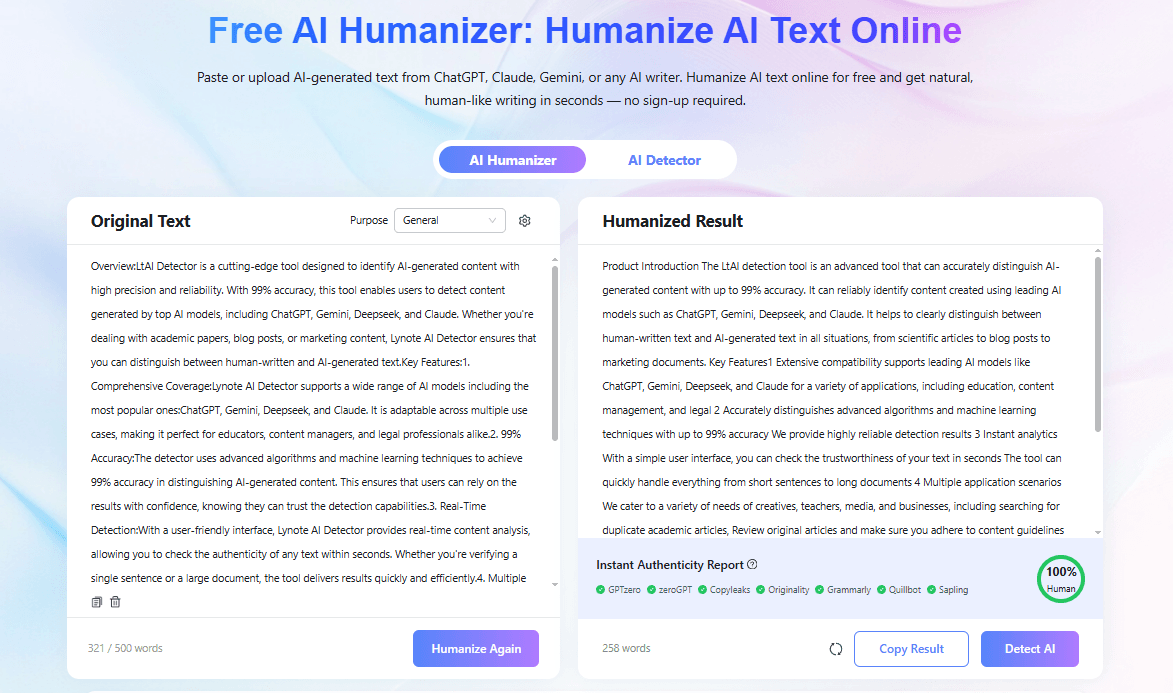
The reason is not just detector positioning. It is the combination of writing quality, control, SEO preservation, and broader editorial usability.
Superhumanizer clearly has strengths. Our tests showed that it can perform well on GPTZero, Copyleaks, QuillBot, and a Turnitin-style detection environment. That is enough to make it a legitimate tool rather than a low-effort rewriter.
But the same tests also showed a major weakness: its results are inconsistent across platforms, especially on stricter detectors like Originality.ai.
That is where Lynote AI Humanizer has the edge.
According to Lynote’s official AI Humanizer page, the product is built around context-aware rewriting rather than surface-level synonym swapping. In practice, that matters because the biggest weakness of many AI humanizers is not that they fail to change words. It is that they fail to change the deeper structure, cadence, and paragraph flow that still make content feel machine-written. Lynote explicitly positions its engine around preserving meaning while rewriting at both the sentence and paragraph level, which makes it better suited for content that needs to read naturally, not just look different on a detector scan
Lynote also gives users more control over rewrite intensity. Its public page highlights Simple, Standard, and Enhanced humanization modes, which is a more flexible framework than tools that mainly offer a shallow rewrite versus a deep rewrite. That extra control is useful because not every draft needs maximum transformation. Sometimes you want light cleanup. Sometimes you need much heavier restructuring for long-form blog content or detector-sensitive pages.
Another reason Lynote is the better alternative is its SEO focus. The platform specifically says it is designed to preserve important keywords while improving readability and flow. That is a meaningful advantage for blog posts, landing pages, affiliate articles, and product pages, where aggressive rewriting can easily damage keyword placement or distort search intent. A strong AI humanizer should not just lower AI signals. It should also protect the parts of the draft that matter for rankings and on-page performance.
Lynote also presents itself as a better fit for long-form editorial content. Its product page repeatedly emphasizes rhythm, variation, sentence movement, and paragraph-level coherence. That makes it more compelling for users who care about how a piece actually reads from start to finish, especially in essays, thought-leadership articles, SEO content, and publishable blog posts.
That difference matters because the strongest humanized content usually has:
- more organic pacing
- less templated structure
- more believable tone variation
- stronger paragraph-level flow
- better long-form readability
- stronger meaning preservation during rewrites
Lynote’s positioning is also broader. Beyond detector awareness, it emphasizes multilingual support, privacy protections, plagiarism-free output, and document upload workflows. That makes it feel less like a narrow detector-bypass utility and more like a more complete AI-to-human rewriting tool for real publishing use cases.Lynote AI Humanizer
So while Superhumanizer may be enough for short-form cleanup or lighter detector-sensitive tasks, Lynote AI Humanizer is the better overall alternative for users who want stronger editorial quality, better SEO preservation, more rewrite control, and a more natural final result.
Superhumanizer AI Review FAQ
Is Superhumanizer AI free?
Superhumanizer promotes free access with usage limits, along with paid plans for higher-volume use.
What does Superhumanizer AI do?
It rewrites AI-generated text to make it sound more human while also offering a built-in AI detector.
Can Superhumanizer AI bypass GPTZero and Originality.ai?
Based on our tests, Superhumanizer performed well on GPTZero, but it did not perform well on Originality.ai. So the answer is not a simple yes. Its success depends heavily on which detector is being used.
Is Superhumanizer AI safe for academic use?
That would still be risky. Although the tool performed well in a Turnitin-style detection environment, the cross-platform results were inconsistent, and academic use demands a much higher standard of reliability.
What is the best alternative to Superhumanizer AI?
For deeper rewriting and stronger long-form writing quality, Lynote AI Humanizer is the better alternative.
Final Verdict: Is Superhumanizer AI Worth It?
After testing Superhumanizer AI across multiple major detectors, the answer is more nuanced than its marketing suggests.
Superhumanizer is not a weak tool. It has clear positioning, useful rewrite modes, a built-in detector, transparent pricing, and a workflow aimed directly at users who want AI text to sound more human.
More importantly, the actual test results show that it can work.
The rewritten passage performed well on:
- GPTZero
- Copyleaks
- Turnitin
- QuillBot AI Detector
Those are meaningful wins, and they show that Superhumanizer can reduce AI signals in at least some major detection systems.
But the results also revealed a major limitation.
Originality.ai flagged the same passage as 99% AI, which means Superhumanizer did not pass consistently across all major detectors.
That leads to the most honest conclusion:
Superhumanizer AI can improve AI writing and may help it pass some major detectors, but it is not a reliable all-detector bypass solution.
So is it worth trying?
Yes, if you want a straightforward AI humanizer that improves readability, reduces some obvious machine patterns, and performs well in several detector environments.
But if you need deeper rewriting, stronger long-form quality, and a more dependable human-like writing experience overall, Lynote AI Humanizer remains the better choice.

Written by Danny
Product Marketing Manager
Danny explains how Lynote features fit real workflows, from everyday productivity to product-led writing use cases. View all articles →