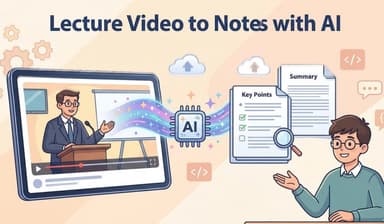

AI Note-Taker vs. Manual Notes: Which Method Boosts Your Learning?

The rise of AI note-takers promises effortless summarization and organization, but does that mean the end of pen and paper? Not necessarily. While AI tools offer speed and automation, traditional manual note-taking fosters deeper engagement and critical thinking. The best approach depends on your learning style, the situation, and what you value most: raw speed or nuanced comprehension. This article explores the strengths and weaknesses of each method, helping you choose the right note-taking strategy for your needs.

Quick Verdict: AI vs. Manual – Which Note-Taking Method is Right for You?
Deciding between AI and manual note-taking hinges on what you prioritize: speed and convenience or in-depth processing and retention. Here's a quick look at the key differences:
| Method | Best For | Tradeoffs | Speed |
|---|---|---|---|
| AI Note-Taker | Lectures, meetings, large volumes of information | May miss nuances, requires review for accuracy, potential data privacy concerns | Very Fast (~10s for a typical lecture) |
| Manual Note-Taking | Brainstorming, creative writing, in-depth study | Time-consuming, can be disorganized, relies on individual skill | Slow (~1 hr per lecture) |
Illustrative timings only, assuming clean audio and typical lecture length. Actual results will vary.
If you're swamped with information and need quick summaries, AI note-takers are a game-changer. However, for tasks requiring deep engagement and critical thinking, manual note-taking remains a valuable tool. Consider your learning style and the specific context to make the best choice.
Efficiency: How Much Time Can You Save?
One of the most compelling arguments for AI note-takers is their efficiency. Imagine sitting through a one-hour lecture and having a summarized transcript ready within seconds. That's the power of AI. These tools automate the process of transcribing and summarizing, freeing you from the tedious task of writing everything down manually.
But let's be realistic. AI isn't a magic bullet. You'll still need to invest time in reviewing and editing the AI-generated notes to ensure accuracy and clarity. There's also a learning curve associated with mastering the software and customizing it to your specific needs. However, the potential time savings in reviewing and summarizing notes are significant.
The main reason AI outperforms manual note-taking for raw speed is its ability to process information in real-time, generating summaries and transcripts almost instantly.
Think about it: a student juggling multiple courses could use AI to quickly capture the key points from each lecture, freeing up valuable time for studying and other activities. A professional attending a conference could use AI to record and summarize presentations, allowing them to focus on networking and engaging with other attendees.
Accuracy and Comprehension: Capturing the Nuances
While AI excels at speed, accuracy and comprehension are where manual note-taking often shines. AI tools are constantly improving, but they can still misinterpret information or miss subtle cues. Sarcasm, tone, and context can be lost in translation, leading to inaccuracies in the AI-generated notes.
Manual note-taking, on the other hand, forces you to actively listen, process, and synthesize information. This active engagement fosters deeper understanding and critical thinking. You're not just passively recording what's being said; you're actively constructing your own understanding of the material.
However, manual note-taking also has its limitations. Human error, fatigue, and distractions can all impact the accuracy and completeness of your notes. It's also challenging to capture every detail, especially in fast-paced lectures or meetings.
To improve AI accuracy, consider providing clear and concise prompts. Review and edit the AI-generated notes carefully, paying attention to any potential errors or omissions. Use AI as a starting point, but always bring your own critical thinking and understanding to the table.
Accessibility and Organization: Finding What You Need
In the age of digital information, accessibility and organization are crucial. AI note-takers offer powerful features like searchable transcripts, automated organization, and cloud storage. You can quickly find specific information by searching for keywords, and your notes are always accessible from any device.
Manual note-taking, while offering flexibility and customization, can sometimes fall short in terms of organization. Unless you're meticulous about organizing your notes, they can become scattered and difficult to navigate. Finding specific information can be time-consuming, especially if you have a large collection of notebooks and papers.
However, manual note-taking allows for personalized organizational systems. You can use color-coding, symbols, and visual cues to create a system that works best for you. This level of customization can be difficult to achieve with AI tools, which often impose a specific organizational structure.
You might be wondering, can you combine the best of both worlds? Absolutely! Consider using AI to generate a transcript of a lecture or meeting, then manually edit and organize the notes to suit your own learning style.
Cost Analysis: Free vs. Paid Solutions
Cost is always a factor when choosing between AI note-takers and manual note-taking. AI tools range from free to paid, with varying features and capabilities. Free AI tools may have limitations on usage, storage, or features, while paid subscriptions offer more comprehensive functionality.
Consider the potential costs associated with subscriptions, hardware (like a good microphone), and software. Also, factor in the cost of your time. While AI can save time in the long run, there's an initial time investment required to learn and set up the tools effectively.
Manual note-taking, on the other hand, has relatively low upfront costs. Notebooks and pens are inexpensive and readily available. However, the time invested in manual note-taking can be significant, especially if you're taking detailed notes.
Use Cases: When Does AI Note-Taking Shine?
AI note-takers truly shine in situations where speed and efficiency are paramount. Here are a few examples:
- Lectures: AI can quickly transcribe and summarize lectures, allowing students to focus on understanding the material rather than frantically writing everything down.
- Meetings: AI can record and transcribe meetings, freeing participants from the burden of note-taking and ensuring that everyone has access to a complete record of the discussion.
- Interviews: AI can capture the key points from interviews, allowing researchers and journalists to focus on asking insightful questions and building rapport with their subjects.
However, there are also situations where manual note-taking may be more appropriate. Brainstorming sessions, creative writing, and in-depth study often benefit from the active engagement and critical thinking that manual note-taking provides.
For example, imagine a lawyer reviewing a pile of scanned legal documents. Using Lynote, they could upload these documents, and the AI could generate summaries highlighting key clauses and potential issues. This saves hours compared to manually sifting through each page.
Feature Spotlight: Lynote for AI-Powered Learning
Lynote is an AI-powered learning and note-taking toolkit designed to enhance your study experience. Our upcoming roadmap includes powerful features to help you create notes from various media formats, including documents, video, and audio.

Here's a glimpse of what's coming:
- AI Summary: Automatically generate summaries of documents, videos, and audio recordings.
- Chat with AI: Ask questions and get instant answers based on your notes and learning materials.
- Auto-Generated Flashcards: Create flashcards from your notes with the click of a button, making it easy to review and memorize key concepts.
Lynote is designed for students, teachers, international students, and anyone who wants to study or learn more efficiently. We're committed to providing you with the tools you need to succeed in your academic and professional endeavors.

Common Misconceptions About AI Note-Taking
It's important to address some common misconceptions about AI note-taking. One is the belief that AI tools are always accurate. While AI is constantly improving, it's not perfect. Human oversight and critical thinking are still essential to ensure accuracy and completeness.
Another misconception is that AI can completely replace human note-takers. AI can automate many aspects of the note-taking process, but it can't replace the human ability to understand context, interpret nuances, and engage in critical thinking.
Finally, it's important to consider the ethical implications of AI note-taking. Data privacy and security are paramount. Choose AI tools that prioritize your privacy and protect your data.
FAQ: AI Note-Takers vs. Manual Notes
Is there a steep learning curve for AI note-taking tools?
The learning curve varies depending on the tool. Some AI note-takers are intuitive and easy to use, while others require more technical knowledge. However, most AI tools offer tutorials and support to help you get started.
How accurate are AI-generated notes?
The accuracy of AI-generated notes depends on several factors, including the quality of the audio or video, the clarity of the speaker's voice, and the complexity of the subject matter. Always review and edit the AI-generated notes to ensure accuracy.
What's the best way to integrate AI into my note-taking workflow?
Start by identifying the areas where AI can provide the most value. Use AI to automate tasks like transcription and summarization, but always retain control over the final product. Edit and organize the AI-generated notes to suit your own learning style.
Why do AI summaries sometimes miss key points?
AI algorithms prioritize common patterns and frequently used words. The main reason AI misses key points is that it may not understand the context or significance of certain information. If a speaker makes a crucial point using less common language or relies on shared knowledge, the AI might overlook it. The fix: Always review AI-generated summaries and add any missing information.
Conclusion: Choosing the Right Note-Taking Method for You
The choice between AI note-takers and manual note-taking depends on your individual needs and preferences. If you prioritize speed and efficiency, AI note-takers are a game-changer. If you value deep engagement and critical thinking, manual note-taking remains a valuable tool.
For students juggling multiple courses, AI can provide a significant time-saving advantage. For professionals attending conferences or meetings, AI can ensure that you capture all the key information without missing a beat.
Ultimately, the best approach may be a combination of both methods. Use AI to automate the tedious tasks, but always retain control over the final product. Edit and organize the AI-generated notes to suit your own learning style.
Expert takeaway: There's no universal "best" method. Experiment to find the balance that maximizes your learning and productivity.
Ready to experience the power of AI-powered learning? Explore Lynote's upcoming features and discover how AI can transform your note-taking workflow.
Editor’s Choice: For students and professionals dealing with information overload, Lynote offers a compelling AI-powered solution to streamline note-taking and enhance learning. The key benefit is the AI summary feature, which can drastically reduce the time spent reviewing lectures and documents. However, users should be aware that AI accuracy isn't perfect, so careful review and editing are still necessary.

Written by Janet L. Harris
AI Writing Specialist
Janet reviews AI detectors and humanization tools, with a focus on accuracy, limitations, and responsible use. View all articles →
![10 Best AI Summary Generators: Tools to Condense Information Fast [2026]](/_next/image?url=https%3A%2F%2Fstrapi.lynote.ai%2Fuploads%2Fbest_si_summary_generators_01_0f7f4200b7.jpg&w=384&q=75)