
How Many Note-Taking Methods Are There? 10 Systems Explained

There is no official master list that fixes the number of note-taking methods. Most university study-skills guides teach five classic systems: Cornell, outline, mapping, charting, and sentence notes. A broader practical toolkit can reasonably include ten by adding boxing, flow notes, sketchnoting, SQ3R reading notes, and Zettelkasten.
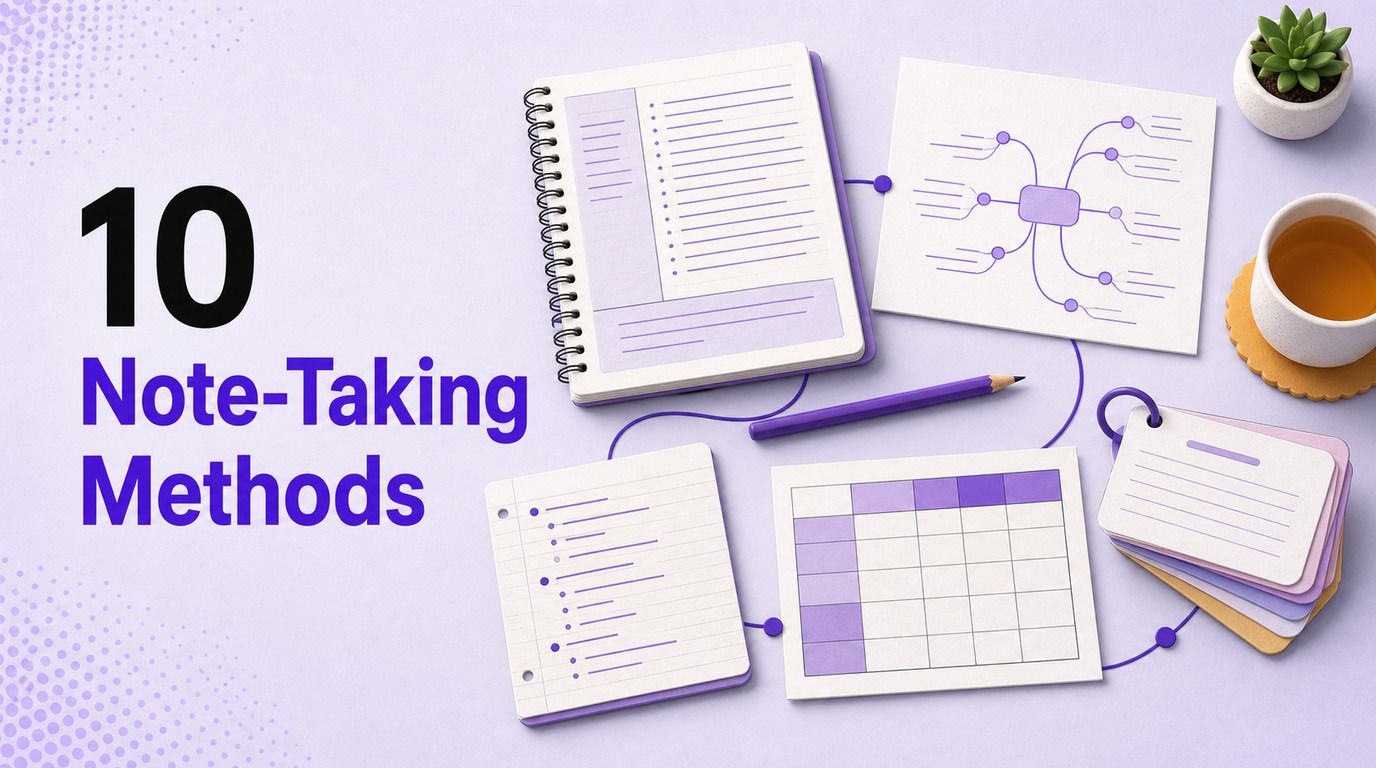
The number matters less than the job each method performs. Some help you keep up with a fast speaker, some reveal relationships, and others turn reading into questions or connect ideas across months of research. The best note-taking method is therefore the one that fits both the source in front of you and what you plan to do with the notes later.
Quick Answer: How Many Note-Taking Methods Are There?
The shortest defensible answer is five classic methods and several useful extensions. Cornell, outline, mapping, charting, and sentence notes appear repeatedly in university learning resources because they represent five distinct page structures rather than minor styling variations.
This guide covers ten methods because students and knowledge workers do more than capture classroom lectures. They also read textbooks, synthesize research, attend meetings, watch videos, solve problems, and build knowledge that needs to remain useful after the next exam.
If your starting point is a long document, lecture recording, video, webpage, or YouTube lesson, the Lynote AI Note Generator can create an editable first-pass structure before you reshape the material with one of the methods below. That first pass is raw material, not finished learning: you still need to select, question, connect, and review the ideas yourself.
| Method | Shape on the Page | Best Input | Strongest Review Use | Learning Curve |
|---|---|---|---|---|
| Cornell | Cues, main notes, bottom summary | Testable lectures and readings | Cover-and-recall self-testing | Medium |
| Outline | Indented hierarchy | Structured lectures and chapters | Scan main ideas and supporting detail | Low |
| Mapping | Central idea with branches | Connected concepts and brainstorming | Reconstruct relationships | Medium |
| Charting | Rows and fixed columns | Repeated categories and comparisons | Compare across cases | Low to medium |
| Sentence | One numbered idea per line | Fast or unpredictable speech | Reorganize after capture | Low |
| Boxing | Separate visual topic blocks | Digital or tablet notes | Review one concept cluster at a time | Low |
| Flow notes | Arrows, phrases, and reactions | Processes and problem solving | Retrace the logic | Medium |
| Sketchnoting | Words, icons, diagrams, connectors | Talks and conceptual material | Recall through visual cues | Medium |
| SQ3R | Questions and answers across five reading stages | Difficult textbook chapters | Recite without looking | Medium |
| Zettelkasten | Atomic linked notes | Multi-source research | Reuse ideas across projects | High |
How Note-Taking Methods Differ
A note-taking method is more than a page template. It decides what you capture, where you place it, and what kind of thinking the page makes easier afterward. Two pages can contain the same facts yet support very different review behaviors.
It helps to separate five jobs that are often bundled together:
- Capture: Preserve an idea before it disappears.
- Organize: Show which details belong under which topic.
- Connect: Make relationships, causes, contrasts, or sequences visible.
- Retrieve: Turn notes into prompts that require an answer from memory.
- Reuse: Carry useful ideas into future essays, projects, decisions, or research.
No method is equally strong at all five. Sentence notes favor capture, mapping favors connection, Cornell builds retrieval into the page, and Zettelkasten emphasizes reuse across sources and time.
This is why good note making often happens in two passes. You might capture a fast lecture with sentence notes, then convert the important points into Cornell questions that evening. The second pass is not wasteful copying when it changes the function of the material.
The 5 Classic Note-Taking Methods
These five systems are the most useful starting point because each solves a common classroom problem with a distinct structure. Learn what each structure does before deciding which one looks nicest.
1. Cornell Method
The Cornell method divides a page into three functional zones. A narrow cue column sits on the left, a wider notes area fills the right side, and a summary strip runs along the bottom. The boundaries matter because every zone supports a different stage of learning.
During a lecture, write the main ideas, explanations, examples, and evidence in the large notes area. After class, reduce those notes into keywords and questions in the cue column, then write a short summary at the bottom. Later, cover the notes area and answer from the cues instead of merely rereading.
Cornell Method Example
Imagine a biology lecture on cellular respiration. During class, the main notes area might contain the following compressed record:
| Cue or Question | Main Notes |
|---|---|
| What is the purpose of cellular respiration? | Cells convert energy stored in glucose into ATP that can power cellular work. |
| Where does glycolysis occur? | Cytosol; glucose is split into two pyruvate molecules; a small amount of ATP and NADH is produced. |
| What happens before the citric acid cycle? | Pyruvate enters the mitochondrion and is converted to acetyl-CoA, releasing carbon dioxide and producing NADH. |
| Why is the electron transport chain important? | Electrons from NADH and FADH2 help pump protons across the inner mitochondrial membrane. The gradient powers ATP synthase. |
| What is oxygen's role? | Oxygen accepts electrons at the end of the chain and combines with hydrogen ions to form water. |
The bottom summary should compress the page rather than repeat every line: Cellular respiration transfers energy from glucose to ATP through glycolysis, pyruvate oxidation, the citric acid cycle, and oxidative phosphorylation. Most ATP depends on the proton gradient and ATP synthase, while oxygen serves as the final electron acceptor.
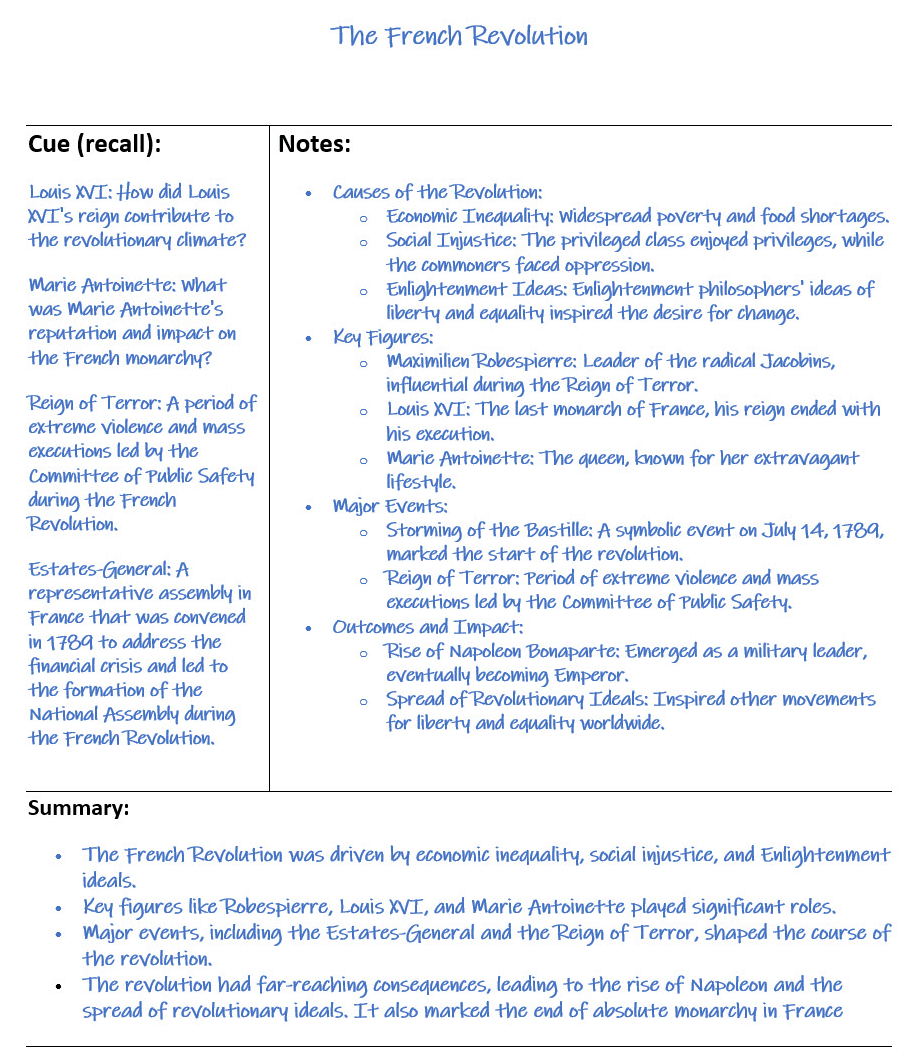
To review, hide the main notes and answer each cue aloud or on paper. If you cannot explain why oxygen is necessary, reveal only that row, correct the answer, and try again later. This retrieval step is the part that distinguishes working Cornell notes from a page that merely has three boxes.
Best for: Exam-heavy courses, testable lectures, and readings that can become questions.
Strengths: The layout connects capture, compression, and self-testing. It also exposes weak understanding because vague cue questions produce vague answers.
Limitations: Preparing or maintaining the zones takes effort, and the format can feel restrictive during a chaotic lecture. It is also easy to neglect the cue and summary areas, which reduces Cornell notes to ordinary two-column notes.
Do not use it when: The material is primarily a visual process, a repeated comparison, or an open-ended brainstorming session. Mapping, charting, or flow notes may fit those shapes better.
2. Outline Method
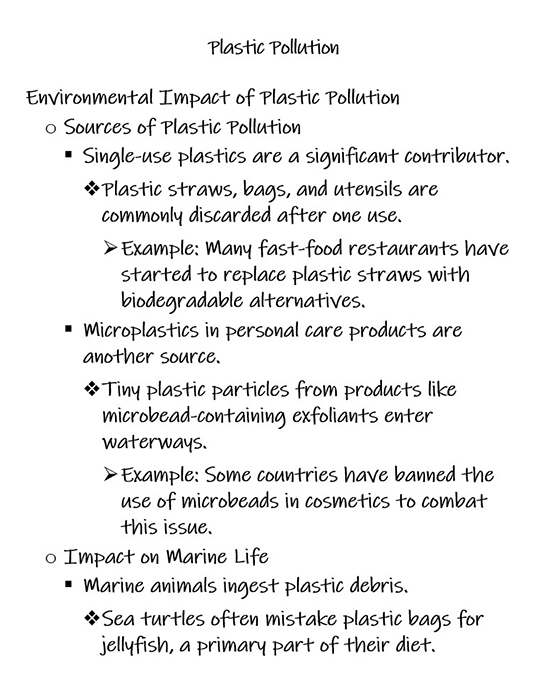
The outline method turns information into a hierarchy. Main topics sit at the left margin, subtopics are indented beneath them, and supporting facts move another level to the right. Indentation carries meaning, so the reader can see importance before reading every word.
A history lecture on the causes of the French Revolution might begin like this:
- Financial crisis
- Expensive wars increased state debt.
- The tax system placed unequal burdens on social groups.
- Attempts at reform faced political resistance.
- Social structure
- Legal privileges separated the estates.
- The Third Estate carried many obligations but had limited political power.
- Political crisis
- The Estates-General exposed disputes over representation.
- The National Assembly challenged existing authority.
The method works because the lecture already has a skeleton. You are identifying that skeleton and attaching evidence to the correct level instead of writing an uninterrupted transcript.
Best for: Textbook chapters, presentations with clear headings, structured lectures, and meetings with an agenda.
Strengths: Outlines are fast to scan, easy to expand, and compatible with paper or digital editors. They also make missing support visible when a heading has no details beneath it.
Limitations: A speaker who jumps backward and forward forces constant restructuring. An outline can also hide relationships between separate branches, such as one cause influencing several outcomes.
Review move: Close the lower levels and try to rebuild them from each main heading. If you can name the headings but not explain their supporting evidence, the outline is organized but not yet learned.
3. Mapping Method
The mapping method places a central idea in the middle and develops it through branches. Subtopics split into supporting details, while arrows or cross-links show relationships that a linear hierarchy would conceal.
For a climate-change lesson, the center might read Climate Change. Major branches could include causes, physical effects, ecological effects, human impacts, mitigation, and adaptation. A cross-link might connect fossil-fuel combustion to greenhouse-gas concentration, rising temperature, heat stress, and electricity demand.
Mapping is useful when the question is not just “What belongs under this heading?” but also “How does this idea affect another part of the system?” The page becomes a model of relationships rather than a list of isolated facts.
Best for: Conceptual subjects, brainstorming, essay planning, systems, and revision that requires a big-picture view.
Strengths: A map makes relationships and gaps visible. It supports non-linear thinking and can combine words, arrows, symbols, formulas, and small diagrams.
Limitations: Dense maps become crowded, and adding late branches on paper can be awkward. Mapping is also inefficient for exact quotations, long definitions, detailed numerical data, or a lecture that moves too quickly to position ideas carefully.
Review move: Recreate the main branches from a blank center, then explain every connecting arrow. A link that you cannot describe in a sentence may be decorative rather than meaningful.
4. Charting Method
The charting method organizes repeated information into rows and columns. Instead of rewriting the same categories for every item, you define the categories once and place comparable facts into cells.
Suppose an economics course compares market, command, and mixed economies. A useful chart might look like this:
| System | Resource Decisions | Role of Prices | Potential Strength | Common Limitation |
|---|---|---|---|---|
| Market | Individuals and firms | Coordinate supply and demand | Responsive to incentives | Can distribute outcomes unevenly |
| Command | Central authority | May play a limited role | Can direct resources toward stated goals | Information and incentive problems |
| Mixed | Markets plus government | Important but regulated | Can combine flexibility with public provision | Policy trade-offs and regulatory complexity |
The difficult part is selecting columns that will remain useful across every row. If one column applies to only one case, it may belong in a note below the table rather than in the shared comparison structure.
Best for: Dates, theories, historical cases, scientific organisms, medications, products, court decisions, or any material with repeated attributes.
Strengths: Charts expose similarities, differences, missing evidence, and inconsistent categories quickly. They also convert naturally into comparison questions.
Limitations: Premature columns can distort the material by forcing every idea into the same categories. Charts also flatten causal narratives and may strip away context that explains why a difference matters.
Review move: Hide one column and reconstruct it row by row, or choose one row and explain how it differs from the others without looking.
5. Sentence Method
The sentence method records each new idea on its own numbered line. It removes most live formatting decisions, making it easier to keep up when the structure of a lecture or meeting is unclear.
A fast guest lecture might produce notes like these:
- The team originally measured activation but later changed the main outcome to retention.
- Early interviews revealed that onboarding language confused first-time users.
- A shorter form improved completion but removed information needed by support staff.
- The final design separated required fields from optional context.
- The speaker described the project as an information-priority problem, not a visual-design problem.
These notes preserve complete thoughts without pretending you already know their hierarchy. During cleanup, lines 2 through 4 could become evidence under a heading called Onboarding trade-offs, while line 5 could become the section's main conclusion.
Best for: Fast lectures, interviews, meetings, discussions, and speakers who change direction frequently.
Strengths: The method is easy to learn and fast to execute. Numbered lines also make it simple to reference an earlier point or mark an action item.
Limitations: Raw sentence notes are difficult to scan and tempt the writer to transcribe. Without a processing pass, the page remains a chronological log rather than a useful model of the subject.
Review move: Within a day, label groups of related lines, delete repetition, and convert important statements into headings, questions, or decisions.
5 More Note-Making Methods for Visual, Reading, and Research Work
The next five methods extend beyond the traditional classroom list. Some are visual page structures, while SQ3R and Zettelkasten are broader workflows. They belong here because they solve common note-making problems that the five classic layouts do not fully address.
6. Boxing Method
The boxing method places related notes into separate visual containers. Each box represents one topic, process, case, or cluster, and the boxes can vary in size according to the amount of information they contain.
In digital anatomy notes, one box might contain the structure and function of the left ventricle, another the right ventricle, and a third the valves. Color can distinguish structures, but the box boundaries should do the organizational work even when color is removed.
Best for: Tablet notes, modular subjects, lecture slides with distinct themes, and pages that need rearrangement later.
Strengths: Boxing produces a clean visual overview without requiring a strict hierarchy. Digital boxes are easy to move, resize, duplicate, and group.
Limitations: Separate boxes can make a connected process look more fragmented than it is. The method also becomes decorative when writers spend more time styling containers than deciding what belongs together.
Review move: Hide a box and reconstruct its key points from the title, then explain how that box relates to at least one neighboring cluster.
7. Flow Notes
Flow notes follow the logic of an explanation rather than a fixed page template. Short phrases, arrows, equations, questions, and personal reactions show how one step leads to another.
During a statistics lesson, a flow might move from research question → variable types → suitable test → assumptions → result → interpretation. If the instructor changes an assumption, an arrow can branch toward a different test and record why the choice changed.
Best for: Problem solving, demonstrations, causal processes, mathematical reasoning, and lectures where understanding the path matters more than preserving every sentence.
Strengths: Flow notes make the writer process ideas during capture. They preserve the reasoning that often disappears from polished final formulas or conclusions.
Limitations: The page can be difficult for someone else to read because abbreviations and personal connections carry much of the meaning. It is also a weak archival format unless you add labels and a short summary afterward.
Review move: Retrace the path without the source and explain why each arrow is valid. Mark any jump that you can follow visually but cannot justify conceptually.
8. Sketchnoting
Sketchnoting combines words with simple visual elements such as icons, frames, arrows, dividers, people, timelines, and diagrams. The goal is visual encoding, not illustration quality.
At a design workshop, a sketchnote might use a small ear icon for user interviews, a funnel for prioritization, a rough screen for prototyping, and a loop arrow for iteration. Short captions preserve precise language while the images create memorable landmarks on the page.
You do not need artistic skill. A useful visual vocabulary can be built from circles, squares, arrows, stick figures, and a few recurring symbols; the difficult skill is choosing what deserves emphasis.
Best for: Talks, workshops, conceptual summaries, storytelling, and learners who remember spatial or visual cues.
Strengths: Sketchnotes make hierarchy and movement visible while encouraging selection rather than transcription. A distinctive visual can also serve as a strong recall cue.
Limitations: Drawing can slow capture and distract from unfamiliar technical content. The method is poor for dense definitions, exact legal wording, long quotations, or detailed numerical evidence.
Review move: Use the icons as prompts and explain the associated idea without reading the captions. Redraw only the core path on a smaller page to test whether the structure is clear.
9. SQ3R Reading Notes
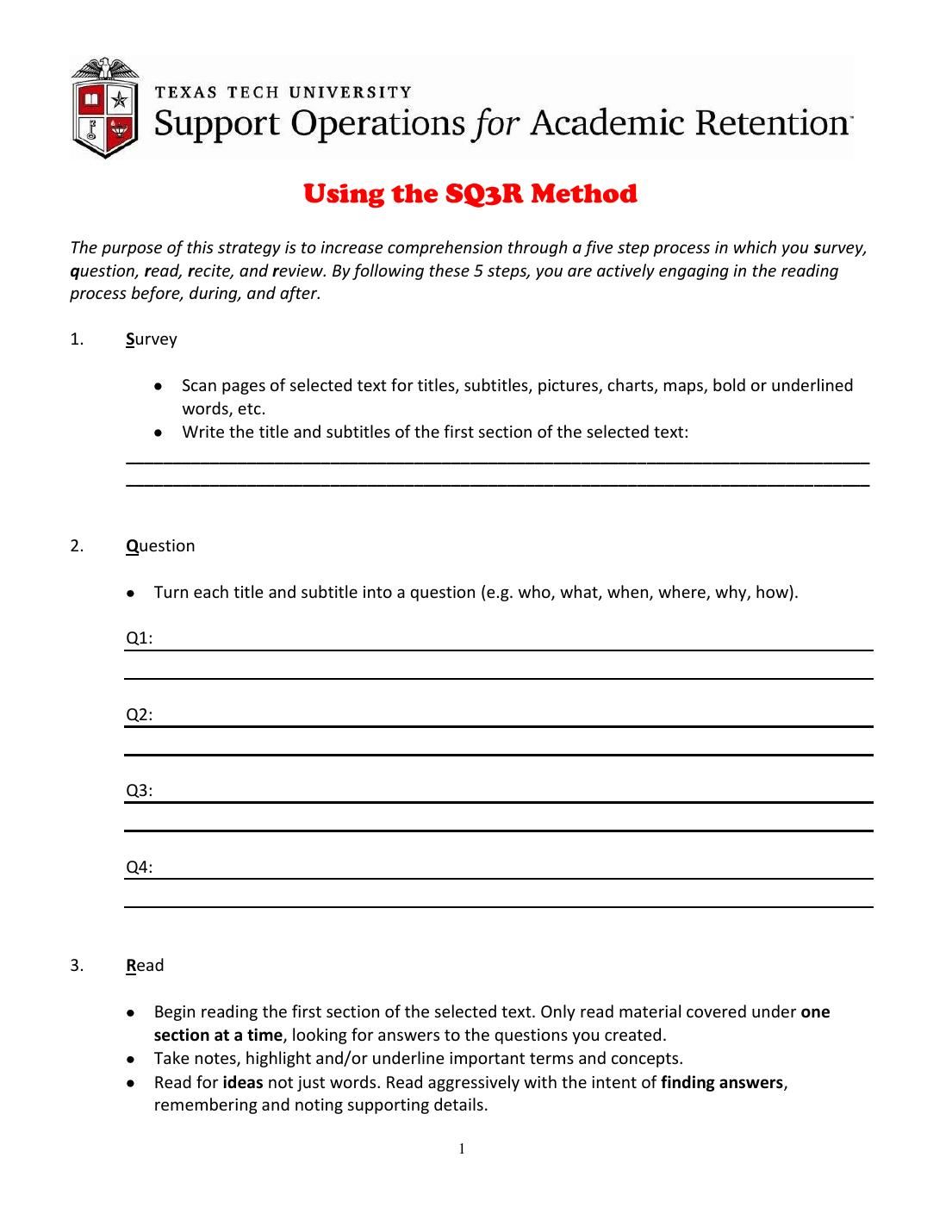
SQ3R is a five-stage reading workflow: Survey, Question, Read, Recite, and Review. Unlike Cornell or outlining, it does not prescribe one page shape; it controls how you interact with a text before, during, and after reading.
For a textbook chapter on memory, begin by surveying headings, diagrams, summaries, and review questions. Turn a heading such as Working Memory Limits into focused questions.
Ask what limits working memory, what evidence supports that limit, and which strategies reduce overload. These questions give the detailed reading a purpose.
Read to answer those questions rather than highlighting everything that sounds important. Close the book and recite the answers in your own words, then review the questions later and identify what you could not retrieve.
Best for: Dense textbooks, assigned chapters, unfamiliar theory, and readings that will appear on an exam.
Strengths: SQ3R makes reading active before the first detailed paragraph. Questions guide attention, while recitation reveals the difference between recognition and recall.
Limitations: The workflow is slower than casual reading and can be excessive for simple reference material. Poor questions also produce shallow notes, so the survey stage must identify meaningful concepts rather than merely copy headings.
Review move: Keep the questions separate from the answers and revisit them without reopening the chapter. Add a Cornell page, outline, or chart if the answers need a more stable structure.
10. Zettelkasten Method
Zettelkasten is a long-term system built from small, focused notes that connect to one another. Instead of storing everything about a book under one large summary, you create atomic notes that each express one useful idea in your own words.
A researcher reading two papers about remote work might create one note arguing that autonomy affects satisfaction, another explaining how communication delay changes coordination, and a third connecting both ideas: Autonomy benefits may depend on whether coordination costs remain manageable. Each note links back to its source and forward to related ideas.
Modern implementations often distinguish fleeting notes, source or literature notes, and permanent notes. Fleeting notes capture quickly, source notes record what a specific work says, and permanent notes express an idea clearly enough to connect and reuse later.
Best for: Theses, literature reviews, books, long-term research, writing, and knowledge that should compound across projects.
Strengths: Linking makes old notes active when new ideas arrive. Atomic notes can become building blocks for arguments instead of remaining trapped inside source summaries.
Limitations: The method requires consistent processing and careful wording. Creating IDs, links, and permanent notes is unnecessary overhead for a short lecture that only needs to support next week's quiz.
Review move: Follow a link trail and explain why each connection exists. If a note cannot stand alone or connect to anything meaningful, revise it rather than adding more tags.
Which Note-Taking Method Is Best for Your Situation?
Choose by the shape and speed of the material, then by the output you need. A visually beautiful method that prevents you from keeping up is not the best method for that situation.
| Situation | Start With | Optional Second Pass | Why |
|---|---|---|---|
| Structured college lecture | Outline | Cornell | Capture the hierarchy, then create retrieval cues. |
| Fast, unpredictable lecture | Sentence | Cornell or outline | Preserve complete ideas first; organize after class. |
| Concept-heavy science | Mapping | Cornell | See system relationships, then test precise details. |
| Dates, cases, drugs, or theories | Charting | Flashcards | Compare repeated attributes, then retrieve exact facts. |
| Mathematics or worked problems | Flow notes | Error log or summary | Preserve the reasoning path and identify failed steps. |
| Dense textbook chapter | SQ3R | Outline or Cornell | Read from questions, then stabilize the answers. |
| Brainstorming an essay | Mapping | Outline | Generate connections before choosing a linear argument. |
| Meeting or interview | Sentence | Boxes for decisions and actions | Keep up live, then separate outcomes from context. |
| Visual workshop or conference talk | Sketchnoting | Short written summary | Capture themes and memorable signals without losing the conclusion. |
| Thesis or long research project | Zettelkasten | Mapping for synthesis | Build reusable ideas and reveal connections across sources. |
For college students, Cornell is a strong default when the notes will become exam questions, but it is not the best answer to every class. An engineering derivation may need flow notes, an anatomy comparison may need a chart, and a seminar discussion may require sentence notes before any structure becomes visible.
For professionals, the output often matters more than the subject. A meeting that must produce decisions and owners benefits from fast sentence capture followed by boxes for decisions, actions, risks, and open questions.
How to Combine Note-Taking Methods Without Creating Extra Work
Combining methods should change the function of the notes, not merely make a cleaner copy. A second pass earns its time when it compresses, connects, tests, or prepares the material for reuse.
Sentence Notes to Cornell
Use sentence notes to keep up with a fast lecture. Afterward, group the important lines in the Cornell notes area, write questions in the cue column, and summarize the page. The transformation converts chronological capture into retrieval practice.
Outline to Mapping
Start with an outline when a chapter or lecture has a clear hierarchy. Build a smaller map afterward only for relationships that cross branches, such as one policy affecting several social outcomes.
Charting to Flashcards
Use a chart to expose the dimensions of a comparison. Turn the cells that require exact recall into flashcards, but keep the chart for context so isolated cards do not erase the broader pattern.
SQ3R to Zettelkasten
Use SQ3R to understand one difficult source. Promote only the ideas that matter beyond that source into permanent atomic notes, then connect them to your existing research rather than storing the whole chapter as one oversized note.
Set a short processing deadline. If raw notes have not been transformed within a day or two, mark the few items worth keeping and archive the rest; an ambitious system that creates an endless cleanup queue is not helping.
Using Lynote to Turn Source Material Into Structured Notes
Manual methods become difficult when the source is a long PDF, recorded lecture, video, image, webpage, or YouTube lesson. In that situation, Lynote can handle the initial source-to-note conversion while you decide how the information should be processed for learning.
The workflow is straightforward:
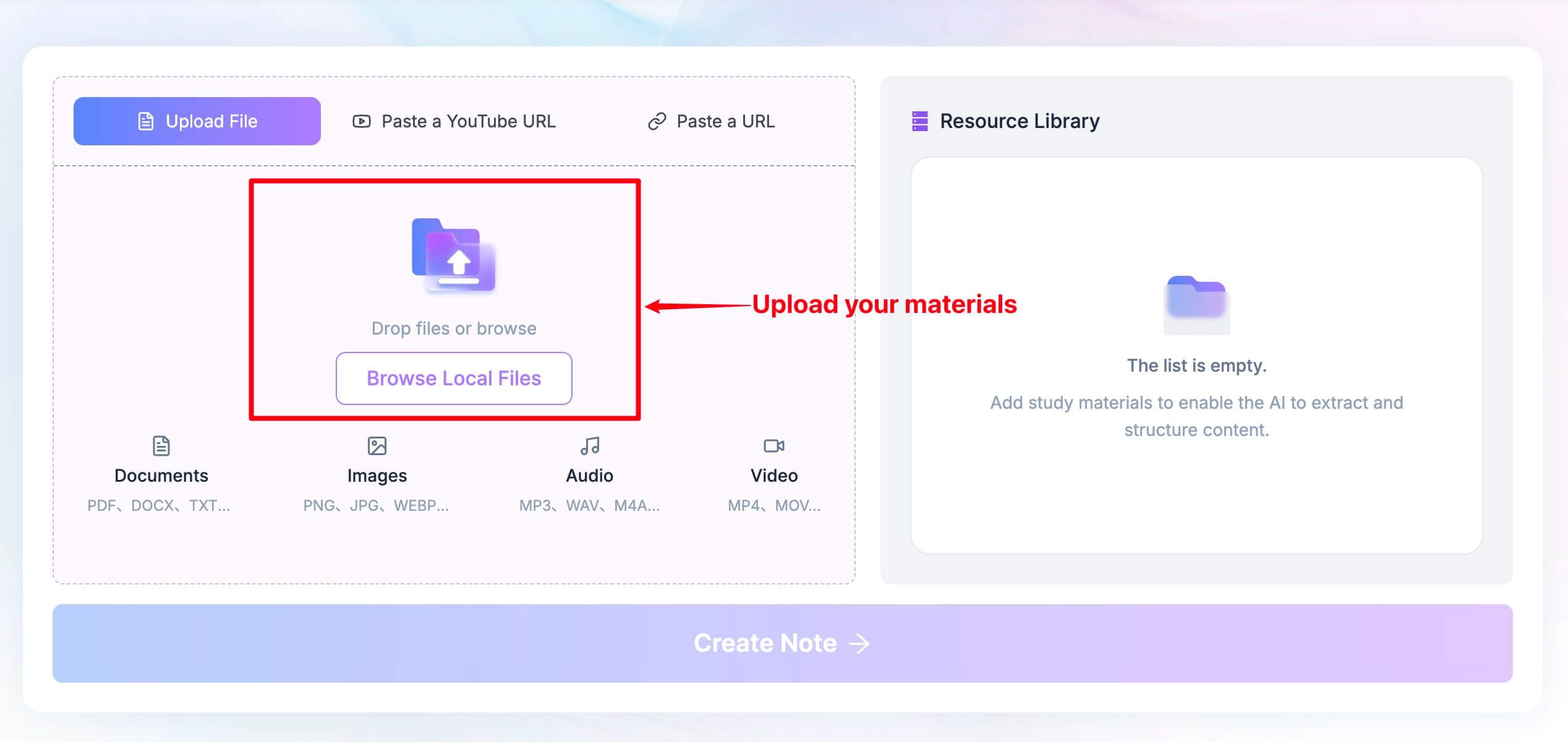
- Step 1 — Add the source: Add the relevant file or paste the source URL. Use Parse for a URL so the content can be fetched; direct uploads do not need that step.
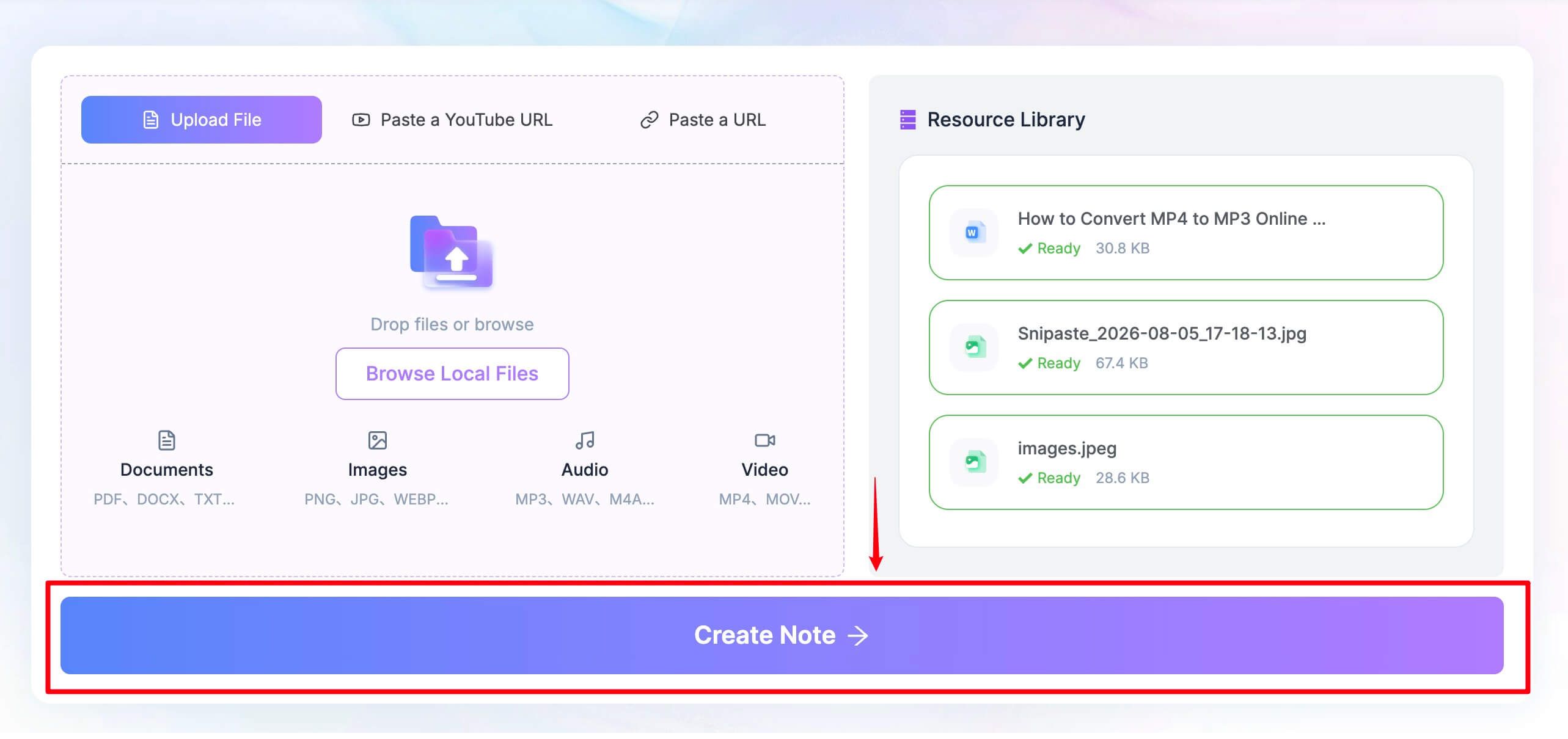
- Step 2 — Create the note: Click Create Note to produce structured, editable notes with headings, bullets, and source-linked sections.
- Step 3 — Reshape the result: Check the source context, remove weak or irrelevant points, and reshape the useful material into Cornell cues, an outline, a chart, or another method that matches your goal.
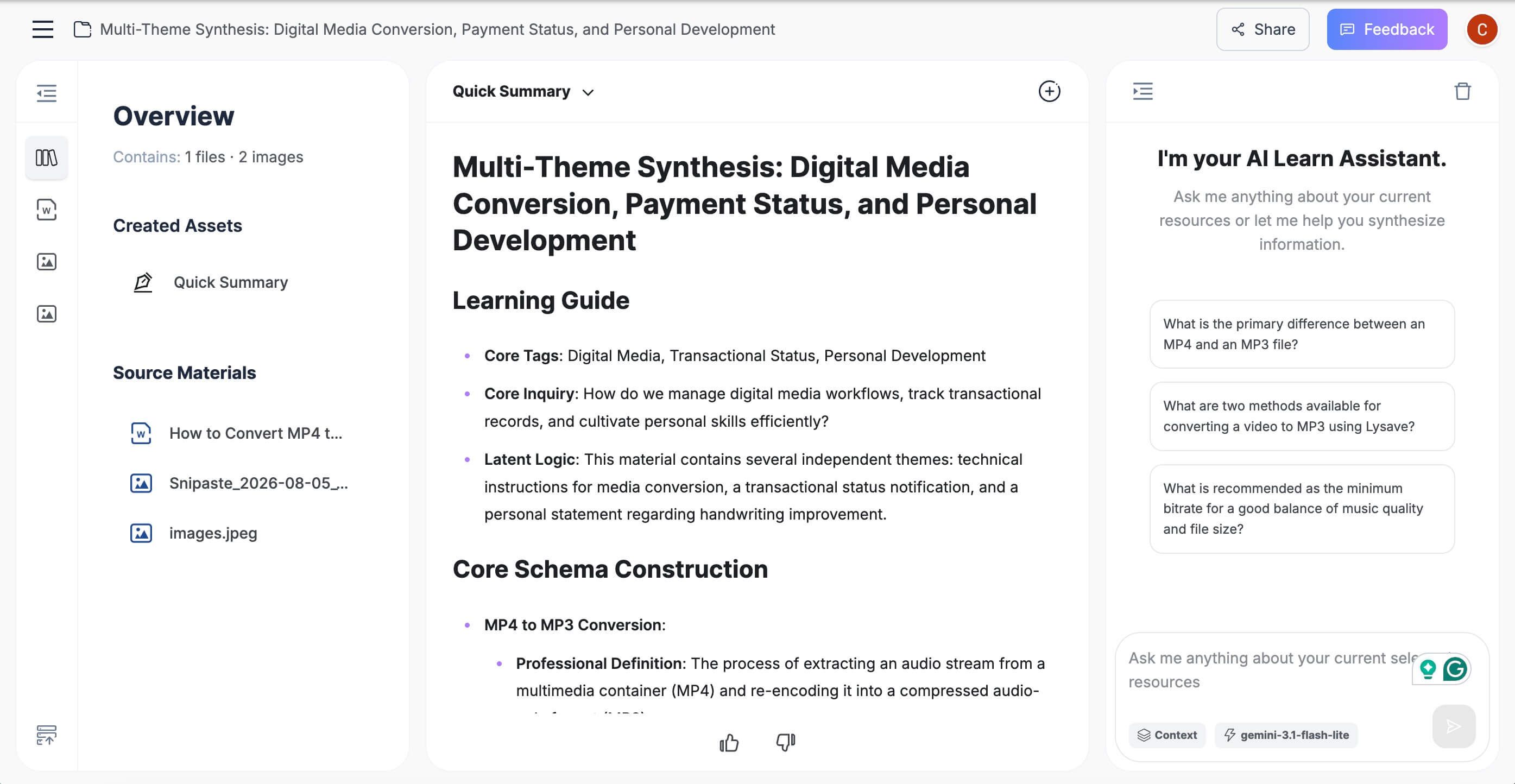
- Step 4 — Continue studying: Ask follow-up questions when a concept needs clarification, or convert selected material into flashcards when exact retrieval is the next task.
Generated structure saves capture time, but it should not decide what you understand. A good workflow uses the source-linked output for orientation, then requires you to question, compress, connect, and retrieve the material.
Common Note-Taking Mistakes That Make Any Method Fail
Transcribing Instead of Selecting
Writing every sentence leaves little attention for deciding what matters. Replace complete transcription with main claims, evidence, examples, and questions; preserve an exact quotation only when the wording itself matters.
Formatting Too Much During Capture
Colors, fonts, icons, and precise spacing compete with comprehension when information is moving quickly. Capture with a limited visual vocabulary, then format only what improves later scanning or retrieval.
Never Reviewing the Notes
A well-organized page is still an external record. Cover answers, rebuild a diagram, explain a process, compare cases, or write a summary from memory so the notes become prompts rather than wallpaper.
Using One Method for Every Subject
A favorite method can become a constraint. Keep one default and one fallback, then switch when the material changes shape: hierarchy calls for outlining, comparison for charting, relationships for mapping, and speed for sentence notes.
Mixing Raw and Permanent Notes
Unprocessed fragments, polished explanations, and final project notes should not look equally trustworthy. Mark raw capture clearly and promote only reviewed ideas into a durable knowledge system.
Collecting Screenshots and Highlights Without Processing Them
Saving information is not the same as making a note. Add a short explanation of why the item matters, what question it answers, and where it connects; otherwise the collection grows while its usefulness declines.
A 7-Day Test to Find Your Best Note-Taking Method
Do not choose a method from a personality label or an attractive template. Test two plausible methods on real, comparable material and measure what happens after capture.
- Day 1 — Choose the test: Select one recurring source, such as two lectures in the same course or two chapters with similar difficulty.
- Day 2 — Choose two candidates: Select methods suited to that source, not two random methods.
- Days 3 and 4 — Capture: Use Method A for the first session and Method B for the next.
- Day 5 — Normalize effort: Limit cleanup to the same amount of time for both.
- Day 6 — Test retrieval: Answer questions or summarize without looking.
- Day 7 — Score and repeat: Score each method, then repeat the comparison once before making it permanent.
- Decision: Keep the higher-scoring method as your default and the other as a fallback for different material.
| Criterion | 1 Point | 3 Points | 5 Points |
|---|---|---|---|
| Capture speed | Frequently missed ideas | Kept most main ideas | Kept up without losing attention |
| Structure | Hard to locate anything | Main sections were visible | Relationships and priorities were clear |
| Next-day retrieval | Could recall very little | Recalled main points | Could explain and apply the ideas |
| Cleanup effort | Required a major rewrite | Needed moderate edits | Needed only focused corrections |
| Reuse | Notes worked only for rereading | Supported some questions | Easily became questions, summaries, or project material |
| Willingness to review | Avoided reopening them | Reviewed with effort | Naturally invited active review |
The highest total is not automatically the winner if one category is essential. A medical student may accept higher cleanup effort for stronger retrieval, while a project manager may prioritize capture speed and clear action items.
FAQs About Note-Taking Methods
What Are the Five Main Note-Taking Methods?
The five classic methods are Cornell, outline, mapping, charting, and sentence notes. They represent different page structures for cues and review, hierarchy, relationships, repeated comparisons, and rapid linear capture.
How Many Note-Taking Methods Are There?
There is no official fixed number. Five methods form the common academic core, while broader lists add systems such as boxing, flow notes, sketchnoting, SQ3R, and Zettelkasten according to the kinds of learning and knowledge work being covered.
What Is the Best Note-Taking Method for College Students?
Cornell is useful when lecture notes need to become exam questions, while outlining works well for structured classes. The best college toolkit usually also includes sentence notes for fast lectures and charting or mapping for subjects whose information has a different shape.
What Is a Simple Cornell Method Example?
Place detailed notes about a lecture in the right column, then write questions such as “What is oxygen's role in cellular respiration?” in the left cue column. Add a two-sentence summary at the bottom and cover the right side when answering the questions later.
Is the Cornell Method Better Than Outlining?
Cornell is better for built-in self-testing because its cue column turns information into prompts. Outlining is faster when the source already has a clear hierarchy, so a practical workflow may capture with an outline and convert only the most testable material into Cornell questions.
Which Note-Taking Method Is Best for Fast Lectures?
The sentence method is a strong choice because each new idea receives its own line without requiring immediate hierarchy. Process the lines into an outline or Cornell page soon afterward so the chronological record becomes easier to understand and review.
Which Method Works Best for Textbooks?
SQ3R works well for difficult chapters because it begins with questions and requires recitation. Outlining is efficient when the chapter's headings already provide a reliable structure, while charting is useful when several cases share the same categories.
Can I Combine Two Note-Taking Methods?
Yes. Combine methods when the second one performs a new job, such as turning sentence capture into Cornell retrieval cues or turning an outline into a map of cross-topic relationships.
Is Typing or Handwriting Better for Taking Notes?
Neither medium wins in every context. Handwriting may encourage selection because it is slower, while typing can help with speed, editing, search, and accessibility; the important question is whether you process ideas in your own words and actively review them afterward.
What Is the Difference Between Note Taking and Note Making?
Note taking often refers to capturing information from a lecture, text, or meeting. Note making emphasizes what happens next: selecting, paraphrasing, connecting, questioning, and turning captured material into something you can understand or reuse.
Conclusion: Build a Small Note-Taking Toolkit
Five methods form the classic core, but ten systems provide a more realistic toolkit for modern learning and knowledge work. You do not need to use all ten; you need to recognize which problem each one solves.
Start with one fast capture method, one structured review method, and, if your work extends across projects, one long-term synthesis method. The durable skill is not producing a beautiful page but turning information into explanations, questions, connections, and decisions you can use later.
Written by Kristen I.
Content Strategist
Kristen focuses on content structure, editorial planning, readability, and creating useful experiences for readers. View all articles →