


This SEO.AI AI Content Detector review started with a practical SEO question: can a free detector tell me whether an article draft looks AI-written before it goes live?

After testing SEO.AI with several SEO-style samples, my answer is cautious. It caught very repetitive AI-like passages, but it scored several more realistic short and medium SEO samples as human-made, including one intentionally generic AI-style introduction.
That makes SEO.AI useful as a fast screening tool, not as a final editorial decision. If you manage SEO content, the real value is not the percentage itself; it is whether the result helps you decide what to inspect, rewrite, verify, or discuss with the writer.
Quick Verdict: Useful for a Fast Check, Not Enough for a Final Decision
SEO.AI AI Content Detector is appealing because it is simple. You paste text, click the test button, and get a probability score that labels the text as human-made, uncertain, or AI-generated.
For a busy SEO writer or editor, that low-friction workflow is genuinely helpful. It gives you a quick signal before you send a draft to a client, publish a guest post, or review a batch of AI-assisted articles.
The problem is that the signal is thin. In my test, SEO.AI returned 0 percent AI probability for multiple realistic SEO passages that still read generic, polished, and AI-like to me as an editor.
| Question | My take |
|---|---|
| Is SEO.AI AI Content Detector easy to use? | Yes. The workflow is very simple. |
| Did it catch obvious AI-like text? | Yes, but mainly when the sample was highly repetitive. |
| Did it flag realistic AI-style SEO copy? | Not consistently in my small test. |
| Does it give sentence-level revision guidance? | No. It gives a score and a sub-score chart, not line-by-line editing direction. |
| Best use | Quick first-pass screening for SEO drafts, followed by human review. |
My practical verdict: use SEO.AI when you want a fast smoke test. Do not use it as proof that a draft is human-written, AI-written, original, accurate, or ready to publish.
What SEO.AI AI Content Detector Is
SEO.AI is an SEO-focused AI platform with a collection of free SEO and content tools. Its AI Content Detector is one of those public tools, built around a simple paste-and-check flow.
The official page describes a three-step workflow: paste AI-generated content, click "Test AI-content probability," and get a likelihood score. A very low score is presented as human-made, while a score closer to the top of the range suggests a higher probability of AI generation.
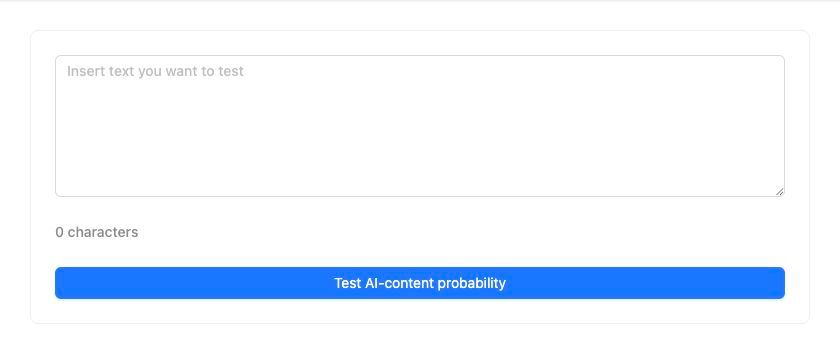
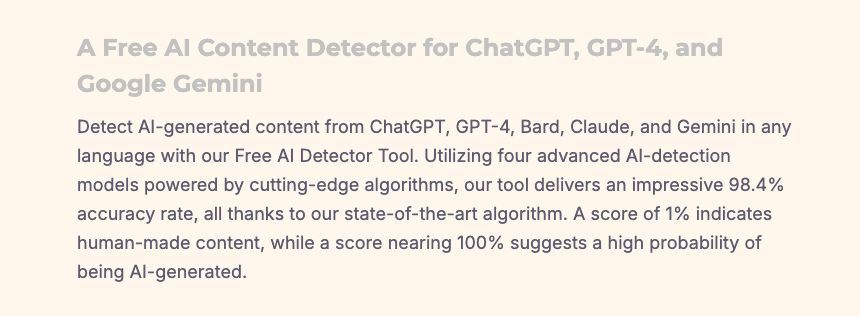
SEO.AI also says the detector uses four AI-detection models and can detect content from tools such as ChatGPT, GPT-4, Bard, Claude, and Gemini. The page also claims support for more than 50 languages.
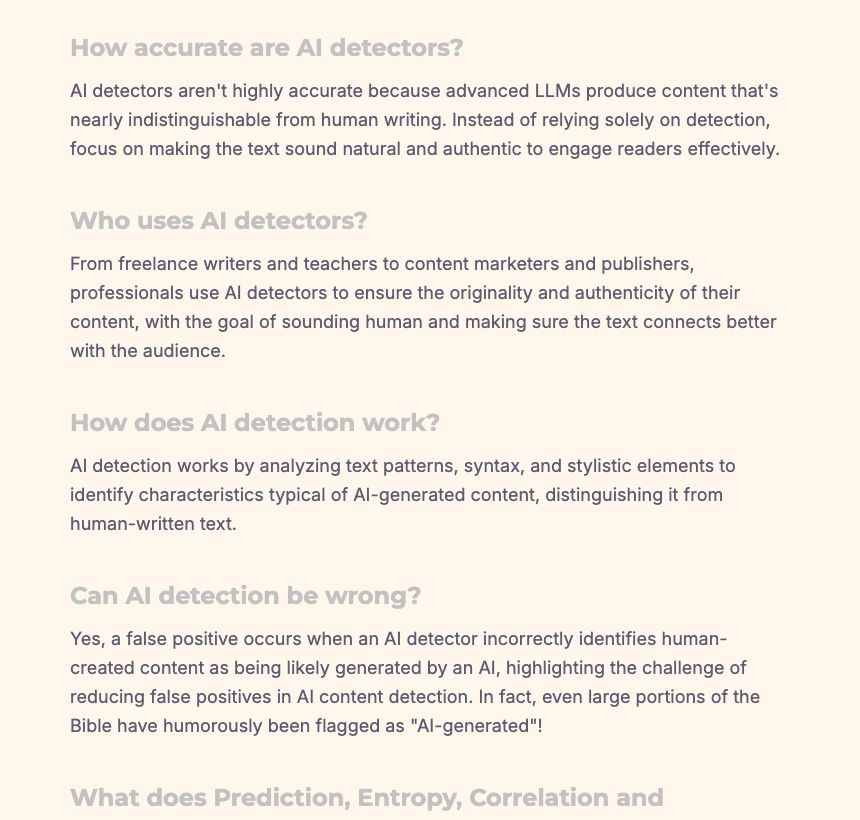
That sounds strong on the surface, but the same page also includes a more careful point: AI detectors are not highly accurate because modern language models can produce text that is difficult to separate from human writing. It also acknowledges false positives.
That tension is exactly why I wanted to test it. The marketing claim sounds confident, but the practical editorial question is narrower: does SEO.AI help an SEO team make better decisions about a draft?
What SEO.AI Claims, and Why the Fine Print Matters
The headline claim that stood out to me was the reported 98.4 percent accuracy rate. For a free detector, that is a bold number, especially when the page also says the tool uses four models and works across many languages.
But accuracy claims around AI detection need careful reading. A detector can perform well on one benchmark and still struggle with short passages, edited AI text, translated text, highly structured human writing, or polished SEO copy.
SEO teams rarely review clean lab samples. They review messy drafts: an AI-generated outline rewritten by a freelancer, a product review edited by a subject-matter expert, a paragraph polished with grammar software, or a short meta-style intro that sounds generic because the topic itself is generic.
That is why I care less about whether a detector looks confident and more about whether it is useful. A good workflow should help an editor decide where to look, what to question, and how to revise without treating a percentage like a courtroom verdict.
How I Tested SEO.AI's Detector
I tested SEO.AI through the same endpoint loaded by its official detector module. The visible page loads an external detector script, and that script sends text to SEO.AI's AI detection endpoint with a simple JSON request.
That mattered because my first browser automation attempt did not trigger the visible page state correctly. The text appeared in the input area, but the character counter stayed at zero and no valid result appeared, so I did not use those screenshots as evidence.
For the actual test, I sent eight text samples through the official module endpoint. This was a small practical review, not a statistical accuracy benchmark.
I chose samples that resemble what SEO teams actually review:
- A polished, generic AI-style SEO introduction.
- A rough first-person editorial note written in a more human voice.
- A mixed AI-assisted and human-edited paragraph.
- A short polished SEO paragraph.
- A longer template-like business paragraph.
- Three highly repetitive stress-test passages.
The goal was not to prove whether SEO.AI is "accurate" in every possible case. The goal was to see whether the detector gave useful editorial signal across obvious, ambiguous, and realistic SEO writing situations.
My SEO.AI Test Results
The clearest result was this: SEO.AI flagged the extreme repetitive samples, but it did not flag my more realistic SEO-style samples.
For the first five samples, SEO.AI returned 0 percent AI probability or a rounded 0 percent result. That group included the intentionally AI-like SEO introduction and a longer business paragraph that was polished, broad, and template-like.
| Test sample | Character count | SEO.AI result | My editorial note |
|---|---|---|---|
| AI-like SEO intro | 506 | 0 percent AI, Human-made | This was the most concerning miss because it had the style of a generic AI blog opening. |
| Rough human editorial note | 268 | 0 percent AI, Human-made | Directionally reasonable. The text had a specific point of view. |
| Mixed AI-assisted draft | 340 | 0 percent AI, Human-made | Did not surface partial AI assistance or generic structure. |
| Short polished SEO copy | 258 | 0 percent AI, Human-made | Short copy produced almost no useful signal. |
| Longer template-like business copy | 990 | 0 percent AI, Human-made | Surprising because the paragraph was broad and uniform. |
| Repetitive AI-style marketing text | 2,669 | 100 percent AI, AI-generated | Strong catch, but the sample was intentionally repetitive. |
| Repeated AI disclosure phrasing | 1,216 | 100 percent AI, AI-generated | Strong catch on an obvious stress-test sample. |
| Repeated generic business sentence | 2,172 | 100 percent AI, AI-generated | Strong catch on extreme repetition. |
This pattern tells me SEO.AI can identify some very obvious machine-like patterns, especially repetition. But it was much less helpful for the kind of polished, mid-length SEO copy that content editors often worry about.
That does not mean the tool is useless. It means the practical value is limited if you use it to clear content quickly.
If SEO.AI says a passage is AI-generated, I would inspect it. If SEO.AI says a passage is human-made, I would not automatically trust that the content is original, specific, or publication-ready.
What Other Testing Has Suggested
My small test lines up with a broader caution I saw while researching the topic. A competing AI detector company published its own SEO.AI review and reported that SEO.AI gave human-leaning scores to several ChatGPT-generated samples.
I would not treat that third-party review as final proof because it used a small sample and came from a competitor. Still, it is useful context because it points to the same concern my own test found: SEO.AI may under-detect certain AI-written or AI-like SEO samples.
For readers, the takeaway is simple. Do not make a high-stakes decision from one detector, especially when the tool gives only a single probability score.
For editors, the better move is to compare multiple signals: detector score, sentence quality, factual specificity, source quality, firsthand detail, and whether the piece says anything competitors do not already say.
Accuracy: The Questions That Matter More Than One Score
Most AI detector reviews get stuck on a single question: "Is it accurate?" That is understandable, but it is also too broad to be useful.
For SEO work, I would break accuracy into five smaller questions.
| Accuracy question | Why it matters for SEO content |
|---|---|
| Can it catch obvious AI-generated text? | Useful for screening low-effort drafts before editorial review. |
| Can it avoid false positives on human writing? | Important for writer trust and fair feedback. |
| Can it identify mixed AI-assisted drafts? | Most modern workflows are mixed, not purely human or AI. |
| Does it work on short snippets? | SEO teams often check intros, product blurbs, and meta-style copy. |
| Does it explain what to fix? | A score is less useful if it does not guide revision. |
SEO.AI performed best on the first question in my test, but only when the text was extremely repetitive. It performed less well on the mixed and realistic SEO samples.
The short-snippet issue matters a lot. Many AI detectors need enough text to find patterns, and short SEO copy can be both human-written and formulaic. When a short paragraph returns a low score, that may simply mean there was not enough pattern signal.
The actionability issue matters even more. SEO.AI shows a result label and sub-score chart, but it does not highlight sentences or explain which phrases triggered the result.
That leaves the editor with a familiar problem: the tool can make you suspicious, but it does not do much to help you revise.
Workflow Review for SEO Teams
In a real SEO workflow, I would use SEO.AI near the beginning of content QA. It is fast enough to run on a draft before deeper editing, and the no-friction interface makes it easy for writers to check their own work.
The strongest use case is triage. If a long draft returns a high AI score, the editor can slow down and inspect the opening, repeated transitions, generic claims, missing examples, and sections that feel like filler.
The weaker use case is approval. A low score should not be used to approve content on its own, because a draft can score as human-made and still be thin, derivative, unhelpful, inaccurate, or too similar to the SERP.
My SEO editing workflow would look like this:
- Run the draft through SEO.AI for a quick AI-risk signal.
- Read the introduction and conclusion manually, because those often reveal generic AI structure.
- Check whether each major section adds examples, judgment, or original observations.
- Verify any factual claims, pricing claims, product claims, or accuracy claims.
- Use a second detector only when the result affects an editorial decision.
- Revise for reader usefulness, not just for a lower AI score.
That last step is the most important. The goal is not to "pass" a detector. The goal is to publish a page that is useful, accurate, and clearly shaped by human judgment.
What I Liked About SEO.AI AI Content Detector
The best thing about SEO.AI's detector is speed. The tool is easy to understand, and the basic workflow does not require a complex account setup.
I also like that it is attached to an SEO-focused brand rather than being framed only as a classroom or plagiarism tool. That makes the use case feel closer to how content managers actually think about AI writing risk.
The result label is simple enough for non-technical users. Human-made, uncertain, and AI-generated are easy categories to understand, even if they should not be treated as final judgments.
I also appreciated that the page itself includes cautionary language about AI detector limitations. Some detector pages overstate certainty, but SEO.AI at least acknowledges that detection can be wrong.
What I Did Not Like
The biggest weakness is that the result is not very actionable. A single score can tell you to be careful, but it does not tell you which sentence needs more detail, which claim lacks support, or which paragraph sounds formulaic.
The second weakness is sensitivity. In my small test, SEO.AI did not flag several realistic SEO-style samples that I would still revise heavily before publishing.
The third weakness is confidence mismatch. A public accuracy claim can make users overtrust the result, while the actual editorial workflow still requires caution, second opinions, and human review.
I also would not use SEO.AI as the only detector for sensitive decisions. If a client payment, writer relationship, classroom accusation, or compliance question depends on the result, one score is not enough.
SEO.AI AI Content Detector Pros and Cons
| Pros | Cons |
|---|---|
| Fast and simple paste-based workflow | Does not give sentence-level revision guidance |
| Useful as a first-pass SEO content screen | Missed several realistic AI-like SEO samples in my small test |
| Clear label and probability output | A low score can create false confidence |
| Caught highly repetitive AI-style passages | Short and polished copy may not provide enough signal |
| Official page acknowledges false positives | Not enough for high-stakes authorship decisions |
The pros are strongest when you need speed. The cons matter most when you need editorial evidence.
That is why I would treat SEO.AI as a first-pass detector, not as a complete content integrity workflow.
SEO.AI vs Other AI Content Detectors
SEO.AI sits in an interesting place. It is easier and lighter than many paid detector platforms, but it also provides less diagnostic detail.
If you only need a quick check, that simplicity may be enough. If you manage writers, publish at scale, or need to revise specific lines, a more detailed workflow will usually be more useful.
| Tool | Best for | Result detail | SEO workflow fit | Main caution |
|---|---|---|---|---|
| SEO.AI AI Content Detector | Quick free AI-risk screening | Score, label, and sub-score chart | Good for first-pass checks | Limited guidance after the score |
| Originality.ai | Publisher and agency content integrity workflows | AI score plus broader editorial features | Strong for content operations | More than casual users may need |
| Surfer SEO AI Content Detector | Fast checks inside an SEO tool ecosystem | AI and human percentages | Good for SEO teams using Surfer | Score alone can be thin |
| GPTZero | Education-style detection and document review | Document and sentence-level signals depending on plan | Useful as a second opinion | Less focused on SEO publishing workflows |
| Copyleaks | AI detection plus plagiarism-oriented review | Detection and originality features | Useful for agencies and institutions | Can feel heavier than a quick SEO check |
| Lynote SEO AI Content Detector | Review-and-revision workflow for SEO drafts | AI, mixed, and human percentages with sentence highlights | Strong when the next step is editing | Still a signal, not proof |
For SEO teams, the question is not which detector has the boldest claim. The better question is which tool fits the decision you need to make.
If you just want to screen a paragraph, SEO.AI can be enough. If you need to revise a draft and explain what changed, you need more granular feedback.
Use Lynote SEO AI Content Detector When You Need a More Actionable Review
SEO.AI can tell you when a draft deserves attention. Lynote SEO AI Content Detector is more useful when you need to turn that concern into an editing workflow.
That distinction matters because most SEO drafts are not simply "AI" or "human." A writer might use AI for an outline, write the body manually, polish the introduction with a grammar tool, and then add product screenshots or firsthand notes.
For that kind of mixed workflow, a single score often feels too blunt. You need to know which parts look AI-generated, which parts look mixed, and which parts appear more human-written.
Step 1. Paste or Upload the SEO Draft
Open Lynote SEO AI Content Detector and paste the SEO section you want to review. For longer content, use the upload path for supported formats such as PDF, DOCX, or TXT.
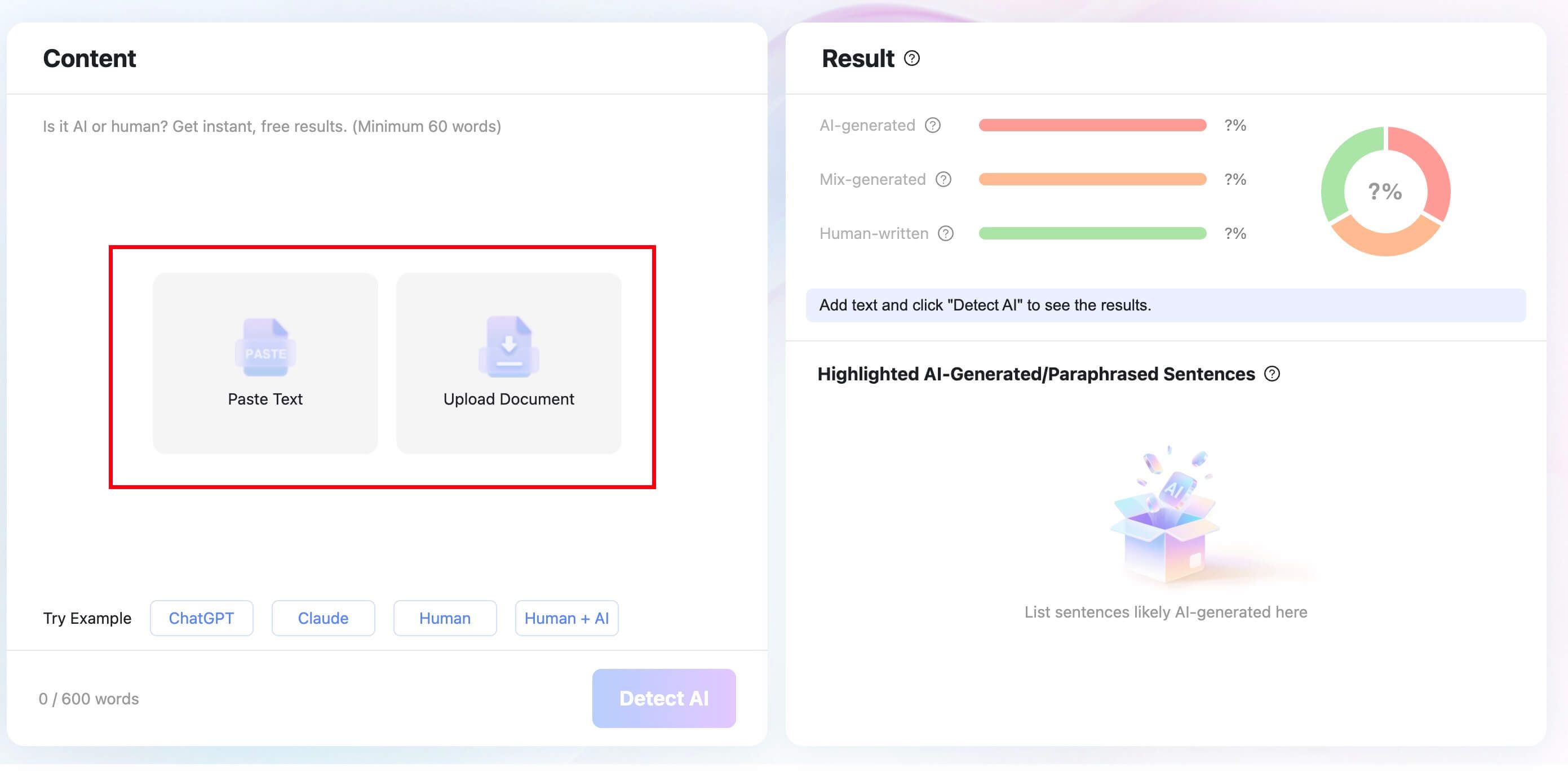
I would start with the introduction, comparison sections, product review sections, and final verdict. Those parts usually reveal whether the article has real editorial judgment or only polished filler.
Step 2. Click Detect AI
After the text is ready, click the Detect AI button. Lynote scans the writing and returns a breakdown across AI-generated, mixed, and human-written content.
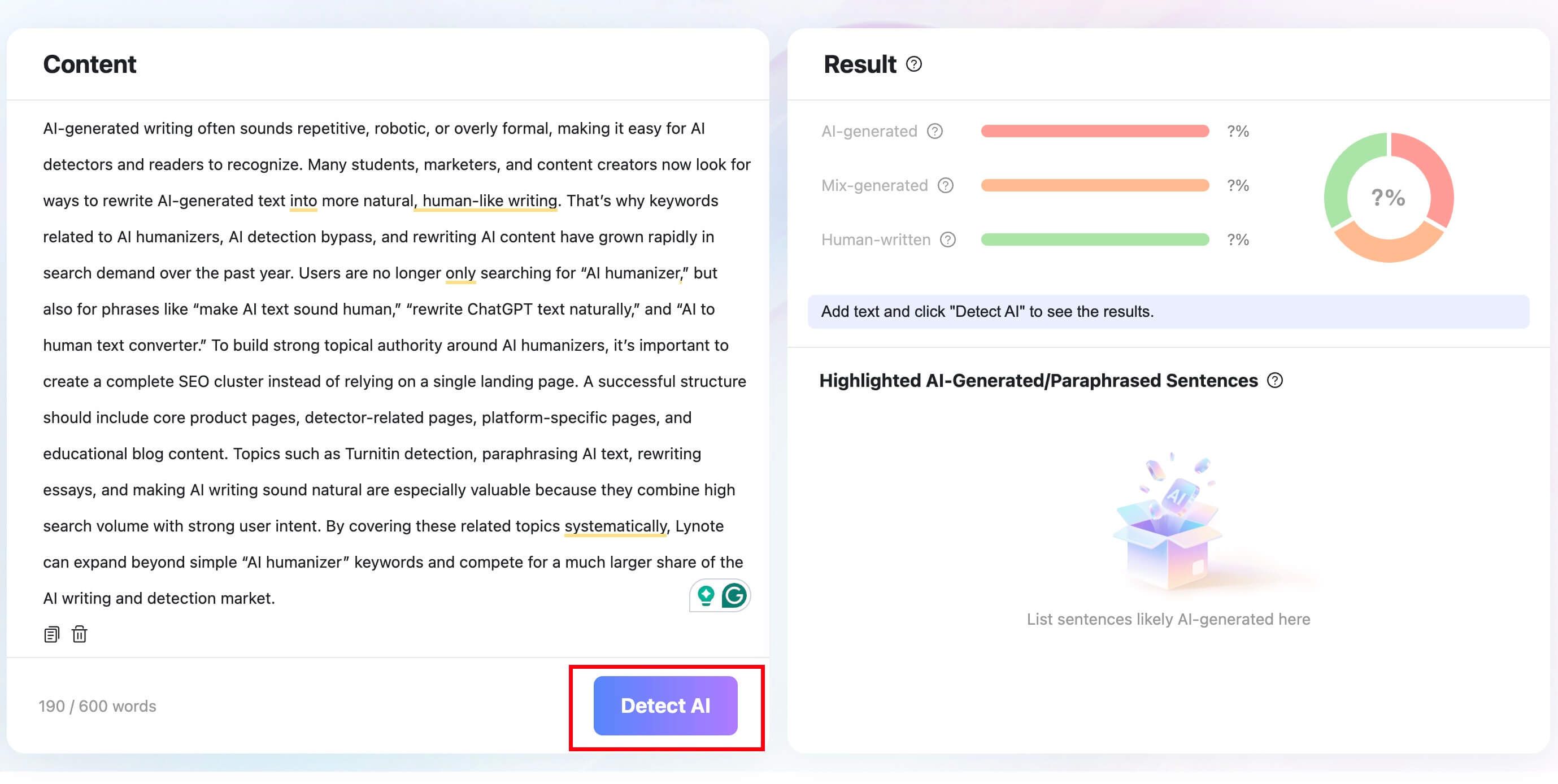
The mixed category is useful for SEO teams because it matches how modern content is actually produced. It gives an editor a more realistic review signal than a simple yes-or-no result.
Step 3. Review the Percentages and Sentence Highlights
Use the result as a revision map. Look at the AI-generated, mixed, and human-written percentages, then inspect the highlighted sentences that may need attention.
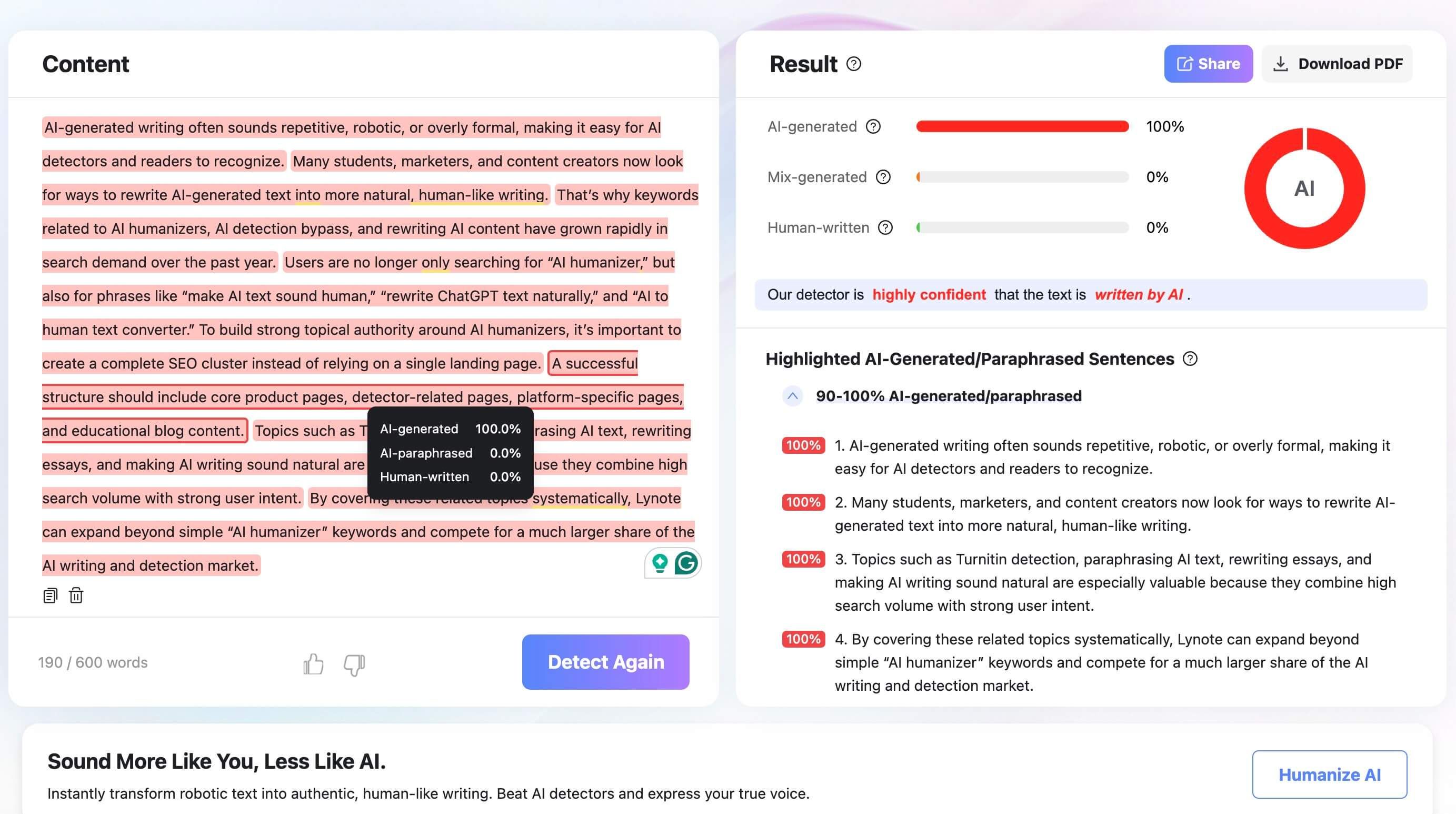
The goal is not to rewrite mechanically. The goal is to add specificity, remove filler, check claims, clarify your point of view, and make the draft more useful to the reader.
Step 4. Revise and Recheck
After editing, run the revised text again. A better detector result can be useful, but the real standard is whether the content now includes clearer evidence, better examples, and stronger editorial judgment.
This is where an AI detector becomes productive. It stops being a label and becomes part of the revision loop.

Who Should Use SEO.AI's Detector?
SEO.AI is a good fit for writers who want a fast check before sending a draft to an editor. It is also useful for content managers who need a quick first screen before reviewing a batch of articles.
Agencies can use it as a triage step, especially when reviewing outsourced drafts. A high score can tell the editor to inspect the piece more carefully before client delivery.
It is not a good fit as the only evidence in a dispute. If someone is being accused of using AI, losing payment, or having work rejected, a single AI detector result should not carry that decision alone.
It is also not a full SEO quality checker. A low AI score does not mean the article satisfies search intent, adds original value, uses accurate facts, or deserves to rank.
Best Use Cases by Scenario
| Scenario | Use SEO.AI? | Better workflow |
|---|---|---|
| Quick check before sending a draft | Yes | Use it as a fast warning signal. |
| Reviewing a long, suspicious outsourced article | Yes | Pair the score with manual editorial review. |
| Checking a short intro or product blurb | Maybe | Be careful because short text may produce weak signal. |
| Resolving a writer dispute | No, not by itself | Use multiple signals and ask for drafting context. |
| Improving a draft after a high score | Not enough alone | Use sentence-level review and revise for specificity. |
| Final SEO publication approval | No, not alone | Add fact-checking, intent review, internal links, examples, and human editing. |
This is the most practical way to use SEO.AI: let it start a review, not finish one.
FAQs About SEO.AI AI Content Detector
Is SEO.AI AI Content Detector free?
SEO.AI presents the detector as a free public tool. The workflow is built around pasting text and getting a probability score without a complex setup.
How accurate is SEO.AI AI Content Detector?
SEO.AI's page claims a 98.4 percent accuracy rate, but my small practical test was mixed. It caught highly repetitive AI-style samples, but it returned 0 percent AI probability for several realistic SEO-style passages.
Can SEO.AI detect ChatGPT, Claude, and Gemini text?
SEO.AI says its detector can identify text from major AI systems, including ChatGPT, GPT-4, Bard, Claude, and Gemini. In practice, detection performance can vary by text length, editing level, language, and writing style.
Can SEO.AI AI Content Detector be wrong?
Yes. SEO.AI's own page acknowledges false positives, and all AI detectors can produce misleading results. A detector score should be treated as a signal that deserves review, not a final judgment.
Is SEO.AI enough before publishing SEO content?
Not by itself. It can help with AI-risk screening, but final publication review should also include search intent, originality, factual accuracy, product detail, examples, internal links, and human editorial judgment.
What should I do if SEO.AI gives my article a high AI score?
Do not panic and do not rewrite only to lower the number. Read the draft carefully, look for generic sections, add specific examples, verify claims, improve sentence variety, and use a more actionable detector workflow if you need sentence-level guidance.
Final Verdict: How I Would Use SEO.AI in a Real SEO Workflow
I would use SEO.AI AI Content Detector as a fast first-pass check. It is simple, low-friction, and capable of catching some obvious repetitive AI-style text.
I would not use it as the final word on whether a draft is human-written or publishable. My small test showed that realistic SEO-style passages can return very low AI probabilities even when the prose still feels generic and needs editing.
For SEO teams, the best workflow is layered: use SEO.AI for quick screening, inspect the draft manually, verify claims, add firsthand details, and use a more granular review tool when you need to revise specific lines.
That is the healthier way to think about AI detection. The detector should support editorial judgment, not replace it.

Written by Janet L. Harris
AI Writing Specialist
Janet reviews AI detectors and humanization tools, with a focus on accuracy, limitations, and responsible use. View all articles →