

When students and writers search for how to bypass Turnitin AI detection, they are usually looking for a quick fix to lower their AI score. The short answer is that no tool or trick can reliably promise a zero AI detection rate on Turnitin. While people try paraphrasing tools and synonym swapping, these methods often fail because Turnitin looks for deep structural patterns rather than just specific words. The safest approach is not trying to trick the system, but rather revising your draft to include original reasoning, unique structure, and proper citations.
What People Mean by “Bypass Turnitin AI Detection”
The phrase "bypass Turnitin AI detection" means different things depending on who you ask. For some, it is an attempt to hide fully AI-generated essays from their professors or teachers. For others, it is a defensive measure against the fear of false positives in their completely original work.
Many writers use AI as a brainstorming partner but worry that their final draft still sounds robotic. In these cases, bypassing detection really means revising AI-like prose until it reflects a natural human voice. Understanding this distinction is crucial because relying on evasion tricks carries severe academic risks, while ethical revision improves your actual writing skills.

Common Methods Students Try to Avoid Turnitin AI Detection
Students often experiment with several tactics to avoid triggering Turnitin's AI flags. One popular approach is running AI-generated text through a basic paraphrasing tool to swap out common words for synonyms. Others try inserting intentional typos or grammatical errors, hoping the flaws will make the text appear more human.
More advanced attempts involve using dedicated AI humanizers that restructure sentences to lower predictability scores. Finally, some writers rely on manual rewriting, adding personal anecdotes or course-specific examples to ground the text. While these methods are widely discussed online, their effectiveness varies wildly, and some can actually harm the overall quality of the writing.
The important distinction is whether a change improves the substance of the paper or merely changes its surface. Surface edits may alter a detector score, but they do not add comprehension, evidence, or academic ownership. Substantive revision changes the argument itself by adding sources, clarifying the thesis, and rebuilding the structure around what you actually understand.
Which Methods Usually Fail and Why
Most surface-level edits fail because Turnitin does not just look for specific vocabulary words. Instead, it analyzes the predictability of the sentence structure, the variation in sentence length, and the logical transitions between ideas. When you simply swap synonyms or use a basic spinner, the underlying AI-generated framework remains intact.
Inserting intentional typos is also highly ineffective and immediately lowers the academic quality of your paper. Furthermore, professors often spot these unnatural phrasing choices even if a detector misses them. The table below outlines why common evasion tactics typically fall short, based on an editorial heuristic of AI detection mechanics.
| Method | How It Works | Why It Fails |
|---|---|---|
| Synonym Swapping | Replaces common words with alternatives. | Leaves the predictable AI sentence structure and logic completely intact. |
| Intentional Typos | Adds spelling or grammar mistakes. | Lowers your grade and rarely fools advanced structural analysis models. |
| Basic Paraphrasing | Uses software to spin paragraphs lightly. | Preserves the original robotic transitions and lacks human voice variability. |
| Font Tricks | Hiding white text or special characters. | Modern systems strip formatting and extract raw text, making this useless. |

What Turnitin and Instructors Actually Evaluate
Turnitin is only one part of the review process. In academic settings, a suspicious AI score usually leads to a closer human review rather than an automatic conclusion. That means your writing can be questioned for reasons that have nothing to do with the percentage shown by a detector.
Instructors often compare the submitted paper with your earlier writing, assignment draft history, class participation, and ability to explain the argument. A paper that has a polished tone but weak source integration can still raise concern. Likewise, a paper with a low detector score can still feel suspicious if the reasoning does not match your previous work.
| Review Signal | What It Suggests | How to Strengthen the Draft |
|---|---|---|
| Sudden voice shift | The paper sounds unlike your previous assignments. | Rewrite key sections in your normal vocabulary and sentence rhythm. |
| Generic evidence | The argument could fit almost any class. | Add course readings, lecture details, and assignment-specific examples. |
| Weak citation trail | Sources appear disconnected from the claims. | Verify every citation manually and explain how each source supports the point. |
| No draft history | It is harder to show how the paper developed. | Keep outlines, notes, rough drafts, and revision comments. |
| Poor oral explanation | The writer may not fully understand the submitted argument. | Practice explaining your thesis, evidence, and counterargument in plain language. |
Does Paraphrasing Help With Turnitin AI Detection?
Light paraphrasing rarely helps you avoid Turnitin AI detection. If you only change a few words per sentence, the overall rhythm and predictable logic of the AI output remain unchanged. Turnitin's detection models are specifically trained to recognize these persistent structural patterns.
However, deep manual paraphrasing based on true comprehension is different. When you read a concept, internalize it, and rewrite it entirely from scratch using your own voice, the text naturally loses its AI-like signals. The key difference is that genuine rewriting introduces human variability, whereas automated paraphrasing just applies a fresh coat of paint to a robotic structure.
Does Humanizing AI Text Work Against Turnitin?
AI humanizers are designed to adjust sentence length, vocabulary predictability, and structural variation to mimic human writing. These tools can certainly improve the readability of an AI-assisted draft by removing repetitive transitions and generic phrasing. Some humanizers may change the resulting detection signals, but they cannot promise reliable outcomes against enterprise tools like Turnitin.
It is important to remember that Turnitin updates its detection models continuously to adapt to new humanization techniques. Therefore, relying solely on a humanizer to beat a detector is a risky strategy. Instead, view humanizers as a drafting aid to help you refine stiff text before you add your own original insights.
How to Lower AI-Like Writing Signals Without Cheating
The most reliable way to avoid detection issues is to ensure your writing is genuinely original and deeply researched. Start by integrating specific course materials, class discussions, and unique evidence that an AI language model would not know. Adding personal reasoning and critical analysis naturally disrupts the predictable patterns that detectors look for.
Additionally, ensure your citations are accurate and properly formatted, as AI often hallucinates sources or integrates them poorly. Reviewing your structure to ensure it flows logically rather than following a rigid, formulaic template also helps. Use the checklist below to evaluate your draft for common AI-like signals.
| Signal to Check | How to Fix It |
|---|---|
| Generic statements | Replace vague claims with specific evidence from course readings. |
| Repetitive sentence structure | Vary your sentence lengths and combine short, choppy ideas. |
| Lack of citations | Manually verify and insert proper academic references for all facts. |
| Formulaic transitions | Remove robotic phrases like "In conclusion" or "It is important to note." |
Before you submit, run one final human review pass. Read the introduction and conclusion out loud to confirm they sound like the same person. Check whether every paragraph advances the thesis rather than simply restating the prompt. Finally, make sure your strongest examples come from sources you can explain without relying on the draft in front of you.
Lynote Workflow: Detect, Rewrite, and Review Your Draft
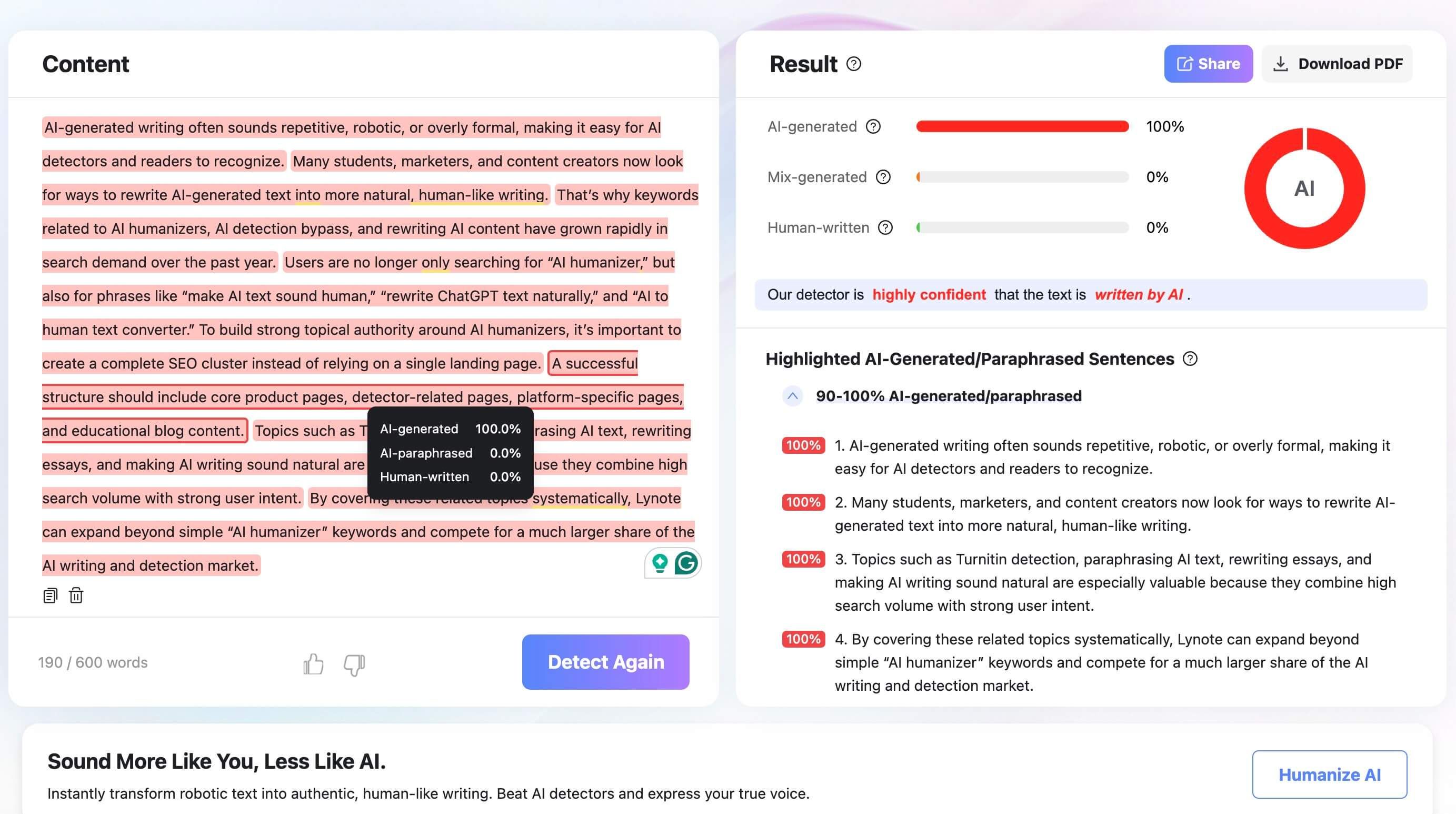
If you want to check your original writing for accidental robotic phrasing, the Lynote AI Detector provides a helpful baseline. It breaks down your text into AI-generated, mixed, and human-written percentages, offering sentence-level highlights so you know exactly where your phrasing feels unnatural. Remember to treat these results as a helpful signal rather than definitive proof of authorship.
If certain passages remain stiff, the Lynote AI Humanizer can help rewrite them for better clarity and flow. This tool offers Balanced, Focus, and Advanced modes to restructure your text while preserving its original meaning. By combining these tools with your own manual review, you can confidently refine your drafts.
Step 1: Check Your Draft with Lynote AI Detector
Access the Lynote AI Detector and either paste your text or upload a supported document like a .docx or .pdf file.
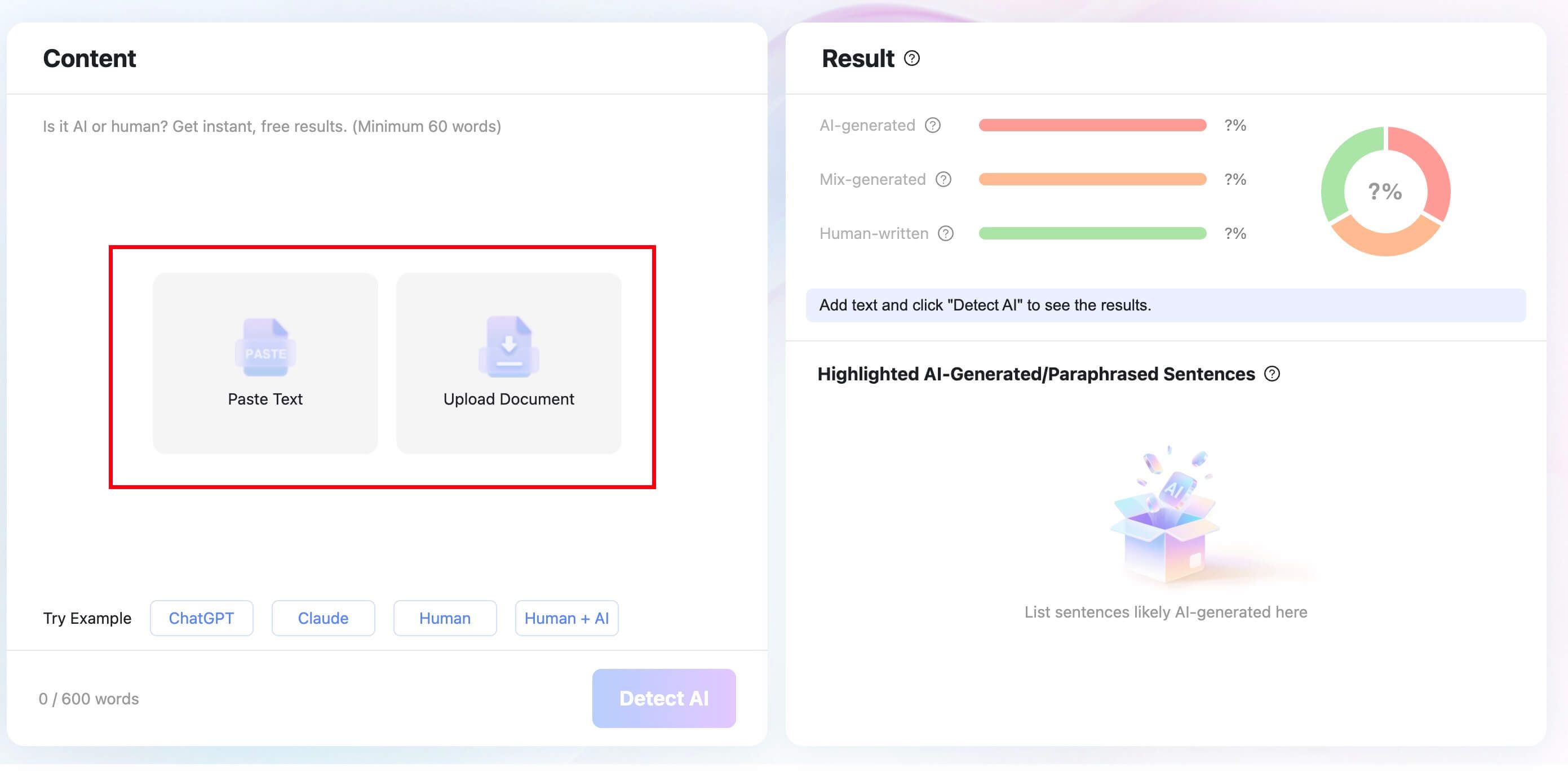
Click the "Detect AI" button to scan your content for linguistic patterns.
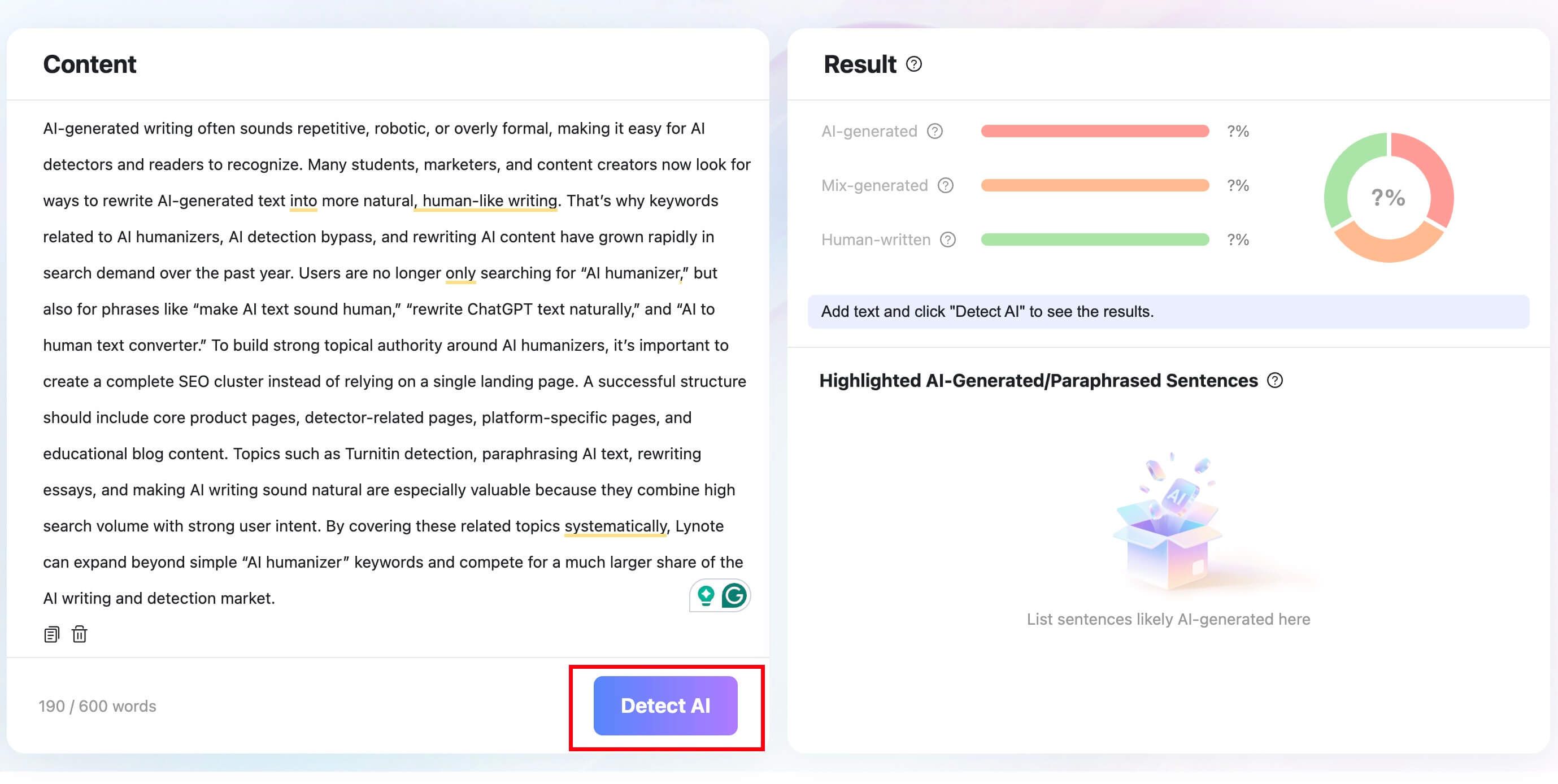
Review the detailed report and sentence-level highlights to identify areas that need manual revision. The result screen also includes Copy, Download, and Humanize AI actions; if you click Humanize AI, the text can move into the humanizer flow for rewriting.
Step 2: Refine Stiff Text with Lynote AI Humanizer
If you need help rephrasing a highlighted section, open the Lynote AI Humanizer. Paste the stiff text into the input box and select your preferred rewriting intensity, such as the Balanced mode. Click "Humanize" to generate a more natural version of the text, which you can then edit further to match your unique voice.
FAQs About Bypassing Turnitin AI Detection
What is the short answer for how to bypass Turnitin AI detection? There is no reliable way to bypass Turnitin. The safest approach is writing original content, citing sources properly, and manually revising AI-assisted drafts to include your unique human voice and critical analysis.
Can paraphrasing or humanizing text avoid AI detection? While paraphrasing tools and AI humanizers can alter the predictability of your text, they cannot promise a zero percent detection score. They may change the detection signals, but Turnitin frequently updates its models to identify automated rewriting.
Can AI detectors be wrong? Yes, AI detectors can produce false positives, especially with highly structured writing, non-native English, or formulaic academic prose. This is why detector results should always be treated as a signal for review rather than absolute proof of cheating.
What is a safer way to revise AI-like writing? A safer revision method involves injecting personal insights, specific course materials, and unique structural choices into your draft. Manual review ensures your arguments are supported by real evidence and reflect genuine comprehension.
How can Lynote help with this workflow? The Lynote AI Detector highlights sentences that read like AI, giving you a clear signal on what to review. You can then use the Lynote AI Humanizer to help rephrase stiff sections into natural prose before adding your final manual edits.
Final Verdict
Ultimately, trying to bypass Turnitin AI detection with quick tricks or basic paraphrasing is a risky and unreliable strategy. Detectors analyze deep structural patterns that automated spinners and synonym swappers simply cannot hide. The most effective and ethical path forward is focusing on the quality of your writing.
By integrating original research, personal analysis, and proper citations, you naturally eliminate the predictable signals that trigger AI flags. Use tools like AI detectors and humanizers as revision aids to improve your clarity, not as a crutch to evade academic standards. In the end, genuine comprehension and authentic writing will always be your best defense.

Written by Janet L. Harris
AI Writing Specialist
Janet reviews AI detectors and humanization tools, with a focus on accuracy, limitations, and responsible use. View all articles →