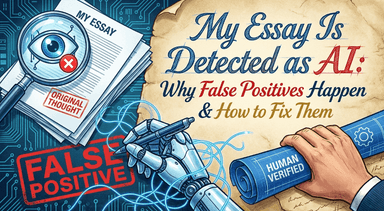


Are you wondering if Originality.ai is the most accurate AI detector for your content team? In this comprehensive Originality AI review, we evaluate its strict detection models, pricing structure, and real-world accuracy. Built for publishers, agencies, and SEO professionals, Originality.ai excels at catching synthetic text from ChatGPT, Claude, and Gemini. However, its strictness can sometimes flag human writing, requiring a careful editorial review process. Read on to discover if this premium tool is worth the investment for your editorial workflow, how its credit math works, and what alternatives exist.

The digital publishing landscape has fundamentally changed since the widespread release of generative artificial intelligence. Content teams, search engine optimization professionals, and digital agencies are now flooded with synthetic text. This massive influx of automated content has created an urgent need for reliable gatekeepers to maintain editorial standards. Publishers are increasingly terrified of algorithmic demotions and a loss of brand trust due to low-quality, robotic writing.
Originality.ai emerged early in this generative AI boom, positioning itself as the premier defense against synthetic content. Unlike basic free checkers found across the web, this platform was built specifically for serious content operations managing high volumes of text. It promises to identify not just raw AI output, but also text that has been lightly edited or passed through paraphrasing tools. For editors managing dozens of freelance writers, this kind of automated oversight feels like a massive operational advantage.
However, evaluating an AI detector requires looking past the marketing claims to understand how the technology actually functions in a daily workflow. Any thorough review must examine the tool's strictness, its pricing model, and the very real danger of false positives. Relying blindly on automated scores can damage relationships with talented human writers and disrupt content pipelines. A detector score is always a signal, never a conclusive proof of cheating.
This comprehensive review breaks down everything you need to know about Originality.ai before integrating it into your editorial process. We will explore its feature set, analyze its internal accuracy claims, and decode the math behind its credit-based pricing system. By the end of this analysis, you will know exactly whether this tool is the right fit for your specific content needs.
| Category | Details |
|---|---|
| Best For | Publishers, content agencies, and SEO teams managing large volumes of freelance content. |
| Standout Features | Deep Scan, Plagiarism Checker, Fact Checker, Chrome/Google Docs extensions, API access. |
| Biggest Drawback | Strict detection models (Turbo) can flag highly formulaic human writing or ESL content as AI. |
| Pricing | Starts at $30 (Pay-as-you-go for 3,000 credits) or $14.95/month (Pro plan). |
What is Originality.ai?
Originality.ai is far more than a simple copy-and-paste text checker for casual users. It is a comprehensive content integrity platform designed specifically for web publishers, digital marketing agencies, and professional editors. The platform aims to be an all-in-one quality control dashboard that verifies the authenticity and originality of written material before it is published. Rather than just looking for robotic phrasing, it attempts to analyze the underlying structure of the text to predict its origin.
At its core, the platform features a highly sensitive AI detection engine trained to recognize the output of major large language models. According to vendor claims, the tool is continuously updated to detect text from GPT-4, Gemini, Claude, and other emerging models. This constant updating is crucial, as generative AI models are evolving rapidly, and older detection tools quickly become obsolete. Originality.ai positions itself as a tool that evolves alongside the AI industry to maintain its defensive capabilities.
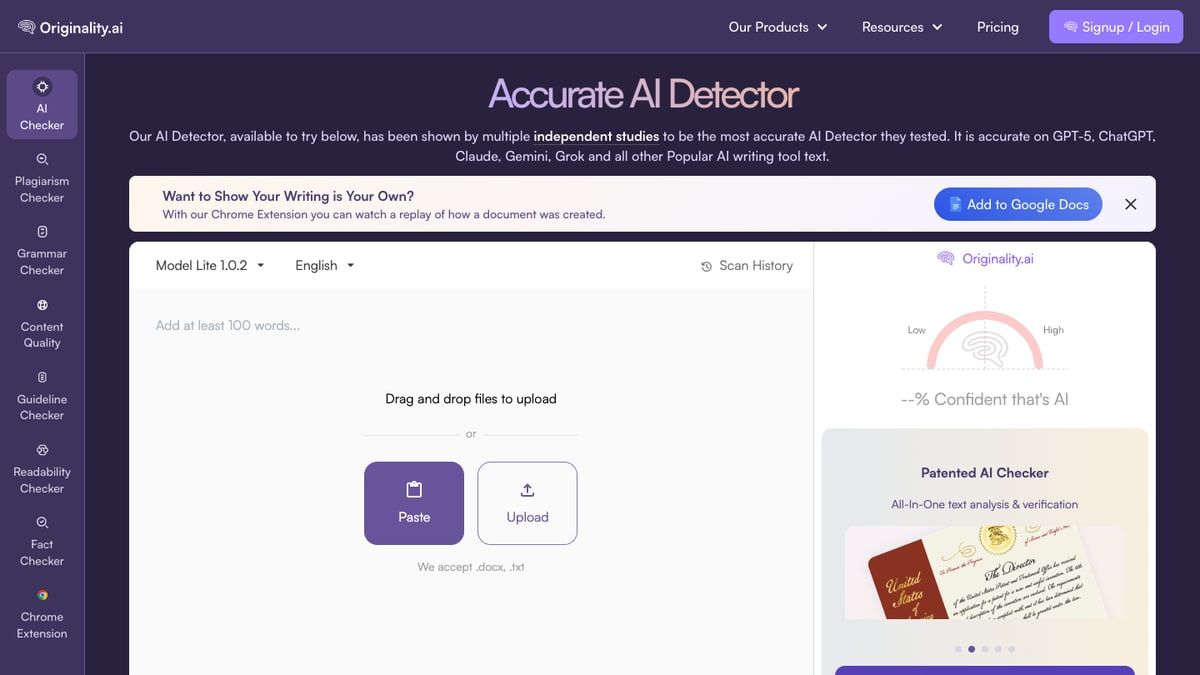
Beyond simple AI detection, Originality.ai includes a robust suite of editorial tools designed to streamline the publishing workflow. It features a built-in plagiarism checker that scans the web to ensure content is not duplicated from existing sources. This is a critical feature for SEO professionals, as duplicate content can severely harm search engine rankings. By combining AI detection and plagiarism checking into a single scan, the platform saves editors significant time during the review process.
The platform also offers additional features like readability checking, fact-checking, and grammar analysis to provide a holistic view of content quality. For teams working directly in content management systems, Originality.ai provides a WordPress plugin and extensions for Chrome and Google Docs. These integrations allow editors to check content directly within their native workflows rather than constantly switching between browser tabs. Furthermore, the platform offers an API, enabling large enterprise teams to automate the scanning process across thousands of documents.
It is important to note who Originality.ai is not built for. The platform is not tailored for the academic market, meaning it lacks deep integrations with learning management systems like Canvas or Blackboard. It is also not ideal for casual students or solo hobbyist writers who only need to check a few paragraphs a month. The tool’s interface, pricing structure, and feature set are unapologetically geared toward commercial content operations that require scale, team management, and historical scan data.
How to Interpret the Originality.ai Score
One of the most widespread misconceptions in the digital publishing industry revolves around how to read an AI detector's results. When users see a score of 90% on an Originality.ai scan, they frequently assume that 90% of the words in the document were generated by artificial intelligence. This fundamental misunderstanding leads to unfair accusations, editorial confusion, and a breakdown in trust between editors and writers. It is vital to understand exactly what the platform's metrics actually represent.
An Originality.ai score is a confidence score, not a literal percentage of the document's volume. If a document receives a 90% AI score, it means the detection model is 90% confident that the text, as a whole, was generated by AI. It is a prediction of probability based on the text's perplexity and burstiness, comparing the writing patterns to known LLM outputs. Therefore, a high score indicates a strong likelihood of AI involvement, but it does not mean the writer simply copied and pasted nine out of ten paragraphs.
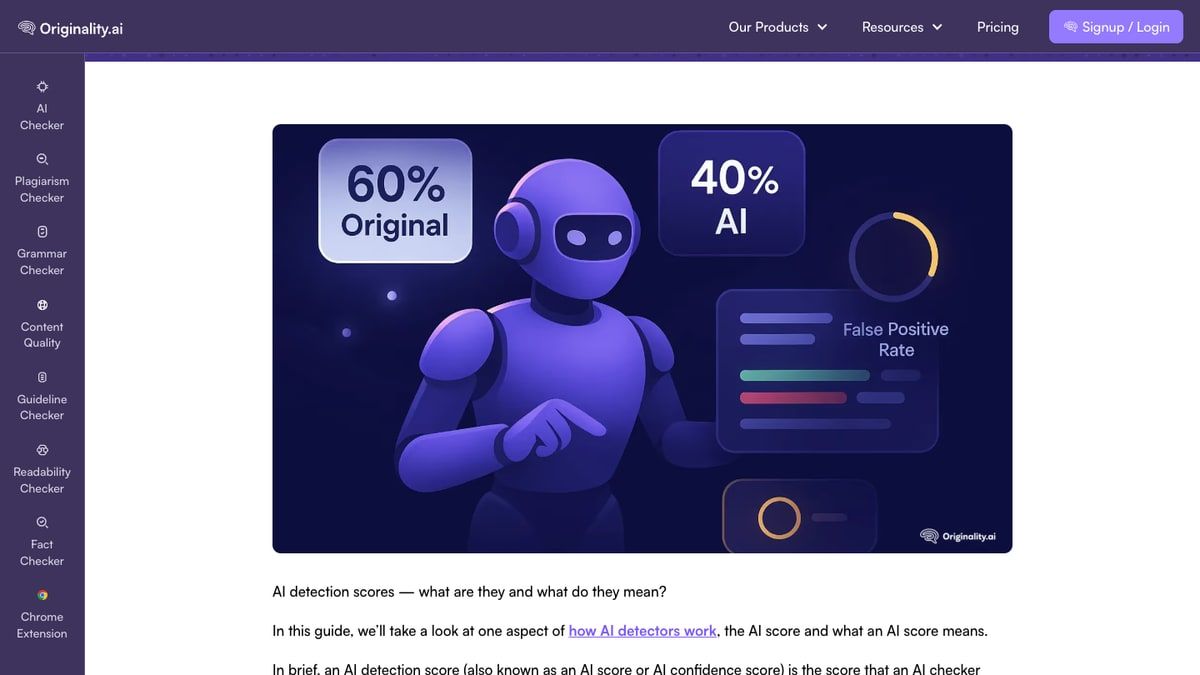
To help editors pinpoint problematic areas, Originality.ai offers sentence-level highlighting within the scanned document. The tool color-codes specific sentences, visually indicating which parts of the text triggered the AI detection algorithms. This feature is incredibly useful for editors trying to determine if a writer used AI to draft an entire article or just used it to generate a single concluding paragraph. It allows for a more nuanced editorial review rather than a blanket rejection of the entire piece.
However, editors must approach this sentence-level highlighting with a high degree of professional caution and critical thinking. Because the tool is analyzing patterns and predictability, highly formulaic human writing can sometimes trigger the highlights. A writer who uses repetitive transition phrases, standard corporate jargon, or highly structured lists might see their entirely human work flagged. The highlights should be viewed as areas requiring human editorial review, not as conclusive proof of a writer's dishonesty.
Ultimately, interpreting the score requires a balanced, human-in-the-loop approach to content management. Editors should use the Originality.ai score as a preliminary signal to initiate a conversation with the writer, rather than an automated firing mechanism. If a trusted writer submits a piece that flags highly for AI, the editor should review the highlighted sentences, check the document's version history, and ask the writer about their drafting process. A detector score is a valuable piece of evidence, but editorial judgment must always remain the final arbiter.
Accuracy Claims vs. Real-World Limitations
When evaluating any AI detection software, it is crucial to separate the vendor's internal marketing claims from the messy reality of daily content operations. Originality.ai is very transparent about its internal testing, publishing detailed studies on its own accuracy metrics. The platform currently offers different detection models to suit various strictness preferences, primarily the Lite model, the Turbo model, and the Academic model. Each of these models is tuned differently to balance the detection of AI against the risk of flagging human writers.
According to the vendor's stated claims, the Lite model demonstrates a 99% accuracy rate with a very low false-positive rate of around 0.5%. This model is designed for teams that want to catch blatant, unedited AI content while minimizing the risk of falsely accusing human writers. It is generally considered the safer option for agencies that prioritize writer relationships and want to avoid unnecessary editorial friction. The Lite model is excellent at catching raw ChatGPT output but may struggle if the text has been heavily edited.
For more aggressive detection, Originality.ai offers the Turbo model, which the vendor claims achieves 99%+ accuracy against the latest LLMs. The Turbo model is specifically engineered to catch AI content that has been passed through paraphrasing tools or so-called humanizers. However, this increased sensitivity comes with a trade-off, as the vendor notes a slightly higher false-positive rate of around 1.5%. In real-world applications, this strictness means that editors will catch more hidden AI, but they will also have to investigate more false alarms.
Despite these impressive internal metrics, real-world limitations inevitably complicate the detection process. One of the most significant challenges for Originality.ai is the evaluation of highly formulaic human writing. Technical documentation, legal disclaimers, standard operating procedures, and heavily optimized SEO content often lack the natural variance of conversational human text. Because this writing is inherently predictable, the detection algorithms can easily misinterpret it as machine-generated, leading to frustrating false positives.
Another critical real-world limitation involves content written by individuals who speak English as a second language (ESL). ESL writers often rely on standardized grammatical structures, simpler vocabularies, and common phrasing to ensure their writing is clear and correct. Unfortunately, these exact characteristics are the primary markers that AI detectors look for when flagging synthetic text. Consequently, ESL writers face a disproportionately higher risk of having their original work falsely flagged by strict models like Turbo.
Because of these inherent limitations, it is vital to remember that no AI detector is flawless. The technology is engaged in a constant arms race with generative AI models that are specifically designed to mimic human writing more convincingly every day. Content managers must acknowledge these real-world constraints and build editorial policies that account for the possibility of algorithmic error. Relying entirely on a machine to judge human effort is a fundamentally flawed approach to modern publishing.
Where Originality.ai Feels Stricter Than Other Detectors
If you have tested multiple AI detection tools, you will quickly notice that Originality.ai often returns higher AI probability scores than its competitors. This is not an accident; the platform is intentionally engineered to be highly aggressive in its scanning protocols. The developers have prioritized catching sophisticated, heavily edited AI content over maintaining a completely frictionless user experience. For content managers, understanding where this strictness manifests is crucial for setting realistic editorial expectations.
One area where Originality.ai feels notably stricter is in its handling of standard B2B marketing copy. Business-to-business writing often relies on industry-specific jargon, structured formatting, and highly optimized keyword placement. Because this type of writing is designed to be easily scannable and highly predictable, Originality.ai's Turbo model frequently flags it as synthetic. Writers who produce highly structured listicles or technical guides often find themselves battling the detector, even when their work is entirely original.
Another specific trigger for Originality.ai's strict algorithms is the use of common transition phrases and predictable sentence openings. Phrases like "Furthermore," "In conclusion," "It is important to note," and "Additionally" are heavily favored by large language models. When a human writer naturally uses these transitions to bridge their paragraphs, the detector's confidence score can spike dramatically. This forces writers to artificially alter their natural cadence just to bypass the software, which can sometimes degrade the overall quality of the writing.
The platform is also exceptionally strict when evaluating short-form content, such as product descriptions or social media captions. AI detectors rely on analyzing large sample sizes of text to accurately measure perplexity and burstiness. When given only a few sentences to analyze, the mathematical models lack the necessary context to make a highly confident prediction. As a result, Originality.ai tends to err on the side of caution, frequently flagging short, punchy marketing copy as potentially AI-generated.
Finally, Originality.ai's strictness is highly evident when dealing with content that has been run through grammar-checking tools like Grammarly. Many writers use these tools to polish their syntax, correct passive voice, and standardize their punctuation. However, this polishing process removes the natural quirks and variations that AI detectors look for in human writing. Consequently, a heavily Grammarly-edited human article will often trigger a much higher AI score on Originality.ai than the raw, unedited draft.
Pricing and Credit Math: Is It Worth It?
Understanding the value of Originality.ai requires a deep dive into its pricing structure and the specific credit math that dictates how much scanning actually costs. Unlike some software-as-a-service platforms that offer unlimited usage for a flat monthly fee, Originality.ai operates on a strict credit-based system. This means that every time you scan a document, you are spending a specific amount of your purchased digital currency. For high-volume publishers, calculating these costs accurately is essential for maintaining a profitable content operation.
The fundamental rule of Originality.ai's pricing math is that one credit equals 100 words of scanned text. Therefore, scanning a standard 1,000-word blog post will consume exactly 10 credits from your account balance. If you are running multiple scans on the same document—for example, checking it once, asking the writer for revisions, and then checking it again—you will pay for those words twice. This credit consumption applies to all the core features, meaning AI detection and plagiarism checks draw from the same pool of resources.
| Plan | Cost | Credits Included | Best For |
|---|---|---|---|
| Pay-as-you-go | $30 (one-time) | 3,000 credits (approx. 300,000 words) | Occasional users and solo writers. |
| Pro | $14.95 / month | 2,000 credits / month | Active editors, small publishers, and bloggers. |
| Enterprise | $179 / month | Custom / High Volume | Large agencies, API users, and team management. |
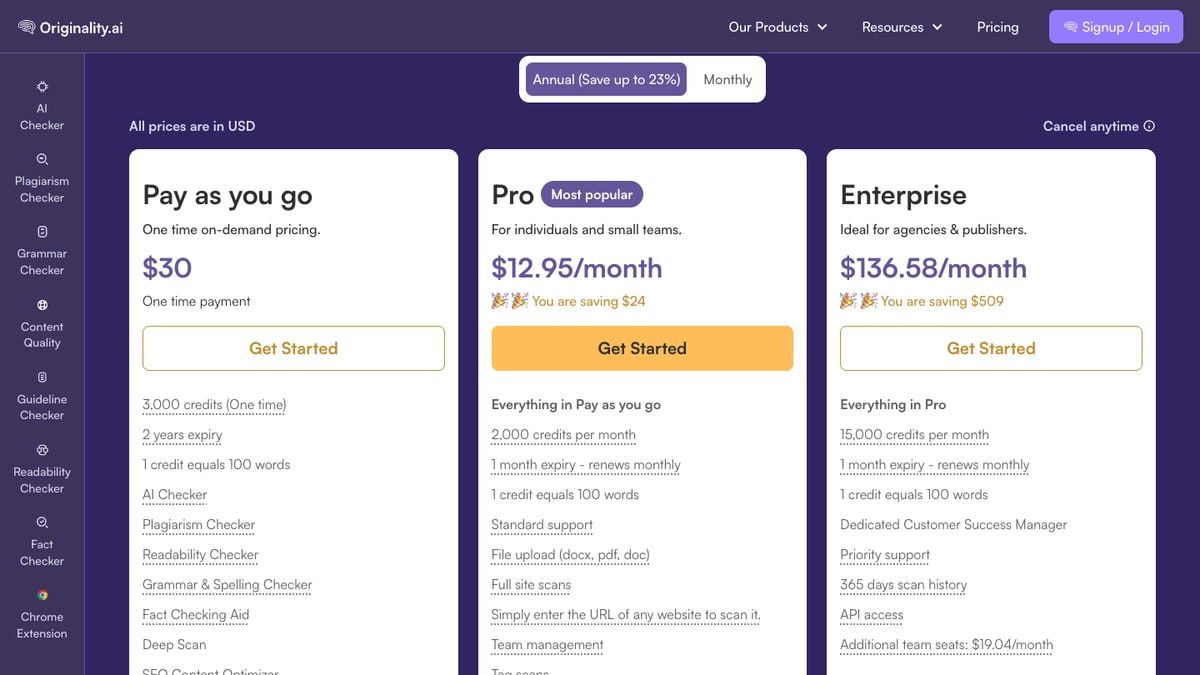
For users with lower volume needs, the platform offers a Pay-as-you-go option listed at a one-time fee of $30. This purchase grants the user 3,000 credits, which translates to approximately 300,000 words of scanning capacity. This tier is highly attractive for solo freelance writers or small business owners who only publish a few articles a month. It is important to note that these pay-as-you-go credits expire after two years, which is a generous window but still requires eventual usage.
For more active content teams, the Pro plan is listed at $14.95 per month, or slightly cheaper if billed annually at $12.95 per month. This subscription provides 2,000 credits per month (covering 200,000 words) and unlocks essential features like a 30-day scan history and document sharing. The Pro plan is generally the sweet spot for boutique marketing agencies and independent publishers who need regular, reliable access to the tool. It provides enough volume for daily editorial work without requiring a massive upfront financial commitment.
At the highest tier, the Enterprise plan is listed at $179 per month and is designed for large-scale operations that require deep integration. This plan is crucial for teams that need API access to automate their scanning processes directly within their own custom software or content management systems. It also offers advanced team management features, allowing administrators to add multiple team members and track usage across different departments. For massive digital agencies processing thousands of articles a week, the Enterprise tier is the only viable option to maintain workflow efficiency.
Strengths and Limitations
Evaluating Originality.ai requires a balanced look at where the platform excels and where its inherent limitations become apparent. For web publishers, SEO professionals, and content agencies, the tool's strengths are highly apparent and directly address the pain points of modern digital publishing. The platform's ability to combine strict AI detection with a robust plagiarism checker saves editors immense amounts of time. Instead of running content through multiple disparate tools, a single scan provides a comprehensive health check on the document's originality.
One of the platform's most significant strengths is its Deep Scan feature and its focus on workflow integration. The Chrome extension and Google Docs add-on allow editors to view the creation history of a document, tracking the writer's keystrokes and editing patterns. This writer process evidence is incredibly valuable when a document is flagged for AI, as it allows the editor to see if the text was typed out naturally or pasted in large chunks. Furthermore, the ability to bulk scan multiple documents at once is a massive time-saver for agencies processing large batches of freelance submissions.
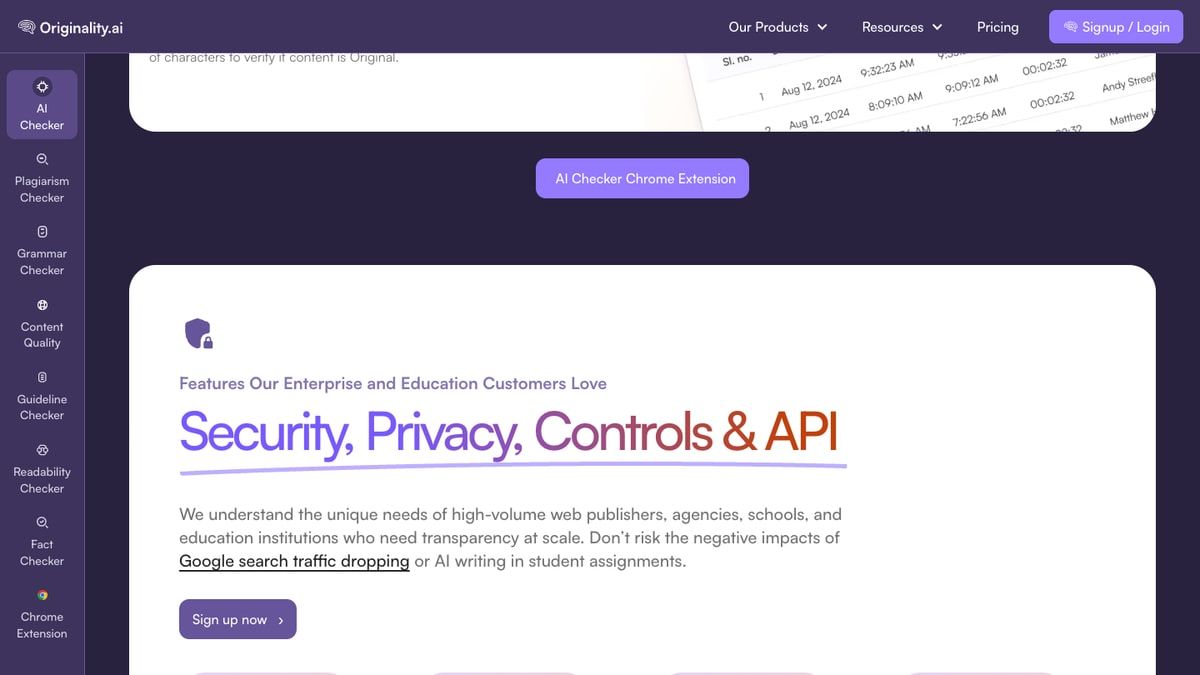
However, these powerful features come with notable limitations, particularly when the tool is used outside of its intended commercial context. Originality.ai is not designed for high-stakes academic environments, and using it to evaluate student essays is highly risky. The strictness of the Turbo model, while excellent for catching lazy SEO spam, can easily flag a student's heavily researched, rigidly structured academic paper. Educational institutions require tools integrated deeply into their grading software, with models specifically trained on student writing, which Originality.ai does not prioritize.
The most critical limitation of Originality.ai—and indeed any AI detector—is the danger of using its scores for absolute, high-stakes decisions. Firing a long-term freelance writer, denying payment for an article, or publicly accusing someone of cheating based solely on an automated score is a dangerous practice. The inherent risk of false positives means that innocent writers will occasionally be caught in the crossfire of the AI detection algorithms. Content managers must implement dispute resolution processes and use the tool as a diagnostic instrument rather than an automated judge and jury.
Ultimately, the strength of Originality.ai lies in its ability to act as a highly efficient filter for commercial content pipelines. It excels at identifying low-effort, synthetic text that could harm a website's search engine rankings and brand reputation. But its limitations become glaringly obvious when users forget that the tool is making mathematical predictions, not absolute factual determinations. Recognizing these boundaries is the key to successfully integrating the platform into a healthy, productive editorial environment.
Using Lynote AI Detector as a Second Signal
Because no single AI detection tool is infallible, the most sophisticated content teams are moving away from relying on a single point of failure. When an editor encounters a document that triggers a high AI score on Originality.ai, making an immediate, harsh decision is often a mistake. Instead, best practices dictate implementing a multi-tool workflow to cross-reference the results and gather more context. By using a secondary tool to evaluate the flagged text, editors can make much more informed, nuanced decisions about how to proceed.
In this advanced workflow, Originality.ai acts as the primary gatekeeper, scanning every piece of content that enters the editorial pipeline. If a document passes the initial scan, it moves forward to publication without delay. However, if the Turbo model flags a document, the editor does not immediately reject it. Instead, they isolate the specific sentences or paragraphs that were highlighted and run them through a secondary analysis tool. This is where integrating Lynote AI Detector becomes an invaluable step in the editorial revision process.
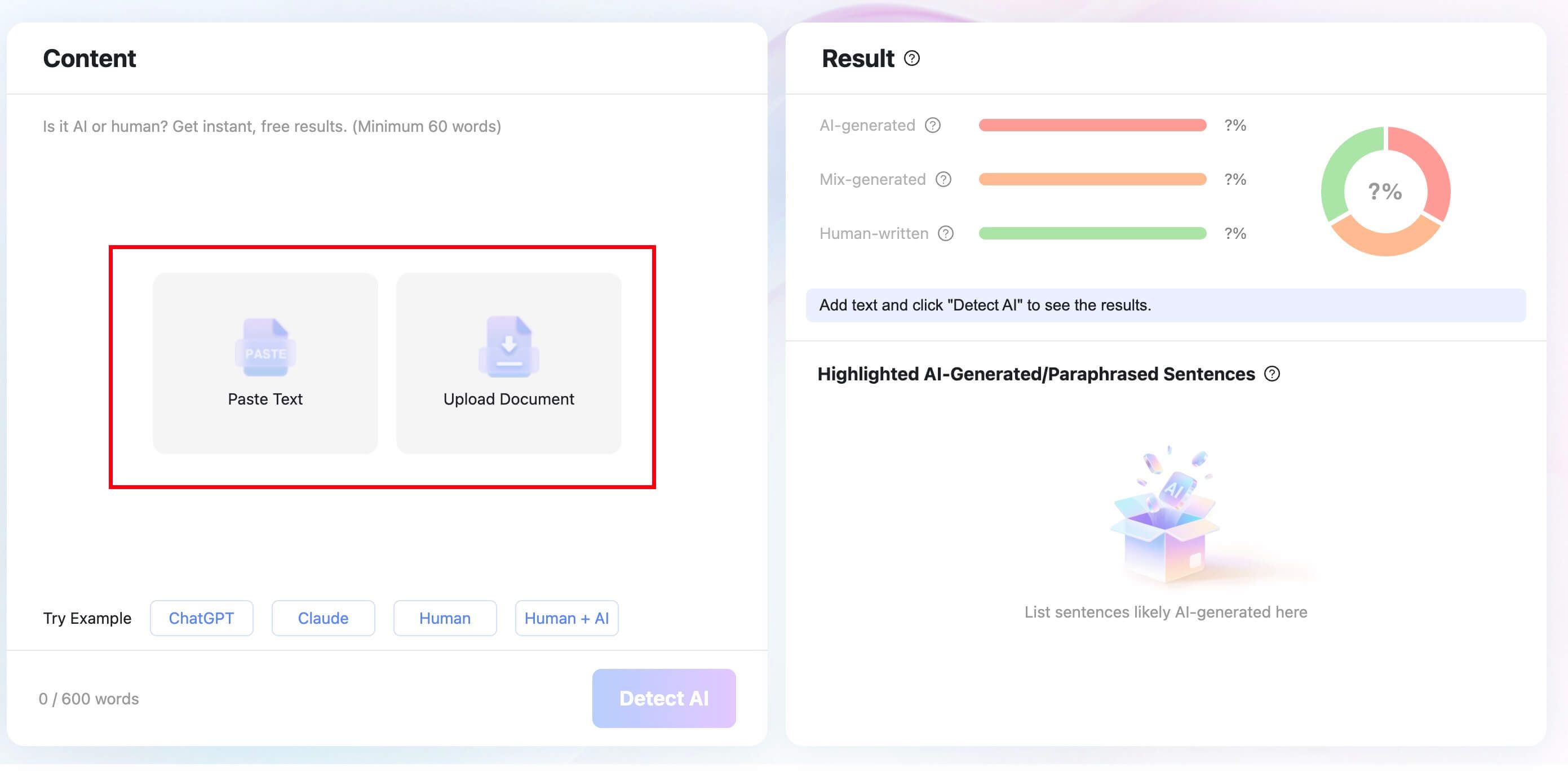
Step 1. Paste or Upload the Flagged Text
When Originality.ai highlights specific paragraphs as potentially AI-generated, the first step is to isolate that exact text. Copy the flagged sections from your original document and paste them directly into the Lynote interface. By focusing only on the problematic areas rather than the entire document, you can get a much clearer picture of what is triggering the algorithms. This targeted approach prevents the overall score from being skewed by the surrounding, unflagged human text.
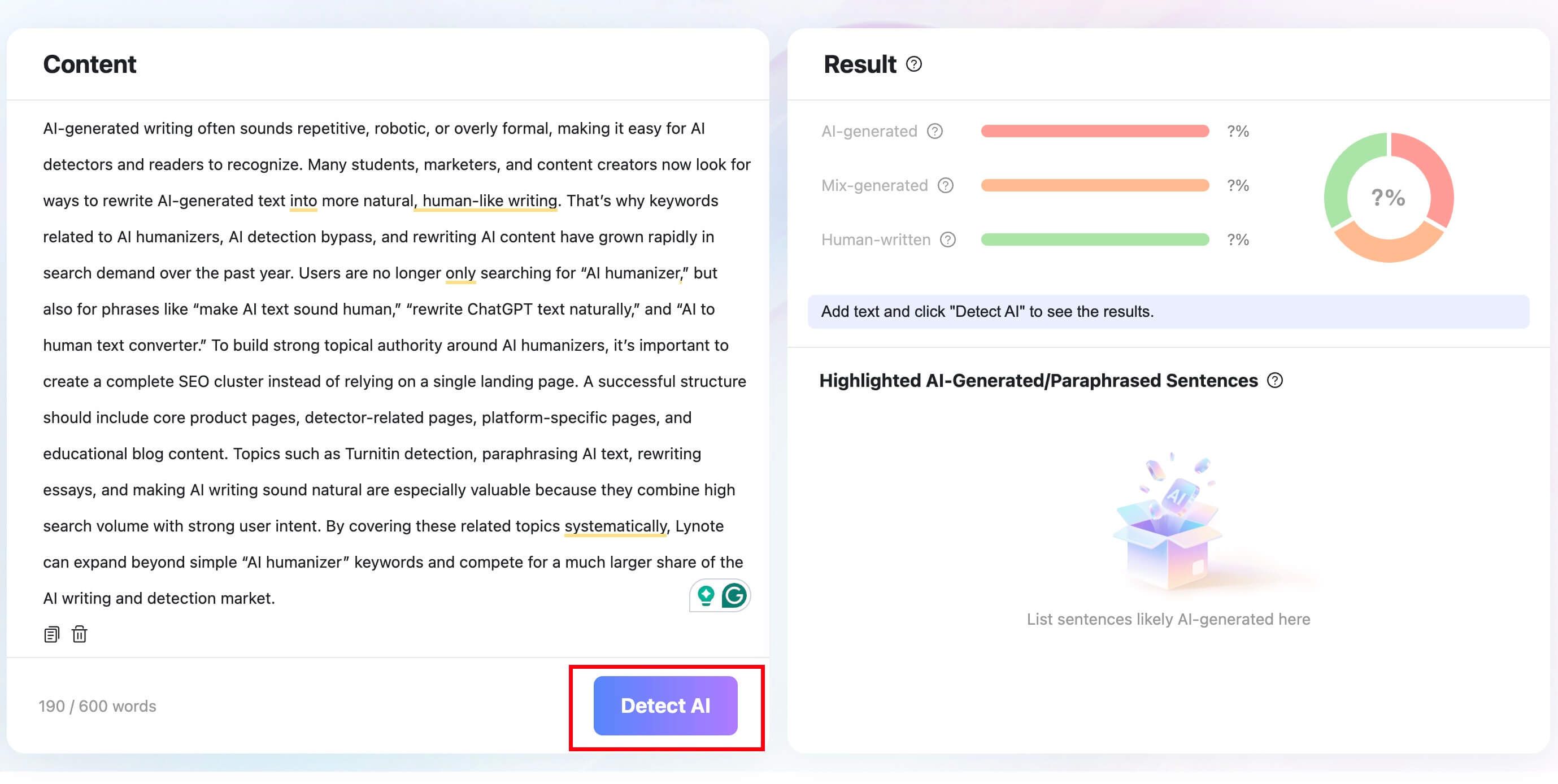
Step 2. Run a Second AI Detection Check
Once the text is pasted, initiate the scan within Lynote to generate a secondary confidence score. Lynote uses a different set of analytical models to evaluate perplexity and burstiness, providing a fresh perspective on the content. If Lynote also flags the text with a high AI probability, you have compelling evidence that the content may indeed be synthetic. Conversely, if Lynote scores the text as highly human, it strongly suggests that Originality.ai may have generated a false positive based on formulaic phrasing.
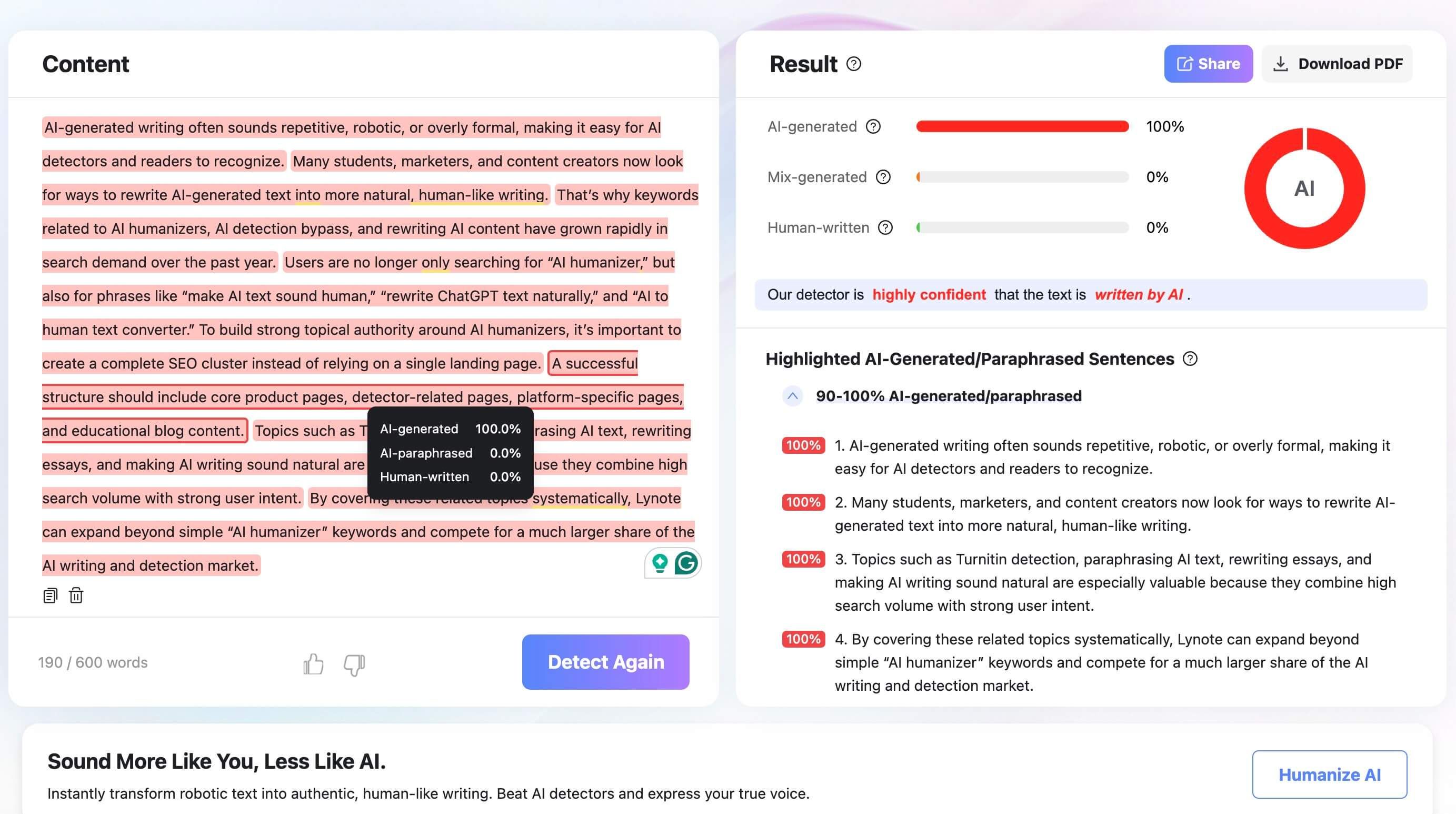
Step 3. Review Sentence-Level Signals Before Revising
After the scan is complete, carefully review Lynote's sentence-level feedback to understand the structural issues in the writing. Look for repetitive sentence lengths, predictable vocabulary choices, and a lack of natural conversational variance. Use these insights to guide your revision process, manually breaking up uniform sentences and injecting more dynamic, human phrasing. By addressing these specific structural signals, you can naturally humanize the text and resolve the detection flags across both platforms.

This dual-tool approach fundamentally changes the dynamic between editors and writers from an adversarial one to a collaborative one. If both tools flag the text heavily, the editor has a much stronger case to request a complete rewrite from the author. However, if Originality.ai flags the text but Lynote indicates that minor structural adjustments can resolve the issue, the editor can guide the writer accordingly. The goal is to use Lynote to help humanize and refine the content, improving its natural flow and readability.
Ultimately, using a secondary signal reinforces the core philosophy that a detector score is a signal, not definitive proof. It empowers writers to understand why their work might be triggering alarms and gives them the tools to revise their text proactively. By combining the strict, broad-scale scanning of Originality.ai with the targeted, revision-focused analysis of a secondary tool, content teams can maintain high standards without sacrificing their relationships with human creators.
Originality.ai vs. Competitors
To truly understand the value of Originality.ai, it must be evaluated against the other major players in the AI detection market. The landscape is highly competitive, with different tools carving out specific niches based on their target audiences and underlying technologies. While Originality.ai dominates the SEO and digital marketing space, it faces stiff competition from platforms designed for enterprise compliance and educational integrity. Choosing the right tool depends entirely on the specific environment in which the text is being evaluated.
One of the most prominent alternatives is Copyleaks, a platform that has built a massive footprint in both enterprise and academic environments. Copyleaks is renowned for its deep integrations with Learning Management Systems and its robust, enterprise-grade security features. While Originality.ai focuses heavily on catching paraphrased web content, Copyleaks is often preferred by large institutions that need to scan internal documents, student submissions, and proprietary code. For a web publisher, Originality.ai's interface is likely more intuitive, but for a university, Copyleaks is generally the superior choice.
| Tool | Primary Focus | Best Use Case |
|---|---|---|
| Originality.ai | Strict AI & Plagiarism detection | Web publishers and SEO content agencies. |
| Copyleaks | Enterprise & Academic integrity | LMS integration and institutional use. |
| GPTZero | Educational AI detection | Teachers and academic environments. |
| Lynote AI Detector | Sentence-level revision & workflow | Writers needing a secondary signal to humanize text. |
Another major competitor is GPTZero, which was built from the ground up specifically for the educational sector. GPTZero focuses heavily on providing teachers with detailed reports on student writing, analyzing perplexity and burstiness in a way that is easy for educators to explain to students. Unlike Originality.ai, which defaults to highly strict models to protect web rankings, GPTZero is tuned to be highly cautious about falsely accusing students of academic dishonesty. If your primary goal is grading essays rather than optimizing blog posts, GPTZero is far more aligned with your needs.
Winston AI is another strong contender that frequently goes head-to-head with Originality.ai in the publishing space. Winston AI boasts a highly visual, user-friendly interface and claims exceptional accuracy rates, particularly with French and Spanish content. While Originality.ai is heavily focused on English-language SEO content, Winston AI offers a slightly broader linguistic appeal. However, Originality.ai's pricing structure is often viewed as more flexible for agencies that experience fluctuating monthly content volumes.
Finally, many users wonder how Originality.ai compares to the basic AI detection features now included in tools like Grammarly. Grammarly's AI detection is generally considered a lightweight feature added to its core grammar product, rather than a standalone, rigorous security tool. Originality.ai's Turbo model is vastly more sophisticated and strict than basic grammar checkers, making it far more capable of catching hidden or lightly edited AI text. For serious content operations, relying solely on a grammar checker's AI alert is insufficient protection against modern LLMs.
FAQs About Originality.ai
Is Originality.ai accurate?
Originality.ai is highly accurate at detecting standard AI-generated text from models like ChatGPT, Gemini, and Claude, with internal tests claiming 99%+ accuracy on its Turbo model. However, like all AI detectors, it can occasionally produce false positives. This is especially true when analyzing highly formulaic writing, technical documentation, or content produced by ESL human writers.
What does the Originality.ai score mean?
The score represents the tool's confidence that the text was generated by AI, not the percentage of the article that is AI-written. For example, a 90% AI score means the tool is 90% confident the text is AI-generated based on its predictive algorithms. It is a measure of probability, not a literal word count metric.
Can Originality.ai detect paraphrased or humanized AI content?
Yes, Originality.ai's Turbo model is specifically designed to be strict and can often detect AI content that has been run through basic paraphrasing tools or humanizers. The algorithms look for underlying structural patterns that remain even after surface-level words are changed. However, heavily edited AI text that has been substantially rewritten by a human may still pass undetected.
Is there a free version of Originality.ai?
Originality.ai does not offer a robust free tier for ongoing use. It operates entirely on a paid credit system to maintain its advanced detection models. Users can start with a $30 pay-as-you-go option or choose a monthly Pro subscription for higher volume scanning needs.
Does Originality.ai check for plagiarism?
Yes, Originality.ai includes a built-in plagiarism checker that scans the web for duplicate content. This feature draws from the same credit pool as the AI detector, allowing users to perform both checks simultaneously. It is a highly valuable feature for SEO professionals looking to protect their site from duplicate content penalties.
Final Verdict: Should You Buy Originality.ai?
Determining whether Originality.ai is worth the investment comes down to the scale and nature of your content operations. For SEO professionals, digital publishers, and content agencies managing multiple freelance writers, the platform is often considered a top-tier investment. The ability to scan for both AI generation and plagiarism simultaneously, combined with robust team management and API capabilities, makes it an essential operational safeguard. It provides the necessary friction to prevent low-quality, synthetic text from harming a website's search engine rankings and brand authority.
However, the tool is not a universal solution for everyone who interacts with digital text. For casual writers, solo hobbyists, or students looking to check their own work, the credit-based pricing system and the strictness of the detection models are likely overkill. Furthermore, educational institutions should look toward tools specifically designed for academic integrity, as Originality.ai's aggressive Turbo model poses too high a risk for false positives on student essays. The platform is a specialized commercial tool, and it should be utilized strictly within that context.
Ultimately, the future of AI detection will require a delicate balance between automated oversight and human editorial judgment. Originality.ai provides incredibly powerful data, but that data must be interpreted by experienced professionals who understand the technology's limitations. As long as content managers remember that a detector score is a diagnostic signal rather than final proof, Originality.ai remains one of the most effective defenses in the modern digital publishing landscape.

Written by Janet L. Harris
AI Writing Specialist
Janet reviews AI detectors and humanization tools, with a focus on accuracy, limitations, and responsible use. View all articles →