

German AI Detector



AI Content Detector of German for DACH Text
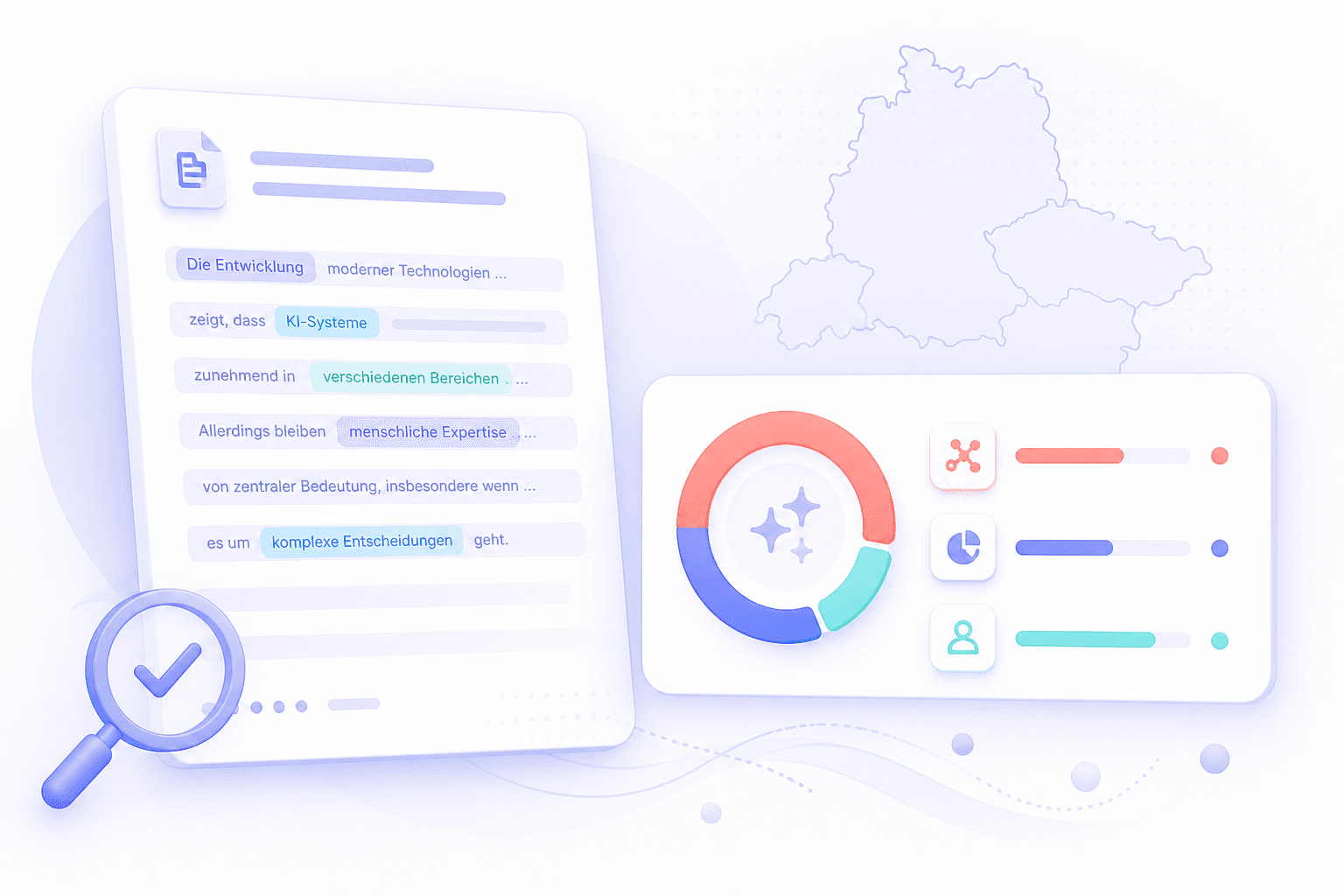
German research papers and DACH business documents should be evaluated by a native German AI detection tool, rather than a translation-based workaround. This German AI detector tool is specifically designed to check DACH texts in German. It works with 99% proven accuracy and provides AI, mixed and human percentage values. A more detailed report allows you to assess the content in a fair manner.
Highlight AI and DeepL-Like German Sentences
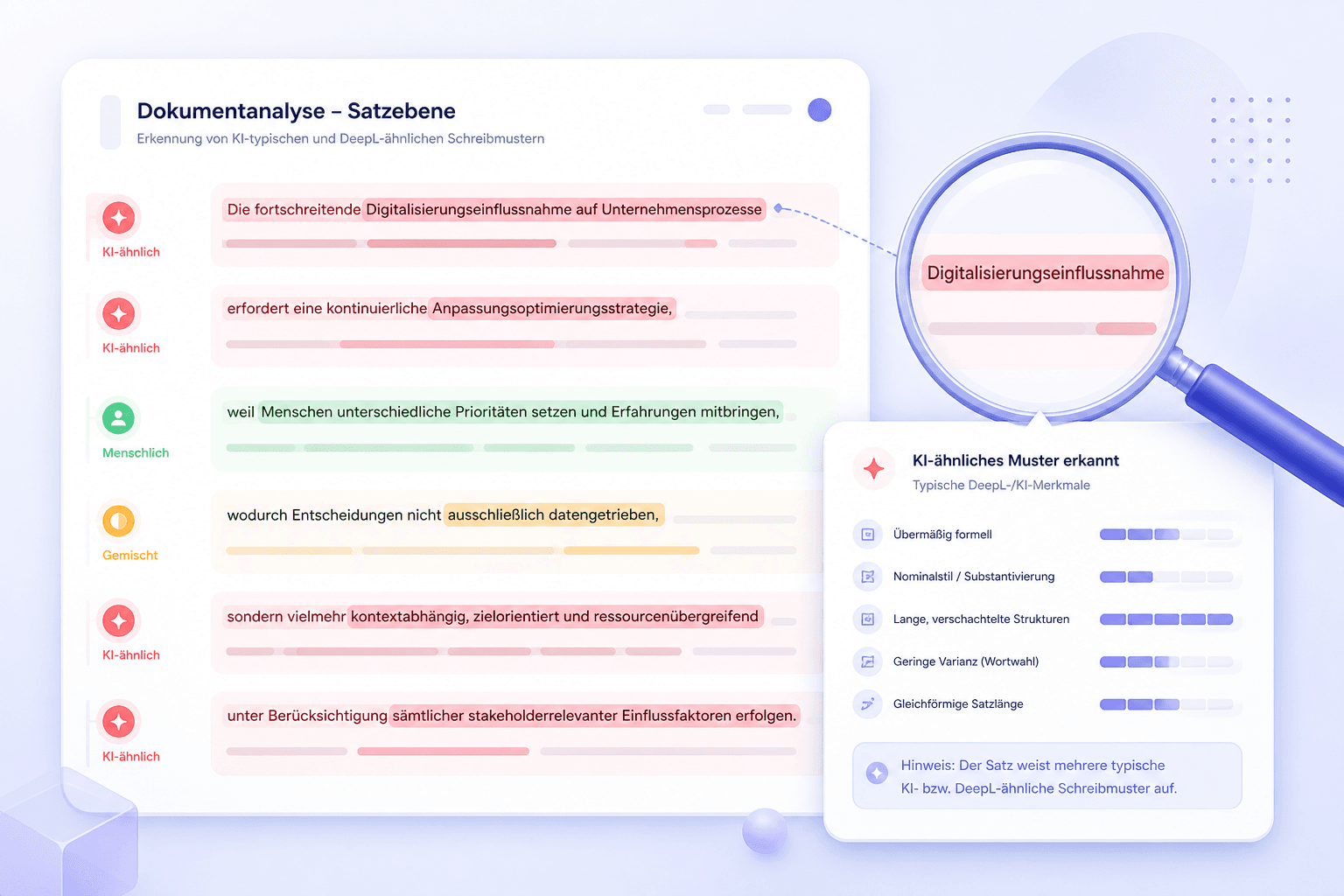
German AI-generated texts usually tend to be well-formulated, formal sentences that might lack variety in style. This AI text detector German detects unnatural, AI-generated or paraphrased sentences, helping you understand what needs to be revised. Teachers and students can read and modify such parts to ensure better readability.
Upload German Documents Directly for Sentence-Level Analysis
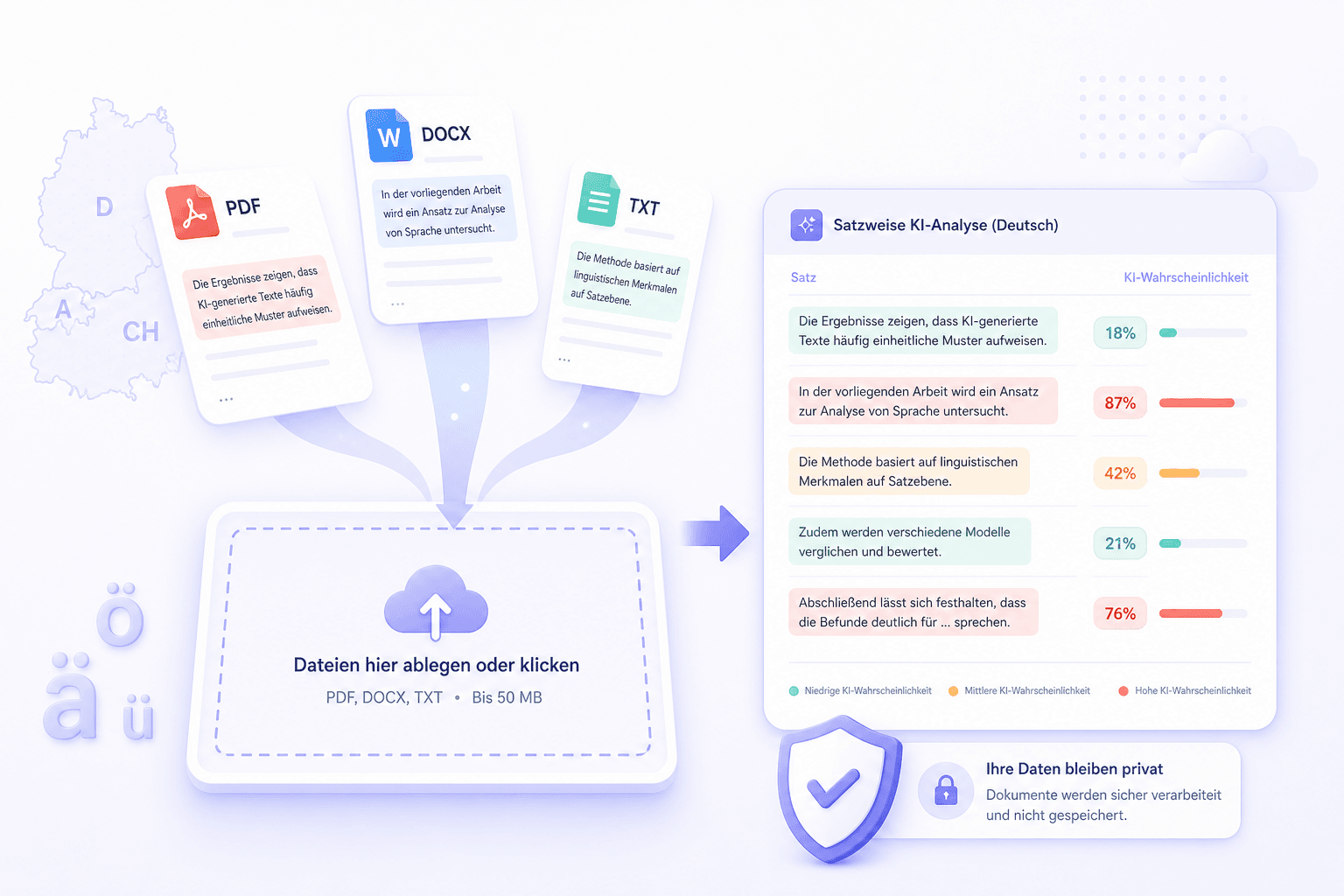
Reviewing large-scale reports or assignments shouldn’t mean hours of copy-and-paste work. With this tool, you don’t need to copy-and-paste German documents, as you can upload German .docx, .pdf or .txt files directly to the detector and have it check your text right away. This fast process ensures that your formatting is preserved, while at the same time giving you a reliable indication of how the content reads.
Why Choose Our German AI Detector?

DACH Text Accuracy
Get DACH text accuracy for German essays, reports, and localized pages with detection tuned for syntax and phrasing.

DeepL Pattern Review
Spot German text that was machine-translated through DeepL or heavily paraphrased by AI tools before final submission.

Major LLM Detection
Use major LLM detection for German outputs from ChatGPT, Claude, Gemini, and other models without translating into English first.

Sentence-Level Flags
Use sentence-level flags to see which German lines appear AI-written, mixed, or paraphrased before manual review.

Paraphrased German Lines
Find paraphrased German lines that keep human ideas but still carry overly polished machine structure.

Private German Review
Keep private German review safer with no-training handling and privacy-minded processing for submitted text.
How to Check AI Content By Detector of German?
Step 1. Paste or Upload German Text
Drop your German text into the detection field or upload a .docx, .pdf, or .txt file. We prepare the file for a targeted syntax scan.

Step 2. Click Detect AI
Hit the Detect AI button and let the tool do its work. It’ll generate probabilities for AI, hybrid and human content.
Step 3. Review the German Report
Read through your German probability report, and look closely at each flagged sentence. Are there hints of machine-translation, DeepL-like syntax or language-tool influence?

Step 1. Paste or Upload German Text
Drop your German text into the detection field or upload a .docx, .pdf, or .txt file. We prepare the file for a targeted syntax scan.
Step 2. Click Detect AI
Hit the Detect AI button and let the tool do its work. It’ll generate probabilities for AI, hybrid and human content.
Step 3. Review the German Report
Read through your German probability report, and look closely at each flagged sentence. Are there hints of machine-translation, DeepL-like syntax or language-tool influence?
Who Is This German AI Detector For?

University Professors
Review student Hausarbeiten and academic theses to identify undisclosed AI generation before assigning final grades.

Content Managers
Verify that freelance German articles and blog posts are original human work, not raw AI outputs.

DACH Students
Pre-check your German essays and coursework to ensure standard grammar tools did not trigger false positives.

SEO Specialists
Review localized German landing pages for natural phrasing and AI-like patterns before sending them to editors or clients.

German Copywriters
Review ad copy and marketing emails before sending them to DACH clients to spot AI-like German phrasing.

Editorial Teams
Review incoming DeepL translations to catch heavily robotic phrasing, allowing editors to manually rewrite the text.
What Our Users Say About Lynote German AI Detector

University Lecturer

I use Lynote when reviewing German seminar papers that feel unusually polished. The sentence highlights help me start a fair conversation instead of relying on a vague suspicion.

SEO Manager
Our DACH landing pages often pass through several AI-assisted drafts. Lynote helps us spot overly uniform German phrasing before we publish.

Content Strategist
The tool is useful for checking German blog copy after translation and editing. It shows which passages still sound too automated or too formal.

Master's Student
Before submitting long German essays, I scan the draft and revise highlighted sections. It helps me keep the final version closer to my own wording.

Editor-in-Chief
For contributor articles, I like seeing AI, mixed, and human signals in one report. It makes editorial review faster without replacing human judgment.

Compliance Officer
We review German policy documents and training materials before sharing them internally. Lynote gives our team a practical second check for authenticity.
Rewrite German AI-Flagged Lines Before You Publish
If your German scan shows AI-heavy or overly formal passages, move the draft into Lynote AI Humanizer and reshape it into clearer, more natural wording while keeping the original meaning intact.
Frequently Asked Questions
Still got questions about our German AI detector? Here are the answers.
Our German AI detector is tailored to detect the nuances of the German language. Most tools aren’t specifically trained for German sentence structure, but our AI text detector German detects language specific to the DACH region and provides a precise AI probability report.
Yes. Sometimes texts written by humans look machine-like due to heavy use of grammar checker or translation tools. In such cases, our AI text detector German will mark these sections as mixed so that they can be checked manually.
No. We value your privacy. Neither the text nor any documents you submit are saved. Nor do we use your data to train our future AI detectors.
Yes! Just upload a .pdf, .docx, or .txt file. With our AI content detector, the German text will be extracted automatically. You can upload a large file and scan it in one go, no copy-and-paste needed.
The free version allows you to paste up to 600 words of German text. Pro users can analyze up to 3000 words per scan. If you have a longer German document, simply upload it as a file.
When you use the AI text detector, German sentences are scanned for patterns and predictability. The tool then matches the text against known patterns from large language models. The sentences with a higher chance of being AI-generated will be highlighted for further inspection.
Yes, although this depends on how the sentence was written. ChatGPT outputs tend to have distinct structural patterns, whereas DeepL-translated text from a human-written source generally maintains a more natural structure. In some cases, you may get mixed results.
No, you don’t need an account to use the tool. Just paste the text or upload the document, and you’ll receive your detection report.
More Tools for German AI Review and Rewriting


German AI Detection Guides and Review Tips
Read practical Lynote guides on AI detector accuracy, scoring signals, and safer revision workflows for students, editors, and DACH content teams.


