

This Copyleaks review looks at the AI detector from the perspective that most readers actually care about: can you trust the score, is the pricing reasonable, and what should you do when Copyleaks flags writing as AI?
The short answer is that Copyleaks is one of the more serious AI detection products on the market. It has institutional features, plagiarism pairing, browser and Google Docs workflows, API access, and multi-language coverage. But a Copyleaks score is still a detection signal, not final proof of who wrote a document.
That distinction matters. Copyleaks can be useful for review, triage, and policy workflows. It becomes risky when a school, editor, or manager treats one score as a complete authorship judgment.
Quick Verdict: Copyleaks Is Strong, but Not a Final Judge
Copyleaks is worth considering if you need more than a quick paste-and-check AI detector. Its strongest use cases are education, publishing, SEO review, compliance workflows, and developer integrations where AI detection needs to sit beside plagiarism scanning.
For casual users, the product can feel heavier than necessary. You get more platform depth than a simple free checker, but you also get credit limits, pricing decisions, and results that still require interpretation.
Here is the practical verdict:
| Question | Short answer |
|---|---|
| Is Copyleaks a real AI detector? | Yes. It is a mature content-authenticity platform, not a throwaway checker. |
| Is Copyleaks AI Detector accurate? | It can be strong on obvious AI text, but accuracy depends on text type, length, language, editing, and context. |
| Can Copyleaks be wrong? | Yes. False positives and detector disagreement are possible with any AI detector. |
| Is it best for students? | It can be useful, but students should not treat it as a final verdict about their own writing. |
| Is it best for schools and teams? | Often yes, especially when plagiarism checks, reports, integrations, and admin controls matter. |
| Is it worth paying for? | It depends on scan volume and whether you need plagiarism, reports, API, or team workflows. |
My view is simple: Copyleaks is a serious tool for serious review workflows. It is not a magic authorship machine.
What Is Copyleaks?
Copyleaks is a content integrity platform that includes AI detection, plagiarism detection, writing authenticity tools, browser extensions, Google Docs scanning, LMS integrations, and API access. It is used by individuals, educators, businesses, and developers who need to review writing at scale.
The AI detector is the product most people search for, but Copyleaks is broader than that. It can combine AI detection with plagiarism analysis, show text-level signals, support multiple languages, and fit into school or enterprise systems.
That breadth is important for this review. A student pasting one paragraph into an AI checker has a very different need from a university reviewing thousands of submissions or a publisher checking hundreds of freelancer drafts.
Copyleaks is strongest when the question is not only "does this look AI-written?" but also "how do we review, store, compare, and act on content-authenticity signals inside a repeatable workflow?"
How Copyleaks AI Detector Works in Practice
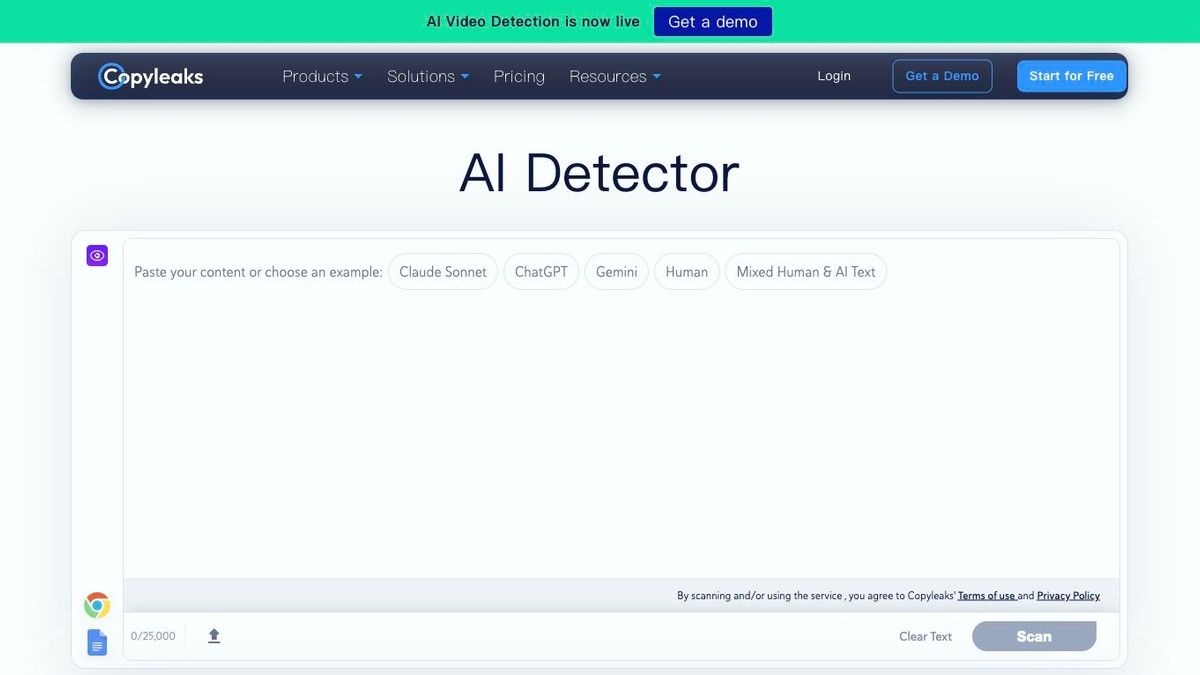
At the user level, Copyleaks checks submitted text and returns a probability-style result about whether the content appears human-written or AI-generated. Depending on the workflow and plan, users may also see highlighted sections, AI Logic explanations, plagiarism context, saved scans, and credit usage.
Copyleaks also supports more advanced routes. Users can scan through browser extensions, Google Docs, LMS environments, or the API. That makes it more flexible than tools designed only for one-off text checks.
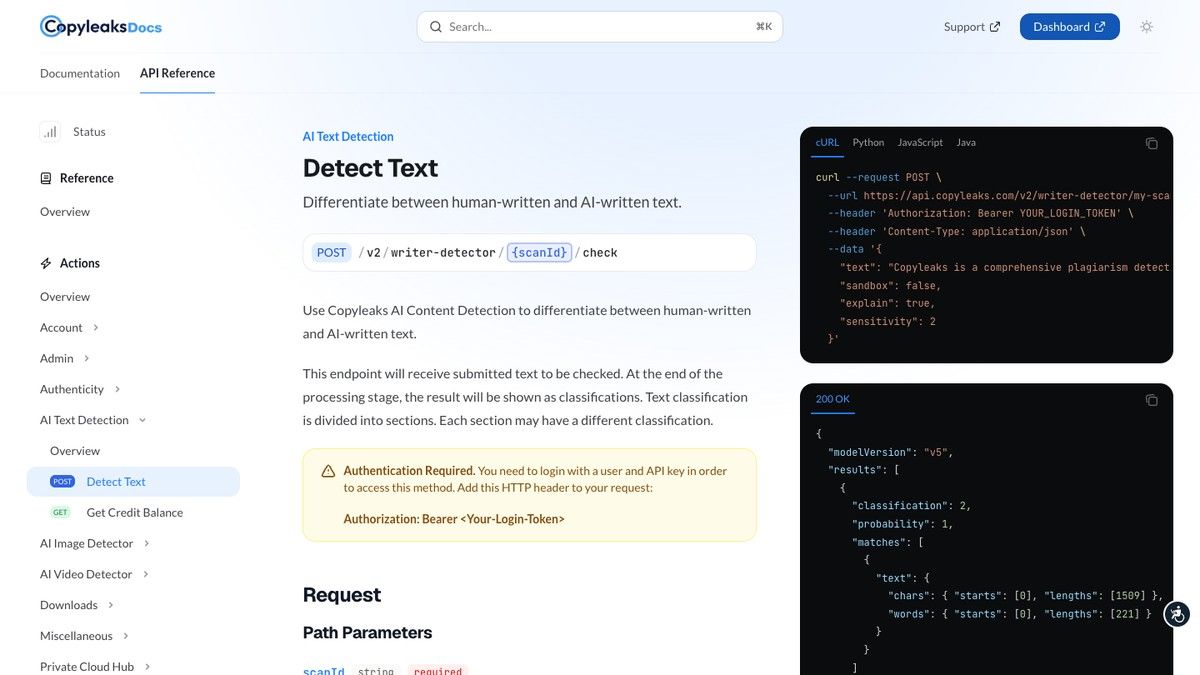
The API side is especially relevant for teams. Copyleaks' AI text detection endpoint accepts submitted text, returns classification results, and supports options such as explain mode and sensitivity settings. Those settings matter because detecting raw AI text is not the same as detecting lightly edited or heavily modified AI-assisted writing.
| Feature | What it means in practice | Who benefits most |
|---|---|---|
| AI text detection | Flags text that appears likely to be AI-generated | Students, teachers, editors, content managers |
| Plagiarism detection | Checks overlap and reuse alongside AI signals | Schools, publishers, SEO teams |
| AI Logic | Helps explain why text was flagged | Reviewers who need more than one percentage |
| Browser extension | Checks content while browsing or editing online | Writers, editors, lightweight reviewers |
| Google Docs add-on | Runs checks inside writing workflows | Students, teachers, content teams |
| LMS integrations | Fits into academic submission systems | Schools and universities |
| API | Automates detection inside custom systems | Developers and enterprise teams |
| Multi-language support | Checks AI signals across many languages | International schools, global teams |
This is the main reason Copyleaks stays relevant. The product is not only trying to win the "free AI checker" category. It is trying to be infrastructure for content verification.
How Accurate Is Copyleaks AI Detector?
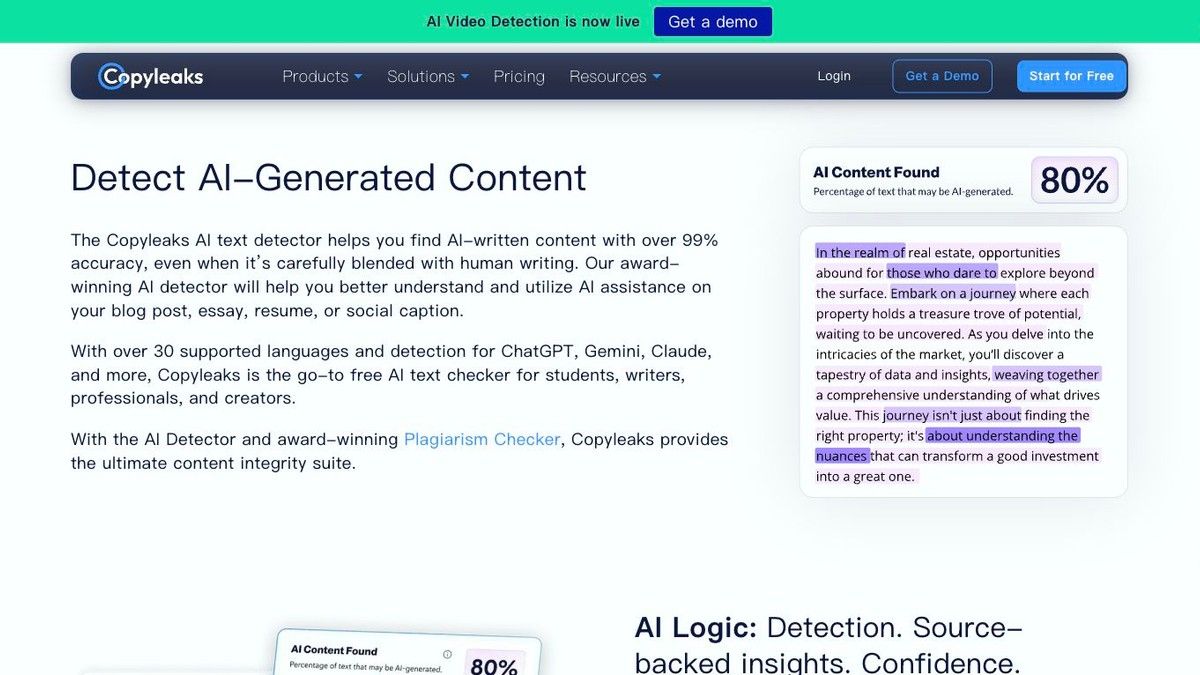
Copyleaks officially claims over 99% AI detection accuracy and promotes support for major AI models such as ChatGPT, Claude, Gemini, DeepSeek, and others. It also states that the headline accuracy rating on its homepage is based on internal testing of English-language datasets.
That claim is useful, but it should not be read as "every real-world document will be judged correctly." Real writing is messy.
Students revise drafts, editors rewrite paragraphs, AI text gets mixed with human text, PDF extraction can be messy, and some human writing is formulaic enough to resemble generated prose.
The better question is not "is Copyleaks accurate?" It is "accurate for what kind of text, under what conditions, and with what consequence if the result is wrong?"
| Scenario | Expected reliability | Why it matters |
|---|---|---|
| Raw AI-generated essay | Usually stronger | The text may contain clearer model-like patterns. |
| Raw human essay with a natural draft history | Usually stronger, but not immune to false positives | Human writing can still be formal, generic, or template-like. |
| Mixed human and AI draft | Harder | A single overall score may hide which parts need review. |
| Human-edited AI text | Harder | Editing changes surface patterns without always changing the underlying structure. |
| Short paragraph | Less reliable | There may not be enough signal to classify confidently. |
| Highly formulaic academic writing | Riskier | Standard phrasing can look machine-like even when written by a person. |
| Non-English writing | Depends on language and text type | Support does not automatically mean equal performance everywhere. |
| PDF or OCR-extracted text | Depends on extraction quality | Formatting artifacts can distort what the detector sees. |
This is why I would treat Copyleaks as a strong review tool, not a final judgment tool. A high score should trigger closer reading, process review, and possibly a second detector. It should not automatically become an accusation.
What Reddit Complaints Reveal About Copyleaks
The Reddit search intent around Copyleaks is emotionally loaded. Many users are not asking about product features. They are asking why Copyleaks flagged their work, why it disagreed with another detector, or whether a school will trust the result.
Reddit discussions show two patterns. Some users describe Copyleaks as unusually sensitive or surprisingly good at detecting AI. Others report extreme false-positive experiences, including human-written assignments being flagged as fully AI-generated.
Those stories are not controlled tests, so they should not be treated as proof that Copyleaks is accurate or inaccurate. But they are valuable because they reveal the real user problem: people do not only need a detector. They need a fair interpretation process.
If Copyleaks says a document is likely AI-generated, the next question should be "what evidence supports that?" not "how do we punish the writer?" Good review looks at the flagged passages, the writing process, the assignment context, and whether the author can explain the claims.
For SEO and publishing teams, the Reddit complaints also point to a business risk. If an editor rejects work solely because one detector reports a high AI score, they may reject acceptable human writing or miss the real issue: thin, generic, unhelpful content.
Copyleaks Strengths
Copyleaks has several real strengths, especially compared with lightweight AI checkers.
First, it combines AI detection with plagiarism-oriented workflows. That matters because AI suspicion and originality concerns often overlap, but they are not the same thing. A text can be human-written and plagiarized, AI-generated but original, or human-edited with weak source use.
Second, Copyleaks is built for institutions and teams. Browser extensions and Google Docs help individual workflows, while API and LMS integrations make the product more useful for schools, platforms, and organizations that need repeatable checks.
Third, the product has more explainability than a bare percentage score. Features such as AI Logic and highlighted sections can help reviewers focus on specific passages instead of treating the whole document as equally suspicious.
Fourth, the multilingual coverage is useful. Many AI detection products are still strongest in English, and Copyleaks' support for many languages makes it more attractive for international schools and global teams.
Finally, Copyleaks is a better fit for policy-driven environments than many simple free tools. If your organization needs user seats, scan history, combined reports, or API behavior, Copyleaks belongs on the shortlist.
Copyleaks Limitations and False-Positive Risks
The biggest limitation is not that Copyleaks is unserious. The limitation is that AI detection itself is probabilistic.
An AI detector evaluates patterns in the text. It does not see your notes, your writing history, your browser tabs, your drafts, or your thinking process. That makes it useful for spotting suspicious patterns, but weak as standalone proof.
False positives can happen when human writing is very polished, very generic, very formulaic, or heavily edited. Academic writing is especially vulnerable because students are often trained to use predictable structure, cautious phrasing, and formal transitions.
False negatives can also happen. A heavily revised AI draft may look more human than the original. A writer may add examples, citations, personal reasoning, or rougher sentence rhythm that changes the signal a detector sees.
The hardest category is mixed writing. Real AI-assisted work is often not fully generated or fully human. It may include an AI outline, a human draft, an AI rewrite, a human edit, and then a grammar pass. One score cannot explain that whole process.
That is why Copyleaks should be part of a review workflow, not the whole workflow.
Copyleaks Pricing: Is It Worth Paying For?
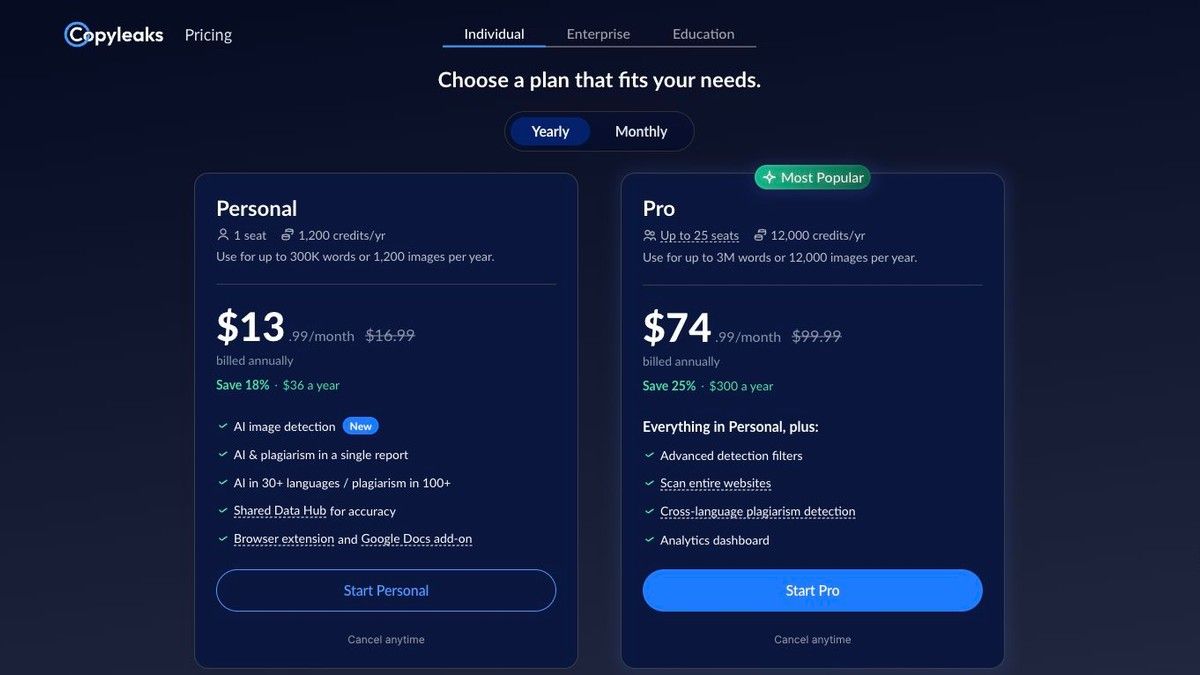
Copyleaks uses a credit-based pricing model. On the individual side, the Personal plan is listed at $16.99 per month, or $13.99 per month when billed annually. The Pro plan is listed at $99.99 per month, or $74.99 per month when billed annually.
One credit covers up to 250 words or 1 image. On the monthly Personal plan, 100 unified credits equals up to about 25,000 words or 100 images. On the monthly Pro plan, 1,000 unified credits equals up to about 250,000 words or 1,000 images.
That pricing is reasonable for users who actually need repeated checks. It is less attractive if you only need to test one or two short passages.
| User type | Is Copyleaks worth it? | Why |
|---|---|---|
| Student checking one paper | Maybe not | A paid plan may be more than you need unless your school already uses it. |
| Teacher reviewing many submissions | More likely | Reports and repeated scans matter more than one free check. |
| SEO writer | Depends | Useful for review, but content quality matters more than detector scores alone. |
| Agency or editorial team | Often yes | Scan volume, saved history, and plagiarism pairing can justify the cost. |
| University or school | Often yes | LMS, policy workflows, and admin needs make the platform more relevant. |
| Developer or SaaS team | Often yes | API access and sensitivity controls are stronger than manual checking. |
The pricing question is really a workflow question. If you only need occasional reassurance, Copyleaks may feel expensive. If you need repeatable content review across people, documents, and systems, it becomes easier to justify.
Copyleaks vs Other AI Detectors: What Should You Compare?
Most AI detector comparisons focus too much on one question: which tool is "most accurate?" That is understandable, but it is incomplete.
A better comparison looks at the whole review experience. Can the tool highlight suspicious sentences? Does it explain why text was flagged? Does it support document upload? Does it include plagiarism? Does it work in Google Docs? Can a team manage scans? Can developers use an API?
| Comparison point | Why it matters |
|---|---|
| Accuracy by scenario | Raw AI, mixed text, humanized AI, and short samples behave differently. |
| Sentence-level review | Reviewers need to know which lines deserve attention. |
| Plagiarism pairing | AI detection and originality checking solve different problems. |
| Workflow integrations | Schools and teams need more than a paste box. |
| Pricing and credits | A cheap tool can become expensive if scans are limited. |
| False-positive handling | High-stakes review needs process evidence, not only a score. |
| API access | Developers need structured responses, limits, and automation. |
Copyleaks compares well when integration depth matters. GPTZero is often discussed in education contexts, Originality.ai is popular with SEO and publishing teams, Grammarly AI Detector fits everyday writing workflows, and simpler AI checkers may be easier for casual users.
The best tool depends on the consequence of the decision. If a detector score could affect a grade, client payment, publication decision, or employee review, one tool should not be the entire evidence base.
Use Lynote AI Detector When You Need a Second Review Signal
If Copyleaks flags a passage and you want a simpler second look, Lynote AI Detector can help you review the text before revising. It is best used as another signal, not as proof that Copyleaks is right or wrong.
Lynote is especially useful when you want a clear breakdown and sentence-level highlights without building an institutional workflow. For students, writers, and editors, that can be enough to decide which lines need closer attention.
Step 1. Paste Text or Upload a Document
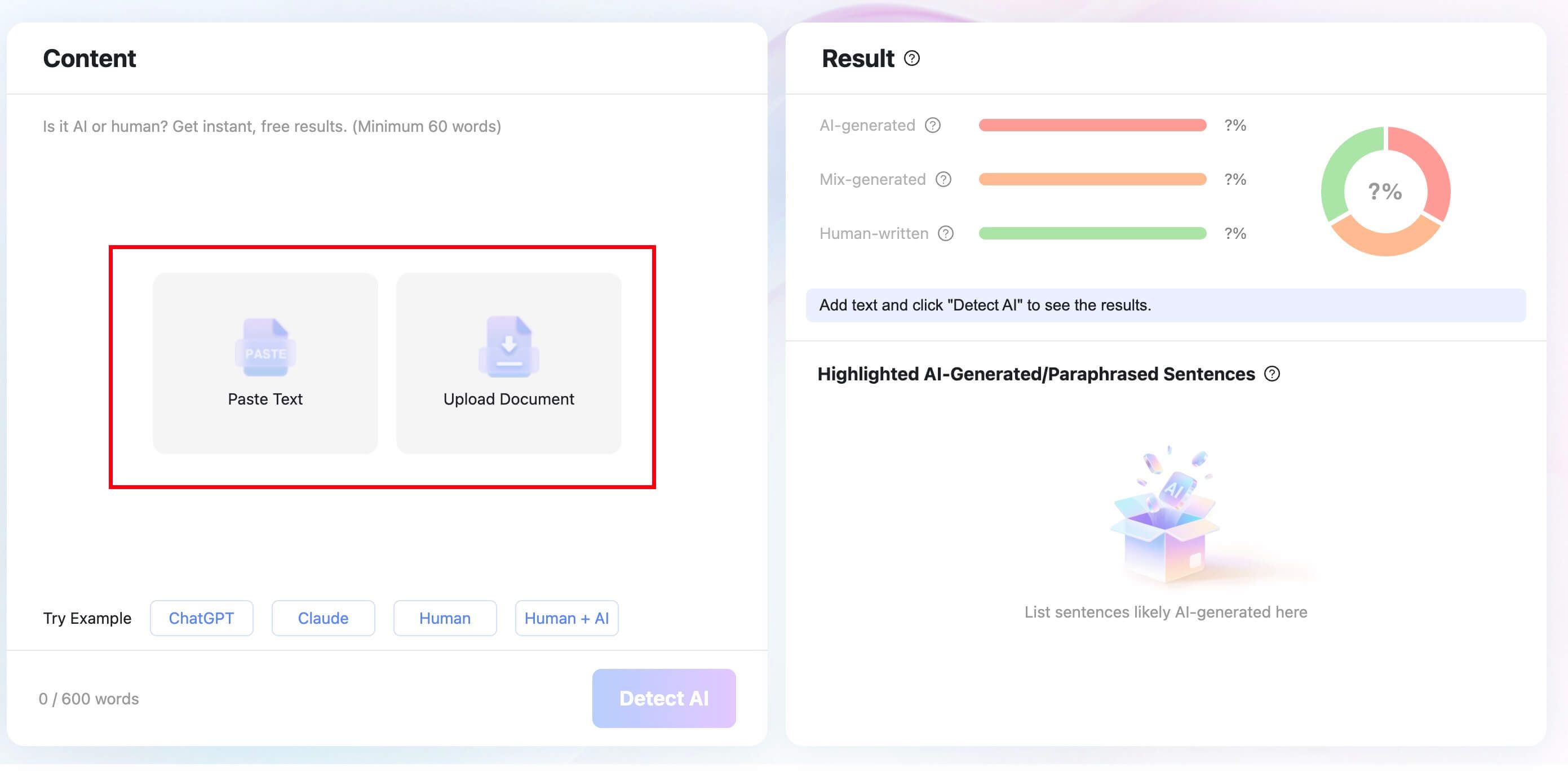
Open Lynote AI Detector and paste the passage you want to check. You can also upload a supported Word, PDF, or TXT document when you need to review a longer draft.
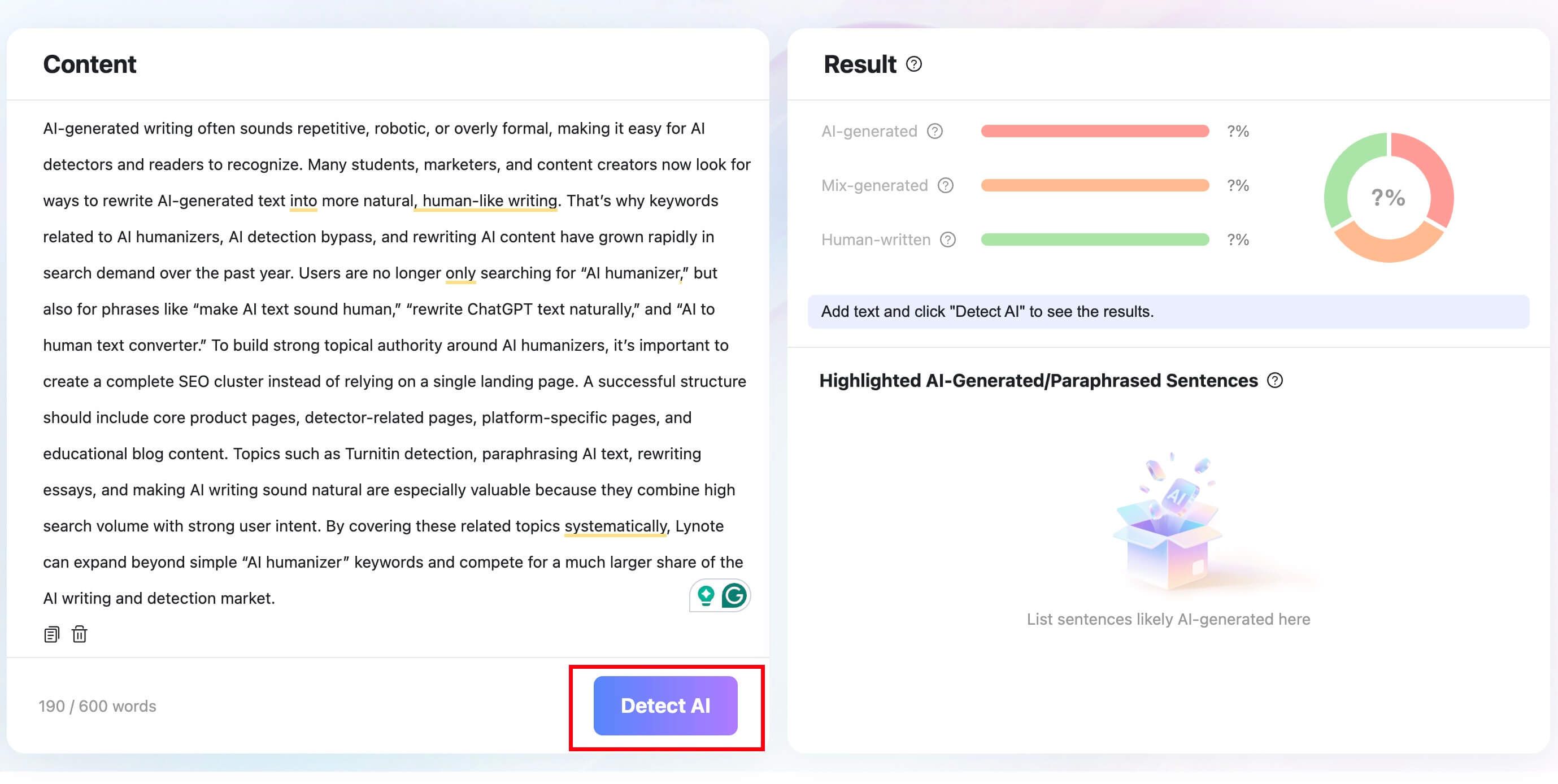
Step 2. Click Detect AI
Click "Detect AI" to scan the text. Lynote analyzes the writing and returns a breakdown of AI-generated, mixed, and human-written signals.
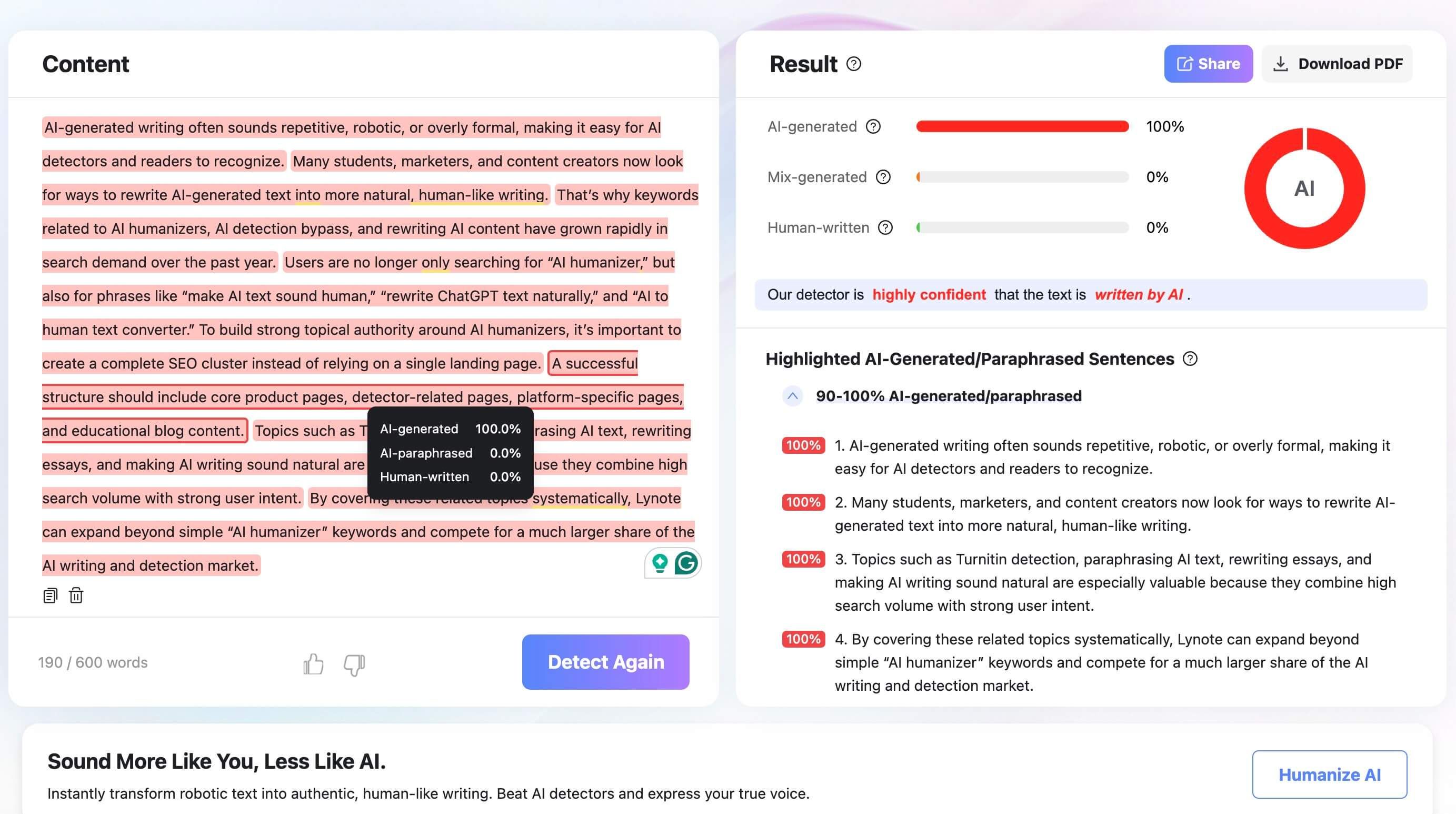
Step 3. Review the Highlighted Sentences
Use the highlighted sentences to decide what needs revision. Look for generic phrasing, unsupported claims, weak evidence, or passages that sound much more polished than the rest of the draft.

The goal is not to chase an ideal score. The goal is to make the writing clearer, more specific, and easier to explain.
Who Should Use Copyleaks?
Copyleaks makes the most sense for users who need structured review at scale. That includes schools, academic integrity teams, publishers, agencies, enterprise compliance teams, and developers building detection into another product.
It is also useful for teachers or editors who want to combine AI detection with plagiarism checking. Those are separate questions, but seeing both in one workflow can save time.
Copyleaks is less ideal for users who want a quick, low-friction second opinion on a single paragraph. It can also be the wrong tool if the reviewer is looking for certainty that no detector can honestly provide.
Use Copyleaks when the workflow matters. Use a lighter detector when you only need a quick review signal. Use human judgment either way.
What To Do If Copyleaks Flags Your Writing
If Copyleaks flags your writing, do not panic and do not immediately rewrite everything through another tool. Start by identifying what the flagged section actually looks like.
Ask whether the passage is too generic, too polished, too repetitive, or too disconnected from evidence. Many detector problems are also writing-quality problems. If a paragraph could appear in any essay on the topic, it probably needs more specificity.
Next, gather process evidence. Keep your outline, research notes, version history, comments, and earlier drafts. If the writing is questioned, those materials often matter more than a second detector score.
Then revise the substance before polishing the wording. Add concrete examples, explain why the evidence matters, remove claims you cannot defend, and make the paragraph fit the assignment or publication goal.
For academic disputes, follow the school's review process. A detector score should be discussed with context, not fought with another score alone.
FAQs About Copyleaks AI Detector
Is Copyleaks AI Detector accurate?
Copyleaks can be accurate in many AI detection scenarios, especially when reviewing obvious AI-generated text. But accuracy depends on text length, language, editing, formatting, and whether the writing is mixed human-AI content.
How accurate is Copyleaks AI Detector according to Reddit?
Reddit does not provide controlled accuracy data. It does show real user frustration around false positives, score disagreement, and sudden high AI scores, which are important practical concerns.
Can Copyleaks be wrong?
Yes. Any AI detector can produce false positives or false negatives. Copyleaks results should be interpreted with drafts, writing history, context, and human review.
Does Copyleaks detect ChatGPT, Claude, Gemini, and DeepSeek?
Copyleaks says its AI detector is built to detect writing from major AI models, including ChatGPT, Claude, Gemini, DeepSeek, and others. That does not mean every output from every model will be classified correctly in every context.
Can Copyleaks detect humanized AI text?
Sometimes, but humanized or heavily edited AI text is harder to judge than raw AI output. Rewriting can change the surface signals that detectors rely on.
Is Copyleaks free?
Copyleaks offers limited free access for new users, but repeated scanning and advanced workflows use paid plans or institutional access. The paid individual plans are credit-based.
Is Copyleaks better than GPTZero?
It depends on the use case. Copyleaks is stronger when you need plagiarism pairing, integrations, API workflows, and institutional review. GPTZero may be simpler for education-focused individual checks.
Should teachers rely on Copyleaks alone?
No. Teachers should treat Copyleaks as one review signal. A fair process also considers drafts, assignment fit, source use, version history, and whether the student can explain the work.
Final Verdict
Copyleaks is a strong AI detector review candidate if you need a serious content-authenticity platform. It is especially useful for schools, publishers, agencies, and developers who need more than a single paste box.
Its limits are just as important as its strengths. A Copyleaks score can point to writing that deserves review, but it cannot replace human judgment, process evidence, or careful reading.
If you are comparing AI detectors, choose based on workflow and consequence. Copyleaks is a good fit for structured detection and plagiarism review; Lynote AI Detector is a practical second signal when you want a simpler sentence-level check before revising.

Written by Janet L. Harris
AI Writing Specialist
Janet reviews AI detectors and humanization tools, with a focus on accuracy, limitations, and responsible use. View all articles →