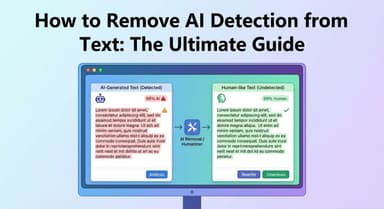


If you are staring at a deadline and need to ensure your essay passes tools like Turnitin, GPTZero, or Originality.ai, you generally have three options. While all three can work, the trade-off usually comes down to time vs. reliability.

Learning how to make your essay undetectable by AI isn't just about cheating the system; often, it's about protecting your work from false positives and ensuring your writing flows naturally.
Quick Verdict: The Best Ways to Bypass AI Detection
Here is the fast breakdown of how the top methods compare:
| Method | Success Rate | Time Required | Risk Level | Verdict |
|---|---|---|---|---|
| Specialized Humanizers (e.g., Lynote) | High (99%+) | Seconds | Low | Best Balance of speed & safety. |
| Manual Editing (The "Native" Way) | High | Hours | Low | Best for Control, but very slow. |
| Basic Paraphrasers (e.g., Quillbot) | Low/Medium | Minutes | High | Outdated. Modern detectors catch this. |
The Winner: Specialized AI Humanizers
For most students and writers, using a dedicated tool like the Lynote AI Humanizer is the most efficient path. Unlike basic paraphrasers that simply swap synonyms (which detectors can easily spot), humanizers restructure the logic and syntax of your text. This gives you a 100% undetectable essay in seconds without sacrificing the original meaning of your arguments.
The Alternative: Manual Rewriting
If you have hours to spare, manually rewriting your essay is a safe bet. This involves changing sentence structures, adding personal anecdotes, and intentionally varying paragraph lengths. It is free, but it defeats the purpose of using AI to save time in the first place.
The Risk: Old-School Paraphrasing
Avoid relying solely on standard paraphrasing tools. While they were effective in 2023, modern detection algorithms have evolved. They can now identify the "synonym-swapping" patterns used by these tools, leaving your essay vulnerable to being flagged.
Method 1: Using Specialized AI Humanizers (Best for Speed & Accuracy)
If you need a "fix-it button" that works immediately, specialized AI humanizers are the industry standard. These engines are engineered to adjust two specific metrics: Perplexity (complexity of text) and Burstiness (variation in sentence structure).
By adjusting these metrics, specialized humanizers break the predictable patterns that detectors like Turnitin and GPTZero look for, rendering the text statistically indistinguishable from human writing.
The Champion: Lynote AI Humanizer
We recommend Lynote because it focuses on context-aware rewriting. It doesn't just scramble words; it understands your essay's argument and restructures the syntax while keeping your original meaning intact.
Here is how to use it to bypass detection in under 60 seconds:
- Input: Copy your generated text directly from ChatGPT, Claude, or Jasper.
- Process: Paste the text into the Lynote AI Humanizer dashboard.
- Configure: Select your desired output mode. Choose "Academic" for university essays to maintain formal language, or "Standard" for blogs and casual writing.
- Transform: Click "Humanize." The engine will analyze the text's semantic structure and rewrite it to introduce natural human variation.
- Verify: Review the output. You will notice the arguments remain the same, but the sentence flow is now varied and "bursty," mimicking human thought patterns.

Pro Tip: Lynote supports 50+ languages, making it ideal for ESL students or international SEO campaigns. If you are a publisher, the tool ensures the output remains SEO-optimized, preserving your keywords while removing the AI footprint.
Alternative Options
While Lynote offers the best balance of features, there are other tools on the market worth noting:
- Undetectable.ai: A popular choice that offers various "readability" levels (High School to Doctorate). It is effective, though it operates on a strict credit system which can become expensive for long-form dissertations.

- StealthWriter: Good for creative writing and blogs. It offers a "Ghost" model for deeper rewriting. However, users often report that the strictest settings can sometimes alter the original meaning of the text too heavily, requiring manual cleanup.
Method 2: The "Native" Approach (Prompt Engineering & Manual Edits)
If you prefer to stay within ChatGPT or Claude rather than using external tools, you need to fundamentally change how you interact with the AI. Standard prompts yield standard, robotic results. To bypass detection, you must manually inject the chaotic elements of human writing into the generation process.
The Champion: Advanced Prompt Engineering
AI detection tools look for predictable patterns. To defeat them, you must instruct the LLM to write with high complexity and sentence variation.
A standard prompt like "Write an essay about climate change" will result in a flat, monotonous structure that flags immediately. Instead, use a prompt that explicitly forbids AI-typical language.
Copy and paste this prompt to "humanize" your output directly in ChatGPT:
"Rewrite the following essay with a focus on high perplexity and burstiness.
- Sentence Structure: Use a mix of very short, punchy sentences and long, complex clauses. Avoid repetitive sentence starts.
- Vocabulary: Avoid common AI transition words like 'Furthermore,' 'Moreover,' 'In conclusion,' and 'Delve.' Use natural, conversational transitions instead.
- Tone: Write in a tone that is authoritative but conversational. Eliminate robotic phrasing.
- Formatting: Do not use bullet points unless absolutely necessary; prioritize flowing paragraphs.
Here is the text to rewrite: [PASTE YOUR TEXT HERE]"
Manual Humanization Techniques
Even the best prompt engineering can leave behind "AI residue." To ensure your essay is truly undetectable, you must perform a manual sweep to inject elements that LLMs struggle to replicate authentically.
- Inject Personal Anecdotes: AI cannot replicate genuine lived experience. Adding a sentence like "In my experience during the 2022 field study..." or "I recall a conversation with..." creates a distinct 'human signal' that algorithms have difficulty flagging as artificial.
- Add Specific, Recent Data: LLMs often hallucinate specific numbers or generalize with phrases like "many studies show." Replace these generalizations with hard data, specific dates, and real citations. This not only bypasses detection but improves the academic quality of the paper.
- Intentional Imperfection: AI writing is grammatically hyper-correct. Humans are not. Depending on the context, using a colloquialism, a rhetorical question, or a sentence fragment for dramatic effect can break the perfect statistical pattern that detectors look for.
- Remove "AI Fluff": Aggressively delete empty adjectives like "vital," "crucial," "tapestry," and "landscape." If a sentence doesn't add new information, cut it. AI uses these to fill space; humans use them sparingly.
Method 3: The "Old School" Approach (Paraphrasers & Translators)
Before dedicated AI humanizers entered the market, students and writers relied on standard paraphrasing tools. While these methods are often free, they operate differently than advanced humanizers and carry higher risks when facing modern detection software like Turnitin.
The Champion: Quillbot (Paraphrasing)
You need to understand the distinction between Humanizing and Paraphrasing.
- Humanizers (like Lynote): Rewrite the logic, sentence structure, and flow of the text.
- Paraphrasers (like Quillbot): Primarily swap words for synonyms while keeping the underlying sentence structure (syntax) exactly the same.
Because AI detectors analyze sentence patterns rather than just vocabulary, simple paraphrasing is often not enough to bypass rigorous checks. However, it remains a popular tool for light editing.
How to use a standard paraphraser:
- Input: Copy your generated text from ChatGPT.
- Paste: Insert the text into the paraphrasing tool's dashboard.
- Select Mode: Choose a mode like "Fluency" or "Standard" (avoid "Creative" or "Formal" if you want to keep the meaning strictly accurate).
- Spin: Click the "Paraphrase" button.
- Manual Tweak: Click on individual words in the output to select alternative synonyms if the auto-suggestion feels awkward.
Warning: Modern detectors like Turnitin and Originality.ai have evolved. They can detect the robotic syntax underneath the new synonyms. If you use a paraphraser, you must manually alter sentence lengths afterwards to avoid flagging.
Alternative: The "Recursive Translation" Trick
This is a niche method often used by students on a zero budget. It relies on the imperfections of translation algorithms to break the predictable patterns of AI text.
The Process:
- Paste your English text into Google Translate.
- Translate it into a distinct language (e.g., German).
- Take that German text and translate it into a completely different language family (e.g., Japanese).
- Translate the Japanese text back into English.

The Verdict:
- Reliability: Low.
- Cost: Free.
- Risk: This method often results in broken grammar or nonsensical phrasing. You will need to spend significant time fixing the English output to make it readable again. While it disrupts AI patterns, it often disrupts the actual meaning of your essay as well.
Comparison Guide: Which Method is Right for Your Essay?
Choosing the right method isn't just about beating the algorithm; it’s about balancing speed, safety, and academic integrity. While manual editing offers granular control, it often requires hours of work that you might not have. Conversely, older paraphrasing tools are fast but frequently result in "word salad" that flags plagiarism detectors.
Here is a direct comparison to help you decide which approach fits your current deadline and risk tolerance.
| Feature | Lynote AI Humanizer | Manual Editing | Standard Paraphrasers |
|---|---|---|---|
| Detection Bypass | High (100% Undetectable) | High (Depends on skill) | Low/Medium |
| Time Required | Seconds | Hours | Minutes |
| Context Retention | High (Context-Aware) | High | Low (often breaks meaning) |
| Cost | Premium/Free Trial | Free | Freemium |
The Verdict: How to Choose
- Choose Lynote AI Humanizer if: You are on a tight deadline and need a guaranteed bypass without sacrificing the logical flow of your essay. It is the only method that balances speed with the sophisticated "burstiness" required to beat GPTZero and Turnitin reliably.
- Choose Manual Editing if: You have zero budget and ample time. This is the safest "native" route but requires a deep understanding of how to vary sentence structure to mimic human unpredictability manually.
- Choose Standard Paraphrasers if: You are only concerned with basic plagiarism checks (like Copyscape) and not AI detection. Be warned: simple synonym swapping is easily detected by modern AI classifiers.
Critical Safety & Ethics: Avoiding "False Positives"
The single biggest fear for students and writers today isn't necessarily getting caught using AI—it’s being falsely accused when the work is original. Because AI detection software acts as a "black box," understanding how to protect yourself from false positives is just as important as the writing itself.
How AI Detectors Actually Work
It is crucial to understand that tools like Turnitin and GPTZero do not "know" if text was written by a bot. They are not magic; they are probabilistic engines.
They analyze two main factors:
- Perplexity: A measure of how unpredictable the text is. AI writes with low perplexity (highly predictable choice of words), while humans write with high perplexity (creative, chaotic choices).
- Burstiness: The variation in sentence structure and length. Humans naturally vary their rhythm; AI tends to be monotonous.
If your writing style is naturally formal, concise, or repetitive, you risk triggering a false positive even if you typed every word yourself.
The ESL Dilemma: Why Humanizers Are Essential
Non-native English speakers (ESL) are disproportionately targeted by AI detectors. When you write in a second language, you naturally gravitate toward standard grammar rules and simpler vocabulary to maximize clarity.
Unfortunately, to a detector, "grammatically perfect and simple" looks exactly like ChatGPT.
Using a tool like the Lynote AI Humanizer isn't just about bypassing detection; for ESL students, it acts as a style equalizer. It injects the "burstiness" and idiomatic nuance that native speakers use intuitively, ensuring your work is judged on its arguments, not flagged due to linguistic simplicity.
Pro Tip: The "Version History" Defense
The ultimate defense against a false accusation is proof of process. Always write your essays in Google Docs.
If a professor questions your authorship, you can open the Version History to show the document evolving over time—timestamps, edits, and incremental word counts. This forensic data is nearly impossible to fake and serves as undeniable proof that you did the work, whereas a copy-pasted block of text looks suspicious.
FAQ: Making Essays Undetectable
Can Turnitin detect Lynote AI Humanizer?
No, usually not. Standard AI detectors like Turnitin, GPTZero, and Originality.ai rely on identifying predictable patterns in syntax (low perplexity) and sentence structure (low burstiness). Lynote AI Humanizer is specifically engineered to disrupt these patterns.
By restructuring sentences, varying vocabulary, and introducing natural human nuances, Lynote creates text that statistically resembles human writing. While detector algorithms are constantly updating, Lynote's focus on semantic rewriting rather than simple synonym swapping makes it highly effective at bypassing current detection models.
Is it illegal to use an AI humanizer for university essays?
It is not "illegal" in a legal sense, but it often falls into a gray area regarding Academic Integrity. Most universities classify submitting AI-generated work as your own as a violation. However, the distinction lies between plagiarism (stealing ideas) and assisted writing (polishing text).
Many students and researchers use humanizers ethically to:
- Refine rough drafts.
- Improve grammar for ESL (English as a Second Language) submissions.
- Overcome writer's block.
Pro Tip: Always treat AI tools as assistants, not replacements. Ensure the core arguments and research data are your own to maintain integrity.
Does rewriting AI text affect the word count?
Yes, likely. When an AI humanizer rewrites text to sound more natural, the word count will fluctuate.
- Expansion: To increase "burstiness," the tool may combine short sentences or add transitional phrases, slightly increasing the count.
- Contraction: If the original AI text was repetitive or fluffy (common with ChatGPT), the humanizer might tighten the phrasing, reducing the count.
Most users see a variance of +/- 10%. If you have a strict word limit, check the final output before submission.
What is the difference between ChatGPT and an AI Humanizer?
Think of ChatGPT as a Generator and a Humanizer as a Polisher.
- ChatGPT (LLM): Designed to predict the next most likely word. This creates coherent but statistically predictable (robotic) text. Its goal is information delivery.
- AI Humanizer (e.g., Lynote): Designed to analyze existing text and rewrite it to look less predictable. Its goal is pattern disruption and stylistic improvement.
Using ChatGPT alone leaves a digital fingerprint; using a humanizer removes it.
Conclusion
Navigating the landscape of academic writing in 2025 requires more than just good ideas; it requires ensuring your work is recognized as human. While manual editing remains the most "organic" method to bypass detection, it is incredibly time-consuming and demands a deep understanding of linguistic nuance.
On the other hand, basic paraphrasing tools often sacrifice readability for uniqueness, leaving you with awkward phrasing that raises red flags for different reasons.
For students and researchers who need a balance of speed, safety, and context retention, specialized tools offer the strongest safety net. You shouldn't have to choose between efficiency and peace of mind.
Ready to secure your grades? Ensure your essay is 100% undetectable and retains its original meaning in seconds.

Written by Janet L. Harris
AI Writing Specialist
Janet reviews AI detectors and humanization tools, with a focus on accuracy, limitations, and responsible use. View all articles →