

The 5 Best AI Tools to Summarize Long Articles (2026 Review)

The best AI to summarize long articles is one that preserves core arguments, understands nuance across many pages, and integrates into a practical workflow. For students and researchers, the Lynote AI article summarizer excels by embedding summaries into a learning-focused note-taking system. For pure academic firepower, Scholarcy offers unparalleled structured analysis of research papers. For versatility, large language models like Claude 3 Opus provide a massive context window for power users who are comfortable with detailed prompting. Each tool addresses the core challenge of long-form content differently, moving beyond simple paragraph extraction to deliver genuine insight.
Information overload isn't just a buzzword; it's the ten browser tabs of dense PDFs you have open right now. It's the 80-page market research report that landed in your inbox this morning with a deadline of EOD. The promise of AI is to cut through this noise, but summarizing a short news brief is child's play compared to dissecting a lengthy academic paper or a complex legal document.
The real challenge isn't just shortening the text; it's preserving the logical thread. A great AI summarizer has to understand the argument on page 5, connect it to the evidence presented on page 27, and recognize the conclusion on page 42. Most generic tools fail this test, giving you a disjointed collection of "important" sentences. In this guide, we'll break down the tools that actually get it right.
Quick Verdict: Top AI Summarizers for Long Articles
For those who need to make a quick decision, this table breaks down our top picks based on who they serve best. We're moving beyond vague labels to give you a clear picture of the strengths and necessary tradeoffs for each option.
| Tool | Best For | Context Handling (Long Docs) | Accuracy Score (1-5) | Key Tradeoff |
|---|---|---|---|---|
| Lynote | Students & Active Learners | Integrates summary into editable notes | 4.8 / 5 | Focused on a learning workflow, not a general-purpose API. |
| Scholarcy | Academic Researchers | Section-aware; understands citations & data | 4.8 / 5 | Premium price point; highly specialized for research papers. |
| Claude 3 Opus | Versatile Power Users | Massive 200K token context window | 4.2 / 5 | Requires skilled prompting to get the best results; can be verbose. |
| ChatGPT (GPT-4) | Quick Gists & General Use | Good, but can lose track in very long docs | 4.0 / 5 | Smaller context window than Claude; risks oversimplification. |
| Genei | Collaborative Research Teams | Project-based organization & linking | 4.1 / 5 | Can have a steeper learning curve; subscription-based. |
Scores are editorial heuristics based on performance with long, complex documents, not measured benchmarks.
For students who need to turn a summary into study notes or an essay outline, Lynote is the most direct path from document to knowledge. For PhDs and professional researchers who live and breathe peer-reviewed papers, Scholarcy is a non-negotiable efficiency tool. If you're a tech-savvy professional who wants a powerful, flexible AI for various tasks including summarization, Claude 3 is your best bet.
How We Tested: Criteria for the Best Long-Article Summarizer
To find the best AI for summarizing long articles, we couldn't just throw a few blog posts at them. We evaluated these tools against a framework designed to stress-test their capabilities with dense, lengthy, and often technical material.
- Summary Accuracy & Coherence: The absolute baseline. Does the summary faithfully represent the source material's key findings and arguments? We looked for tools that could distinguish between a primary argument and a supporting detail, creating a summary that flows logically instead of reading like a checklist.
- Context Retention over Long Text: This is where most tools stumble. We tested with documents exceeding 20,000 words (around 40-50 pages) to see if the AI could remember the thesis statement from the introduction when interpreting the conclusion. Tools that suffer from "context drift" start to forget the beginning of the document by the time they reach the end.
- Handling of Technical Jargon & Nuance: A summarizer for a legal contract or a scientific paper must understand specialized terminology. We assessed whether the AI correctly interpreted jargon or simply repeated it without context. More importantly, did it capture nuance—the difference between "suggests," "proves," and "correlates"?
- Speed and Efficiency: While accuracy is king, you can't wait 15 minutes for a summary. We considered the time from upload to a usable output. The ideal tool strikes a balance, providing a deep summary without a frustrating delay.
- Usability & Supported Formats: How easy is it to get started? We prioritized tools with clean interfaces and broad support for common formats like PDF, DOCX, and TXT. A powerful engine is useless if it's locked behind a clunky, unintuitive user experience.
Champion Article Summarizers: Built for Deep Understanding
Some AI summarizers are designed for more than quick text shortening. Tools like Lynote and Scholarcy focus on helping users deeply understand complex academic and professional content.
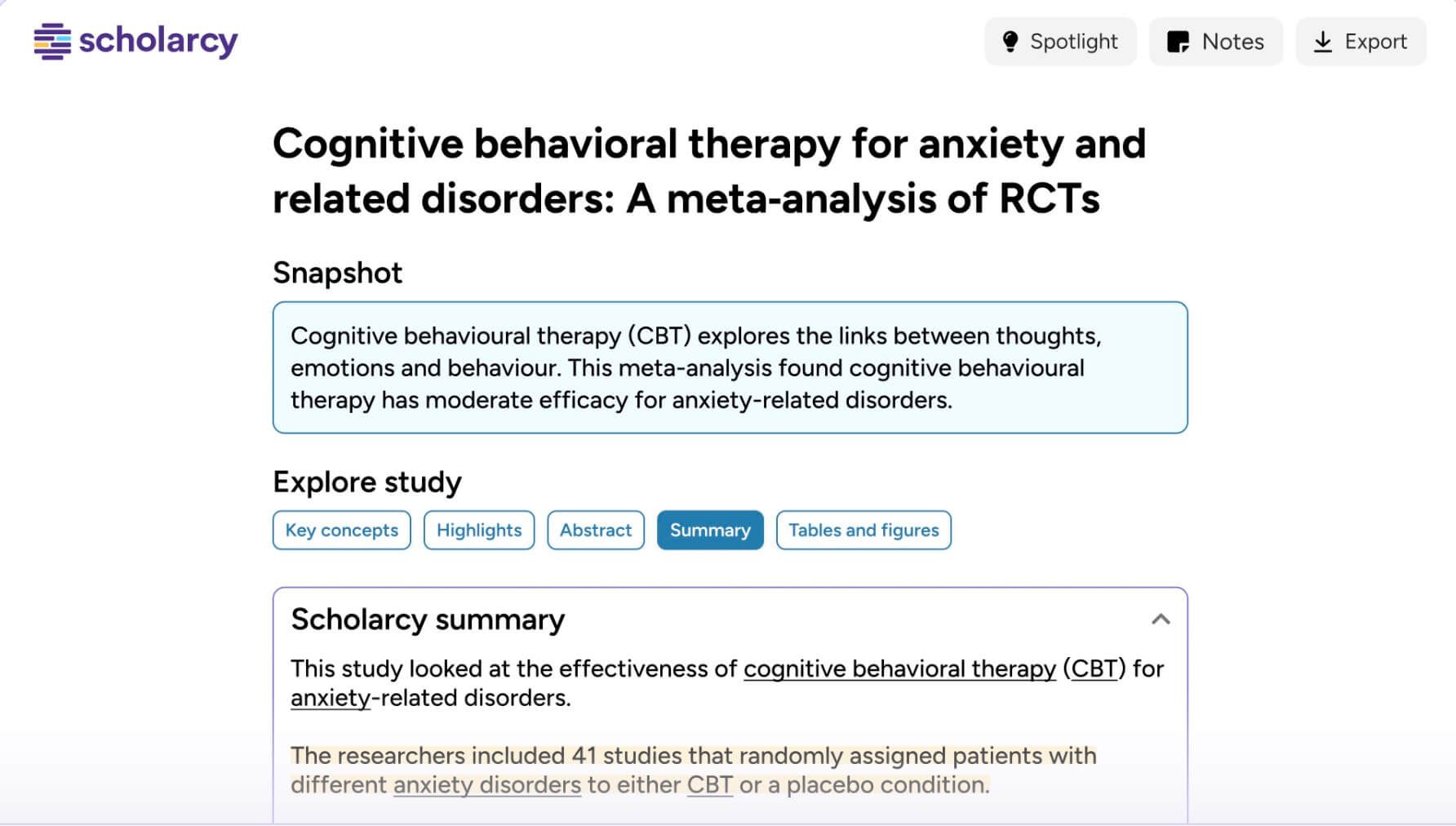
Scholarcy is well known for research-focused summarization. It can break down academic papers into structured summary cards that highlight the hypothesis, methodology, key findings, limitations, references, figures, and tables. For graduate students and researchers, this makes reviewing papers much faster and more organized.
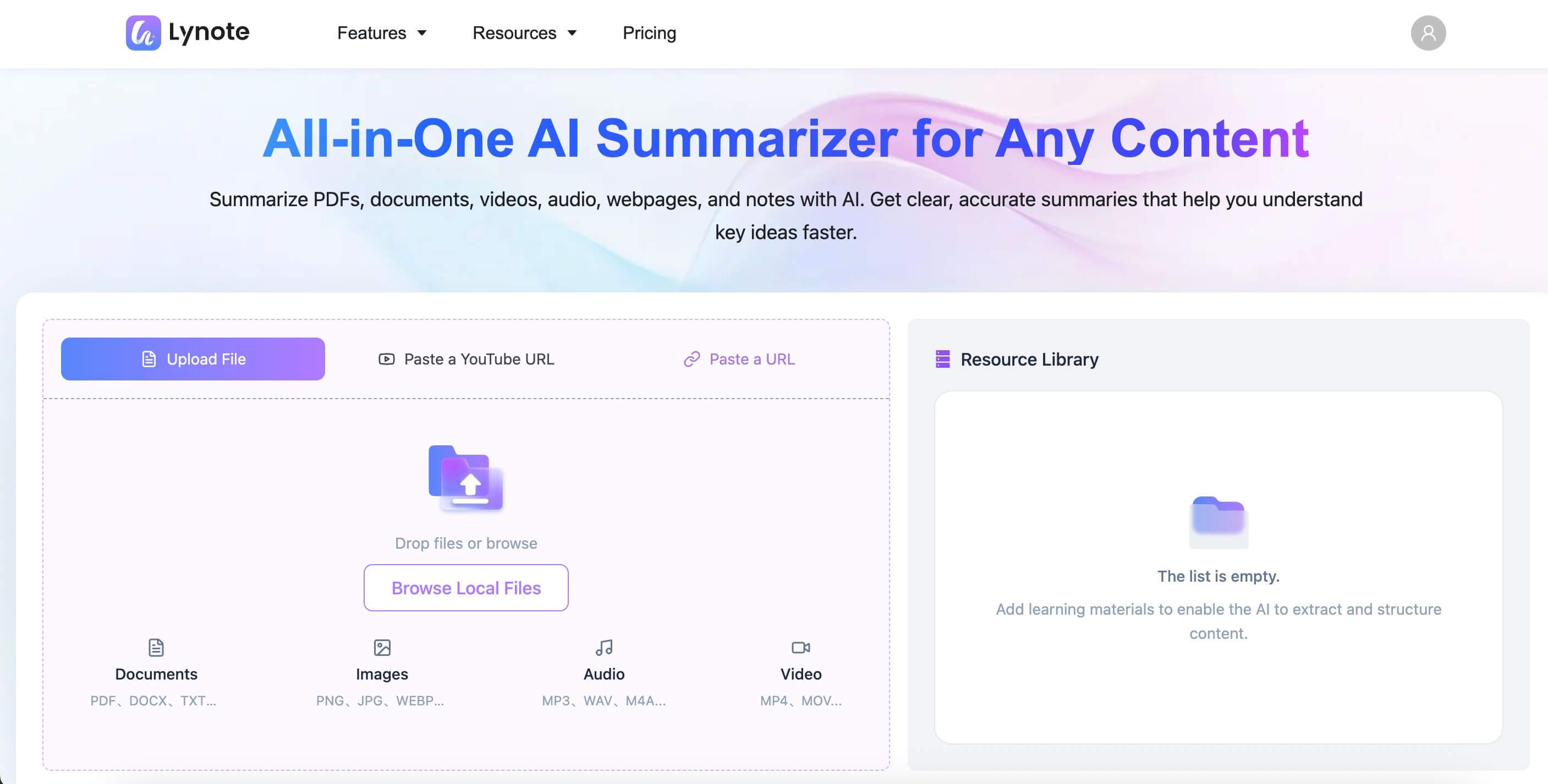
Lynote takes this workflow further by combining AI summarization with interactive learning tools. In addition to generating structured summaries from PDFs, videos, audio, and webpages, Lynote lets users chat with the source content, ask follow-up questions, generate notes and flashcards, and explore information more deeply instead of only reading a static summary.
For students, researchers, knowledge workers, and content creators, both tools help reduce the time spent processing long materials while making important information easier to understand and reuse.
Lynote: The Best AI Article Summarizer for Students and Active Learners
Where dedicated tools focus on pure extraction and general LLMs offer broad utility, Lynote carves out a vital niche: turning summarization into an active part of the learning process. It's built on the understanding that for a student, a summary isn't the final product—it's the raw material for essays, exam preparation, and genuine understanding.
The power of the Lynote AI article summarizer is its integration. The summary doesn't just appear in a chat box; it becomes the foundation of a new, editable note. This seemingly small distinction has a massive impact on workflow. You can instantly start adding your own thoughts, pulling in quotes from the original text, and structuring the information for an assignment without ever switching apps.
Here’s the honest truth: I’ve seen countless students get a summary from a chatbot, copy-paste it into a Word doc, and then feel stuck. The context is gone. Lynote bridges that gap by keeping the summary directly linked to the learning environment.
Before you start:
- Have your file ready: Lynote works best with digital text-based documents like PDFs, DOCX, and TXT files.
- Check for restrictions: Ensure your PDF is not password-protected or a scanned "image-only" file. The AI needs selectable text to work its magic.
- Keep it focused: For best results, upload one article or paper at a time to get a specific, high-quality summary.
Step 1. Upload Your Article
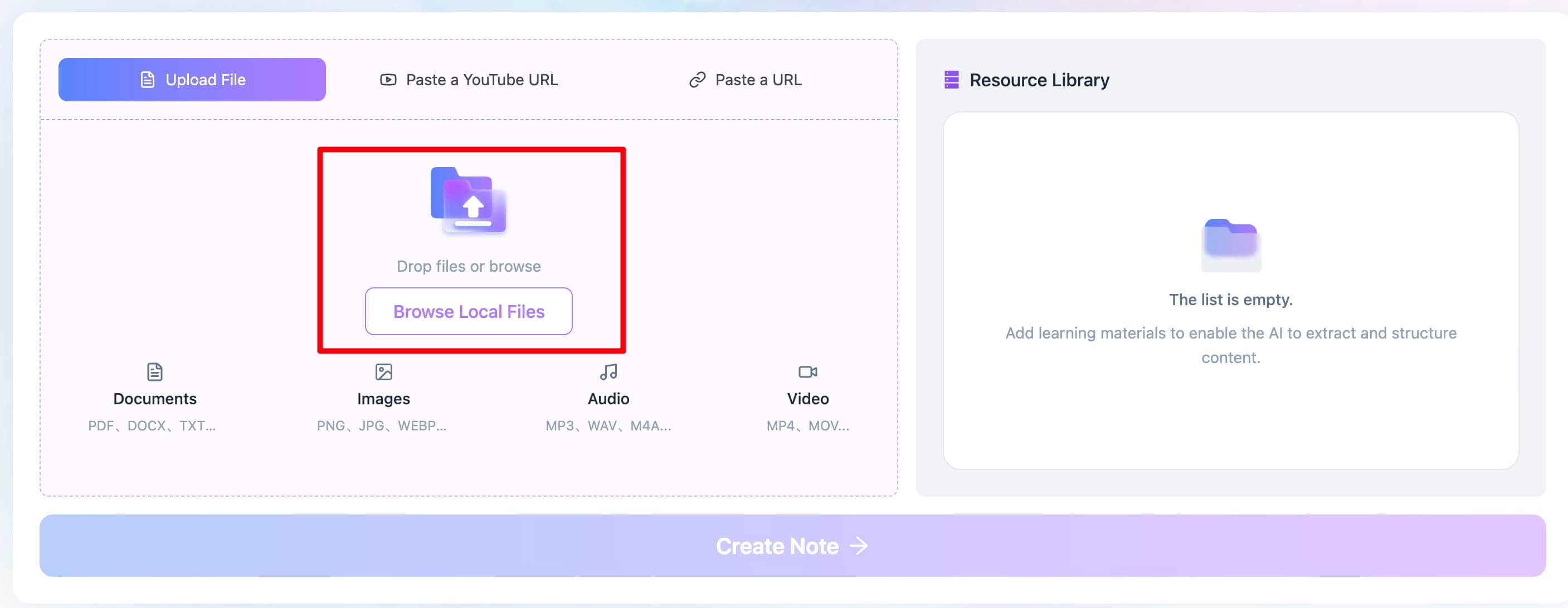
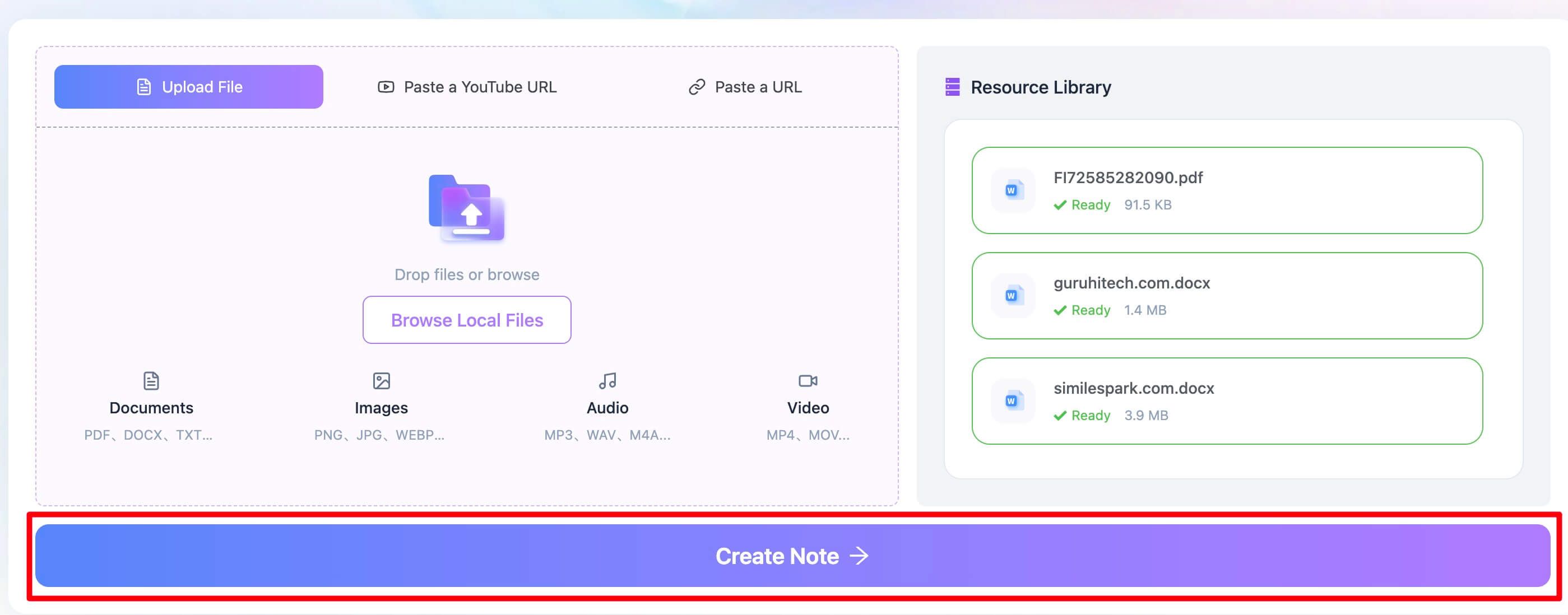
Getting started is straightforward. Navigate to the summarizer and you'll be prompted to upload your source material. You can select a file directly from your computer. Lynote’s support for common formats like PDF and Microsoft Word's DOCX means you likely won't have to waste time converting your file first. Just locate the research paper, report, or article you need to digest and upload it.
Step 2. Generate the AI Summary
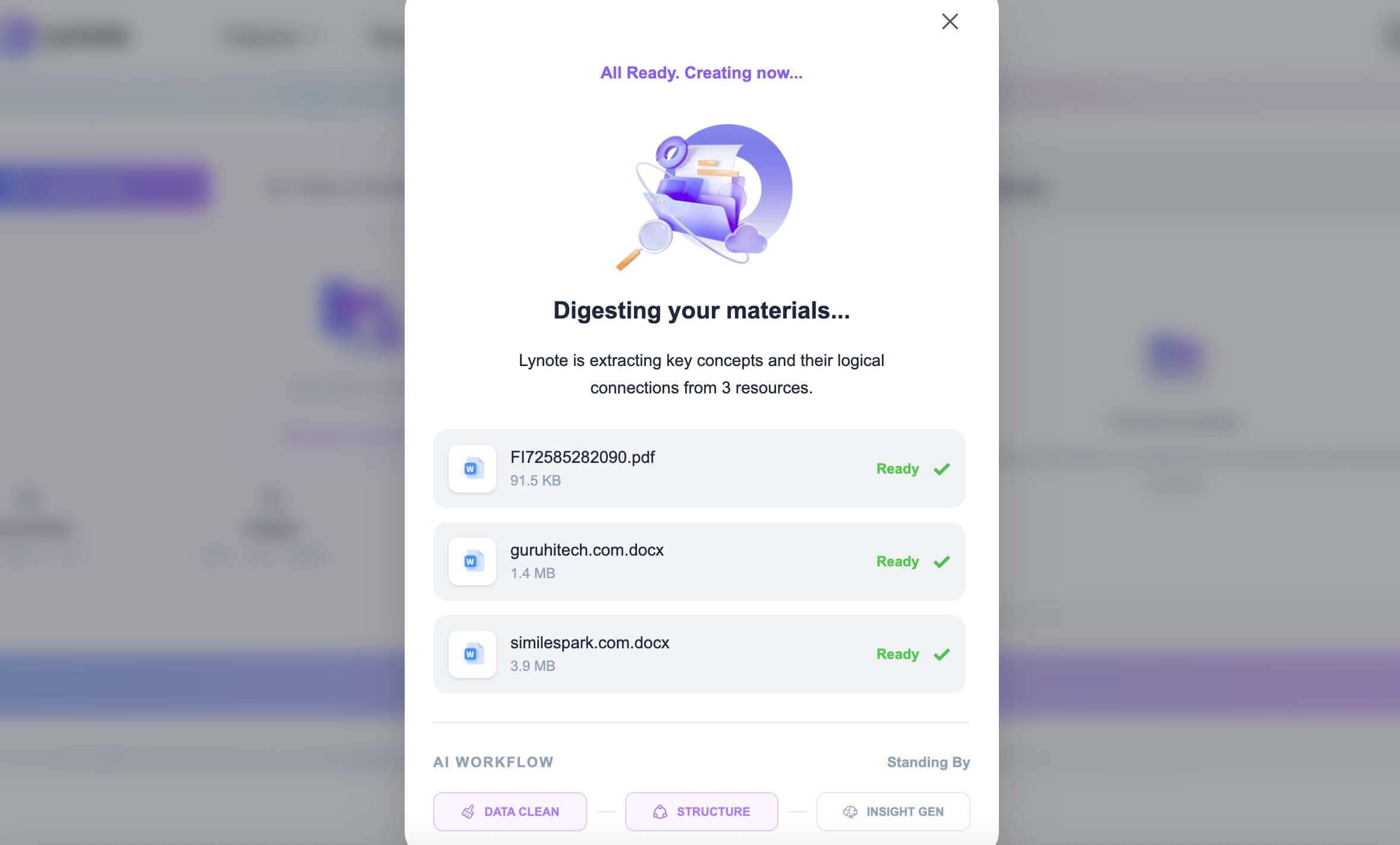
Once your document is uploaded, you simply click the "Create Note" button. This is the key step where Lynote's AI gets to work. It's not just skimming for keywords; it's performing a deep analysis of the text's structure, identifying the core thesis, tracking the main arguments, and pinpointing the key pieces of evidence and the final conclusions. This all happens in the background, transforming the dense original text into a coherent and accurate summary.
Step 3. Use Your Summary
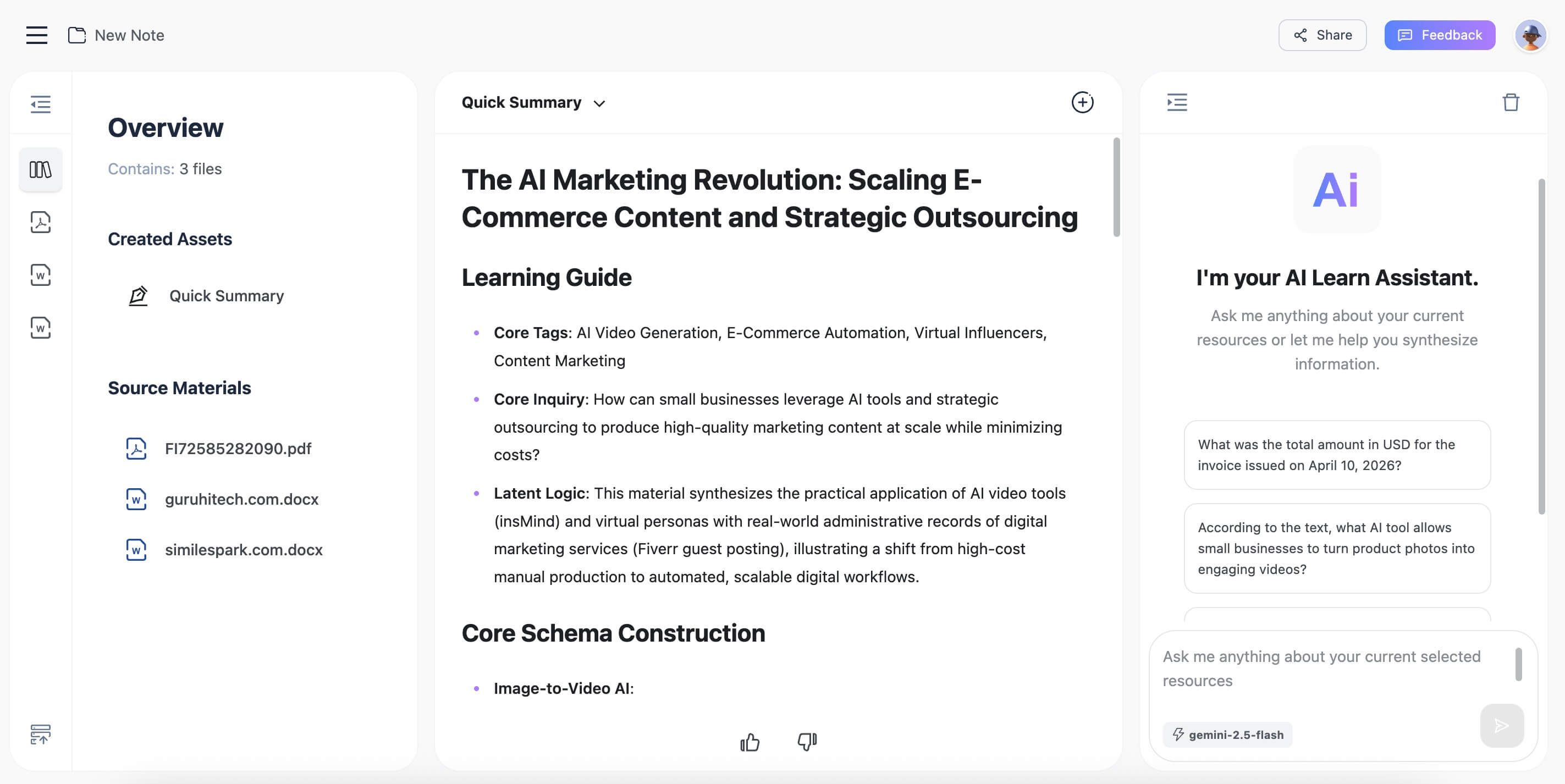
Within seconds, the system generates a concise summary and presents it within a new, editable note. This is where Lynote truly shines. The summary isn't a dead end. You can immediately copy the text for use elsewhere, export the entire note, or—most powerfully—start editing it directly. You can refine the points, add your own analysis, or restructure it to form the backbone of an essay outline. The power to instantly act on the summary is what makes it a superior tool for active learning.
The Alternative: Using General LLMs like ChatGPT and Claude
You might be wondering, "Can't I just paste my article into ChatGPT or Claude?" The answer is a qualified yes, but it comes with significant caveats, especially for truly long documents.
The Pros:
- Versatility: These models are conversational. You can ask for a summary, then ask follow-up questions, request it in a different tone, or ask it to focus on a specific section.
- Accessibility: Many people already have access to them, making them a convenient first choice.
The Cons (and they're big ones):
- Context Window Limits: While models like Claude 3 Opus boast enormous context windows (up to 200,000 tokens, or ~150,000 words), even they have limits. More importantly, their "attention" isn't perfect across that vast space. For a 100+ page document, the model can start to "forget" details from the beginning, leading to an unbalanced summary. ChatGPT-4's context window is smaller, making this problem more acute.
- The "Mushy Middle" Problem: With very long texts, general LLMs often do a great job summarizing the introduction and conclusion but can lose the plot in the middle. The complex argumentation in the body of the text gets flattened into generic statements.
- Requires Prompt Engineering: Getting a high-quality summary requires more than just "summarize this." You need to provide a detailed prompt, perhaps asking it to adopt a certain persona, focus on specific themes, or output in a particular format. It's more work for the user.
The main reason general LLMs can underperform dedicated summarizers for academic texts is their lack of domain-specific architecture. Unlike Scholarcy, which is trained to look for an "abstract" or "methodology," a general LLM treats a research paper like any other block of text, missing the structural signposts that give the document its meaning.
Common Pitfalls: Why Some AI Summaries of Long Articles Fail
It's easy to be wowed by AI, but as a practitioner, I've seen these tools fail in predictable ways. Understanding these failure modes helps you choose the right tool and critically evaluate its output.
- Context Drift: As mentioned, this is the AI "forgetting" the beginning of a long document. The summary of the final sections might contradict or ignore the premises laid out in the introduction. This is a critical failure in analyzing cohesive, long-form arguments.
- Nuance Flattening: This happens when the AI strips out crucial qualifying language. A paper that says "our findings suggest a potential correlation under specific conditions" might be summarized as "the study proves X causes Y." For legal, medical, or scientific content, this isn't just inaccurate; it's dangerous.
- Ignorance of Visuals: Most summarizers are text-only. They will completely ignore the critical data presented in a chart, graph, or complex table. The text might refer to "Figure 2," but the AI has no idea what Figure 2 shows, leading to an incomplete or misleading summary.
- Bias Amplification: An AI model trained on a vast corpus of internet text can inadvertently pick up and even amplify biases present in the source material. If an article presents a one-sided argument, the AI will summarize that argument faithfully without providing the critical context that a human reader might add.
Expert Takeaway: Never trust an AI summary blindly. Use it as a first-pass tool to grasp the core ideas, but always refer back to the source document for critical details, data, and nuanced claims.
Frequently Asked Questions
What is the best free AI to summarize articles?
For shorter articles, the free tiers of models like Claude or Microsoft Copilot (using GPT models) can be effective. However, most free tools impose strict length limits, making them unsuitable for the long documents we're discussing here. They are best for getting a quick gist of a news article or blog post, not for a 40-page report.
Can AI accurately summarize a 100-page document?
Yes, but it depends heavily on the tool. A model with a large context window like Claude 3 Opus is technically capable of "reading" the whole document at once, which is far superior to methods that require you to "chunk" the document into smaller pieces. Dedicated tools are often designed to handle this scale for specific document types. However, accuracy can still dip in the "mushy middle," and a human review is always recommended.
How do AI summarizers handle scanned PDFs or documents with complex formatting?
This is a critical, and often overlooked, issue. When you upload a scanned PDF, the tool must first perform Optical Character Recognition (OCR) to convert the image of the text into actual machine-readable text. This OCR process can introduce errors—mistaking an "l" for a "1," for example. Complex formatting like multi-column academic papers or official reports with stamps and headers can confuse the OCR engine, leading to garbled text being fed to the summarizer AI. For best results, always use a clean, digitally-native PDF. This is where a tool like the Lynote AI article summarizer performs best, as it's optimized for clean document inputs typical in student and research workflows.
Final Thoughts: Choosing the Right Summarizer for You
The "best" AI summarizer isn't a single product; it's the one that best fits your specific task. The landscape has matured beyond one-size-fits-all solutions. Your choice should be guided by your primary goal.
- If your goal is deep academic analysis of peer-reviewed literature, a specialized tool like Scholarcy is your champion.
- If you need a versatile, powerful AI for a wide range of tasks and are comfortable with prompting, Claude 3 is the top contender.
- If your goal is to understand, retain, and use information for your studies or research projects, the integrated workflow of Lynote is unmatched.
Editor's Choice
For its smart integration of summarization into the active learning process, Lynote is our top recommendation for students, researchers, and lifelong learners. The main reason it stands out is its philosophy: a summary shouldn't be the end of the road. By making the output an instantly editable note, it transforms a passive act of extraction into an active process of engagement.
The candid downside: Lynote is not a general-purpose chatbot. If you're looking for an AI to write code, draft emails, and summarize articles, a broader tool like ChatGPT or Claude might be more suitable. But for its focused mission of making learning from long documents more efficient, Lynote is in a class of its own.

Written by Janet L. Harris
AI Writing Specialist
Janet reviews AI detectors and humanization tools, with a focus on accuracy, limitations, and responsible use. View all articles →