
AI Humanizer For Academic Writing
Content
Result

Your humanized result will be ready here. To begin, paste your AI-generated text in the left box.
Why an Academic Humanizer Matters More Than You'd Think

The Same Rigid Essay Skeleton Every Time
AI essays are often repetitive, with a topic sentence followed by two supporting sentences and a concise conclusion, repeated throughout the piece, from paragraph to paragraph. Real student writing goes further. Sometimes the paragraph is only 2 sentences that make one point and then go on.
AI essays are often repetitive, with a topic sentence followed by two supporting sentences and a concise conclusion, repeated throughout the piece, from paragraph to paragraph. Real student writing goes further. Sometimes the paragraph is only 2 sentences that make one point and then go on.

Claims Stated With Too Much Certainty
Academic writers hedge all the time. These imply. "It can be inferred. AI is inclined to present information as if it were true, and when it's not, it's immediately apparent to a savvy grader, and it certainly sounds like it was written by a machine to anyone who knows their way around.
Academic writers hedge all the time. These imply. "It can be inferred. AI is inclined to present information as if it were true, and when it's not, it's immediately apparent to a savvy grader, and it certainly sounds like it was written by a machine to anyone who knows their way around.

One Flat Tone From Start to Finish
The entire register of AI is measured and analytical, from the first line to the last. Human writers tend to be more variable, more assured when they are knowledgeable about the subject, more judicious when it does become really complicated. The flatness is a pretty good indicator.
The entire register of AI is measured and analytical, from the first line to the last. Human writers tend to be more variable, more assured when they are knowledgeable about the subject, more judicious when it does become really complicated. The flatness is a pretty good indicator.

Sources Summarized, Never Really Argued With
AI's introduction of a source is largely repetitive. Real students challenge claims, agree on part of a claim, add detail to a point, or relate it to an unrelated point. Even today, it is difficult for AI to convincingly simulate such a specific interaction.
AI's introduction of a source is largely repetitive. Real students challenge claims, agree on part of a claim, add detail to a point, or relate it to an unrelated point. Even today, it is difficult for AI to convincingly simulate such a specific interaction.
What an AI Humanizer for Academic Writing Actually Changes

Brings Back Real Academic Caution
The evidence supporting the claim is reintroduced wherever it is needed, e.g., the evidence suggests, arguably. The hedging is not as absolute as it is across all sentences, but rather in line with the degree of confidence in the point.

Breaks the One-Size Paragraph Mold
The structure of topic, evidence, and conclusion is deliberately disrupted. Some paragraphs begin with evidence, others start with a question, and a few are short to emphasize the variety that professors actually expect to see on the page.

Let a Real Opinion Come Through
“I'd argue” or “my reading of this suggests" are places where first-person framing can be seen as appropriate. Real students have real opinions about their material, and this allows the opinions to emerge, rather than remaining flat and lifeless.

Keeps Every Citation and Number Intact
The writing style around the citations, statistics, and main argument remains intact as the rest of the writing changes. You can review anything that's important before submitting, but the integrity of the research is never touched by the rewrite.
What Makes This Academic AI Humanizer Different
Built Around Academic Writing From Day One
This was not a generic tool that was adapted to the specific application. It's a blend of academic knowledge and technical writing skills, specifically geared towards formal research writing from the outset.
Trained Across Several Language Models
A series of models that have been fine-tuned on human-written research papers from various fields, along with syntax-aware analysis and word-level knowledge bases, all contributing to making AI-generated phrases sound like human writing.
Built to Catch Patterns From Every Major AI Model
Familiar with the unique style signatures of the prominent AI families in the market: OpenAI, Anthropic, Google Gemini, Meta Llama, and more. Patterns are still trapped, irrespective of the writing tool of the first draft.
Finds and Removes the Statistical Fingerprint
The engine learns the statistical characteristics of sentences: sentence burstiness, word predictability, and token distribution (which is what the detectors are supposed to detect) and eliminates them from the final draft before you ever read it.

Builds On Each Pass Instead of Starting Over
Later rounds of humanization will not be identical to the initial round but on top of it, meaning the more rounds, the more the humanization is enhanced.
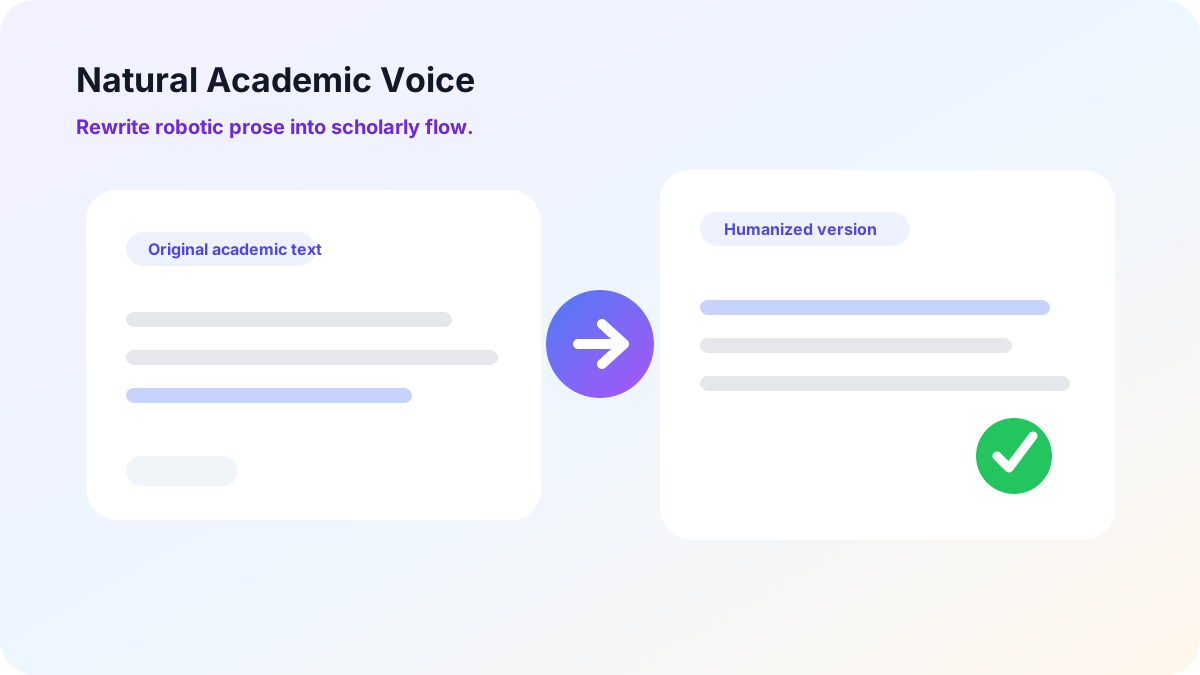
Rewrites for a Genuinely Natural Academic Voice
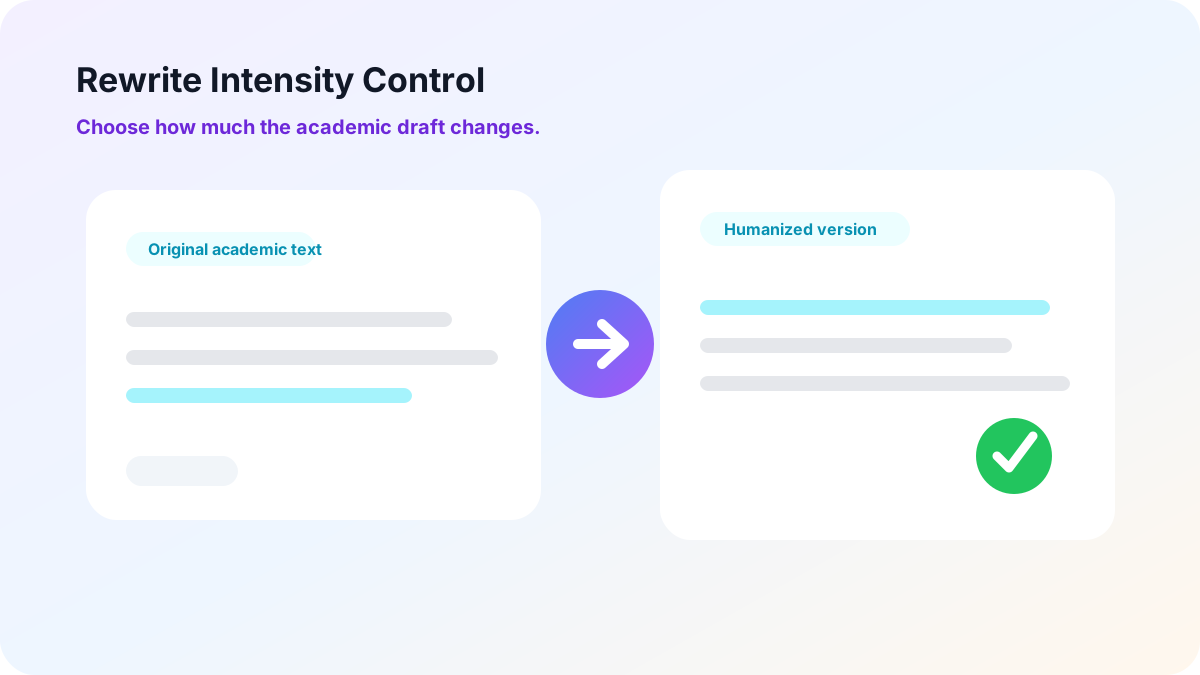
Control Exactly How Much Gets Rewritten For Academic Writing
An Academic Humanizer Built to Clear University Detectors
Locks Down Names, Dates, and Numbers in Academic AI Humanizer
Citations Stay Exactly Where They Belong in Academic Text
Keeps the Reading Level Where Academic Work Needs It
Rewrites in Academic Way Without Introducing New Mistakes
See the Numbers Behind Every Rewrite Academic Content
The Academic Writing an AI Humanizer for Academic Text Handles

Essays & Papers
Essays that require passing AI detection but not compromising their academic rigor, such as argumentative essays, compare-and-contrast papers, cause-and-effect analysis, and more.

Research Papers
Original research, case studies, and empirical work in which academic rigor and careful language are of critical importance throughout.

Dissertations & Theses
Graduate-level work, capstone projects, and complete thesis defenses, where months of research really merit writing that is all yours.

Literature Reviews
Systematic reviews, meta-analyses, and annotated bibliographies that require a systematic interaction with the sources, rather than a succession of summaries.
How to Use an Academic AI Humanizer, Step by Step
1. Drop In Your Draft
Copy and paste your academic writing or upload the file if it is more convenient for you. The two paths end up at the same spot on the other side.


2. Pick the Right Intensity
Decide what level of rewrite is needed, depending on the level of AI soundness in the draft. Lighter for quick pass, stronger when it still sounds like it's obviously generated.

3. Read It Over and Finalize
Verify the outcome against the meaning of the original text, verify that citations have ended in the correct place, verify that you have arrived at the correct citations, and export it so it can be submitted.
What Students and Researchers Are Saying

Graduate Student

"I used Lynote for my master's thesis chapters, which maintained my academic tone without making it sound like I wrote it with AI, and my advisor never marked any single page that was written with AI."

PhD Candidate
"I had to have my literature research done by AI and make it sound like scholarly writing, and Lynote did that without altering my argument from where it needed to be."

Research Scientist
"There was a lot of polishing needed for the paper that was going to a top journal, but nothing changed in the citations or data points; it was all polished by Lynote."
Frequently Asked Questions
Yes, popular citation styles such as APA, MLA, IEEE, and others are detected and retained despite changes in surrounding text.
It's designed to withstand academic-level detection methods, but it's always a good idea to preview submissions of this type before submitting them.
Yes, it does. Long-form academic writing – dissertations, theses, and so on – is treated in the same way as a short essay, except that it has a lot more pages.
Yes, there is an intensity setting, and you can opt for light touch-up or rewrite heavily, depending on the level of AI-soundness of the draft.
It does. However, not intentionally make the detection easier – like some tools do – but simply to lower the detection score. The true goal is to have clean grammar here.
More Lynote Tools for Academic AI Writing and Review








Helpful Reads on AI Humanizing, Detection, and Academic Writing
Explore practical Lynote resources on natural AI writing, detector-aware editing, rewriting, and responsible academic workflows.