logo
menu

How to Translate Legal Documents (Step-by-Step Guide for Accurate Results)

By Janet | April 24, 2026

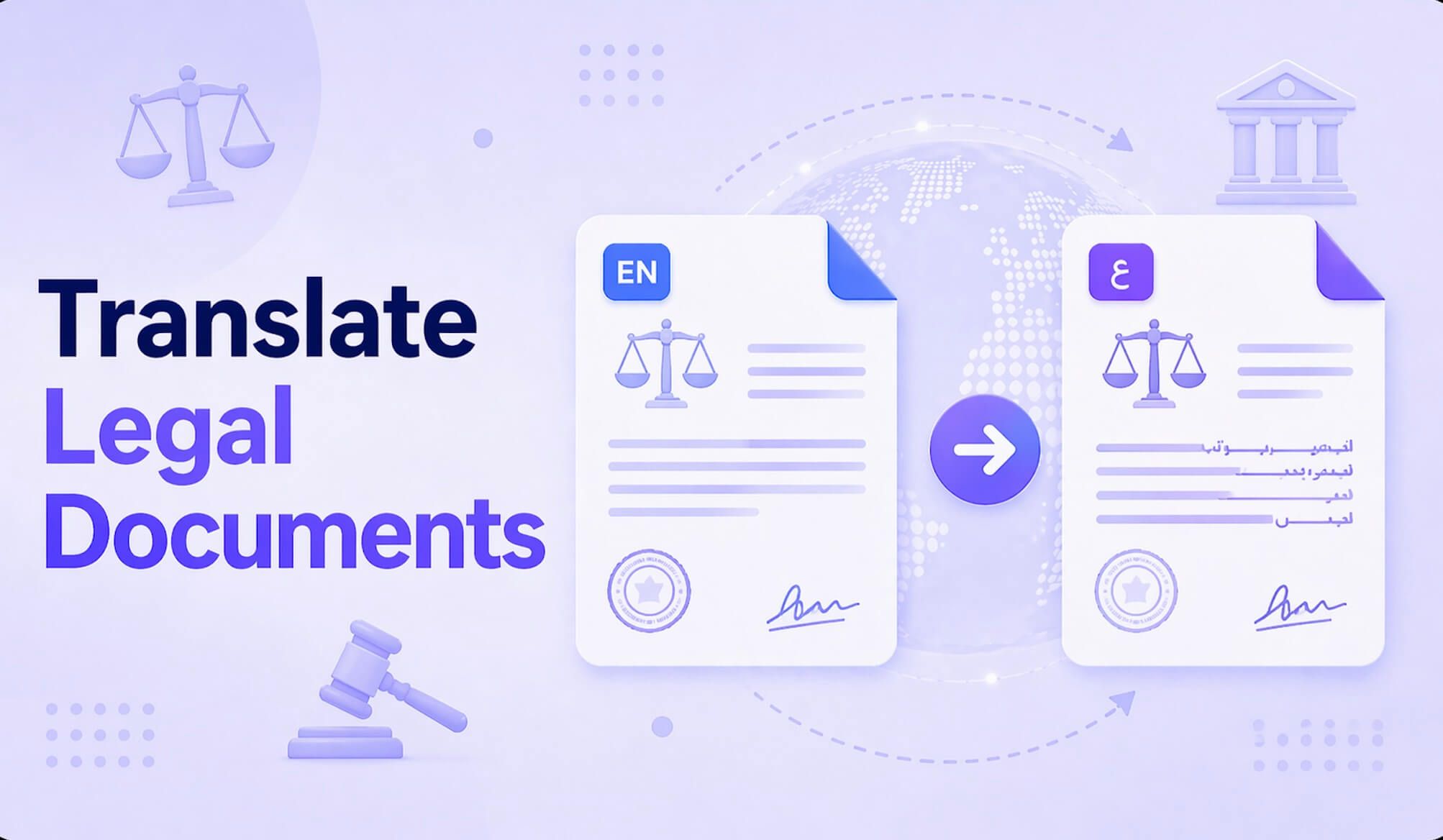
Translating a legal document isn't like translating a blog post or an email. A single misplaced word in a contract, a misconstrued clause in a court filing, or an inaccurate term in an immigration application can have severe consequences. Accurate legal translation requires balancing speed, cost, and absolute precision. This guide covers the three primary methods—AI tools for speed, professional translators for accuracy, and a hybrid approach for the best of both worlds. We'll walk you through how to choose the right path for your document and avoid costly errors like contract invalidation or visa delays.

translate-legal-document.jpg

Why Translating Legal Documents Is a High-Stakes Task

Before we dive into the "how," it's critical to understand the "why." Why is legal translation so fundamentally different from general translation? The answer lies in risk and precision.

In casual language, "promise," "agreement," and "covenant" might seem interchangeable. In a legal contract, they carry vastly different weights, obligations, and consequences. The language of the law is a system of its own, where every comma and clause is deliberate.

Here’s the hard truth: a simple mistranslation can transform a binding agreement into a worthless piece of paper. The risks are not hypothetical:

  • Contract Invalidation: An ambiguously translated clause can be exploited or be grounds for voiding the entire contract.
  • Legal Disputes: Misinterpretations of rights, responsibilities, or deadlines are a direct path to costly litigation.
  • Immigration Rejection: Government bodies like USCIS have zero tolerance for ambiguity. An incorrectly translated birth certificate or legal affidavit will be rejected, delaying or derailing the entire process.
  • Financial Loss: A mistranslated term in a patent or financial agreement could cost a company millions.

Bottom Line: Legal translation is not just language conversion; it's a form of legal interpretation that must be flawless. The goal is to create a document that has the exact same legal effect in the target language as it does in the original.

Quick Verdict: AI vs. Human vs. Hybrid Translation Methods

When you're facing a legal document in another language, you need to make a judgment call. Your choice of translation method depends entirely on the document's purpose. Is it for your own understanding, or is it for an official submission? Here's a quick breakdown to guide your decision.

MethodBest ForAccuracy Score (1-5)Cost (Illustrative)Turnaround Time
AI Document TranslatorInternal review, first drafts, understanding foreign-language evidence, low-risk documents3.5 / 5$0 - LowMinutes
Professional Human TranslatorCourt submissions, signed contracts, immigration filings, patents, official records5 / 5$0.10 - $0.30 / wordDays to Weeks
Hybrid Workflow (AI + Human)High-value contracts, complex litigation, business agreements needing both speed & accuracy4.5 / 5Moderate (less than full human)1-3 Days

Scores are editorial heuristics based on typical use cases, not measured benchmarks. Costs and times are illustrative ranges.

For a quick gut check, an AI tool is your best bet. For anything you'll sign or submit to an authority, you need human expertise involved. The hybrid workflow is the professional’s choice, balancing the best of both worlds.

Common Types of Legal Documents That Require Translation

The term "legal document" covers a vast territory. Understanding which category your document falls into helps determine the level of precision required.

  • Contracts & Agreements: This includes sales contracts, employment agreements, NDAs, lease agreements, and partnership agreements. Precision is paramount, as these documents define legal obligations.
  • Court & Litigation Documents: Affidavits, depositions, court orders, judgments, and evidence files. These require verbatim accuracy and often need to be certified for use in legal proceedings.
  • Immigration Paperwork: Birth certificates, marriage licenses, passports, visa applications, and asylum documentation. Government agencies almost always require certified translations for these.
  • Corporate & Compliance Documents: Articles of incorporation, bylaws, financial statements, and regulatory filings. These are crucial for international business operations.
  • Intellectual Property: Patents, trademark applications, and copyright registrations. Technical and legal precision here is non-negotiable to protect IP rights across borders.

Method 1: Using an AI Translator for a First Draft

Let’s be clear: for any document that carries significant legal weight, AI alone is not enough. However, as a starting point, it’s an incredibly powerful tool. Modern AI document translators have moved far beyond the simple copy-paste boxes of the past. They can process entire files while preserving the original formatting—a game-changer for legal work.

This method is ideal when your goal is to:

  • Quickly understand the contents of a contract sent by an international partner.
  • Triage a large volume of foreign-language documents for discovery.
  • Create a solid first draft that a legal professional can then refine.

A great example is the Lynote Document Translator, which is designed for exactly this purpose. It uses a powerful translation engine and focuses heavily on maintaining the document's structure.

Before you start:

  • Check your file: Ensure the document is not password-protected.
  • Scan quality: If you're using a scanned PDF, make sure the text is clear and legible. Blurry or skewed text will challenge any OCR (Optical Character Recognition) engine.
  • File size: Be aware of any file size limits. Lynote, for instance, handles files up to 10 MB on its free web tool.

Here’s a practical workflow.

Step 1. Upload Your Legal Document

First, navigate to the Lynote Document Translator. The interface is clean and straightforward—no need to create an account for a one-off task. You can either drag your file (like a PDF of a contract or a Word version of an agreement) directly into the upload box or click “Choose Document” to browse your computer. This immediate access is a lifesaver when you're on a deadline.

upload-your-document-ai-translator (1).jpg

Step 2. Set the Source and Target Languages

Once your file is uploaded, the tool typically auto-detects the source language. This is surprisingly accurate for most common languages. Your main job is to open the dropdown menu for the target language and select the one you need from the list of over 135 options. A quick click and you're ready for the magic to happen.

select-language-ai-translator.jpg

Step 3. Download the Translated File with Layout Intact

Click the translate button. The AI engine gets to work, and for a typical 10-20 page document, the process is usually finished in under a minute. The download button will appear, providing you with a new file. The main reason this outperforms simple text translators is layout preservation. Your translated document retains the original fonts, tables, columns, and image placements. For a legal document, where the position of a clause or a table of figures is critical, this is an indispensable feature.

download-translated-file.jpg

document-translator-cta.svg

Method 2: The Hybrid Workflow (Best Practice for Accuracy & Efficiency)

This is the method the pros use. It combines the raw speed and scalability of AI with the nuance, legal expertise, and accountability of a human professional. It’s the smartest way to manage both time and risk for important, but not yet court-ready, documents.

You might be wondering, why not just go straight to a human? Cost and speed. A full human translation of a 50-page agreement can take a week and cost thousands. The hybrid workflow can cut that time and cost by more than half.

Here’s the process:

  1. Step 1: AI First Draft. Use a tool like Lynote to generate an initial, fully formatted translation in minutes. This handles about 80-90% of the linguistic heavy lifting.
  2. Step 2: Human Legal Review. Provide this AI-translated draft to a qualified human translator who specializes in law, or better yet, a bilingual lawyer. Their job is no longer to translate from scratch but to perform a much faster (and cheaper) review. They focus on:
    • Correcting legal terminology: Ensuring "indemnity" wasn't translated to the generic "protection."
    • Verifying jurisdictional nuances: Confirming that a term used in U.S. common law is adapted correctly for a civil law system in France.
    • Ensuring conceptual equivalence: Checking that the legal intent of each clause remains intact.
  3. Step 3: Final Proofreading. A final pass ensures there are no grammatical errors or typos introduced during the review phase.

The main reason the Hybrid Workflow outperforms AI alone for high-stakes documents is its integration of human legal oversight, which catches jurisdictional nuances machines miss.

Method 3: When to Hire a Professional Certified Translator

There are times when no shortcuts are acceptable. For documents being submitted to a court, a government agency, or as part of a major corporate transaction, you almost always need a certified translation.

So what is a certified translation? It’s not just a good translation. A certified translation is one where the translator or translation agency provides a signed statement, or affidavit, attesting that the translation is a complete and accurate representation of the original document. This signed statement is called a "Certificate of Translation Accuracy."

This certification adds a layer of formal accountability. It’s the translator putting their professional reputation on the line.

You must use a certified translator in these scenarios:

  • Immigration: USCIS requires certified translations for all foreign-language documents, like birth certificates, marriage certificates, and academic transcripts.
  • Court Proceedings: Evidence, witness statements, and foreign statutes submitted in U.S. courts must be certified.
  • High-Value Contracts: When executing a multi-million dollar international contract, both parties’ legal teams will insist on a certified translation to serve as the official, binding version.
  • Patents: Filing a patent in a foreign country requires a meticulously accurate translation that will likely need certification.

Hiring a professional is slower and more expensive, but for these use cases, it is the only way to ensure your document is legally valid.

5 Critical Mistakes to Avoid in Legal Translation

Getting this wrong is easy. Here are the most common traps people fall into, which you can now sidestep.

  1. Using a General-Purpose Translator: Never, ever copy and paste the text of a contract into a generic online translator. These tools strip all formatting, lose context between sentences, and have no concept of legal terminology. The output is a recipe for disaster.
  2. Ignoring Jurisdictional Differences: Translating "consideration" (a common law concept) directly into a language from a civil law country can be meaningless. A true legal translator knows to find the functional equivalent concept, not just the dictionary word.
  3. Literal (Word-for-Word) Translation: Legal language is full of idioms and "terms of art." A literal translation of "without prejudice" might make no sense. It must be translated to the equivalent legal phrase in the target language.
  4. Breaking Document Structure: Deleting a section number, messing up a bulleted list, or causing tables to misalign can alter a document's meaning. This is why using a format-preserving tool for the first draft is so important.
  5. Skipping the Human Review: The most dangerous mistake is trusting an AI translation for a final, binding document. An AI cannot be held liable. It doesn't understand the legal implications of its word choices. For anything important, a qualified human must have the final say.

Frequently Asked Questions About Legal Document Translation

How do you translate legal documents accurately?

Accuracy comes from a multi-step process: start with a high-quality AI tool to create a formatted first draft, then have a human translator specializing in the relevant legal field (e.g., corporate law, immigration) review and perfect the terminology and legal concepts. For official use, get it certified.

Can I use Google Translate for legal documents?

No, not for any official purpose. While the underlying technology is powerful, the standard Google Translate interface (the copy-paste box) destroys formatting and context. It's only suitable for getting the absolute roughest gist of a document's meaning for your own informal understanding.

How much does legal translation cost?

AI tools can be free or low-cost. Professional human legal translation is typically priced per word, ranging from $0.10 to $0.30 per word, depending on the language pair and complexity. A certified translation will often have an additional flat fee. The hybrid approach can significantly reduce this cost.

What is the best AI tool for legal translation?

The best tools are those designed specifically for document translation with layout preservation. Services like the Lynote Document Translator are excellent for this because they focus on keeping the file's structure intact, which is critical for legal documents. They are built to handle file types like PDF and DOCX seamlessly.

Why does the formatting sometimes change even with a good tool?

This is an excellent and surprisingly technical question. The issue often lies with the source PDF. A "native" PDF (created from a Word document) has a clean, digital text layer. A "scanned" PDF is just an image of text. The AI tool must use OCR to "read" the image, which can sometimes misinterpret complex layouts like multi-column text or tables with merged cells, causing minor shifts. For best results, always start with a high-quality, native document if possible.

Conclusion: Making the Right Choice for Your Document

Translating a legal document is a task where the cost of a mistake far outweighs the cost of doing it right. Your choice of method should always be dictated by the document's final purpose.

Here’s the decision framework:

  • For quick understanding or an internal draft: An AI document translator is fast, cost-effective, and surprisingly capable.
  • For official submission to courts or government: A professional, certified human translator is the only acceptable option.
  • For most high-stakes business documents: The hybrid workflow—AI draft followed by human legal review—offers the ultimate balance of speed, cost, and accuracy. It’s the modern standard for best practice.

Don't leave the integrity of your legal work to chance. Start the right way by creating a fast, formatted first draft, and then bring in the human expertise your document deserves.